Results
Square Footage
0ft²
Cubic Feet
0ft³
Cubic Yards
0yd³
Tonnage
0tons
Total Cost
$0
Cost Per Sq Ft
$0/ft²

Calculate exact asphalt tonnage, cubic yards, and project costs for driveways, parking lots, and roads in seconds. Our free 2026 calculator uses industry-standard formulas (145 lbs/ft³ density) trusted by 50,000+ contractors and homeowners. Enter your dimensions below for instant results with regional cost estimates.
Getting an accurate asphalt estimate takes just 3 simple steps. Whether you're paving a driveway, parking lot, or road, the process is the same.
Measure the length and width of your project area in feet. For irregular shapes, break the area into rectangles, calculate each one, and add them together. Use a measuring wheel for large areas or a tape measure for driveways.
Select the right asphalt depth based on your project type:
Enter your dimensions above and click Calculate. You'll instantly see tonnage, cubic yards, and total cost with waste factor included.
Here's exactly how we calculate your asphalt needs — no black box:
The Formula:
Volume (ft³) = Length × Width × (Thickness ÷ 12)
Weight (lbs) = Volume × Density (145 lbs/ft³)
Tonnage = Weight ÷ 2,000
Example: 30ft × 20ft driveway, 4 inches thick
→ Volume = 30 × 20 × (4 ÷ 12) = 30 × 20 × 0.33 = 198 ft³
→ Weight = 198 × 145 = 28,710 lbs
→ Tonnage = 28,710 ÷ 2,000 = 14.36 tons
→ Cost at $120/ton = $1,723 + 10% waste = $1,895 total
Pro tip: Always add 5–10% extra for waste and compaction. It's cheaper to return unused asphalt than to order a second delivery.
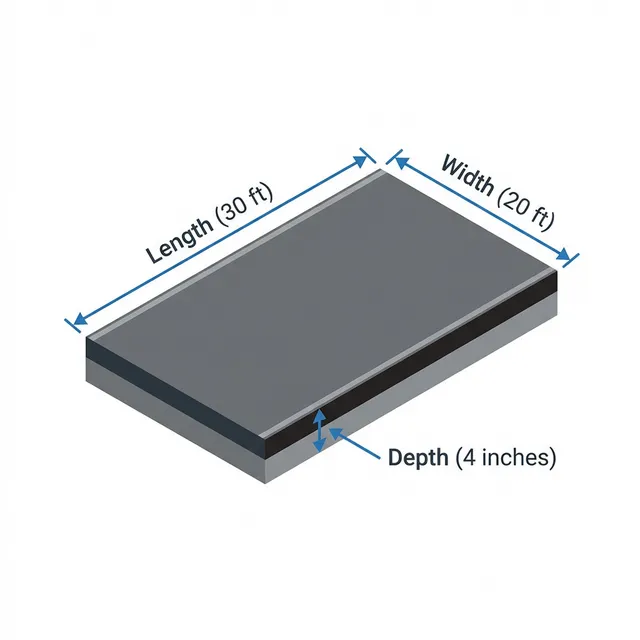
Asphalt prices vary significantly across the U.S. due to transportation costs, local supply, crude oil prices, and seasonal demand. Here are current 2026 prices:
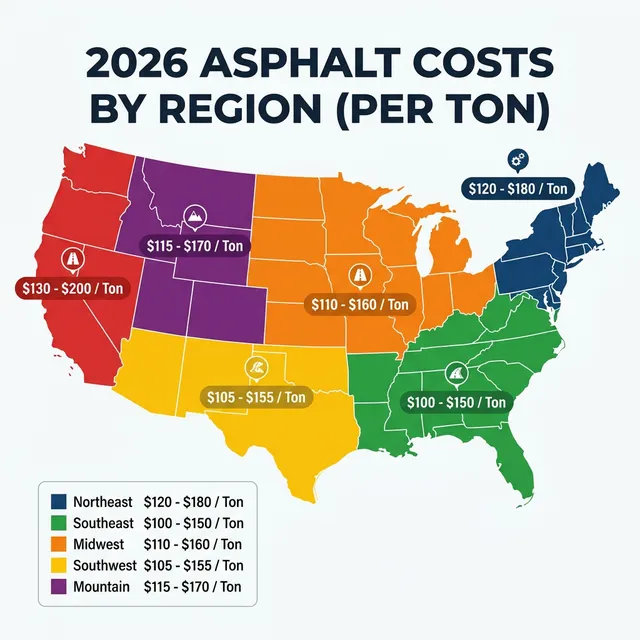
| Region | Price Per Ton | Price Per Sq Ft (3") | Avg Driveway Cost |
|---|---|---|---|
| Northeast | $120–$180 | $3.50–$5.50 | $3,500–$7,200 |
| Southeast | $100–$150 | $2.50–$4.50 | $2,400–$5,400 |
| Midwest | $110–$160 | $3.00–$5.00 | $2,800–$6,000 |
| Southwest | $105–$155 | $2.75–$4.75 | $2,600–$5,700 |
| West Coast | $130–$200 | $4.00–$6.50 | $4,000–$8,500 |
| Mountain | $115–$170 | $3.25–$5.25 | $3,000–$6,500 |
Prices based on a typical 600 sq ft (20×30) residential driveway at 3" thickness. Includes material only — labor adds $2–$5/sq ft. Updated March 2026.
Want exact pricing for your area? Enter your local cost-per-ton in the calculator above, or check our Asphalt Price Per Ton: 2026 Regional Guide for detailed state-by-state data.
Choosing the right asphalt type is critical for project longevity and cost efficiency. Here's what each type is best for:
| Asphalt Type | Best For | Cost/Ton | Density (lbs/ft³) | Lifespan |
|---|---|---|---|---|
| Hot Mix (HMA) | New driveways, parking lots, roads | $100–$150 | 145 | 15–20 years |
| Warm Mix (WMA) | Eco-friendly projects, cooler weather | $110–$160 | 145 | 15–20 years |
| Cold Mix | Patches, repairs, emergency fixes | $80–$120 | 140 | 1–3 years |
| Porous/Permeable | Drainage-sensitive areas, eco zones | $120–$180 | 125 | 15–20 years |
| Recycled (RAP) | Budget projects, base layers, rural roads | $40–$80 | 140 | 10–15 years |
Which type should you use? For most residential driveways, Hot Mix Asphalt (HMA) is the gold standard — it's the most durable, widely available, and offers the best cost-to-lifespan ratio. Use Cold Mix only for temporary repairs. Consider Recycled Asphalt (RAP) if budget is tight — it costs 40–60% less but won't last as long.
Adjust the density field in the calculator above to match your chosen asphalt type for more accurate results.
Schedule paving in late spring or early fall when contractors are less busy. You can save 10–20% compared to peak summer pricing. Asphalt plants also offer better rates during shoulder seasons. Read our full guide: Best Time to Pave a Driveway.
If neighbors are planning similar projects, coordinate orders. Bulk asphalt purchases often receive 5–15% discounts from suppliers, and the paving crew can do multiple jobs in one mobilization.
While asphalt laying requires professional equipment, you can save $2–$4 per square foot by preparing the base yourself — excavation, grading, and compacting the crushed stone sub-base.
Prices vary 20–30% between contractors for the same project. Always get multiple quotes and ensure they include materials, labor, base prep, and cleanup.
If your existing asphalt has only surface damage (minor cracks, fading), an overlay costs 40–60% less than full replacement. Check our Driveway Resurfacing Cost Guide to see if you qualify.
Choosing the right driveway material depends on your budget, climate, and how long you need it to last.
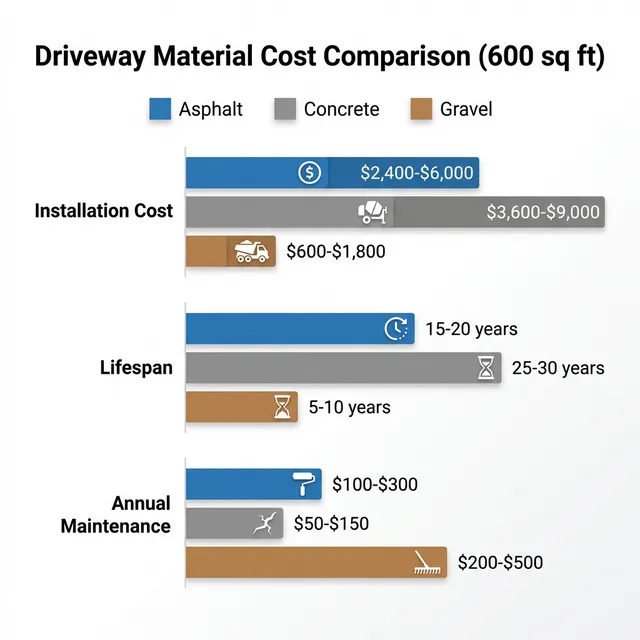
| Factor | Asphalt | Concrete | Gravel |
|---|---|---|---|
| Cost Per Sq Ft | $3–$7 | $6–$15 | $1–$3 |
| 600 Sq Ft Driveway | $2,400–$6,000 | $3,600–$9,000 | $600–$1,800 |
| Lifespan | 15–20 years | 25–30 years | 5–10 years |
| Maintenance | Sealcoat every 2–3 yrs | Minimal | Regrade annually |
| Cold Climate | ✅ Excellent (flexes) | ⚠️ Can crack | ⚠️ Shifts with frost |
| Hot Climate | ⚠️ Can soften | ✅ Excellent | ✅ Good |
| Repair Ease | ✅ Easy & cheap | ❌ Difficult | ✅ Very easy |
Bottom line: Asphalt is the best value for most homeowners — it costs 50% less than concrete upfront, handles freeze-thaw cycles better, and is easy to repair. Gravel is cheapest but needs annual maintenance. Concrete lasts longest but costs 2x more. For a deep dive, read our Asphalt vs Concrete Driveway Cost comparison.
For a 1,000 sq ft driveway at the standard 3-inch thickness, you'll need approximately 12–13 tons of hot mix asphalt (about 9.3 cubic yards). At current 2026 prices of $100–$150/ton, the material cost alone would be $1,200–$1,950. Add 10% for waste, bringing your total to roughly $1,320–$2,145 for materials.
One ton of asphalt covers approximately 40–80 square feet, depending on thickness. At 2 inches thick: ~80 sq ft. At 3 inches thick: ~55 sq ft. At 4 inches thick: ~40 sq ft. Use our calculator above for exact coverage based on your specific thickness.
The minimum recommended thickness is 2 inches for light residential use (cars only). However, 3–4 inches is strongly recommended for durability and longevity. Areas with heavy vehicles or cold climates should use 4+ inches. Thinner asphalt cracks sooner and costs more in repairs long-term. See our guide: Is 2 Inches of Asphalt Enough?
In 2026, asphalt costs $100–$200 per ton depending on your location and mix type. Hot Mix Asphalt (HMA) averages $120/ton nationally. The Southeast is cheapest ($100–$150), while the West Coast is most expensive ($130–$200). See our full breakdown: 2026 Asphalt Price Per Ton Guide.
Hot Mix Asphalt (HMA) is the right choice for 95% of projects — new driveways, parking lots, and roads. It's heated to 300–350°F, provides superior durability, and lasts 15–20 years. Cold Mix doesn't require heating and is only for temporary repairs and pothole patches — it lasts 1–3 years at most. Always use hot mix for permanent installations.
Yes — always. A proper base is the #1 factor in asphalt longevity. Use 4–6 inches of compacted crushed stone or gravel for residential driveways, 6–8 inches for commercial use. Sandy soil needs 4 inches of base; clay soil needs 6–8 inches. Skipping the base is the most expensive mistake homeowners make — it leads to premature cracking and settling within 2–3 years.
A properly installed asphalt driveway lasts 15–20 years with regular maintenance, and can reach 25–30 years with excellent care. Key maintenance includes sealcoating every 2–3 years and filling cracks immediately. Without maintenance, expect 8–12 years. Read our complete guide: How Long Does an Asphalt Driveway Last?
The best time to pave is May through September when air temperatures are consistently above 50°F. Asphalt needs warm temps to compact properly. However, you can save 10–15% by booking in late spring or early fall when contractors are less busy. Avoid winter paving entirely. See: Best Time to Pave a Driveway.
Our calculator uses the industry-standard formula with a density of 145 lbs/ft³ for hot mix asphalt, which is the professional standard used by contractors and engineers. Results are accurate within 5% for most applications. We recommend adding 5–10% to your calculated tonnage to account for waste, compaction, and edge irregularities.
Yes — this calculator works for any rectangular asphalt project including driveways, parking lots, roads, walkways, and sport courts. For parking lots, use 4–6 inch thickness for standard traffic and 6–8 inches for truck-heavy areas. For dedicated tools, see our Parking Lot Cost Calculator.