
Asphalt & Concrete Maintenance for Residential Communities — Complete 2026 Guide
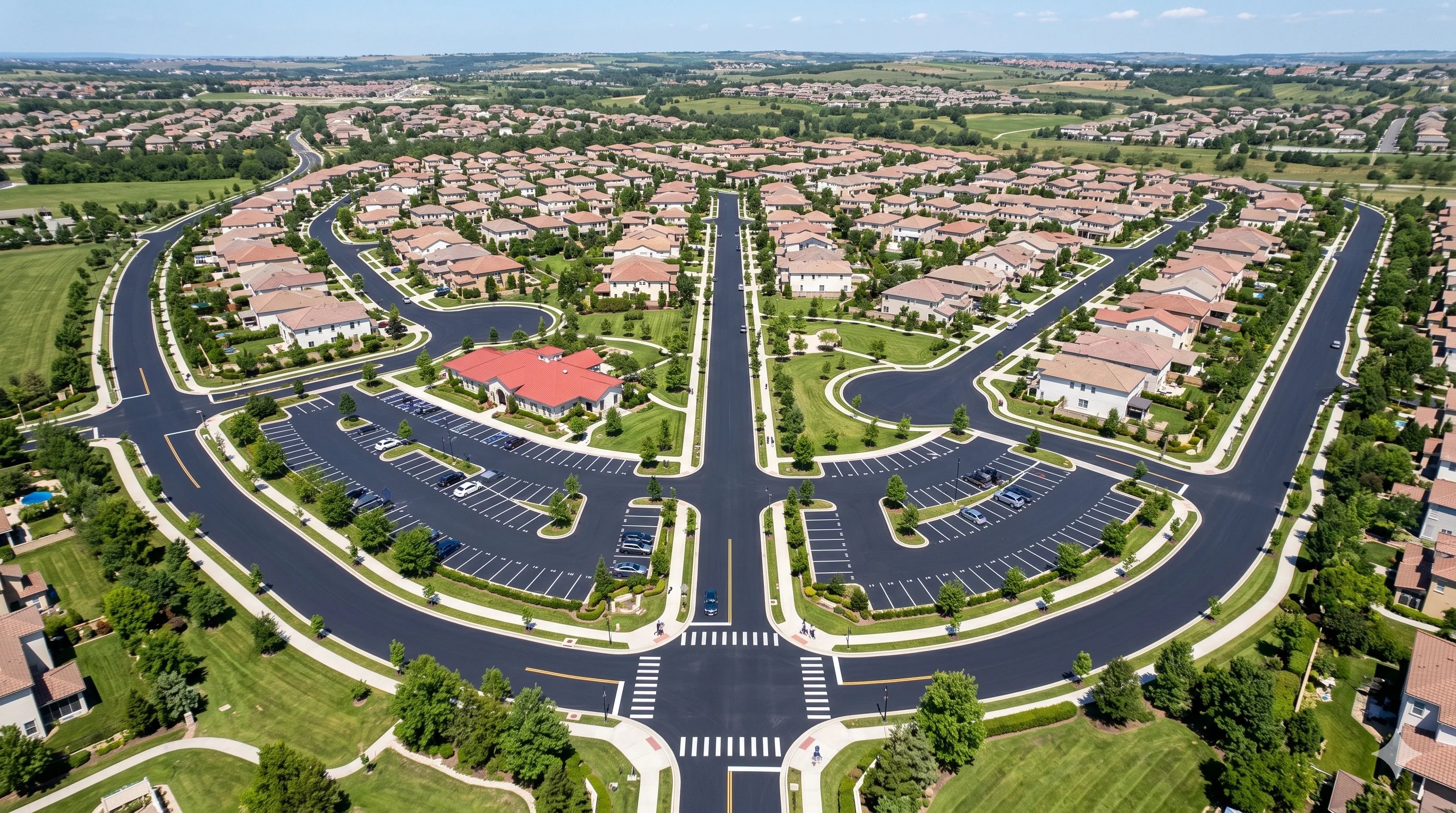
Asphalt and concrete maintenance for residential communities involves a structured annual program covering inspection, crack sealing, sealcoating, pothole repair, and surface replacement on a rotating schedule. For most HOAs and property managers, a proactive maintenance budget of $0.05–$0.15 per square foot per year extends pavement life by 50–100% compared to reactive repair-only approaches. This guide covers everything community managers need to plan, budget, and execute a complete pavement maintenance program.
Why Pavement Maintenance Matters for Residential Communities
Pavement is typically the largest physical asset an HOA manages outside of structures. Community roads, parking lots, driveways, and walkways can represent $500,000–$5,000,000 in replacement value for a mid-size community — yet pavement maintenance is consistently underfunded until visible deterioration forces expensive emergency action.
The mathematics of deferred maintenance are unforgiving: a $500 crack seal job deferred becomes a $5,000–$15,000 full-depth repair within 3–5 years. Water infiltrates unsealed cracks, degrades the subbase, and causes base failure. What was a surface problem becomes a structural one. Studies from FHWA (Federal Highway Administration) and state DOTs consistently show that every $1 spent on preventive maintenance saves $4–$7 in future rehabilitation costs.
Beyond cost, HOA boards and property managers carry legal and financial responsibility for maintaining common area pavement in a safe condition. Trip hazards on walkways, vehicle damage from potholes, and slip-and-fall incidents on deteriorated pavement create significant liability exposure. Proactive maintenance is both the fiscally responsible and legally prudent approach for any community association.
Types of Pavement in Residential Communities
Asphalt (Most Common)
Used for community roads, parking lots, and HOA-managed driveways. Lifespan of 15–20 years with proper maintenance. Standard maintenance program: sealcoat every 2–3 years, crack seal annually, spot-patch potholes as needed, overlay or replace at end of life. The most cost-effective surface material for large community areas due to lower initial cost and straightforward repair.
Concrete
Used primarily for sidewalks, curbs, some community driveways, and occasionally roads. Lifespan of 25–30 years with proper joint maintenance. Standard concrete maintenance: joint sealing every 3–5 years, crack repair, surface sealing, individual panel replacement when trip hazards develop. Higher upfront cost than asphalt but lower long-term maintenance frequency. Use our concrete driveway calculator for cost estimates on concrete work.
Pavers and Decorative Surfaces
Used for entrance features, common area walkways, courtyards, and decorative elements. Lifespan of 25–50 years with proper maintenance. Maintenance includes joint sand replenishment, individual paver replacement, periodic re-leveling as subbase settles, and cleaning. Most durable of the three surface types but carries the highest initial cost and the most complex maintenance skill requirements.
The Residential Community Pavement Maintenance Schedule
A structured maintenance schedule — not a reactive repair approach — is the single most impactful decision a community board can make for its pavement assets. Here is the complete recommended schedule:
🔵 Annual Maintenance (Every Year)
- Spring inspection: Walk all pavement after winter. Document cracks, potholes, drainage issues, and trip hazards using a simple zone-based grading system (Good / Fair / Poor / Failed). Photograph all issues for board records.
- Crack sealing: Fill all cracks wider than ¼ inch with hot-pour or cold-pour crack filler before they allow water infiltration. Cost: $0.50–$1.50/linear foot professionally applied. Use our crack fill calculator to estimate quantity and cost.
- Pothole repair: Patch all potholes before winter freeze-thaw worsens them. Cold patch: $15–$40 per hole DIY. Professional infrared repair: $100–$300 per repair — the preferred method as it bonds permanently to surrounding pavement.
- Drainage inspection: Clear all catch basins, area drains, and curb outlets. Verify slopes direct water away from structures. Standing water is the primary accelerator of pavement failure.
- Striping inspection: Assess parking space lines, fire lane markings, and ADA-compliant HC spaces. Re-stripe immediately if faded — faded HC striping creates ADA compliance liability.
🟢 Every 2–3 Years
- Sealcoating (asphalt surfaces): Apply 2-coat sealcoat to all asphalt roads, parking lots, and paved driveways. Professional cost: $0.15–$0.25/sqft. For a 50,000 sqft community lot: $7,500–$12,500. Use our sealcoating calculator for exact material quantity and cost estimate.
- Re-striping: After every sealcoating application, re-stripe all parking spaces, fire lanes, ADA spaces, directional arrows, and crosswalk markings. Never sealcoat without budgeting for re-striping.
- Concrete joint sealing: Re-seal all expansion and control joints in concrete sidewalks, curbs, and pads every 3–5 years to prevent water infiltration and vegetation growth that accelerates joint deterioration.
🟡 Every 5–10 Years
- Slurry seal or micro-surfacing: Thin surface treatment that restores oxidized asphalt, seals the surface, and extends pavement life 5–7 additional years without the cost of a full overlay. Cost: $0.75–$1.50/sqft — significantly less than an overlay.
- Concrete sidewalk panel replacement: Any panels with a vertical displacement exceeding ¼ inch (a trip hazard under ADA standards) must be replaced. Cost: $8–$15/sqft for concrete panel replacement.
- Curb and gutter repair: Replace damaged or failed curb sections that compromise drainage and pavement edge support. Cost: $20–$35/linear foot. Use our curb calculator for estimates.
- ADA compliance audit: Hire a certified accessibility consultant every 5–7 years to audit all HC spaces, ramps, curb cuts, and accessible routes against current ADA standards.
🔴 Every 15–20 Years
- Asphalt overlay (resurfacing): Mill top 1.5–2 inches and apply new asphalt surface course. Cost: $2–$4.50/sqft. Use our asphalt overlay calculator to estimate community road and lot resurfacing cost.
- Full-depth asphalt replacement: When the structural base has failed (alligator cracking, rutting, drainage failure), full removal and reconstruction is required. Cost: $4–$8/sqft. Use our road construction cost calculator for community streets.
- Parking lot reconstruction: Complete tearout and rebuild when the base is structurally failed. This is why reserve fund contributions from Year 1 matter — a community that has been building reserves avoids the financial crisis of a $500,000+ sudden reconstruction expense.
Community Pavement Maintenance Budget Guide
Annual Budget Per Square Foot
| Approach | Annual Cost/Sqft | Long-Term Outcome |
|---|---|---|
| Minimal — reactive only | $0.02–$0.05/sqft | ⚠️ 50–70% higher lifecycle cost |
| Proactive — recommended | $0.05–$0.12/sqft | ✅ Maximum pavement lifespan at lowest cost |
| Comprehensive — with reserves | $0.10–$0.18/sqft | ✅ Includes reserve build for future replacement |
Sample Annual Budget — 200-Home Community
| Feature | Approx. Area | Annual Budget | Notes |
|---|---|---|---|
| Community roads (2 miles) | 120,000 sqft | $6,000–$14,400 | $0.05–$0.12/sqft |
| Parking lots | 50,000 sqft | $2,500–$6,000 | $0.05–$0.12/sqft |
| Sidewalks / walkways | 20,000 sqft | $800–$2,400 | $0.04–$0.12/sqft |
| Common driveways | 15,000 sqft | $750–$1,800 | $0.05–$0.12/sqft |
| Reserve contribution | All surfaces | $8,000–$20,000 | For future replacement |
| Total annual budget | 205,000 sqft | $18,050–$44,600 | Per 200-home community |
Reserve Fund Planning
HOA reserve studies typically recommend setting aside $0.30–$0.80/sqft of pavement area per year in reserves for future replacement. A 200-home community with 205,000 sqft of pavement needs $61,500–$164,000 in annual reserve contributions for pavement alone. This figure is why proactive maintenance — which delays replacement by 5–10 years — is not just a maintenance decision but a major financial strategy for HOA solvency.
⚠️ The Deferred Maintenance Trap
- A $500 annual crack-sealing program deferred 5 years → $5,000–$15,000 base repair
- A $12,000 sealcoating program deferred → $50,000+ overlay needed 5 years early
- A skipped overlay → $200,000+ full reconstruction on 50,000 sqft lot
- The 4–7× cost multiplier is consistent across all pavement types and climates
Hiring a Pavement Maintenance Contractor for Your Community
What to Look for in a Community Pavement Contractor
- Documented HOA/multi-family experience — request references from 3+ comparable communities
- Commercial liability insurance of $2M+ — community work requires higher coverage than residential
- Multi-year maintenance planning capability — not just one-time quotes but ongoing program management
- ADA compliance familiarity — critical for any work touching accessible routes and HC spaces
- Detailed scope-of-work contracts — with material specifications, thickness, and warranty terms
- Board reporting documentation — before/after photos, condition logs, completion certificates
Getting Competitive Bids
Get at least 3 bids for any project over $5,000. Prepare a complete bid package providing all bidders with: accurate square footage measurements (use our square footage calculator), a current pavement condition assessment report, a specification sheet listing pavement type, material grades, desired thickness, and timeline requirements. Comparing identical bid packages is the only way to make a valid apples-to-apples comparison.
🚩 Community Contractor Red Flags
- Unusually low bids — often indicate thin material applications, skipped steps, or no permits
- No written scope of work specifying materials and thickness
- Requiring full payment upfront before work begins
- No local references from HOA or commercial property work
- Unable to provide a certificate of insurance at $2M+ commercial coverage
Asphalt vs. Concrete — Which Is Better for Community Roads?
| Factor | Asphalt | Concrete |
|---|---|---|
| Initial cost (community roads) | $4–$8/sqft | $7–$14/sqft |
| Maintenance frequency | Every 2–3 years | Every 5 years |
| Winter performance | Excellent — flexes with freeze-thaw | Can crack at expansion joints |
| Repair visibility | Blends reasonably with surface | Patches are visually obvious |
| Traffic noise | Lower — absorbs sound | Slightly louder |
| 30-year lifecycle cost | Similar | Similar |
| Best climate | Cold / northern communities | Hot / arid Sun Belt communities |
For most communities, asphalt offers better value due to lower initial cost and easier repair — particularly important for HOA budgets. See our full asphalt vs. concrete cost comparison for a detailed lifecycle analysis.
Pavement Condition Index — Know Where Your Community Stands
The Pavement Condition Index (PCI) — developed by the US Army Corps of Engineers — provides a standardized 0–100 scale for assessing pavement condition. Every community board should understand this scale when reviewing maintenance proposals:
Use our asphalt repair cost calculator to estimate whether repair or replacement is the more cost-effective path for specific community sections.
Free Calculators for Community Property Managers
Use these free tools to build accurate cost estimates before soliciting contractor bids. Having independent estimates helps boards negotiate better contracts and plan reserve budgets with confidence:
- Asphalt Repair Cost Calculator
Crack repair and patching cost estimates
- Sealcoating Calculator
Sealer quantity and cost for large community lots
- Parking Lot Cost Calculator
Full parking lot paving and resurfacing estimate
- Asphalt Overlay Calculator
Community road and lot resurfacing cost
- Crack Fill Calculator
Crack filler quantity by linear footage
- Road Construction Cost Calculator
Community road reconstruction estimate
- Pothole Repair Cost Calculator
Per-pothole repair cost — DIY vs professional
- Curb Calculator
Curb and gutter replacement cost estimate
Frequently Asked Questions
How often should an HOA sealcoat its parking lots and roads?
Asphalt surfaces in residential communities should be sealcoated every 2–3 years. New asphalt should cure for 6–12 months before the first sealcoating application. Communities in harsh climates — heavy snow/ice in the north, extreme UV exposure in the south — benefit from the 2-year interval. Sealcoat protects asphalt from UV oxidation, water infiltration, and oil damage — the three primary causes of premature pavement failure. Use our sealcoating calculator to estimate cost for your community's total surface area.
What is the average cost of asphalt maintenance for a residential community?
A proactive maintenance program costs $0.05–$0.12 per square foot per year for maintenance activities. For a typical 200-home community with 150,000–200,000 sqft of pavement, that translates to $7,500–$24,000 annually — excluding reserve contributions for future replacement. Communities that defer maintenance consistently end up paying 4–7× more in emergency repairs and premature full replacement over a 20-year period.
How do HOAs budget for pavement replacement?
HOAs should commission a reserve study every 3–5 years that includes a full pavement lifecycle analysis. Standard reserve fund contributions for pavement are $0.30–$0.80 per square foot per year. A community with 150,000 sqft of asphalt should target $45,000–$120,000/year in pavement reserves to fund future overlay at year 15 and eventual full replacement at year 25–30. Communities without adequate reserves face special assessment crises when major pavement work becomes unavoidable.
What pavement maintenance tasks can an HOA do themselves vs. hiring out?
DIY-appropriate tasks: crack filling with cold-pour filler ($10–$30 per tube, suitable for cracks under ½ inch), small pothole patching with cold-mix asphalt bags, storm drain and catch basin clearing, and basic line marking touch-up with aerosol marking paint. Always hire professionals for: sealcoating (results depend heavily on proper equipment, mixing ratios, and application technique), hot-pour crack sealing, infrared pothole repair, any overlay or resurfacing work, and any ADA-related modifications where improper work creates serious liability exposure.
How do I know if community pavement needs repair or full replacement?
Use the Pavement Condition Index (PCI) framework. Score 70–100: Good — routine crack sealing and sealcoating are sufficient. Score 40–70: Fair — rehabilitation needed, overlay or extensive crack repair. Score 0–40: Poor — reconstruction is required, repair costs exceed replacement value. Key signs requiring replacement rather than repair: alligator (fatigue) cracking throughout large areas indicating base failure; widespread potholes forming faster than they can be patched; significant rutting or surface depression; persistent drainage failure regardless of drain clearing.
What ADA requirements apply to community pavement?
Communities must maintain ADA-compliant accessible routes throughout all common areas. Key requirements: HC parking spaces must be 8 ft wide (van-accessible spaces 11 ft) with 5 ft access aisles; accessible routes must not exceed 2% cross-slope and 5% running slope; no surface breaks or vertical lips exceeding ½ inch on accessible paths; all curb transitions must have compliant ramps. Non-compliance exposes HOAs to individual ADA complaints, DOJ enforcement actions, and civil liability — all significantly more expensive than proactive compliance.
How do I get competitive bids for community pavement work?
Prepare a complete bid package and provide identical information to all bidders: accurate area measurements (see our square footage calculator), current condition assessment photos and notes, a specification sheet with material grades and thickness requirements, desired project timeline, and a detailed scope-of-work checklist. Send to 3–5 pre-qualified local contractors with HOA references. Compare bids line by line — not just total price. The lowest bid almost always reflects thinner material applications, skipped preparation steps, or inferior products.