
Asphalt Sealcoating Contractors — How to Hire, Vet & Get Fair Quotes (2026)
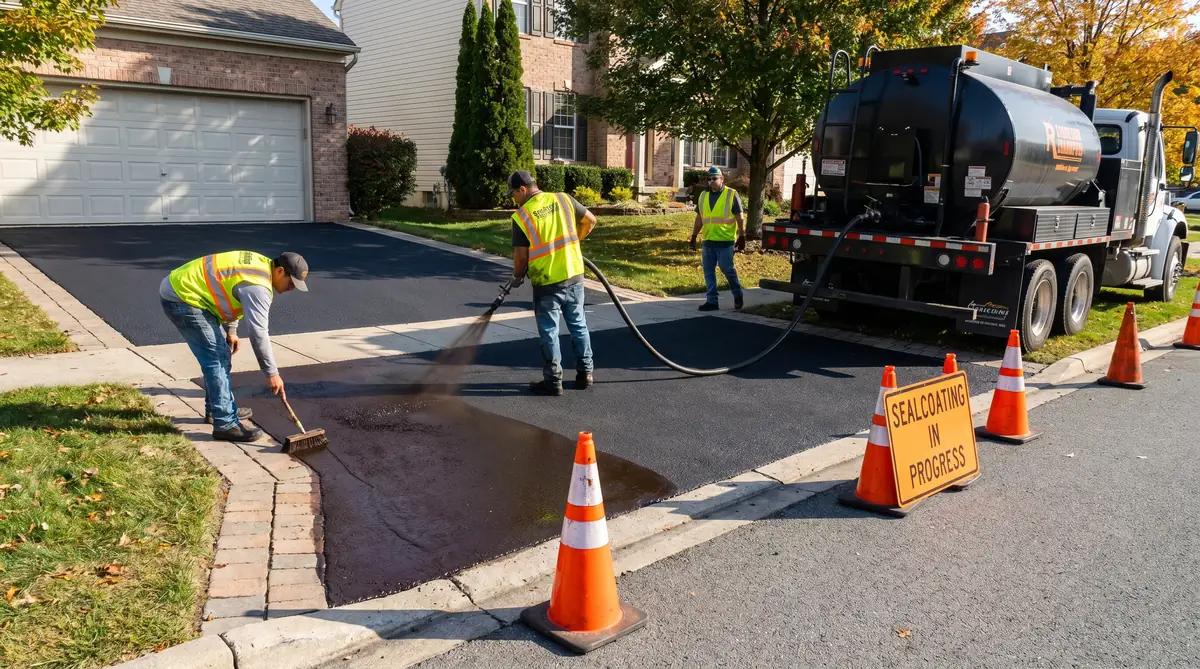
Quick Answer: What Sealcoating Contractors Do & What They Charge
Asphalt sealcoating contractors apply a protective coating (asphalt emulsion or refined coal tar) to your driveway or parking lot to block UV oxidation, water intrusion, and fuel spills. Professional jobs include prep, crack filling, two coats, and drying management. Cost: $0.15–$0.35/sq ft residential, $0.10–$0.25/sq ft commercial. A 600 sq ft driveway runs $180–$350 installed. Use the state contractor finder below to search in your area.
What a Professional Sealcoating Job Includes
A legitimate sealcoating contractor does significantly more than just brush on sealer. Skipping prep steps is the most common cause of early failure — and the easiest way to tell a quality contractor from a fly-by-night crew.
| Step | What It Involves | DIY skips this? |
|---|---|---|
| Surface cleaning | Blower, broom, or pressure wash to remove loose material, dirt, and vegetation from cracks | Often |
| Oil spot treatment | Oil-spot primer applied to petroleum-stained areas — emulsion sealer won't bond to oil without primer | Almost always |
| Crack filling | Hot-pour or rubberized cold-pour filler in all cracks over 1/8 inch before sealing | Often partial |
| Edging | Hand-brush sealer at edges, expansion joints, curbs, and garage aprons where spray overshoot isn't acceptable | Yes |
| First coat application | Full coverage squeegee, brush, or spray pass — usually north-south direction | Yes |
| Drying window | Minimum 4–6 hours between coats; professional crews plan jobs to allow this | Rushed |
| Second coat application | Full coverage in perpendicular direction (east-west) for even film build | Sometimes skipped |
| Overspray protection | Masking or plastic sheeting on garage doors, vehicles, landscaping | Missed often |
| Traffic control | Cones, barrier tape, or vehicle relocation during cure | Minimal |
Find Sealcoating Contractors Near You — By State
Sealcoating is a highly local service — pricing, product regulations (especially coal tar bans), and contractor density vary significantly by state. Use the tool below to get region-specific search links, price context, and licensing notes.
🔍 Sealcoating Contractor Finder by State
Select your state to see typical price range, coal tar status, contractor density, and direct search links.
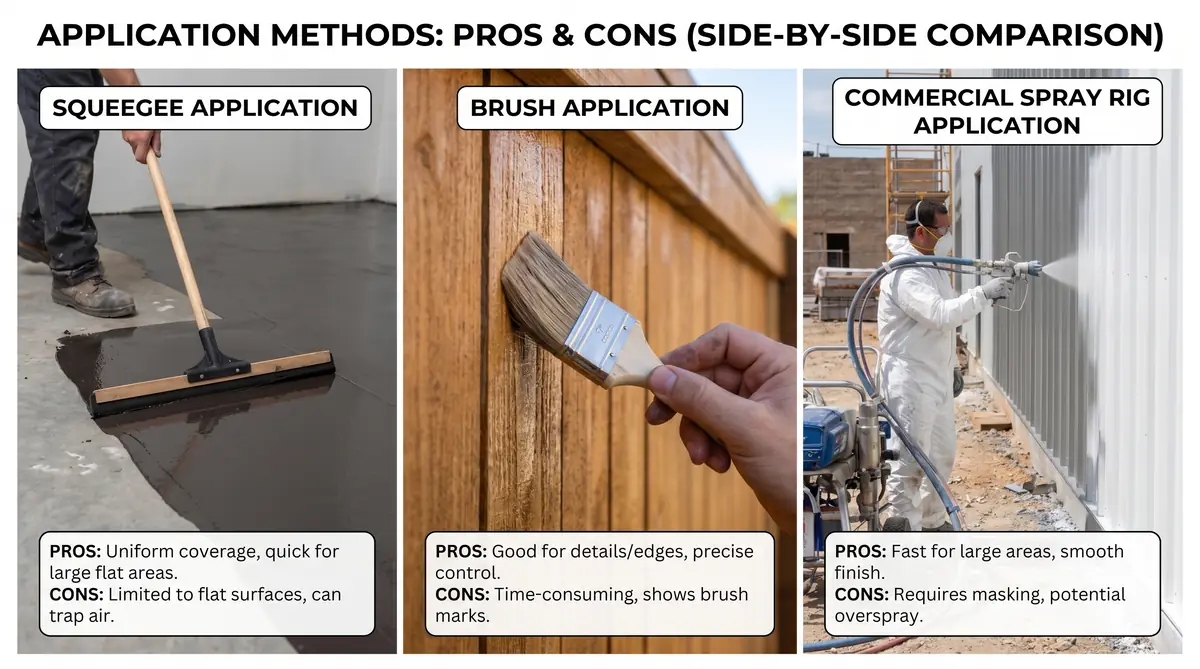
Application Methods — What Contractors Use
| Method | Best For | Finish Quality | Speed | Notes |
|---|---|---|---|---|
| Squeegee | Residential driveways, textured surfaces | Excellent — fills surface voids | Medium | Forces sealer into surface texture; best for aged, porous asphalt |
| Brush | Edging, detail work, small areas | Good | Slow | Used to edge along garage doors, curbs, and landscaping — not for full coverage |
| Spray (commercial rig) | Large parking lots, smooth surfaces | Very uniform on smooth surfaces | Fast | Faster, consistent coverage; requires windless conditions; not ideal for porous or rough surfaces |
| Combination | Commercial lots with mixed conditions | Best overall | Medium | Spray for field, squeegee or brush at edges and textured areas — professional standard |
Pricing — What to Expect in 2026
| Project Type | Area | Price per sq ft | Typical Total |
|---|---|---|---|
| Small residential driveway | 400–600 sq ft | $0.22–$0.35 | $130–$210 |
| Standard residential driveway | 600–1,000 sq ft | $0.18–$0.30 | $180–$350 |
| Large residential driveway | 1,000–2,000 sq ft | $0.15–$0.25 | $225–$500 |
| Small commercial lot | 2,000–5,000 sq ft | $0.12–$0.20 | $350–$1,000 |
| Medium commercial lot | 5,000–20,000 sq ft | $0.10–$0.16 | $700–$3,200 |
| Large commercial lot | 20,000+ sq ft | $0.08–$0.13 | $2,400+ |
Add-ons typically priced separately:
- Crack filling: $1.50–$4.00 per linear foot (hot-pour) or $0.50–$1.50/LF (cold-pour)
- Oil spot treatment / primer: $15–$40 per spot
- Third coat (premium): add 30–40% to base price
- Parking lot line striping: $1.50–$3.50 per linear foot; $200–$600 per standard stall layout
- Speed bump painting: $50–$150 each
For a full cost breakdown and regional pricing, see our sealcoating cost guide. Use the sealcoating calculator to estimate your specific project before calling for bids.
Coal Tar vs Asphalt Emulsion — What Your Contractor Should Be Using
| Sealer Type | Base Material | Cost | Durability | Health / Legal |
|---|---|---|---|---|
| Coal tar (RTS) | Coal tar pitch | Lowest | Good (3–5 yr) | Contains PAHs — carcinogenic; banned in DC, MD cities, MN, IL municipalities, and others |
| Asphalt emulsion | Refined asphalt + water | Moderate | Good (2–4 yr) | EPA-preferred; low odor; safe for children and pets after cure |
| Polymer-modified emulsion | Asphalt emulsion + polymer | Higher | Best (4–6 yr) | EPA-compliant; best flexibility and UV resistance |
| Fast-dry / acrylic | Acrylic polymer | Highest | Good (3–5 yr) | Safe; used on sport courts and premium residential |
How to Vet a Sealcoating Contractor — 10-Point Checklist
- Valid general liability insurance ($1M minimum) — request the certificate of insurance, not just a verbal confirmation
- Names the product they're using — brand, product name, and whether it's coal tar or emulsion-based
- States the dilution ratio — manufacturer specs allow a small amount of water to aid application; excessive dilution (over 10% water addition) significantly reduces durability
- Commits to two coats in writing — single-coat jobs look fine on day one but fail much faster
- Crack filling is part of prep, not an upsell — a contractor who says "we'll seal right over the cracks" is not doing proper prep
- Local business address and verifiable reviews — Google Business profile, BBB listing, or Angi profile with recent reviews
- Won't start a job in rain or near-rain forecast — minimum 24 hours of dry weather before and after application
- Provides a written quote with specs — not just a price; includes sq footage, coat count, product, crack fill scope
- Gives realistic cure time guidance — 48–72 hrs for vehicle traffic; any contractor who says "drive on it tomorrow" is cutting corners
- Has been operating for 2+ seasons — sealcoating has low entry barriers; ask how long they've been in business and for 3 local references
Red Flags — Scams and Low-Quality Contractors to Avoid
- "Leftover material" door-to-door offer — the most common sealcoating scam; the "leftover" is heavily diluted or recycled used oil with sealer added; no legitimate contractor operates this way
- Cash only, no written quote — no legal recourse if work is substandard or incomplete
- Price 50%+ below other quotes — almost always means extreme dilution, single coat, or no crack prep
- No company name on their truck — magnetized signs that come off, generic unmarked vehicles
- Refuses to show insurance certificate — if they damage your property or a worker is injured on your property, you're liable
- Won't say what product they're using — often means cheap coal tar, used motor oil blend, or heavily diluted off-spec product
- Starts immediately without cleaning or prep — sealing over dirty, oily, or wet asphalt guarantees early delamination
- "Lifetime guarantee" from a new company — guarantees are only as good as the company's continued existence
Getting and Comparing Quotes
Get at least 3 written quotes. A proper quote for sealcoating should include every item below — if any are missing, ask before signing:
- Total square footage to be sealed (verify this yourself with a tape measure)
- Number of coats (two minimum)
- Sealer brand, product name, and dilution ratio
- Application method (squeegee / spray / combination)
- Crack filling: what's included and at what linear footage
- Oil spot treatment: included or priced per spot
- Cure time before foot and vehicle traffic
- Warranty: what's covered and for how long
- Start date and completion schedule
- Insurance certificate (attached or available on request)
When to Sealcoat
| Scenario | Recommendation |
|---|---|
| New asphalt pavement | Wait 90–180 days before first sealcoating — binder must fully cure and off-gas oils first |
| Previously sealed driveway | Re-seal every 2–3 years, or when surface begins to show grey oxidation |
| Heavily cracked / alligator surface | Do not seal — sealcoat over structural damage accelerates failure; repair first |
| Best time of year | Late spring through early fall (May–September); minimum ambient temp 50°F and rising, no rain within 24 hrs |
| Worst time | Late fall and winter — cool temps slow curing; frost ruins fresh sealer overnight |
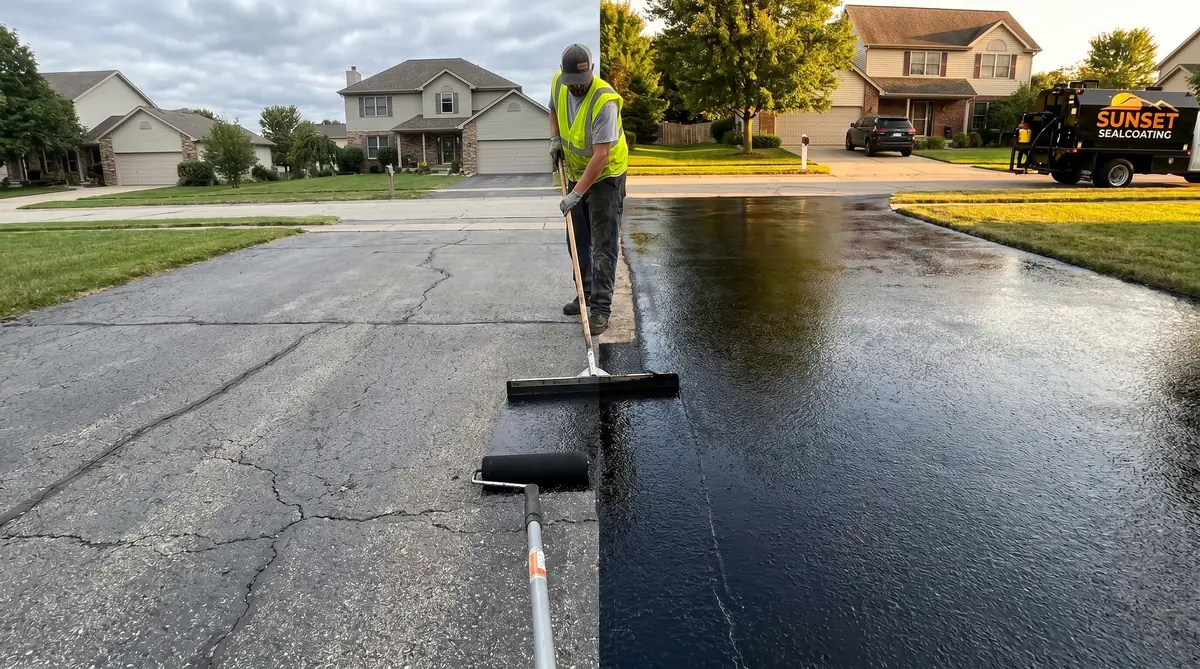
Before After — What a Pro Job Looks Like
Questions to Ask Before Signing
- What product (brand + name) are you applying — is it coal tar or asphalt emulsion?
- How many coats are included in this price?
- What is the dilution ratio you're using?
- Does the quote include crack filling — and how many linear feet?
- How will you treat oil spots?
- What is the minimum temperature and weather condition you require to start?
- How long before I can walk on it — and how long before vehicle traffic?
- Can you provide a certificate of insurance and 3 local references from this season?
Asphalt Sealcoating Contractors FAQs
How much do sealcoating contractors charge?
$0.15–$0.35/sq ft residential, $0.10–$0.25/sq ft commercial. A 600 sq ft driveway: $180–$350 with two coats and basic crack filling. Crack filling, line striping, and oil spot treatment are usually extra. See our full cost guide for regional breakdowns.
How do I find a reputable sealcoating contractor near me?
Google "sealcoating contractor near me" (filter 4+ stars, 20+ reviews), check BBB, ask for an insurance certificate, and get 3 references from the current season. Use the state finder tool at the top of this page for direct search links.
What is the difference between coal tar and asphalt emulsion?
Coal tar is cheaper, jet-black, and very durable — but contains carcinogenic PAHs and is banned in many jurisdictions. Asphalt emulsion is EPA-preferred, safer, and adequate durability. Polymer-modified emulsion is the premium option for longevity. Always ask what product is being used.
How many coats of sealer should a contractor apply?
Two coats is professional standard — applied in perpendicular directions for even film build. Single coat is a red flag. Three coats is a premium upsell for new pavement or high-traffic commercial.
How long after sealcoating can I drive on my driveway?
Foot traffic: 24 hours minimum. Vehicles: 48–72 hours minimum. In cool or humid conditions, extend to 72–96 hours. Don't park in the same spot for 2 weeks in warm weather — sealer continues curing.
What should a written sealcoating quote include?
Square footage, coat count, product name and dilution ratio, crack fill scope, oil spot treatment, cure time commitment, warranty terms, and insurance certificate. Any quote that's just a price with no spec is a red flag.
How often should I reseal my driveway?
Every 2–3 years in most climates. High UV or freeze-thaw climates (Southwest sun, Northeast winters) may benefit from 2-year cycles. Don't over-seal — more than 4 accumulated coats builds up a brittle film that cracks. Strip and recoat if you have heavy sealer buildup.
Can a contractor seal and crack-fill the same day?
Cold-pour crack filler: yes, after a 1–2 hour dry time. Hot-pour crack sealant: usually the same day after 30–60 minutes of cooling. The crack filler must be fully dry before sealer goes on — wet or tacky filler under sealer traps moisture and causes delamination.
Related Guides & Tools
References: NAPA Pavement Preservation · EPA Coal Tar Sealant Report