
How to Calculate Asphalt Tonnage — Formula, Examples & Calculator
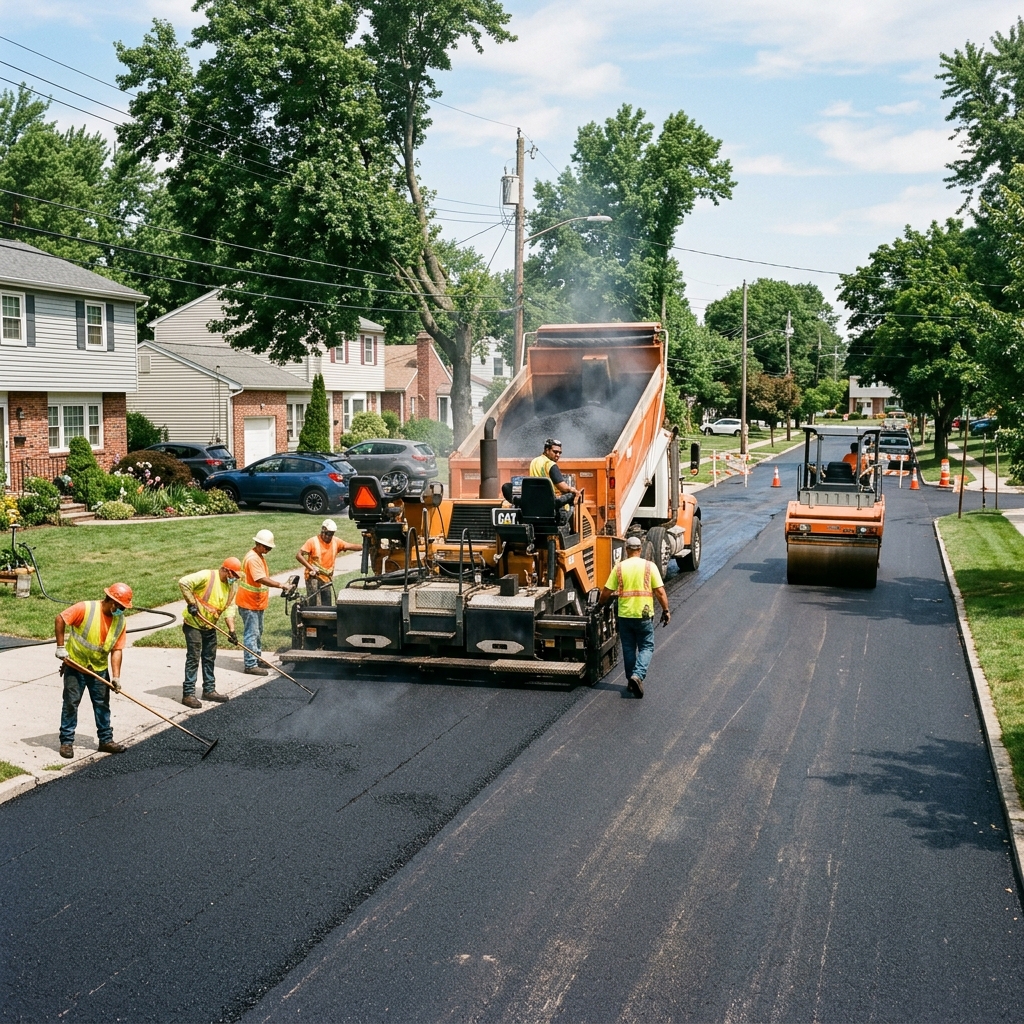
How to calculate asphalt tonnage: Use the formula Tons = Area (sqft) × Thickness (inches) × 0.00604, then add 10% for waste. This is based on standard Hot Mix Asphalt density of 145 lbs/ft³. For a quick answer, use our free asphalt tonnage calculator — just enter your dimensions and it does the math instantly.
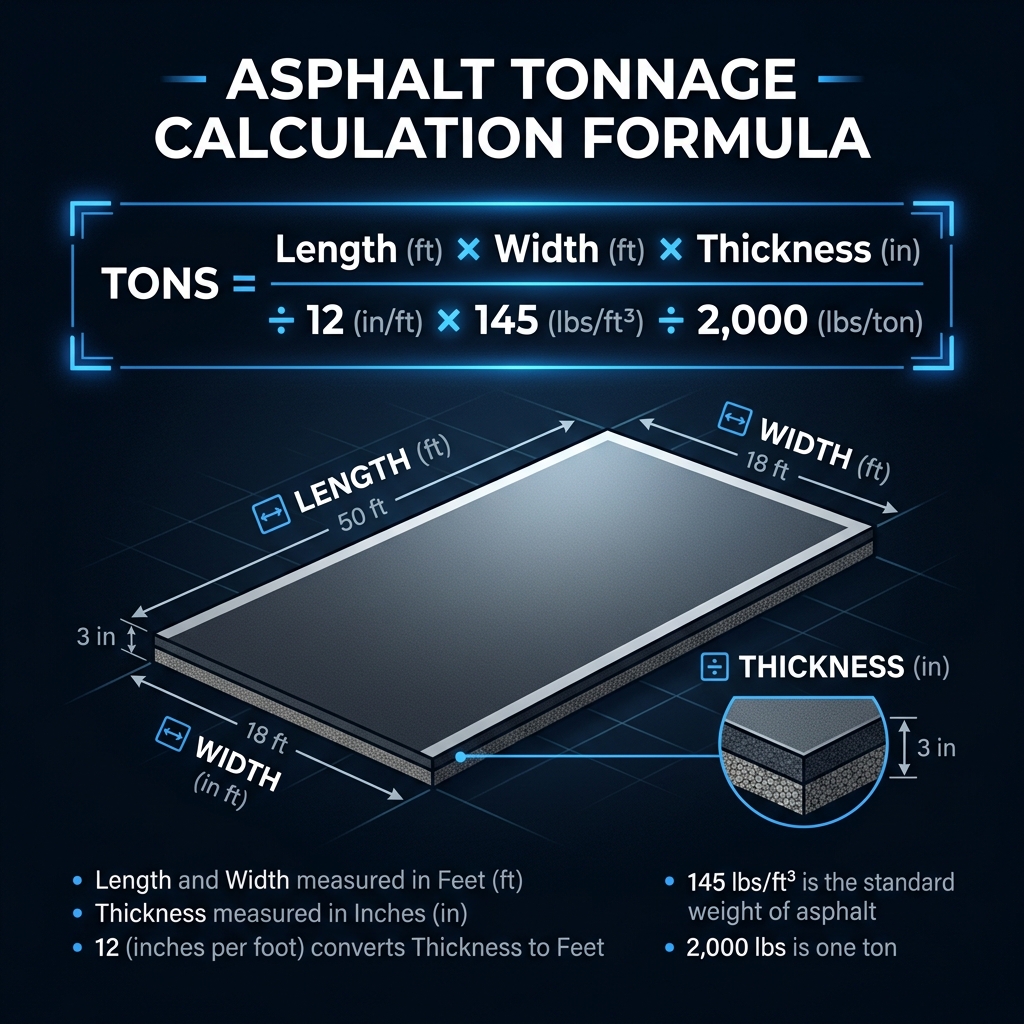
The Asphalt Tonnage Formula
Here's the complete step-by-step formula used by paving contractors and engineers:
Volume (ft³) = Length × Width × (Thickness ÷ 12)
# Step 2: Convert volume to weight in pounds
Weight (lbs) = Volume × 145
# Step 3: Convert pounds to tons
Tons = Weight ÷ 2,000
# Combined single formula:
Tons = Length × Width × Thickness × 145 ÷ 24,000
# Quickest shortcut:
Tons = Area (sqft) × Thickness (in) × 0.00604
# Always add 10% waste for ordering:
Order Quantity = Calculated Tons × 1.10
The constant 0.00604 combines the density conversion and the inch-to-foot conversion: 145 lbs/ft³ ÷ 12 ÷ 2,000 = 0.006042. This shortcut makes field calculations fast and reliable.
3 Worked Examples
🏠 Example 1 — Residential Driveway: 20×30 ft at 3 inches
🅿️ Example 2 — Commercial Parking Lot: 100×200 ft at 4 inches
🔧 Example 3 — Repair Patch: 15×15 ft at 2 inches
Quick Reference Tonnage Table
All figures include 10% waste factor. Based on 145 lbs/ft³ Hot Mix Asphalt:
| Area (sq ft) | 2" thick | 3" thick | 4" thick | 6" thick |
|---|---|---|---|---|
| 100 | 1.33 tons | 2.00 tons | 2.66 tons | 3.99 tons |
| 200 | 2.66 | 3.99 | 5.32 | 7.97 |
| 500 | 6.64 | 9.97 | 13.28 | 19.93 |
| 600 | 7.97 | 11.96 | 15.94 | 23.91 |
| 1,000 | 13.28 | 19.93 | 26.57 | 39.86 |
| 2,000 | 26.57 | 39.86 | 53.14 | 79.71 |
| 5,000 | 66.42 | 99.64 | 132.85 | 199.27 |
| 10,000 | 132.85 | 199.27 | 265.70 | 398.55 |
For any area not in this table, use the shortcut: Area × Thickness × 0.00604 × 1.10. Or use our asphalt tonnage calculator for instant results.
Asphalt Density by Mix Type
The formula above uses 145 lbs/ft³ — the standard for Hot Mix Asphalt. Here's the correct density for each mix type:
| Mix Type | Density (lbs/ft³) | Tons Per CY | When to Use |
|---|---|---|---|
| HMA Standard | 145 | 1.96 | Default for most calculations |
| Dense Graded HMA | 148 | 2.00 | High-traffic roads |
| Warm Mix Asphalt | 143 | 1.93 | Lower production temp |
| Cold Mix Asphalt | 140 | 1.89 | Patching, rural roads |
| Recycled (RAP) | 140 | 1.89 | Recycled asphalt pavement |
| Porous / Open-Graded | 125 | 1.69 | Drainage applications |
To use a different density in the formula, replace 145 with your mix's density: Tons = Area × (Thickness÷12) × Density ÷ 2,000. Our asphalt unit converter supports all 8 mix types with auto-density switching.
⚠️ The 4 Most Costly Tonnage Calculation Mistakes
- Not dividing depth by 12. Thickness must be in feet (not inches) in the volume formula. Forgetting to divide by 12 gives you a result 12× too high — the most common and expensive mistake.
- Skipping the 10% waste factor. Running short on asphalt mid-pour means a second delivery at $200–$400 mobilization cost, plus potential project delays.
- Using the wrong density. Using 100 or 150 lbs/ft³ instead of 145 creates 3–5% errors. Always confirm the exact mix density with your asphalt plant.
- No buffer for irregular shapes. Curves, tapers, and patchy areas always consume more material than a simple rectangle suggests. Add 15% instead of 10% for irregular shapes.
Frequently Asked Questions
What is the formula for calculating asphalt tonnage?
Tons = Length × Width × (Thickness ÷ 12) × 145 ÷ 2,000. The fastest shortcut is: Area (sqft) × Thickness (inches) × 0.00604. Always multiply by 1.10 to add the standard 10% waste factor. Example: 600 sqft at 3 inches = 600 × 3 × 0.00604 × 1.10 = 11.96 tons to order.
How many tons for a 1,000 sqft driveway?
At 3 inches: 19.93 tons (with 10% waste). At 2 inches: 13.28 tons. At 4 inches: 26.57 tons. Calculate using the shortcut: 1,000 × thickness × 0.00604 × 1.10. Use our tonnage calculator for instant results at any size.
How do I convert square feet to tons of asphalt?
Multiply: sqft × thickness (inches) × 0.00604 for net tons, then × 1.10 to add the standard 10% waste factor. You need to know the thickness because the same area at 2 inches requires exactly half the tonnage of 4 inches. For precise ordering, always confirm the density with your plant.
What density should I use for asphalt tonnage calculations?
Use 145 lbs/ft³ for standard Hot Mix Asphalt (HMA) — the industry default for ordering calculations. Use 140 for cold mix or recycled asphalt (RAP). Use 125 for porous/drainage asphalt. Use 148 for dense-graded HMA on highways. The shortcut factor of 0.00604 is pre-calculated at 145 lbs/ft³.
How much area does 1 ton of asphalt cover?
At standard HMA density (145 lbs/ft³): 1 ton covers 165 sqft at 1 inch, 82 sqft at 2 inches, 55 sqft at 3 inches, and 41 sqft at 4 inches. These are net figures — divide your area by the coverage per ton at your chosen thickness to find the minimum tons needed, then add 10%.
Should I order extra asphalt tonnage?
Always order more than your calculated minimum. The industry standard is 10% overage for regular rectangular areas and 15% for irregular shapes, curves, or patching work. A second delivery costs $200–$400 in mobilization fees alone — far more expensive than the extra half-ton of material you'd waste by ordering enough the first time.
Can I calculate asphalt tonnage online?
Yes. Use the free asphalt tonnage calculator at Asphapro.com. Enter your length, width, thickness, material density, and cost per ton — it instantly calculates net tons, tons with waste, cubic yards, and estimated project cost. No registration required.