
Asphalt Tack Coat — What It Is, Why It Matters & How Much to Apply (2026)
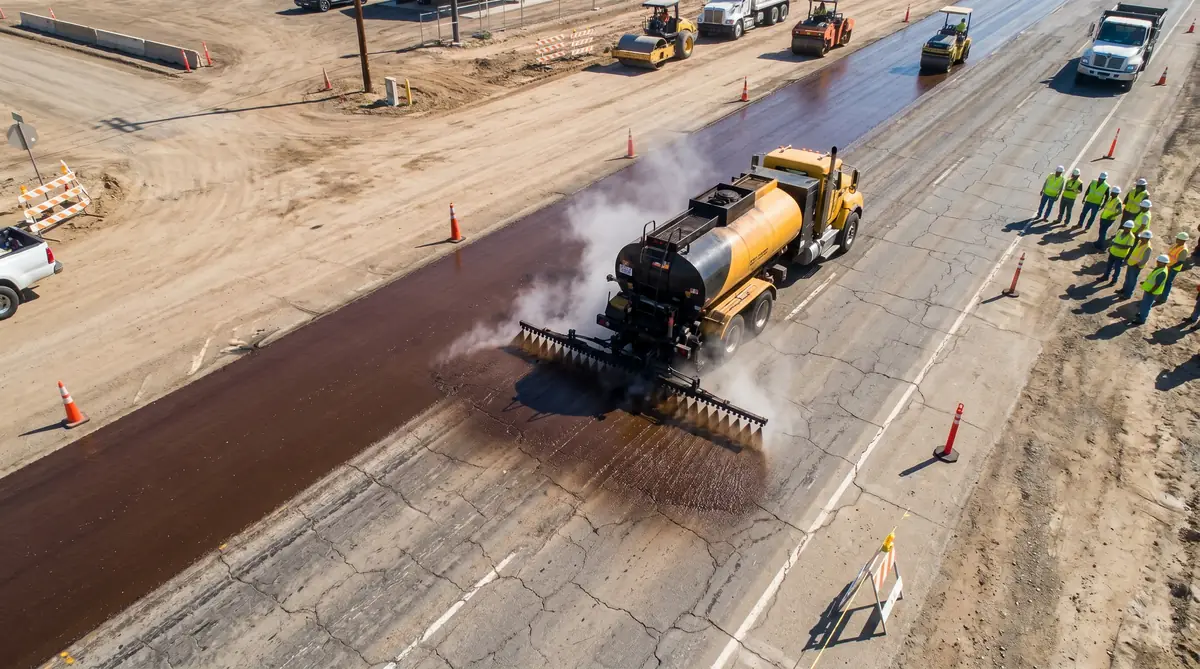
Tack coat is the least glamorous step in any paving project — a thin brown liquid sprayed on the existing surface before the paver rolls through. Most homeowners never see it, and some small contractors quietly skip it to save time. That's a mistake that shows up 2–5 years later as a delaminating overlay that slips, ripples, and breaks apart. This guide covers what tack coat is, which type to use, how much to apply, and what it costs.
Quick Answer
Tack coat is a diluted asphalt emulsion applied between pavement layers to bond them together. The most common type is CSS-1h diluted 1:1 with water, applied at 0.03–0.08 gallons per square yard (residual). It costs $0.05–$0.15/sq yd in materials and is included in contractor overlay quotes. Never skip it — delamination without tack coat is a matter of when, not if.
What Tack Coat Does
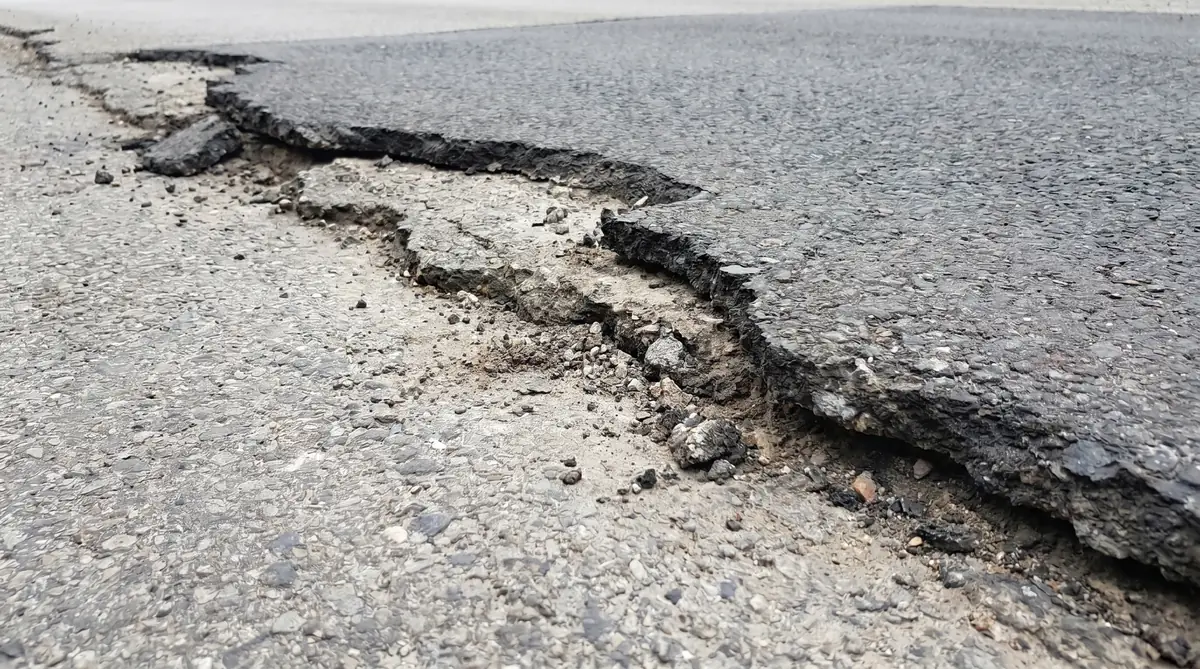
When you lay a new asphalt lift on top of an existing surface, the two layers need to be chemically and mechanically bonded — otherwise they behave as two independent slabs. Under repeated wheel loading, the upper layer begins to slip horizontally relative to the lower one. This creates slippage cracking (crescent-shaped cracks at the surface) and eventually full delamination where the overlay separates and can be peeled up by hand.
Tack coat solves this by:
- Wetting the existing surface and creating a tacky, adhesive interface
- Filling micro-voids in the existing surface to improve mechanical interlock
- Providing a thin layer of fresh binder that fuses with the bottom of the new lift during compaction
Tack Coat Material Types
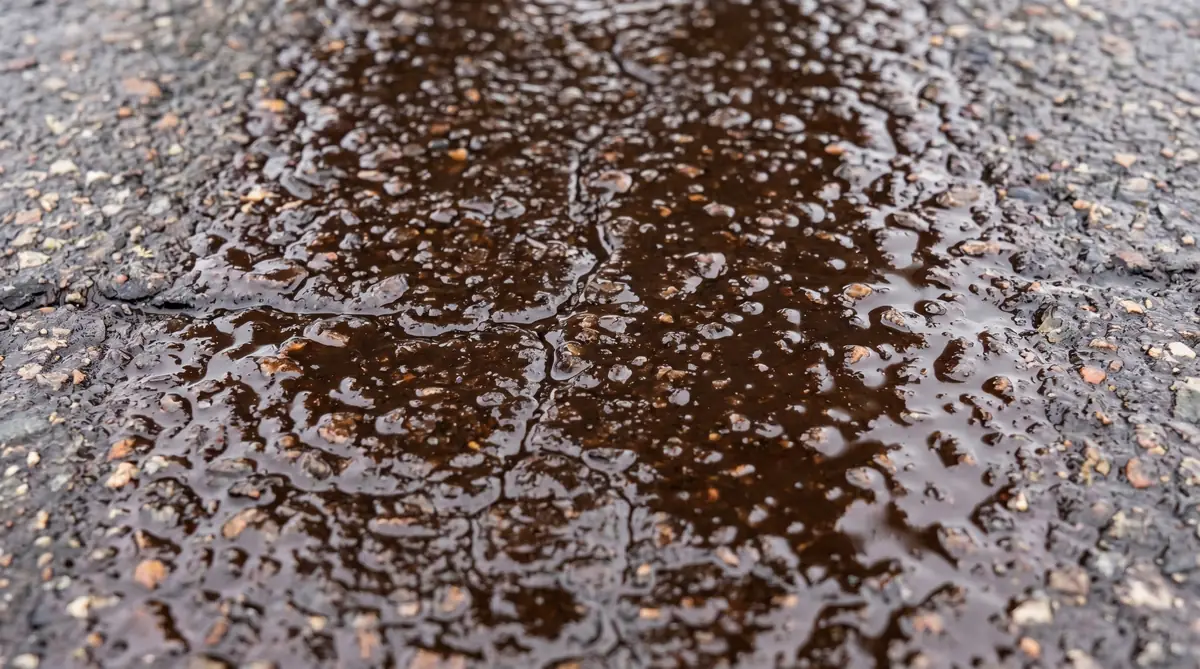
Tack coat is made from asphalt emulsion — asphalt binder dispersed in water with an emulsifying agent. Different grades have different set times and residual binder content.
| Type | Set Speed | Dilution | Best For |
|---|---|---|---|
| CSS-1h | Slow (60–90 min) | 1:1 with water | Standard overlay on existing asphalt — most common spec |
| CSS-1 | Slow (60–90 min) | 1:1 with water | Similar to CSS-1h, slightly softer binder grade |
| RS-1 | Rapid (15–30 min) | No dilution | When paving must proceed quickly after application |
| RS-2 | Rapid (10–20 min) | No dilution | High-traffic roads, fast-paced construction schedules |
| CRS-2 | Rapid (10–20 min) | No dilution | Cationic rapid-set — bonds well to aggregate-rich surfaces |
| Trackless tack | Very rapid (5–10 min) | No dilution | High-traffic areas where pickup on tires is a concern |
Application Rates by Surface Type
Application rate is expressed as gallons of residual asphalt per square yard — the binder remaining after the water in the emulsion evaporates. This is different from the applied (diluted) rate, which is typically double for CSS-1h diluted 1:1.
| Surface Type | Residual Rate (gal/sy) | Applied Rate CSS-1h (gal/sy) |
|---|---|---|
| Milled asphalt (rough texture) | 0.02–0.05 | 0.04–0.10 |
| Existing asphalt (smooth, aged) | 0.03–0.08 | 0.06–0.16 |
| New asphalt (between lifts) | 0.02–0.05 | 0.04–0.10 |
| Portland cement concrete | 0.05–0.10 | 0.10–0.20 |
| Primed granular base | 0.05–0.10 | 0.10–0.20 |
What Happens Without Tack Coat
Delamination is the primary failure mode. It typically progresses in three stages:
- Slippage cracking (Year 1–3): Crescent or half-moon shaped cracks appear at the surface where shear stress from braking and turning exceeds the bond strength between layers.
- Shoving and rutting (Year 2–5): The unbonded overlay begins to move laterally under wheel loads, creating visible humps and depressions — especially at intersections and brake points.
- Full delamination (Year 3–7): Large sections of the overlay crack and separate from the base. In severe cases the new layer can be manually lifted in slabs.
Repairing delaminated overlay means milling off the failed layer and repaving — a cost that far exceeds the tack coat that was skipped. For a complete picture of overlay costs, see our Asphalt Overlay Calculator.
How to Apply Tack Coat
Large projects — distributor truck
A bituminous distributor truck applies tack coat at a controlled rate via a spray bar. The operator sets the application rate (gal/sy), spray bar height, and truck speed — the machine handles uniform coverage across the full paving width. This is the standard method for any commercial or road paving job.
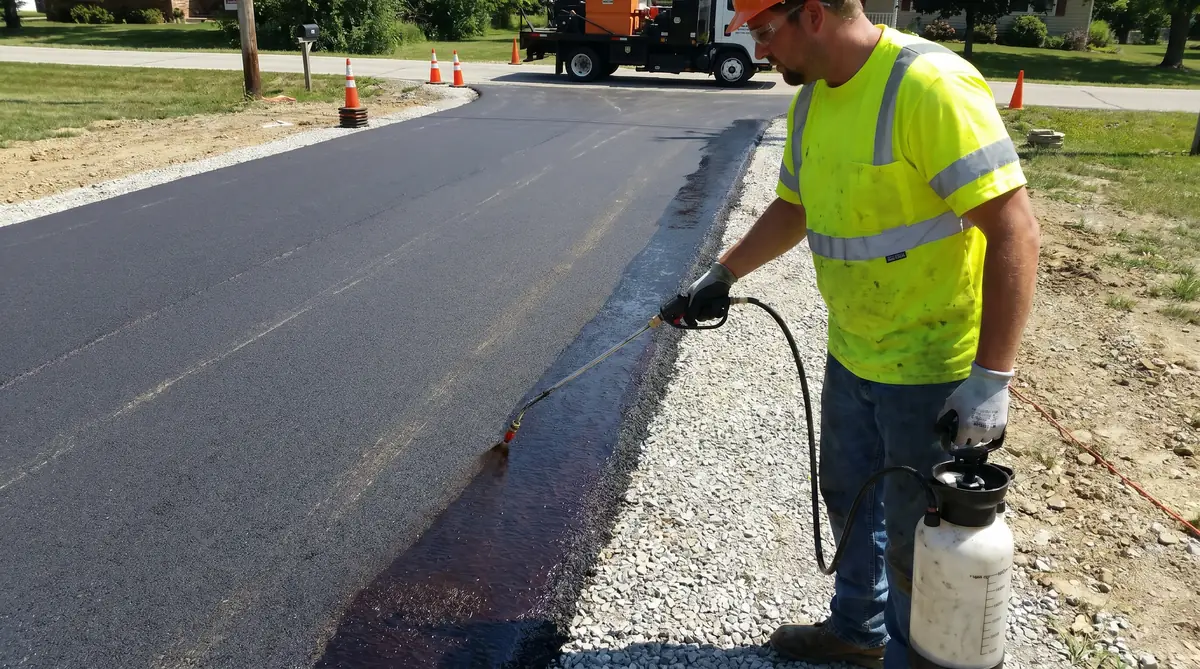
Small projects — hand wand or squeegee
For driveways and small patches, a hand-held spray wand connected to a small tank or a paint roller can apply diluted CSS-1h emulsion. Uniform coverage is harder to achieve manually — the goal is a thin, uniform brown coat with no pooling and no dry spots. For a typical driveway overlay, this takes 15–30 minutes.
Timing — when to pave after tack
CSS-1h emulsion breaks when it turns from brown to black — water has evaporated, leaving residual binder. This takes 30–90 minutes at 70°F. In cooler or humid weather it can take 2+ hours. Paving over unbroken (still brown) tack coat is a common mistake — the water in the emulsion steams under the hot mix, causing bubbling and a weak bond. Wait until fully black.
Tack Coat Cost
| Item | Cost | Notes |
|---|---|---|
| CSS-1h emulsion (bulk) | $0.40–$0.70/gallon | From asphalt plant or supplier |
| CSS-1h (small quantity) | $2–$5/gallon | Hardware store, 5-gallon pails |
| Material cost per sq yd | $0.03–$0.10/sy | At bulk rate, 0.06 gal/sy applied |
| Contractor application | $0.05–$0.20/sy | Included in overlay quote at this rate |
| Typical driveway (600 sy) | $30–$120 | Material only — negligible vs overlay cost |
Tack coat material adds less than 1–2% to a typical overlay project cost. Any contractor who skips it to "save money" is saving pennies while creating a liability. When reviewing overlay quotes, confirm tack coat application is explicitly included — use our Paving Cost Calculator to benchmark full project pricing.
Common Mistakes to Avoid
- Over-application: Too much tack coat creates a slip plane rather than a bond plane. Pooled emulsion under the new lift acts as a lubricant — the opposite of the intended effect. Stick to specified rates.
- Applying to a wet or dirty surface: Tack coat won't adhere to standing water or loose debris. The surface must be clean and dry. Blow out cracks and sweep before application.
- Paving over unbroken tack: Laying hot mix on still-brown (unbroken) emulsion steams the water out under heat, creating a weak, bubbly bond. Wait for full break.
- Tire pickup: If construction traffic drives over fresh tack before it breaks, it picks up the emulsion on tires and redistributes it unevenly — or strips it entirely. Use trackless tack or restrict traffic until break is complete.
- Skipping tack on concrete substrate: Asphalt over concrete requires higher application rates (0.05–0.10 gal/sy residual) than asphalt over asphalt. The smoother, non-porous concrete surface needs more binder to achieve adequate bond.
For the full context on what your contractor will use after applying tack coat, see our Asphalt Paving Machine guide and Hot Mix Asphalt Price Per Ton for 2026 material costs.
Frequently Asked Questions
What is asphalt tack coat?
A thin layer of diluted asphalt emulsion sprayed on an existing pavement surface before a new asphalt lift is laid. It bonds the two layers together, preventing delamination and slippage cracking under traffic. Required on all overlay and resurfacing projects.
What type of tack coat is most commonly used?
CSS-1h (Cationic Slow-Setting, grade 1h) diluted 1:1 with water is the most widely specified type in the U.S. for standard overlays. RS-2 and CRS-2 rapid-set emulsions are used on highway projects where the road must re-open quickly. Trackless tack is used in high-traffic areas to prevent emulsion pickup on vehicle tires.
How much tack coat do I need per square yard?
Residual rates: 0.02–0.05 gal/sy on milled asphalt, 0.03–0.08 gal/sy on existing asphalt, 0.05–0.10 gal/sy on concrete. For CSS-1h diluted 1:1, double these figures for the applied rate. Use our Tack Coat Calculator for exact quantities.
Can you skip tack coat on a driveway overlay?
You can, but you shouldn't. Skipping tack coat on a driveway overlay significantly increases delamination risk — especially at high-stress points like the apron and turning areas. It adds very little cost ($30–$120 for a typical driveway) and the difference in overlay longevity is significant: bonded overlays last 10–15 years; unbonded overlays often fail within 3–5.
How long does tack coat take to dry before paving?
CSS-1h breaks in 30–90 minutes at 70°F — it turns from brown to black when ready. RS-2 breaks in 10–30 minutes. Pave only after full break (uniformly black surface, no wet brown areas). Cold or humid weather extends break time significantly.