
Dowel Bars in Continuously Reinforced Concrete Pavement — Function, Specs & Installation (2026)
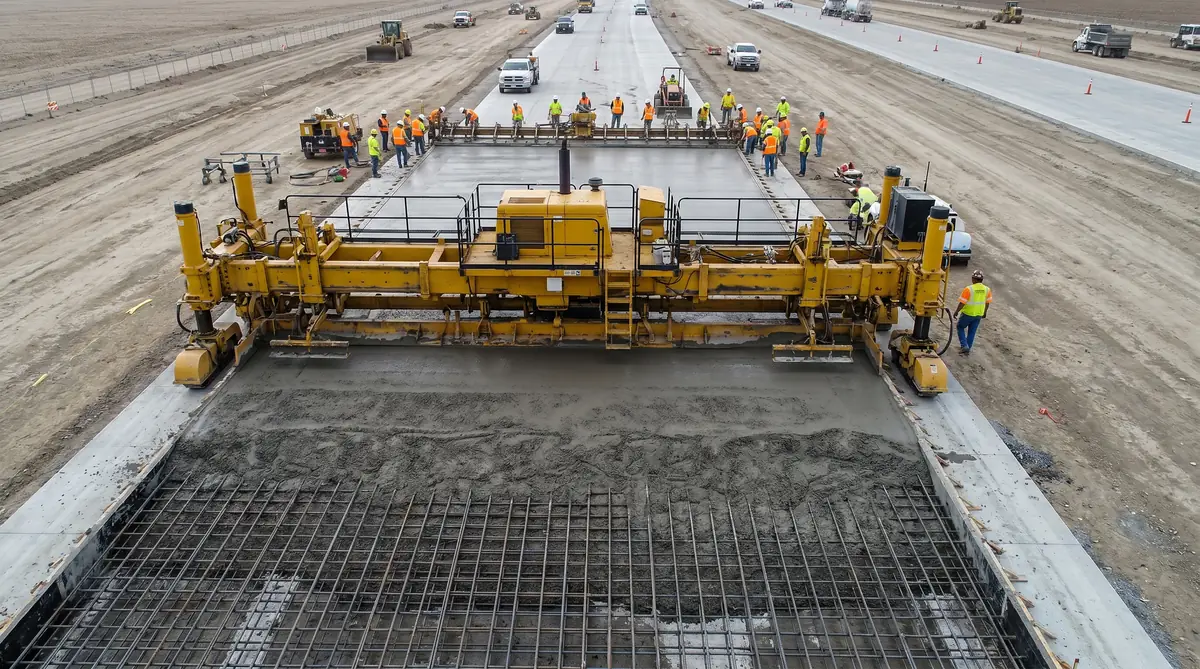
Do Dowel Bars Appear in CRCP?
CRCP does not use transverse joints across the full pavement length — so dowel bars are not needed for mid-slab load transfer. However, dowel bars are required at specific locations in every CRCP project: terminal joints where the slab ends at a bridge, intersection, or pavement type change, and at construction joints. At these discontinuities, dowels transfer vertical load across the gap while permitting controlled horizontal thermal movement.
What Is Continuously Reinforced Concrete Pavement (CRCP)?
Continuously reinforced concrete pavement (CRCP) is a rigid pavement design that eliminates transverse contraction joints along the mainline by using a continuous mat of longitudinal steel reinforcement — typically deformed rebar at 0.6–0.7% of the pavement cross-sectional area. Instead of sawcut joints, CRCP is allowed to crack naturally at close intervals (3–8 feet) as the concrete cures and contracts. The continuous rebar holds those cracks tightly closed, preventing faulting or spalling and maintaining structural integrity and load transfer without mechanical devices.
The result is a pavement type with no joints to seal, no joint faulting, and a longer service life than jointed pavement — typically 30–40 years on interstate highways before major rehabilitation. The tradeoff is higher initial cost and more complex terminal joint detailing. For a comparison of asphalt and concrete pavement types, see our asphaltic concrete guide.
CRCP vs JPCP — Key Differences
| Property | CRCP | JPCP (Jointed Plain) |
|---|---|---|
| Transverse joints | None (mainline) | Every 15–20 ft |
| Longitudinal steel | Continuous rebar (0.6–0.7% cross-section) | None or minimal |
| Dowel bars required | Terminal joints & construction joints only | Every transverse joint |
| Crack pattern | Regular tight cracks (3–8 ft spacing) | Controlled at sawcut joints |
| Joint maintenance | None — no mainline joints | Joint sealing every 5–10 years |
| Design life | 30–40 years (interstate) | 20–30 years |
| Ride quality | Excellent — no joint faulting | Degrades with faulting over time |
| Initial cost | Higher — steel cost | Lower |
| Repair complexity | Higher — full-depth repair required | Moderate |
Why Dowel Bars Are Not Used Along CRCP Mainline
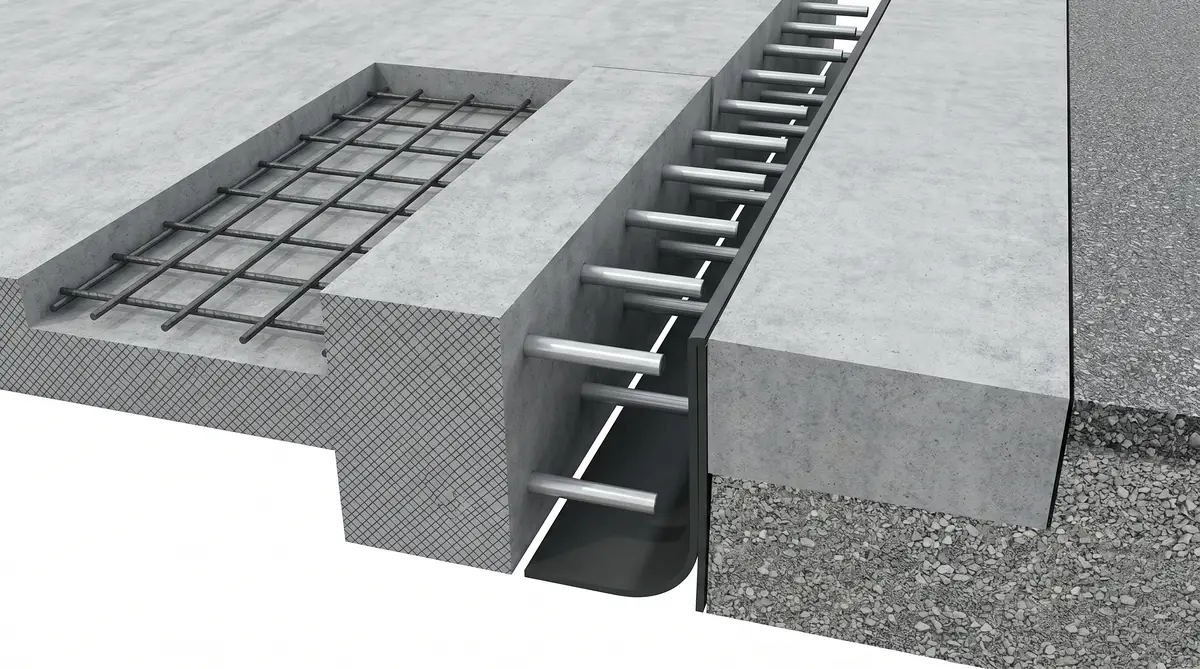
In jointed plain concrete pavement (JPCP), each transverse contraction joint is a potential faulting point — the slab on one side of a joint can deflect under load independently of the slab on the other side. Dowel bars are placed across every joint to provide load transfer: they prevent differential vertical deflection while allowing the slabs to expand and contract horizontally.
In CRCP, the continuous longitudinal rebar eliminates this problem entirely. Because the steel mat runs unbroken through the full pavement length, the closely-spaced natural cracks that form are held in aggregate interlock — the crack faces remain in tight contact and transfer vertical load through friction and interlock without any mechanical device. Dowels are therefore structurally unnecessary along the mainline.
Where Dowel Bars Are Used in CRCP
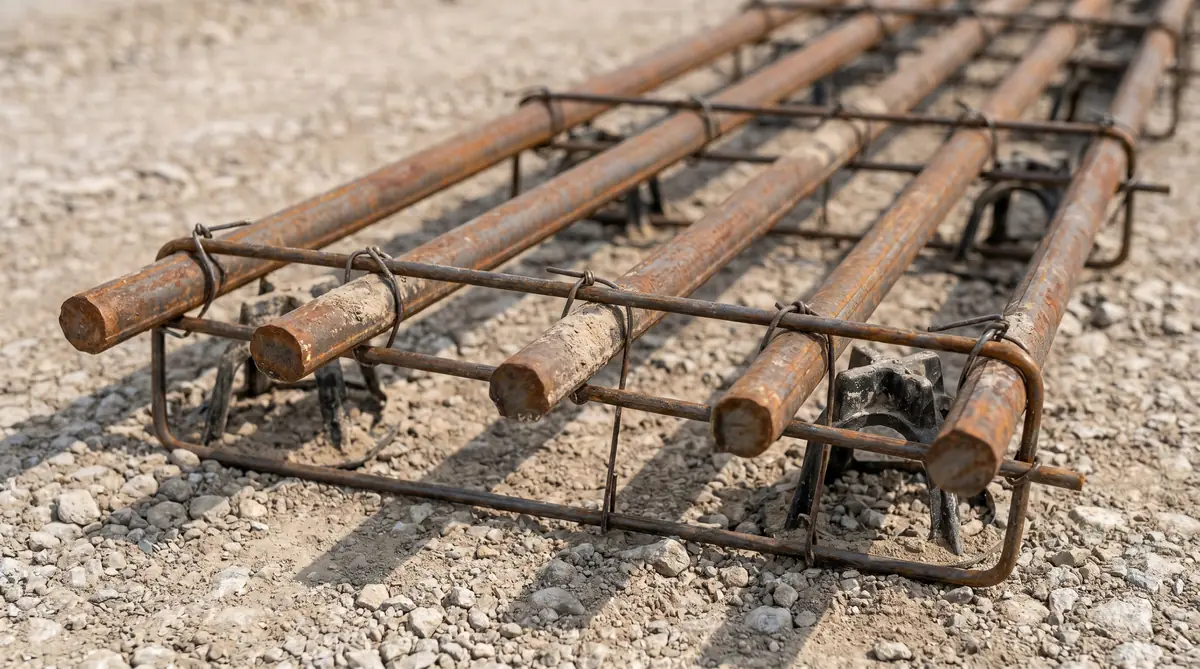
1. Terminal Joints
The most critical location for dowel bars in CRCP. A terminal joint is the engineered end-of-slab at locations where the CRCP must terminate — bridge approach slabs, major intersections, toll plazas, or transitions to a different pavement structure. The terminal joint must handle the concentrated stress from the free end of the continuously restrained slab, which tends toward upward curling and high-strain cycling.
Terminal joint design typically includes:
- A thickened slab end section (typically 1.5× normal slab thickness for 3–5 feet)
- Anchor bars or sleeper slabs to resist horizontal movement
- Dowel bars across the joint for vertical load transfer
- An expansion joint gap (typically 1–2 inches) to accommodate thermal growth
2. Construction Joints
When paving must stop and resume — end of day, equipment breakdown, planned interruption — a transverse construction joint is formed at the stopping point. Dowel bars are placed across this joint to restore load transfer continuity when paving resumes. Construction joint dowels follow the same specifications as JPCP joint dowels: smooth bar, one end bonded, one end lubricated with a plastic sleeve or bond-breaking compound.
3. Tie-In to JPCP or Flexible Pavement
Where CRCP transitions to a jointed concrete section or to flexible (asphalt) pavement, a carefully detailed transition joint prevents differential settlement and step formation at the interface. Dowel bars anchor into the CRCP end and project into the adjacent structure, providing load transfer across what would otherwise be a high-stress free edge.
Dowel Bar Specifications
| Parameter | Standard Specification | Notes |
|---|---|---|
| Diameter | 1/8 × slab thickness (min 1.0 in, typical 1.25–1.5 in) | 1.5 in for 12-in slabs; AASHTO T 253 |
| Length | 18 inches (450 mm) | Standard for most highway applications |
| Spacing | 12 inches (300 mm) on center | Across full lane width at joint |
| Placement depth | Mid-depth of slab (±1 in) | Critical — off-center placement causes lockup |
| Material — standard | Plain steel (ASTM A615 Gr. 60) | Interior / low-corrosion environments |
| Material — corrosive env. | Epoxy-coated (ASTM A775) or stainless (ASTM A955) | Snow belt, coastal, deicing salt exposure |
| Material — premium | GFRP (glass fiber reinforced polymer) | No corrosion, lighter, higher cost |
| Bond condition | One end bonded, one end free (lubricated or sleeved) | Free end allows horizontal thermal movement |
Dowel Bar Materials Compared
| Material | Corrosion Resistance | Cost vs Plain Steel | Best Use |
|---|---|---|---|
| Plain steel (A615) | Low | Baseline | Dry climates, no deicing salts |
| Epoxy-coated (A775) | Good | +15–25% | Standard snow belt / salt exposure |
| Stainless steel (A955) | Excellent | +200–400% | High-corrosion coastal / aggressive environments |
| GFRP composite | Excellent | +150–300% | Aggressive environments, bridge decks, premium projects |
| Galvanized steel | Good | +20–35% | Moderate corrosion risk, cost-sensitive |
Installation Methods
Basket Assembly (New Construction)
For new CRCP terminal joints and construction joints, dowel bars are pre-assembled into steel basket supports that hold each bar at the correct height (mid-slab depth), spacing (12 inches on center), and alignment (perpendicular to joint, parallel to pavement surface). The basket is placed on the sub-base before concrete is poured and the slip-form paver passes over it. The concrete encases the basket and bonds permanently to the bonded half of each bar.
Retrofit Dowel Bar Insertion (DBI)
On existing concrete pavements where faulting has developed and the original joints lacked dowels — or where dowels have corroded and failed — retrofit dowel bar insertion (DBI) restores load transfer without full-depth slab replacement. The process:
- Diamond saw slot cutting: Parallel slots are cut across the joint, sized to fit the dowel bar (typically 1.75 in wide × 2 in deep × 24 in long)
- Slot cleaning: Slots are sandblasted and air-blown to remove dust and loose concrete
- Bar insertion: Dowel bar (with sleeve on free end) is centered in the slot and held at mid-depth with support chairs
- Grout backfill: High-early-strength cementitious grout or rapid-set mortar is packed into the slot around the bar
- Surface restoration: Excess grout is struck flush with the slab surface and cured
- Diamond grinding: The joint area is diamond-ground to restore ride quality and remove faulting step
Common Failure Modes
- Dowel misalignment: Bars tilted out of parallel with the pavement surface or skewed transversely create binding as the slab moves thermally. Binding causes localized bearing stress that crushes the concrete around the bar — called "dowel lockup." Results in joint cracking, spalling, and eventually faulting. Placement tolerance is ±0.25 inch vertical and ±0.25 inch horizontal over the bar length.
- Corrosion expansion: In freeze-thaw and deicing salt environments, plain steel dowels corrode. Rust occupies greater volume than parent steel — the expansive pressure fractures the surrounding concrete, creating longitudinal "blowup" cracking along the joint. Epoxy-coated or stainless bars prevent this.
- Inadequate free end: If the lubricant or sleeve fails on the free end, the bar bonds to both sides of the joint. The slab cannot move thermally and high horizontal restraint forces build up, causing joint or slab cracking — known as "locked joint" failure.
- Under-depth placement: Bars placed significantly above or below mid-depth create eccentricity in load transfer — the effective load transfer capacity drops and the slab may punch through the concrete above or below the bar under heavy loads.
CRCP Terminal Joint Design Considerations
Terminal joints are the most maintenance-intensive location in any CRCP system. The free end of the continuously restrained slab wants to curl upward (thermal gradient curling) and translate horizontally (seasonal expansion/contraction). Both movements concentrate stress at the terminal joint, which is why terminal joint failures — punchouts, corner breaks, spalling — are the most common rehabilitation need on CRCP highways.
Key terminal joint design parameters per FHWA and AASHTO guidance:
- Thickened end: Slab thickness increased 50% over a 3–5 foot transition zone to absorb terminal stress
- Tie bars: Deformed rebar (not smooth dowels) at the anchor section to resist horizontal slab end movement
- Expansion gap: 1–2 inch compressible filler to allow seasonal thermal growth without slab buckling
- Drainage: Terminal joints must be sealed and drained — water infiltration at the free end accelerates subbase erosion and loss of support, the root cause of most terminal joint failures
- Sleeper slabs: Some designs use a separate footing-like concrete element beneath the terminal joint to prevent differential settlement between the CRCP end and the adjacent structure
Cost Context
| Item | Typical Cost Range (2026) |
|---|---|
| Plain steel dowel bar (1.5 in × 18 in) | $3–$6 per bar |
| Epoxy-coated dowel bar | $4–$8 per bar |
| Stainless steel dowel bar | $12–$25 per bar |
| GFRP dowel bar | $10–$20 per bar |
| Dowel bar basket (pre-assembled, per joint) | $80–$180 per joint (12-ft lane width) |
| Retrofit DBI (per joint, including grinding) | $400–$900 per joint |
| CRCP terminal joint construction (per each) | $8,000–$25,000 per terminal |
Frequently Asked Questions
Does CRCP use dowel bars?
Not along the mainline — the continuous rebar mat provides load transfer at natural cracks without dowels. Dowel bars are used only at terminal joints (slab ends at bridges and transitions), construction joints, and tie-ins to adjacent jointed pavement sections.
What is the function of a dowel bar?
Dowel bars transfer vertical shear load across a joint or crack without restricting horizontal thermal movement. One end bonds to the concrete; the other is lubricated or sleeved to slide freely. This prevents differential vertical deflection (faulting) at the joint face, which is the primary ride quality failure mode in jointed concrete pavement.
What size dowel bars are used in concrete pavement?
Standard diameter is 1/8 of the slab thickness — typically 1.25 inches for 9–10 inch slabs and 1.5 inches for 12-inch slabs. Standard length is 18 inches, placed at 12-inch spacing on center across the joint width.
What is a CRCP terminal joint?
The engineered end-of-slab where CRCP terminates at a bridge, intersection, or pavement transition. It includes a thickened slab end, anchor bars, expansion gap, and dowel bars to manage the concentrated stress at the free end of the continuously restrained slab — the most structurally demanding detail in CRCP design.
What causes dowel bar failure?
The three main causes are: misalignment (bar not parallel to pavement surface or to direction of movement — causes binding and concrete crushing), corrosion (plain steel in deicing salt environments — rust expansion fractures surrounding concrete), and locked free end (sleeve or lubricant failure — bar bonds both sides and slab cannot move thermally, causing cracking).