
Best Asphalt Crack Filler (2026) — Top 7 Products Ranked by Crack Type
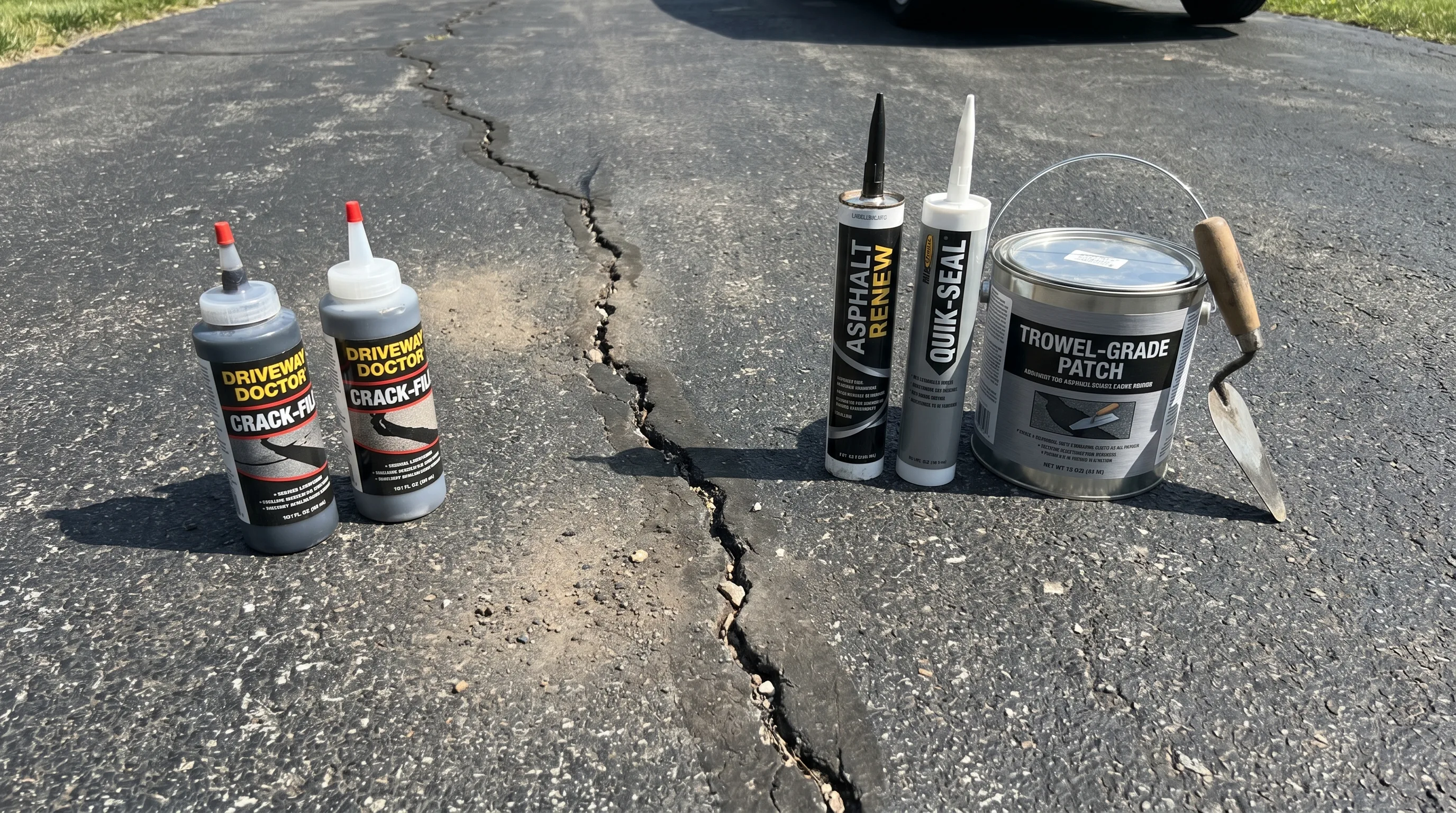
Quick Picks
Best Overall: Sikaflex 1A Self-Leveling Polyurethane — flows into irregular cracks, stays flexible through freeze-thaw cycles, lasts 3–5 years.
Best for Wide Cracks: Dalton PLI-STIX Hot-Applied Rope — permanent-type repair without a professional melter, driveable in 30 minutes.
Best for Hairline Cracks: Rust-Oleum EZ Squeeze Blacktop Crack Filler — no tools needed, pour and go.
Best Professional Grade: Crafco Polyflex Hot-Pour — 7–10 year lifespan, contractor standard for commercial pavements.
Crack Filler vs Crack Sealant — What's the Difference?
The terms are used interchangeably in stores, but they describe different material behaviors:
| Crack Filler | Crack Sealant | |
|---|---|---|
| Material | Semi-rigid asphalt emulsion or cold-pour liquid | Flexible polyurethane or rubberized asphalt |
| Movement | Rigid after cure — cracks with thermal movement | Remains flexible — moves with pavement expansion/contraction |
| Lifespan | 1–3 years typical | 3–7 years typical |
| Best for | Narrow hairline cracks in stable pavements | Any crack — especially in cold climates with freeze-thaw cycling |
| Examples | Gardner Drive-Maxx, Rust-Oleum EZ Squeeze | Sikaflex 1A, Quikrete Non-Sag, Crafco Polyflex |
For most residential driveways — especially in cold-climate states — a flexible crack sealant is worth the small price premium over a rigid filler. Rigid fillers often crack themselves within one or two freeze-thaw cycles.
Identify Your Crack Type First
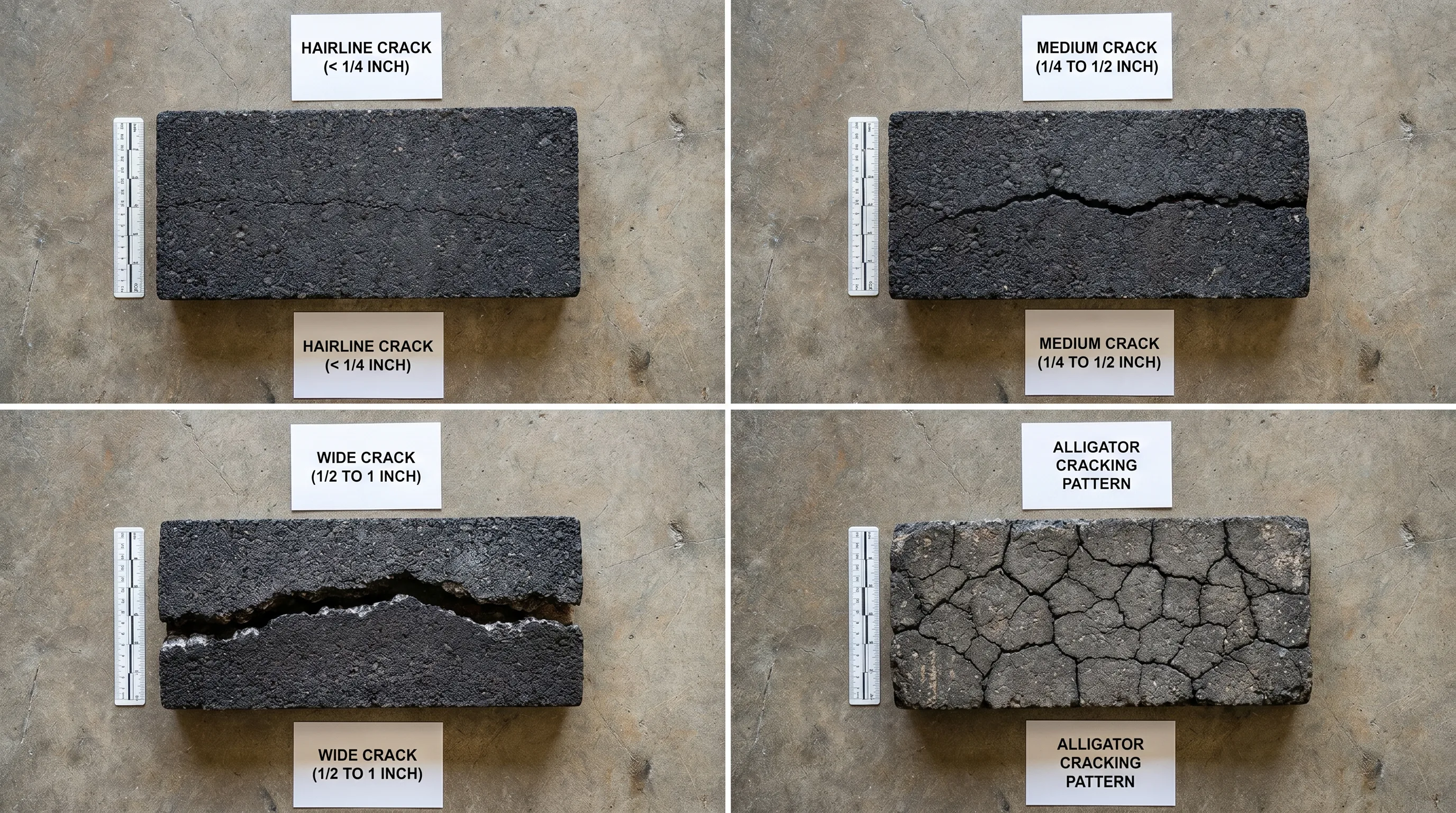
| Crack Type | Width | Typical Cause | Fillable? | Best Product Type |
|---|---|---|---|---|
| Hairline | < 1/8" | UV oxidation, surface aging | Yes | Liquid cold-pour (squeeze bottle) |
| Medium | 1/8"–1/2" | Thermal cycling, light traffic | Yes | Self-leveling polyurethane sealant |
| Wide | 1/2"–1" | Settlement, heavy load, drainage | Yes + backer rod | Non-sag sealant or PLI-STIX hot rope |
| Edge cracks | Varies | Edge loading, lack of support | Yes | Non-sag sealant + backer rod |
| Longitudinal | Long linear | Reflective cracking from base joints | Yes | PLI-STIX or professional hot-pour |
| Alligator / fatigue | Interconnected pattern | Base failure, structural weakness | No | Full-depth patch or reconstruction required |
Crack Filler Types Compared
| Type | Application | Best Crack Width | Dry Time | Lifespan | Cost / LF |
|---|---|---|---|---|---|
| Cold-pour liquid | Squeeze bottle, pour | Up to 1/2" | 24–48 hrs | 1–3 years | $0.20–$0.50 |
| Cold-pour polyurethane sealant | Caulk gun | 1/8"–1" | 24–72 hrs | 3–5 years | $0.50–$1.50 |
| Hot-applied rope (PLI-STIX) | Propane torch | 3/8"–3/4" | 30 min | 5–8 years | $0.80–$1.20 |
| Trowel-grade compound | Trowel / putty knife | 1"+ or surface voids | 24–48 hrs | 2–4 years | $1.00–$2.50 |
| Hot-pour professional | Melter machine | Any width | 30–60 min | 7–10 years | $0.30–$0.80 (materials) |
Top 7 Best Asphalt Crack Fillers (2026)
Sikaflex 1A Self-Leveling Polyurethane Sealant
Single-component polyurethane — flows in, bonds tight, stays flexible through freeze-thaw
Sikaflex 1A is the benchmark for residential crack sealing. As a single-component moisture-curing polyurethane, it self-levels into the crack without tooling on flat surfaces — you just cut the tip and pour it in. It cures to a firm but flexible rubbery bead that won't crack with thermal movement, making it the top choice for cold-climate driveways where rigid fillers repeatedly fail. Widely available at Home Depot and Lowe's.
Pros
- Self-leveling — no tooling on flat cracks
- Stays flexible through freeze-thaw
- Excellent adhesion to asphalt and concrete
- Paintable and sealcoatable after cure
- Widely available at big-box stores
Cons
- Will sag on slopes — use non-sag version
- Requires 24–72 hrs cure before sealing over
- Gray color, not black — visible until sealcoated
Dalton Enterprises PLI-STIX Asphalt & Concrete Crack Filler
Hot-applied rope product — torch-melted into wide cracks for near-permanent results without a professional melter
PLI-STIX is the closest thing to a professional hot-pour repair available to DIYers. You press the flexible rubberized rope into the crack and melt it in place with a standard propane torch — the rope liquefies, flows into the crack, and bonds to the crack walls as it cools. Driveable within 30 minutes. The result is a rubberized, flexible seal that significantly outlasts any cold-pour product on wide or longitudinal cracks.
Pros
- Best lifespan for DIY — 5–8 years
- Driveable in 30 min after application
- Black color blends with asphalt
- Works in cooler temps (above 40°F)
- Excellent for wide or longitudinal cracks
Cons
- Requires propane torch — added cost/step
- Less effective on cracks narrower than 3/8"
- Takes practice to apply evenly
Quikrete Polyurethane Non-Sag Sealant
Non-sag polyurethane sealant for cracks on slopes and edges where self-leveling products run
If your driveway slopes toward the street or garage, self-leveling sealants like Sikaflex 1A will run before they cure. Quikrete's non-sag polyurethane is formulated to stay in place when applied on inclines and vertical crack faces. Applied with a standard caulk gun, it tooled smooth with a putty knife or gloved finger. Same polyurethane flexibility and adhesion as Sikaflex — just engineered to stay put.
Pros
- Stays put on slopes — won't sag or run
- Flexible polyurethane — won't crack in freeze-thaw
- Standard caulk gun application
- Available at most hardware stores
Cons
- Requires tooling — doesn't self-level
- Gray color until sealcoated over
- Smaller tube — more tubes for big jobs
Rust-Oleum EZ Squeeze Blacktop Crack Filler
Ready-to-use squeeze bottle — no tools, no mixing, pour directly into narrow cracks
For homeowners dealing with scattered hairline and fine cracks on a relatively sound driveway, Rust-Oleum's EZ Squeeze is the fastest, easiest option on the market. No caulk gun, no torch, no mixing — just squeeze the bottle, fill the crack, wipe flush, and you're done. The rubberized asphalt formula dries black and blends well with most driveways. Best used as an annual maintenance fill before sealcoating, not as a permanent repair on wider cracks.
Pros
- Zero tools required
- Dries black — matches asphalt color
- Affordable, widely available
- Good for quick annual touch-ups
Cons
- Not suitable for cracks wider than 1/2"
- Shorter lifespan — rigid, not flexible
- May need re-filling after first winter
Gardner Drive-Maxx 10 Blacktop Crack Filler
Budget liquid asphalt filler — lowest cost per linear foot for light cracking on large driveways
Gardner Drive-Maxx is the volume option when you have a lot of light cracking to cover across a large driveway or parking area. At $8–$12 per bottle covering roughly 25–30 linear feet of hairline cracks, it's the lowest cost per linear foot of any product on this list. Performance is adequate for mild-climate areas with minimal freeze-thaw cycling — in cold climates, the rigid formula will re-crack more quickly and you're better off spending more on polyurethane.
Pros
- Lowest cost per linear foot
- Good coverage on hairline/narrow cracks
- Easy squeeze-bottle application
- Widely available at hardware stores
Cons
- Shortest lifespan — re-cracks in cold climates
- Not suitable for wide cracks
- Semi-rigid — no freeze-thaw flexibility
Latex-ite Trowel Patch Driveway Filler
Trowel-grade rubberized compound for wide cracks, surface spalls, and edge voids over 1 inch
When the damage exceeds what a caulk gun can handle — spalls, surface pop-outs, wide edge breaks, or cracks over an inch — Latex-ite Trowel Patch is the go-to. Applied with a putty knife or margin trowel, it fills irregular voids cleanly and sands or scrapes flush after curing. It's not a structural repair (it won't fix base failure), but for cosmetic restoration of surface-level damage it produces a clean result that sealcoats well.
Pros
- Handles wide cracks and surface voids
- Sealcoatable after cure
- Good adhesion to prepared asphalt
- Available at Home Depot / Lowe's
Cons
- Requires trowel and more surface prep
- Shorter lifespan in freeze-thaw climates
- Not suitable for narrow cracks
Crafco Polyflex Type 3 Hot-Applied Crack Sealant
Commercial hot-pour rubber sealant — contractor standard for roads, parking lots, and large driveways
Crafco Polyflex is the product that highway crews and commercial paving contractors use for crack sealing — applied at 380–400°F through a melter/applicator, it flows perfectly into any crack width and bonds permanently to crack walls. As a DIY option it requires renting a hot-pour applicator ($150–$300/day) or melter trailer, which only makes sense for large jobs with significant cracking. For a contractor bidding your driveway, specifying hot-pour application is a meaningful quality upgrade.
Pros
- Longest lifespan — 7–10 years
- Driveable in 30–60 min
- Works on any crack width
- Industry standard — proven performance
Cons
- Requires melter machine — not true DIY
- High upfront equipment cost to rent
- Best left to contractors for most homeowners
Best Crack Filler by Use Case
| Your Situation | Best Pick | Why |
|---|---|---|
| Hairline cracks, flat driveway, warm climate | Rust-Oleum EZ Squeeze | Easiest application, lowest cost, adequate for minimal movement |
| Medium cracks (1/8"–1/2"), cold climate | Sikaflex 1A Self-Leveling | Flexible polyurethane survives freeze-thaw, self-levels, no tooling |
| Sloped driveway, any crack width | Quikrete Non-Sag Sealant | Won't run before curing — stays in place on inclines |
| Wide cracks (1/2"–1"), want long-lasting DIY | Dalton PLI-STIX | Hot-applied rope, 5–8 year lifespan, no melter machine needed |
| Large spalls, voids, or edge breaks | Latex-ite Trowel Patch | Trowel-grade compound fills irregular shapes and large voids |
| Budget — large area, light cracking | Gardner Drive-Maxx | Lowest cost per linear foot for cosmetic touch-ups |
| Commercial property or large residential | Crafco Polyflex (contractor) | Hot-pour 7–10 year seal — best ROI on large crack volume |
| Filling cracks before sealcoating | Sikaflex 1A or Quikrete | Fully flexible before sealer goes over — won't re-crack through the sealcoat |
Backer Rod — When and How to Use It
Backer rod is closed-cell polyethylene foam rope pressed into the crack before sealant to control fill depth. Without it on wide cracks, you waste product filling a bottomless void and the repair sinks below the surface. Use backer rod on any crack deeper than 1/2 inch and wider than 1/2 inch.
| Crack Width | Backer Rod Diameter | Target Sealant Depth |
|---|---|---|
| 1/4"–3/8" | 1/2" | 1/4" below surface |
| 1/2"–5/8" | 3/4" | 3/8" below surface |
| 3/4"–1" | 1" | 3/8"–1/2" below surface |
| 1"–1.5" | 1-1/4" to 1-1/2" | 1/2" below surface |
How to Fill Asphalt Cracks — Step-by-Step
-
1
Assess crack width and depth
Use a putty knife or screwdriver to probe depth. Classify as hairline (<1/8"), medium (1/8"–1/2"), wide (1/2"–1"), or structural. Rule out alligator cracking — if the crack pattern is interconnected, stop and consult a paving contractor about a base repair.
-
2
Clean the crack
Remove all loose debris, sand, and vegetation with a stiff wire brush or compressed air (blower, compressor, or air can). The crack must be dry and free of standing water. For dirty cracks with embedded debris, use a heat gun or torch carefully to blow out moisture and soften hardened asphalt edges.
-
3
Install backer rod (if needed)
For cracks deeper than 1/2 inch and wider than 1/2 inch, press the appropriately sized backer rod into the crack with a putty knife or roller. Target depth: 1/4"–1/2" below the pavement surface. The backer rod prevents the sealant from being wasted filling an excessively deep void.
-
4
Apply crack filler
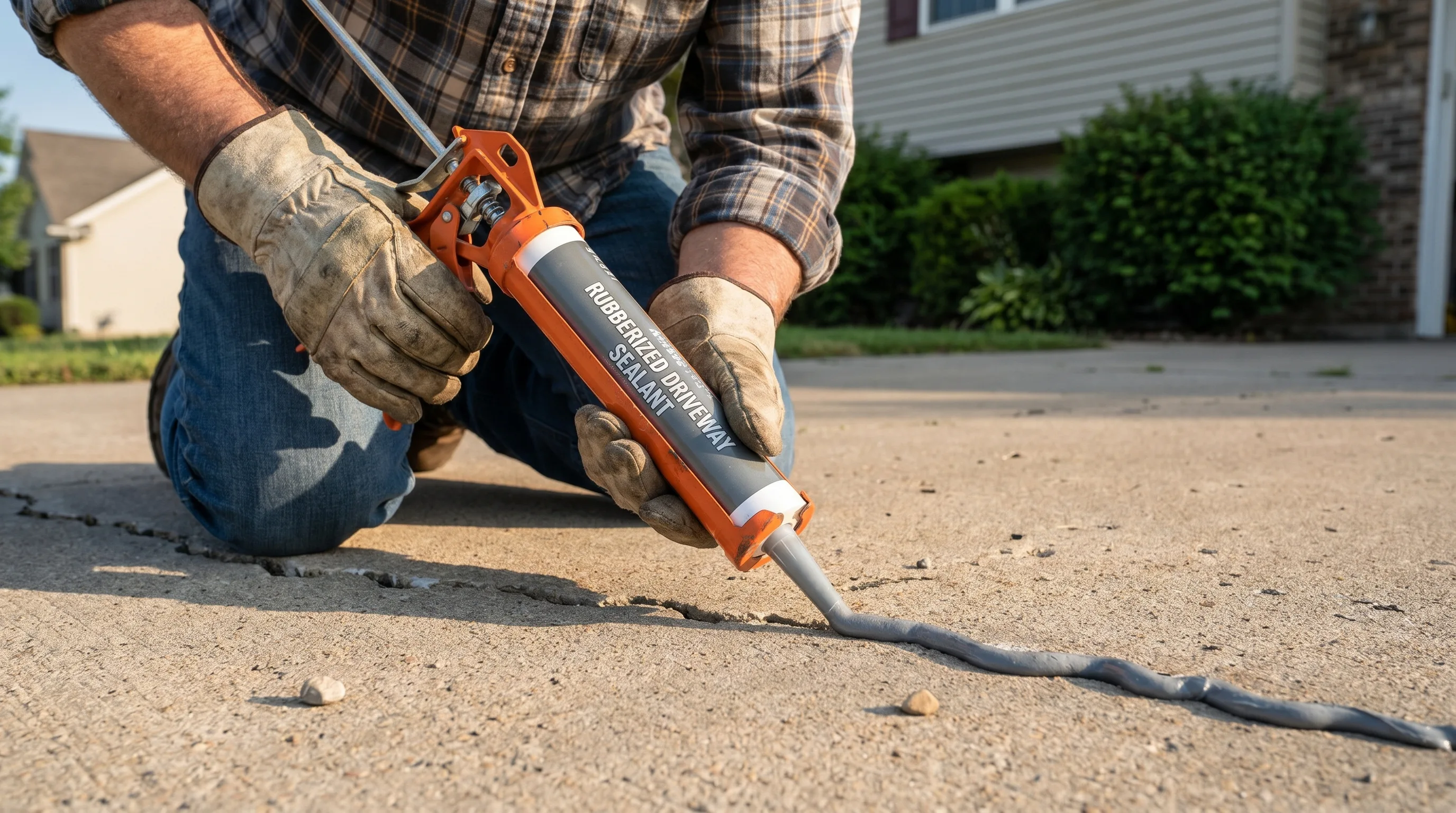
For liquid cold-pour: pour slowly from the bottle, slightly overfilling. For caulk-gun sealant: apply in a steady bead, slightly proud of the surface. For PLI-STIX: press rope into crack, torch-melt until flowing, then move on. Fill in sections — don't try to run the entire crack in one pass on wide cracks.
-
5
Tool the surface flush
Use a putty knife, margin trowel, or gloved finger to smooth the bead flush with or slightly below the pavement surface. A joint that is proud (above the surface) collects water, peels, and becomes a trip hazard. PLI-STIX self-levels during torch application — wipe with a gloved hand while still warm if needed.
-
6
Allow full cure before traffic
Cold-pour products: 24–48 hours minimum for foot traffic, 48–72 hours for vehicles. Polyurethane sealants: 24–48 hours for vehicles. PLI-STIX: 30 minutes. Do not drive over uncured filler — it will displace and create a worse void than the original crack.
-
7
Re-inspect and top-fill if shrunken
After full cure (24–72 hours), check each repair. Cold-pour products often shrink slightly as solvent evaporates. Top-fill any recessed spots with a second thin pass. Once flush and cured, the surface is ready to sealcoat — wait the product's stated cure time before applying sealer over the top.
DIY vs Professional Crack Filling
| DIY | Professional | |
|---|---|---|
| Small job (5–10 cracks) | $25–$60 | $150–$350 |
| Medium driveway (10–25 cracks) | $60–$150 | $300–$600 |
| Large / heavily cracked | $100–$250 | $500–$1,500 |
| Time required | 2–4 hours | 1–2 hours |
| Product lifespan (typical) | 1–5 years depending on product | 5–10 years (hot-pour standard) |
| Best for | Light cracking, maintenance fills, warm climates | Heavy cracking, cold climates, commercial properties |
- Filling alligator cracks — the interconnected pattern means base failure; filling individual cracks is cosmetic and won't stop deterioration.
- Applying in rain or cold — below 50°F, cold-pour products won't bond. Rain washes uncured sealant out of the crack entirely.
- Overfilling — a proud joint traps water, peels, and becomes a trip hazard. Keep the bead flush or slightly recessed.
- Sealcoating too soon — applying sealer before filler is fully cured traps moisture and causes adhesion failure on both products.
- Skipping backer rod on deep cracks — you'll waste an entire tube of sealant filling a void that a $2 piece of backer rod would have solved.
Frequently Asked Questions
What is the best asphalt crack filler?
Sikaflex 1A Self-Leveling Polyurethane is the best overall — it flows into irregular cracks without tooling, stays flexible through freeze-thaw cycles, and lasts 3–5 years. For wide cracks where you want DIY-friendly near-permanent results, Dalton PLI-STIX hot rope is the better pick. For hairline cracks on a flat driveway in a mild climate, Rust-Oleum EZ Squeeze is the fastest and easiest option.
What is the difference between asphalt crack filler and crack sealant?
Crack filler is typically a semi-rigid cold-pour compound that fills the void but may crack with thermal movement. Crack sealant is a flexible polyurethane or rubberized compound that moves with the pavement through expansion and contraction. For cold-climate driveways, always choose a flexible sealant — rigid fillers re-crack within one or two winters and require re-filling annually.
How wide a crack can you fill with cold-pour filler?
Cold-pour squeeze-bottle products handle cracks up to 1/2 inch wide. For cracks 1/2–1 inch, use a caulk-gun polyurethane sealant with backer rod. For cracks wider than 1 inch, use trowel-grade compound or hot-pour. Never try to bridge a crack wider than the product's rated maximum — the repair will sink, crack, or pull away from the walls.
How long does asphalt crack filler last?
Cold-pour liquid: 1–3 years. Polyurethane cold-pour sealant: 3–5 years. PLI-STIX hot rope: 5–8 years. Professional hot-pour: 7–10 years. Cold climates with significant freeze-thaw cycling reduce lifespan by 20–40% across all product types. The best way to extend any repair is to sealcoat over the filled cracks once fully cured.
Can you fill asphalt cracks in cold weather?
Cold-pour products require a minimum of 50°F — below that temperature, they won't bond to crack walls and will pull out in the first freeze. PLI-STIX hot rope works down to around 40°F because the torch heats the joint locally. Professional hot-pour equipment works down to 35–40°F. The best practice is to fill cracks in early fall before temperatures drop consistently below 50°F.
Do I need to use a backer rod for asphalt crack filling?
Yes, for any crack deeper than 1/2 inch and wider than 1/2 inch. Backer rod (foam rope pressed into the crack) creates a floor for the sealant so you're not filling a bottomless void. Without it, the sealant sinks, uses 3–5x more product, and still leaves a void above it that traps water. Size the rod one diameter larger than the crack width so it stays compressed in place.
How soon can you drive on a filled asphalt crack?
Cold-pour liquid: wait 48–72 hours for vehicle traffic. Polyurethane sealant: 24–48 hours. PLI-STIX hot rope: 30 minutes after cooling. Professional hot-pour: 30–60 minutes. Driving on uncured filler displaces it and creates a worse void. When in doubt, wait longer — the temperature and humidity on the day of application significantly affect actual cure time.
Can you apply asphalt sealer over crack filler?
Yes — and it's recommended. Sealcoating over filled cracks locks in the repair and protects it from UV and water. But only after the filler is fully cured — at minimum 24 hours, preferably 48–72 hours for cold-pour products. Applying sealer too soon traps moisture and causes adhesion failure on both the filler and the sealer coat. The sequence is always: fill cracks → cure fully → sealcoat.