
Full Depth Recycling Asphalt Train — How FDR Works, Equipment, Cost & When to Use It (2026)
Quick Answer
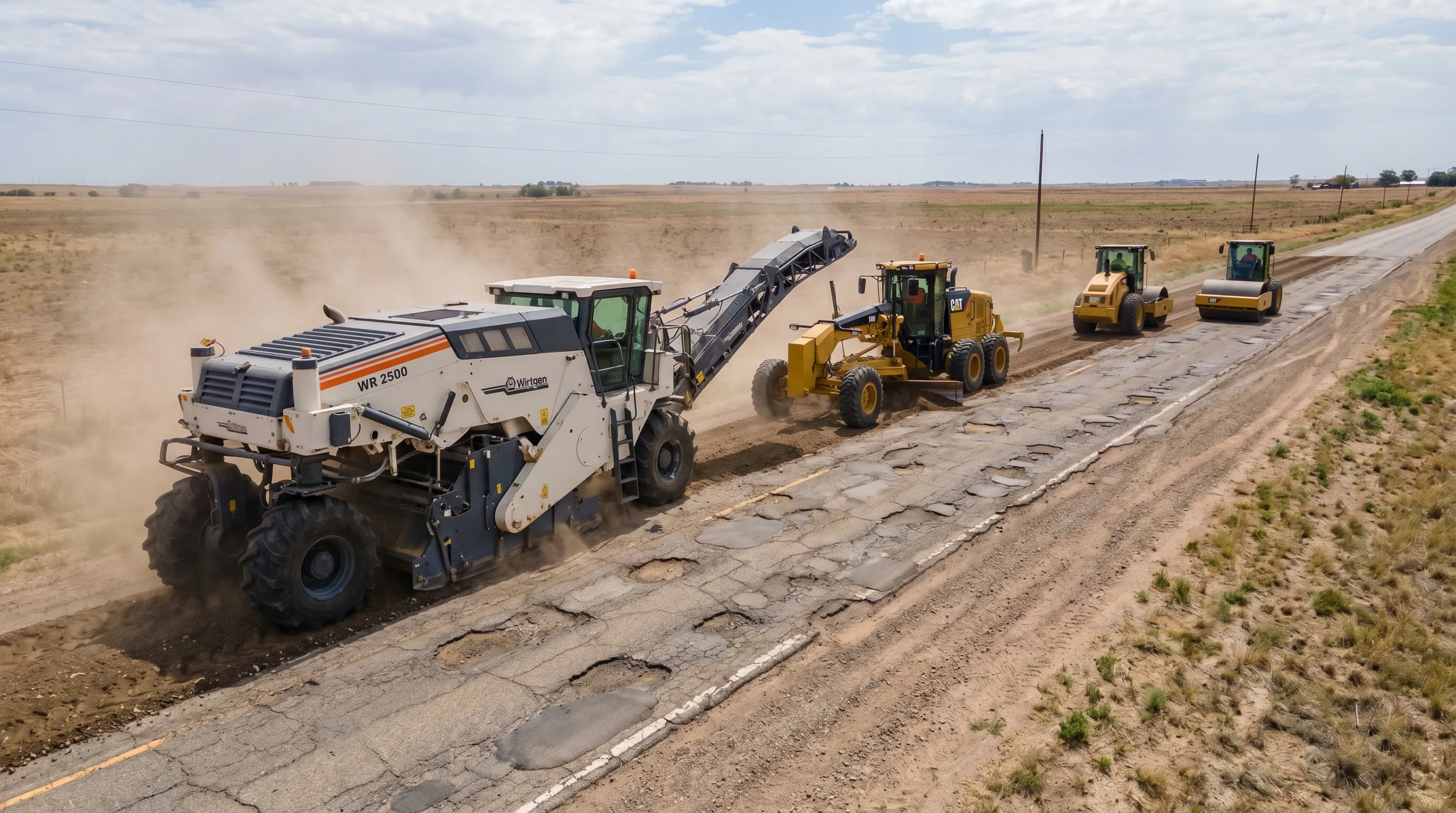
A full depth recycling asphalt train is a convoy of coordinated equipment that performs full depth reclamation (FDR) in a single continuous pass — pulverizing existing asphalt and base to 6–12 inches, adding a stabilizing agent, and recompacting as a new structural base. All-in cost: $12–$28/sq yd vs $35–$80/sq yd for full reconstruction — a 50–70% savings while recycling 100% of existing material on-site.
What Is Full Depth Reclamation (FDR)?
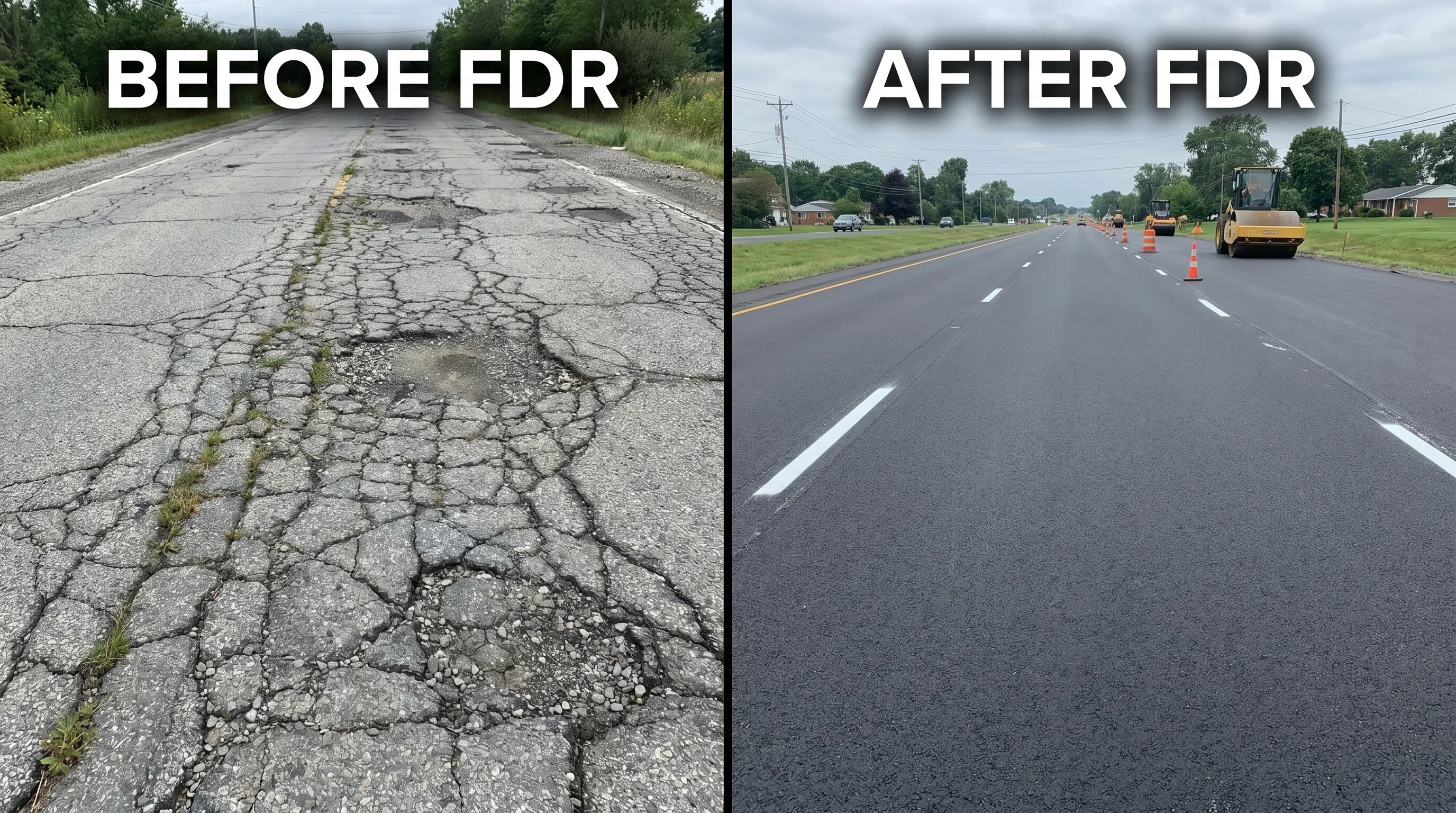
Full depth reclamation is a pavement rehabilitation technique that treats the root cause of road failure — deteriorated base — rather than simply overlaying the damaged surface. Where mill-and-overlay only addresses the top 1.5–3 inches of asphalt, FDR pulverizes the entire existing pavement structure (asphalt layer plus underlying aggregate base) to a specified depth of 6–12 inches, mixes the material with a stabilizing agent in-place, and recompacts it to form a new, stronger structural base layer.
The result is a recycled base that is often stronger than the original construction. A new 1.5–3 inch asphalt overlay is then placed on top, producing a fully rehabilitated road at a fraction of reconstruction cost. Because all work is done in-place, FDR eliminates the truck traffic, disposal costs, and material procurement associated with conventional reconstruction.
The Full Depth Recycling Asphalt Train — Equipment Sequence
The term "train" refers to the coordinated convoy of machines that move forward together in sequence, each performing a discrete step in the FDR process. A typical full depth recycling asphalt train runs in this order:
| Equipment | Function | Key Spec | Notes |
|---|---|---|---|
| Water truck (1–2) | Pre-wet pavement; supply water to reclaimer injection system | 2,000–4,000 gal capacity | Water controls dust and optimizes compaction moisture content |
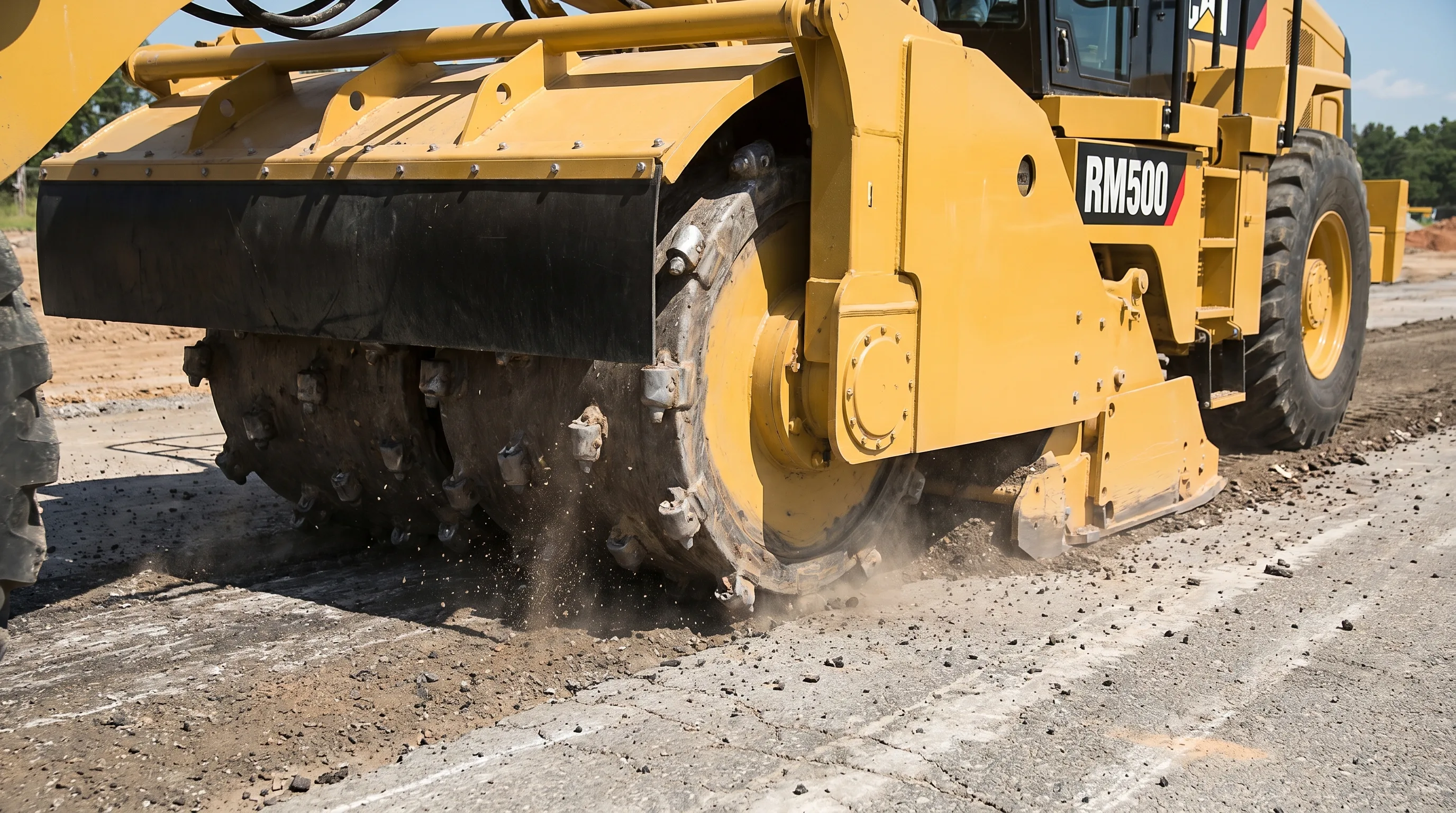
| Reclaimer / stabilizer | Pulverizes asphalt + base to specified depth using rotating drum | 7–12 ft cutting width; 6–18 in depth | Wirtgen WR series, Caterpillar RM series, Bomag MPH series are the main machines |
| Stabilizing agent spreader | Distributes dry agent (cement, lime, fly ash) ahead of reclaimer or after first pass | Application rate 2–15% by weight | Dry agent pre-spread or liquid agent injected directly into reclaimer drum via separate manifold |
| Motor grader | Shapes recycled material to design cross-section and grade | 14–16 ft blade | Sets crown, superelevation, and transitions; 2–3 passes typical |
| Vibratory roller | Initial compaction — achieves 95%+ of modified Proctor density | 10–15 ton, padfoot or smooth drum | 4–6 passes at 3–5 mph; direction alternates |
| Pneumatic tire roller | Final densification through kneading action; seals surface | 25–35 ton ballasted | Kneading closes surface voids; critical for cement-treated layers to prevent shrinkage cracking |
FDR vs Alternative Rehabilitation Methods
| Method | Depth Treated | Cost / Sq Yd | Best When | Material Reuse | Traffic Disruption |
|---|---|---|---|---|---|
| Full depth recycling (FDR) | 6–12 inches | $12–$28 | Base failure, alligator cracking >30% | 100% on-site | 1–5 days per section |
| Mill and overlay | 1.5–3 inches | $8–$18 | Surface distress, sound base | RAP hauled off-site | 1–2 days |
| Cold in-place recycling (CIR) | 3–5 inches | $6–$14 | Asphalt failure, sound base | 100% on-site | 1–2 days |
| Full reconstruction | 12–24 inches | $35–$80 | Subgrade failure, utility work needed | None (all hauled) | 2–6 weeks |
| Crack seal + overlay | Surface only | $4–$10 | PCI >55, light cracking only | None | Hours |
Stabilizing Agents — Types & Selection
The stabilizing agent added during FDR determines the structural properties of the recycled base. Agent selection depends on the existing material's gradation, plasticity index (PI), and moisture sensitivity.
| Agent | Application Rate | Strength Gain | Best Soil Type | Cost / Ton Applied | Notes |
|---|---|---|---|---|---|
| Portland cement | 2–5% by dry weight | 7–28 days | Most soil types; best for granular | $80–$140/ton | Most common; rigid result; requires curing before overlay |
| Fly ash (Class C) | 10–18% by dry weight | 14–90 days | Clayey soils; high PI materials | $30–$70/ton | Self-cementing; slower strength; often combined with lime |
| Hydrated lime | 3–6% by dry weight | 7–90 days | High-plasticity clays (PI >12) | $120–$200/ton | Reduces plasticity permanently; excellent for clay subgrade stabilization |
| Asphalt emulsion | 2–4% by weight | 3–7 days | Granular, low PI materials | $60–$100/ton | Flexible result; open to traffic sooner; lower unconfined strength |
| Foamed asphalt | 2–3% by weight | 3–7 days | Granular and semi-granular | $50–$90/ton | Hot asphalt injected into drum; no cure wait; excellent performance |
| Cement + emulsion blend | 1.5% cement + 2% emulsion | 7–14 days | Variable/mixed materials | $70–$120/ton blended | Combines rigid and flexible properties; reduces shrinkage cracking |
Treatment Depth Selection Guide
| Pavement Condition | Recommended FDR Depth | Basis |
|---|---|---|
| Alligator cracking 30–50%, moderate deflections | 6–8 inches | FWD deflection <40 mils; base has partially degraded |
| Alligator cracking 50–80%, high deflections | 8–10 inches | FWD deflection 40–80 mils; significant base failure |
| Near-complete structural failure, pumping | 10–12 inches | FWD deflection >80 mils; base + upper subgrade involvement |
| Subgrade failure (pumping, springs) | Not FDR — reconstruction | FDR cannot correct subgrade failure; full reconstruction required |
FDR Project Timeline — 1 Lane-Mile Example
Pre-construction evaluation
Falling weight deflectometer (FWD) testing, coring to measure existing layer thicknesses, soil sampling for gradation and PI testing, and utility locates. Results drive agent selection and application rate.
Mobilization and traffic control
Equipment convoy arrives, lane closures established, temporary traffic control signs and flaggers positioned. Dry agent spreader pre-loads with stabilizer. Water trucks fill at nearest source.
Reclaimer train first pass
Water truck pre-wets; reclaimer pulverizes to specified depth while dry agent is pre-spread ahead or liquid agent is injected into drum. Motor grader shapes after reclaimer. 1 lane-mile in 4–8 hours.
Initial compaction
Vibratory roller makes 4–6 passes immediately after grading. Nuclear gauge density testing confirms 95%+ modified Proctor. Soft spots identified and recompacted or reworked.
Final grading and pneumatic rolling
Motor grader makes final grade pass to design cross-section. Pneumatic roller completes densification with kneading action — typically 6–8 passes. Surface sealed and smooth.
Curing period
Cement and lime-stabilized FDR requires minimum 72-hour cure (7 days preferred) before overlay. Emulsion and foamed asphalt FDR can be overlaid same day or next day. Moist-cure cement FDR by misting or membrane curing compound.
Proof rolling
Loaded tandem-axle truck (18,000 lb axle load minimum) traverses the cured FDR surface at 5–8 mph. Any deflection over 1/2 inch triggers rework before overlay is placed.
Asphalt overlay
Tack coat applied, then 1.5–3 inch hot mix asphalt overlay placed and compacted. Lane opened to traffic within 2–4 hours of final roller pass on the overlay.
Cost Breakdown
| Cost Component | Per Sq Yd | Per Lane-Mile | Notes |
|---|---|---|---|
| Mobilization | $0.50–$1.50 | $9,000–$26,000 | Higher for remote locations; lower on large projects |
| Reclaimer operation | $1.50–$3.00 | $26,000–$53,000 | Includes equipment, fuel, operator, water |
| Stabilizing agent (cement @ 3%) | $1.50–$3.50 | $26,000–$61,000 | Agent cost dominates; foamed asphalt and emulsion are lower |
| Compaction and grading | $0.75–$1.50 | $13,000–$26,000 | Roller and grader passes |
| Traffic control | $0.25–$0.75 | $4,000–$13,000 | Flaggers, signs, temporary striping |
| FDR subtotal | $4–$10 | $78,000–$179,000 | |
| Asphalt overlay (2 inch) | $8–$18 | $140,000–$317,000 | Standard 9.5mm dense-graded HMA |
| Total FDR + overlay | $12–$28 | $218,000–$496,000 | vs $500K–$1.2M for full reconstruction |
When FDR Is the Right Choice
- Alligator cracking covers 30–80% of the surface — indicating base failure not correctable by overlay
- Pavement condition index (PCI) is below 40
- Existing asphalt layer is 3–6 inches thick — enough material to pulverize and recycle
- No shallow utility conflicts (water mains, gas lines) within the treatment depth
- Subgrade is stable — FDR fixes the base, not the subgrade
- Right-of-way or traffic constraints prevent conventional reconstruction staging
- Environmental or sustainability goals require minimizing haul truck traffic and virgin material use
When FDR Is NOT Appropriate
- Subgrade failure (springs, pumping) — FDR incorporates subgrade into the blend if not stopped at the right depth; subgrade failure requires reconstruction with underdrain installation
- Shallow utilities — gas mains, water lines, or fiber conduit within 8–12 inches of surface will be destroyed by the reclaimer drum
- Contaminated material — asphalt with heavy fuel or chemical contamination may not respond to stabilization; material characterization testing required first
- Very thin existing asphalt (<2 inches) — insufficient bituminous material to produce a workable recycled blend
- High plasticity subgrade that has already infiltrated the base — requires subgrade replacement, not base stabilization
Quality Control Requirements
| QC Test | When | Acceptance Criteria |
|---|---|---|
| Moisture content (nuclear gauge or oven) | During compaction | Within ±2% of optimum moisture |
| In-place density (nuclear gauge) | After each roller pass | ≥95% modified Proctor density |
| Gradation of recycled material | Before agent application | Per project specification; typically 100% passing 1.5 inch |
| Unconfined compressive strength (UCS) | Lab mix design + field samples | Cement-treated: 150–400 psi at 7 days typical |
| Proof rolling | After curing, before overlay | No deflection >0.5 inch under loaded tandem axle |
| FWD post-construction | After overlay (optional) | Compare to pre-construction deflection basins to confirm structural improvement |
Environmental & Economic Benefits
| Factor | FDR | Full Reconstruction |
|---|---|---|
| Material reuse | 100% existing material recycled in-place | All existing material hauled and landfilled |
| Haul truck trips (1 lane-mile) | ~20 (agent delivery only) | ~400–600 (material out + aggregate in) |
| Virgin aggregate required | None | 1,500–3,000 tons |
| CO₂ reduction vs reconstruction | ~60–70% | Baseline |
| Construction duration | 3–5 days per lane-mile | 3–8 weeks per lane-mile |
| Cost savings vs reconstruction | 50–70% | Baseline |
- Insufficient curing before overlay — placing asphalt over cement-treated FDR before 72-hour cure causes reflective cracking within the first winter
- Over-stabilization — too much cement creates a rigid, brittle layer that shrinks and cracks; UCS should not exceed 400 psi for road applications
- Wrong depth — treating only 4 inches when base failure extends to 8 inches leaves the problem partially unresolved
- Skipping proof rolling — soft spots that aren't caught before overlay pump through immediately under traffic
Frequently Asked Questions
What is a full depth recycling asphalt train?
A convoy of coordinated equipment that performs full depth reclamation in a single continuous pass: water truck → reclaimer/stabilizer → agent spreader → motor grader → vibratory roller → pneumatic roller. The train advances at 20–40 feet per minute, processing deteriorated pavement and recycling 100% of existing material in-place.
What is full depth reclamation (FDR)?
A pavement rehabilitation technique that pulverizes the existing asphalt layer plus a portion of the aggregate base (6–12 inches total), mixes it with a stabilizing agent, recompacts it as a new structural base, and overlays with fresh asphalt. It treats base failure — the root cause of alligator cracking — at 50–70% of reconstruction cost.
How much does full depth reclamation cost?
$12–$28 per sq yd all-in (FDR process + asphalt overlay), vs $35–$80/sq yd for full reconstruction. On a lane-mile basis: $218,000–$496,000 for FDR vs $500,000–$1,200,000 for reconstruction — a savings of 50–70%.
What depth does full depth reclamation treat?
6–12 inches depending on severity of base failure, determined by FWD deflection testing. Light-moderate failure: 6–8 inches. Significant failure: 8–10 inches. Severe failure: 10–12 inches. Subgrade failure is not correctable with FDR.
What stabilizing agents are used in full depth reclamation?
Portland cement (most common, 2–5% by weight), fly ash (10–18%), hydrated lime (3–6% for high-PI clays), asphalt emulsion (2–4%), foamed asphalt (2–3%), or blends. Selection depends on existing material gradation and plasticity index.
How long does a full depth reclamation project take?
3–5 working days for a 1-lane-mile section: one day for the reclaimer train pass, one day for final grading and rolling, 3–7 days curing (cement/lime), then one day for the asphalt overlay. Emulsion and foamed asphalt FDR can skip the long cure and overlay same day or next day.
When is full depth reclamation the right choice?
When alligator cracking exceeds 30–40% of the surface, PCI is below 40, existing asphalt is 3–6 inches thick, no shallow utilities are present, and the subgrade is stable. FDR is particularly cost-effective on rural roads, subdivision streets, parking lots, and industrial facilities.
What is the difference between FDR and cold in-place recycling (CIR)?
CIR recycles only the asphalt layer (3–5 inches) and is appropriate when the aggregate base is structurally sound. FDR goes deeper (6–12 inches), incorporates base material, and adds a structural stabilizing agent. FDR is required when both the asphalt and base have failed.