
Asphalt Basketball Court — Cost, Construction & How Long It Lasts (2026)
Quick Answer: Asphalt Basketball Court Cost & Lifespan
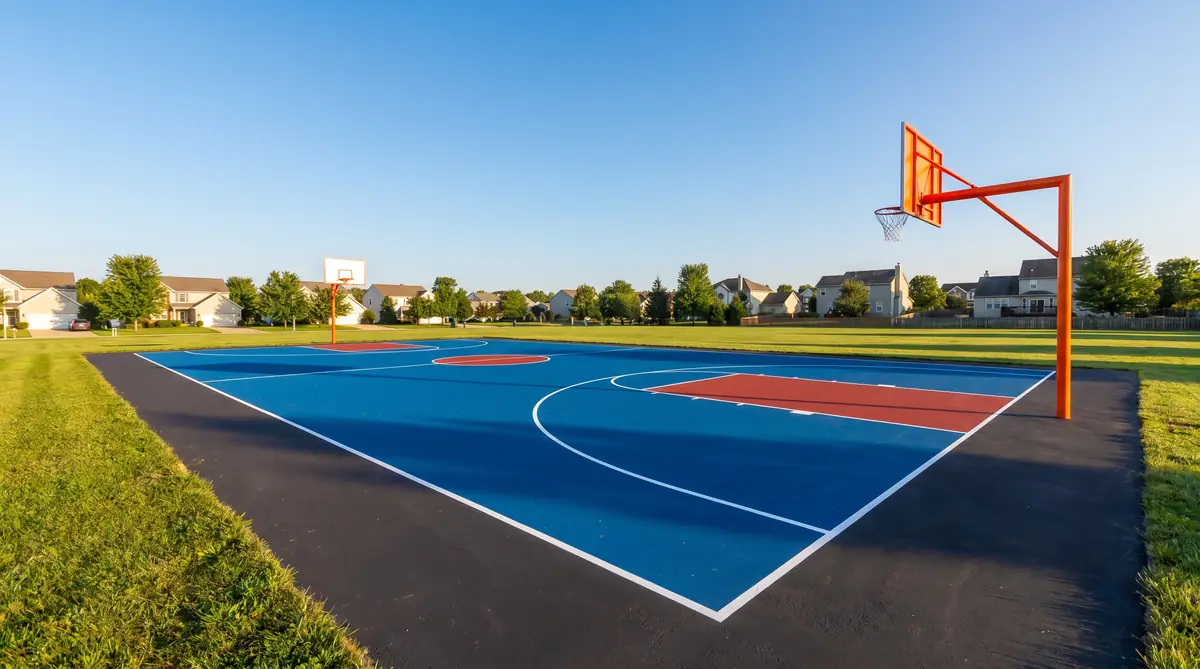
A residential half-court asphalt basketball court costs $8,000–$18,000 installed (sub-base, asphalt, acrylic coating, striping, one hoop). A full regulation court runs $35,000–$75,000. Properly built with a solid sub-base and 3–4 inches of asphalt, a court lasts 20–30 years. The acrylic sport coating needs reapplication every 3–7 years. Asphalt costs 20–40% less than concrete upfront but requires more ongoing maintenance.
Asphalt vs Concrete for Basketball Courts
| Factor | Asphalt | Concrete |
|---|---|---|
| Upfront cost | $8–$15/sq ft installed | $12–$22/sq ft installed |
| Lifespan | 20–30 years | 30–50 years |
| Heat performance | Softens above 120°F surface temp | Stable in all temperatures |
| Crack resistance | Flexible — fewer large cracks, more surface cracks | Rigid — joint cracking common |
| Repairability | Easy to patch, resurface, or overlay | Harder to repair invisibly |
| Acrylic coating adhesion | Good — requires resurfacer primer coat | Excellent — very stable base |
| Ball bounce | Slightly softer — good with acrylic coat | Consistent — preferred for competitive play |
| Maintenance frequency | Higher — recoat every 3–5 years | Lower — recoat every 5–7 years |
For most residential and recreational installations, asphalt is the practical choice — the lower upfront cost and easy repairability outweigh the longevity advantage of concrete. For school courts, parks, and facilities where heavy daily use is expected, concrete may deliver better value over a 20-year horizon despite higher upfront cost.
Cost Breakdown by Court Size
| Court Type | Dimensions | Sq Ft | Asphalt + Sub-base | Acrylic Coating + Striping | Total Installed |
|---|---|---|---|---|---|
| Residential half court | 30×28 ft | 840 | $4,000–$8,000 | $2,500–$5,000 | $8,000–$18,000 |
| Recreational full court | 60×30 ft | 1,800 | $8,000–$16,000 | $4,000–$8,000 | $14,000–$28,000 |
| High school full court | 84×50 ft | 4,200 | $18,000–$35,000 | $8,000–$15,000 | $28,000–$55,000 |
| Regulation full court | 94×50 ft | 4,700 | $20,000–$40,000 | $10,000–$18,000 | $35,000–$75,000 |
Standard Court Dimensions
| Court Type | Length × Width | Three-Point Line | Key Width |
|---|---|---|---|
| NBA regulation | 94 × 50 ft | 23.75 ft (corner 22 ft) | 16 ft |
| NCAA / College | 94 × 50 ft | 22.15 ft | 12 ft |
| High school | 84 × 50 ft | 19.75 ft | 12 ft |
| Junior high | 74 × 42 ft | 19.75 ft | 12 ft |
| Recreational half court | 30 × 28 ft (min) | 19 ft (recreational) | 12 ft |
| Driveway half court | 20 × 15 ft (min) | No three-point line | N/A |
Construction Steps
- Site clearing and excavation: Remove existing vegetation, topsoil, and any soft spots to a depth of 8–12 inches. Identify and address any drainage issues at this stage — poor drainage is the primary cause of long-term court failure. The finished court must slope a minimum of 1% (1/8 inch per foot) away from any structures for water to sheet off.
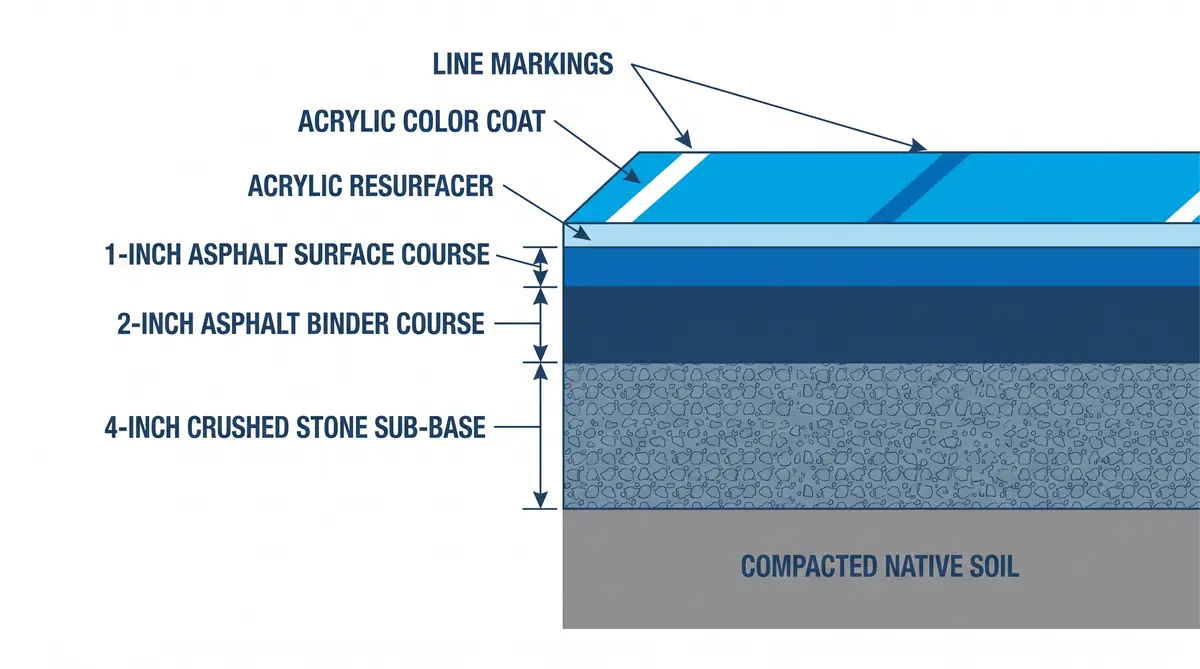
- Sub-base installation and compaction: Install 4–6 inches of compacted crushed stone (ASTM #57 or equivalent) as the base layer. This is the most critical structural element of the court — a weak or thin sub-base causes the asphalt to crack and heave within years regardless of how thick the asphalt is. Compact in 2-inch lifts with a plate compactor or roller to 95% proctor density.
- Asphalt binder course: Pave a 2-inch compacted binder course (coarser aggregate mix) as the structural asphalt layer. Allow to cure for at least 24 hours before applying the surface course.
- Asphalt surface course: Apply a 1-inch compacted fine-aggregate surface course (typically 3/8-inch top size aggregate) to provide the smooth, tight surface needed for acrylic coating adhesion. Total asphalt thickness should be 3 inches minimum for residential and 4 inches for heavier use.
- Asphalt cure period: Wait a minimum of 30 days before applying acrylic coating — new asphalt off-gasses residual oils that prevent proper coating adhesion. 60–90 days is preferred, especially in warm climates.
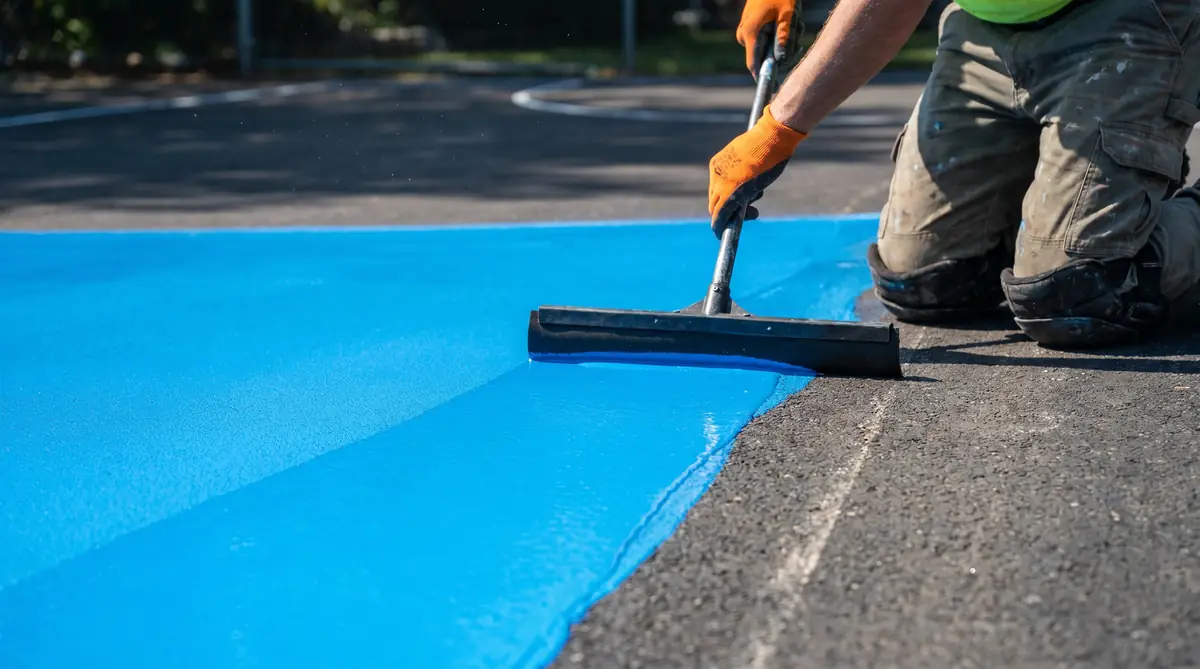
- Acrylic sport coating and line striping: Apply 2–3 coats of acrylic resurfacer to fill minor surface texture, then 2 coats of colored acrylic sport coating. Paint court lines using a layout template and athletic line paint. See our pavement paint guide for line marking product details.
Asphalt Thickness Requirements
| Use Type | Sub-base | Binder Course | Surface Course | Total Asphalt |
|---|---|---|---|---|
| Residential driveway court | 4 inches crushed stone | 2 inches | 1 inch | 3 inches |
| Backyard recreational court | 4–5 inches crushed stone | 2 inches | 1 inch | 3 inches |
| School / park court | 6 inches crushed stone | 2.5 inches | 1.5 inches | 4 inches |
| High-use facility court | 6–8 inches crushed stone | 3 inches | 1.5 inches | 4.5 inches |
Acrylic Sport Coating
Bare asphalt is not a suitable playing surface for basketball — it's too dark (heat absorption), too rough (ball friction and abrasion on skin), and has no defined playing lines. Acrylic sport coating solves all three: it provides a consistent, slightly cushioned surface with good traction, reflects more heat than bare asphalt, and acts as the base for line markings.
Acrylic Coating Options
| Coating Type | Layers | Texture | Lifespan | Cost (half court) |
|---|---|---|---|---|
| Standard acrylic (2-coat) | 2 color coats | Medium | 3–5 years | $1,500–$3,000 |
| Cushioned acrylic system | Rubber base + 2 color coats | Slightly cushioned | 5–8 years | $3,000–$6,000 |
| Premium textured system | Resurfacer + 3 color coats | Controlled texture | 7–10 years | $4,000–$8,000 |
Color choices are unlimited — the most common combination is blue key/paint area with red or green three-point zone and gray or green out-of-bounds area. Dark colors absorb more heat; lighter colors keep the surface cooler in summer. Always apply lines last, over the fully cured color coats, using a chalk snap line and athletic line paint for crisp edges.
Drainage Design
Water is the primary enemy of an asphalt basketball court. Standing water softens the sub-base, causes frost heaving in freeze-thaw climates, and accelerates oxidation of the asphalt binder. Every court must be designed with a positive drainage slope — minimum 1% (1/8 inch per foot) in at least one direction, ideally toward a perimeter drain, swale, or open lawn area.
A common mistake is building a court in a low spot that collects runoff from the surrounding yard. Before construction, verify the site naturally drains away — if not, install a French drain or perimeter trench drain around the court perimeter as part of the project. The added cost ($1,000–$3,000) is far less than repairing a heaved or delaminated court in 5 years.
Maintenance Schedule
| Task | Frequency | DIY? | Approximate Cost |
|---|---|---|---|
| Sweep and clean surface | Monthly | Yes | Free |
| Inspect and fill hairline cracks | Annually (spring) | Yes | $50–$200 materials |
| Re-paint faded court lines | Every 2–4 years | Yes (with template) | $200–$600 |
| Full acrylic recoat | Every 3–7 years | No — contractor | $1,500–$5,000 half court |
| Structural crack repair + recoat | As needed | No — contractor | $500–$3,000 |
| Full resurfacing (overlay) | Every 15–20 years | No — contractor | $3,000–$12,000 half court |
| Full replacement | Every 25–35 years | No — contractor | $8,000–$18,000 half court |
Resurfacing vs Full Replacement
| Condition | Recommended Action | Half-Court Cost |
|---|---|---|
| Faded coating, minor surface cracks | Acrylic recoat only | $1,500–$4,000 |
| Multiple cracks, rough surface, coating worn through | Crack repair + full resurfacing + recoat | $3,000–$8,000 |
| Alligator cracking, surface depressions | Partial removal + patch + resurfacing | $5,000–$12,000 |
| Sub-base failure, widespread heaving, deep structural cracks | Full tearout and reconstruction | $8,000–$18,000 |
DIY vs Professional
| Task | DIY Feasible? | Notes |
|---|---|---|
| Crack sealing | Yes | Use pourable asphalt crack filler; clean crack first |
| Line repainting | Yes | Use chalk snap lines and athletic line paint for straight edges |
| Acrylic recoating (single color) | Possible with prep | Requires proper cleaning, priming, and squeegee application — results vary |
| Asphalt paving | No | Requires paver, roller, and HMA delivery — contractor only |
| Sub-base work | No | Proper compaction requires plate compactor or roller; critical to get right |
| Full resurfacing system | No | Multi-coat systems require professional application for warranty and durability |
Common Problems to Avoid
- Building in a drainage low spot: Water pooling under the court destroys the sub-base within a few freeze-thaw cycles. Grade the site before paving — this cannot be fixed after the fact without full reconstruction.
- Thin asphalt under 2.5 inches: The single most common cause of early cracking. Always specify and verify 3-inch minimum total asphalt thickness — probe after paving if you have doubts.
- Skipping the acrylic resurfacer coat: Applying color coats directly over bare asphalt without a resurfacing primer results in poor adhesion and early peeling, especially over the texture peaks of the asphalt aggregate.
- Coating new asphalt too soon: Applying acrylic within 30 days of paving traps residual oils — the coating peels within one season. Wait 60–90 days minimum.
- Ignoring hairline cracks: Small surface cracks are easy and cheap to fill annually. Left untreated, water enters, freezes, and turns hairline cracks into structural failures within 2–3 winters.
For professional court installation or resurfacing, use our asphalt paving contractor guide to vet and compare local contractors. Confirm they have specific sport court experience — standard paving contractors may not have the sport coating and line striping expertise required.
Frequently Asked Questions
How much does an asphalt basketball court cost?
A residential half court (30×28 ft) costs $8,000–$18,000 installed including sub-base, asphalt, acrylic coating, striping, and one hoop. A regulation full court (94×50 ft) runs $35,000–$75,000. Costs vary by region, site conditions, and coating system chosen.
How long does an asphalt basketball court last?
20–30 years for the asphalt base with proper maintenance. The acrylic sport coating needs reapplication every 3–7 years. Without any maintenance, surface deterioration typically begins within 8–12 years.
Is asphalt or concrete better for a basketball court?
Asphalt costs 20–40% less upfront and is easier to repair; concrete lasts longer and holds coating better. For residential use, asphalt is the practical choice. For high-use school or park courts where longevity matters more than initial cost, concrete is preferred.
How thick should asphalt be for a basketball court?
Minimum 3 inches total (2-inch binder + 1-inch surface course) over a 4-inch compacted crushed stone sub-base for residential. School and high-use courts need 4 inches of asphalt over a 6-inch sub-base. Anything under 2.5 inches will crack prematurely.
Can you resurface an asphalt basketball court?
Yes, if the base is structurally sound. Resurfacing involves crack repair, acrylic resurfacer to level the surface, new color coats, and re-striping. Costs $3,000–$12,000 for a half court versus $8,000–$18,000 for full replacement. Alligator cracking or sub-base failure requires full reconstruction.