
Asphalt Concrete Paving — Process, Mix Types, Equipment & Costs (2026)
Quick Answer: What Is Asphalt Concrete Paving?
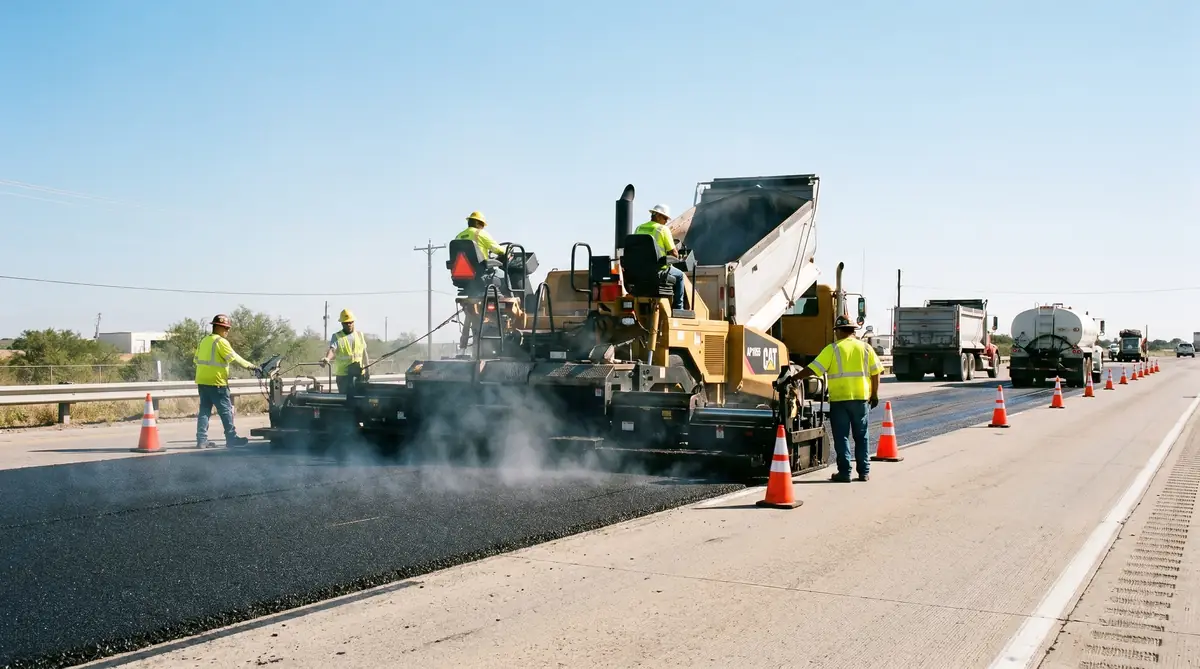
Asphalt concrete paving is the process of placing and compacting hot mix asphalt (HMA) — an engineered blend of crushed aggregate and bitumen binder — onto a prepared base to form a load-bearing surface. It is used for roads, driveways, parking lots, runways, and sport courts. Costs range from $2–$5/sq ft for large commercial projects to $4–$8/sq ft for residential driveways. The process requires strict temperature control: material must be placed above 275°F and compacted before it cools to 175°F.
Asphalt Concrete vs Plain Asphalt — What's the Difference?
The terms are often used interchangeably, but they mean different things in engineering. Asphalt (or bitumen) is the dark, petroleum-derived binder that holds the mix together — it is a liquid at high temperatures and a semi-solid at ambient. Asphalt concrete is the finished composite material: aggregate (crushed stone, gravel, sand) bound with asphalt cement, engineered to specific gradations and binder percentages to meet strength and durability targets.
When a contractor says "pave it in asphalt," they mean asphalt concrete. When an engineer writes "AC-20" in a spec, they mean an asphalt concrete mix with 20-grade binder. The distinction matters when selecting materials and reading project specifications — see our deeper guide on asphaltic concrete composition for the material science side.
Asphalt Concrete Mix Types
| Mix Type | Full Name | Air Voids | Best Use | Key Advantage |
|---|---|---|---|---|
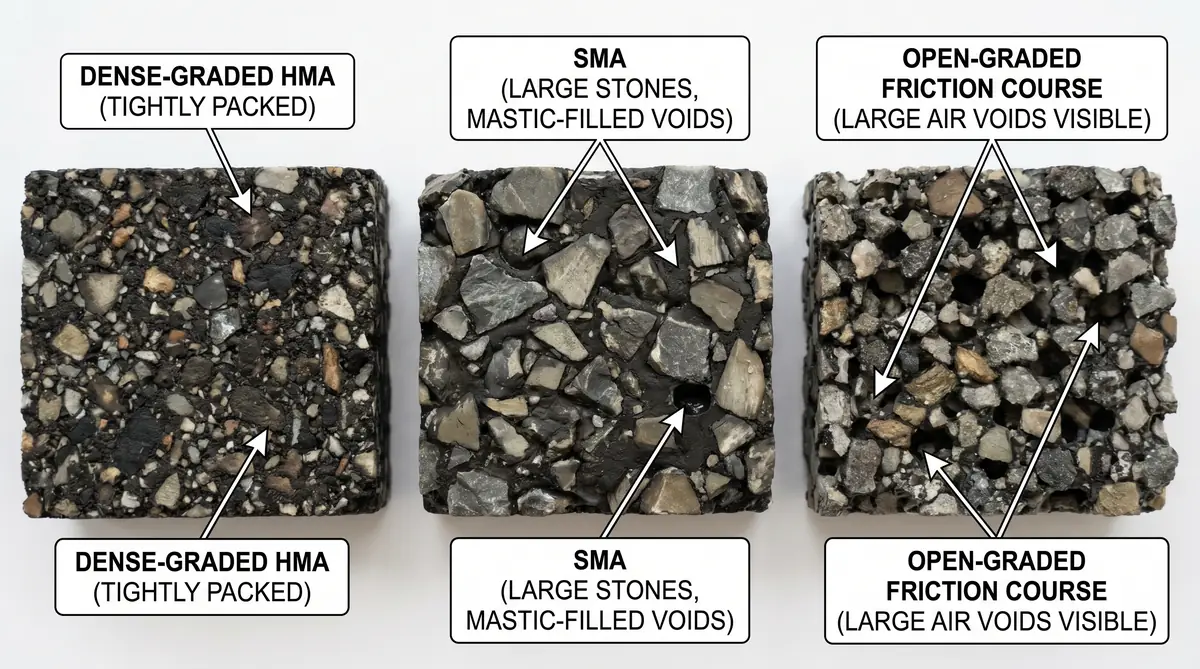
| Dense-graded HMA | Hot Mix Asphalt | 3–5% | Roads, driveways, parking lots | All-around durability and waterproofing |
| SMA | Stone Matrix Asphalt | 3–4% | High-traffic roads, highways | Superior rutting resistance under heavy loads |
| WMA | Warm Mix Asphalt | 3–5% | Any application, lower-temp paving | Produced 50–100°F cooler — reduced emissions, longer haul |
| OGFC | Open-Graded Friction Course | 15–20% | Highway surface course | Drains rainwater through surface, reduces splash and hydroplaning |
| CIR / RAP | Cold In-Place Recycle / Recycled Asphalt Pavement | Varies | Road rehabilitation base courses | Cost-effective — recycles existing pavement material |
| Perpetual Pavement HMA | Multi-layer rich-bottom mix | 3–4% | Interstates and heavy freight roads | 50+ year lifespan through deep structural design |
For most residential and commercial projects — driveways, parking lots, private roads — dense-graded HMA is the default. SMA and OGFC are specified by highway agencies for high-speed, high-volume roadways. Warm mix is increasingly common wherever haul distances are long or cold-weather paving is needed.
The Asphalt Concrete Paving Process — 8 Steps
-
Subgrade Preparation
Strip vegetation and topsoil. Proof-roll the exposed subgrade with a loaded dump truck or roller — any areas that deflect or pump indicate soft spots requiring excavation and replacement with compacted granular fill. Subgrade must be dry, stable, and graded to drain. Target compaction: 95% standard Proctor density (AASHTO T99).
-
Sub-base and Base Course Installation
Place crushed aggregate base in lifts of 4–6 inches, compacting each lift to 98% modified Proctor. For residential driveways a 4-inch compacted crushed stone base is typical; commercial lots require 6–12 inches depending on traffic loading. The base course is the primary structural layer — under-building it here causes premature pavement failure regardless of asphalt thickness above.
-
Tack Coat Application
Spray a thin layer of diluted emulsified asphalt (SS-1h or CSS-1h, diluted 1:1 with water) onto the base or existing pavement at 0.05–0.15 gal/sq yd. The tack coat creates a bonding interface between the base and the new asphalt lift. Allow to break (turn from brown to black) before paving — typically 15–30 minutes. Skipping or under-applying tack coat causes lift separation (slippage cracking) within 1–3 years.
-
Mix Production and Hauling
HMA is produced in a drum-mix or batch plant at 300–325°F (149–163°C). The target binder content is typically 4.5–6.5% by weight of mix depending on aggregate gradation and traffic level. Material is hauled in insulated dump trucks; maximum haul time is 2 hours or until mat temperature drops to 280°F, whichever comes first. Trucks must be tarped in ambient temperatures below 60°F.
-
Paving with Asphalt Screed
An asphalt paver receives material from the truck via a conveyor, distributes it across the paving width with augers, then strikes it off with a heated screed at the target mat thickness. Set the screed to lay material 15–25% thicker than the target compacted depth to account for compaction. Mat temperature behind the screed should be 290–320°F. Paver speed is typically 20–40 ft/min — consistent speed prevents mat texture variation.
-
Breakdown Rolling
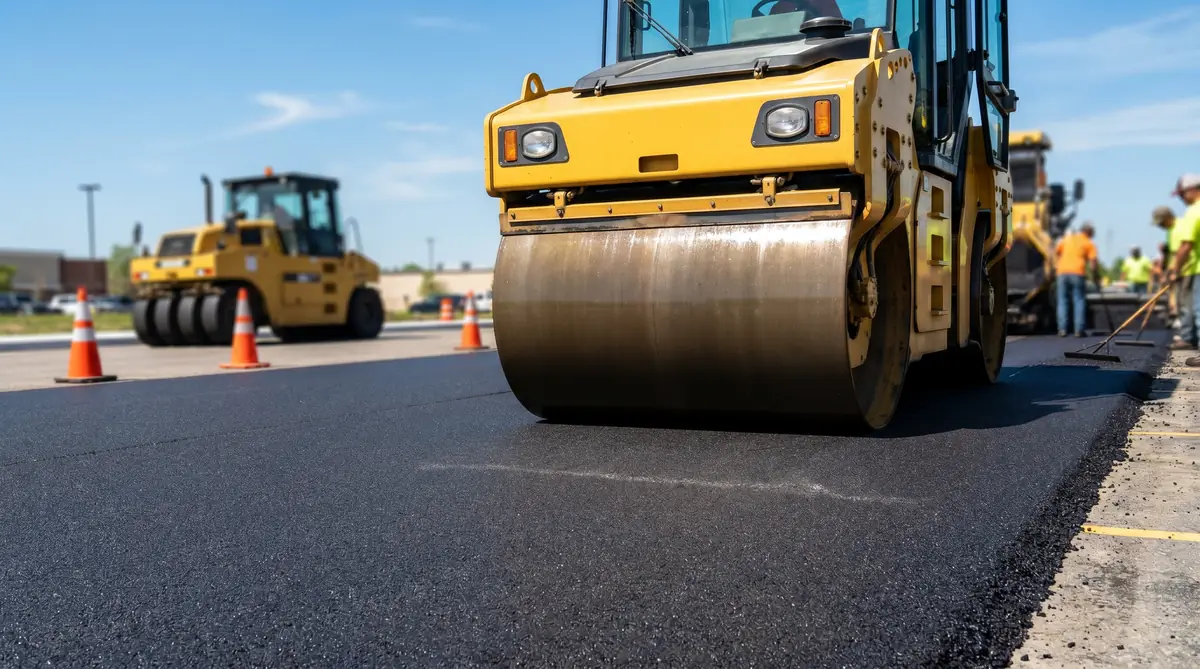
A steel drum vibratory roller (10–14 ton) makes 3–5 passes immediately behind the paver while the mat is above 275°F. Vibration is engaged on the first pass, static on subsequent passes to avoid cracking the mat edge. The roller must stay within 50 feet of the paver to capture heat. This pass achieves the majority of compaction — roughly 85–90% of target density.
-
Intermediate (Pneumatic) Rolling
A pneumatic tire roller (25–35 ton) makes 2–4 passes at 200–250°F to knead the mix, seal the surface, and improve density uniformity. The tire kneading action closes surface voids and bridges any minor density variations left by the steel drum. On thin lifts or residential paving, this step is sometimes skipped in favor of additional steel drum passes.
-
Finish Rolling and Surface Acceptance
A static steel drum finish roller (8–10 ton) makes 2–3 passes at 150–175°F to remove any roller marks and achieve final surface texture. Accept when the surface has cooled to ambient temperature — no traffic until below 140°F (60°C). Core samples or nuclear density gauges verify that target density (typically 92–96% Gmm per ASTM D2041) has been achieved before accepting the work.
Temperature Requirements
| Stage | Temperature Requirement | Why It Matters |
|---|---|---|
| Plant production | 300–325°F (149–163°C) | Full binder coating of aggregate |
| Delivery to paver | ≥280°F (138°C) | Mix workability maintained |
| Behind screed | 290–320°F | Screed can strike off smoothly |
| Start breakdown rolling | ≥275°F (135°C) | Mix still plastic enough to compact |
| Complete all rolling | ≥175°F (80°C) | Below this point mix is too stiff — rolling tears surface |
| Open to traffic | ≤140°F (60°C) | Prevents rutting from early wheel loads |
| Minimum ambient air (paving) | ≥50°F (10°C) | Cold air accelerates cooling, limits compaction window |
Compaction Specifications
| Roller Type | Weight | Passes | Speed | Target Density Contribution |
|---|---|---|---|---|
| Breakdown (vibratory steel drum) | 10–14 ton | 3–5 | 2–3 mph | 85–90% of Gmm |
| Intermediate (pneumatic) | 25–35 ton | 2–4 | 3–5 mph | 90–94% of Gmm |
| Finish (static steel drum) | 8–10 ton | 2–3 | 3–5 mph | Final surface texture, no density gain |
ASTM D2041 defines the maximum theoretical density (Gmm) of the compacted mix. Most highway specifications require field density cores to achieve 92–96% of Gmm. Densities below 92% leave excess air voids that allow water infiltration and oxidation — accelerating cracking. Densities above 96% can over-compact the mix, causing bleeding or flushing as binder migrates to the surface under traffic.
Cost Breakdown by Application Type (2026)
| Application | Typical Thickness | Material Cost/Sq Yd | Installed Cost/Sq Ft | Notes |
|---|---|---|---|---|
| Residential driveway | 2–3 in | $14–$22 | $4–$8 | Small paver or hand-lay; higher unit cost |
| Parking lot (light duty) | 2.5–3.5 in | $10–$16 | $3–$6 | Standard commercial paver; good economy of scale |
| Parking lot (heavy duty) | 4–5 in | $16–$24 | $5–$9 | Semi trucks, loading docks — thicker lifts |
| Local road / subdivision | 4–6 in | $18–$28 | $5–$10 | Often bid/sqft including base prep |
| Highway (surface course only) | 1.5–2 in | $8–$14 | $2–$4 | Surface overlay only; base already exists |
| Airport apron / taxiway | 8–18 in total structure | $50–$120 | $15–$25 | FAA P-401 spec; multiple lifts, high QC requirements |
The cost range within each category is driven by regional asphalt cement (AC binder) prices, aggregate haul distance, project size, and site conditions. Asphalt binder is a crude oil derivative — its price fluctuates with oil markets. Projects bid during high crude price periods can see material costs 20–30% higher than low-period benchmarks.
Residential vs Commercial vs Municipal Paving
| Factor | Residential | Commercial | Municipal / Highway |
|---|---|---|---|
| Design basis | Contractor experience / rule of thumb | Traffic study or structural design | AASHTO pavement design method |
| Mix specification | Local DOT dense-graded HMA or contractor standard | Project-specific spec based on ESALs | State DOT spec, often SMA or PG-graded binder |
| Compaction testing | Usually none (contractor judgment) | Nuclear gauge, occasional cores | Core samples per spec, lot-by-lot acceptance |
| Warranty | 1–5 years workmanship (varies) | 1–3 years, performance bond common | Performance-based, multi-year maintenance period |
| Base depth | 4 in crushed stone | 6–12 in depending on loading | Per AASHTO structural number calculation |
| Lift thickness | 2–3 in single lift | 2-in surface + 2-in binder typical | Multiple lifts per design, each ≤3 in |
Common Defects, Causes, and Fixes
| Defect | Root Cause | Prevention / Fix |
|---|---|---|
| Rutting (wheel path depressions) | Insufficient mix stability, over-asphalt content, early traffic before cooling | Use SMA or stiffer PG binder; delay traffic opening; verify density |
| Shoving (lateral displacement) | Weak tack coat, over-asphalt, heavy turning loads on thin lift | Correct tack coat rate; verify mix binder content; increase lift thickness |
| Alligator cracking | Structural failure — base or subgrade insufficient for traffic loading | Full-depth reclamation or reconstruction; no overlay fix |
| Longitudinal cracking | Poor longitudinal joint construction — cold joint not tacked, paver pass overlap too narrow | Tack all joints; overlap screed 1–2 inches over previous lane; use joint heater |
| Bleeding / flushing | Excess binder content, over-compaction, or low-void mix in hot climate | Verify mix design; limit rolling to spec — do not exceed target density |
| Raveling (aggregate loss) | Under-compaction, low binder content, mix too cold at placement, or aged binder | Monitor mat temperature; verify rolling pattern; check binder content in mix design |
| Thermal cracking (transverse) | Binder too stiff for climate — wrong PG grade for low-temperature environment | Specify PG binder grade matched to project climate per AASHTO M320 |
Binder Grade Selection
Performance Grade (PG) binders are specified by high-temperature and low-temperature performance — for example, PG 64-22 performs at a high temperature of 64°C and a low temperature of −22°C. Choosing the wrong PG grade is the primary cause of rutting (binder too soft for climate) and thermal cracking (binder too stiff for cold winters).
| Climate Zone | Typical High PG | Typical Low PG | Common Full Grade |
|---|---|---|---|
| Hot desert (AZ, NV, TX) | 70–76 | -10 to -16 | PG 70-10 or PG 76-16 |
| Mild / temperate (CA coast, PNW) | 64–70 | -16 to -22 | PG 64-16 or PG 70-22 |
| Humid continental (Midwest, Northeast) | 58–64 | -22 to -28 | PG 64-22 or PG 58-28 |
| Cold northern (MN, ND, Canada) | 52–58 | -28 to -40 | PG 58-28 or PG 52-40 |
Lift Thickness Rules
Each asphalt concrete lift has a minimum and maximum compacted thickness based on the maximum aggregate size (NMAS) in the mix:
| Nominal Max Aggregate Size (NMAS) | Min Lift Thickness | Max Lift Thickness | Typical Application |
|---|---|---|---|
| 3/8 in (9.5 mm) | 1 in (25 mm) | 1.5 in (38 mm) | Thin surface course, sport courts, driveways |
| 1/2 in (12.5 mm) | 1.5 in (38 mm) | 2.5 in (64 mm) | Surface and intermediate course |
| 3/4 in (19 mm) | 2 in (50 mm) | 3 in (76 mm) | Standard binder and base course |
| 1 in (25 mm) | 2.5 in (64 mm) | 4 in (102 mm) | Heavy-duty base course |
| 1.5 in (37.5 mm) | 3 in (76 mm) | 6 in (152 mm) | Deep structural base, airport pavements |
Lifting thinner than the minimum causes aggregate bridging — the large stones contact each other before the mix is fully compacted, leaving permanent voids. Going thicker than the maximum means the core of the lift stays too hot for too long, and the surface cools and stiffens before the interior is properly compacted.
Quality Control Checklist
- Verify plant mix temperature on delivery ticket — reject loads below 280°F
- Check mat temperature with IR gun behind screed — minimum 290°F
- Confirm tack coat coverage rate and break time before paving
- Document rolling pattern (number of passes, roller speed, amplitude setting)
- Take nuclear density gauge readings during rolling — adjust pattern if below target
- Extract cores after cooling to confirm 92–96% Gmm acceptance criterion
- Check longitudinal joint density separately — joints routinely 1–3% below mat density
- Measure surface smoothness with straightedge or profilograph if specified
- Verify mat thickness from cores or depth gauges at beginning of each day's paving
Asphalt Concrete Paving FAQs
What is asphalt concrete paving?
The process of placing and compacting hot mix asphalt (HMA) — engineered aggregate bound with bitumen binder — onto a prepared base to form a durable paved surface. Used for roads, driveways, parking lots, runways, and courts. The paved material is technically called asphalt concrete (AC) or hot mix asphalt (HMA).
How much does asphalt concrete paving cost per square foot?
$3–$7/sq ft for residential driveways, $2–$5/sq ft for large commercial parking lots, and $8–$20/sq ft for airport or heavy-duty applications. These figures cover materials and labor but not sub-base preparation, which adds $1–$4/sq ft depending on depth and existing conditions.
What temperature does asphalt concrete need to be laid at?
Material must be placed above 275°F (135°C) and all rolling completed before the mat cools below 175°F (80°C). Plant production is typically 300–325°F. Paving should not occur when ambient air is below 50°F unless warm-mix additives are used and lift thickness is reduced.
What is the difference between HMA and WMA?
Hot mix asphalt (HMA) is produced at 300–325°F. Warm mix asphalt (WMA) uses chemical additives, water-based foaming, or organic wax additives to achieve full mix coating at 250–275°F — 50–100°F cooler. WMA reduces fuel use, lowers plant emissions, extends the rolling window in cold weather, and allows longer haul distances. Mix performance is equivalent when properly designed.
How many roller passes does asphalt concrete need?
Typically 3–5 breakdown passes (vibratory steel drum), 2–4 intermediate passes (pneumatic), and 2–3 finish passes (static steel drum). Exact count depends on mix type, lift thickness, roller weight, and ambient temperature. The target is 92–96% of maximum theoretical density (Gmm) per ASTM D2041 — not a fixed pass count.
How thick should asphalt concrete be for a parking lot?
Light-duty lots (passenger vehicles only) need 2.5–3.5 inches of asphalt over 4–6 inches of compacted base. Heavy-duty lots (semi trucks, delivery vehicles) need 4–5 inches of asphalt over 8–12 inches of base. Single-pass thickness over 3 inches should be placed in two lifts for proper compaction.