
Asphalt Paving Contractor — How to Find, Hire & Vet One (2026 Guide)
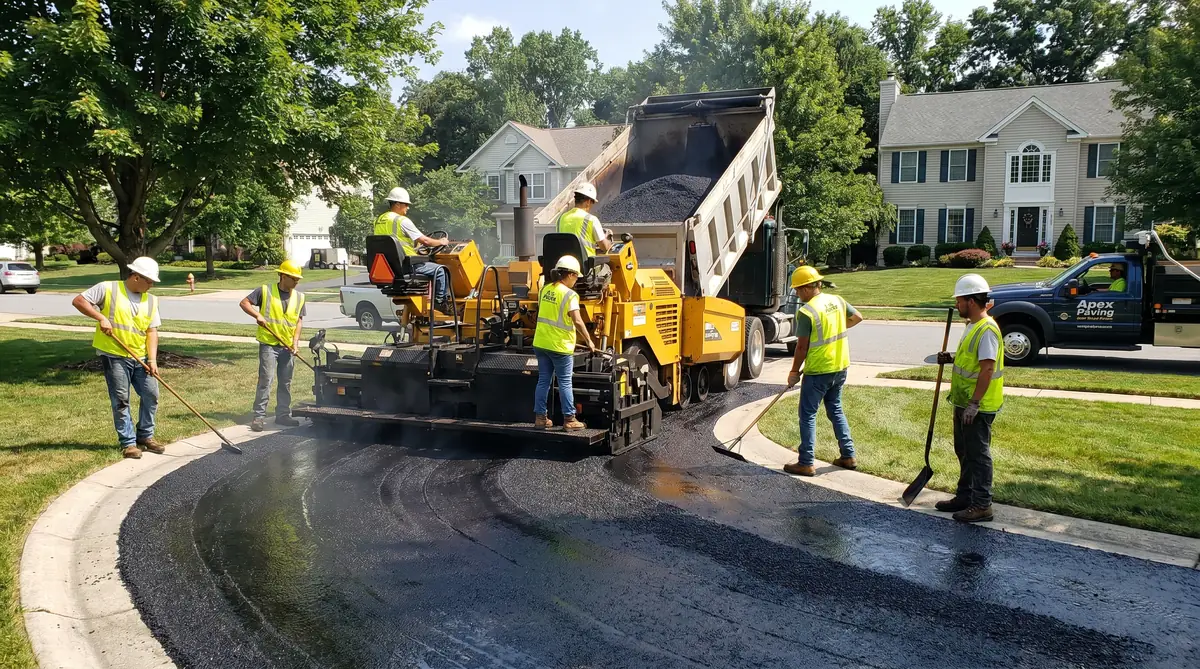
Hiring the wrong asphalt paving contractor is one of the most expensive mistakes a homeowner or property manager can make. A crew that skips proper base preparation, lays asphalt too thin, or uses substandard materials will leave you with a driveway or parking lot that cracks and deteriorates within a few years — at which point the contractor is long gone and you're facing the full cost again.
This guide gives you a complete framework for finding, vetting, and hiring a reliable asphalt paving contractor in 2026. It covers what contractors charge, which services they offer, the red flags that separate professional crews from cut-rate operators, and the 10 questions that every contractor should answer before you sign anything. Use our Asphalt Project Calculator to estimate your job cost independently — before you talk to anyone.
In this guide
- What an Asphalt Paving Contractor Does
- Types of Paving Contractors
- Services Asphalt Contractors Offer
- 2026 Asphalt Paving Contractor Rates
- How to Find a Reliable Contractor Near You
- Red Flags to Avoid
- 10 Questions to Ask Before You Sign
- What to Expect During the Paving Process
- DIY vs Hiring a Contractor
- FAQ
What an Asphalt Paving Contractor Does
An asphalt paving contractor specializes in the installation, repair, and maintenance of asphalt surfaces — driveways, parking lots, roads, pathways, basketball courts, and more. Their work spans every phase of a paving project: site preparation, excavation, gravel base installation, asphalt laying, compaction, and finishing.
Unlike a general contractor who subcontracts paving work, a dedicated paving contractor owns their own paving equipment — asphalt pavers, rollers, plate compactors, and dump trucks — and employs experienced crews who specialize exclusively in asphalt concrete paving. This specialization matters because proper paving requires precise control of asphalt temperature, compaction passes, and layer thickness, all of which come from experience.
Key distinction: A paving contractor installs the asphalt surface. The excavation and grading work before paving may be done by their crew or a separate earthwork contractor, depending on the company's capabilities.
Types of Paving Contractors: Residential vs Commercial
Not all asphalt paving contractors work every type of job. Understanding the categories helps you find the right fit for your project.
Residential Paving Contractors
Residential contractors focus on driveways, walkways, and small parking areas for homes and small businesses. They typically run smaller crews with narrower paving equipment suited to tight residential spaces. Most residential driveways are 300–1,000 sq ft — a job that takes one day for an experienced crew.
Commercial Paving Contractors
Commercial contractors handle large parking lots, retail centers, industrial yards, and municipal projects. They operate wide-format asphalt pavers, heavy compaction rollers, and can manage projects ranging from 5,000 sq ft to several acres. Commercial jobs often involve striping, drainage systems, and ADA-compliant curb cuts as part of the scope.
Full-Service vs Specialty Contractors
Some paving contractors offer the full scope of asphalt paving systems — excavation, drainage, base preparation, paving, sealcoating, and striping — under one roof. Others specialize in paving only and partner with excavation contractors for site prep. A full-service contractor simplifies project management and accountability; a specialty contractor may offer lower paving-only pricing but requires you to coordinate multiple subs.
Services Asphalt Paving Contractors Offer
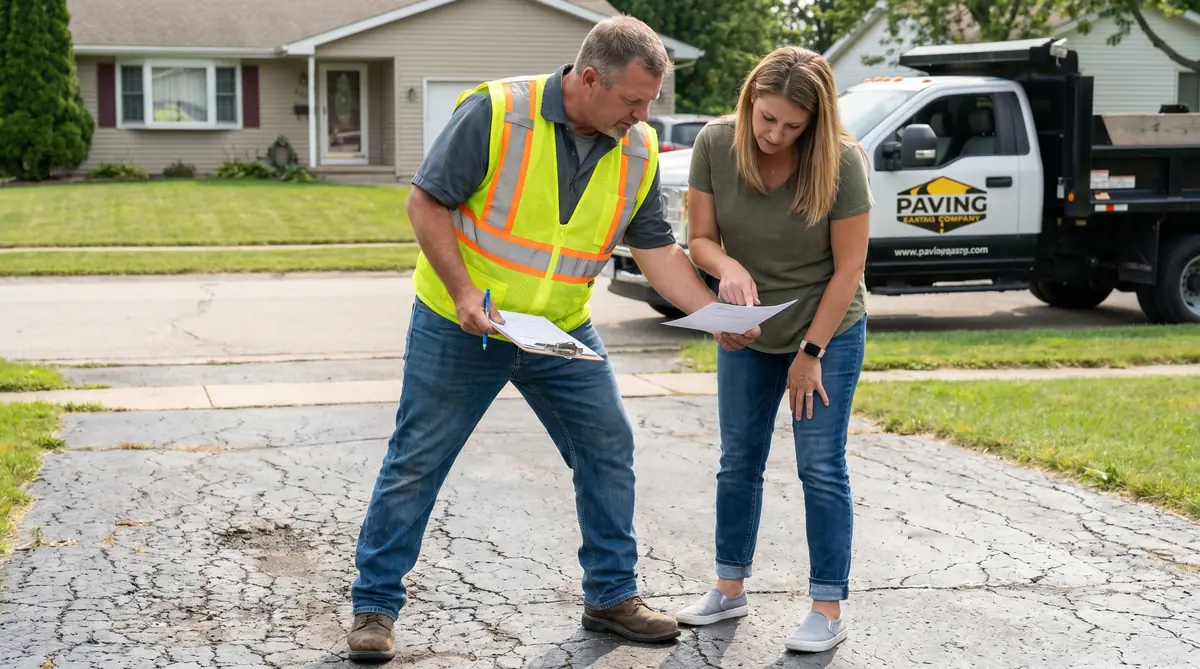
A full-service asphalt paving contractor typically offers the following services:
- New driveway installation — full excavation, gravel base, and asphalt surface on virgin ground
- Asphalt overlay / resurfacing — laying a new asphalt layer over an existing stable surface
- Full-depth replacement — removing deteriorated asphalt and base, then starting fresh
- Parking lot paving — commercial-scale asphalt concrete paving with drainage and line striping
- Pothole repair and patching — saw-cut, clean, and fill damaged areas
- Crack sealing — hot-pour or cold-pour filler for surface cracks before they worsen (see our asphalt crack filler guide)
- Sealcoating — protective coal tar or asphalt emulsion coating applied every 3–5 years (estimate cost with our sealcoating calculator)
- Driveway grading and drainage — slope correction, French drain installation, catch basins
- Line striping and marking — parking spaces, fire lanes, directional arrows
2026 Asphalt Paving Contractor Rates
Contractor pricing varies by region, project size, and scope. The numbers below are 2026 national averages for the US market. Larger projects always cost less per square foot due to equipment mobilization being spread across more area. Use our Asphalt Project Calculator to generate a custom estimate for your dimensions.
| Service | Cost per sq ft | Typical total (600 sq ft) |
|---|---|---|
| New driveway installation (full depth) | $3.00–$7.00 | $1,800–$4,200 |
| Asphalt overlay / resurfacing | $1.50–$3.50 | $900–$2,100 |
| Full replacement (remove + repave) | $5.00–$10.00 | $3,000–$6,000 |
| Commercial parking lot (per sq ft) | $2.00–$5.00 | — |
| Pothole repair (per sq ft) | $8.00–$25.00 | — |
| Crack sealing (per linear ft) | $0.50–$2.00 | — |
| Sealcoating | $0.15–$0.35 | $90–$210 |
Factors that push costs higher include: steep or sloped sites requiring additional grading, poor existing subgrade needing deep excavation, remote locations with long haul distances from the nearest asphalt plant, and small job sizes where mobilization costs dominate. See the full breakdown in our cost to replace asphalt driveway guide.
How to Find a Reliable Asphalt Paving Contractor Near You
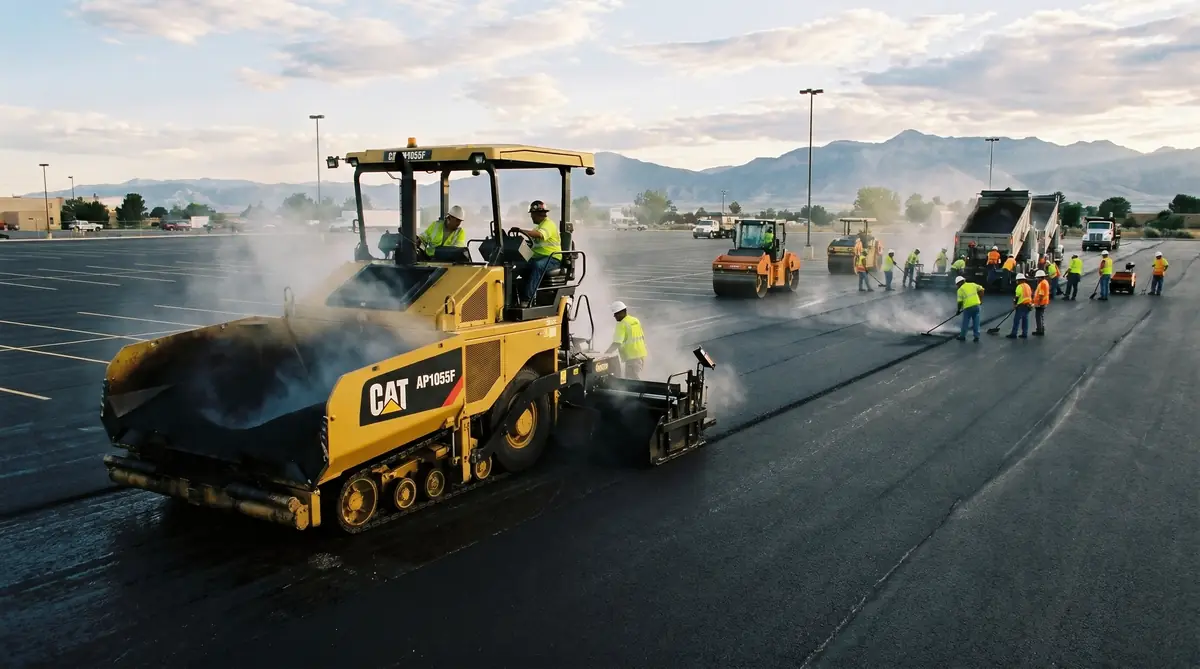
Finding a reliable contractor requires more than a Google search and taking the first quote. Here's a proven process:
- Start with Google reviews and the BBB. Search "asphalt paving contractor near me" and filter for contractors with 20+ reviews and a 4.5+ star average. Check the Better Business Bureau for complaint history.
- Get 3 written quotes minimum. Never accept a single quote. Three gives you a market baseline and reveals outliers — both suspiciously low and unreasonably high bids.
- Verify license and insurance. Ask for the contractor's license number and certificate of insurance showing general liability and workers' compensation. Verify the certificate directly with the insurer — fake certificates are common in the paving industry.
- Ask for recent references. Request 3 references from jobs completed in the last 12 months in your area. Call them and ask specifically about job quality, timeline accuracy, and post-job cleanup.
- Check their equipment. A legitimate paving contractor owns their paving equipment. If they mention renting or borrowing a paver, that's a yellow flag — it suggests low volume and inexperience.
- Compare quotes line by line. Every quote should specify asphalt thickness, base depth, mix type (HMA vs warm mix), and whether excavation is included. Quotes that lack this detail are not comparable.
Pro Tip: Calculate Before You Call
Run your project dimensions through our asphalt driveway calculator before contacting contractors. Knowing your expected tonnage and rough cost prevents you from being misled by inflated material quantities or low-ball bids that cut corners on thickness.
Red Flags: Bad Contractor Warning Signs
The paving industry has a well-documented problem with storm chasers and fly-by-night operators. These contractors approach homeowners door-to-door claiming they have "leftover asphalt from a nearby job" and offer suspiciously low prices. The result is almost always thin, poorly compacted asphalt with no proper base that deteriorates within one or two winters.
Watch for these red flags when evaluating any asphalt paving contractor:
- No written contract or itemized quote — legitimate contractors always provide a written scope of work
- Demands full payment upfront — standard payment is 10–30% deposit, remainder on completion
- No physical business address — search their address; if it's a residential home or doesn't exist, walk away
- Unusually low bid — a bid 40%+ below other quotes usually means thin asphalt, no real base, or recycled cold mix
- "Leftover asphalt from another job" — hot mix asphalt has a short temperature window; leftover material is never suitable for a proper install
- Pressure to sign immediately — high-pressure sales tactics are a hallmark of scam operations
- No liability insurance or won't provide a certificate — you are personally liable if an uninsured worker is injured on your property
- Subcontracts all work without disclosure — ask upfront whether their own crew does the work or if it's subcontracted
Warning: Door-to-Door Paving Scams
If someone knocks on your door offering a discounted paving job because they have "extra asphalt," decline immediately. This is one of the most common home improvement scams in North America. The material used is typically cold-patch or recycled millings, not proper hot mix asphalt. It will look fine for a few weeks and then crumble.
10 Questions to Ask an Asphalt Paving Contractor Before Signing
These 10 questions separate professional contractors from those who cut corners. Any legitimate asphalt paving contractor should answer all of them clearly and without hesitation.
- Are you licensed and insured? Ask for the license number and a certificate of insurance showing general liability (minimum $1M) and workers' comp. Verify both independently.
- What thickness of asphalt will you install? Residential driveways require 2–3 inches of compacted hot mix. Less than 2 inches is inadequate for passenger vehicles; demand it in writing.
- How deep will the gravel base be? The base should be 4–6 inches of compacted crushed stone for a residential driveway. On poor subgrade, 6–8 inches. No base = no long-term performance. Read our asphalt driveway installation guide for full layer specs.
- Will you excavate or pave over the existing surface? Paving over a deteriorated or unstable surface is a shortcut. For a proper installation, existing asphalt that is alligatored, heaved, or structurally failed must be removed.
- What mix type will you use? Ask for the HMA (hot mix asphalt) specification. Dense-graded mixes (9.5mm or 12.5mm nominal size) are standard for driveways. Be skeptical of contractors who can't name the mix.
- Can I see references from recent jobs? Ask for 3 references completed in the last year. Drive by one of the finished driveways if possible before committing.
- How long will the project take? A standard residential driveway is a one-day job. Multi-day estimates for small projects may indicate understaffing or scheduling problems.
- What is the payment schedule? Standard is 10–30% deposit, balance due on satisfactory completion. Never pay more than 50% before work begins.
- Do you offer a warranty? Reputable contractors offer a 1–5 year workmanship warranty. Get it in writing. Materials warranties come from the mix plant, not the contractor.
- Who will actually perform the work — your crew or subcontractors? If the work will be subcontracted, ask who, and verify their credentials separately. You're hiring based on the company's reputation; a random sub may not meet that standard.
What to Expect During the Asphalt Paving Process
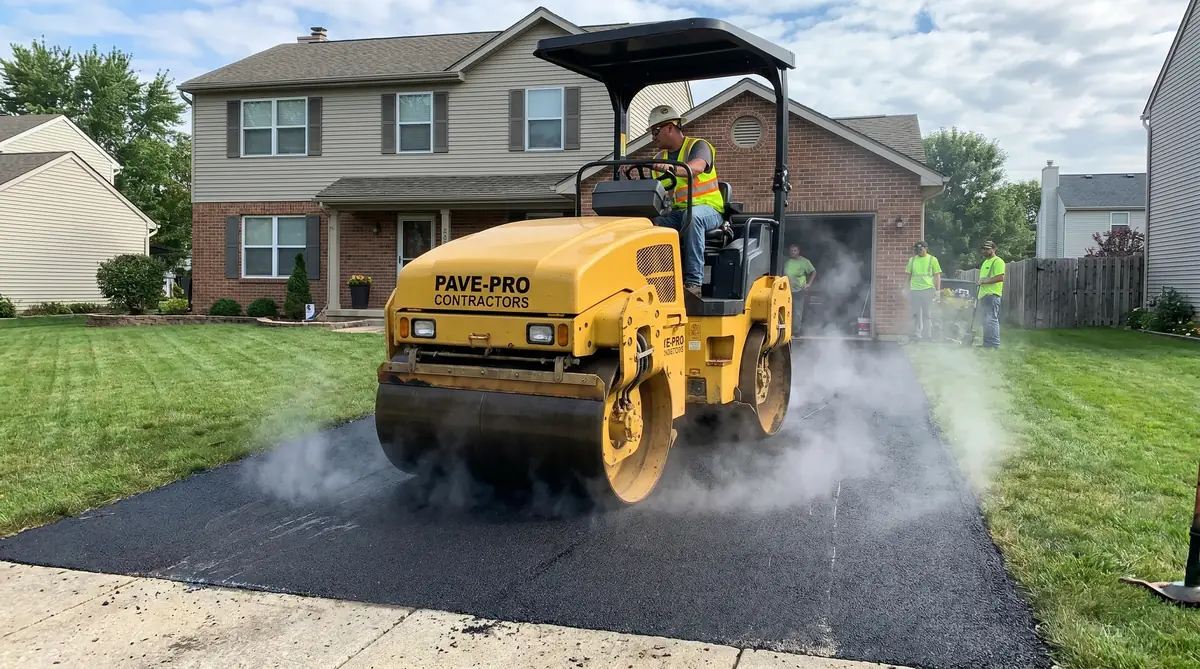
Once you've hired a contractor, here's what the asphalt paving process looks like from start to finish:
- Day 1 — Site prep: The crew excavates the existing surface (if replacing), grades the subgrade, and compacts it with a vibratory plate or roller. Drainage slope is established at this stage — typically 1–2% cross-slope for positive drainage.
- Base installation: Crushed stone aggregate (typically 3/4" or 21A stone) is spread and compacted in lifts to the specified base depth. This is the most important step — a weak base causes premature failure regardless of asphalt quality.
- Tack coat application: Before asphalt is laid over an existing surface or concrete edge, a thin layer of asphalt emulsion (tack coat) is sprayed to bond the new layer to the substrate.
- Asphalt paving: Hot mix asphalt (typically 280–325°F) is delivered by dump truck, loaded into the paver hopper, and laid in a continuous mat at the specified thickness. Asphalt must be compacted while still hot — typically above 185°F.
- Compaction: A steel drum roller makes multiple passes to compact the asphalt to 92–96% density. Edge compaction with a walk-behind roller finishes the perimeter. Proper compaction is what gives asphalt its strength and longevity.
- Cleanup and cure: The crew removes equipment, cleans the edges, and the surface is left to cool. You can walk on it after 24 hours and drive on it after 2–3 days. Full cure takes 6–12 months.
For a detailed breakdown of every installation step with layer diagrams, see our complete asphalt driveway installation guide.
DIY vs Hiring an Asphalt Paving Contractor
DIY asphalt paving is theoretically possible but rarely practical for most homeowners. Here's the honest comparison:
| Factor | DIY | Hiring a Contractor |
|---|---|---|
| Equipment needed | Plate compactor, roller (rental), tools | Contractor provides all |
| Hot mix asphalt access | Limited — plants sell retail by the ton | Contractor has direct plant access |
| Compaction quality | Difficult without commercial rollers | Professional multi-pass compaction |
| Material cost (600 sq ft) | $800–$1,400 | Included in total bid |
| Total cost (600 sq ft) | $1,200–$2,000 (incl. equipment rental) | $1,800–$4,200 |
| Result quality | Lower — amateur compaction | Higher — professional result |
| Warranty | None | 1–5 year workmanship warranty |
| Best use case | Small patches, repairs | New driveways, full replacements |
For small repairs and patching, DIY with cold-mix asphalt is cost-effective. For any new installation or full replacement over 200 sq ft, hiring a qualified asphalt paving contractor consistently delivers better results and better long-term value. Consider asphalt millings as a lower-cost contractor-installed alternative if budget is a constraint.
Estimate your project cost accurately with our paving cost calculator and driveway cost calculator before making any decision.
Frequently Asked Questions
How much does an asphalt paving contractor charge per square foot?
Asphalt paving contractors charge $3–$7 per square foot for residential driveways in 2026, including materials, labor, and equipment. Commercial parking lots run $2–$5/sq ft due to larger job sizes. Overlays and resurfacing are cheaper at $1.50–$3.50/sq ft. Excavation, grading, and removal add $1–$3/sq ft on top of paving costs. Use our Asphalt Project Calculator for a detailed estimate.
How do I find a reliable asphalt paving contractor near me?
Start with Google reviews and the Better Business Bureau for local contractors. Get 3 written quotes minimum. Verify the contractor has a valid license, carries liability insurance and workers' comp, and can provide references from jobs in the last 12 months. Avoid contractors who demand full payment upfront or can't provide a written contract with itemized specifications.
What are red flags when hiring an asphalt paving contractor?
Key red flags include: no written contract or itemized quote, pressure to sign immediately, demand for full payment before work starts, no physical business address, unusually low bid, offering to use "leftover asphalt" from another job, and no liability insurance. Always verify insurance certificates directly with the insurer — fake certificates are common in this industry.
What questions should I ask an asphalt paving contractor?
The 10 most important questions cover: license and insurance verification, asphalt thickness, gravel base depth, whether they'll excavate or pave over, mix type specification, recent references, project timeline, payment schedule, warranty terms, and whether their own crew or subcontractors will do the work. Every legitimate contractor should answer all 10 clearly and in writing.