
Asphalt vs Architectural Shingles — Cost, Durability, Wind Rating & Which to Choose (2026)
Quick Answer
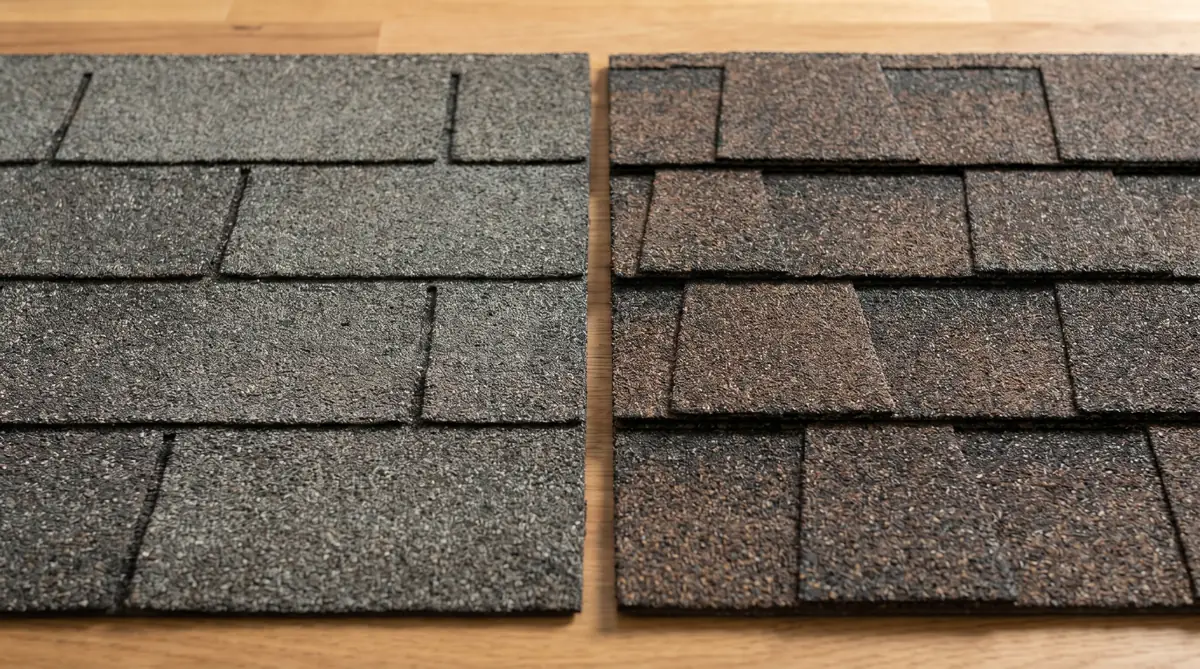
Architectural shingles are asphalt shingles — the real comparison is 3-tab (basic) vs architectural/dimensional (premium). Architectural shingles cost 20–40% more but last 10–15 years longer, resist winds up to 130 mph vs 60–70 mph, carry better warranties, and can qualify for 20–30% insurance discounts. For most homeowners, architectural shingles deliver better total cost of ownership.
First: The Terminology Explained
The phrase "asphalt vs architectural shingles" is a common misconception — architectural shingles are a type of asphalt shingle, not a competing material. Both products share the same core construction: a fiberglass mat saturated with asphalt and coated with mineral granules. The difference is in thickness, weight, and layer construction.
3-Tab Asphalt Shingles
- Single-layer construction
- Flat, uniform appearance
- Weight: 200–250 lbs/square
- Wind rating: 60–70 mph
- Lifespan: 15–25 years
- Warranty: 25 years typical
- Cost: $80–$120/square material
Architectural (Dimensional) Shingles
- Multi-layer laminated construction
- Textured, shadow-line appearance
- Weight: 280–400 lbs/square
- Wind rating: 110–130 mph
- Lifespan: 25–30 years
- Warranty: 30–50 years typical
- Cost: $100–$180/square material
Master Comparison: 12 Factors
| Factor | 3-Tab Asphalt | Architectural | Winner |
|---|---|---|---|
| Material cost / square | $80–$120 | $100–$180 | 3-Tab |
| Installed cost / square | $250–$450 | $350–$700 | 3-Tab |
| Lifespan | 15–25 years | 25–30 years | Architectural |
| Manufacturer warranty | 25 years | 30–50 years (lifetime) | Architectural |
| Wind resistance | 60–70 mph | 110–130 mph | Architectural |
| Weight / thickness | 200–250 lbs/sq | 280–400 lbs/sq | Architectural |
| Appearance / curb appeal | Flat, uniform | Dimensional, textured shadow lines | Architectural |
| Class A fire rating | Yes | Yes | Tie |
| Algae resistance | Basic (optional upgrade) | Standard on most products | Architectural |
| Insurance discount eligibility | None | 20–30% (Class 4 IR only) | Architectural |
| Resale / home value impact | Neutral | Positive (~$1,500–$5,000) | Architectural |
| DIY installation difficulty | Easier (lighter, uniform) | Moderate (heavier, staggered) | 3-Tab |
Cost Breakdown by Project Size
| Roof Size | 3-Tab Installed | Architectural Installed | Premium |
|---|---|---|---|
| 1,000 sq ft (10 squares) | $2,500–$4,500 | $3,500–$7,000 | +$1,000–$2,500 |
| 1,500 sq ft (15 squares) | $3,750–$6,750 | $5,250–$10,500 | +$1,500–$3,750 |
| 2,000 sq ft (20 squares) | $5,000–$9,000 | $7,000–$14,000 | +$2,000–$5,000 |
| 2,500 sq ft (25 squares) | $6,250–$11,250 | $8,750–$17,500 | +$2,500–$6,250 |
| 3,000 sq ft (30 squares) | $7,500–$13,500 | $10,500–$21,000 | +$3,000–$7,500 |
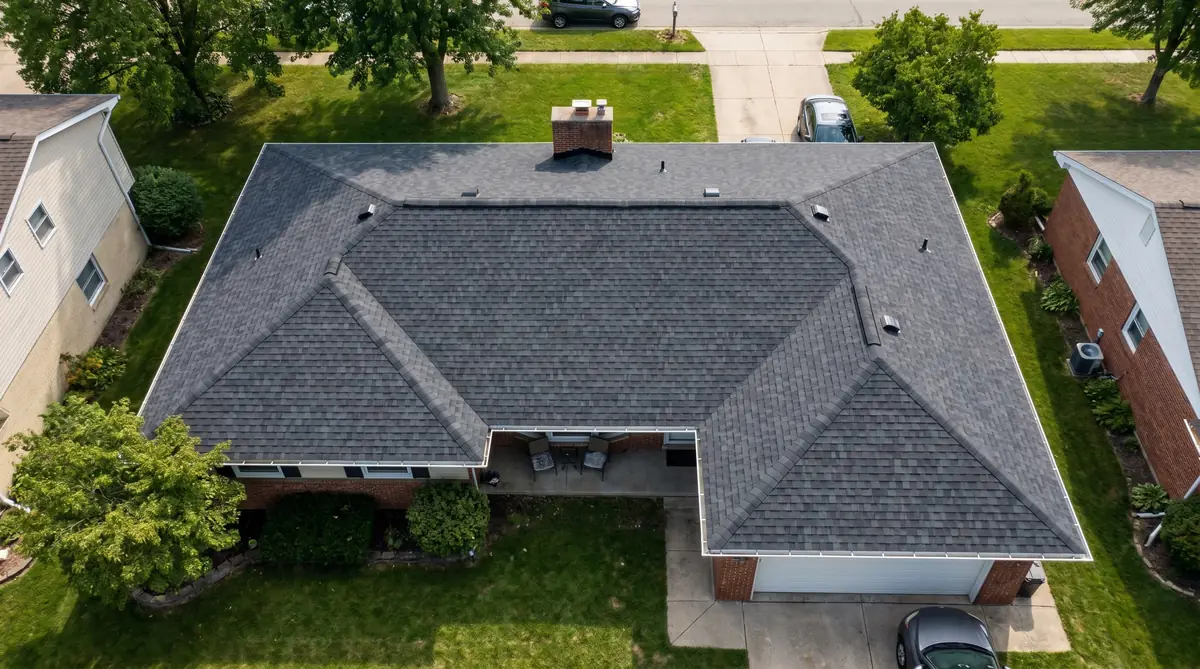
Installed cost includes tear-off of existing shingles, underlayment, ridge cap, starter strips, flashing, and labor. Material-only cost is roughly 40% of the installed total.
Lifespan & Warranty Comparison
| 3-Tab | Standard Architectural | Premium Architectural | |
|---|---|---|---|
| Expected lifespan | 15–25 years | 25–30 years | 30–50 years |
| Manufacturer warranty | 25 years limited | 30 years limited | Lifetime (50-year) limited |
| Wind warranty | 60 mph | 110–130 mph | 130–150 mph |
| Algae warranty | 10 years (if applicable) | 10–25 years | 25 years |
| Transferable to new owner? | Rarely | Often (partial) | Yes (typically) |
Wind Resistance — The Biggest Practical Difference
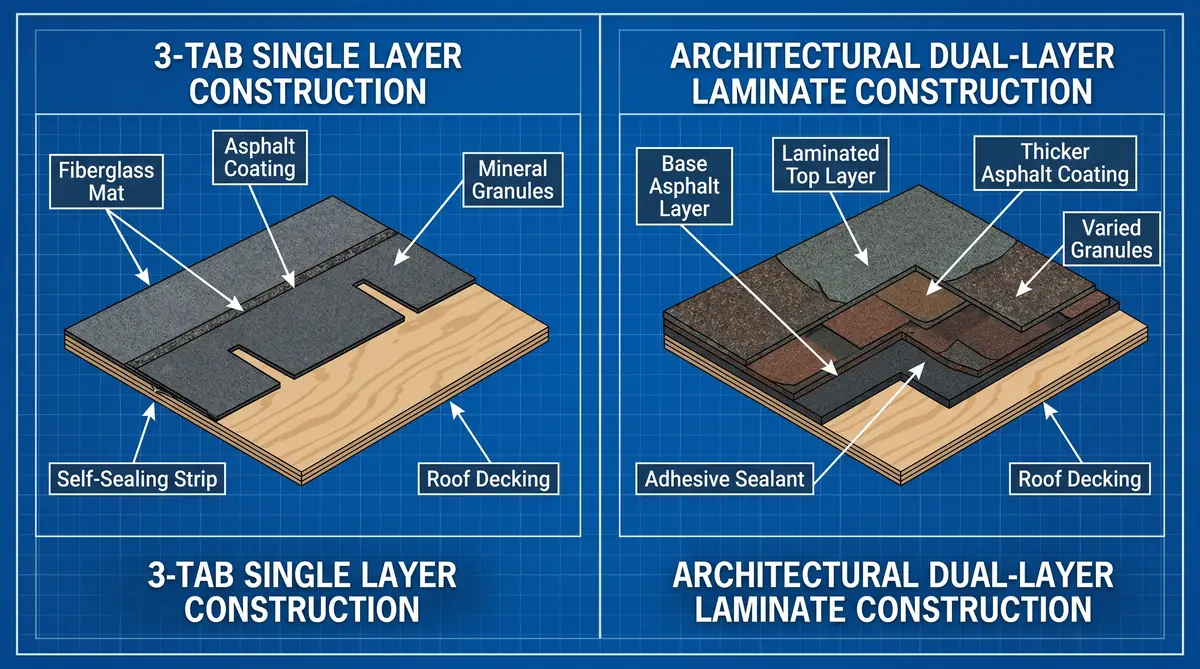
Wind resistance is where the gap between 3-tab and architectural shingles matters most. 3-tab shingles have a single tab exposed to wind uplift with adhesive strips as the only anchor. Architectural shingles have greater mass, a laminated lower layer adding structural rigidity, and larger self-sealing adhesive zones.
| Shingle Type | Wind Rating | ASTM Standard | Where Appropriate |
|---|---|---|---|
| 3-Tab standard | 60–70 mph | ASTM D3462 | Low-wind zones only |
| Architectural standard | 110 mph | ASTM D3462 / D7158 Class D | Most US markets |
| Architectural Class F | 110–150 mph | ASTM D7158 Class F | Gulf Coast, Midwest storm belt |
| Architectural Class G | 150+ mph | ASTM D7158 Class G | Hurricane zones, Florida |
| Impact-resistant (Class 4 IR) | 110–130 mph + hail | UL 2218 Class 4 | Hail-prone: TX, CO, OK, KS |
Appearance & Curb Appeal
3-tab shingles have a flat, uniform profile — all tabs are the same size and thickness, producing a repetitive horizontal pattern. They were the residential standard through the 1990s and are still functional, but they look dated on modern homes.
Architectural shingles use a laminated second layer cut into irregular shapes and bonded to the base shingle at specific intervals. This creates the dimensional shadow lines that mimic the look of wood shake or slate at a fraction of the cost. From the street, an architectural shingle roof has visible depth and texture that adds perceived quality to any home.
Realtors consistently report that a new architectural shingle roof adds $1,500–$5,000 to perceived home value and reduces time on market compared to a home with an aging 3-tab roof.
Climate Performance by Region
| Climate / Region | Recommended | Reason |
|---|---|---|
| Hot & dry (Southwest, AZ, NV) | Architectural with cool-roof granules | UV resistance and thermal cycling durability; ENERGY STAR rating reduces cooling load |
| Hot & humid (FL, Gulf Coast) | Architectural with algae resistance | Without copper granules, 3-tab turns black with algae within 3–5 years; Class G wind rating recommended in FL |
| Cold / freeze-thaw (Northeast, Midwest) | Architectural | Greater mass resists thermal cracking; ice dam protection requires heavier underlayment regardless of shingle type |
| High wind (Plains, Tornado Alley) | Architectural Class F or G | 60–70 mph 3-tab rating is inadequate; Class F/G required by many local codes in OK, KS, TX |
| Hail-prone (CO, TX, OK, NE) | Class 4 Impact-Resistant Architectural | Insurance discount of 20–30% recovers premium in 2–4 years; 3-tab fails hail impact testing entirely |
| Mild & low-risk (Pacific Northwest interior) | Either — 3-tab acceptable | Low wind, mild temps, low hail risk; 3-tab performs adequately and budget savings are real |
When to Choose 3-Tab Shingles
- Strict budget constraint — the upfront cost difference is real and matters when cash is limited
- Short-term ownership — selling within 5 years and the premium won't be recouped in sale price
- Low-value secondary structure — detached garage, storage shed, or rental where aesthetics and longevity are secondary
- Low-wind, mild-climate location — interior Pacific Northwest, parts of California where 60 mph rating is sufficient
- Matching an existing 3-tab roof — partial repair or addition that must visually match existing shingles
When to Choose Architectural Shingles
- Primary residence you'll own 10+ years — longer lifespan and lower maintenance cost justify the premium
- Storm-prone or high-wind area — 110–150 mph rating vs 60–70 mph is not a cosmetic difference
- Hail-prone area — Class 4 IR products recover their premium through insurance discounts in 2–4 years
- Planning to sell within 3–7 years — new architectural roof is a marketable upgrade that speeds sale and supports asking price
- HOA or municipality requirement — many HOAs prohibit 3-tab; some jurisdictions no longer allow 3-tab on new construction
- Roof has complex geometry — hips, valleys, dormers benefit from the added weight and adhesion of architectural shingles
Overlay vs Full Tear-Off
Most building codes allow one layer of new shingles over one existing layer. Installing architectural shingles over old 3-tab shingles — called a "recover" or "overlay" — saves $1–$2 per sq ft in tear-off labor. However, roofing professionals recommend against overlays for several reasons:
- The wavy or worn profile of old 3-tab creates an uneven substrate — architectural shingles installed over it never lie fully flat and the result looks poor
- Combined weight (old + new) may stress older roof decking, especially in snow-load areas
- You lose the ability to inspect and repair the roof deck — hidden rot or damage goes undetected
- Most warranty coverage is voided or reduced on overlay installations
Full tear-off costs more upfront but produces a better result, full warranty coverage, and typically adds 3–5 years to the functional roof life. For a full repair guide, see our asphalt roof repair guide.
Frequently Asked Questions
What is the difference between asphalt shingles and architectural shingles?
Architectural shingles ARE asphalt shingles. The comparison is between 3-tab (basic single-layer asphalt) and architectural/dimensional (multi-layer laminated asphalt). Both use fiberglass mat, asphalt, and mineral granules. Architectural shingles have an extra laminated layer creating thickness, shadow lines, and better wind resistance.
How much more do architectural shingles cost than 3-tab?
20–40% more. Material: 3-tab $80–$120/square vs architectural $100–$180/square. Installed on a 2,000 sq ft roof: 3-tab $5,000–$9,000 vs architectural $7,000–$14,000. The premium is partially offset by longer lifespan and potential insurance discounts.
Do architectural shingles last longer than 3-tab?
Yes — 25–30 years vs 15–25 years for 3-tab. Premium architectural lines are rated 30–50 years. The extra mass and laminated construction resists UV degradation, wind uplift, and thermal cracking better than single-layer 3-tab products.
Are architectural shingles better in high winds?
Significantly better. 3-tab: 60–70 mph. Standard architectural: 110–130 mph. Class F/G architectural: 110–150+ mph. In hurricane or tornado zones, architectural shingles — particularly hip-and-ridge sealed products — are meaningfully safer and often required by local code.
Can you put architectural shingles over 3-tab shingles?
Codes typically allow it, but professionals recommend against overlay installations. Old 3-tab creates an uneven surface, combined weight may stress decking, you can't inspect for hidden rot, and most warranties are voided or reduced. Full tear-off produces a better long-term result.
Do architectural shingles qualify for insurance discounts?
Class 4 impact-resistant architectural shingles qualify for 20–30% discounts in hail-prone states (TX, CO, OK, KS). Standard architectural shingles typically do not. 3-tab shingles never qualify. The payback period on the Class 4 premium is usually 2–4 years through annual savings.
Which shingle is better for hot climates?
Architectural with algae-resistant granules and ENERGY STAR certification. In humid heat (Gulf Coast, Florida), algae-resistant architectural shingles prevent the black streaking that affects 3-tab within 3–5 years. In dry heat, look for architectural products with high solar reflectance ratings.
Are architectural shingles worth the extra cost?
For most homeowners, yes. The premium buys 10–15 extra years of lifespan, better wind and hail resistance, superior appearance, longer warranty, and potential insurance savings. The exception is short-term ownership, very tight budgets, or low-value secondary structures.