
Best Concrete Cleaner — Types, Top Products, How to Use & Stain Guide (2026)
Quick Answer
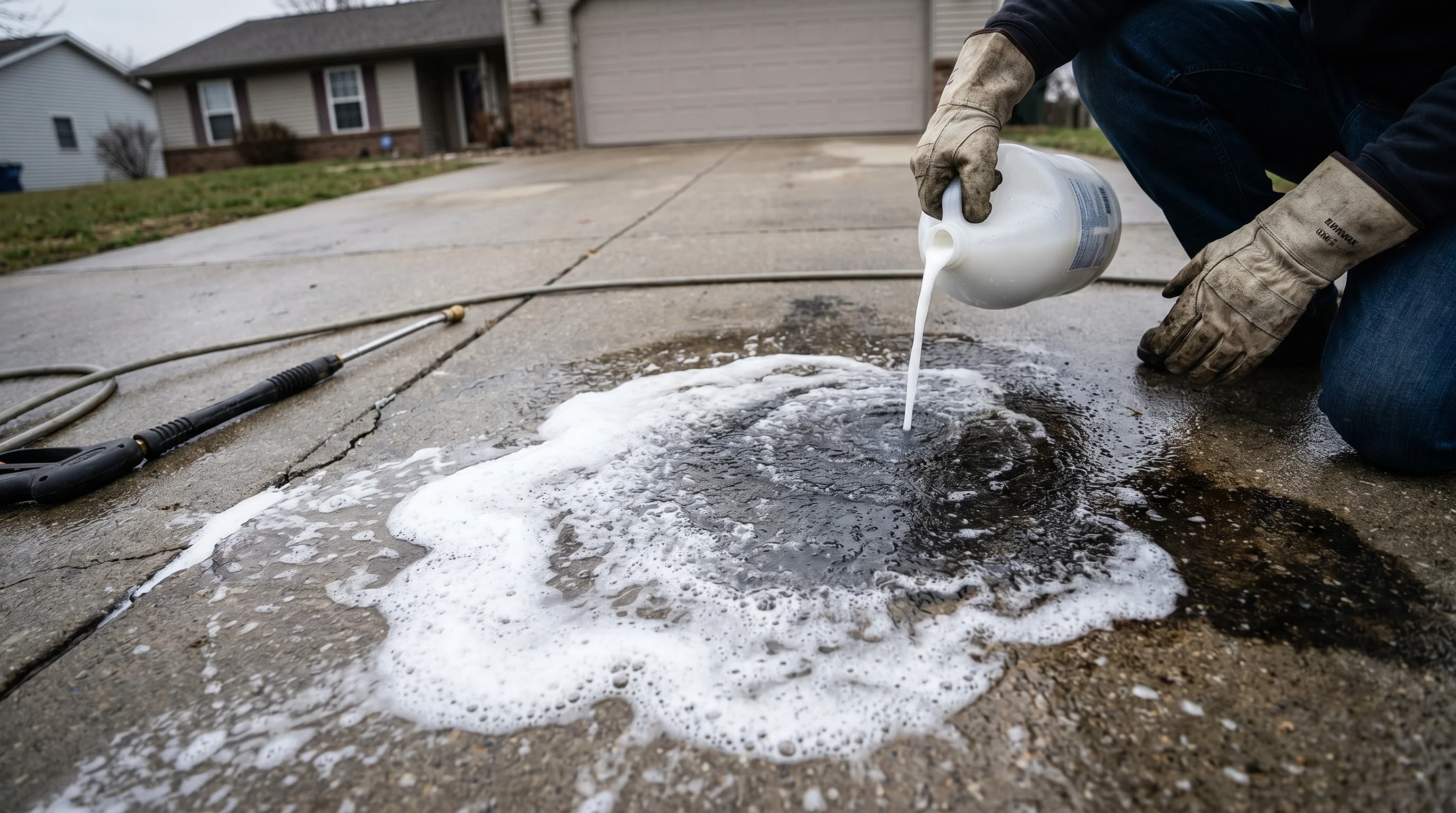
The best concrete cleaner depends on your stain type: alkaline degreasers (Zep Citrus, Krud Kutter) for oil and grease; acidic cleaners or CLR for rust and efflorescence; oxygen bleach (Simple Green Oxy Solve) for mold and algae; enzymatic cleaners for bio-organic stains; and muriatic acid for heavy mineral buildup and surface prep. Match cleaner to stain chemistry — using the wrong type leaves the stain intact.
Concrete looks bombproof, but it's actually one of the most porous common building materials. That open pore structure that makes concrete strong enough to hold up a building is the same reason motor oil from a leaking car can soak in 1–2 inches deep within minutes, why rust from a metal chair leg can permanently stain a patio, and why efflorescence (white salt deposits) seemingly reappears out of nowhere every spring. The pores act like a wick — drawing in contamination and locking it in.
Understanding why concrete stains so readily also tells you why cleaning it requires chemistry, not just water pressure. Most stains bond chemically with the calcium silicate hydrate matrix of the concrete — you can't physically scrub them out without the right cleaner to break those bonds first. Alkaline degreasers surround and emulsify oil molecules. Acid-based cleaners dissolve mineral salts and rust compounds. Enzymatic cleaners biologically digest organic carbon chains. Each type works on a specific category of contamination; none works on everything.
This guide covers every category of concrete cleaner, ranks the top 8 products available in 2026, gives you a stain-type matching table, walks through the 8-step cleaning process, and covers the safety rules that matter — especially if you're working with acid-based products.
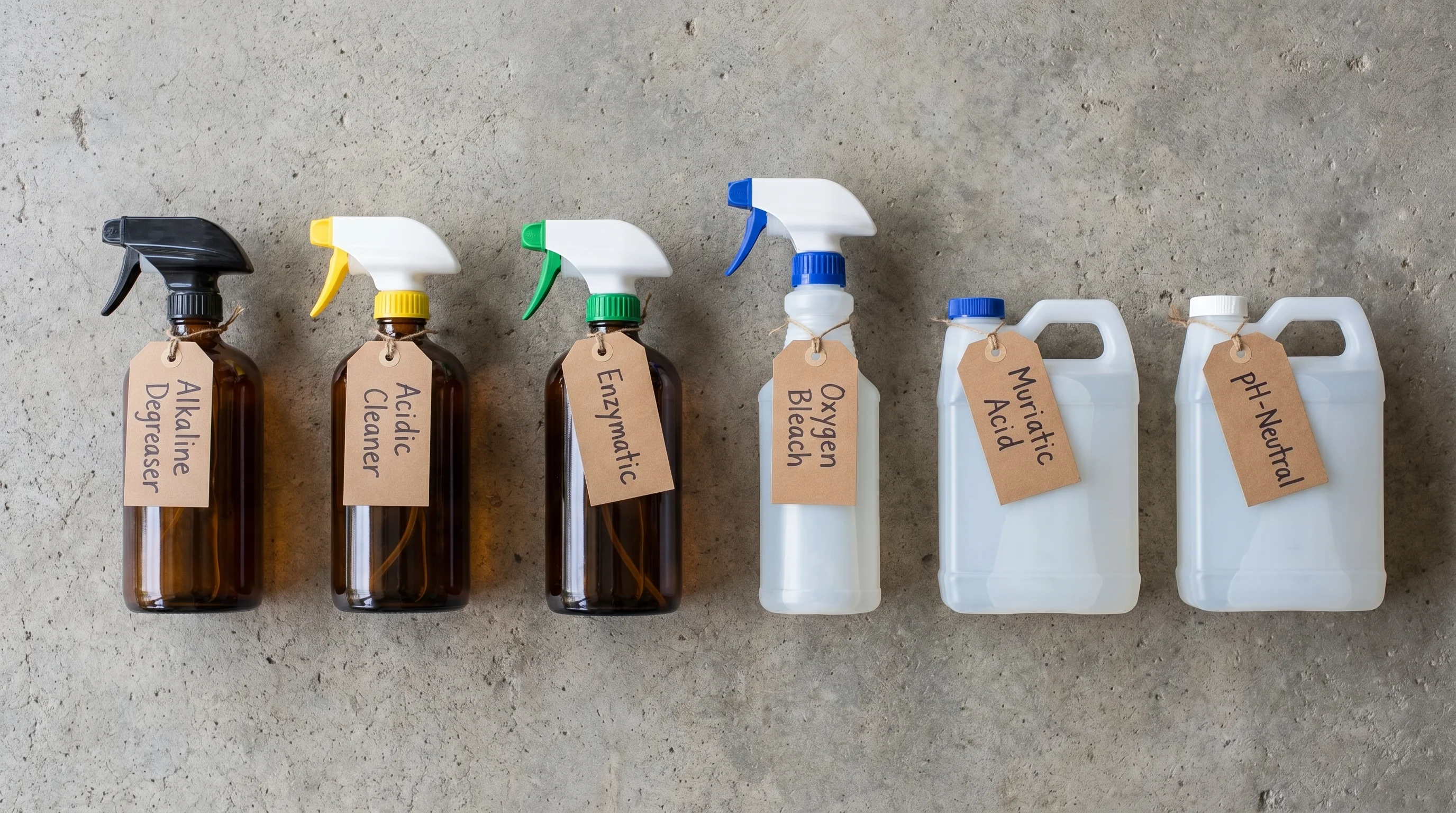
6 Types of Concrete Cleaner Compared
| Type | pH | How It Works | Best For | Limitations |
|---|---|---|---|---|
| Alkaline Degreaser | 9–13 | Surfactants emulsify oil/grease molecules so they rinse away | Oil, grease, hydraulic fluid, cooking grease | Does not remove rust, minerals, or mold |
| Acidic Cleaner | 1–5 | Acid dissolves mineral salts, iron oxide (rust), and calcium deposits | Rust, efflorescence, mineral stains, hard water | Can etch concrete, strip color, corrode metal |
| Enzymatic / Bio | 6–8 | Microbes and enzymes biologically digest organic hydrocarbons | Oil, grease, organic stains — safe for drains | Slower-acting; needs warm temps (>50°F) to work |
| Oxygen Bleach | 10–12 | Releases oxygen that oxidizes and breaks down organic staining agents | Mold, algae, moss, general grime, organic stains | Less effective on mineral/oil stains; needs dwell time |
| Muriatic Acid | <1 | Strong HCl acid aggressively dissolves cement paste and mineral deposits | Heavy efflorescence, etching for sealer prep, severe rust | Highly hazardous; requires PPE; must neutralize |
| pH-Neutral | 6–8 | Mild surfactants lift surface dirt without aggressive chemistry | Colored/stamped concrete, routine maintenance | Ineffective on heavy staining; not for oil or rust |
Alkaline Degreaser — Deep Dive
Alkaline degreasers are the workhorses of concrete cleaning. They work through saponification and surfactant chemistry: the high pH (typically 10–13) breaks the ester bonds in oils and greases, while the surfactant molecules form micelles around oil droplets — a hydrophilic outer shell that allows the oil to be surrounded by water and rinsed away. This is why degreasers need both dwell time (to penetrate the pores) and mechanical agitation (to break up the oil film) before rinsing.
Dilution matters significantly. Most concentrated degreasers are designed to be diluted 1:4 to 1:20 with water depending on stain severity. Using them at full concentration is not always better — on some formulations it actually reduces effectiveness because the surfactant concentration gets too high and the foam prevents penetration. Read the label and start with the recommended dilution for heavy degreasing (typically 1:4 to 1:8).
Dwell time is where most people fail. Ten to twenty minutes is the minimum for old, set-in oil stains — not the 2–3 minutes most people give it. On hot sunny days, keep the surface wet by misting with water during the dwell period to prevent the cleaner from drying and redepositing the dissolved grease. Covering the treated area with plastic sheeting for 15–20 minutes improves penetration significantly on vertical or fast-drying surfaces.
Temperature also affects alkaline cleaners. Below 50°F the surfactant chemistry slows considerably — expect 30–50% reduced effectiveness in cold conditions. On hot pavement above 90°F, the cleaner evaporates quickly and may need reapplication. The sweet spot is 60–80°F ambient temperature.
Acidic Cleaner — Deep Dive
Acidic concrete cleaners contain one or more of the following active acids: phosphoric acid (moderate strength, often in commercial cleaners), oxalic acid (targeted for rust and tannin stains), citric acid (mild, in many "green" formulas), sulfamic acid (descaling, low fuming), or hydrochloric acid (muriatic acid — strongest, requires the most caution). All work through the same mechanism: the hydrogen ions in the acid react with alkaline mineral compounds — calcium carbonate, iron oxide, magnesium sulfate — and convert them into soluble salts that can be rinsed away.
The key difference between etching and cleaning: etching removes a thin layer of the concrete surface itself (the cement paste), which opens pores for sealer adhesion or changes the surface profile. Cleaning removes the deposit sitting on or within the surface without necessarily removing concrete. Most acidic cleaners designed for rust or efflorescence removal are formulated to clean without significant etching. Muriatic acid at full strength etches aggressively — it's used before painting or sealing to profile the surface, not just clean it.
For efflorescence removal specifically: dry-brush the loose white powder first, which removes the mechanically bonded material and reduces the volume the acid needs to dissolve. Apply the acid solution to a dry surface (not pre-wetted as you would for alkaline cleaners) so the acid concentrates at the deposit rather than being diluted. Allow 3–5 minutes dwell, then scrub and rinse. Multiple lighter applications are safer than one heavy application for protecting the concrete surface beneath.
Enzymatic and Bio-Based Cleaners — Deep Dive
Enzymatic and microbial concrete cleaners represent a different paradigm — instead of breaking stains apart chemically, they use living microorganisms and the enzymes they produce to biologically digest hydrocarbon chains in oil and grease. The microbes consume the contamination as a food source, converting it into carbon dioxide and water through metabolic processes. The result is complete stain elimination rather than just emulsification — the contamination is actually consumed, not just suspended and rinsed.
The trade-off is time and conditions. Enzymatic cleaners typically require 24–72 hours of contact time for heavy oil stains, compared to 15–30 minutes for alkaline degreasers. Temperature must stay above 50°F and ideally above 65°F for the microbes to be active. The surface must remain moist. For driveways or garage floors where you need results quickly, an alkaline degreaser is more practical. Where enzymatic cleaners shine is: storm drain-adjacent areas (the microbes continue working in the drain system, preventing clogs and reducing environmental contamination), shop floors with chronic oil contamination, and situations where aggressive chemicals are restricted.
Muriatic Acid Safety — Complete Protocol
Dilution protocol: always add acid to water, never water to acid. The mnemonic is "AAA — Always Add Acid." Adding water to concentrated acid can cause a violent exothermic reaction and splashing. For concrete cleaning, a 1:10 dilution (1 part muriatic acid to 10 parts water) is the appropriate starting point. For heavy efflorescence or rust, you can go to 1:5. Full-strength muriatic acid on concrete will etch aggressively and may damage the surface — only use full strength when deliberately profiling concrete for coatings.
Application: pre-wet the concrete surface with clean water first — this prevents the acid from being absorbed too deeply too quickly and gives you more control. Apply the diluted acid solution with a plastic watering can or plastic sprayer (never metal — acid corrodes it). Work in small sections (50–100 sq ft at a time). Watch for bubbling/fizzing — this is the acid reacting with calcium carbonate and is expected. When bubbling slows, scrub with a stiff plastic or acid-resistant brush, then rinse thoroughly with water. Immediately after rinsing, apply the baking soda neutralization solution, let it sit 2–3 minutes, then final rinse. Test the pH of rinse water with litmus paper — should be above 6 before you leave the area.
8 Best Concrete Cleaner Products (2026)
Zep Heavy-Duty Citrus Degreaser
One of the best-performing alkaline degreasers on the market. D-limonene (citrus solvent) combined with industrial surfactants cuts through heavy motor oil, hydraulic fluid, and cooking grease. Concentrate — dilute 1:4 to 1:20 depending on severity. Works well with pressure washers. Safe for asphalt and most pavers. Price: ~$18–$22/gallon concentrate.
Krud Kutter Concrete Cleaner & Degreaser
Ready-to-use alkaline degreaser that excels on driveways and garage floors. Non-toxic, biodegradable, and effective on both fresh and set-in grease stains. Good for routine maintenance applications where you don't want to mix concentrates. Works well as a pre-treatment before pressure washing. Price: ~$10–$14/32 oz RTU.
Simple Green Oxy Solve Concrete & Driveway Cleaner
Oxygen bleach (sodium percarbonate) formula excellent for mold, algae, moss, and general organic grime. Safer than chlorine bleach — no toxic fumes, won't bleach clothing or kill nearby plants when used correctly. Effective on food stains, bird droppings, and general surface darkening. Best results with 10–15 minute dwell time and a stiff brush. Price: ~$12–$16/32 oz concentrate.
ACT Microbial Concrete Cleaner
Professional-grade enzymatic/microbial cleaner ideal for chronic oil contamination on garage floors, shop floors, and parking areas. The microorganisms continue working for 72+ hours after application, reaching deeper into pores than chemical cleaners. Drain-safe and environmentally compliant — excellent for applications near storm drains. Price: ~$35–$45/gallon concentrate (makes 10–20 gallons).
RMR-86 Instant Mold & Mildew Stain Remover
Chlorine-based stain remover with sodium hypochlorite concentrate — the fastest-acting mold and mildew stain remover available. Works in 15–30 seconds on surface mold staining. Not for use on colored concrete. Requires excellent ventilation and PPE (gloves + eye protection). Use outdoors only. Very effective for patios, walkways, and pool surrounds with heavy biological staining. Price: ~$22–$28/32 oz.
CLR Pro Calcium, Lime & Rust Remover
Professional-strength acidic cleaner (lactic + gluconic + sulfamic acids) formulated specifically for calcium deposits, lime scale, and rust. Outstanding performance on rust stains from metal furniture, irrigation heads, or rebar bleed-out, and on hard water mineral deposits. Safe for colored concrete when used per label dilution (1:1 with water for concrete). Price: ~$14–$18/28 oz.
Rust-Oleum Concrete Etch & Cleaner
Pre-mixed muriatic acid alternative (ethanedioic acid + surfactants) that cleans, etches, and profiles concrete for painting or sealing. Much easier to use than raw muriatic acid — no mixing required, lower fume generation, and gentler on adjacent surfaces. Purpose-built for pre-coating surface preparation. Not as aggressive as muriatic for severe efflorescence — better for moderate cleaning + sealer prep. Price: ~$14–$18/32 oz.
Sakrete Concrete & Asphalt Cleaner
pH-neutral surfactant cleaner safe for colored, stamped, and decorative concrete surfaces. Will not strip integral pigments or damage stamped textures. Good for routine maintenance cleaning (quarterly or after heavy use periods). Also safe for asphalt and pavers. Does not require rinsing on most surfaces. Best paired with a scrub brush and garden hose for low-effort maintenance. Price: ~$10–$13/32 oz.
Stain-Type Matching Table
Using the wrong cleaner wastes time and money without removing the stain. Match your cleaner to the stain chemistry every time.
| Stain Type | Best Cleaner Type | Recommended Products | Dwell Time | Notes |
|---|---|---|---|---|
| Fresh motor oil (<48 hrs) | Alkaline degreaser | Zep Citrus, Krud Kutter | 10–15 min | Absorb bulk with cat litter first |
| Old/set-in oil (>1 week) | Heavy alkaline degreaser | Zep Citrus concentrate (1:4) | 20–30 min + scrub | May need 2–3 applications |
| Rust (from metal/rebar) | Acidic cleaner | CLR Pro, Rust-Oleum Etch | 3–5 min | Rinse thoroughly; neutralize |
| Efflorescence | Acidic cleaner or muriatic acid | CLR Pro, diluted muriatic | 3–5 min | Dry-brush loose powder first |
| Mold / algae / moss | Oxygen bleach or chlorine bleach | Simple Green Oxy Solve, RMR-86 | 10–15 min | Rinse to protect plants |
| Tire marks (rubber transfer) | Alkaline degreaser | Zep Citrus, Krud Kutter | 15–20 min | Hot water improves results |
| Paint (latex) | Alkaline degreaser + scrape | Krud Kutter Paint Remover | 15–30 min | Mechanical removal may be needed |
| Paint (oil-based) | Solvent + alkaline degreaser | Acetone + Zep follow-up | 10–15 min | Solvent loosens, degreaser cleans |
| Bird droppings | Oxygen bleach or pH-neutral | Simple Green Oxy Solve | 5–10 min | Dry scrape if hardened first |
| Battery acid spill | Alkaline neutralizer then neutral | Baking soda + water, then clean | Immediate | Neutralize acid first — safety priority |
| Hard water mineral deposits | Acidic cleaner | CLR Pro, white vinegar | 5–10 min | Multiple applications for buildup |
| Colored/stamped concrete | pH-neutral only | Sakrete Concrete Cleaner | 5–10 min | Never use acid or strong alkali |
8-Step Concrete Cleaning Process
-
1
Clear and Dry-Sweep the Surface
Remove all furniture, vehicles, and obstacles. Sweep or blow off loose dirt, leaves, and debris. A clean dry surface lets you see all stain locations before they get wet and darker. For garage floors, sweep out grit that would otherwise scratch the surface when you scrub. Note every stain type so you can target each with the correct cleaner.
-
2
Pre-Treat Heavy Stains
For fresh oil stains: pour an absorbent material (cat litter, cornstarch, or commercial oil dry) over the spill, press in with your foot, and leave for 30–60 minutes to pull as much oil out of the pores as possible before applying cleaner. For hardened bird droppings or paint: dry-scrape with a plastic scraper to remove the bulk mechanically. This pre-treatment dramatically reduces the chemical load the cleaner must handle.
-
3
Pre-Wet the Concrete (Alkaline and Enzymatic Cleaners Only)
For alkaline degreasers and enzymatic cleaners: pre-wet the surface with water before applying the cleaner. This prevents the cleaner from being absorbed too rapidly into the top layer, ensures even distribution across the surface, and cools hot concrete in summer. Do not pre-wet when using acidic cleaners — the acid should contact the dry mineral deposits at full concentration for best results.
-
4
Apply the Cleaner
Apply your chosen cleaner per label instructions. For concentrates, mix correctly first (add concentrate to water, not the reverse). Use a pump sprayer, plastic watering can, or pour directly. Ensure complete coverage of the stained area plus a 6-inch border. For large areas, work in manageable sections (50–100 sq ft) to prevent the cleaner from drying before you can rinse it.
-
5
Allow Dwell Time — Don't Rush
This is the most commonly skipped step. The cleaner needs time to penetrate the pores and react with the staining agent. Degreasers: minimum 10 minutes for fresh stains, 20–30 minutes for old stains. Oxygen bleach: 15–20 minutes. Enzymatic: 20–60 minutes (or leave overnight for heavy contamination). Keep the surface wet during dwell — mist with water if it starts to dry in hot or windy conditions.
-
6
Agitate with a Stiff Brush
Use a stiff-bristle deck brush or scrub brush to work the cleaner into the pores and break up loosened staining material. For circular scrubbing motions, apply firm downward pressure — you're not polishing, you're physically dislodging the contamination the cleaner has loosened. For large areas, a long-handle push brush reduces fatigue. Use a hand brush for corners and cracks. Agitation can make the difference between a 70% and 95% clean result.
-
7
Rinse Thoroughly
Rinse with a garden hose on high-pressure setting or a pressure washer (1,500–3,000 PSI with a 25° to 40° fan tip for concrete). Rinse in overlapping passes, working the dirty water toward a drain. For acid cleaners, rinse until no fizzing occurs and the surface appears clean. Adequate rinsing is critical — residual alkaline cleaner left on the surface can cause whitish hazing as it dries; residual acid can continue etching the surface.
-
8
Neutralize (After Acid Cleaners) and Inspect
After using any acidic cleaner, apply a baking soda neutralization solution (1 cup per gallon of water) over the entire treated area, let it sit 2–3 minutes, then final rinse. This raises the surface pH back to neutral and stops any residual etching. Allow the surface to dry completely (6–24 hours) before inspecting results. Repeat targeted applications on any remaining stains — heavy contamination often requires 2–3 treatment cycles.
- Apply cleaner first and let it dwell — never try to pressure wash without a cleaner on oil or rust stains. Water alone cannot break the chemical bond.
- Use a 25° tip (yellow) for general concrete rinsing, 40° tip (white) for colored or decorative concrete.
- Keep the nozzle moving — holding in one place for more than 2 seconds can etch or surface-damage older or weaker concrete.
- For concrete <3 years old, limit pressure to 1,500 PSI — freshly cured concrete is softer and easier to damage.
- Downstream injection (through the pressure washer wand) of degreaser concentrate combined with pressure washing is the most time-efficient cleaning method for large driveways.
- Rinse in the direction of the nearest drain or landscape area — never let chemical-laden water flow toward a storm drain without diluting first.
DIY Concrete Cleaner Recipes
Commercial cleaners are the most reliable option, but for routine maintenance, light staining, or situations where you need a quick solution, these DIY recipes are effective:
| Recipe | Ingredients | Best For | Dwell Time |
|---|---|---|---|
| General Degreaser | 1 tbsp dish soap + 2 tbsp baking soda + 1 gallon warm water | Light oil, general grime | 10 min + scrub |
| Mold/Algae Killer | 1 cup OxiClean per gallon hot water | Mold, mildew, moss, organic discoloration | 15–20 min |
| Efflorescence Remover | Undiluted white vinegar (5% acetic acid) | Light efflorescence, mineral deposits | 5–10 min |
| Heavy Mold Treatment | 1 part bleach + 10 parts water (outdoor use only) | Severe mold, heavy algae on walkways/patios | 10–15 min |
| Rust Spot Treatment | Lemon juice (citric acid) applied undiluted | Small, fresh rust stains | 5 min |
| Surface Prep (Pre-Sealing) | 1 cup TSP substitute + 1 gallon warm water | General pre-sealing cleaning | 10 min + rinse well |
Cleaning Concrete by Surface Type
Not all concrete surfaces are the same — cleaning approach should vary based on surface characteristics:
| Surface | Special Considerations | Recommended Approach | Avoid |
|---|---|---|---|
| Driveway (standard gray) | Heavy vehicle traffic; oil/tire marks common | Alkaline degreaser + pressure washer | Nothing restricted |
| Garage floor | Enclosed space — fume buildup risk | Alkaline degreaser; enzymatic for chronic oil | Muriatic acid indoors |
| Stamped/colored concrete | Acid and strong alkalis damage color and texture | pH-neutral cleaner only | Acid, bleach, strong alkali |
| Patio (unsealed) | Porous; stains absorb deeply | Alkaline or oxygen bleach depending on stain | Nothing restricted |
| Patio (sealed) | Sealer layer protects surface; scrubbing can scuff | pH-neutral; mild alkaline only | Acid (strips sealer) |
| Pool surround | Water and chemical runoff into pool | Oxygen bleach; rinse extremely well | Acid, bleach (affects pool chemistry) |
| Basement floor | Enclosed; possible drain; radon risk area | Enzymatic or alkaline with strong ventilation | Acid or bleach without ventilation |
| Sidewalk / curb | Storm drain proximity; public surface | Enzymatic or oxygen bleach (drain-safe) | Strong acid or bleach near drain |
Concrete Cleaner for Pressure Washer vs. Hand Application
Many concrete cleaners are formulated specifically for one delivery method or the other. Understanding the distinction helps you choose the right format:
Pressure washer concentrates are designed for downstream injection — they're ultra-concentrated (often 10:1 to 20:1 dilution), low-foaming (foam interferes with pressure washer performance), and flow well through the injection orifice. Zep's concentrate line and many janitorial-grade degreasers fall in this category. Using a regular foaming degreaser in a downstream injector will clog it and reduce effectiveness.
Hand application formulas are typically ready-to-use or designed for 4:1–8:1 dilution. They may foam more heavily (foam extends contact time on vertical surfaces and in cracks) and are packaged in spray bottles or pour jugs for targeted application. Most retail products (Krud Kutter RTU, CLR Pro) are in this category.
The practical takeaway: for a 400 sq ft driveway, a pressure washer with downstream-injected concentrate cleans in 20–30 minutes total. Hand-scrubbing the same area takes 1–2 hours. Where precision matters (targeting specific stain types, treating colored concrete carefully), hand application gives more control.
How to Clean Concrete Before Sealing
Surface preparation is the most critical step before applying any concrete sealer, paint, or epoxy coating. A sealer applied over contamination will fail — the bond between the sealer and the concrete is broken by trapped oil, salts, or dust. The required cleaning sequence:
- Remove all surface contamination — degrease any oil stains completely; treat rust with acid cleaner; remove all mold and biological staining with oxygen bleach or bleach solution.
- Profile the surface with acid etch — apply diluted muriatic acid (1:10) or a commercial concrete etch product to open the pores and create a mechanical bond profile. Water should bead on unsealed concrete; if it soaks in immediately, profiling is adequate. If it beads, the surface is too smooth or still has sealer residue.
- Neutralize completely — apply baking soda solution, rinse, and test pH. Surface pH should be 6.5–7.5 before sealer application.
- Allow full cure dry time — typically 24–48 hours minimum after cleaning before applying sealer. Moisture trapped under the sealer will cause bubbling and adhesion failure.
- Final sweep and blow — remove any dust or loose material that has settled during the drying period immediately before applying sealer.
8 Common Concrete Cleaning Mistakes
- Using the wrong cleaner chemistry for the stain type. Alkaline degreaser on rust does nothing. Acid cleaner on oil does nothing. Match cleaner to stain — consult the stain-type table above before buying.
- Not allowing adequate dwell time. Applying cleaner and rinsing after 2 minutes is the most common reason cleaning fails. Most cleaners need 10–20+ minutes to penetrate and react.
- Skipping absorbent pre-treatment on fresh oil spills. Applying degreaser to a still-liquid oil spill just pushes the oil deeper into the pores. Pull the bulk out with an absorbent first.
- Applying acid cleaner to a pre-wetted surface. Pre-wetting dilutes the acid at the surface right when you need maximum concentration at the mineral deposit. Apply acid to a dry surface and pre-wet only for alkaline cleaners.
- Using muriatic acid in an enclosed space. HCl fumes accumulate rapidly indoors. Even brief exposure causes respiratory damage. Muriatic acid is an outdoor-only product.
- Mixing bleach with any other cleaner. Toxic gas production is immediate and dangerous. Use one product at a time and rinse thoroughly between switching chemistry types.
- High-pressure washing without pre-treating. Water alone cannot remove oil or rust chemically. Running a pressure washer over an oil stain without degreaser just spreads the oil over a larger area and drives it deeper.
- Not sealing concrete after cleaning heavy staining. Cleaned concrete without a follow-up sealer will re-stain just as quickly — the open pores are now clean but still completely exposed. Apply a penetrating sealer within 48–72 hours of cleaning if you want lasting results.
When to Hire a Professional Concrete Cleaner
Most residential concrete cleaning is a legitimate DIY job with the right products and process. Professional cleaning makes sense when:
- The stained area exceeds 500–1,000 sq ft (professional truck-mounted equipment is dramatically faster)
- The staining involves hazardous substances — motor oil from a major spill, industrial chemicals, or fuel — that create disposal concerns
- You have very old concrete (pre-1980) where aggressive cleaning could damage brittle or carbonated concrete
- The surface needs acid etching before a professional epoxy or polyurea coating installation
- The concrete has significant pitting, cracking, or spalling — pressure washing can extend damage in compromised areas
- HOA or municipality rules require licensed contractors for work visible from the street
Professional concrete cleaning typically costs $0.15–$0.35 per square foot for basic pressure washing + degreasing, or $0.40–$0.80 per square foot for full clean + etch + preparation for coating. See our concrete cleaning near me guide for a state-by-state contractor finder and complete pricing breakdown.
Frequently Asked Questions
What is the best concrete cleaner for oil stains?
Alkaline degreasers — specifically heavy-duty citrus-based or solvent-emulsifying formulas — are the best concrete cleaners for oil and grease stains. Products like Zep Heavy-Duty Citrus Degreaser or Krud Kutter work by surrounding oil molecules with surfactants, emulsifying them so they rinse away with water. For fresh oil, pour an absorbent (cat litter or baking soda) first to pull the bulk of the oil out of the pores, then apply the degreaser. For old, set-in oil stains, let the degreaser dwell 10–20 minutes and agitate with a stiff-bristle brush before rinsing. Enzymatic cleaners like ACT Microbial are also excellent for chronic oil contamination.
Can I use bleach to clean concrete?
Yes — diluted bleach (1:10 ratio) is effective for killing mold, mildew, algae, and moss on concrete. However, bleach does not remove oil, rust, or mineral stains. Never mix bleach with any acidic cleaner — the reaction produces chlorine gas. Bleach can lighten colored concrete and may kill surrounding plants if it runs off. Oxygen bleach (Simple Green Oxy Solve) is a safer alternative effective against mold without the toxicity risks of chlorine bleach.
What removes rust stains from concrete?
Acidic concrete cleaners specifically formulated for rust removal work best — products containing oxalic acid, phosphoric acid, or citric acid dissolve the iron oxide that causes rust staining. CLR Pro is one of the most effective for rust. Apply it undiluted to the stained area, let it dwell 2–5 minutes, agitate with a brush, then rinse. Alkaline degreasers will not remove rust — you need an acid-based product.
How do I clean concrete without a pressure washer?
Apply your chosen cleaner to a pre-wetted surface, let it dwell 5–15 minutes, then scrub with a stiff-bristle brush or push broom with stiff nylon bristles. A garden hose with a high-pressure nozzle setting will rinse most cleaners adequately. For heavy oil stains without a pressure washer, apply the degreaser, cover with plastic sheeting for 20–30 minutes to prevent drying, then scrub vigorously. Repeat applications beat scrubbing harder.
Is muriatic acid safe to clean concrete?
Muriatic acid is effective at cleaning concrete but is a serious chemical hazard requiring full PPE: chemical-resistant gloves, chemical splash goggles, acid-resistant clothing, and a half-mask respirator with acid-gas cartridges. Always dilute to 1:10 (acid to water), add acid to water (never the reverse), work outdoors with excellent ventilation, and neutralize the surface with baking soda solution before the final rinse. Pre-mixed muriatic acid alternatives like Rust-Oleum Concrete Etch are safer and easier for most applications.
How do I remove efflorescence from concrete?
Dry-brush the loose white powder first, then apply an acidic cleaner (CLR Pro, diluted muriatic acid, or commercial efflorescence remover) to a dry surface. Let it dwell 3–5 minutes, scrub with a stiff brush, and rinse thoroughly. To prevent recurrence, seal the concrete after cleaning to block the moisture migration that deposits the salts. If efflorescence keeps returning, there is a persistent moisture source behind the concrete that needs to be addressed.
What concrete cleaner is safe for colored or stamped concrete?
Use pH-neutral concrete cleaners for colored or stamped concrete — acidic cleaners can strip integral color pigments and etch stamped textures, while strong alkaline cleaners can cause surface whitening. Sakrete Concrete Cleaner, Simple Green's standard formula, and products specifically labeled for decorative concrete are the safest choices. Avoid muriatic acid entirely on colored concrete. After cleaning, reseal stamped or colored concrete to protect the surface.
Can I make my own concrete cleaner?
Yes — for general cleaning: mix 1 tablespoon dish soap + 2 tablespoons baking soda per gallon of warm water. For mold: 1 cup OxiClean per gallon of hot water. For light efflorescence: undiluted white vinegar left 5–10 minutes. DIY solutions work well on fresh or light staining. Heavy or old stains typically require commercial cleaners with more concentrated active chemistry — especially for oil and rust.