
Concrete Paint — Best Types, Top Products & How to Apply (2026)
Quick Picks by Surface
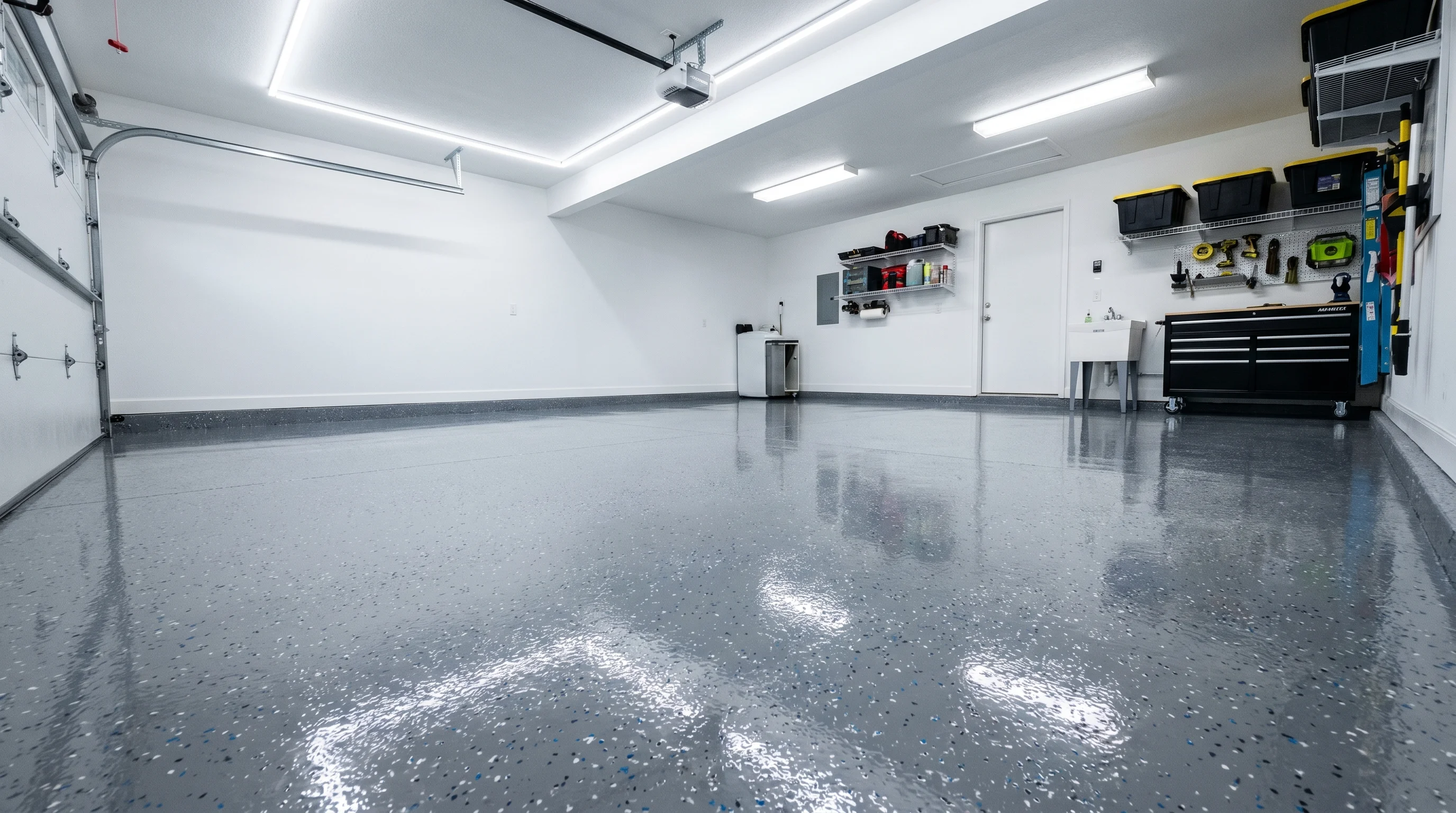
Garage floor: Two-part epoxy floor paint — Rust-Oleum EpoxyShield or BEHR Premium Granite Grip. Best chemical resistance, durability, and cleanability.
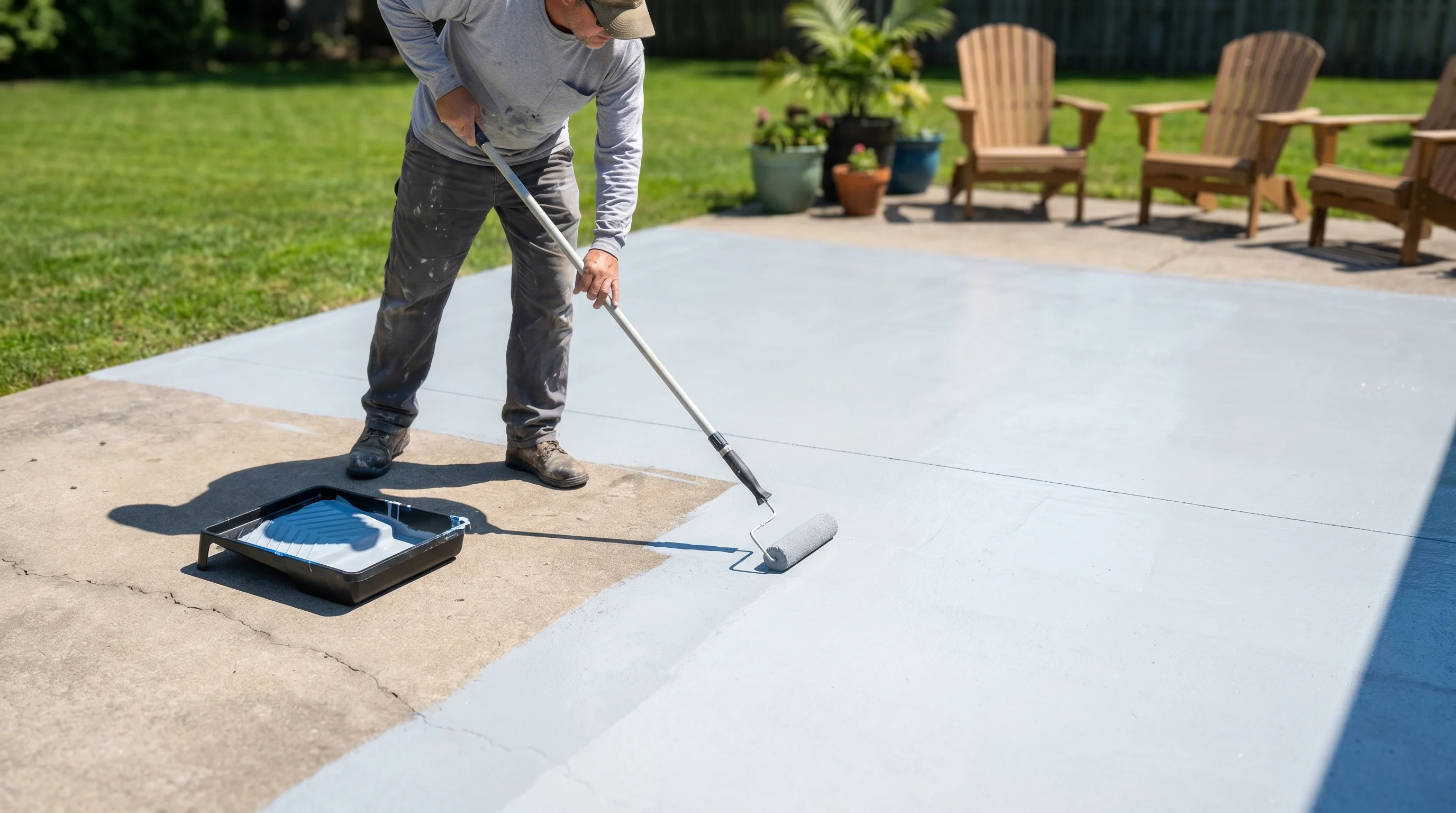
Patio / pool deck: Masonry acrylic or elastomeric — KILZ Over Armor or BEHR Concrete & Masonry. Add anti-slip grit. UV stable.
Basement walls: Waterproofing masonry paint — Drylok Masonry Waterproofer. Blocks moisture vapor, prevents mold and efflorescence.
Exterior concrete walls (cracks present): Elastomeric paint — Rust-Oleum Elastomeric. Bridges hairline cracks up to 1/16 inch, expands and contracts with temperature cycles.
Driveway: Epoxy masonry coating — KILZ Over Armor or Rust-Oleum Concrete & Garage. Expect to recoat every 2–4 years under vehicle traffic.
Concrete Paint vs Concrete Stain vs Concrete Sealer — What's the Difference?
These three terms are frequently confused, and choosing the wrong product category leads to wasted money and poor results. Here is exactly how they differ:
Concrete paint forms an opaque film on top of the concrete surface, covering its appearance entirely — similar to painting a wall. It provides color, protection, and can bridge minor surface imperfections. Because it sits on top of the concrete rather than inside it, it is susceptible to peeling, chipping, and wear under heavy traffic or moisture pressure from below. Paint is the right choice when you want color coverage, a fresh decorative finish, or a surface that can be repainted in a different color later.
Concrete stain penetrates into the surface of the concrete and chemically or physically colors the material itself. Acid stains react with calcium compounds in the concrete to produce permanent, variegated earth-tone colors — every surface looks slightly different, which is considered the aesthetic appeal. Water-based stains use pigment particles that physically penetrate the pores. Because stain is inside the concrete rather than on top of it, it cannot peel. However, it cannot be removed once applied, and color options are somewhat limited compared to paint. Stain is the right choice when you want a permanent, natural-looking color treatment that will not need reapplication.
Concrete sealer is not a color product at all — it is a protective treatment that may or may not be tinted, applied primarily to protect the concrete from water, salt, staining, and abrasion rather than to change its color. Penetrating sealers are entirely invisible; film-forming sealers (acrylic, epoxy, polyurethane) add a sheen but typically preserve the natural concrete color. Sealer is the right choice when protection is the primary goal and changing the color is secondary or unwanted. See our full concrete sealer guide for a deep dive on sealer types and products.
| Product Type | How It Works | Appearance | Reversible? | Lifespan | Best For |
|---|---|---|---|---|---|
| Concrete Paint | Opaque film on surface | Full color coverage | Yes (strip and repaint) | 2–7 years | Garage floors, patios, exterior walls |
| Concrete Stain | Penetrates into concrete | Translucent, variegated color | No (permanent) | Permanent | Decorative floors, patios, stamped concrete |
| Concrete Sealer | Surface film or penetrating | Natural / sheen / gloss | Film-forming: yes; penetrating: no | 1–10 years | Driveways, exterior flatwork, all-around protection |
5 Types of Concrete Paint — Full Comparison
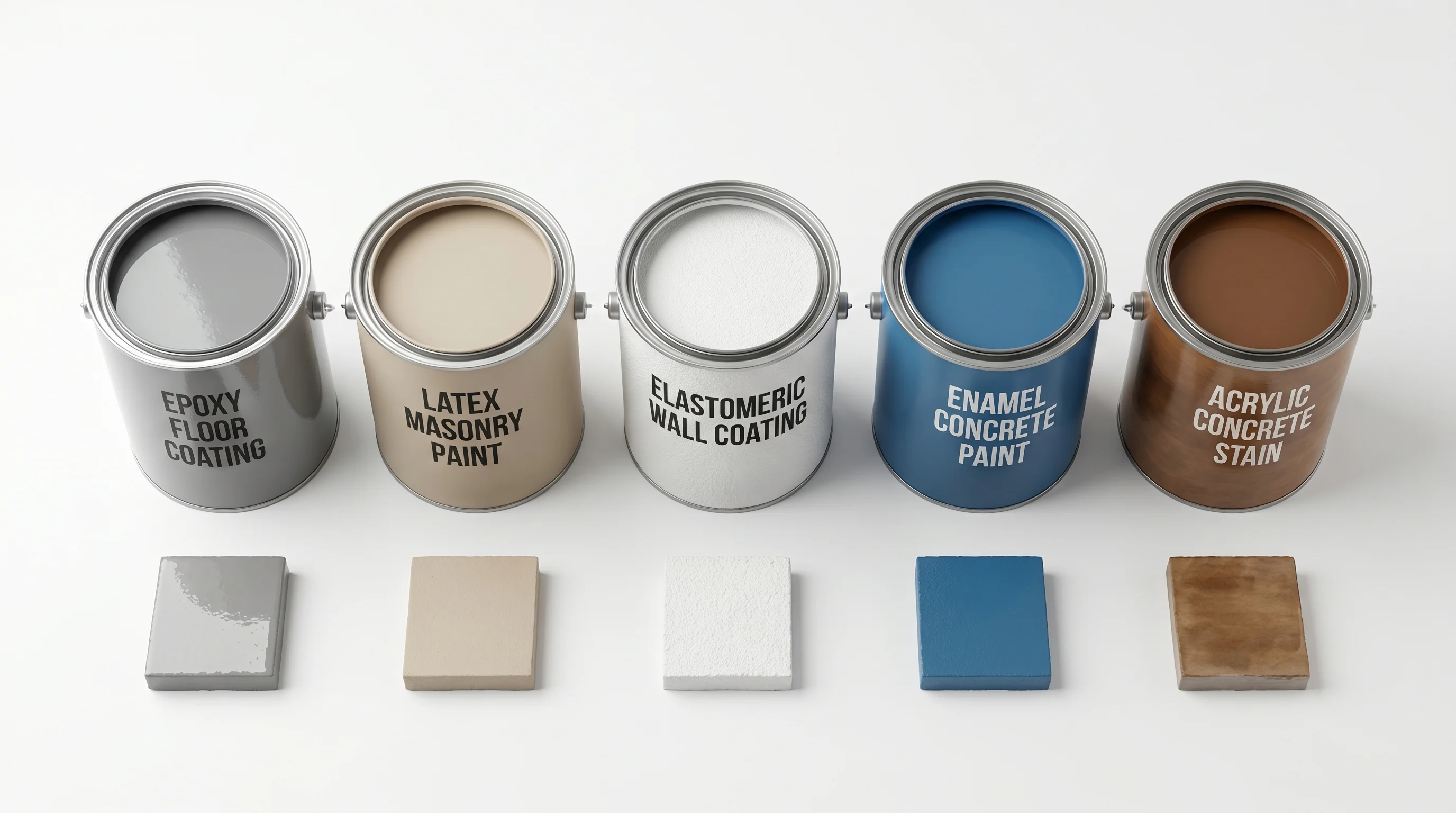
| Paint Type | Finish | Durability | Prep Required | Indoor / Outdoor | Cost/gal |
|---|---|---|---|---|---|
| Epoxy floor paint | High gloss | Excellent (3–7 yr) | Etch or grind, primer | Indoor primarily | $35–$80 |
| Latex / acrylic masonry paint | Flat to eggshell | Good (3–5 yr on walls) | Clean, primer | Indoor & outdoor | $20–$50 |
| Solvent-based masonry paint | Satin to semi-gloss | Very good (4–6 yr) | Clean, etch recommended | Outdoor preferred | $25–$60 |
| Elastomeric paint | Flat to satin | Very good (5–10 yr walls) | Clean, primer on bare concrete | Exterior walls | $30–$70 |
| Concrete enamel | Semi-gloss to high gloss | Good (2–4 yr floors) | Clean, degloss, primer | Indoor floors & walls | $25–$55 |
Epoxy Floor Paint — Deep Dive
Epoxy floor paint is the most durable and high-performance category of concrete paint — and for garage floors, commercial workshops, and industrial floors, it is almost always the correct choice. Understanding the product category helps you pick the right version for your needs, because "epoxy" covers a wide range of formulations with significantly different performance characteristics.
Two-Part vs One-Part Epoxy
True two-part (2K) epoxy floor paint consists of a resin component and a hardener that are mixed together just before application. The cure happens through a chemical reaction between the two components, not by evaporation — this produces an extremely hard, dense, solvent-resistant film that adheres powerfully to properly prepared concrete. Two-part epoxy is significantly more durable than one-part products and is what professional contractors use in commercial and industrial settings.
One-part epoxy-based paints — marketed as "epoxy paint" in most home improvement stores — are water-based latex paints with a small percentage of epoxy resin added for marketing purposes. They do not cure through a chemical reaction and do not provide the same level of hardness, chemical resistance, or adhesion as true two-part epoxy. They are easier to apply and have no pot life constraints, but they will not last as long under vehicle traffic and chemical spills. Most DIY epoxy kits sold at big-box stores are water-based one-part products — adequate for light residential garage use but not equivalent to professional-grade two-part systems.
Water-Based vs Solvent-Based Epoxy
Water-based epoxy floor coatings are lower in VOCs, easier to clean up (soap and water), more forgiving to apply, and less sensitive to moisture during application than solvent-based systems. For most residential garages, a water-based two-part epoxy kit provides an excellent result. Solvent-based epoxy provides deeper penetration into the concrete and a harder final film — the preferred option for commercial and industrial floors with very heavy mechanical traffic. The tradeoff is stronger odor, solvent cleanup, and greater sensitivity to temperature and humidity during application.
Chip / Flake Systems
Many epoxy floor systems include decorative vinyl color chips or "flakes" broadcast onto the wet first coat of epoxy before it cures. The chips serve two purposes: they add visual texture and color variation that hides tire marks and dirt, and they provide a subtle anti-slip texture. After the chips are broadcast and the base coat cures, a clear epoxy or polyurethane topcoat is applied over the chips to lock them in and provide the final wear surface. Chip systems are significantly more visually appealing than solid-color epoxy and hide wear more gracefully over time.
Latex and Acrylic Masonry Paint — Deep Dive
Latex and acrylic masonry paints are the broadest and most versatile category — formulated specifically for the porous, alkaline nature of concrete, brick, stucco, and block. Unlike interior latex wall paints, masonry paints contain additional binders that allow them to flex with the substrate's expansion and contraction cycles and resist the alkaline pH of concrete, which degrades ordinary latex paints rapidly.
Water-based masonry paints are the easiest to work with: low odor, soap-and-water cleanup, quick dry time between coats, and compatible with most concrete surfaces without aggressive surface prep beyond thorough cleaning and a masonry primer. They are the right choice for painting concrete walls (exterior and interior), poured concrete foundations, cinder block, stucco, and decorative concrete surfaces where a clean, solid color is desired without the complexity of an epoxy system.
On horizontal surfaces subject to vehicle traffic — driveways, parking areas — standard latex masonry paint wears through relatively quickly (1–3 years) because vehicle tires generate significant shear stress on the paint film. For floors and driveways, upgrade to a floor-specific product such as BEHR Premium Granite Grip, KILZ Over Armor, or a dedicated epoxy floor coating rather than a standard masonry wall paint.
Application Notes for Latex Masonry Paint
Latex masonry paints are roller-applied in two coats, similar to painting a wall. Use a 3/4-inch nap roller for textured or rough concrete, 3/8-inch nap for smooth surfaces. A masonry primer applied first dramatically improves adhesion and reduces the number of topcoats needed for full coverage. Allow the primer to dry fully (typically 4–6 hours at 70°F) before applying the first topcoat. Apply two thin coats rather than one heavy coat — thick coats sag on walls and dry unevenly on floors, creating a soft, easily-damaged film rather than a hard, durable one.
Elastomeric Paint — Deep Dive
Elastomeric paints are a specialized high-build coating category designed specifically for exterior masonry and concrete surfaces where crack bridging, waterproofing, and weather resistance are the primary requirements. They contain a significantly higher solids content than standard latex masonry paints — typically 50–65% solids by volume versus 25–35% in standard paints — and cure to a thick, rubbery, flexible film rather than the rigid film of conventional paint.
Key Properties of Elastomeric Paint
Crack bridging: Elastomeric paint can bridge and seal hairline cracks up to approximately 1/16 inch (1.6 mm) wide — a significant advantage on older concrete or masonry surfaces with superficial cracking. The flexible film stretches over the crack rather than cracking itself as temperatures cycle. Structural cracks (moving, wide, or water-infiltrating cracks) must be repaired before painting — elastomeric paint is not a structural repair material.
Waterproofing: The thick, continuous film of elastomeric paint creates an effective barrier against wind-driven rain and water infiltration through above-grade masonry walls. It is commonly used on concrete block buildings, stucco, and poured concrete foundation walls above the waterline.
Temperature cycling: Elastomeric paint's flexibility allows it to expand and contract with the substrate through freeze-thaw cycles without cracking, delaminating, or losing adhesion — a significant advantage over rigid paint films on exterior concrete in cold climates.
Elastomeric paint is not recommended for horizontal surfaces subject to traffic (it is too soft and flexible to resist abrasion), and it is not suitable for basement or below-grade applications where hydrostatic water pressure from outside can push through the wall. For below-grade applications, use a crystalline waterproofing product or negative-side waterproofing system.
8 Top Concrete Paint Products
Rust-Oleum EpoxyShield Garage Floor Coating — Best Overall Garage Epoxy Kit
The most widely available two-part water-based epoxy floor kit in the US. Includes Part A resin, Part B hardener, decorative color chips, and detailed instructions. Covers approximately 250–500 sq ft per kit depending on concrete porosity. Resists oil, gasoline, transmission fluid, and tire scuffing. Requires etching with included acid solution before application. Available in multiple base colors. Lifespan: 3–5 years under typical residential garage use. Kit cost: $90–$130.
BEHR Premium Granite Grip — Best Textured Concrete Floor Paint
100% acrylic concrete floor paint with a built-in decorative granite-like texture that provides natural anti-slip properties and hides surface imperfections well. No chips to broadcast — the texture is built into the paint. Interior and exterior rated. Excellent for patios, porches, pool decks, and garage floors where anti-slip is a priority. Coverage: 200–300 sq ft per gallon. Recoat every 2–4 years on high-traffic surfaces. ~$35–$50 per gallon.
Rust-Oleum Concrete & Garage Floor Paint — Best Value Floor Enamel
Single-component water-based floor enamel for interior concrete and garage floors. Lower cost and easier application than two-part epoxy, with good abrasion and chemical resistance for light garage use. Available in a wide range of colors including neutral gray, slate gray, and tan. Coverage: 400 sq ft per gallon. Not recommended for areas with heavy vehicle traffic or frequent chemical spills — in those cases, upgrade to the EpoxyShield two-part kit. ~$20–$30 per gallon.
KILZ Over Armor Smooth Concrete Coating — Best for Driveways & Patios
Heavy-duty 100% acrylic coating engineered specifically for concrete driveways, walkways, and patios. Fills minor cracks and surface imperfections up to 1/4 inch, resists UV fading, and provides a smooth, slip-resistant finish. Tintable to a range of colors. Coverage: 75–100 sq ft per gallon (intentionally applied thick for crack-filling). Expect 3–5 years on driveways with moderate vehicle traffic. ~$45–$65 per gallon.
INSL-X STIX Bonding Primer — Best Concrete Primer Before Paint
Water-based bonding primer specifically formulated to adhere to hard, smooth, difficult surfaces including concrete, tile, glass, and previously painted surfaces. Critical for painting smooth or previously sealed concrete where standard primers fail to bond. Apply one coat before any topcoat — improves adhesion dramatically and extends topcoat lifespan. Coverage: 300–400 sq ft per gallon. ~$25–$40 per gallon.
Drylok Masonry Waterproofer — Best Basement Wall Paint
Hydraulic-cement-fortified waterproofing paint that physically blocks water infiltration through above-grade and below-grade concrete and masonry walls. The active ingredient — Portland cement — swells and fills capillary pores in the concrete as it cures, creating a permanent barrier. Used as both a primer and a finish coat on basement walls, crawl spaces, retaining walls, and window wells. Withstands up to 12 PSI hydrostatic pressure. ~$20–$35 per gallon (covers 75–100 sq ft — intentionally heavy application).
Sherwin-Williams H&C Concrete Stain & Sealer — Best for Decorative Concrete
Semi-transparent water-based acrylic coating that adds color while allowing the natural texture and aggregate of decorative concrete to show through. Ideal for stamped concrete, exposed aggregate, and broom-finished concrete where a fully opaque paint would obscure the decorative detail. UV stable, slip-resistant when dry, and available in 40+ colors. Works as both a stain and a sealer in one product. Coverage: 200–300 sq ft per gallon. ~$30–$50 per gallon.
Rust-Oleum Elastomeric Masonry Paint — Best for Exterior Concrete Walls
High-build elastomeric coating that bridges hairline cracks up to 1/16 inch and provides excellent waterproofing for above-grade concrete block, poured concrete, and stucco walls. Flexible film expands and contracts with temperature cycles without cracking. Applied at twice the thickness of conventional paint — one gallon covers 50–75 sq ft. Ideal for older concrete buildings, retaining walls, and any exterior masonry with minor surface cracking. 10-year waterproofing guarantee. ~$35–$55 per gallon.
Surface Preparation — 8 Steps Before Painting Concrete
Surface preparation is the single most important factor in how long concrete paint lasts. Paint applied to a clean, properly prepared surface consistently outlasts the same paint on a poorly prepared surface by two to three times. Every concrete painting failure — peeling, bubbling, flaking within months of application — traces back to inadequate surface prep.
-
1
Clear the area completely and sweep
Remove all furniture, vehicles, equipment, and planters. Sweep the entire surface thoroughly, paying attention to edges, expansion joints, and corners where debris accumulates. Blow out or vacuum cracks to remove embedded grit and organic material.
-
2
Degrease oil and chemical stains
Apply a concrete degreaser or TSP (trisodium phosphate) solution to any oil, grease, or chemical stains. Scrub with a stiff-bristle brush, allow 10–15 minutes of dwell time, then rinse thoroughly. Oil that remains on the surface creates a release agent — paint cannot bond over it and will peel from those areas within weeks.
-
3
Remove failing existing paint if present
Paint applied over peeling or flaking existing coatings will fail with the existing coating — the new paint bonds to the old failing film, not the concrete. Use a chemical stripper compatible with the existing paint type, or mechanically grind or shot blast. All existing paint must be removed, or at minimum, all loose and delaminating material must be fully removed and edges feathered before overcoating.
-
4
Treat efflorescence and mold
White efflorescence deposits and biological growth (mold, mildew, algae) must be removed before painting — paint applied over either will fail prematurely. Treat efflorescence with a dilute muriatic acid solution (10:1 water to acid), scrub, and rinse. Treat mold with a dilute bleach solution (4:1 water to bleach), allow to dwell 15 minutes, scrub, and rinse thoroughly. Allow the surface to dry completely after treatment.
-
5
Pressure wash the entire surface
Use a 2,000–3,000 PSI pressure washer with a 25° or 40° fan tip. Work in overlapping strips at a consistent 8–12 inch distance from the surface. Pressure washing removes embedded contaminants, cleaning residue, and surface laitance (the soft layer of fine cement particles that forms on the surface of concrete during curing) that would prevent adhesion.
-
6
Etch smooth or previously sealed concrete
For epoxy floor coatings applied to garage floors, or any paint applied to smooth, dense, or previously sealed concrete: etch the surface with a muriatic acid solution (10:1 water to acid for standard porosity concrete, stronger for very dense or power-troweled concrete) or mechanically grind with a diamond grinder. Etching opens the pores and creates a mechanical tooth for the paint to grip. Neutralize acid-etched surfaces with a baking soda solution, rinse, and allow to dry fully before painting.
-
7
Repair cracks and damaged areas
Fill cracks wider than 1/8 inch with a concrete patching compound or polyurethane caulk. Repair spalled or delaminated areas with a polymer-modified concrete repair mortar. Allow all repairs to cure fully before painting — minimum 24 hours for most patching compounds, 7 days for large repairs. Unprepared cracks will telegraph through the paint film and provide an entry point for moisture that undermines the surrounding paint.
-
8
Allow to dry completely and check weather
After pressure washing and any wet prep steps, allow the concrete to dry for a minimum of 24–48 hours before painting. In humid conditions, allow 48–72 hours. Perform the plastic sheet moisture test: tape a 12×12 inch piece of plastic to the surface for 24 hours — if condensation forms underneath, the concrete is still too wet to paint. Do not paint if rain is expected within 24 hours, or if ambient temperature is below 50°F or above 90°F.
How to Apply Concrete Paint — Step by Step
-
1
Apply masonry primer first
For bare, unpainted concrete: apply a masonry primer or bonding primer before any topcoat. This seals the surface porosity, evens out absorption, and dramatically improves paint adhesion. Allow the primer to dry fully per the manufacturer's instruction — typically 2–4 hours for water-based primers, 6–8 hours for oil-based. For epoxy systems: skip the separate primer; the etching step performs the same function.
-
2
Mix two-part products thoroughly
For two-part epoxy systems: combine Part A (resin) and Part B (hardener) in the exact ratio specified by the manufacturer. Mix for 3–5 minutes with a paint mixing paddle on a drill — ensure no streaks or swirls remain. Allow the mixed product to "induct" (rest) for 15–30 minutes before applying — this allows the chemical reaction to begin and improves flow and adhesion. Do not mix more than you can apply within the pot life (typically 2–4 hours at 70°F).
-
3
Cut in edges with a brush
Use a 2–3 inch brush to paint a 3–4 inch border around walls, joints, drains, and any obstacles before rolling the main surface. This ensures full coverage at edges and prevents the roller from damaging adjacent surfaces. Work wet-on-wet — keep the cut-in wet until you can roll up to it to avoid lap marks at the boundary.
-
4
Roll the first coat in thin, even strokes
Use a 3/8-inch nap roller for smooth concrete, 1/2–3/4-inch nap for textured or rough surfaces. Apply thin coats — the most common mistake in concrete painting is applying paint too thick. Thick coats sag on walls, dry unevenly, trap solvents, and produce a soft film rather than a hard one. Work in 4x4 foot sections, maintaining a wet edge to prevent lap marks. For epoxy, work quickly — the pot life is limited.
-
5
Broadcast decorative chips (epoxy systems only)
If using a chip or flake system, broadcast the vinyl chips into the wet epoxy base coat immediately after rolling each section — do not let the epoxy begin to set before adding chips. Broadcast liberally and evenly by hand from about 3 feet above the surface. The chips should land flat, not clump. After the base coat cures, sweep or vacuum off excess loose chips before applying the clear topcoat.
-
6
Apply second coat perpendicular to the first
Allow the first coat to dry to the point where it is dry to the touch but still within the recoat window — typically 4–8 hours for latex/acrylic, 8–12 hours for epoxy. Apply the second coat perpendicular to the first (if the first coat went front-to-back, roll the second coat side-to-side). This crossing pattern ensures even film thickness and eliminates thin spots from the first pass.
-
7
Add anti-slip aggregate to the final coat on horizontal surfaces
For any painted horizontal surface that will be walked on when wet — patios, pool decks, exterior stairs, and driveways — add anti-slip aggregate (aluminum oxide grit or silica sand) to the final topcoat or broadcast it onto the wet final coat. Painted concrete becomes significantly more slippery than unpainted concrete when wet, especially with glossy epoxy or enamel finishes. Anti-slip additive is not optional on exterior painted floors.
-
8
Allow full cure before traffic
Dry time vs cure time: paint is "dry to the touch" within hours but does not reach full hardness and chemical resistance for days. Allow light foot traffic after 24 hours for latex/acrylic, 24–48 hours for epoxy. Allow vehicle traffic only after full cure: 5–7 days for epoxy floor coatings, 3–5 days for latex masonry paint on driveways. Tire marks on a partially cured epoxy floor are permanent.
Surface-by-Surface Concrete Paint Selection Guide
| Surface | Recommended Paint Type | Product Example | Key Considerations |
|---|---|---|---|
| Garage floor (residential) | Two-part epoxy | Rust-Oleum EpoxyShield | Etch first; add chips for appearance; polyurethane topcoat for UV |
| Garage floor (commercial / heavy use) | 100% solids 2-part epoxy | Sherwin-Williams Armorseal | Professional application recommended; grind don't etch |
| Patio / pool deck | Acrylic floor paint with anti-slip | BEHR Granite Grip | Anti-slip grit essential; UV stable; recoat every 2–3 yr |
| Concrete driveway | Heavy masonry coating or epoxy | KILZ Over Armor | Penetrating sealer often better long-term; expect recoating |
| Exterior concrete walls | Elastomeric or masonry acrylic | Rust-Oleum Elastomeric | Crack-bridging critical; breathable formula prevents trapping moisture |
| Basement floor | Epoxy or concrete enamel | Rust-Oleum Concrete & Garage | Address moisture source first; vapor barrier under slab if needed |
| Basement walls | Waterproofing masonry paint | Drylok Masonry Waterproofer | Vapor permeable; apply to interior of exterior walls only |
| Concrete block / cinder block | Masonry paint or elastomeric | BEHR Masonry Stucco & Brick | Block is very porous — prime first; may require extra coats |
| Stamped / decorative concrete | Semi-transparent acrylic | Sherwin-Williams H&C | Opaque paint hides the decorative texture — use semi-transparent |
| Interior concrete floor | Concrete enamel or epoxy | Rust-Oleum Concrete & Garage | Low-VOC water-based for occupied spaces; adequate ventilation |
How Long Does Concrete Paint Last? Recoating Schedule
| Paint Type | Surface | Typical Lifespan | Early Failure Signs |
|---|---|---|---|
| Two-part epoxy | Garage floor | 3–7 years | Peeling at edges, tire pick-up marks, delamination near floor drain |
| Acrylic floor paint | Patio / pool deck | 2–4 years | Fading, chalking, thin worn areas in high-traffic paths |
| Masonry acrylic | Exterior walls | 4–7 years | Chalking, color fade, hairline paint cracks, moisture staining |
| Elastomeric | Exterior walls | 5–10 years | Bubbling (moisture trapped), peeling, film tearing at cracks |
| Waterproofing masonry | Basement walls | 5–10 years | White efflorescence pushing through, damp patches, peeling |
| Latex masonry | Driveway / floor | 1–3 years | Worn patches in tire tracks, chalking, surface erosion |
- Look for thin spots, worn areas, or color fade — especially in high-traffic zones like the center of a garage floor or the approach to a door
- Run a fingernail across the surface — if it scratches easily or powders off, the film has degraded and recoating is overdue
- Pour a small amount of water on the surface — if it absorbs into the paint rather than beading, the film has lost its integrity
- Check edges and expansion joints — these are always the first areas to delaminate and lift
- If more than 20–25% of the surface shows wear through to the concrete, strip and recoat rather than spot-coating
Paint vs Stain vs Epoxy Coating — Verdict by Use Case
Garage Floor
Winner: Two-part epoxy coating. Unmatched chemical resistance and durability for vehicle traffic, oil drips, and cleaning. No stain provides this level of protection. No paint matches this lifespan.
Patio
Winner: Acrylic concrete paint or stain. Paint for complete color change and coverage; stain for a natural-look color treatment that will never peel. Both work well — choose based on aesthetic preference.
Driveway
Winner: Penetrating sealer (not paint). For protection longevity and minimal maintenance, a silane-siloxane sealer outperforms any paint on a driveway. Use paint only if aesthetics are the primary goal.
Basement Walls
Winner: Waterproofing masonry paint (Drylok). Addresses the primary concern (moisture) better than any stain or regular paint. Fix the source of water infiltration first — no coating is a substitute for proper drainage.
Exterior Walls with Cracks
Winner: Elastomeric paint. No stain bridges cracks. Standard paint cracks over them. Only elastomeric provides the flexibility to seal hairline cracks while providing full color coverage and weather resistance.
Stamped / Decorative Concrete
Winner: Semi-transparent stain or acrylic sealer. Opaque paint destroys the decorative detail. Semi-transparent stain or solvent-based acrylic sealer enhances color while preserving the texture and pattern.
Common Concrete Painting Mistakes
- Skipping the primer on bare concrete — unpainted concrete absorbs the first coat unevenly, leaving thin spots and requiring extra topcoats; a masonry primer costs $15–$30 and saves you a full extra coat of expensive topcoat
- Applying thick coats — thick coats sag on walls, trap solvents on floors, and cure to a soft film; always apply two or three thin coats rather than one thick coat
- Not etching before epoxy — epoxy applied to smooth, non-etched concrete has nothing to mechanically grip and will delaminate in sheets, often within one winter freeze-thaw cycle
- Painting over damp concrete — water below the paint film creates vapor pressure that pushes the paint off; concrete must be dry for minimum 24–48 hours before painting
- Using interior paint on exterior concrete — interior latex lacks the UV inhibitors, mildewcides, and flexibility required for exterior temperature cycling; always use exterior-rated masonry paint outdoors
- Painting in direct hot sun or extreme heat — surface temperatures above 90°F cause paint to dry before it can properly wet the surface and bond; apply in morning or wait for shade
- Skipping anti-slip additive on horizontal surfaces — any painted concrete that gets wet — patio, pool deck, steps, driveway — becomes dangerously slippery; anti-slip grit is non-negotiable
- Allowing vehicle traffic before full cure — tire marks on epoxy or enamel that has not fully cured are permanent; even if the paint is dry to the touch, wait 5–7 days for vehicle traffic on epoxy floors
Frequently Asked Questions
What kind of paint do you use on concrete?
For garage floors: two-part epoxy floor paint (Rust-Oleum EpoxyShield). For patios and exterior flatwork: acrylic masonry floor paint (BEHR Granite Grip, KILZ Over Armor). For basement walls: waterproofing masonry paint (Drylok). For exterior concrete walls with cracks: elastomeric paint (Rust-Oleum Elastomeric). The key is using products specifically formulated for concrete — not interior latex wall paint, which has inadequate adhesion, durability, and moisture resistance for concrete surfaces.
Do you need to prime concrete before painting?
Yes — a masonry primer is strongly recommended for bare concrete before most paint types. It seals porosity, improves adhesion, and significantly improves topcoat coverage and longevity. For epoxy floor coatings, proper acid etching or mechanical grinding replaces traditional priming. The only situation where primer may be skipped is when overcoating well-adhered existing masonry paint with a compatible product, and even then, a light scuff-sand before repainting is beneficial.
How long does concrete paint last?
Epoxy garage floor: 3–7 years. Acrylic patio floor paint: 2–4 years. Masonry acrylic on walls: 4–7 years. Elastomeric on exterior walls: 5–10 years. Waterproofing masonry paint: 5–10 years. Latex on driveways (light traffic): 1–3 years. Proper surface preparation quality is the biggest variable — well-prepared surfaces consistently reach the top of these ranges.
Can you paint over old concrete paint?
Yes, if the existing paint is well-adhered with no peeling or flaking. Clean, lightly scuff, and apply a compatible topcoat. If the existing paint is peeling or flaking, it must be fully removed first. You cannot apply an oil-based product over a water-based one without a bonding primer, and vice versa. Always use compatible products — when in doubt, apply a bonding primer before the new topcoat to ensure adhesion.
What is the difference between concrete paint and concrete stain?
Concrete paint forms an opaque film on top of the surface — full color coverage, can peel, can be changed later. Concrete stain penetrates into the concrete and colors the material itself — translucent, variegated, permanent, and cannot peel. Paint is better when you want complete color coverage and the ability to repaint later. Stain is better when you want a natural look that is truly permanent and maintenance-free.
How do you prepare concrete for painting?
Sweep, degrease all oil stains, remove peeling existing paint, treat efflorescence, pressure wash at 2,000–3,000 PSI, etch smooth surfaces for epoxy, repair cracks, allow to dry 24–48 hours, then check weather. No concrete painting step matters more than preparation — paint on a clean, dry, properly etched surface will last two to three times longer than paint on a poorly prepared surface.
Can you paint a concrete driveway?
Yes — use KILZ Over Armor, BEHR Granite Grip, or a dedicated epoxy masonry coating. Expect recoating every 2–5 years depending on traffic. A penetrating silane-siloxane sealer is often a better long-term choice for driveways — it protects from within, cannot peel, and lasts 5–10 years with no stripping required before reapplication.
Is concrete paint the same as masonry paint?
Masonry paint is a category of paint designed for porous substrates — concrete, brick, stucco, block. All masonry paints work on concrete, making them a type of concrete paint. Not all products labeled "concrete paint" are true masonry paint — always select a product specifically labeled for concrete or masonry, with appropriate surface prep instructions, rather than a general-purpose latex that happens to be tinted for concrete.