
Concrete Saw — Types, Best Models, Blades & How to Cut Concrete (2026)
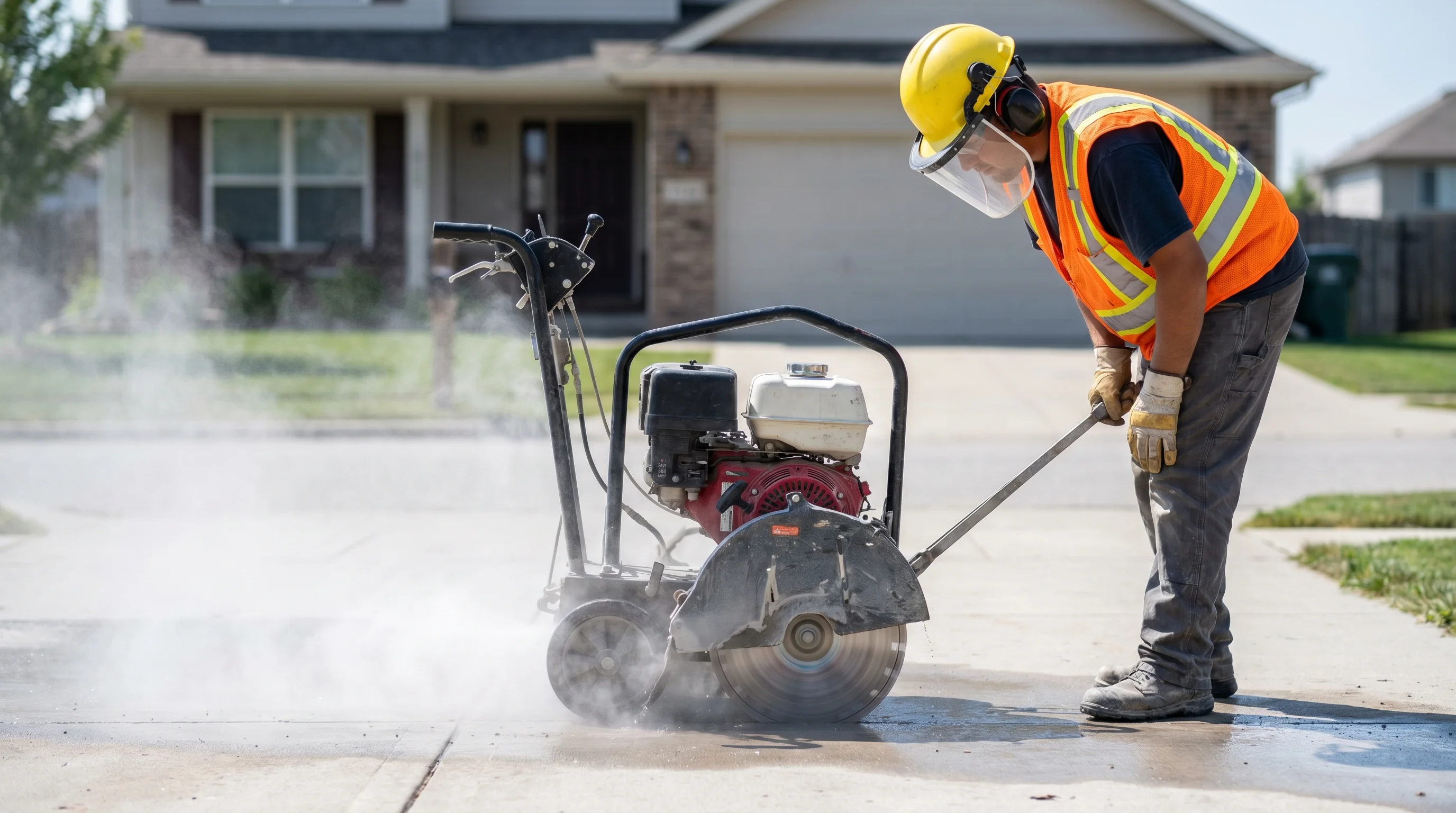
Quick Answer
For cutting concrete slabs and driveways: a walk-behind flat saw with a 14"–18" segmented diamond blade is the professional standard. For smaller cuts and utility work: a gas cut-off saw (Stihl TS420, Husqvarna K970) handles most DIY and contractor needs. Always wet-cut when possible — water extends blade life 5–10x and suppresses silica dust. Match blade bond hardness to concrete hardness: hard concrete needs a soft bond, soft concrete needs a hard bond.
Concrete is one of the hardest materials a saw encounters. Depending on mix design, cured concrete ranges from 2,500 PSI to 8,000+ PSI compressive strength — harder than most natural stone. The aggregate (gravel, crushed limestone, granite chips) embedded in the cement matrix is abrasive enough to destroy conventional saw blades in seconds. And when reinforcing steel (rebar) is present, you're cutting through two completely different materials simultaneously: hard mineral aggregate and ductile steel.
This is why concrete cutting requires diamond blades — industrial diamonds are the only material hard enough to cut concrete reliably. But "diamond blade" is not a single product: bond hardness, segment design, diamond grit size, and blade diameter all determine whether a blade works or fails on your specific concrete. The saw itself matters too — RPM, horsepower, wet system design, and blade guard geometry all affect the quality and safety of the cut.
This guide covers every concrete saw type, explains diamond blade selection in detail, reviews the 8 top models available in 2026, walks through the complete cutting process, and covers the safety requirements that no concrete cutter should skip.
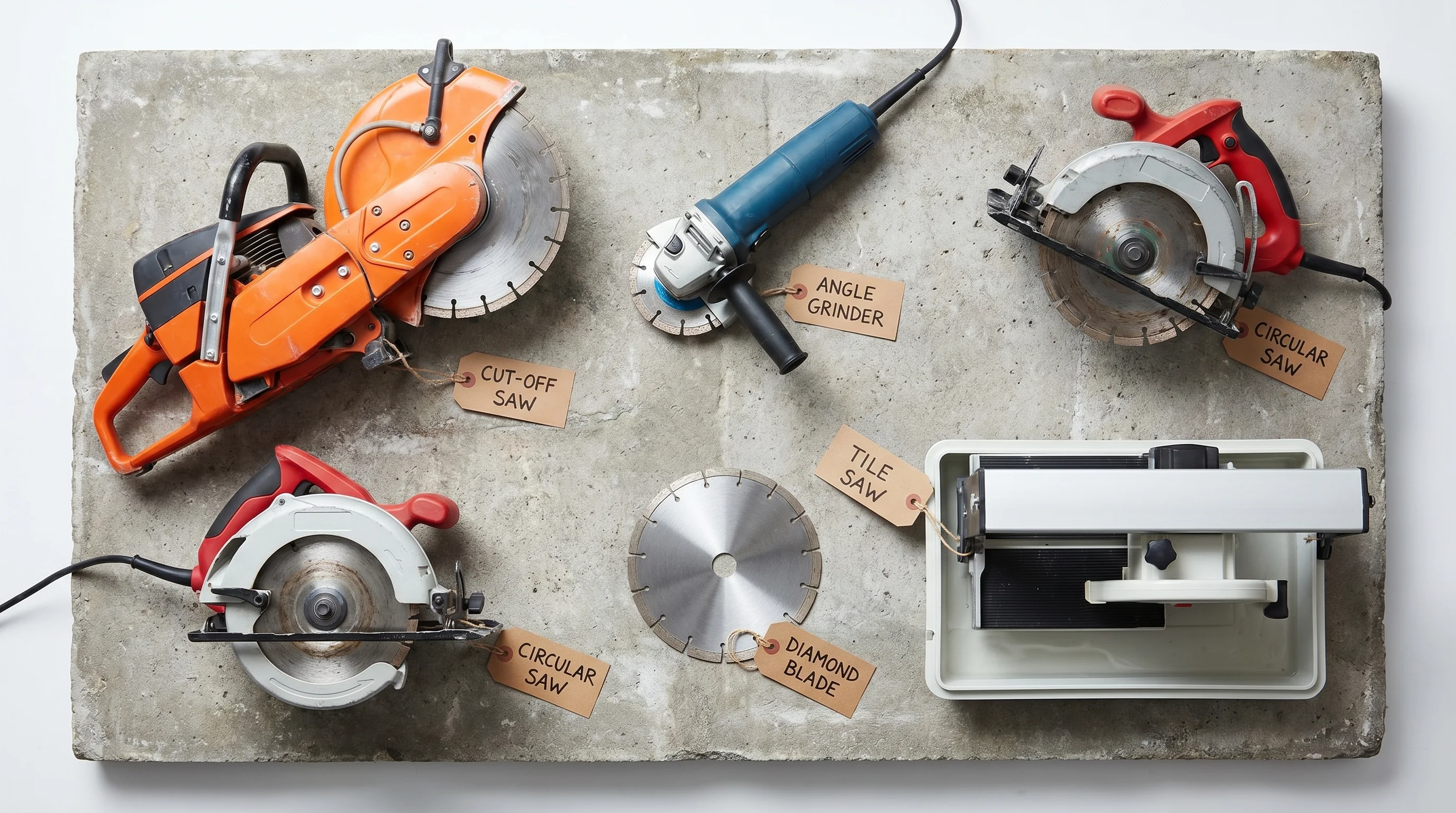
7 Types of Concrete Saw Compared
| Type | Blade Size | Max Depth | Best For | Typical Cost (Buy) | Typical Rental/Day |
|---|---|---|---|---|---|
| Walk-Behind (Flat Saw) | 14"–20" | 4.5"–9" | Slab cuts, road cuts, control joints, large areas | $2,500–$12,000 | $150–$400 |
| Handheld Cut-Off Saw | 12"–14" | 4"–4.75" | General cuts, curbs, block, utility work | $500–$1,800 | $60–$90 |
| Angle Grinder + Blade | 4.5"–9" | 1.5"–3" | Shallow cuts, notches, small repairs | $80–$350 | $20–$40 |
| Circular Saw + Blade | 7"–7.25" | 2"–2.5" | Control joints in thin slabs, occasional use | $60–$200 | $25–$45 |
| Table / Tile Saw | 8"–14" | 3"–5" | Pavers, tile, block, precision cuts | $300–$2,000 | $60–$120 |
| Wall Saw | 16"–60" | Up to 27" | Openings in walls, deep vertical cuts | $15,000–$50,000 | $400–$900 |
| Wire Saw | N/A (wire loop) | Unlimited | Massive demolition, rebar-heavy sections, bridges | $30,000–$100,000+ | Specialist only |
Diamond Blade Types — Deep Dive
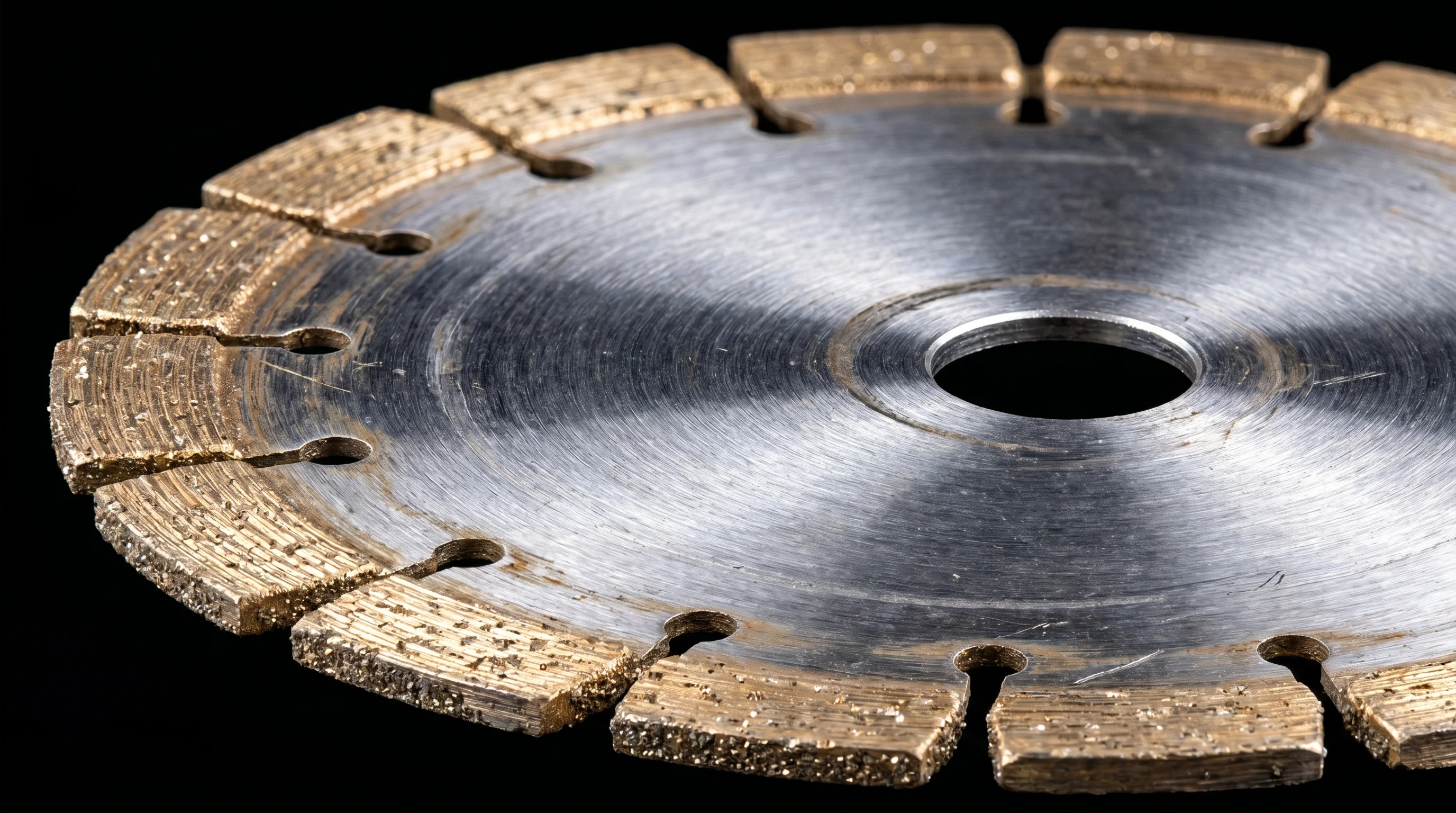
All diamond blades share the same basic structure: a steel core with diamond-impregnated segments bonded to the perimeter. The diamonds are not surface-coated — they are embedded throughout the segment matrix (a mixture of metal powders including cobalt, iron, bronze, and tungsten carbide). As the segment wears, fresh diamonds are continually exposed. The bond matrix holds the diamonds in place while they cut; when a diamond dulls completely, the bond must release it so the next diamond can be exposed. This is why bond hardness must match material hardness.
Bond Hardness — The Most Critical Variable
Hard bond blades hold diamonds longer before releasing them. They are designed for soft, abrasive materials (green concrete, asphalt, soft limestone, brick) that wear the segment naturally and release dulled diamonds on their own. Using a hard bond blade on hard concrete causes the segments to glaze over — the dulled diamonds cannot be ejected, the blade stops cutting, and heat builds rapidly.
Soft bond blades release diamonds more easily under the wear of hard, non-abrasive materials like dense cured concrete, granite aggregate, and reinforced concrete. The matrix wears continuously, exposing fresh diamonds. Using a soft bond on abrasive materials wears the segments down too fast, shortening blade life dramatically.
Concrete PSI is the practical guide: below 3,000 PSI — hard bond. 3,000–6,000 PSI — medium bond. Above 6,000 PSI or very dense aggregate — soft bond. If you don't know your concrete's PSI (common on older slabs), test by making a 6-inch cut: if the blade cuts slowly and gets hot, the bond is too hard — use a softer bond. If it cuts fast but the segments wear down quickly, the bond is too soft.
Segment Design
| Blade Type | Segment Design | Best Material | Wet or Dry | Edge Quality |
|---|---|---|---|---|
| Segmented (Standard) | Raised segments with gullets (gaps) between them | General concrete, block, brick | Wet or dry | Moderate — some chipping |
| Turbo / Serrated Rim | Continuous rim with serrated turbine pattern | Dry cutting concrete, asphalt, brick | Dry (mainly) | Good — faster than segmented dry |
| Continuous Rim | Uninterrupted solid rim, no gullets | Tile, glass, decorative concrete | Wet only | Excellent — chip-free cuts |
| Sandwich / Combo | Alternating hard/soft segments | Reinforced concrete (rebar present) | Wet or dry | Moderate |
| Green Concrete | Segmented, soft bond | Concrete within first 48 hrs of pour | Wet or dry | Moderate |
| Asphalt | Wide gullets, very hard bond | Asphalt, asphalt-over-concrete | Dry (mainly) | Moderate |
Walk-Behind Concrete Saw — Deep Dive
Walk-behind flat saws (also called slab saws, road saws, or floor saws) are the standard for professional concrete cutting. The operator walks behind the machine, which is self-propelled on larger models, and guides the blade along a marked cut line. The blade is mounted below the saw body and cuts from the top surface downward — the opposite of a circular saw's cut direction.
Gas vs electric: Gas-powered walk-behind saws dominate outdoor applications where power access is limited. Honda GX390 (13 HP) and Kohler CH440 (14 HP) engines power most mid-range saws; higher-output Kohler Command Pro (20+ HP) engines power large 18"–20" blade machines. The key advantage of gas is portability and sustained power over long cuts. Electric walk-behind saws (typically 3-phase 480V) are used in indoor environments (parking garages, warehouse floors) where exhaust fumes are a hazard — they are quieter, produce no fumes, and require less maintenance, but need a power supply.
Blade size and depth math: Maximum cut depth is approximately 1/3 of the blade diameter (the blade guard covers roughly 2/3 of the blade). A 14" blade: 14 × 0.32 = ~4.5" max depth. An 18" blade: 18 × 0.36 = ~6.5". A 20" blade: 20 × 0.38 = ~7.6". For a 4" residential slab, a 14" blade reaches full depth with clearance. For a 6" highway slab, an 18" blade is needed. For deeper cuts, multiple passes at increasing depth settings are sometimes used, but a single full-depth pass is preferred for clean, straight cuts.
Wet system: Walk-behind saws use continuous water feed through a water tank (typically 5–10 gallons) connected to jets positioned on both sides of the blade. Water flow rates of 0.5–1.5 GPM are typical for a 14" blade; larger blades need more. The slurry (water + concrete dust) flows to both sides of the cut — plan for drainage before starting. On sloped surfaces, cutting uphill prevents the slurry from flowing back into the blade path.
Handheld Cut-Off Saw — Deep Dive
Handheld cut-off saws (also called demolition saws or petrol cut-off saws) are the most versatile concrete cutting tool in a contractor's arsenal. They run a 12" or 14" diamond blade at high RPM (typically 4,300–5,100 RPM) driven by a 2-stroke or 4-stroke engine. The three dominant brands are Stihl, Husqvarna, and HILTI — each with specific strengths.
Stihl TS series are the most widely used cut-off saws in North America. The TS 420 (3.2 kW, 4.4 HP) handles 12" blades up to 4" depth; the TS 800 (4.4 kW, 6.0 HP) runs 16" blades for deeper cuts. Stihl's STIHL OILGUARD system monitors engine oil levels automatically. The TS 410 and TS 420 are among the lightest in their class (23–24 lbs) making them manageable for overhead and vertical cuts.
Husqvarna K970 (4.8 kW, 6.5 HP) is the professional benchmark for cut-off saw performance. The K970 runs a 14" blade to 4.9" depth and features a Smart Tensioner for blade guard adjustment without tools. It's heavier than Stihl at 26.5 lbs but produces noticeably higher cutting power in hard concrete and rebar-dense material. The K970 Ring is a specialized variant with a circular cutting head for coring-style cuts.
HILTI DSH 700-X is the premium professional option with a 4-stroke engine that runs on regular gasoline (no oil mixing). The 4-stroke reduces emissions, produces more torque at lower RPM (less blade wear), and eliminates the hassle of 2-stroke oil mixing. At $1,600–$1,800, it's the most expensive handheld option but preferred on commercial job sites where emissions and compliance matter.
Angle Grinder Concrete Cutting
For cuts under 2"–3" deep — control joints in thin slabs, notching block, trimming pavers, cutting around obstacles — an angle grinder with a 4.5" or 7" diamond blade is often the most practical tool. Modern 4.5" diamond blades cut concrete effectively at 11,000+ RPM; 7" blades reach ~2.5" depth and suit thicker pavers and blocks.
The limitations are significant: depth is inherently restricted by blade size, continuous cutting generates substantial heat without a wet system (most angle grinders cannot be used with water without an add-on shroud), and the ergonomics of freehand cutting make straight long cuts difficult. An angle grinder is not a replacement for a cut-off saw on jobs longer than a few feet.
For dry angle grinder cutting, use turbo-rim blades and make multiple shallow passes rather than one deep pass — this prevents blade overheating and reduces the risk of blade segment separation (which can cause serious injury). Never use a standard wood-cutting blade or abrasive masonry wheel on an angle grinder for concrete — abrasive wheels disintegrate rapidly, while wood blades can shatter catastrophically.
8 Best Concrete Saw Models (2026)
Stihl TS 420 — Best Handheld Gas Saw (Mid-Range)
3.2 kW / 4.4 HP, 2-stroke engine, 12" blade, 3.9" cut depth. One of the lightest full-featured cut-off saws at 23.4 lbs. X2 air filtration system extends engine life significantly on dusty job sites. Available with water kit for wet cutting. Excellent blade availability and service network across North America. Price: ~$650–$750.
Husqvarna K970 — Best Handheld Gas Saw (Professional)
4.8 kW / 6.5 HP, 2-stroke, 14" blade, 4.9" cut depth, 26.5 lbs. The professional standard for cut-off saws — more power, deeper cut, and Smart Tensioner for tool-free blade guard adjustment. Handles hard reinforced concrete better than lighter saws. Compatible with Husqvarna's vacuum dust extraction shroud for dry indoor cutting. Price: ~$1,100–$1,300.
DEWALT DCS690X2 — Best Cordless Concrete Saw
60V MAX FlexVolt brushless motor, 9" blade, 3.25" cut depth, two 9Ah batteries included. No exhaust, no mixing oil — the top choice for indoor concrete cutting on battery power. Not a replacement for high-power gas saws on long cuts, but outstanding for enclosed spaces, utility cuts, and contractor use where emissions are prohibited. Price: ~$600–$750 (kit).
Husqvarna FS 400 LV — Best Walk-Behind (Residential/Light Commercial)
13 HP Honda GX390 engine, 14" blade, 4.5" cut depth, 200 lbs dry weight. The go-to walk-behind for residential driveways, parking lots, and light commercial slabs. Self-propelled drive with variable speed. Integrated 5-gallon water tank. Blade guard adjusts for varying cut depths. Widely available at rental shops — good for both rental fleet and contractor purchase. Price: ~$3,500–$4,200.
Multiquip QP-8015SH — Best Walk-Behind (Heavy Duty)
20 HP Honda GX630 engine, 18" blade, 6.5" cut depth. Built for highway slab cutting, thick industrial floors, and deep control joints. Dual-belt drive system absorbs blade shock on rebar strikes. 340 lbs — requires a trailer or truck for transport. Hydraulic blade depth adjustment under load. Price: ~$6,500–$8,000.
HILTI DSH 700-X — Best Premium Handheld
4-stroke engine (no oil mixing), 14" blade, 4.6" cut depth, 25.6 lbs. The premium professional choice — 4-stroke means lower RPM, more torque, less blade wear, and no 2-stroke oil mixing on the job site. Complies with California CARB Tier 4 emissions standards where 2-stroke saws may be restricted. Price: ~$1,600–$1,800.
MK Diamond MK-101 — Best Wet Table Saw
1.5 HP direct-drive motor, 10" diamond blade, continuous water bath, 24" rip capacity, 45° miter capability. The professional standard for paver, block, and decorative concrete cutting. Stainless steel water pan resists corrosion. Blade guard and eye shield included. Good for contractor truck kits — compact enough to transport, powerful enough for full-day paver installations. Price: ~$600–$750.
Makita GA9020 + Makita Diamond Blade — Best Angle Grinder Setup
15 AMP 9" angle grinder (6,600 RPM) paired with Makita's 9" segmented diamond blade for concrete. The GA9020 has a dead-man paddle switch (stops blade the instant you release grip), labyrinth construction sealing the motor from dust, and current limiter to protect the motor on heavy cuts. At ~$180 for the grinder + $40–$60 for a quality blade, the most affordable entry point to concrete cutting. Price: ~$180–$230 (grinder only).
Blade Selection by Material
| Material | Blade Type | Bond Hardness | Wet or Dry | Notes |
|---|---|---|---|---|
| Standard cured concrete (3,000–4,000 PSI) | Segmented | Medium | Wet preferred | Most common residential application |
| Hard/dense concrete (5,000+ PSI) | Segmented | Soft | Wet required | Granite aggregate — soft bond releases glazed diamonds |
| Reinforced concrete (rebar present) | Combo/sandwich or rebar-rated | Medium-soft | Wet | Rebar-rated blades have harder steel core to resist shock |
| Green concrete (<48 hrs cured) | Green concrete blade | Soft | Wet or dry | Soft bond wears with the soft green concrete |
| Asphalt | Asphalt blade (wide gullets) | Hard | Dry mainly | Never use a concrete blade on asphalt — gummy asphalt clogs segments |
| Brick / CMU block | Segmented or turbo | Medium-hard | Wet or dry | Softer material — harder bond appropriate |
| Paver / manufactured stone | Continuous rim (wet) or turbo (dry) | Medium | Wet for clean edges | Continuous rim prevents chipping on decorative faces |
| Tile / porcelain | Continuous rim | Hard | Wet only | Dry cutting shatters tile; always use wet table saw |
| Asphalt-over-concrete composite | Asphalt blade for top layer, switch to concrete blade | Hard then medium | Dry top, wet bottom | Two-pass or use a dedicated combo blade rated for both |
Wet vs Dry Cutting — Full Comparison
| Factor | Wet Cutting | Dry Cutting |
|---|---|---|
| Blade life | 5–10x longer — water continuously cools segments | Shorter — heat is the primary enemy of diamond blades |
| Silica dust suppression | Excellent — water captures airborne dust at the source | Poor — requires vacuum extraction system + respirator |
| Cut quality | Slightly better — slurry flushes debris from the kerf | Good for short cuts; debris buildup can cause blade wander |
| Portability | Requires water source or onboard tank | Fully portable — no water logistics |
| Indoor suitability | Messy — water and slurry damage floors | Better indoors with vacuum extraction |
| Setup time | Longer — connect water, check flow jets | Faster — dry blade, go |
| Slurry cleanup | Required — wet concrete slurry is a hazardous waste in some jurisdictions | Dry dust is easier to contain with vacuum |
| Maximum cut length per session | Unlimited | 30 seconds max per pass — must let blade cool |
| OSHA compliance | Meets Table 1 engineering control requirement | Requires HEPA vacuum extraction to meet Table 1 |
8-Step Concrete Cutting Process
-
1
Mark the Cut Line
Use a chalk line or straight edge and marking crayon to lay out the exact cut path. For control joints, use a chalk line snapped between two nails at the correct spacing (typically every 8–12 feet for a 4" slab). Check for buried utilities, conduit, or rebar mats before cutting — a rebar locator (cover meter) is essential on any structural slab. Mark the blade depth on the saw before starting.
-
2
Don Full PPE
Half-face respirator with P100 cartridges (not a paper dust mask), ANSI Z87.1 safety glasses plus face shield, NRR 25+ hearing protection, cut-resistant gloves, steel-toed boots, long pants and sleeves. Do not start the saw until all PPE is on. Concrete saws produce 100–110 dB — without hearing protection, a full day of cutting can cause permanent hearing damage.
-
3
Set Cut Depth
For control joints in a 4" slab, set depth to 1" (1/4 of slab thickness is the minimum for effective crack control; 1/3 depth is the professional standard). For full-depth cuts (demolition, trench access, slab removal), set to maximum depth for your blade size. Make the depth adjustment with the blade stationary and the saw off — never adjust depth while the blade is spinning.
-
4
Set Up Water Supply (Wet Cutting)
Fill the onboard water tank or connect to a garden hose. Check that both water jets are aimed at the blade contact point and that water flows freely at the correct rate (0.5–1.0 GPM for a 14" blade). Verify the water collection path — where will the slurry drain? Plan downhill flow away from electrical equipment and storm drains. Have a squeegee and wet-dry vacuum available for slurry control.
-
5
Start Blade and Make a Scoring Pass (First Pass)
Start the engine and let the blade reach full RPM before touching the concrete — this takes 3–5 seconds. Position the blade at the start of the cut line with the blade guard clear. Lower the blade into the concrete slowly and steadily — never plunge at full speed. Make a shallow scoring pass first (1/4"–1/2" deep) at full RPM to establish the cut line, then increase depth in subsequent passes or drop to full depth immediately if conditions allow.
-
6
Cut at Steady Feed Rate
Move the saw forward at a consistent rate — never force the blade. The saw should pull itself through the cut without excessive operator pressure. If the blade is slowing down significantly under load, you're moving too fast or the bond is too hard for the material. Forcing the saw causes blade segment damage and dangerous kickback. For walk-behind saws, use the self-propelled drive at the appropriate speed setting for your material.
-
7
Complete the Cut and Retract the Blade
At the end of the cut, allow the blade to spin at full RPM while lifting it out of the cut cleanly — do not kill the engine with the blade still in the kerf. For dry cutting, allow the blade to spin freely in the open air for 20–30 seconds after each cut pass to dissipate heat before the next pass. For walk-behind saws, retract the blade to the transport position before moving the machine.
-
8
Clean Up and Seal Control Joints
Rinse wet slurry off the cut surface before it hardens — dried concrete slurry bonds permanently to the surface. Remove all slurry from control joints before filling. Blow out or vacuum dry dust from the cut kerf. For control joints, fill within 24–48 hours with a polyurethane or silicone joint sealant to prevent water infiltration and incompressible material entry. Inspect the blade for segment damage or cracks before the next use.
- Cut control joints within 4–12 hours of concrete placement for best crack control — before random cracking begins but after the concrete can support foot traffic (the "green cut" window).
- Joint depth minimum: 1/4 of slab thickness. Standard: 1/3 slab thickness. Full depth is only needed for isolation joints between different structural elements.
- Joint spacing rule of thumb: 2–3x the slab thickness in feet. A 4" slab: joints every 8–12 feet. A 6" slab: joints every 12–15 feet.
- Use a green concrete blade when cutting within 24 hours — standard concrete blades can create excessive raveling on green concrete.
- Always seal control joints with a flexible polyurethane or silicone sealant rated for concrete joint movement — an unfilled joint collects debris that acts as an incompressible wedge and forces the joint to widen.
Silica Dust — OSHA Requirements
Concrete Saw Rental vs Buy
| Factor | Rent | Buy |
|---|---|---|
| Upfront cost | $60–$400/day | $650–$8,000+ |
| Best for | 1–3 uses per year; occasional DIY; single project | Contractors; 10+ cuts per year; regular professional use |
| Maintenance responsibility | Rental shop handles all maintenance | Owner responsible for engine service, blade replacement |
| Blade included? | Often not — budget $25–$80 for a rental-grade blade | Usually included with one blade; additional blades $30–$150 each |
| Equipment quality | Variable — rental saws may be worn; inspect before use | New equipment in known condition |
| Break-even (walk-behind) | N/A | ~15–20 rental days = purchase price of a mid-range saw |
| Transport | Pickup truck or trailer required for walk-behind; handheld fits in car | Same — plan transport at time of purchase |
| Availability | Call ahead — walk-behind saws book out at rental shops | Ready when you need it |
Best Concrete Saw Picks by Use Case
$65–$90/day. No need to buy; rental shops stock Stihl TS420 or equivalent.
Lightweight, reliable, excellent service network. Handle 80% of jobs.
More power for hard concrete and rebar. Worth the premium for daily use.
No exhaust, quiet, battery-powered. Ideal for enclosed commercial spaces.
Self-propelled, wet system, 14" blade. The right tool for slab-scale jobs.
Precision wet cuts, chip-free edges. Right for patio and hardscape installs.
8 Common Concrete Cutting Mistakes
- Using the wrong bond hardness for the concrete. A glazed blade that spins without cutting is almost always a bond mismatch. Test and adjust — don't force a blade through hard concrete with a hard bond.
- Dry cutting for extended periods without dust control. Beyond the health hazard, heat buildup from dry cutting without adequate airflow will warp or crack blade segments in minutes. Dry cut in short passes with cooling intervals.
- Forcing the saw to maintain depth. If the saw noticeably slows down, back off feed rate — never apply downward pressure. Blade segment damage and kickback result from forcing.
- Using a blade rated for lower RPM than your saw. Check the blade's max RPM rating and confirm it equals or exceeds your saw's no-load RPM. An under-rated blade can disintegrate at speed — a serious safety hazard.
- Neglecting water flow on a wet saw. Wet-blade dry cutting (wet blade run dry because the water tank ran empty) is the fastest way to destroy an expensive diamond blade. Check water flow before each cut pass on long jobs.
- Cutting control joints too late. Random shrinkage cracking begins within 4–24 hours of placing concrete depending on conditions. Waiting until the slab fully cures to cut joints means the cracking has already happened — the joints serve no purpose at that point.
- No utility locate before cutting. Conduit, PVC pipe, copper water lines, and low-voltage wiring all run in slabs and flatwork. A single cut through a water line or conduit creates a costly repair and potential safety hazard. Always call 811 (USA) and use a cover meter before cutting any slab.
- Skipping blade inspection between uses. A segment with a hairline crack or loose laser weld can fail catastrophically at speed. Inspect the full blade perimeter before each use — replace any blade with visible segment damage, core cracks, or warped steel.
Frequently Asked Questions
What kind of saw do you use to cut concrete?
For slab and driveway cuts: a walk-behind flat saw with a 14"–18" diamond blade. For smaller jobs: a gas handheld cut-off saw (Stihl TS420, Husqvarna K970) or angle grinder with a diamond blade. For wall cuts: a wall saw. For precision paver and block work: a wet diamond table saw. A 14" cut-off saw handles the majority of DIY and light contractor concrete cutting needs.
What is the best blade for cutting concrete?
A segmented diamond blade matched to your concrete's PSI and aggregate hardness. Hard concrete (5,000+ PSI, granite aggregate) needs a soft bond. Standard residential concrete (3,000–4,000 PSI) uses a medium bond. Reinforced concrete with rebar needs a rebar-rated combo blade. For dry cutting, use a turbo-rim blade. For tile and decorative concrete, a continuous-rim wet blade produces the cleanest edge.
Can you cut concrete with a regular circular saw?
Yes, if fitted with a diamond blade rated for the saw's RPM. However, standard circular saws are limited to 2–2.5" depth, are not designed for water cooling, and can overheat on long cuts. For occasional shallow cuts — a single control joint in a small slab, one block — a circular saw works. For anything more, a dedicated cut-off saw is safer and produces better results.
Do you need water when cutting concrete?
Wet cutting is strongly recommended — water cools the blade (5–10x longer blade life), suppresses silica dust, and flushes debris from the cut. OSHA requires wet cutting at ≥0.5 GPM or an equivalent vacuum dust extraction system to meet Table 1 silica controls. Dry cutting is acceptable for short passes (under 30 seconds) in ventilated areas with a P100 respirator and HEPA vacuum extraction.
How deep can a concrete saw cut?
Depth depends on blade diameter: 14" blade = ~4.5"–5" max depth. 16" = ~5.5"–6.5". 18" = ~6.5"–7.5". 20" = ~7.5"–9". Angle grinders with 4.5" blades reach ~1.75" depth; 7" blades reach ~2.75" depth. A 14" walk-behind or cut-off saw handles standard 4"–5" residential slabs at full depth.
How much does it cost to rent a concrete saw?
Handheld cut-off saw (14" gas): $60–$90/day. Walk-behind saw (14" blade): $150–$250/day. Walk-behind saw (18"–20" blade): $250–$400/day. Diamond blades are often sold separately — budget $25–$80 for a rental-grade blade. Home Depot Tool Rental, Sunbelt Rentals, and United Rentals are the major national chains.
What PPE do I need to cut concrete?
P100 half-face respirator (not a dust mask), ANSI Z87.1 safety glasses plus face shield, NRR 25+ hearing protection, cut-resistant gloves, steel-toed boots, and long pants and sleeves. Never cut concrete without respiratory protection — crystalline silica causes irreversible silicosis with no cure.
What is the difference between a concrete saw and a masonry saw?
A concrete saw typically refers to a high-power flat saw or cut-off saw for cutting cured slabs and structural concrete. A masonry saw typically refers to a table-mounted wet saw for bricks, blocks, pavers, and tile. In practice, the same diamond blade cuts both; saw type (handheld/walk-behind vs table-mounted) determines the application more than the label.