
Concrete Cleaning Near Me — Find Local Services, Prices & What to Expect (2026)
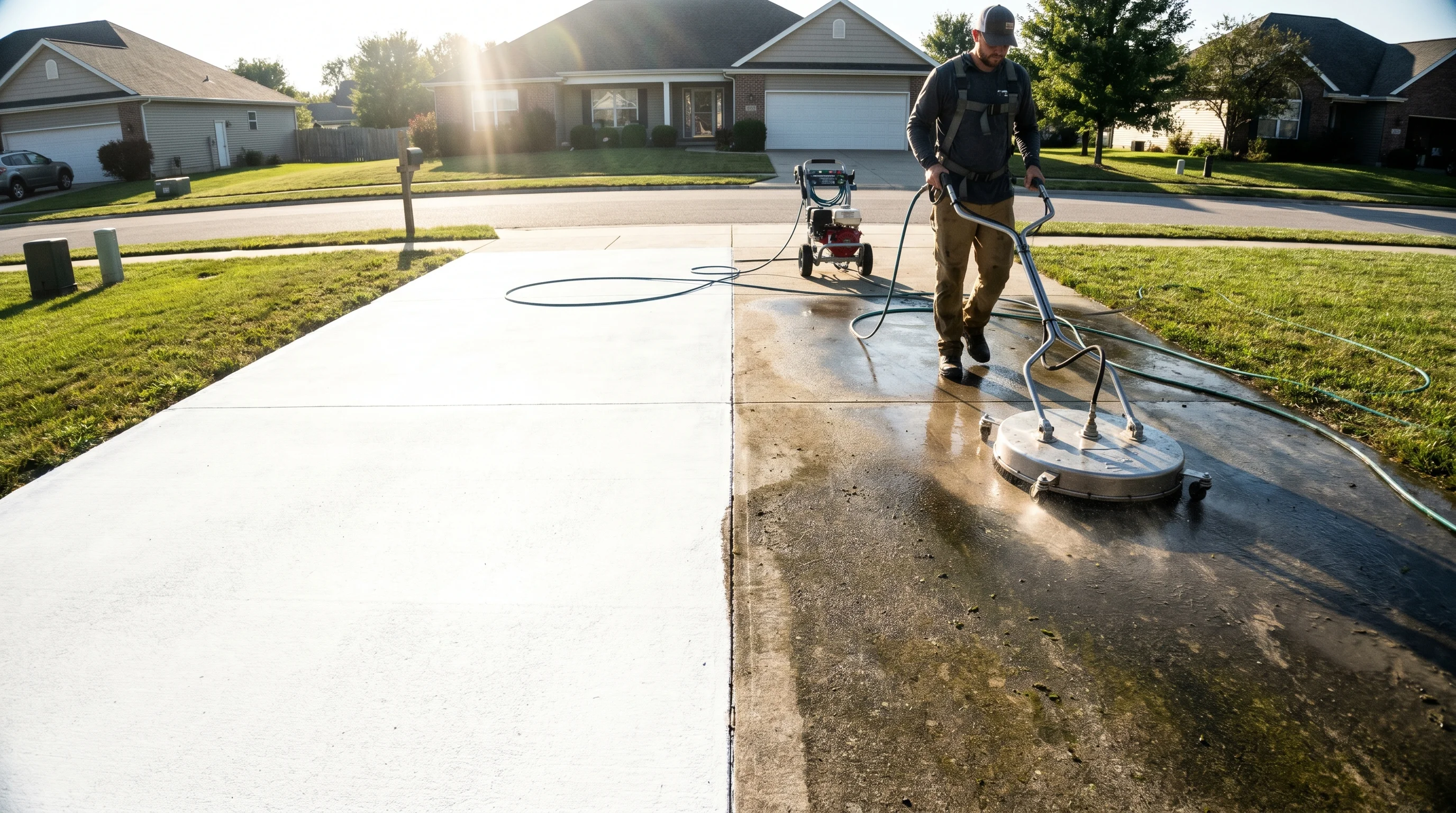
Searching "concrete cleaning near me" returns a mix of pressure washing generalists, specialist concrete cleaners, and home service aggregators. Before you call anyone, know what service you actually need, what a fair price looks like in your area, and the handful of red flags that separate professional cleaners from ones who will damage your surface or disappear after payment. This guide covers all of it — including a state-by-state service finder to get you started.
Quick Answer: What Does Concrete Cleaning Cost?
Professional concrete cleaning costs $0.08–$0.35 per square foot in 2026. A standard residential driveway (500–800 sq ft) runs $80–$200 for pressure washing. Patios and pool decks average $100–$300. Most companies have a $75–$150 minimum regardless of area. A combined clean-and-seal service adds $0.20–$0.60/sq ft depending on sealer type.
Find Concrete Cleaning Services in Your State
Below is a starting list of regional pressure washing and concrete cleaning companies that may serve your area. Always verify licensing, insurance, and current service offerings before hiring.
🔍 State Concrete Cleaning Finder
What Concrete Cleaning Services Actually Do
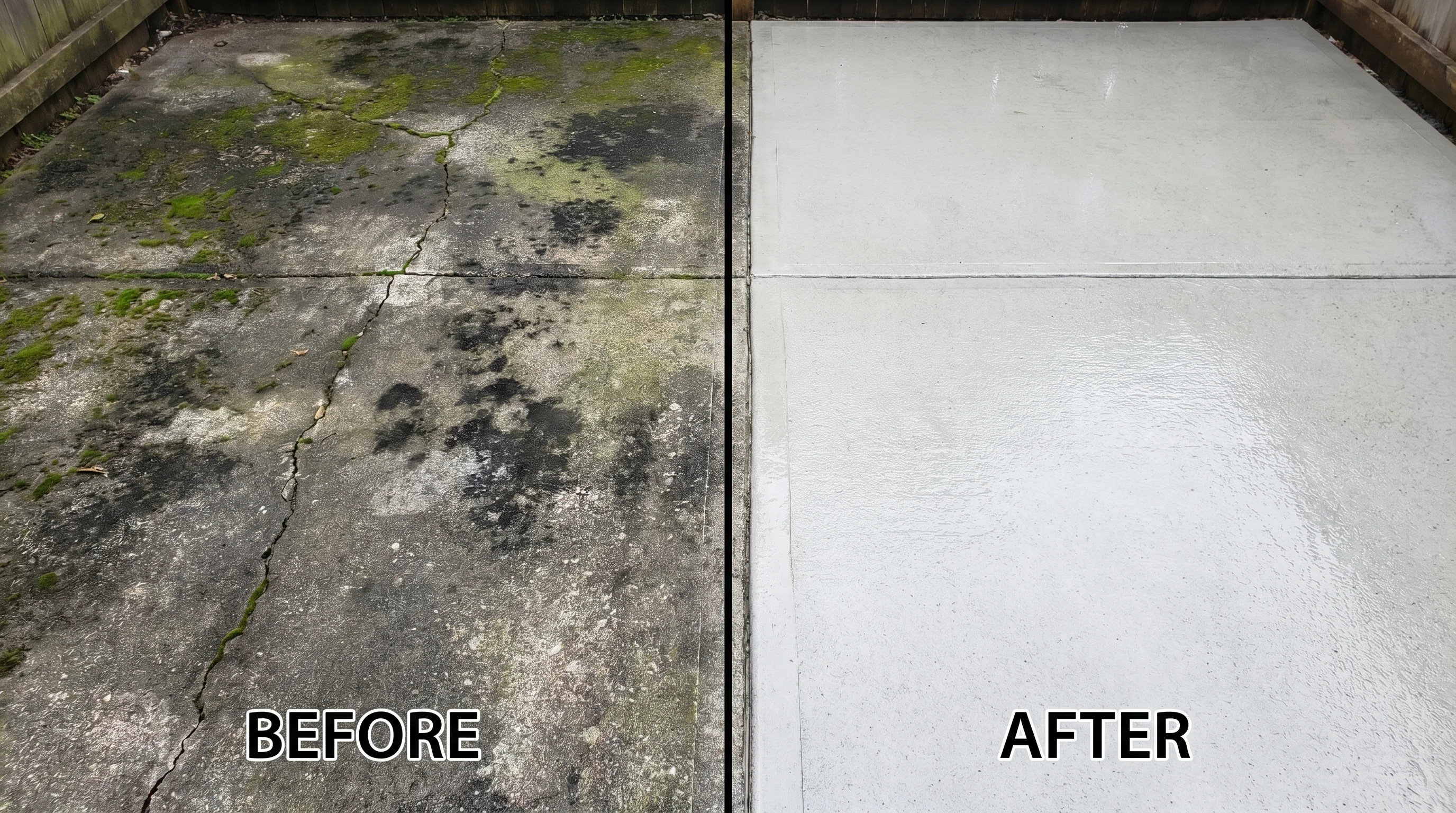
Not all "concrete cleaning" is the same. The service type matters — both for the result and the price. Here's what each approach involves and when it's the right choice:
| Service Type | What It Does | Best For | Typical Cost |
|---|---|---|---|
| Pressure washing | High-pressure water (1,500–4,000 PSI) removes surface dirt, algae, and loose debris | General maintenance cleaning, light biological growth | $0.08–$0.18/sq ft |
| Chemical + pressure wash | Pre-treatment with degreaser or alkaline cleaner, dwell time, then pressure rinse | Oil stains, grease, heavy soiling on driveways | $0.15–$0.30/sq ft |
| Soft washing | Low-pressure application of cleaning solution — algae, mold, and mildew killed chemically | Aged or soft concrete that would be damaged by high pressure | $0.12–$0.25/sq ft |
| Acid washing / etching | Dilute muriatic or phosphoric acid removes efflorescence, mineral deposits, and rust stains | Pre-sealing prep, efflorescence removal, rust stains | $0.20–$0.40/sq ft |
| Hot water extraction | Heated pressure water (180–200°F) for deep sanitization and stubborn grease | Restaurant patios, commercial kitchen areas, heavy grease | $0.25–$0.50/sq ft |
| Clean + seal combo | Full cleaning followed by sealer application while surface is prepared | Best value — protects clean surface and extends time before next cleaning | $0.30–$0.80/sq ft total |
Concrete Cleaning Prices by Surface Type
| Surface | Typical Size | Standard Clean | Chemical Clean | Clean + Seal |
|---|---|---|---|---|
| Residential driveway | 500–800 sq ft | $80–$150 | $120–$220 | $200–$450 |
| Patio / pool deck | 300–600 sq ft | $75–$120 | $100–$180 | $180–$400 |
| Sidewalk / walkway | 100–300 sq ft | $75–$100 (min charge) | $85–$130 | $130–$250 |
| Garage floor | 400–600 sq ft | $90–$160 | $130–$240 | $200–$500 |
| Commercial parking lot | 5,000–20,000 sq ft | $0.05–$0.12/sq ft | $0.08–$0.18/sq ft | $0.15–$0.35/sq ft |
| Concrete retaining wall | Varies | $1.50–$3.50/sq ft | $2.50–$5.00/sq ft | $4.00–$8.00/sq ft |
How to Find a Trustworthy Concrete Cleaning Company
1. Start with Google Maps
- Search "concrete cleaning [your city]" or "pressure washing [your city]" — city-specific searches surface local operators over national aggregator sites
- Filter to results with 4+ stars and 15+ reviews — anything with fewer than 10 reviews is too early to trust
- Read the 3-star reviews — they show real friction points without the bias of 1-star anger or 5-star friend reviews
- Check for owner responses to negative reviews — indicates accountability and professionalism
2. Verify on Angi, Thumbtack, or BBB
- Cross-reference the company name across two or more directories — a legitimate business has a consistent presence
- Angi-verified pros have undergone background checks; Thumbtack shows verified reviews with job photos
- BBB rating of B+ or higher is a baseline signal of business longevity and complaint resolution
3. Confirm Insurance Before Booking
- General liability insurance — minimum $1 million; covers damage to your property from their equipment or chemicals
- Workers' compensation — protects you from liability if a worker is injured on your property
- Request a Certificate of Insurance (COI) by email before the job — a professional company sends it without hesitation
4. Ask About Equipment and Method
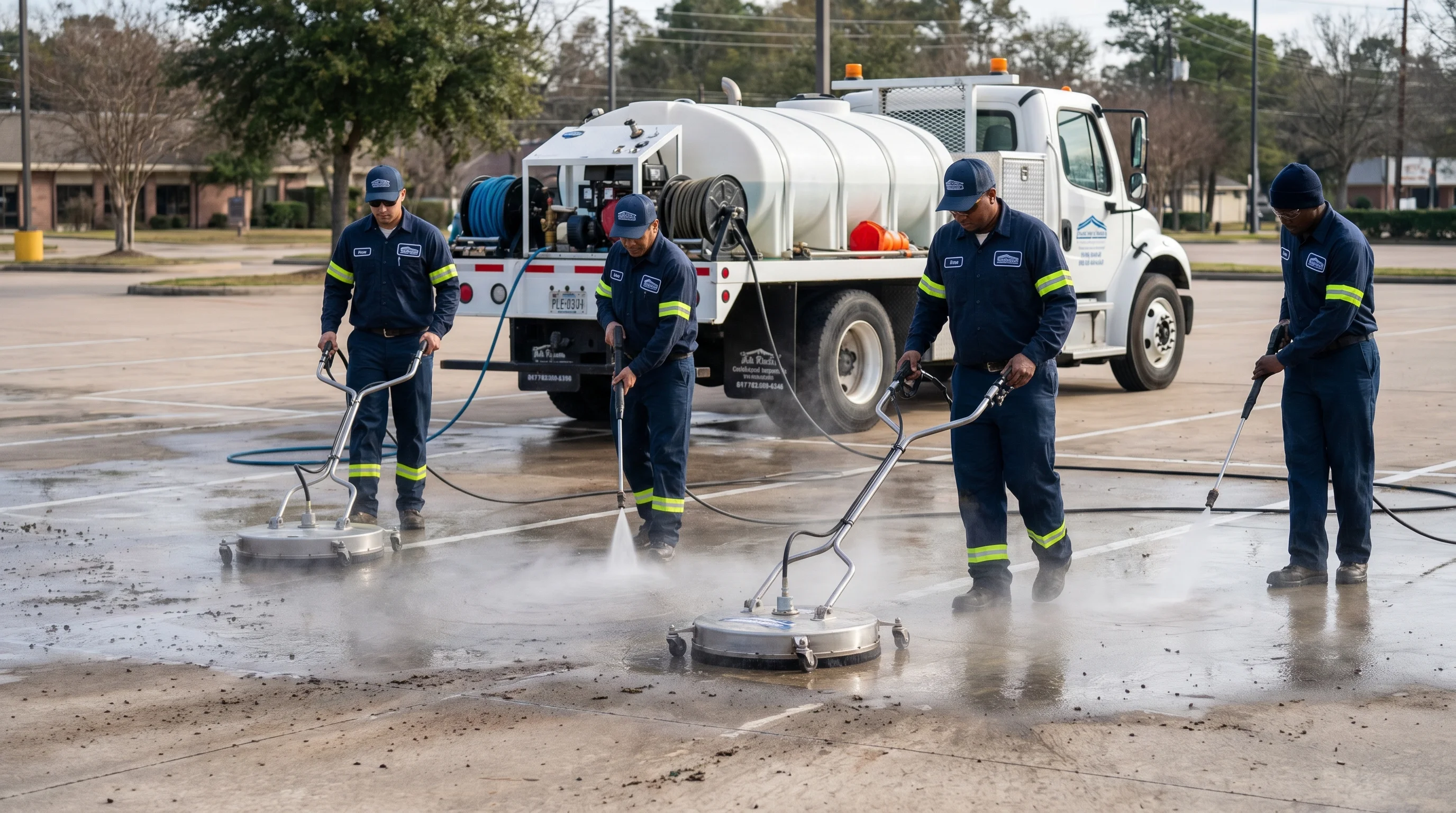
- Professional companies use a surface cleaner attachment (rotating flat head) — not just a wand — for driveways and flat work. Surface cleaners produce even cleaning without the streaking or etching that a direct wand causes.
- Ask the PSI they use on concrete — more than 3,500 PSI on standard residential concrete can cause surface damage
- For oil stains, ask specifically if they pre-treat with a degreaser — pressure alone will not remove embedded oil
- No insurance documentation — if a worker damages your property or is injured, the liability falls on you
- Wand-only pressure washing on driveways — leaves visible stripes and uneven cleaning; surface cleaners are the professional standard for flat concrete
- Using bleach on colored or stamped concrete — chlorine bleach fades integral color and leaves white residue; oxygen bleach or pH-neutral cleaners are correct for decorative surfaces
- Pressure above 4,000 PSI on residential concrete — can pit, etch, and scar the surface, especially on older or softer concrete
- Cash-only, no written quote — no paper trail and no recourse if the job is done poorly
- Door-to-door solicitation — legitimate pressure washing companies book from websites and referrals, not by knocking on doors after rain
- Full payment demanded upfront — industry standard is no deposit or a small deposit (10–20%), balance on completion
The Quote Checklist — What Every Written Quote Must Include
Never approve a concrete cleaning job based on a verbal price or a text message number. Insist on a written quote that specifies:
- Scope of work — exact surfaces to be cleaned, square footage, and method (pressure wash, chemical pre-treat, soft wash, acid wash)
- Pressure and equipment — PSI to be used, whether a surface cleaner attachment is included for flat work
- Chemicals — specific cleaning agents to be applied, dwell time, and neutralization/rinse procedure if acid washing
- Stain treatment — if oil or rust stains are present, confirmation that pre-treatment is included (not just pressure rinsing over them)
- Post-cleaning service — whether sealing is included or quoted separately, and which sealer product if applicable
- Warranty — most professional cleaners offer a 30-day satisfaction guarantee at minimum
- Insurance — reference to their COI or confirmation that it will be provided before work begins
- Payment terms — deposit amount if any, when final payment is due
DIY vs Professional — Which Is Right for Your Job?
| Situation | DIY or Pro? | Reason |
|---|---|---|
| Light surface dirt, dust, leaves | DIY | Garden hose or rented consumer pressure washer sufficient; no chemicals needed |
| Mild algae or mildew growth | DIY | Dilute oxygen bleach solution + consumer pressure washer handles this well |
| Heavy oil stains on driveway | Pro | Requires commercial degreaser, hot water, and industrial PSI to fully lift; DIY results in permanent ghost staining |
| Efflorescence (white mineral deposits) | Pro | Acid washing requires careful dilution, neutralization, and PPE — professional execution recommended |
| Rust stains | Pro | Oxalic acid treatment followed by thorough neutralization — risk of surface damage if done wrong |
| Large area (1,000+ sq ft) | Pro | Surface cleaner attachment and truck-mounted unit produce better, faster results than consumer equipment |
| Pre-sealing or pre-painting prep | Pro | Surface must meet a cleanliness standard that consumer equipment often can't achieve consistently |
| Stamped or decorative concrete | Pro | Wrong chemicals or pressure can damage coloring and texture — professional low-pressure chemical cleaning is safer |
What to Do After Concrete Is Cleaned
A freshly cleaned concrete surface is in the best condition it will be in until the next cleaning — and that window is the right time to protect it. Two actions extend the clean result significantly:
Apply a concrete sealer within 48–72 hours of cleaning. Clean, dry concrete accepts sealer penetration far more effectively than dirty or weathered concrete. A penetrating silane-siloxane sealer applied after professional cleaning creates a water-repellent barrier that prevents re-staining from oil, biological growth, and road salt penetration. It also reduces how quickly the surface re-soils — meaning the next cleaning cycle is lighter and cheaper. For a full breakdown of sealer types and products, see our complete concrete sealer guide.
Address any cracks before they admit water. Cleaned concrete reveals cracks that were hidden under dirt and staining. Water entering cracks initiates freeze-thaw damage and undermines the base — a small crack filled immediately costs $5–$20 in materials; the same crack ignored for a season can become a structural failure costing hundreds to repair. Fill any cracks wider than 1/8 inch with a polyurethane concrete caulk or crack filler before applying sealer.
Frequently Asked Questions
How much does concrete cleaning cost near me?
Professional concrete cleaning runs $0.08–$0.35 per square foot in 2026. Most residential driveways cost $80–$200 for a standard pressure wash, $120–$220 with chemical pre-treatment for oil stains. Patios and pool decks run $75–$300. Most companies have a $75–$150 minimum service charge regardless of area size.
What is the difference between pressure washing and concrete cleaning?
Pressure washing uses high-pressure water to remove surface dirt and debris — adequate for light maintenance. Concrete cleaning is broader: it includes chemical pre-treatment (degreasers, acid washing), surface scrubbing, and hot water extraction for stubborn stains that pressure alone cannot remove. For oil stains, rust, efflorescence, or pre-sealing prep, full chemical concrete cleaning is needed — not just pressure rinsing.
How often should concrete be professionally cleaned?
Residential driveways and patios: every 1–2 years. High-traffic commercial areas: 2–4 times per year. Humid climates with fast algae/mold growth: annually. Always clean before any sealing or painting project, regardless of how recently the surface was last cleaned.
Can concrete cleaning damage my driveway?
Yes — improper technique can damage concrete. A zero-degree nozzle or excessive PSI (above 3,500 on standard residential concrete) etches and pits the surface. Professional cleaners use a surface cleaner attachment that distributes pressure evenly. Always confirm your cleaner uses a rotary surface cleaner, not a direct wand, for flat concrete work.
Should I seal concrete after cleaning?
Yes — cleaned concrete is in the ideal condition to accept sealer. Applying a penetrating silane-siloxane sealer within 48–72 hours of professional cleaning protects against re-staining, oil penetration, and biological regrowth. Many cleaning companies offer a combined clean-and-seal service at a discount. See our concrete sealer guide for full product and type recommendations.