
Concrete Sealer — Best Types, Top Products & How to Apply (2026)
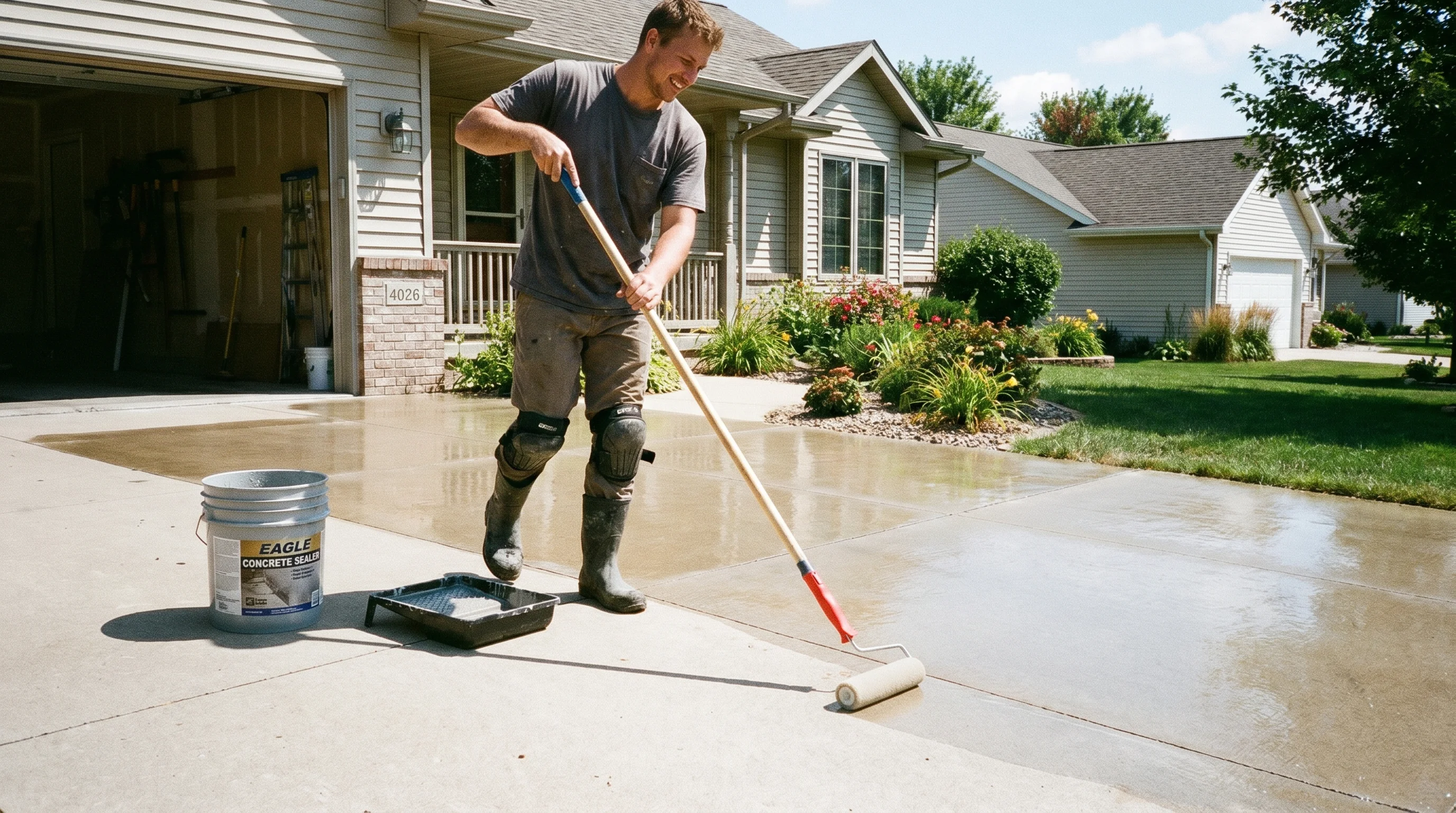
Quick Picks by Use Case
Best for driveways (freeze-thaw / road salt): Penetrating silane-siloxane sealer — Foundation Armor SX5000 or RadonSeal. Invisible finish, lasts 5–10 years, no peeling.
Best for patios (enhanced color + sheen): Solvent-based acrylic sealer — Armor AR350 or Techniseal Wet Look. Wet-look finish, easy reapplication, 2–3 years.
Best for garage floors (chemical + abrasion resistance): 100% solids epoxy coating or polyurethane topcoat — Rust-Oleum EpoxyShield or Armor UTN15. Lasts 3–7 years.
Best for stamped / decorative concrete: Solvent-based acrylic or polyurethane — deepens color, adds sheen without hiding texture detail.
Why Concrete Needs Sealing
Concrete is a porous material. Its surface — no matter how smooth it appears — is riddled with microscopic capillaries and pores that allow water, oils, chemicals, and contaminants to penetrate below the surface. Without a sealer, these substances cause a range of damage over time:
- Freeze-thaw spalling: Water absorbed into concrete pores expands when it freezes, creating internal pressure that fractures the surface — a process called spalling. Over multiple winters, unsealed concrete develops a scaly, pitted surface that deepens progressively.
- Road salt damage: Deicing salts (sodium chloride, calcium chloride, magnesium chloride) accelerate freeze-thaw damage and chemically attack the calcium silicate hydrate matrix of concrete, causing surface scaling and exposing aggregate.
- Oil and chemical staining: Motor oil, gasoline, transmission fluid, and other automotive chemicals soak into unsealed concrete and leave permanent stains that are nearly impossible to fully remove.
- Efflorescence: Soluble salts migrating through the concrete with water deposit white crystalline deposits on the surface — more severe in unsealed concrete with high water ingress.
- Biological growth: Moisture retained in porous unsealed concrete encourages algae, moss, and mildew growth — especially in shaded areas.
- Surface abrasion: Foot and vehicle traffic wears the surface of unprotected concrete faster than sealed concrete, exposing aggregate and roughening the texture.
A concrete sealer addresses all of these issues by either blocking water entry (penetrating sealers) or creating a protective film layer (film-forming sealers) that shields the surface from external damage. The right sealer, properly applied, can double or triple the service life of a concrete surface with minimal ongoing maintenance cost.
5 Types of Concrete Sealer — Full Comparison
| Sealer Type | How It Works | Finish | Lifespan | Cost/gal | Best For |
|---|---|---|---|---|---|
| Penetrating (silane-siloxane) | Chemically bonds inside concrete pores | Natural / invisible | 5–10 years | $40–$90 | Driveways, exterior flatwork, freeze-thaw areas |
| Acrylic (water-based) | Surface film — forms thin protective layer | Matte to satin sheen | 1–3 years | $20–$45 | Patios, walkways, decorative concrete |
| Acrylic (solvent-based) | Surface film — deeper penetration than water-based | Wet-look to high gloss | 2–4 years | $30–$60 | Stamped concrete, patios, decorative surfaces |
| Epoxy coating | Two-part chemical cure — hard surface film | High gloss | 3–5 years | $50–$120 | Garage floors, commercial floors, high-traffic areas |
| Polyurethane | Surface film — flexible, UV stable | Satin to high gloss | 5–7 years | $60–$130 | Garage floors, industrial, outdoor high-traffic |
Penetrating Sealers — Deep Dive
Penetrating sealers are the most technically sophisticated category — and for exterior concrete in freeze-thaw climates, they are almost always the right choice. Rather than forming a film on the surface, these sealers soak into the concrete and chemically react with the free silica and calcium compounds in the cement matrix, forming water-repellent compounds within the pores themselves.
How Penetrating Sealers Work
The active ingredients in penetrating sealers are silane, siloxane, or a blend of both — collectively called silane-siloxane sealers. When applied, these small-molecule compounds migrate into the concrete's capillary network. Once inside, they react with moisture and the alkaline cement matrix to form a water-repellent silicone resin that lines the walls of each pore. Water can no longer enter the pore; vapor can still move out. The result is a surface that looks identical to untreated concrete but repels water almost completely.
Because the sealer is inside the concrete rather than on its surface, it cannot peel, bubble, chip, or wear off from foot or vehicle traffic. It can eventually be consumed or washed out by very aggressive water or acid exposure, which is why reapplication is needed after 5–10 years. But it does not require stripping before reapplication — simply clean and apply another coat.
Silane vs Siloxane vs Silane-Siloxane Blends
| Type | Molecule Size | Penetration Depth | Best For | Limitation |
|---|---|---|---|---|
| Silane | Small | Deep (up to 4 inches) | Dense, hard concrete; brick | Short-lived surface activity — mainly subsurface |
| Siloxane | Larger | Moderate (1–2 inches) | Porous concrete, masonry | Less effective on very dense concrete |
| Silane-Siloxane blend | Mixed | Deep + surface | All concrete types — best overall | Higher cost than single-component |
Film-Forming Sealers — Deep Dive
Film-forming sealers create a protective layer on top of the concrete surface. Unlike penetrating sealers, they change the appearance of the surface — from a subtle sheen to a high-gloss wet look depending on the product and application. They are more decorative and more versatile in appearance, but they require more preparation, can peel or bubble if applied improperly, and need periodic stripping and reapplication as they wear.
Acrylic Sealers
Acrylic sealers are the most widely used film-forming sealers for residential concrete — patios, driveways, walkways, pool decks, and decorative/stamped surfaces. They come in water-based and solvent-based formulations. Water-based acrylics are lower-VOC, easier to apply, and produce a more subtle sheen — ideal for plain concrete where you want protection without dramatically changing the appearance. Solvent-based acrylics penetrate more deeply, enhance color more aggressively, and produce the classic "wet look" finish on stamped and colored concrete.
Acrylic sealers are the easiest to apply and reapply — clean the surface, roll on two thin coats, allow to dry. They are also the shortest-lived, typically lasting 1–3 years before the surface film wears through and reapplication is needed. In high-traffic or high-UV environments, annual reapplication may be necessary.
Epoxy Coatings
Epoxy coatings are two-part systems — a resin and a hardener that are mixed just before application and cure through a chemical reaction rather than by evaporation. The result is an extremely hard, durable film with excellent chemical resistance, stain resistance, and abrasion resistance. Epoxy is the standard coating for garage floors, automotive shops, commercial kitchens, and industrial floors where chemical spills and heavy mechanical traffic are routine.
The tradeoffs: epoxy requires thorough surface preparation (etching or grinding), has a limited working time after mixing, is sensitive to moisture during application and cure, and yellows under UV exposure — making it unsuitable for exterior applications. For interior garage floors, epoxy is hard to beat for durability and ease of cleaning.
Polyurethane Sealers
Polyurethane sealers are the premium film-forming option — more flexible, more UV stable, and harder than acrylic, without the yellowing issue that limits epoxy. They are significantly more expensive than acrylics and require more careful surface preparation, but they provide the longest lifespan of any film-forming sealer (5–7 years) and resist abrasion, chemicals, and UV degradation equally well. Polyurethane is commonly used as a topcoat over epoxy in garage floor systems — the epoxy provides the body and chemical resistance, the polyurethane provides UV stability and a hard-wearing top surface.
8 Top Concrete Sealer Products
Foundation Armor SX5000 — Best Overall Penetrating Sealer
DOT-approved silane-siloxane blend at 40% active ingredient concentration — one of the highest available. Penetrates deeply into dense concrete and masonry, forms durable water-repellent barrier that lasts 7–10 years. Leaves no surface sheen. Works on driveways, foundations, brick, pavers. ~$50–$70 per gallon (covers 100–200 sq ft depending on concrete porosity).
RadonSeal Deep Penetrating Concrete Sealer — Best for Basements & Foundations
Silicate-based penetrating sealer designed specifically for porous concrete and masonry below grade. Reacts with the concrete matrix to permanently densify and waterproof. Excellent for basement walls, foundation blocks, and concrete floors in wet areas. Will not peel, has no VOCs, and lasts the life of the concrete if properly applied. ~$35–$50 per gallon.
Armor AR350 — Best Solvent-Based Acrylic for Patios & Stamped Concrete
25% solids solvent-based acrylic that delivers a rich wet-look finish on stamped, exposed aggregate, and plain concrete. Enhances color depth significantly. UV stable formula resists yellowing. Covers 200–300 sq ft per gallon. Reapply every 2–3 years. Strong solvent odor during application — use outdoors or with ventilation. ~$40–$55 per gallon.
Techniseal Wet Look Natural Stone & Concrete Sealer — Best Water-Based Acrylic
Low-VOC water-based acrylic with a subtle wet-look finish that enhances color without the aggressive gloss of solvent-based products. Easy soap-and-water cleanup. Good for patios, walkways, and pool decks where a natural look is preferred over high gloss. Covers 250–400 sq ft per gallon. Reapply every 1–2 years on high-traffic surfaces. ~$30–$45 per gallon.
Rust-Oleum EpoxyShield — Best Garage Floor Epoxy
Water-based two-part epoxy kit widely available at home improvement stores. Includes primer, color chips, and topcoat. Handles typical garage conditions well — tire traffic, oil drips, car wash runoff. DIY-friendly with roller application. Covers approximately 250 sq ft per kit. May yellow slightly under extended UV exposure through windows. ~$90–$130 per two-car garage kit.
Armor UTN15 — Best Polyurethane Sealer
Water-based aliphatic polyurethane that provides excellent UV stability, chemical resistance, and abrasion resistance with a semi-gloss finish. Suitable for both interior and exterior concrete. Works well as a standalone sealer or as a topcoat over epoxy. Covers 250–300 sq ft per gallon. Lifespan: 5–7 years. ~$55–$80 per gallon.
Siloxa-Tek 8500 — Best for Driveways in Salt / Freeze-Thaw Zones
High-concentration (40% active) silane-siloxane sealer specifically formulated to resist chloride ion penetration from road salts. Tested and accepted by multiple state DOTs for bridge deck and highway concrete protection. Penetrates up to 4 inches. Invisible finish. Covers 100–200 sq ft per gallon. ~$55–$75 per gallon.
GHOSTSHIELD Lithi-Tek 4500 — Best Concrete Densifier / Hardener
Lithium silicate concrete densifier that reacts with free calcium in the concrete to form additional calcium silicate hydrate — permanently hardening and densifying the surface from within. Used as a prep coat before applying a topical sealer, or as a standalone treatment for warehouse and industrial floors. Eliminates dusting, increases surface hardness. ~$30–$50 per gallon (covers 200–400 sq ft).
When to Seal — New Concrete vs Old Concrete
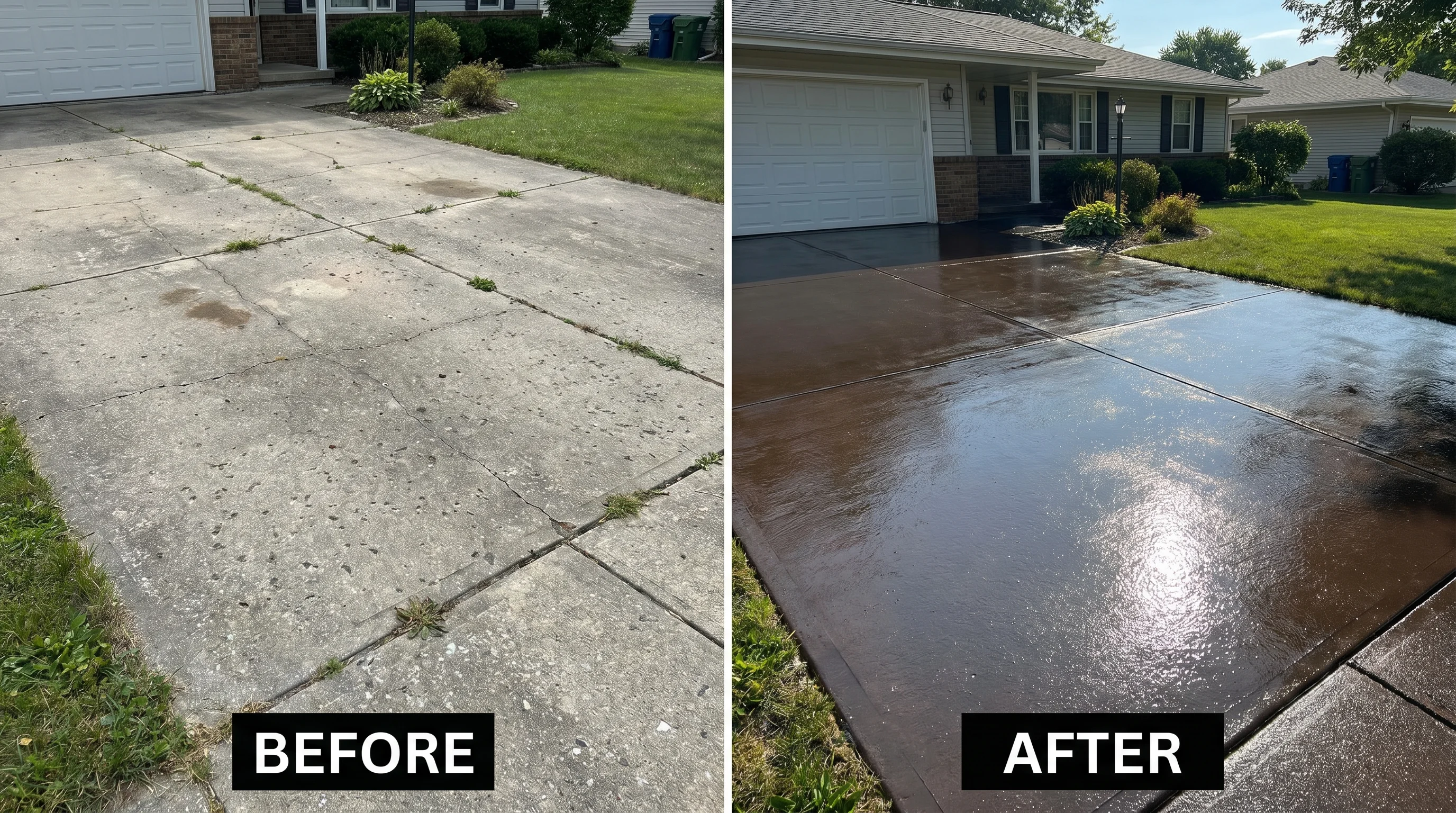
New Concrete
New concrete must cure before sealing. The curing process — hydration of Portland cement — takes approximately 28 days to reach full design strength. During this period, sealing with a film-forming product traps moisture at the surface and can cause discoloration, adhesion failure, and surface scaling.
The correct approach for new concrete: apply a curing compound immediately after finishing (this retains moisture for proper hydration — it is not the same as a sealer). After 28 days of curing, the concrete is ready for a sealer application. Test moisture content first: tape a plastic sheet to the surface and leave for 24 hours — if condensation forms underneath, the concrete is still too wet to seal.
Existing Concrete
Existing concrete can be sealed at any time, provided it is clean, dry, and free of existing coatings that would block penetration. Old concrete that has never been sealed is straightforward — clean thoroughly, allow to dry, apply sealer. Concrete that has been previously sealed requires evaluation: is the existing sealer worn through, peeling, or still intact? Peeling or flaking sealer must be fully removed before reapplication. An intact sealer in good condition can sometimes be recoated without stripping, depending on the product type.
8-Step Surface Preparation Before Sealing
Surface preparation is the most critical factor in sealer performance — more important than which product you choose. Sealers applied to dirty, wet, or contaminated concrete fail regardless of product quality.
-
1
Clear the area and sweep thoroughly
Remove all furniture, vehicles, planters, and debris. Sweep the entire surface to remove loose dirt, leaves, and grit. Pay attention to edges and expansion joints where debris accumulates.
-
2
Treat oil and grease stains
Apply a concrete degreaser or alkaline cleaner to oil stains. Scrub with a stiff-bristle brush, allow to dwell 10–15 minutes, then rinse. Repeat if stains remain. Oil that is not removed before sealing will prevent adhesion in that area and cause the sealer to fail locally.
-
3
Remove existing sealer if peeling or flaking
Use a chemical stripper appropriate for the sealer type, or mechanically grind/shot blast. A peeling sealer cannot simply be overcoated — the new sealer will bond to the old failing film rather than to the concrete, and peel with it.
-
4
Treat efflorescence
White crystalline deposits (efflorescence) must be removed before sealing — sealer over efflorescence will trap the salts and continue to push upward, causing bubbling and peeling. Apply a dilute solution of muriatic acid (10:1 water to acid ratio), scrub with a stiff brush, allow to react for 3–5 minutes, then rinse thoroughly with clean water.
-
5
Pressure wash the entire surface
Use a 2,000–3,000 PSI pressure washer with a 25° or 40° fan tip nozzle. Work in overlapping strips, maintaining a consistent distance (8–12 inches) from the surface. Pressure washing removes embedded dirt, mold, algae, and chemical residue that sweeping cannot reach.
-
6
Repair cracks and spalled areas
Fill cracks wider than 1/4 inch with a concrete crack filler or polyurethane caulk. Patch spalled areas with a polymer-modified concrete repair mortar. Allow repairs to cure fully — at least 24–48 hours — before proceeding. Sealer will not fill or bridge cracks.
-
7
Allow to dry completely — minimum 24–48 hours
After pressure washing, concrete must dry completely before sealer application. In humid conditions, allow 48–72 hours. Perform the plastic sheet moisture test: tape a 12×12 inch piece of plastic sheeting to the surface for 24 hours — no condensation underneath means the concrete is dry enough to seal.
-
8
Check weather forecast before applying
Do not seal if rain is expected within 24 hours, if ambient temperature is below 50°F or above 90°F, or if the concrete surface is in direct hot sun (surface temperature above 90°F causes the sealer to dry too quickly before it can penetrate or bond). Early morning application on a dry day is ideal.
How to Apply Concrete Sealer — Step by Step
-
1
Read the product instructions — every product is different
Dilution ratios, application rates, drying times, and recoat windows vary significantly between sealer types and brands. The product data sheet is your primary reference — these general steps are a framework, not a substitute.
-
2
Apply penetrating sealers with a low-pressure pump sprayer
Penetrating sealers should be flooded onto the surface — not rolled — to maximize penetration. Spray in a single even coat, working from one end to the other. Allow to penetrate for 5–10 minutes, then wipe off any excess that has not absorbed with a clean cloth or squeegee. Do not let it puddle and dry on the surface.
-
3
Apply film-forming sealers with a roller in thin coats
Use a 3/8-inch nap roller for smooth concrete, 1/2-inch nap for textured or exposed aggregate. Work in sections, maintaining a wet edge. Apply thin coats — thick coats trap air, dry unevenly, and cause bubbling. Two thin coats always outperform one thick coat.
-
4
Allow first coat to dry before second coat
Drying time between coats depends on temperature, humidity, and product — typically 1–4 hours for acrylics, 8–12 hours for epoxies and polyurethanes. The surface should be dry to the touch but not fully cured before applying the second coat. Applying too soon causes solvent entrapment and bubbling.
-
5
Apply second coat perpendicular to the first
Rolling the second coat at 90° to the first ensures even coverage and eliminates thin spots. For driveways, apply the first coat front-to-back and the second coat side-to-side. This crossing pattern catches any areas the first pass missed.
-
6
Allow full cure before traffic
Light foot traffic is typically possible after 4–8 hours for acrylics, 12–24 hours for epoxy/polyurethane. Vehicle traffic requires full cure: 24–48 hours for acrylics, 3–7 days for epoxy and polyurethane. Do not allow vehicle traffic until fully cured — tire marks on a partially cured sealer are permanent.
Indoor vs Outdoor Sealer Selection
| Application | Recommended Sealer Type | Key Considerations |
|---|---|---|
| Exterior driveway (freeze-thaw zone) | Penetrating silane-siloxane | Road salt resistance, invisible finish, no peeling risk |
| Exterior driveway (mild climate) | Solvent-based acrylic or penetrating | Enhanced color OK; choose non-slip additive |
| Patio / pool deck | Water-based or solvent-based acrylic | Non-slip additive essential; UV stable formula |
| Stamped / decorative concrete | Solvent-based acrylic or polyurethane | Color enhancement, gloss level preference |
| Garage floor (residential) | Epoxy + polyurethane topcoat | Chemical resistance, ease of cleaning, UV-stable topcoat |
| Basement floor / walls | Silicate penetrating densifier | Vapor permeability critical — film sealers trap moisture below grade |
| Commercial / industrial floor | 100% solids epoxy or polyurethane | Maximum durability, chemical resistance, forklift traffic rating |
| Exterior steps and walkways | Water-based acrylic with anti-slip | Safety — anti-slip grit is essential on any sealed exterior step |
How Often to Reseal Concrete
| Sealer Type | Typical Resealing Interval | Cold Climate | Hot / UV-Heavy Climate |
|---|---|---|---|
| Penetrating silane-siloxane | 5–10 years | 5–7 years | 7–10 years |
| Water-based acrylic | 1–2 years | Annually | 1–2 years |
| Solvent-based acrylic | 2–3 years | 1–2 years | 2–3 years |
| Epoxy (garage floor) | 3–5 years | 3–5 years | 3–4 years (UV degradation) |
| Polyurethane | 5–7 years | 5–6 years | 5–7 years (UV stable) |
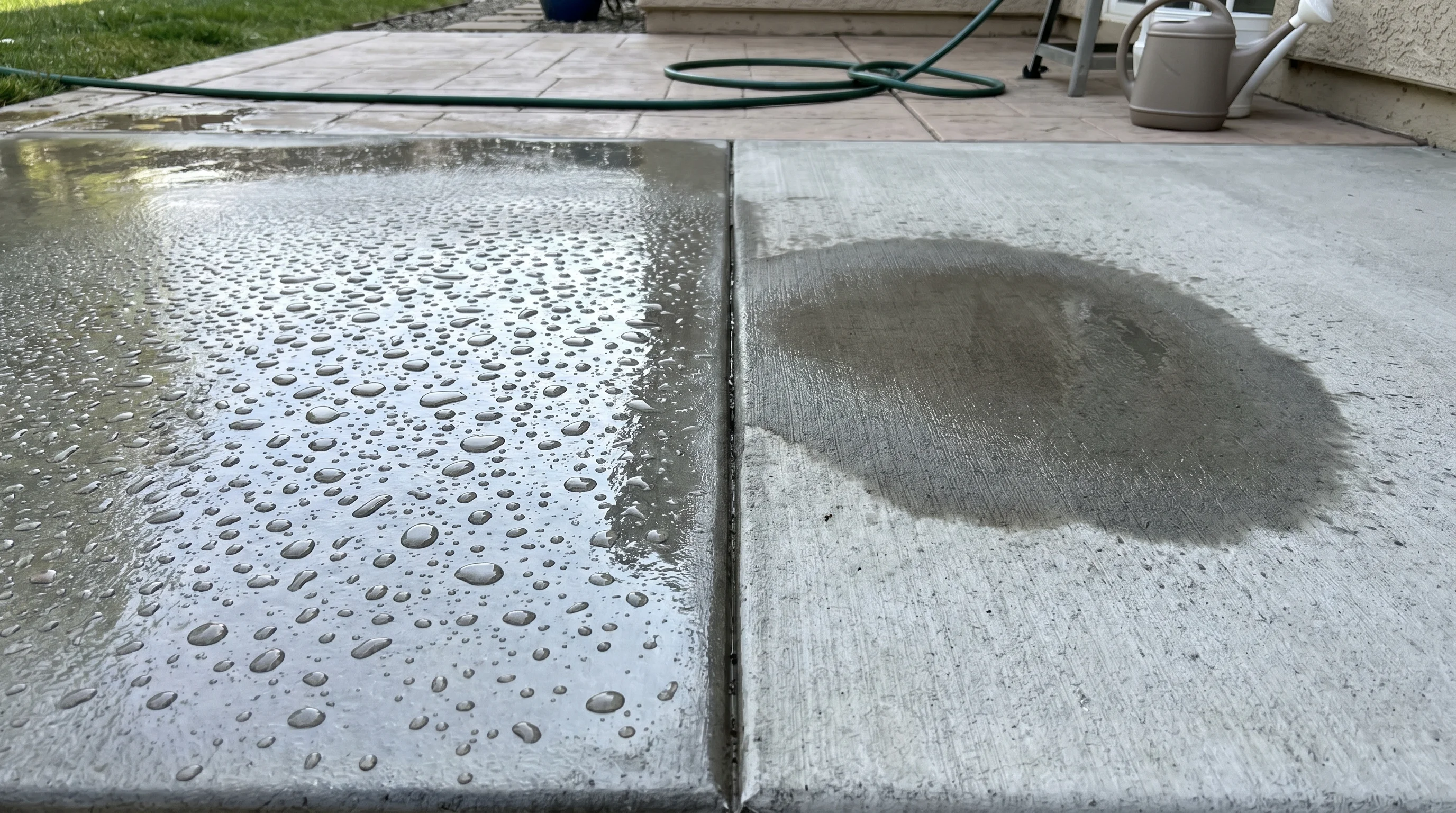
- Pour a small amount of water (about 1/4 cup) onto the surface in several locations
- If the water beads up into droplets and rolls off — the sealer is still working
- If the water darkens the concrete and absorbs within 30 seconds — the sealer has worn through and resealing is needed
- If the water absorbs instantly — the surface has likely never been sealed or the sealer has fully deteriorated
- Also check for peeling, bubbling, white haziness, or flaking — any of these require stripping before reapplication
Common Concrete Sealer Mistakes
- Applying to wet concrete — moisture prevents bonding in film sealers and dilutes penetrating sealers; always wait 24–48 hours after rain or washing
- Applying too thick — thick coats of acrylic or epoxy trap solvents and air, causing bubbling, cloudiness, and peeling; always apply two thin coats
- Sealing over oil stains without degreasing — oil creates a barrier that prevents sealer adhesion; the sealer peels from those spots within weeks
- Sealing in direct hot sun — surface temperatures above 90°F cause sealers to dry before they can penetrate or bond; apply in morning or shade
- Applying over peeling existing sealer — the new sealer bonds to the old failing film, not the concrete; always strip first
- Using a roller with too high a nap for smooth concrete — a thick nap roller leaves air bubbles in the film; use 3/8-inch nap for smooth surfaces
- Allowing vehicle traffic too soon — tire marks on partially cured sealer are permanent; wait the full cure time before any vehicle use
- Skipping anti-slip additive on exterior surfaces — glossy sealers are dangerously slippery when wet; always add anti-slip grit to exterior applications
Sealing Driveways vs Patios vs Garage Floors — Key Differences
Concrete Driveways
Driveways are the most demanding concrete sealing application. They receive vehicle traffic, oil drips, deicing salts, UV exposure, and temperature extremes. For driveways in freeze-thaw climates, a penetrating silane-siloxane sealer is the superior choice — it protects against chloride penetration (the mechanism by which road salt damages concrete) without creating a slippery surface film or requiring the high-maintenance reapplication cycle of acrylic sealers. In mild climates where aesthetics matter, a solvent-based acrylic with non-slip additive is acceptable.
Patios and Pool Decks
Patios and pool decks prioritize appearance and safety. A water or solvent-based acrylic with anti-slip additive is the most popular choice — it enhances color, provides a subtle sheen, and is easy to reapply. For stamped or colored concrete, a solvent-based acrylic or polyurethane sealer brings out the decorative detail most effectively. Anti-slip additive is non-negotiable on pool decks. Avoid high-gloss sealers on any exterior horizontal surface that gets wet regularly.
Garage Floors
Garage floors benefit most from film-forming sealers because the primary concerns are chemical resistance (oil, transmission fluid, brake fluid) and ease of cleaning rather than freeze-thaw or chloride protection. A two-coat epoxy system with a polyurethane topcoat is the gold standard for residential garages. The epoxy provides the bulk, color, and chemical resistance; the polyurethane topcoat adds UV stability and a harder-wearing surface. Surface preparation is critical — etching or diamond grinding ensures the epoxy bonds to the concrete rather than popping off under the first temperature cycle.
Frequently Asked Questions
What is the best concrete sealer?
For driveways in freeze-thaw climates: penetrating silane-siloxane (Foundation Armor SX5000 or Siloxa-Tek 8500). For patios with enhanced color: solvent-based acrylic (Armor AR350). For garage floors: epoxy + polyurethane topcoat (Rust-Oleum EpoxyShield + Armor UTN15). The best concrete sealer is the one matched to your specific application, climate, and appearance goals.
How often should you seal concrete?
Penetrating sealers: every 5–10 years. Acrylic sealers: every 1–3 years. Epoxy: every 3–5 years. Polyurethane: every 5–7 years. Perform the water bead test annually — if water absorbs rather than beading, resealing is needed regardless of the scheduled interval.
Do I need to seal new concrete?
Yes — but wait 28 days for full cure before applying a sealer. Apply a curing compound immediately after finishing to retain moisture for proper hydration. After 28 days, verify the concrete is dry (plastic sheet test), then apply your chosen sealer. Sealing new concrete protects it from the beginning of its service life and dramatically reduces long-term maintenance.
What is the difference between penetrating and film-forming sealers?
Penetrating sealers (silane-siloxane) bond chemically inside the concrete — no surface film, no peeling, invisible finish, 5–10 year lifespan. Film-forming sealers (acrylic, epoxy, polyurethane) form a protective layer on the surface — enhanced color and gloss, higher maintenance, can peel if improperly applied. For exterior freeze-thaw and road salt exposure, penetrating is almost always the better choice.
Can I seal concrete myself?
Yes — most sealers are DIY-friendly. Penetrating sealers are the easiest (spray and wipe). Acrylics apply like paint with a roller. Epoxy and polyurethane require more surface prep and have a shorter working window but are achievable DIY. The critical factor is surface preparation — a properly prepared surface with the wrong sealer outperforms a poorly prepared surface with the best sealer.
How do I prepare concrete for sealing?
Clean with a degreaser for oil stains, treat efflorescence with dilute muriatic acid, pressure wash at 2,000–3,000 PSI, repair cracks, allow to dry 24–48 hours, and check weather. The concrete must be clean, dry, and free of existing coatings, oils, and contamination before any sealer is applied.
Will concrete sealer make the surface slippery?
Film-forming sealers — especially high-gloss acrylics — can make concrete slippery when wet. Always add an anti-slip aggregate (aluminum oxide or silica sand) to any sealer applied to exterior surfaces, steps, pool decks, or ramps. Penetrating sealers do not significantly affect surface texture and are not a slip hazard.
How long does concrete sealer last?
Acrylic: 1–3 years. Epoxy: 3–5 years. Polyurethane: 5–7 years. Penetrating silane-siloxane: 5–10 years. Climate, traffic, and surface preparation quality all affect actual lifespan. The water bead test is the most reliable indicator of when resealing is needed.