
Concrete Drill Bits — Types, Sizes, Hammer Drill vs Rotary Hammer (2026)
Quick Answer
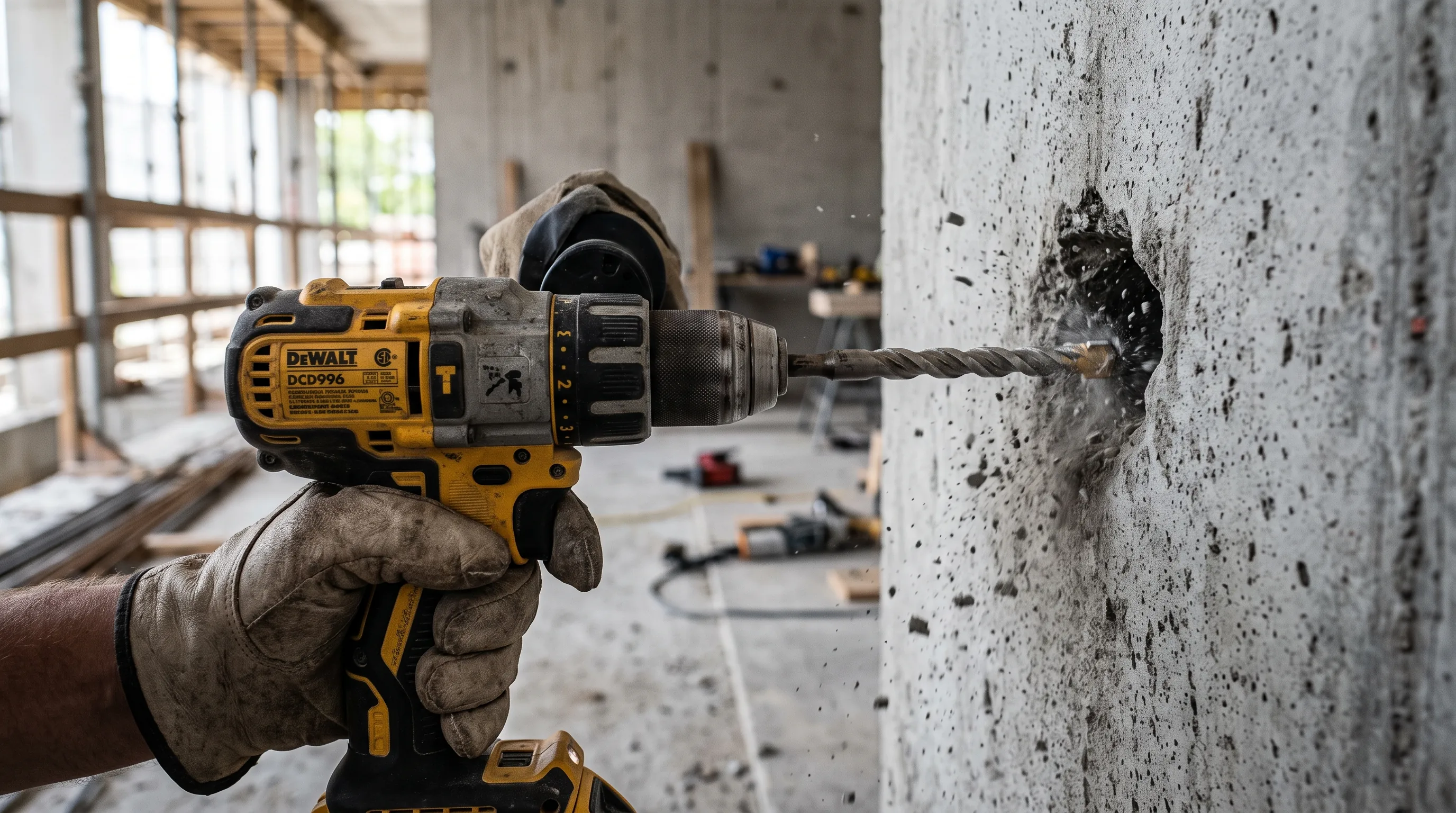
For most concrete drilling — anchors, screws, brackets — use a carbide-tipped masonry bit with a hammer drill for holes up to 1/2" diameter, or an SDS-plus bit with a rotary hammer for faster, cleaner holes and far less bit wear. For holes larger than 1", step up to an SDS-max bit or a diamond core bit run on a core drill rig. Never use a standard high-speed steel (HSS) twist bit on concrete — it has no carbide tip and will burn out in seconds without cutting.
Concrete is not one material — it's a composite of cement paste binding together sand and coarse aggregate (crushed stone, gravel, sometimes granite or quartz). That aggregate is what makes concrete so different to drill compared to wood or metal: you're not cutting a uniform fiber structure, you're fracturing rock embedded in a hardened cement matrix. A standard twist bit designed to shear through wood grain or soft metal has no way to do that — it will spin, generate heat, and dull to uselessness within seconds of contact.
Drilling concrete successfully comes down to three things working together: a carbide or diamond-tipped bit hard enough to fracture the aggregate, percussive hammer action to help the tip do that fracturing instead of just grinding, and the correct bit size and type for the hole's actual purpose. Get any one of those wrong — the wrong bit, no hammer action, the wrong diameter — and you'll be the person standing over a smoking, useless bit wondering why it "won't drill through concrete."
This guide covers every type of concrete drill bit, the tools that drive them, a complete size chart for anchors and screws, real product recommendations, a full step-by-step drilling process, how to avoid hitting rebar, core drilling for larger penetrations, and the mistakes that snap bits or ruin holes.
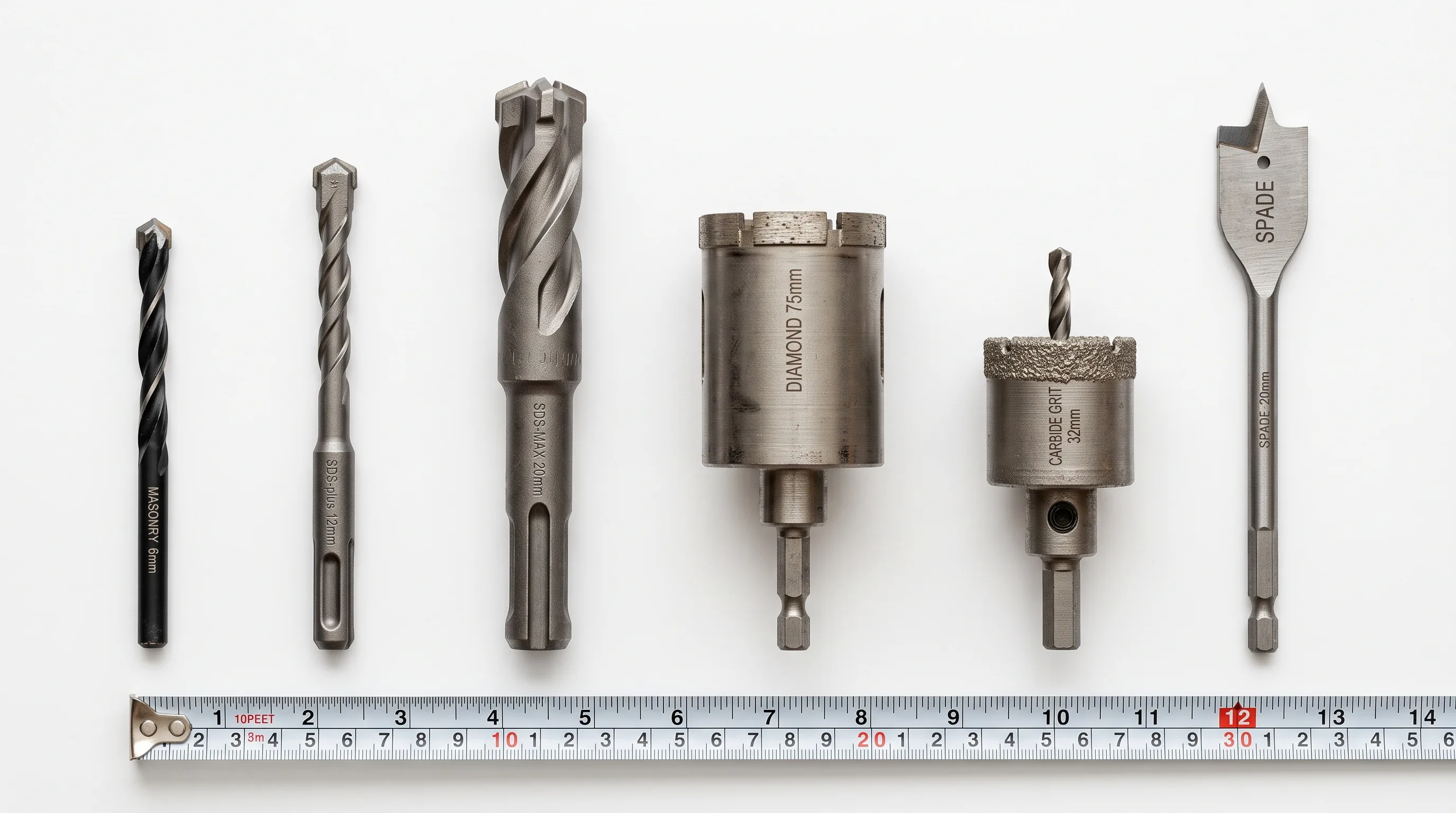
6 Types of Concrete Drill Bits Compared
| Bit Type | Shank / Fits | Best Hole Size | Drill Required | Best For |
|---|---|---|---|---|
| Carbide-Tipped Masonry (Twist) Bit | Round or hex shank | 3/16" – 1/2" | Hammer drill (hammer mode) | Anchors, screws, light-duty holes |
| SDS-Plus Bit | SDS-plus shank | 3/16" – 1" | Rotary hammer (SDS-plus) | Faster drilling, repetitive holes, pro use |
| SDS-Max Bit | SDS-max shank | 1" – 3"+ | Rotary hammer (SDS-max) | Large-diameter holes, heavy structural work |
| Diamond Core Bit | Threaded/arbor mount | 1" – 6"+ | Core drill rig (wet or dry) | Plumbing, electrical, and HVAC penetrations |
| Carbide Grit Hole Saw | Arbor-mounted | 3/4" – 4" | Hammer drill or rotary hammer | Conduit and pipe holes through thin slabs |
| Spade / Flat Masonry Bit | Round shank | 1/4" – 1" | Hammer drill | Block, brick, quick rough holes |
How Concrete Drill Bits Actually Cut Through Concrete
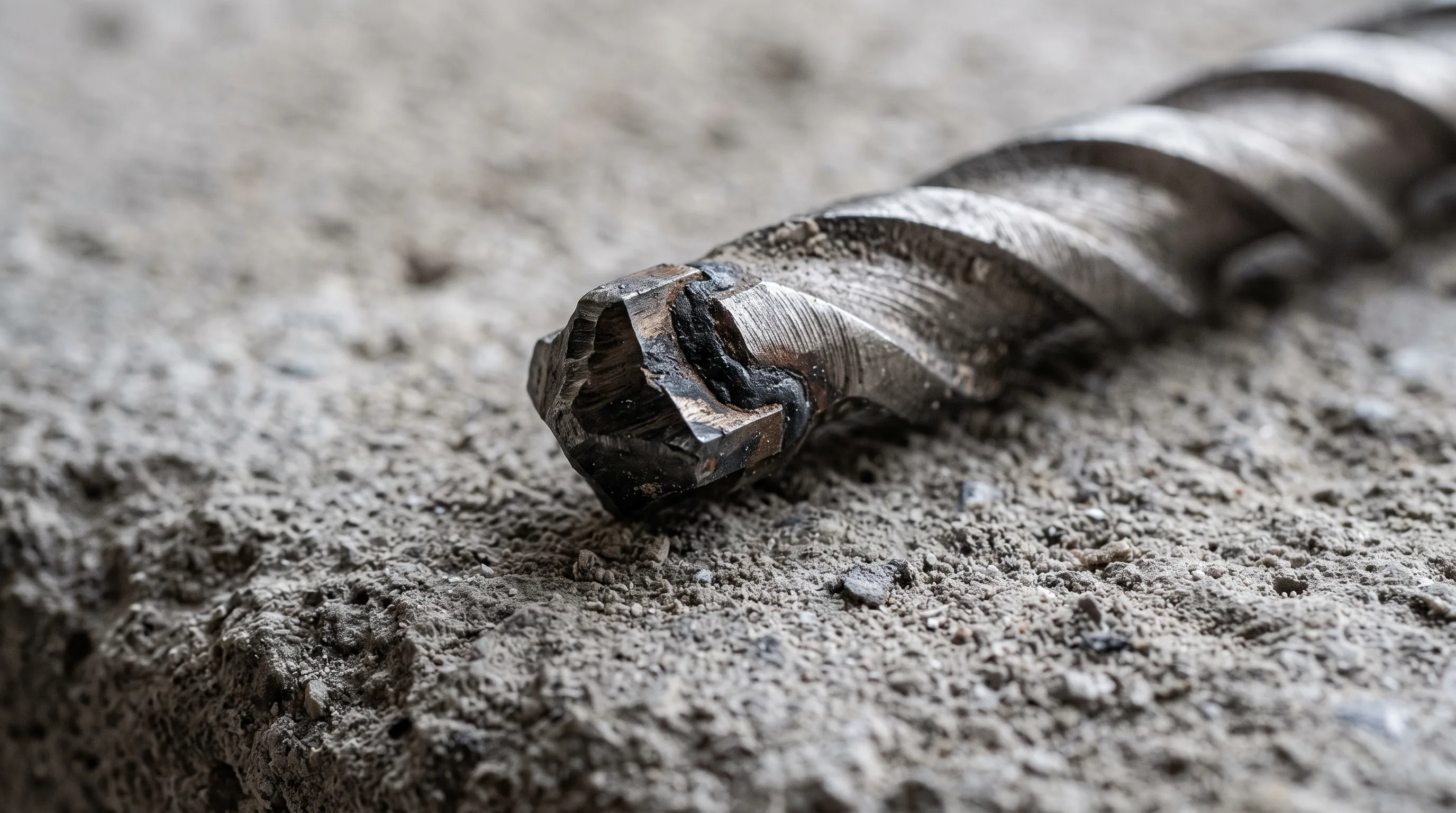
The tip is everything. A concrete-rated bit has a small insert of tungsten carbide — brazed onto a standard masonry bit or sintered directly into a diamond bit's matrix — that is dramatically harder than the quartz, granite, or limestone aggregate it needs to fracture. Standard steel, even hardened tool steel, is softer than most concrete aggregate and will wear down almost immediately on contact. Carbide sits high enough on the hardness scale to actually win that fight.
Hammer action is what turns that hard tip into a cutting tool rather than just a hard point dragging across rock. A hammer drill or rotary hammer delivers rapid impact blows — thousands per minute — while the bit simultaneously rotates. Each impact chips a tiny fragment of aggregate or cement paste loose; the rotation moves the tip to a new contact point for the next impact. It's closer to a miniature jackhammer working in a tight circle than to conventional drilling. This is also why pure rotation without hammer action is so slow on concrete: you're relying on the carbide edge to shear material the way a drill bit shears wood, and concrete's aggregate simply doesn't shear that way.
The spiral flutes running up the bit's shank do a second, equally important job: they auger the pulverized concrete dust up and out of the hole as you drill. Without effective flute design, dust packs into the bottom of the hole, cushions the impact energy before it reaches the aggregate, and stalls progress — which is also why periodically retracting the bit to clear dust (peck-drilling) makes such a large difference in drilling speed and bit life.
Diamond bits work on a related but distinct principle. Rather than one or two carbide inserts doing all the cutting, a diamond bit's rim embeds thousands of microscopic industrial diamond particles in a metal bond matrix. As the bit rotates, exposed diamond points continuously abrade — rather than impact-fracture — a thin kerf of material, and as the outer layer of bond wears away, fresh diamond particles are exposed underneath. Sintered diamond bits (particles fused into the matrix under heat and pressure) hold up to abrasive, high-aggregate concrete and are the standard for core bits. Electroplated diamond bits (particles bonded in a single surface layer via electroplating) cut faster initially but wear out sooner, making them better suited to softer materials like tile or block rather than hard structural concrete.
Hammer Drill vs Rotary Hammer vs Regular Drill
| Tool | Mechanism | Bit Type Used | Hole Range | Typical Cost | Best For |
|---|---|---|---|---|---|
| Regular (Standard) Drill | Rotation only, no hammer action | None — cannot drill concrete | N/A | $30 – $150 | Wood and metal only |
| Hammer Drill | Mechanical clutch — two ridged discs slip to create light concussive vibration | Carbide masonry (round/hex shank) | 3/16" – 1/2" | $60 – $200 | Occasional DIY anchor holes |
| Rotary Hammer (SDS) | Electro-pneumatic piston — far higher impact energy, independent of hand pressure | SDS-plus / SDS-max | 3/16" – 3"+ | $150 – $600 | Frequent drilling, larger holes, pro use |
A hammer drill's "hammer mode" comes from a mechanical clutch: two ridged, spring-loaded discs inside the gearbox that slip against each other as the chuck spins, producing a rapid but relatively light vibration along the bit's axis. It works well for occasional 3/16"–1/2" holes but the impact energy is modest and heavily dependent on how hard you push the tool into the wall.
A rotary hammer works on an entirely different principle — an electro-pneumatic piston mechanism, essentially a sealed air cylinder that fires a hammering weight into the back of the bit dozens of times per second, independent of forward pressure. This is why a rotary hammer drills so much faster and extends bit life so much longer than a hammer drill: the impact energy comes from the tool's mechanism, not your arm. Rotary hammers use SDS-plus (up to about 1") or SDS-max (1" and larger) bits, which lock into a grooved chuck that lets the bit float slightly to receive each piston strike efficiently — a round-shank hammer drill bit can't transmit that energy the same way even with an adapter.
Cordless vs Corded Rotary Hammers
Cordless rotary hammers (18V/20V-class, brushless motor) have closed most of the performance gap with corded models over the past several years and are now the default choice for most residential and light commercial anchor work — no cord to manage, enough impact energy for 3/16" to 3/4" holes, and battery platforms that share with other cordless tools on the same job site. Corded rotary hammers still hold the advantage for sustained, all-day drilling and for SDS-max applications above about 1", where consistent full power without battery drop-off matters more, and for core drilling where the tool may run continuously for several minutes per hole. For occasional DIY use, a cordless SDS-plus rotary hammer covers the vast majority of anchor and screw holes a homeowner will ever need.
- Technically yes, with a standard drill, a sharp carbide bit, steady heavy pressure, and a lot of patience — but only for a single small hole in soft, lower-strength concrete.
- Expect drilling time to be 5–10x longer than with hammer action, and expect to burn through bits faster since you're grinding rather than fracturing the aggregate.
- For anything beyond one occasional hole, renting or buying a basic hammer drill (as low as $60) pays for itself immediately in time and bits saved.
Drill Bit Size Chart — By Anchor and Screw Type
This is where most DIY concrete drilling goes wrong — different fastener systems need different-sized holes for completely different reasons. Thread-cutting fasteners like concrete screws need an undersized hole so the thread can bite into the wall. Expansion-style fasteners like wedge anchors, sleeve anchors, and drop-in anchors need a hole that matches the fastener's diameter exactly, because they rely on mechanical expansion against the hole wall, not thread engagement. Using the wrong logic — sizing a wedge anchor hole the way you'd size a screw hole — is a common and completely avoidable failure.
| Fastener / Use | Fastener Diameter | Required Bit Size | Bit Type |
|---|---|---|---|
| Concrete Screw (Tapcon) | 3/16" | 5/32" (undersized) | Carbide masonry / SDS-plus |
| Concrete Screw (Tapcon) | 1/4" | 3/16" (undersized) | Carbide masonry / SDS-plus |
| Structural Screw (Titen HD) | 3/8" | 5/16" (undersized) | SDS-plus |
| Wedge Anchor | 1/4" | 1/4" (exact match) | SDS-plus |
| Wedge Anchor | 3/8" | 3/8" (exact match) | SDS-plus |
| Wedge Anchor | 1/2" | 1/2" (exact match) | SDS-plus / SDS-max |
| Sleeve Anchor | 1/4" | 1/4" (exact match) | SDS-plus |
| Drop-In Anchor | 3/8" | 3/8" (exact match) | SDS-plus |
| General Pilot Hole (no fastener) | N/A | Match desired hole diameter exactly | Carbide masonry / SDS |
For the full breakdown of concrete screw embedment depth, load ratings, and installation steps, see our concrete screws guide.
8 Best Concrete Drill Bits (2026)
Bosch Bulldog Xtreme Carbide Masonry Bit Set — Best General-Purpose Set
The standard choice for hammer-drill anchor and screw work. Four-cutter carbide tip resists walking and drills straighter holes than two-cutter competitors. Available in a multi-size set covering 3/16" through 1/2". Works in both hammer drills and rotary hammers with a keyless chuck. ~$20–$35 for an 8-piece set.
DEWALT DW5207 SDS-Plus Bit Set — Best SDS-Plus Value Set
Percussion-optimized carbide tip designed specifically for rotary hammer impact energy, with a two-flute design for efficient dust removal. Seven-piece set covers the most common anchor and screw sizes from 3/16" to 3/8". Compatible with any SDS-plus rotary hammer. ~$25–$40 for a 7-piece set.
Milwaukee SHOCKWAVE Carbide SDS-Plus Bits — Best Bit Life
Full carbide head (not just a brazed tip) rated for up to 3x the life of standard carbide bits in Milwaukee's own testing, plus a reinforced shank designed to resist snapping under heavy rotary hammer impact. Ideal for contractors drilling dozens of holes per day. ~$8–$18 per bit depending on diameter.
Bosch Speed Clean SDS-Plus Bit — Best for Dust-Free Anchor Holes
Hollow-core bit design paired with a Bosch dust-extraction attachment pulls concrete dust out through the bit itself as you drill — no manual blow-out step needed, and no silica dust cloud. Especially useful for indoor anchor installation (electrical, HVAC brackets). ~$30–$50 per bit.
DEWALT SDS-Max Bits — Best for Large-Diameter Holes
Four-cutter carbide head built for SDS-max rotary hammers, covering 1" to 1-3/4" diameters for heavy anchor bolts, structural connections, and utility sleeve holes. Reinforced shank designed for high-impact SDS-max hammers up to 20+ lb impact energy. ~$25–$60 per bit.
Diablo Rebar Demon Carbide Bit — Best for Rebar-Prone Concrete
Purpose-built carbide geometry designed to punch through light rebar encounters without immediately dulling or snapping — useful for older residential slabs where rebar or wire mesh location is uncertain. Not a substitute for locating and avoiding structural rebar, but far more forgiving on accidental light contact than a standard masonry bit. ~$15–$25 per bit.
Bosch Diamond Core Bit (Dry-Cutting) — Best for Dry Core Drilling
Segmented diamond rim engineered for dry cutting without a water supply — ideal for indoor plumbing, electrical, and HVAC penetrations where wet cutting isn't practical. Available from 1" to 4" diameter. Pair with a dust-extraction shroud for cleaner cuts and longer bit life. ~$40–$120 depending on diameter.
Makita SDS-Plus Hammer Drill Bit Set — Best Budget Multi-Size Set
Wide-ranging 10-piece set covering 3/16" to 1/2" diameters at a lower price point than premium brands, with a molded case for job-site organization. Two-cutter carbide tip is adequate for typical anchor and screw work in standard residential concrete. ~$18–$28 for the full set.
How to Drill Into Concrete — 8-Step Process
-
1
Locate Rebar and Utilities First
Scan the drilling area with a rebar locator (rentable for under $50/day) to detect embedded rebar and conduit. If a scanner isn't available, drill a small test hole and feel for a sudden jump in resistance, which usually means you've hit rebar.
-
2
Mark and Center-Punch the Location
Mark the exact hole center, then use a masonry nail or center punch and hammer to create a small dimple. This keeps the bit from wandering when you start drilling on the hard, smooth surface.
-
3
Select the Correct Bit Type and Size
Match the bit to the job using a size chart — an undersized bit for thread-cutting concrete screws, an exact-match bit for expansion anchors, or a diamond core bit for larger through-holes.
-
4
Set Hammer Mode and Depth Stop
Switch the drill or rotary hammer to hammer mode and set the depth stop (if equipped) to the required embedment plus about 1/2" extra to allow clearance for dust at the bottom of the hole.
-
5
Start the Hole at Low Speed
Begin at low speed with light, steady pressure until the bit is seated in its own starter hole and no longer skating on the surface, then increase to full speed and normal drilling pressure.
-
6
Peck-Drill to Clear Dust
Drill in short 3–5 second bursts, retracting the bit fully between bursts to clear built-up dust. Packed dust insulates the tip from the concrete and causes overheating, which dulls the carbide and slows progress dramatically.
-
7
Blow Out the Finished Hole
Clear the hole with compressed air or a manual blow bulb. Leftover dust at the bottom compresses under a fastener and prevents it from reaching full embedment — this five-second step is skipped far too often.
-
8
Verify Depth and Diameter
Check the finished hole's depth against the required embedment and confirm the diameter is correct before installing the fastener. A hole that's slightly shallow or oversized should be corrected before you commit to the final fastener.
Concrete Core Drilling — Large-Diameter Holes
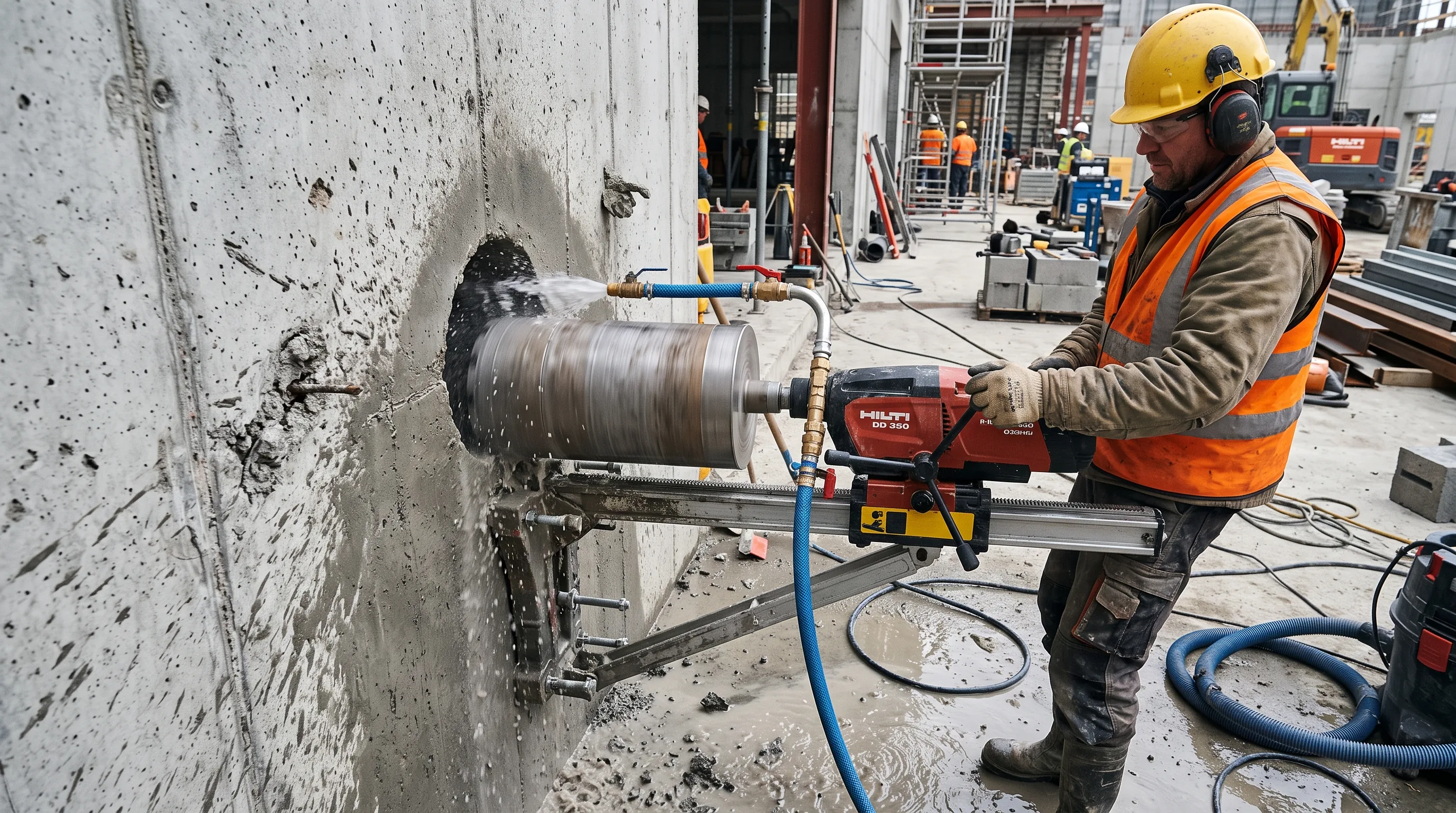
Core drilling is a different process from standard drilling — instead of pulverizing the concrete inside the hole, a diamond-rimmed core bit cuts a circular groove and removes a solid cylindrical "core" or plug of concrete, leaving a clean, precise round penetration. This is the method used for anything that needs to physically pass through a slab or wall: plumbing stacks, electrical conduit runs, HVAC line sets, and dryer vents.
Core bits can be run wet or dry. Wet core drilling uses a continuous water supply to cool the diamond segments and flush cuttings out of the kerf — it produces the fastest cuts, the longest bit life, and the cleanest hole, but requires water management (a containment ring or wet-vac setup) that makes it impractical in finished interior spaces. Dry core drilling uses a dust-extraction shroud attached to a vacuum instead of water — slower and harder on the bit, but far more practical for indoor penetrations where water isn't an option.
| Method | Bit Life | Cut Speed | Mess / Setup | Best Setting |
|---|---|---|---|---|
| Wet Core Drilling | Longest — segments stay cool | Fastest | Requires water containment or vacuum | Outdoor slabs, walls, exterior penetrations |
| Dry Core Drilling | Shorter — segments run hotter | Slower | Dust-extraction shroud + vacuum | Finished interior spaces, no water access |
For holes up to about 2" in non-structural walls, a handheld rotary hammer with a diamond core bit is manageable for an experienced DIYer. For anything larger, through structural slabs, through multiple reinforced layers, or in any application where hitting rebar or a hidden utility line would be costly, a stand-mounted core drill rig and a professional operator is the safer and often cheaper option once you account for rental costs, water/dust management, and the risk of damaging a bit or the structure. Renting a core drill rig typically runs $75–$150/day plus bit cost; hiring a professional concrete drilling contractor for a small number of penetrations is often comparable once bit wear and time are factored in — worth comparing quotes locally before deciding to DIY a structural penetration.
7 Common Concrete Drilling Mistakes
- Using a standard HSS twist bit. No carbide or diamond tip means no ability to fracture aggregate — the bit will overheat and dull within seconds without making meaningful progress.
- Not using hammer mode. Pure rotation relies on shearing rather than fracturing the aggregate, making drilling dramatically slower and harder on the bit even with the right bit type.
- Drilling continuously without pecking. Packed dust at the bottom of the hole insulates the tip and causes it to overheat and "glaze," which dulls the carbide edge and slows drilling to a crawl.
- Ignoring embedded rebar. Forcing a bit through rebar destroys standard carbide tips almost instantly and, in structural elements, risks compromising the concrete.
- Using the wrong bit size for the fastener. Sizing a wedge anchor hole the way you'd size a thread-cutting screw hole (undersized) will prevent the anchor from expanding correctly.
- Not clearing dust from the finished hole. Dust left at the bottom compresses under the fastener and prevents it from reaching full embedment depth, reducing holding capacity.
- No dust control or respiratory protection. Concrete dust contains respirable crystalline silica, regulated by OSHA due to long-term lung health risks — see the safety note below.
Quick Reference — Best Bit by Job
3/16"–3/8", hammer drill or rotary hammer.
Faster drilling, much longer bit life.
1"–3"+ holes, high-impact rotary hammer.
Clean round holes, wet or dry cutting.
More forgiving on accidental light contact.
Lowest tool cost for occasional use.
Concrete Drill Bits vs Other Concrete-Cutting Tools
| Tool | Best For | Hole/Cut Type | Relative Cost | Limitations |
|---|---|---|---|---|
| Drill Bit (Masonry / SDS) | Round holes for anchors and fasteners | Round, typically under 3" | $ | Not practical for large openings |
| Diamond Core Bit | Round penetrations for pipe and conduit | Round, 1"–6"+ | $$ | Needs a core rig; water helps but adds mess |
| Concrete Saw | Straight cuts, control joints, openings | Linear cuts | $$–$$$ | Cannot make round holes — see our concrete saw guide |
| Jackhammer / Breaker | Demolition and removal | Irregular, large-area removal | $$ | Not precise — overkill for a single small hole |
Frequently Asked Questions
What size drill bit do I use for concrete?
It depends on the fastener. For a 3/16" Tapcon screw, use a 5/32" carbide bit; for 1/4", use 3/16". For expansion fasteners like wedge anchors, sleeve anchors, and drop-in anchors, use a bit the same diameter as the anchor — they expand against the hole wall rather than cutting threads. Always confirm on the fastener packaging or ICC-ESR report.
Can I drill into concrete with a regular drill?
Not effectively. A rotation-only drill can sometimes creep through soft concrete with a carbide bit and heavy pressure, but it's slow, generates excessive heat, and is impractical beyond a single shallow hole. Concrete drilling relies on percussive hammer action — use a hammer drill or rotary hammer instead.
What is the difference between a hammer drill and a rotary hammer?
A hammer drill uses a mechanical clutch that creates light vibration — fine for occasional 3/16"–1/2" holes. A rotary hammer uses an electro-pneumatic piston for far higher impact energy, drills faster, extends bit life, and handles larger diameters. Rotary hammers require SDS-shank bits, not the round/hex-shank bits used in hammer drills.
Do I need a special drill bit for concrete, or will any bit work?
You need a carbide-tipped, SDS, or diamond bit. A standard HSS twist bit for wood and metal has no carbide tip and will overheat and dull within seconds against concrete's abrasive aggregate without cutting meaningfully.
How do I drill into concrete without hitting rebar?
Scan the area with a rebar locator before drilling, or drill a small test hole and watch for a sudden jump in resistance. If you hit rebar and the hole isn't a required structural connection point, stop and relocate at least 3 inches away rather than forcing the bit through.
What is the best drill bit for large holes in concrete?
For solid holes from 1" to 3"+, use an SDS-max bit. For holes that need to pass pipe, conduit, or line sets through the wall, use a diamond core bit on a core drill rig, run wet for the cleanest cut or dry with dust extraction for indoor work.
Why does my concrete drill bit keep overheating or getting stuck?
Usually from drilling continuously without clearing dust — packed dust insulates the tip and causes it to glaze and dull. Peck-drill in short bursts, retracting to clear dust, and let the hammer action do the work instead of forcing extra pressure.
Can I use an SDS bit in a regular hammer drill, or vice versa?
No — SDS-plus and SDS-max bits have a grooved shank that only fits an SDS chuck, and round/hex-shank hammer drill bits don't transmit a rotary hammer's impact energy efficiently even with an adapter. Match the bit shank to the tool it's designed for.
How long do concrete drill bits last?
A quality carbide-tipped masonry or SDS bit typically drills 20–50+ holes in standard residential concrete before the tip dulls noticeably, though this varies widely with aggregate hardness, rebar contact, and drilling technique. Peck-drilling instead of forcing continuous pressure, using the correct bit for the tool (SDS in a rotary hammer, not adapted from a hammer-drill bit), and avoiding rebar contact all extend bit life significantly. A bit that suddenly requires much more time and pressure to drill the same hole size it previously handled easily has lost its edge and should be replaced.