
Concrete Blocks — Types, Sizes, Uses, Cost & How to Build With Them (2026)
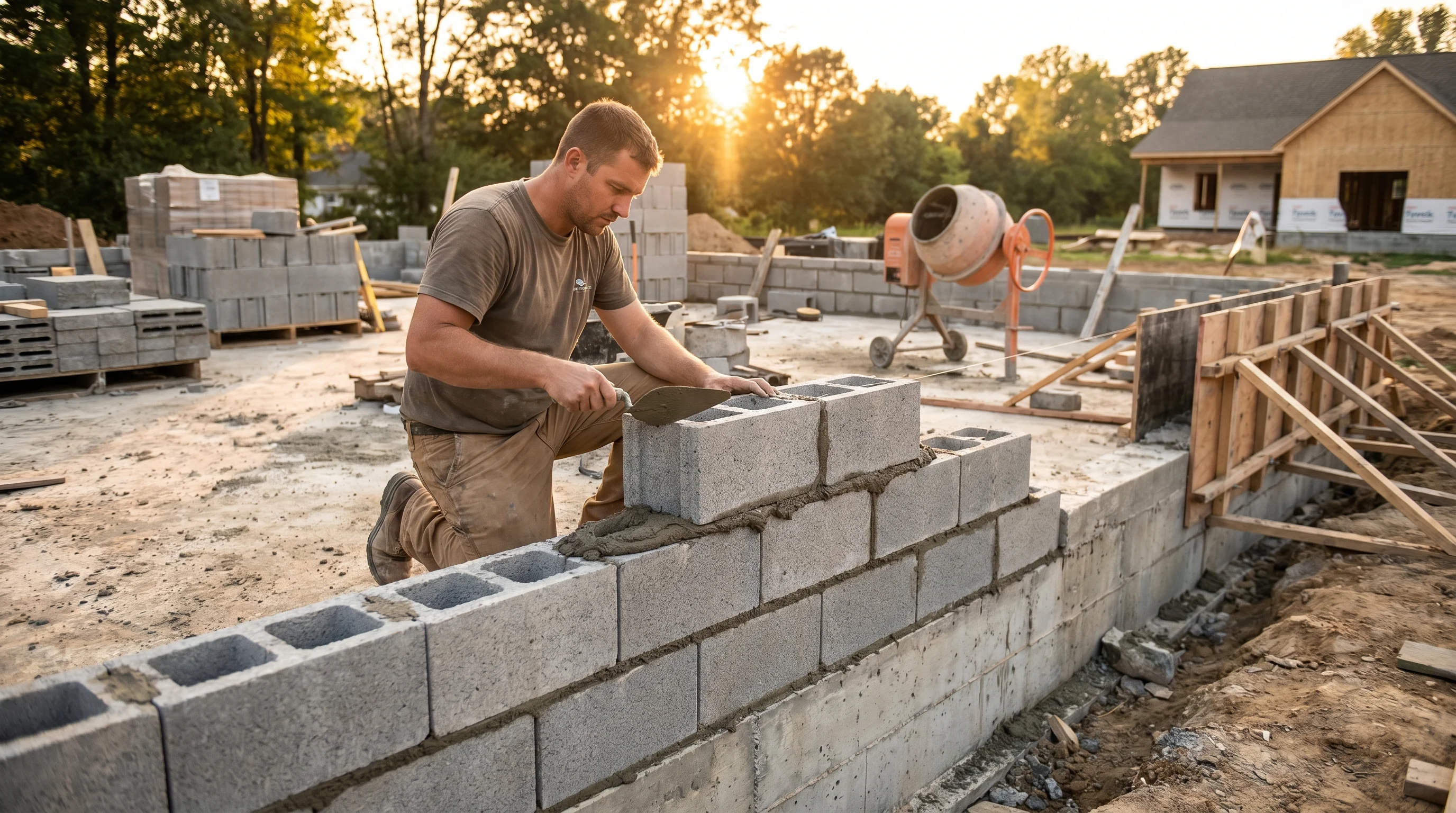
Quick Picks by Use Case
Foundation walls & load-bearing construction: 8" or 12" standard CMU (ASTM C90), cores filled with grout and vertical rebar. The backbone of commercial and residential masonry construction.
Retaining walls (DIY-friendly): Segmental retaining wall blocks — Allan Block, Versa-Lok, Anchor Diamond. Pre-engineered geometry eliminates custom rebar design for walls under 4 ft.
Decorative / visible walls: Split-face or ground-face CMU. Integral texture eliminates the need for exterior finishing and delivers an architectural finish at a masonry price.
Lightweight interior partitions: AAC (autoclaved aerated concrete) blocks. Half the weight of standard CMU, excellent insulation, easy to cut with a handsaw — faster installation for non-structural interior walls.
Outdoor garden & landscape walls: 4" or 6" standard CMU or decorative cap blocks. Low cost, widely available, no permit required under 3 ft in most jurisdictions.
What Are Concrete Blocks?
Concrete blocks — formally called concrete masonry units (CMU) — are precast rectangular building units made from Portland cement, water, and aggregates, cured under controlled conditions to achieve a specified compressive strength before delivery to the job site. Unlike cast-in-place concrete, which is poured wet into a form and cures on site, CMU blocks arrive ready to lay, requiring only mortar between units and, for structural applications, grout and reinforcement in the hollow cores.
The term "concrete block" covers a broad family of products: hollow standard CMU for walls and foundations, solid blocks for specialized structural applications, lightweight units with reduced aggregate for easier handling, split-face and architectural units for visible walls, segmental retaining wall blocks for landscape applications, and specialty products like aerated autoclaved concrete that serve entirely different purposes despite sharing the basic composition of cement and aggregate. Understanding which product category applies to your project is the first decision — and it determines everything from the structural approach to the cost to the tools required.
CMU construction has been the dominant masonry system in American commercial construction for over 80 years. It offers fire resistance, sound attenuation, structural strength, durability, and dimensional consistency that wood framing cannot match. In residential construction, CMU is standard for foundations, basement walls, garages, and any below-grade application. Above grade, it competes with wood frame in hot climates (Florida, Texas, the Caribbean) where termite resistance and hurricane performance favor masonry.
8 Concrete Block Types — Full Comparison
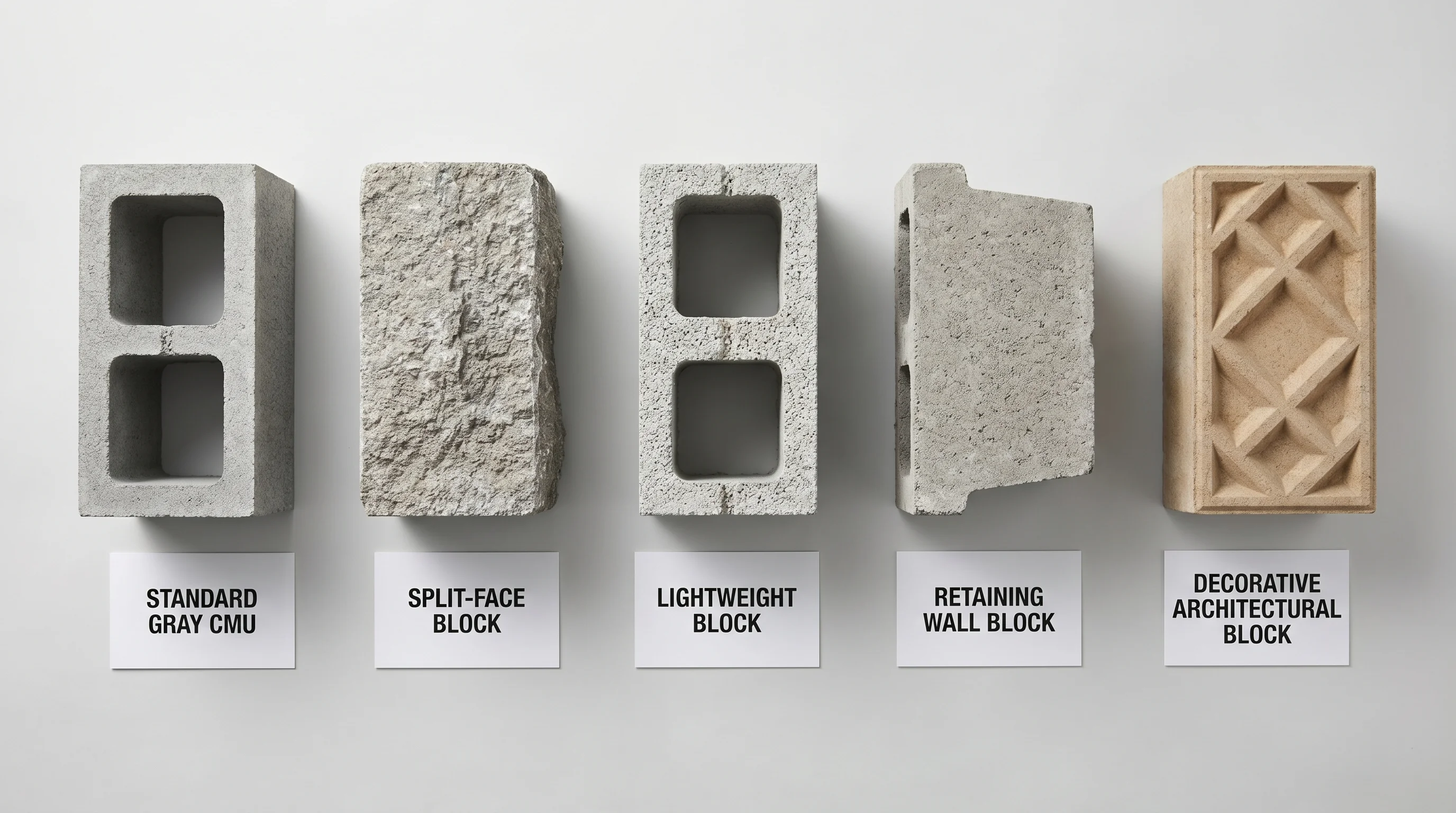
| Block Type | Weight (8" unit) | Compressive Strength | Best Use | Cost Each |
|---|---|---|---|---|
| Standard hollow CMU | 38–43 lbs | 1,900–3,000 PSI | Foundations, load-bearing walls, commercial construction | $1.50–$2.50 |
| Lightweight CMU | 22–28 lbs | 1,900–2,500 PSI | Interior partitions, upper floors, wherever weight savings matter | $2.00–$3.50 |
| Solid CMU | 55–70 lbs | 2,500–4,000 PSI | Below-grade walls, fire separation walls, columns | $2.00–$4.00 |
| Split-face CMU | 40–48 lbs | 1,900–2,500 PSI | Visible exterior walls, commercial facades, decorative landscape | $2.50–$5.00 |
| Ground-face / glazed CMU | 40–50 lbs | 2,000–3,000 PSI | Interior and exterior architectural walls where smooth finish required | $4.00–$9.00 |
| Segmental retaining wall block | 30–80 lbs (varies by system) | 3,000–5,000 PSI | Landscape retaining walls, terracing, slope stabilization | $3.00–$8.00 |
| Interlocking (dry-stack) block | 25–50 lbs | 2,500–4,000 PSI | Garden walls, raised beds, low landscape walls without mortar | $2.00–$5.00 |
| AAC (Autoclaved Aerated Concrete) | 15–25 lbs | 500–900 PSI | Non-structural interior partitions, thermal insulation applications | $3.00–$7.00 |
Standard CMU — Deep Dive
Standard hollow CMU is the workhorse of masonry construction. It dominates commercial building, industrial structures, garages, foundation walls, and any application where structural performance, fire resistance, and dimensional consistency matter. Understanding its properties in depth helps you specify the right unit and build it correctly.
ASTM C90 — The Standard CMU Specification
Almost all structural CMU in the US is manufactured to ASTM C90, the standard specification for loadbearing concrete masonry units. C90 establishes minimum requirements for compressive strength, dimensional tolerances, water absorption, and material composition. The minimum net area compressive strength for C90 units is 1,900 PSI — the baseline for structural calculations. Most commercially available 8-inch CMU exceeds this, with typical values of 2,000–3,000 PSI depending on the manufacturer and aggregate.
C90 units are available in two weight classifications: normal weight (125–135 PCF density) and lightweight (less than 105 PCF density). Normal weight units use gravel or crushed stone aggregate; lightweight units use expanded shale, clay, or slate aggregate. Both meet the same compressive strength minimums — the lightweight classification refers to density, not strength. For structural walls, either can be used; for walls where handling efficiency matters (high walls, upper floor construction), the 15-pound weight difference per block across thousands of units is a meaningful labor consideration.
Hollow vs Solid CMU
Standard CMU is hollow — it has two or three cylindrical cores running through its height that reduce weight, improve thermal performance slightly, and provide a conduit for vertical reinforcement and grout. The hollow area is typically 40–50% of the gross cross-sectional area. For load calculations, structural engineers work with the net area (gross area minus core area) rather than the gross area.
Solid CMU has no cores or only small voids constituting less than 25% of the gross area. Solid units are heavier and more expensive but provide greater cross-sectional area for compressive loads without grouting, are preferred for below-grade walls where water infiltration through unfilled cores is a concern, and achieve higher fire ratings per unit of thickness. They are also used for specific architectural applications where drilled anchor points are needed through the full thickness of the unit.
Core Fill with Rebar and Grout
For structural CMU walls, the hollow cores serve as the reinforcement conduit. Vertical rebar is placed in selected cores at spacing specified by the structural engineer or building code (typically 24–48 inches on center for residential walls, 16–32 inches for commercial), and the cores containing rebar are filled with grout — a high-slump fluid concrete mix (typically 3,000 PSI, 8–10 inch slump) that flows into the cores and consolidates around the rebar without vibration. The result is a composite system in which the CMU carries compressive load and the grouted rebar carries tensile and shear forces.
Fine grout (no coarse aggregate) is used for 4-inch and 6-inch CMU where core dimensions are small. Coarse grout (with aggregate up to 3/8 inch) is used for 8-inch and larger CMU where there is adequate clearance. ACI 530 (Building Code Requirements for Masonry Structures) governs rebar spacing, lap splice lengths, and grout lift heights for structural masonry.
Fire Rating and Sound Transmission
CMU walls have inherent fire resistance that makes them a common choice wherever fire-separation ratings are required by code. An 8-inch hollow CMU wall (unfilled) achieves a 2-hour fire resistance rating per ASTM E119. An 8-inch CMU wall with cores fully grouted achieves a 4-hour rating. A 6-inch solid CMU wall achieves approximately a 3-hour rating. These ratings are the primary reason CMU is specified for party walls between attached garages and living spaces, between commercial tenant spaces, and for stairwell enclosures in multistory buildings.
Sound transmission class (STC) for an 8-inch hollow CMU wall is approximately STC 45–48 — adequate to reduce speech intelligibility between adjacent spaces. Filling the cores with insulation (not grout) instead of leaving them hollow improves the STC slightly to approximately 50–52 without the weight and cost of full grouting. Filling with grout improves STC to approximately 52–55 due to the increased mass. For high-performance acoustic separation (recording studios, mechanical equipment rooms), additional wall assemblies are needed on top of the CMU substrate.
Retaining Wall Blocks — Deep Dive
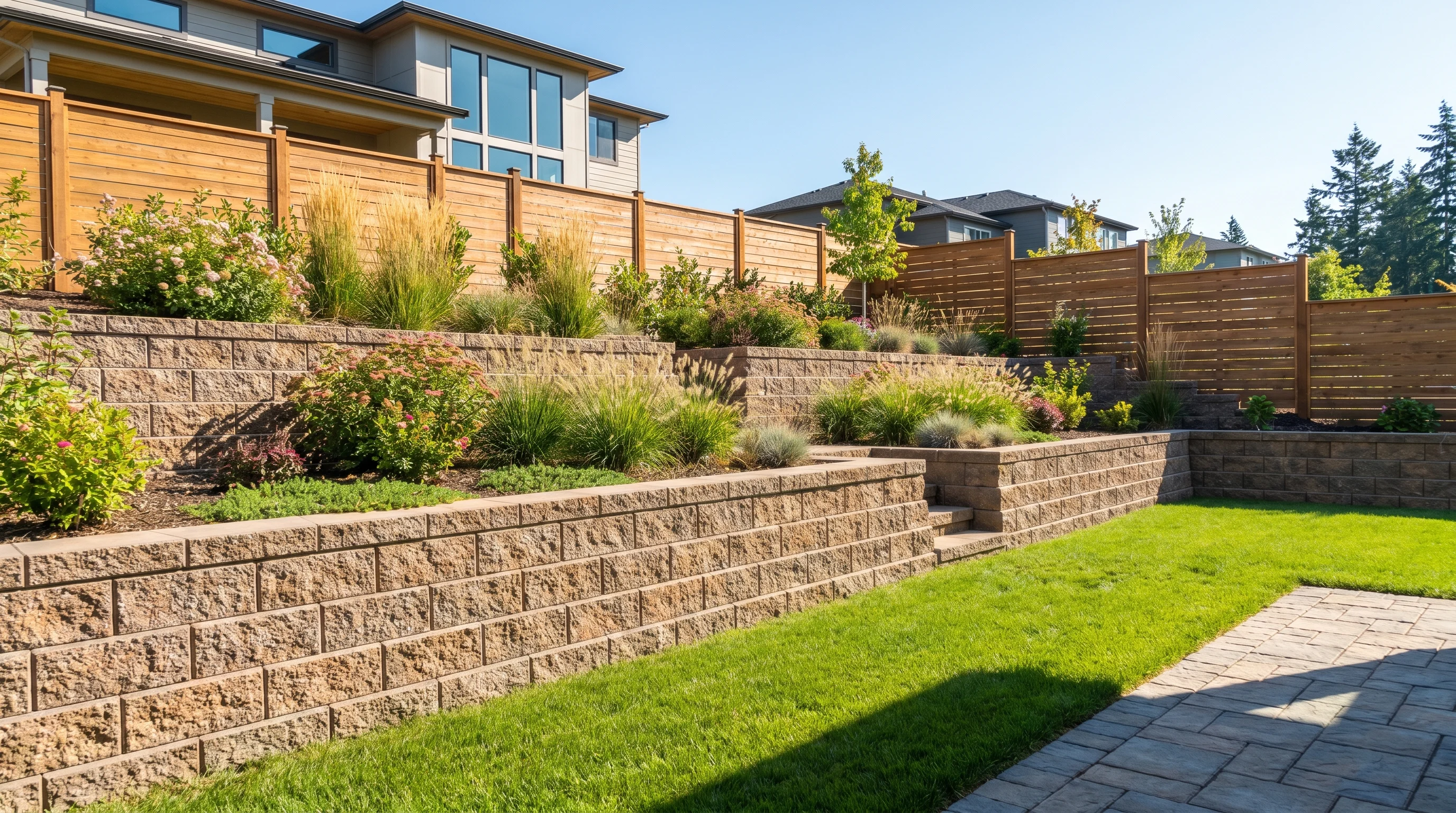
Segmental retaining wall (SRW) systems are the most widely used approach for residential landscape retaining walls — and for good reason. Unlike CMU retaining walls that require custom engineering, rebar design, waterproofing, and masonry skills, SRW systems are pre-engineered for their specific geometry and loading. The blocks interlock, set back slightly with each course (batter angle), and resist overturning through their own weight and the friction of the interlocking faces. For walls under 4 feet of retained height, most SRW systems can be installed by a capable DIYer without engineering review in most jurisdictions.
How Segmental Retaining Wall Systems Work
Each SRW block has a setback (typically 1/16 to 1/8 inch per course) that creates a slight lean-back (batter) into the retained soil. This batter angle reduces the effective overturning moment and directs the wall's weight toward the retained soil rather than away from it. The interlocking faces of each block (either a mechanical pin system like Allan Block or a shear key cast into the block face like Versa-Lok) prevent the blocks from sliding relative to each other horizontally.
For taller walls, geogrid soil reinforcement is required. Geogrid is a polymer mesh that is placed horizontally into the retained soil at specified vertical intervals and connected to the wall. The geogrid anchors the wall into the soil mass, effectively turning a large zone of soil into a reinforced gravity mass. Most SRW manufacturers publish engineering tables specifying geogrid requirements, embedment depth, and maximum wall height for their specific block geometry — these tables are what allow SRW systems to be designed without a custom engineering analysis for typical residential conditions.
Popular SRW Block Systems
Allan Block: One of the most widely available SRW systems in North America. Uses a pinless interlock through the block's natural batter geometry. Available in standard, corner, and cap blocks. Engineering design tables available for walls from 2 to 40+ feet with geogrid. Blocks weigh approximately 75–80 lbs each (AB Classic) at 12 inches deep × 18 inches wide × 6 inches tall. Cost: $4–$7 per block.
Versa-Lok: Uses a pinless interlock through a cast fiberglass pin embedded in the block. Provides a tighter, more consistent setback than gravity-only systems. Available in multiple face textures (standard, mosaic, cobble). Engineering tables cover walls to 25+ feet with geogrid. Standard block: approximately 80 lbs, 6 inches tall. Cost: $5–$8 per block.
Anchor Diamond: Uses a mechanical steel pin through holes in each block for interlock. The pin system allows tighter curves than gravity-only systems. Available in multiple colors and textures. Standard block: approximately 77 lbs. Cost: $4–$7 per block.
Decorative and Architectural CMU — Deep Dive
When concrete blocks are the finished surface rather than a substrate to be covered with stucco, paint, or cladding, the face texture and appearance of the unit become design elements. Architectural CMU covers several finish categories that are manufactured into the block during production — not applied afterward.
Split-Face CMU
Split-face CMU is produced by fracturing oversized CMU units after curing — the split produces a rough, irregular texture that resembles quarried stone. The aggregate in the block (typically limestone, granite chips, or colored stone) is exposed at the split face, creating a naturally variegated appearance with depth and shadow. Split-face CMU is extremely widely used in commercial construction — strip mall exteriors, school buildings, warehouses — where a durable, low-maintenance masonry appearance is desired without the cost of natural stone or brick veneer. Cost: $2.50–$5.00 per 8-inch unit.
Ground-Face CMU
Ground-face CMU is ground smooth after curing, exposing the aggregate in a polished matrix similar to terrazzo. The result is a sleek, contemporary appearance with visible aggregate color and texture. Ground-face blocks are more expensive than split-face and require more careful handling to prevent chipping the polished face. They are used in high-end commercial interiors and exteriors where a refined masonry appearance is required. Cost: $5–$12 per unit.
Glazed CMU
Glazed CMU has a factory-applied ceramic or thermosetting resin glaze on one or more faces. The glaze is available in a wide range of colors and finishes (matte, semi-gloss, high-gloss) and provides an impervious, easily cleanable surface. Glazed CMU is specified for food service facilities, hospital corridors, school locker rooms, and any interior space where hygiene, cleanability, and durability are required simultaneously. Cost: $6–$15 per unit depending on glaze type and color.
AAC Blocks — Deep Dive
Autoclaved aerated concrete (AAC) is a fundamentally different material than standard CMU despite sharing the name "concrete block." AAC is made by mixing Portland cement, lime, fine silica sand, water, and an expansion agent (typically aluminum powder) that reacts to generate millions of tiny hydrogen gas bubbles. The resulting foam is cast into molds, pre-cut into blocks or panels, and then cured in a pressurized steam autoclave that converts the calcium silicate hydrate matrix into tobermorite — a mineral that provides dimensional stability and strength despite the material being approximately 80% air by volume.
AAC Properties vs Standard CMU
The air-bubble structure of AAC gives it properties that differ fundamentally from dense CMU: it is extremely lightweight (25–50 PCF density vs 85–135 PCF for CMU), excellent thermal insulation (R-value approximately 1.25 per inch, compared to 0.2 per inch for standard CMU), and very easy to cut, drill, and shape with standard woodworking tools — a handsaw cuts AAC cleanly, while cutting CMU requires diamond blades and significant effort. AAC also has excellent fire resistance and good acoustic performance relative to its weight.
The tradeoff is compressive strength: AAC typically achieves 500–900 PSI compressive strength, compared to 1,900–3,000+ PSI for standard CMU. AAC is not suitable for structural load-bearing applications in US construction without specific engineered designs. It is widely used in Europe, Latin America, and Asia for structural walls using thin-bed mortar systems with closely controlled joint thicknesses. In the US market, AAC is primarily specified for non-structural interior partition walls, infill panels in concrete frame buildings, and thermal mass applications in hot climates.
Standard CMU Sizes — Complete Reference Table
| Nominal Width | Actual Dimensions (W×H×L) | Weight (normal) | Weight (light) | Cores | Cost Each |
|---|---|---|---|---|---|
| 4-inch | 3-5/8″ × 7-5/8″ × 15-5/8″ | 24–28 lbs | 16–20 lbs | None (solid) or 1 core | $1.00–$1.75 |
| 6-inch | 5-5/8″ × 7-5/8″ × 15-5/8″ | 28–34 lbs | 20–24 lbs | 2 cores | $1.25–$2.00 |
| 8-inch | 7-5/8″ × 7-5/8″ × 15-5/8″ | 38–43 lbs | 22–28 lbs | 2 cores | $1.50–$2.50 |
| 10-inch | 9-5/8″ × 7-5/8″ × 15-5/8″ | 48–55 lbs | 30–36 lbs | 2 cores | $2.00–$3.25 |
| 12-inch | 11-5/8″ × 7-5/8″ × 15-5/8″ | 55–65 lbs | 36–44 lbs | 2–3 cores | $2.50–$4.00 |
All nominal dimensions include a 3/8-inch mortar joint — actual block dimensions are 3/8 inch less than nominal in each direction. This means an 8-course-high CMU wall (8 blocks + 8 mortar joints) equals exactly 64 inches (5 ft 4 in) of wall height. Planning your wall height in 8-inch increments eliminates cut blocks at the top course.
Compressive Strength by Application
| Application | Minimum Strength Required | Recommended CMU Grade | Core Fill Required? |
|---|---|---|---|
| Non-structural garden wall (<3 ft) | None specified | Standard hollow CMU, any grade | No |
| Residential foundation wall | 1,900 PSI (ASTM C90) | 8" or 10" standard CMU | Yes, with rebar |
| Load-bearing wall (residential) | 1,900 PSI minimum | 8" standard CMU, C90 | Yes at rebar locations |
| Retaining wall (over 4 ft retained) | 2,000 PSI minimum | 8" or 12" CMU, engineer specified | Yes, fully grouted |
| Commercial load-bearing | 2,000–3,000 PSI | 8" or 12" CMU, C90 high strength | Yes, per structural drawings |
| Fire separation wall | 1,900 PSI (C90) | 8" hollow or solid CMU | Per fire rating required |
| Below-grade basement wall | 2,000 PSI minimum | 8" or 10" solid or grouted hollow | Yes — fully grouted |
2026 Concrete Block Cost Guide
| Block Type | Cost per Block (retail) | Cost per Block (pallet) | Installed Cost per sq ft |
|---|---|---|---|
| 8" standard hollow CMU | $1.50–$2.50 | $1.20–$1.80 | $15–$25 |
| 8" lightweight CMU | $2.00–$3.50 | $1.60–$2.50 | $18–$28 |
| 12" standard hollow CMU | $2.50–$4.00 | $2.00–$3.00 | $20–$32 |
| Split-face CMU (8") | $2.50–$5.00 | $2.00–$3.75 | $22–$38 |
| Segmental retaining wall block | $3.00–$8.00 | $2.50–$6.00 | $25–$50 (includes base, backfill) |
| AAC block (8" equivalent) | $3.00–$7.00 | $2.50–$5.50 | $18–$32 (faster install) |
Installed costs include labor, mortar, rebar, and grout for standard CMU walls. Regional variation is significant — labor costs in high-wage states (California, New York, Massachusetts) are 40–60% higher than the national average, pushing installed CMU costs to $28–$45 per square foot in those markets. Material costs vary less regionally — within 15–20% of the national average depending on local masonry supply competition.
CMU vs Poured Concrete Walls
| Factor | CMU Wall | Poured Concrete Wall | Winner |
|---|---|---|---|
| Installed cost (residential) | $15–$25/sq ft | $18–$30/sq ft | CMU (slight) |
| Compressive strength | 1,900–3,000 PSI (grouted) | 3,000–5,000 PSI | Poured concrete |
| Tensile strength (unreinforced) | Very low | Low | Tie |
| Construction speed | Slower (block by block) | Faster (one pour) | Poured concrete |
| Equipment required | Minimal (hand tools) | Forms, concrete pump or truck access | CMU |
| Fire resistance | 2–4 hour rating (C90) | 2–4 hour rating | Tie |
| Waterproofing | More joints = more leak paths | Monolithic = fewer leak paths | Poured concrete |
| Thermal mass | Good | Very good | Poured concrete |
| DIY-friendly | Yes — no formwork needed | No — formwork complex | CMU |
| Design flexibility | Limited by module size | Any shape possible | Poured concrete |
How to Build a Concrete Block Wall — 8 Steps
A correctly built CMU wall begins with the footing and ends with proper curing. Skipping or shortcutting any of these steps is the source of almost all CMU wall failures — settlement, cracking, moisture infiltration, and structural inadequacy.
-
1
Pour the concrete footing
A CMU wall must rest on a poured concrete footing, not on soil or gravel. The footing must bear below the frost line (depth varies by climate — from 12 inches in Florida to 60 inches in Minnesota) to prevent heave. Footing width is typically twice the wall width (16 inches for an 8-inch wall) and at least 8 inches thick. Place horizontal rebar in the footing and leave vertical rebar stubs projecting upward at the spacing required for your structural design — typically every 24–48 inches for residential walls. Allow the footing to cure at least 3 days before laying block.
-
2
Dry-lay the first course for layout
Before mixing any mortar, dry-lay (without mortar) the entire first course along the footing to confirm your block spacing, corner locations, and opening positions. Standard CMU with 3/8-inch mortar joints spaces at exactly 8 inches on center — 16-inch blocks with 3/8-inch joints give you 16-3/8 inches per module. Mark the footing for each block position and all corner and door/window opening locations before mixing mortar.
-
3
Mix and apply mortar — first course
The first course is the most critical — it sets the level and alignment for every subsequent course. Mix Type S mortar to a workable but stiff consistency (holds shape when squeezed, doesn't slump off the trowel). Apply a full bed joint (mortar on the footing covering the full width of the block, approximately 3/4 inch thick) for the first course — face shell bedding (mortar on the face shells only) is acceptable for subsequent courses. Set each block with firm downward pressure and tap into level alignment. Check level, plumb, and alignment in all three directions on every block of the first course.
-
4
Build corners first, then fill in
The professional CMU technique is to build corners (leads) up 4–6 courses before filling in the field between them. The corners establish the level and alignment references; a mason's line stretched between corner leads guides the height and alignment of each intermediate block. Build each corner course in a staircase pattern — 4 blocks on the first course, 3 on the second, 2 on the third — so that each course is checked for plumb and level before proceeding. Running bond (each block centered over the joint below) is the standard pattern; this distributes loads and provides structural continuity.
-
5
Install control joints at specified intervals
Control joints are vertical joints filled with flexible sealant (not mortar) that allow the CMU wall to expand and contract with temperature changes without cracking. Without control joints, thermal movement concentrates stress at the weakest point — typically an opening corner or a change in wall height — and causes diagonal cracking. Control joint spacing: maximum 25 feet for unreinforced CMU walls, maximum 40 feet for reinforced. Always place control joints at opening corners, wall intersections, and changes in wall height. Use pre-formed control joint filler strips or raked-out and caulked joints — not mortar.
-
6
Place vertical rebar in cores
For structural walls, vertical rebar (typically #4 or #5 rebar for residential, larger for commercial) is placed in the designated core locations as the wall is built. Rebar must have the correct cover — minimum 1-1/2 inches from the face of the block to the near face of the bar. Lap rebar at splices per ACI 530 requirements (minimum 48 bar diameters for #4 rebar = 24 inches). Tie laps with wire. Do not lean rebar against the core walls — center it with plastic rebar chairs or wire spacers to ensure the grout fully encases it.
-
7
Grout the cores
After building the wall to its full height (or in 5-foot lifts for tall walls), fill the reinforced cores with grout. Mix grout to a very fluid consistency — 8–10 inch slump — so it flows into the cores and around the rebar without rodding or vibration. Pour from the top of the wall into each core, filling in lifts of no more than 5 feet. Rod each lift with a piece of rebar to consolidate and eliminate voids. For walls taller than 5 feet, pour grout in multiple lifts, allowing each to stiffen slightly before the next pour. Grout consolidation failures (voids around rebar) are the most common cause of reinforced CMU wall strength deficiencies.
-
8
Tool joints, cure, and protect
As mortar reaches thumbprint hardness (not wet, not fully set — typically 30–60 minutes after laying), tool the joints with a jointing tool to compress and seal the mortar surface. Tooled joints are more weather-resistant and visually cleaner than flush-cut or raked joints. Keep newly laid CMU walls moist for at least 3 days in hot or dry conditions — cover with burlap and mist with water to slow curing and prevent shrinkage cracking. Do not allow freezing temperatures to reach fresh mortar or grout for at least 24 hours — cold masonry requires heated enclosures or insulated coverings.
- Type S (1,800 PSI): Most common for CMU construction. Required for below-grade masonry, retaining walls, and any structural application. Good bond strength and durability.
- Type N (750 PSI): Adequate for above-grade, non-structural, interior CMU walls in mild climates. More workable and forgiving than Type S. Do not use below grade or for structural walls.
- Type M (2,500 PSI): Highest strength mortar. Used for below-grade foundations, walls in severe freeze-thaw exposure, and walls subjected to high compressive loads. Less workable than Type S.
- Mix ratio for Type S: 1 part Portland cement : 1/2 part lime : 4-1/2 parts masonry sand (by volume), or use pre-bagged Type S masonry cement and sand at 1:3 ratio.
- Consistency check: Correctly mixed mortar holds a smooth shape when formed into a ball but doesn't crumble. It slides slowly off a trowel held at 45° but doesn't flow off immediately.
Retaining Wall Height Limits
| Block System | Max Height (no geogrid) | Max Height (with geogrid) | Permit Typically Required | Engineer Required |
|---|---|---|---|---|
| Allan Block (AB Classic) | 3 ft | Per engineering tables (up to 40+ ft) | Usually over 4 ft | Over 4 ft retained in most jurisdictions |
| Versa-Lok Standard | 3.5 ft | Per engineering tables (up to 25+ ft) | Usually over 4 ft | Over 4 ft retained |
| Standard 8" CMU (reinforced) | N/A — always requires design | Engineer specified | Almost always | Yes — always |
| Dry-stack interlocking block | 2–3 ft (system dependent) | Not applicable | Usually under 3 ft exempt | No for low walls |
| Garden/landscape block | 2 ft typical | Not applicable | Usually exempt under 2 ft | No |
Permit thresholds and engineer requirements vary significantly by jurisdiction. Most US municipalities require a building permit for retaining walls over 3–4 feet in exposed height, and many require a structural engineering design for walls over 4 feet retaining height. In seismic zones (California, Pacific Northwest, parts of the Mountain West), requirements are more stringent — engineered retaining walls are often required at lower heights, and seismic surcharge must be added to the design loads.
An unreinforced CMU wall has almost no tensile or shear capacity — it relies entirely on gravity and its own mass to remain stable. Walls over 4 feet tall that are unreinforced, unfounded below the frost line, or subject to lateral load from soil or wind can collapse suddenly and without warning. CMU wall collapses have killed workers and homeowners. In seismic zones, unreinforced masonry walls are among the most dangerous building elements — the reason California banned unreinforced masonry construction in most occupancies after the 1971 Sylmar earthquake. If you are building any CMU wall over 4 feet tall, or any wall subject to soil pressure, obtain a permit, have the wall designed by a licensed structural engineer, and build to the approved drawings without substitution.
Common Concrete Block Building Mistakes
- No concrete footing — laying block on soil or gravel — CMU walls on uncompacted soil settle unevenly and crack; the footing distributes load and provides a level, stable reference plane
- Wrong mortar type for the application — Type N mortar in a below-grade or structural application is significantly under-strength; always use Type S for structural and below-grade CMU
- Mortar that is too wet — watery mortar shrinks excessively as it dries, creating gaps at the block-mortar interface that admit water and reduce bond strength; mix mortar stiff enough to hold its shape
- No control joints — thermal and moisture movement in long CMU walls without control joints concentrates stress until the wall cracks at its weakest point; space control joints at 25-foot maximum intervals
- Skipping rebar in structural walls — unreinforced CMU has negligible tensile capacity; a lateral load from wind, soil, or seismic activity on an unreinforced wall causes sudden brittle failure
- Grout voids around rebar — rebar that is not fully encased in grout doesn't develop its design bond strength; pour grout slowly into cores, rod each lift, and never skip consolidation
- Not building corners first — laying block in the field without established corner references produces walls that are out of level, out of plumb, and out of alignment — errors that compound with each course
- Laying block in freezing temperatures without protection — mortar that freezes before reaching adequate strength is permanently weakened; in temperatures below 40°F, provide heated enclosures or insulated coverings for at least 24 hours after laying
Frequently Asked Questions
What is the standard size of a concrete block?
The most common US concrete block is the 8-inch nominal CMU with actual dimensions of 7-5/8" × 7-5/8" × 15-5/8". The 3/8-inch difference accounts for the mortar joint. Other common widths: 4", 6", 10", and 12" nominal. All are 7-5/8" tall and 15-5/8" long. Plan wall heights in 8-inch increments to eliminate cut blocks at the top course.
How much does a concrete block cost?
Standard 8" hollow CMU: $1.50–$2.50 retail, $1.20–$1.80 per block on a full pallet from a masonry supplier. Installed wall cost including labor, mortar, rebar, and grout: $15–$25 per square foot residential, $20–$35 per square foot commercial. Regional labor rates add 40–60% in high-wage markets.
Do concrete blocks need to be filled with concrete?
Non-structural and low garden walls — no. Structural walls, foundation walls, retaining walls over 4 feet, and any wall in a seismic zone — yes, cores must be filled with grout and reinforced with rebar at specified spacing. Building codes govern the requirements; always obtain a permit for structural masonry and build to the approved drawings.
What is the difference between a concrete block and a cinder block?
Genuine cinder blocks used coal cinder aggregate and haven't been widely produced since the 1950s. Modern "cinder blocks" are standard lightweight CMU using expanded shale or clay aggregate — they are concrete blocks, not cinder blocks. The terms are used interchangeably today. Lightweight CMU meets ASTM C90 structural requirements just like normal weight CMU.
How many concrete blocks do I need for a wall?
Use 1.125 blocks per square foot of wall face area (accounts for the 3/8" mortar joint). Add 5–10% for waste and cuts. For an 8 ft × 20 ft wall (160 sq ft): 160 × 1.125 = 180 blocks + 18 waste = 198 blocks. Plan courses by dividing required wall height in inches by 8 — an 8-foot wall requires exactly 12 courses of 8" CMU.
Can you build a retaining wall with standard CMU blocks?
Yes — but standard CMU retaining walls require a poured footing below frost line, fully grouted cores with vertical rebar, waterproofing on the soil side, and a drainage system. For walls over 4 feet of retained height, a structural engineer should design the wall. Pre-engineered segmental retaining wall systems (Allan Block, Versa-Lok) are simpler for DIY applications under 4 feet.
What mortar should I use for concrete blocks?
Type S mortar (1,800 PSI) is the standard for CMU construction — suitable for structural walls, below-grade applications, and retaining walls. Type N (750 PSI) is adequate for above-grade, non-structural walls in mild climates. Type M (2,500 PSI) for high-load or severe-exposure below-grade foundations. Use pre-bagged masonry cement and sand for consistency on small projects; batch from scratch (Portland cement + lime + masonry sand) for larger work.
What is the fire rating of a concrete block wall?
8" hollow CMU (unfilled): 2-hour fire resistance rating. 8" CMU (fully grouted): 4-hour rating. 6" solid CMU: approximately 3-hour rating. CMU walls do not burn, do not release toxic gases, and maintain structural integrity far longer than wood framing under fire exposure — the primary reason CMU is specified for fire-separation walls between garages and living spaces.