
Concrete Staining — Acid vs Water-Based Stain, Colors & Cost (2026)
Quick Answer
For a predictable, easy-to-control color on a driveway or patio, use a water-based (acrylic) concrete stain — it goes on like a heavy-duty wood stain and covers a wide color range. For the authentic, one-of-a-kind mottled marble look decorative concrete is known for, use an acid (reactive) stain, but budget for a real test patch first since the color reaction can't be undone. Either way: new concrete needs at least 28 days to cure before staining, and the surface must be sealed afterward — the stain adds color, the sealer is what protects it.
This guide covers decorative concrete staining — adding permanent color to concrete. If you're trying to get oil, rust, or other stains out of concrete, see our concrete cleaner guide, which covers degreasers, rust removers, and stain-specific treatment steps.
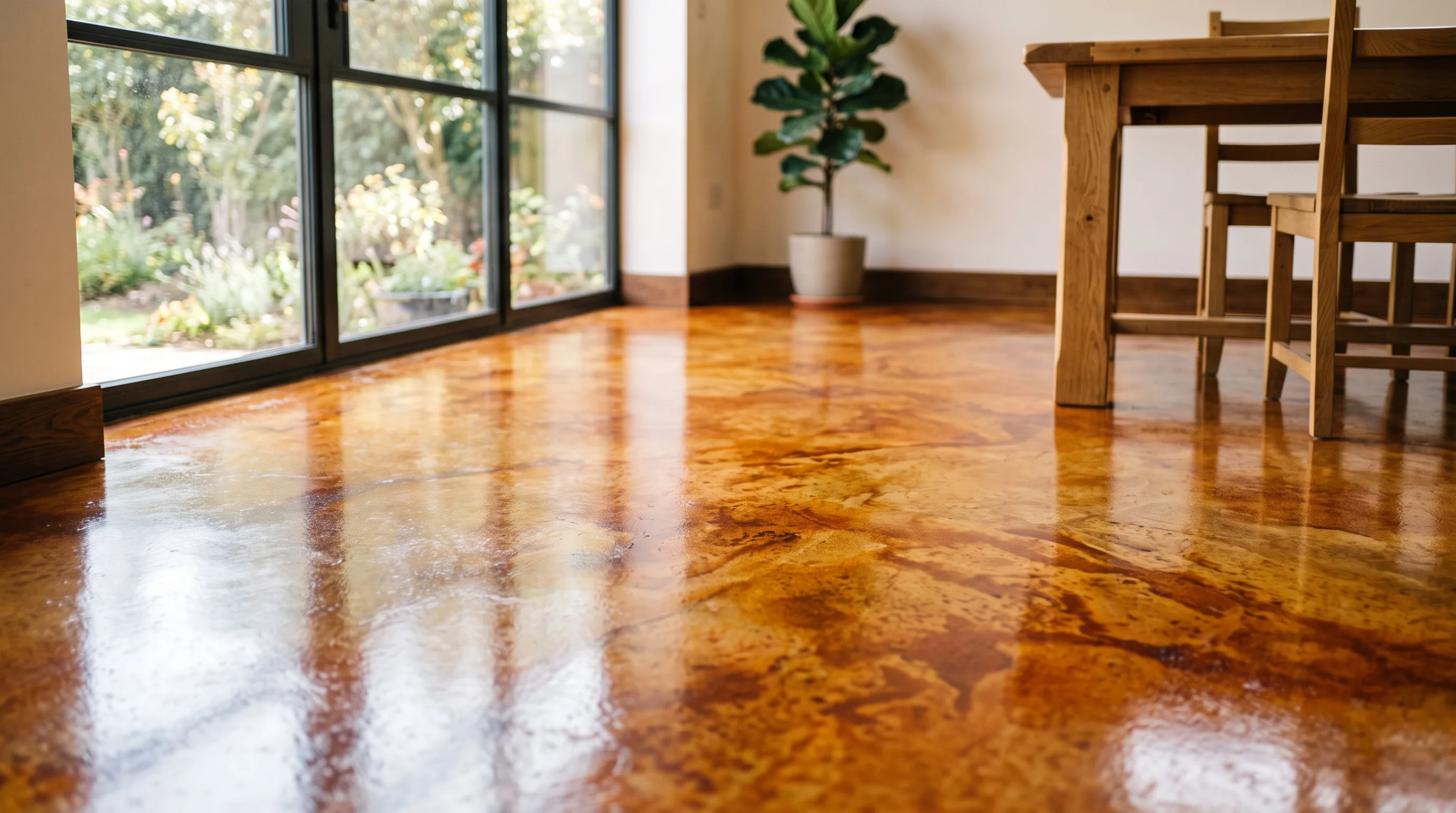
Plain gray concrete is a blank canvas, and staining is how that canvas gets its color without hiding the material's natural texture the way paint or an overlay does. Unlike paint, which sits on top of the surface as an opaque film, stain either chemically reacts with the concrete or penetrates into its pores — the color becomes part of the slab rather than a coating over it. That's the appeal: a stained floor or patio still reads as concrete, just concrete with color and depth.
There are two fundamentally different ways to get there — acid (reactive) stain and water-based (acrylic) stain — and they produce genuinely different looks, carry different risks, and suit different projects. Picking the wrong one for your goals is the single most common regret in DIY concrete staining, usually discovered only after the color has already permanently set.
This guide covers how each stain type actually works, realistic color options, 2026 costs for DIY and professional work, the best products on the market, required cure time and prep, a full step-by-step staining process, safety precautions for acid stain, sealing afterward, and the mistakes that cause blotchy, disappointing results.
Acid Stain vs Water-Based Stain vs Concrete Dye
| Type | How It Works | Color Range | Predictability | Best For |
|---|---|---|---|---|
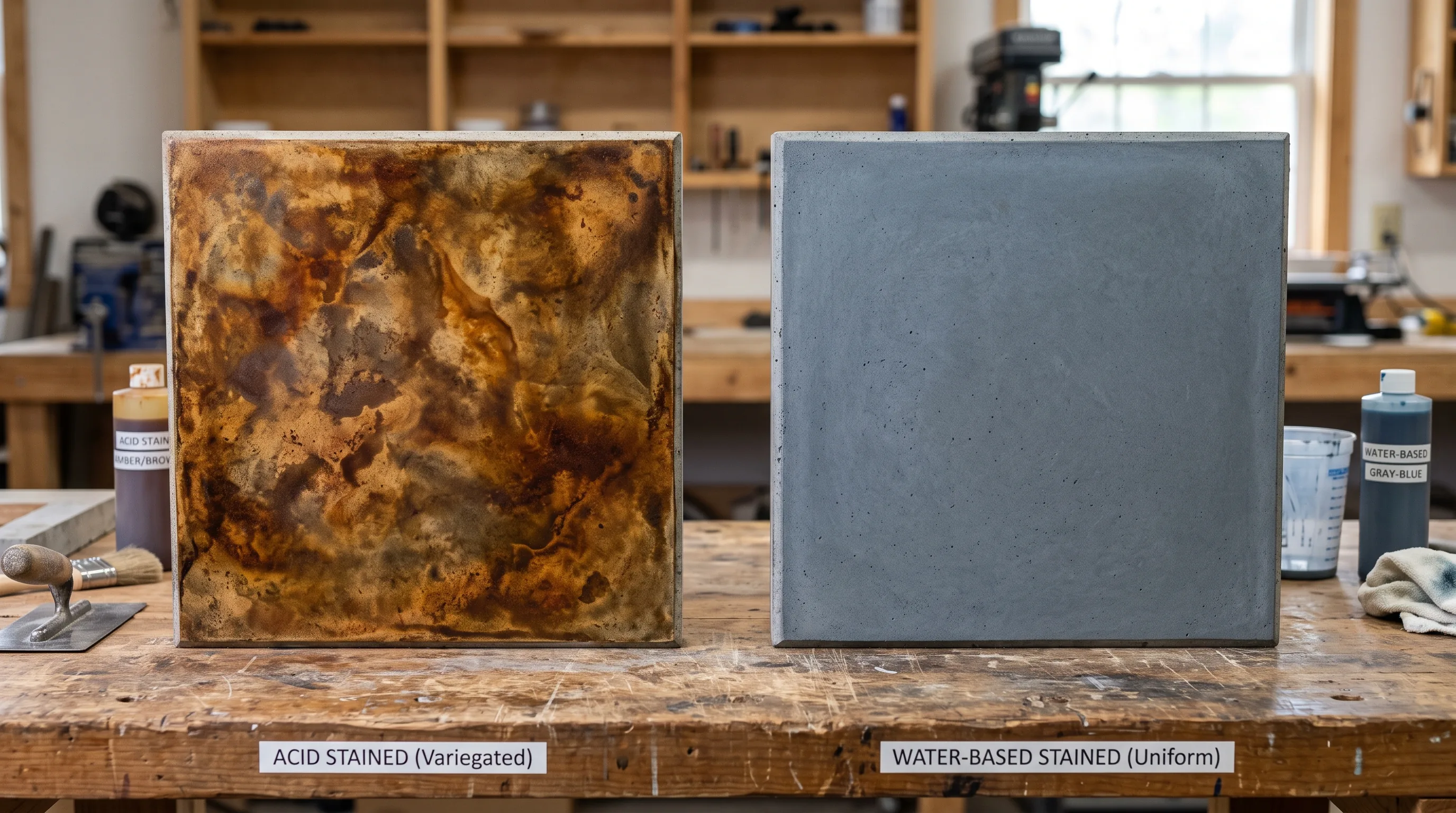
| Acid (Reactive) Stain | Metallic salts chemically react with lime in the concrete | Earth tones — amber, terracotta, brown, charcoal, black | Low — mottled, varies by slab | Authentic, one-of-a-kind decorative floors and patios |
| Water-Based (Acrylic) Stain | Pigment penetrates the surface without a chemical reaction | Wide — grays, blues, greens, whites, custom colors | High — consistent, even coverage | Predictable color, easier DIY application |
| Concrete Dye | Fine pigment particles absorb deep into the pores | Widest — vivid, saturated colors including brights | High, but fades faster in direct UV | Interior floors, accent colors, faux finishes |
How Acid Staining Actually Works
Acid stain isn't a coating — it's a controlled chemical reaction. The product is a solution of metallic salts (iron for browns and blacks, copper for greens and blues, though browns/ambers/blacks dominate real-world use) dissolved in a mild hydrochloric or muriatic acid base. When applied to cured concrete, the acid etches into the surface and reacts with the calcium hydroxide (free lime) left over from the cement hydration process, forming insoluble, colored metallic-salt compounds that become chemically bonded into the top few millimeters of the slab.
Because every batch of concrete has slightly different mineral content, aggregate exposure, density, and porosity — and because the free lime is never perfectly uniform across a slab — the reaction produces a naturally variegated, marbled, mottled result. This is the entire appeal of acid stain: no two acid-stained floors look alike, and even a single floor will show organic color variation rather than a flat, uniform tone. It's also the entire risk: you cannot fully predict or reverse the outcome once the reaction has occurred.
Water-based stain skips the chemistry lesson entirely. It's a pigment suspended in an acrylic or polymer carrier that penetrates into the surface pores and dries in place, similar in principle to staining wood — no reaction, no etching, no unpredictable mottling (though texture and porosity variations will still create some natural depth). This makes it dramatically more forgiving for DIYers and far more suited to projects where a specific, consistent color is the goal.
How Concrete Dye Differs from Both
Concrete dye occupies a third category. Rather than a chemical reaction (acid stain) or a moderate-penetration pigment carrier (water-based stain), dye uses extremely fine pigment particles — small enough to lodge deep into the concrete's capillary pores — suspended in a solvent or water carrier that evaporates quickly. The result is the most saturated, vivid color of the three options, including true brights like red, yellow, and purple that neither acid stain nor most water-based stains can reach. Dye is the standard choice for polished concrete floors, where it's applied during the grinding process so the color becomes integrated into progressively finer polished layers rather than sitting only on the surface.
The tradeoff is UV stability. Dye's small pigment particles are more susceptible to breaking down under direct sunlight than acid stain's chemically bonded compounds, so dyed concrete fades faster outdoors — sometimes noticeably within one to two years of full sun exposure. This is why dye is overwhelmingly an interior product: basements, showrooms, retail floors, and polished residential floors where UV exposure is minimal to none.
Color Options by Stain Type
| Stain Type | Typical Colors Available | Can Achieve Solid/Flat Color? |
|---|---|---|
| Acid Stain | Amber, terracotta, walnut/brown, charcoal, black, sable | No — always some natural mottling |
| Water-Based Stain | Full range — grays, blues, greens, whites, browns, custom-mixed | Yes — much closer to flat, uniform color |
| Concrete Dye | Widest range — includes vivid brights (red, yellow, purple) | Yes — most saturated and uniform of the three |
Cost to Stain Concrete (2026)
| Method | Cost per Sq Ft | Includes |
|---|---|---|
| DIY Water-Based Stain | $0.50 – $2.00 | Stain material only |
| DIY Acid Stain | $1.50 – $3.50 | Stain, neutralizer, and sealer materials |
| Professional Water-Based Staining | $3.00 – $8.00 | Prep, labor, materials, and basic sealing |
| Professional Acid Staining | $7.00 – $15.00+ | Prep, labor, skilled application, sealing |
Multi-color faux finishes, decorative scoring, and stenciled patterns push professional acid staining toward the higher end of that range or beyond. Sealing — required regardless of method — typically adds $0.50 to $1.50 per square foot if not already bundled into a professional quote. See the full breakdown of sealer types and pricing in our concrete sealer guide.
8 Best Concrete Stain Products (2026)
Kemiko Original Acid Stain — Best Classic Acid Stain
One of the longest-standing names in decorative acid staining, with a proven track record on driveways, patios, and interior floors. Available in the full range of earth-tone colors from amber to black. Requires the standard neutralize-and-seal process. ~$45–$65 per gallon (covers 200–400 sq ft depending on porosity).
H&C Concrete Stain (Sherwin-Williams) — Best Widely Available Acid Stain
Available at Sherwin-Williams retail locations nationwide, making it one of the easiest professional-grade acid stains to source locally. Solid formulation history and color-matching support through in-store staff. ~$50–$70 per gallon.
Behr Premium Concrete & Garage Floor Stain — Best DIY Water-Based Stain
Widely available at home centers, formulated specifically for DIY application with a roller or sprayer. Wide color selection and forgiving, predictable results for first-time stainers. Best on garage floors, patios, and driveways where a consistent tone matters more than a mottled decorative look. ~$30–$45 per gallon.
Eagle Armor Seal Acid Stain — Best for Rich, Deep Tones
Known for producing especially rich, saturated color development compared to some competing acid stains, particularly in the brown and black end of the spectrum. Popular with professional decorative concrete contractors for interior floor work. ~$55–$75 per gallon.
Ameripolish Concrete Dye — Best for Vivid Interior Color
Fine-particle dye designed for polished and ground concrete floors, delivering saturated, vivid color including brights that acid stain cannot reach. Best suited to interior floors away from direct sun exposure, since dye fades faster than acid stain under UV. ~$60–$90 per quart concentrate (dilutable).
Rust-Oleum Concrete Stain — Best Budget Water-Based Option
Lower price point than premium water-based competitors, adequate for smaller DIY projects like patios and walkways where budget matters more than the widest possible color selection. ~$20–$35 per gallon.
Kemiko Neutralizing Cleaner — Best Acid Stain Neutralizer
Purpose-made neutralizer that matches Kemiko's stain chemistry, ensuring complete acid neutralization before sealing. Using a generic baking-soda solution works but a matched neutralizer reduces the risk of residual acid interfering with sealer adhesion. ~$25–$35 per gallon.
Consolideck LS/CS Densifier + Stain System — Best for Polished Concrete
Combination densifier and stain system designed for use ahead of mechanical polishing, common on commercial and high-end residential polished floors. Produces a deeper, more integrated color result than surface-only stains on ground concrete. ~$40–$60 per gallon.
New vs Old Concrete — Curing Time and Prep
New concrete needs a minimum of 28 days to cure before staining, whether acid or water-based. This isn't an arbitrary number — it's the standard timeframe for concrete to reach the majority of its design strength and for the surface chemistry to stabilize, particularly the free lime content that acid stain depends on. Staining too early produces inconsistent, blotchy color because the curing reaction is still actively changing the slab's mineral makeup underneath your feet.
Old concrete brings a different set of prep requirements. Any existing sealer, paint, or coating must be fully removed — stain physically cannot penetrate through a prior film, whether that's a coating you applied years ago or a curing compound the original concrete contractor sprayed on at installation. Mechanical prep (diamond grinding or shot blasting) or a chemical stripper handles this. Old concrete also tends to have more variable porosity from years of weathering and wear, which is exactly why a real test patch — not just a mental prediction — matters more on aged slabs than on fresh ones.
How to Stain a Concrete Floor or Patio — 8-Step DIY Process
-
1
Confirm Cure Time and Do a Test Patch
Verify new concrete has cured at least 28 days. Apply your chosen stain to a small, inconspicuous test area first — a corner, or an offcut sample slab — and let it fully develop before committing to the entire surface.
-
2
Clean and Degrease the Surface
Remove all oil, grease, dirt, and efflorescence with an appropriate degreaser or cleaner. Any contamination left on the surface blocks stain penetration and causes uneven color or blotching in that spot.
-
3
Strip Old Sealer or Coatings
For previously coated concrete, mechanically grind or chemically strip the old sealer or paint. Stain cannot penetrate through an existing coating no matter how thin it appears.
-
4
Mask and Protect Edges
Tape off adjacent walls, trim, and fixtures. Cover nearby plants or landscaping, especially for acid stain, since overspray or runoff can damage vegetation and etch unintended surfaces.
-
5
Apply the Stain
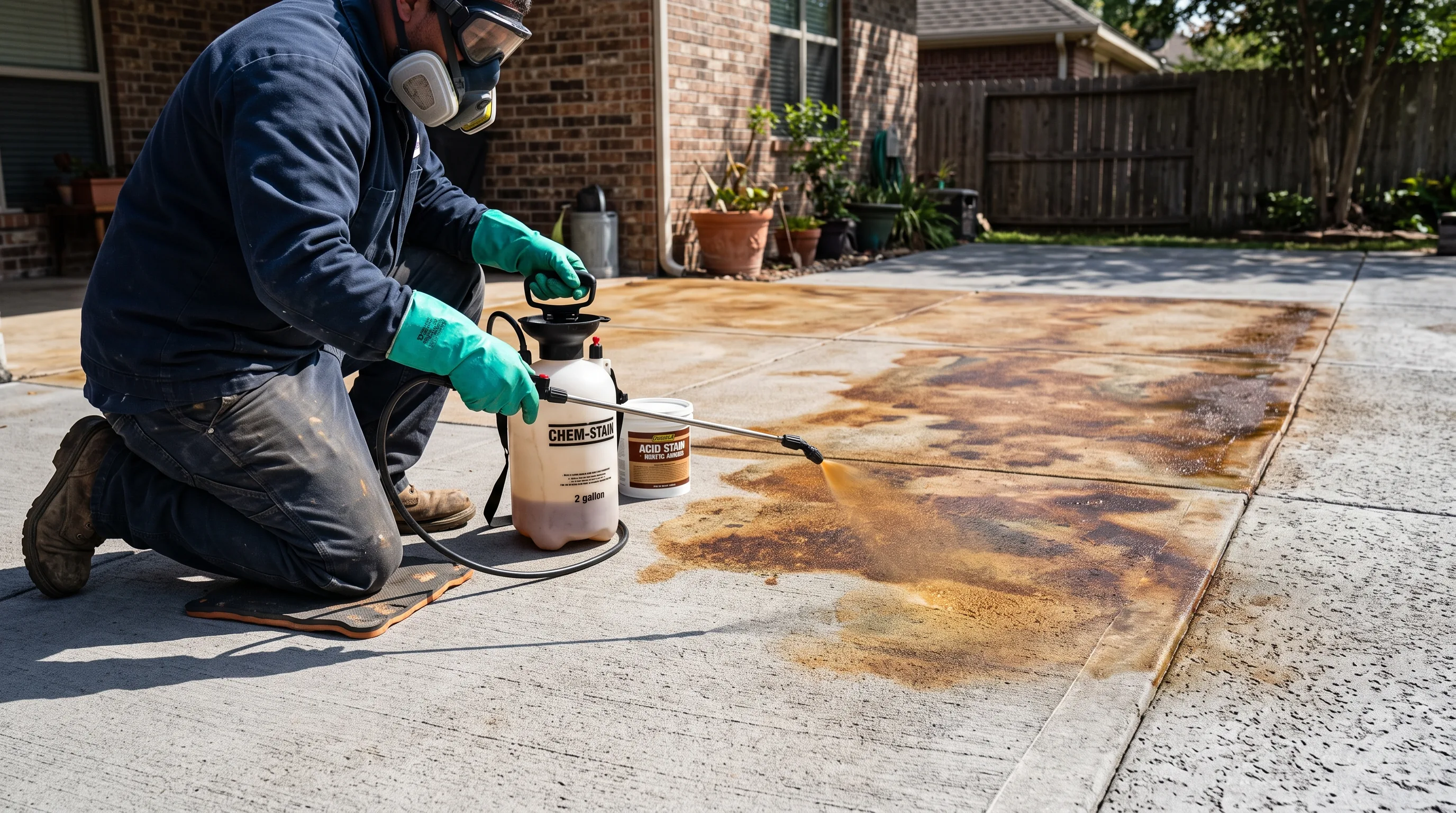
Apply with a low-pressure pump sprayer using overlapping circular motions for acid stain, or a sprayer, roller, or brush for water-based stain. Work in manageable sections and maintain a wet edge throughout to avoid visible lap marks where two application passes meet.
-
6
Let the Stain React or Dry
Acid stain needs 4 to 24 hours for the chemical reaction to fully develop its final color — resist the urge to judge the color too early, as it darkens and matures during this window. Water-based stain simply needs the manufacturer's recommended dry time between coats.
-
7
Neutralize and Rinse (Acid Stain Only)
Neutralize acid residue with a baking-soda-and-water solution or a matched commercial neutralizer, scrub, and rinse thoroughly until the runoff tests neutral. Residual acid left on the surface will interfere with sealer adhesion and can cause the sealer to fail prematurely.
-
8
Seal the Surface
Once fully dry and neutralized, apply a penetrating sealer for a natural matte look or a film-forming acrylic/polyurethane sealer for a glossier, deeper "wet look" finish. This step is not optional — the stain provides color, the sealer provides protection.
Applications — Driveways, Patios, Porches & Interior Floors
Stained driveways and patios are the most common exterior application, where acid stain's natural, stone-like variation reads especially well against landscaping, and durability against UV and weather is the main design constraint — sealing schedule matters more here than indoors. Stained porches follow similar logic on a smaller scale, often with decorative scoring added to mimic tile or stone joint lines. Interior floors — basements, living areas over a slab, commercial spaces — are where water-based stain and concrete dye see the most use, since consistent, predictable color matters more in a space you look at daily, and UV fading is far less of a concern indoors.
Garage floors are a special case: they see regular oil, coolant, and brake fluid drips, so water-based stain paired with a durable film-forming or epoxy topcoat generally holds up better to chemical exposure than an acid-stained finish sealed only with a penetrating sealer. Pool decks need a slip-resistant additive mixed into the topcoat sealer regardless of which stain type is used underneath — a beautifully stained deck that's dangerously slick when wet is a liability, not a feature, and most professional pool deck sealers offer a matte, textured additive specifically for this.
Multi-Color and Scored Decorative Finishes
Professional decorative concrete work frequently combines staining with saw-cut or hand-tooled scoring to mimic the joint lines of tile, flagstone, or ashlar stone patterns, and layers two or more stain colors to create depth — a base earth tone followed by a darker accent stain worked into low spots and edges for an aged, variegated look. This layered, multi-color approach is where the skill gap between a good and mediocre acid-stain contractor becomes most visible, since controlling exactly where a second color reacts (and doesn't) requires real technique with masking, sponge application, and timing. It's also the main reason professional acid-staining quotes for decorative multi-color work run well above the basic single-color rate — the labor and skill involved are substantially higher than a single-pass stain application.
If you'd rather hire a decorative concrete contractor than tackle acid staining yourself — a reasonable call for large areas, multi-color designs, or any interior floor where an uneven result would be visible every day — get quotes from at least two or three local pros and ask specifically to see photos of their acid-stain work, since the skill gap between a good and mediocre acid-stain job is larger than for almost any other concrete finish.
7 Common Concrete Staining Mistakes
- Staining before the 28-day cure window. The surface chemistry is still changing during early cure, producing inconsistent, blotchy color that can't be corrected after the fact.
- Skipping the test patch. Acid stain color cannot be predicted precisely from a can label — always test on a hidden area or sample slab before committing to the full surface.
- Not neutralizing acid stain fully. Residual acid left in the surface interferes with sealer adhesion, leading to peeling or hazing shortly after the job is finished.
- Staining over existing sealer or paint. Stain cannot penetrate a prior coating — the old finish must be fully stripped or ground off first, not just cleaned.
- Uneven application causing lap marks. Losing a wet edge while spraying or rolling creates visible overlap lines where two passes meet — work in sections sized to what you can cover before the edge dries.
- Skipping the sealer. Unsealed stained concrete fades unevenly in traffic patterns and loses vibrancy within one to two outdoor seasons — the sealer is what protects the investment in color.
- Ignoring surface contamination. Oil, grease, or dust left on the surface blocks stain penetration in that exact spot, leaving a visible light or blotchy patch that mirrors the contamination.
Quick Reference — Best Stain by Project
Mottled, marble-like, one-of-a-kind color.
Consistent color, forgiving application.
Widest, most saturated color range.
Natural stone-like appearance outdoors.
Closest to a true flat, uniform color.
Skill gap between good and poor results is large.
Concrete Staining vs Other Color & Finish Options
| Finish | How It Adds Color | Look | Durability | Best For |
|---|---|---|---|---|
| Concrete Staining | Chemical reaction or pigment penetration | Natural, translucent, shows texture | Permanent color; sealer needs recoating | Authentic decorative color that reads as concrete |
| Concrete Paint | Opaque film on the surface | Solid, flat, hides texture | Wears and chips over time — see our concrete paint guide | Full color coverage, hiding imperfections |
| Stamped Concrete | Color hardener/release + texture mat during pour | Mimics stone, brick, or tile pattern | Very durable, integrated at install | New pours wanting a paved-material look |
| Epoxy Coating | Two-part resin film on the surface | Glossy, uniform, often with color flakes | Extremely durable, chemical-resistant | Garages, shops, floors needing chemical resistance |
Frequently Asked Questions
What is the difference between acid stain and water-based concrete stain?
Acid stain chemically reacts with the lime in cured concrete, permanently bonding color into the surface and producing a mottled, marble-like look unique to each slab. Water-based stain is a pigmented coating that penetrates the surface without a reaction, giving far more predictable, uniform color and a wider palette. Acid stain is chosen for an authentic decorative look; water-based stain for consistent, easier-to-control color.
How long does concrete need to cure before staining?
A minimum of 28 days for new concrete. Staining earlier, while the curing reaction is still changing the slab's surface chemistry, produces inconsistent or blotchy color.
Can you stain old or already-sealed concrete?
Yes, but existing sealer or paint must be fully removed first via grinding or chemical stripping — stain cannot penetrate a prior coating. Always run a test patch on old concrete since aged slabs often absorb color less uniformly than fresh ones.
Is acid staining dangerous — what safety precautions do I need?
Yes, acid stain contains hydrochloric or muriatic acid and requires chemical-resistant gloves, splash-proof goggles, a vapor-rated respirator in enclosed spaces, good ventilation, and a neutralizing solution on hand. Never mix it with bleach or ammonia-based products.
Do I need to seal concrete after staining?
Yes — stain provides color but no protection against abrasion, UV fading, or staining. Unsealed stained concrete fades unevenly and loses vibrancy within one to two outdoor seasons. See our concrete sealer guide for the full comparison.
How much does it cost to stain a concrete floor or patio?
DIY water-based stain runs $0.50–$2.00/sq ft; DIY acid stain $1.50–$3.50/sq ft. Professional water-based staining is $3–$8/sq ft installed; professional acid staining is $7–$15+/sq ft installed. Sealing adds $0.50–$1.50/sq ft if not already included.
Can you stain concrete a solid color like white or black?
Water-based stain and concrete dye get much closer to a true solid color since they're pigment-based. Acid stain is limited to earth tones and always shows some natural mottling, even in dark shades, because it depends on a chemical reaction rather than flat pigment coverage.
How long does concrete stain last?
Acid stain color is permanent since it's chemically bonded into the slab. Water-based stain color is also long-lasting and fade-resistant. In both cases, it's the protective sealer — not the underlying color — that needs periodic recoating, typically every 1–3 years outdoors.
Can I stain concrete myself, or do I need a professional?
Water-based stain is very DIY-friendly with predictable results. Acid stain is DIY-possible with a careful test patch and safety precautions, but its unpredictable, permanent nature makes many homeowners choose a professional for large areas, multi-color designs, or interior floors.
Does staining make concrete slippery, especially around a pool?
The stain itself doesn't significantly change slip resistance — that comes down to the sealer topcoat. A glossy film-forming sealer over stained concrete can become noticeably slick when wet, which is a real concern on patios, walkways, and especially pool decks. For any outdoor or wet-prone area, mix a slip-resistant additive (fine silica or polymer grit) into the final sealer coat, or choose a matte, textured sealer formulated for pool decks rather than a high-gloss wet-look finish.