
Concrete Countertops — Complete 2026 Guide: Costs, GFRC, Finishes, DIY & Find a Pro Near You
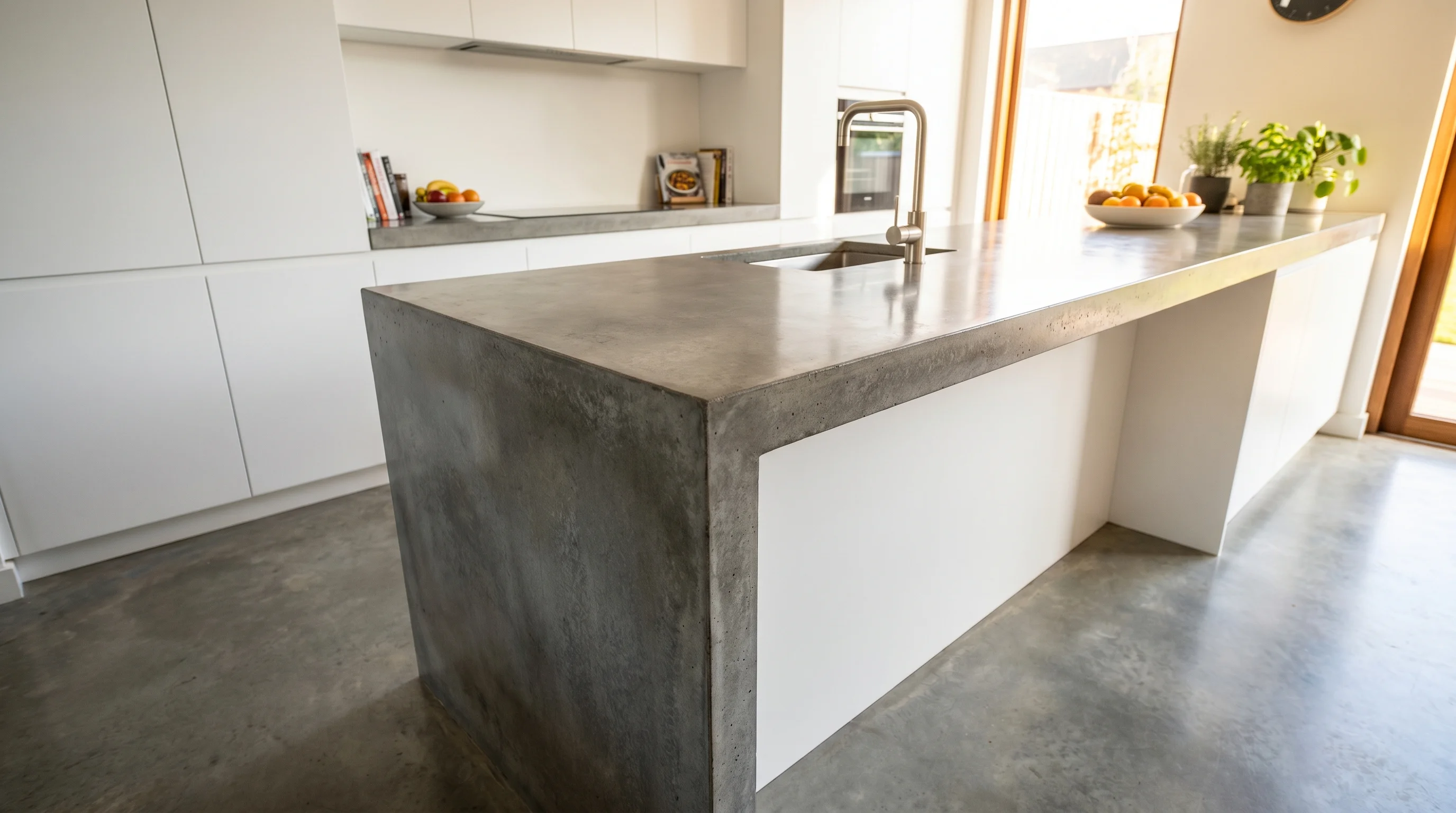
Concrete countertops have moved from a niche industrial look into a mainstream design choice — they show up in modern kitchens, custom bathrooms, restaurant bars, outdoor kitchens, and a growing number of mid-range homes. The reason is simple: concrete is the only countertop material you can shape into any form, color, or texture you can imagine, with seamless drainboards, integrated sinks, custom edges, embedded objects, and a finish that ranges from glossy to raw. This 2026 guide covers everything — types of concrete countertops, GFRC vs traditional cast, costs per square foot, color and finish options, food-safe sealers, the best products on the market, step-by-step DIY installation, common mistakes, and a state-by-state finder for concrete countertop fabricators near you.
Quick Answer: What Are Concrete Countertops & What Do They Cost?
Concrete countertops are custom-cast slabs of high-strength concrete (typically 5,000–8,000 PSI) used as kitchen, bath, or outdoor work surfaces. Professional installation costs $75–$150 per square foot in 2026 ($90–$120 typical). GFRC and heavily customized work runs $130–$250+/sq ft. DIY material cost is $8–$25/sq ft, total project $20–$40/sq ft once you factor tools and time. Properly sealed, they are food safe, scratch-resistant, heat-resistant, and last 50–100 years.
Find Concrete Countertop Fabricators in Your State
Concrete countertops are a custom craft — the right fabricator matters more than the right product. Below is a starting list of regional concrete countertop studios and custom concrete fabricators that may serve your area for kitchens, bathrooms, outdoor kitchens, fireplace surrounds, and bar tops. Always verify licensing, insurance, current portfolio, and a recent client reference before signing a deposit.
🔍 State Concrete Countertops Finder
What Concrete Countertops Actually Are
A concrete countertop is a custom-cast slab of high-strength concrete formed to the exact dimensions of your cabinet run, then sealed for stain and food resistance. Unlike granite or quartz — which are quarried or factory-fabricated and trimmed to fit — a concrete countertop is built specifically for your kitchen from raw materials. That means the fabricator controls every dimension, every edge profile, every embedded element, and every color and texture choice. The downside of that flexibility is that the result depends heavily on the skill of the maker; a great fabricator produces a heirloom-quality piece, a careless one produces something that cracks, stains, or shows craftsmanship flaws within a year.
Modern concrete countertops are not the same as a sidewalk slab. A residential kitchen countertop uses a specialty mix design with very low water-to-cement ratio, crushed quartz or limestone aggregate, polymer modifiers, glass fibers (in GFRC), and integral pigment. Compressive strength typically ranges from 5,000 to 12,000 PSI — two to four times the strength of standard structural concrete — which is what makes a 1-inch-thick GFRC slab strong enough to span cabinets without bracing.
The Three Types of Concrete Countertops
Every concrete countertop falls into one of three construction methods. Each has trade-offs in cost, weight, finish quality, and complexity:
| Type | Thickness | Weight | Best For | Cost / sq ft |
|---|---|---|---|---|
| Cast-in-place | 1.5–2 in | 18–25 lb/sq ft | Simple shapes, outdoor kitchens, bars where access for casting on top of cabinets is easy | $65–$110 |
| Precast (traditional) | 1.5–2 in | 18–25 lb/sq ft | Most kitchen countertops — cast in shop, polished, then transported and set | $85–$140 |
| GFRC precast | 0.75–1 in | 8–12 lb/sq ft | Modern installs, long overhangs, cantilevers, large slabs that need to be light enough to handle | $110–$200+ |
Cast-in-Place
Cast-in-place is exactly what it sounds like — the concrete is poured directly on top of the cabinets in the room where it will live. Forms are built around the cabinet perimeter, the slab is cast, troweled, allowed to cure for several days, then ground and polished in place. This method works well for outdoor kitchens, bar tops, and spaces with tricky geometries or very long runs that would be difficult to transport. The trade-offs are major mess (concrete dust everywhere from grinding), longer install time (a week or more in your kitchen), and limited control over the bottom surface, since you cannot polish what is sitting on top of the cabinets. Most professional fabricators in 2026 have moved away from cast-in-place except for outdoor work.
Precast (Traditional)
Precast is the standard professional method. The fabricator builds melamine forms in their shop, casts the slab upside down (so the smooth bottom of the form becomes the visible top surface), demolds after curing, polishes, seals, and finally transports the finished slab to your kitchen and sets it on the cabinets. The advantage is total control — the shop has dust collection, polishing equipment, climate control for curing, and the slab can be inspected before it ever leaves the studio. The trade-off is weight: a 10-foot-long traditional concrete slab can weigh 400–500 pounds and requires three or four people plus suction cups or a slab cart to set.
GFRC (Glass Fiber Reinforced Concrete)
GFRC is the modern professional standard. It uses a specialty mix that includes alkali-resistant glass fibers (typically 3% by weight) integrated throughout the matrix, which carries tension across the entire slab. Because the fibers handle the tensile load, GFRC slabs can be cast much thinner — 3/4 inch is typical, 1 inch is common — without sacrificing strength. The result is a slab that is 50 to 70 percent lighter than traditional cast concrete, easier to transport and set, and capable of long unsupported overhangs (up to 16 inches with proper steel angle reinforcement at the back). GFRC also cracks less because the fibers distribute shrinkage stresses. Almost every high-end concrete countertop you see in design magazines is GFRC.
Concrete Countertop Costs (2026 Pricing)
Concrete countertop pricing is driven by three factors: the construction method, the level of customization, and your regional market. Here is what a typical kitchen runs in 2026:
| Item | Cost Range | Notes |
|---|---|---|
| Standard precast install | $85–$140 / sq ft | Polished gray or single integral pigment, simple eased edge, undermount sink cutout, no inlays |
| GFRC install | $110–$200 / sq ft | Standard finish; price scales with custom edges, integrated drainboards, embedded objects |
| Custom edges | +$8–$30 / linear ft | Bullnose, ogee, chiseled, slot-edged drip line; varies by complexity |
| Integrated drainboard | +$200–$600 each | Sloped grooves cast into surface to drain water back into sink — premium feature |
| Integral concrete sink | +$800–$2,500 | Sink cast as part of the slab — eliminates seam, fully custom |
| Embedded objects (stone, fossils, glass) | +$25–$75 / sq ft | Fiber optics, recycled glass, river rock, brass strips — labor + material |
| Stamped or textured finish | +$10–$25 / sq ft | Acid-etched, sandblasted, leather, hammered, or trowel texture |
| Acid stain finishing | +$15–$35 / sq ft | Translucent reactive color — multi-step application after cure |
| Tear-out & haul-away of old counters | $150–$500 flat | More if existing counters are tile, granite, or have plumbing complications |
| Plumbing reconnect | $200–$500 | Faucet, disposal, dishwasher reconnect — varies by complexity |
| DIY material cost | $8–$25 / sq ft | Bagged mix, pigment, sealer, melamine, rebar/mesh, fiber, polishing pads — does not include tools |
| DIY total project (first-timer) | $20–$40 / sq ft | After tools, mistakes, replacement materials, finishing supplies |
For a typical 30-square-foot kitchen counter run with a sink cutout and standard finish, expect $2,500–$4,500 from a competent fabricator on the precast end and $3,500–$7,000 for GFRC with custom touches. A bar top or bathroom vanity ranges $800–$2,500 depending on size.
Color & Finish Options
Concrete is the most customizable countertop material on the market. There is no other surface where the fabricator picks every color, every texture, every reflective quality from a near-infinite palette. The choices break down into three categories: color, finish, and embedded elements.
Color: Integral Pigment vs Stain
Integral pigment means iron oxide or color-fast mineral pigment is added to the wet mix before casting. The color is uniform throughout the entire slab — if you chip the edge, the chip is the same color as the surface. Integral pigment is the most fade-resistant approach and works best for clean, modern, single-color looks. The downside is that you commit to one color across the entire piece, with only minor variation from troweling.
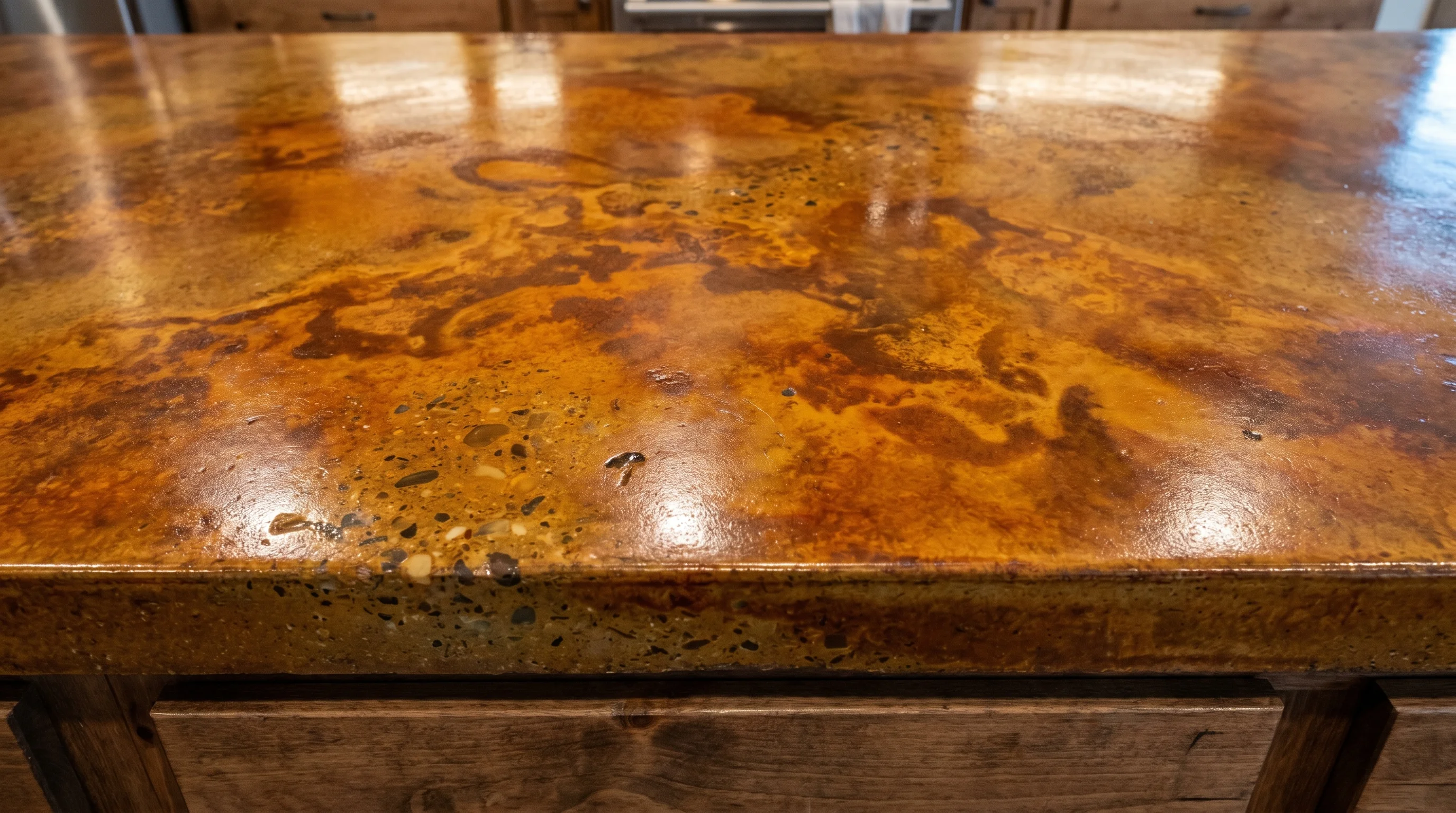
Acid stain is applied after the slab has cured. Acid-soluble metallic salts react with the calcium hydroxide in the cured concrete, creating mottled, translucent color variation that looks more like natural stone or weathered leather. Common acid stain colors range from amber and tobacco to olive, blue-green, and black. Acid stains are unpredictable — that is part of their appeal — but require neutralization and thorough rinsing before sealing.
Water-based concrete stains and dyes offer the layered look of acid stain with more predictable, vibrant colors and no acid neutralization step. Brands like Kemiko Stone Tone and Brickform Stainz dominate the water-stain market.
Finish: Polish, Texture & Patina
| Finish | Look | Process |
|---|---|---|
| Pressed (off-the-form) | Smooth, glassy, with subtle micro-pores from the form face | The cast surface is left as-is — only sealed; lowest cost |
| Honed (matte) | Soft, matte, low-sheen — like soapstone | Polished to ~200 grit then sealed with a matte penetrating sealer |
| Polished (semi-gloss) | Smooth with light sheen, slight aggregate visible | Polished progressively to 400–800 grit, sealed |
| Aggregate exposed | Pebbled or terrazzo-like with stones, glass, or metal showing | Aggressively ground to 60–120 grit to expose embedded aggregate |
| Acid-etched | Rough, sandstone-like texture | Diluted muriatic acid wash etches the surface, then neutralized |
| Sandblasted | Frosted, textured, like beach glass | Media-blasted to remove cream and expose fine aggregate |
| Trowel-textured | Hand-troweled patterns or swirls — rustic look | Achieved during finishing of cast-in-place; not common for precast |
| Leather / hammered | Dimpled, irregular surface with depth | Texture mat pressed into wet concrete or hammered after cure |
Embedded Elements
Embeds are what make concrete countertops genuinely one-of-a-kind. Common options include recycled glass, fiber optics (lit from below), seashells, fossils, bottle caps, brass or copper inlays, river rock, stainless steel strips for trivets, and even client-supplied keepsakes. Every embed has to be planned in the form before casting — they cannot be added after. A skilled fabricator will press lighter embeds (glass, shells) into the bottom of the form so they appear flush on the finished surface after grinding.
Mix Designs & Materials
The right mix design is what separates a kitchen-grade concrete countertop from a sidewalk slab. The differences are not subtle:
| Property | Sidewalk Concrete | Countertop Mix | GFRC Mix |
|---|---|---|---|
| Compressive strength | 3,000–4,000 PSI | 5,000–8,000 PSI | 8,000–12,000 PSI |
| Water-cement ratio | 0.50–0.65 | 0.30–0.40 | 0.30–0.35 |
| Aggregate | 3/4" gravel + sand | Crushed quartz/limestone, 3/8" max | Fine sand only |
| Reinforcement | Rebar or wire mesh | Wire mesh + steel | 3% AR glass fibers + face coat |
| Polymer additives | None | Acrylic polymer, water reducer | Acrylic polymer + plasticizer |
| Workability | Stiff slump | Self-consolidating with vibration | Sprayed face coat + flowable backer |
| Cost / sq ft material | $1–$3 | $8–$15 | $15–$25 |
Bagged commercial mixes designed for countertops include Buddy Rhodes Craftsman Mix, Surecrete Countertop Mix, Z Counterform Pro-Formula, Cheng Pro Formula, and Quikrete Countertop Mix. Each has slightly different working characteristics — Buddy Rhodes flows like pancake batter and self-consolidates; Surecrete has a longer working time; Cheng is forgiving for first-time builders. For GFRC, the standard products are Buddy Rhodes GFRC Blended Mix, Surecrete GFRC, and the Concrete Countertop Institute (CCI) formulations.
Sealers — The Make-or-Break Step
A concrete countertop is only as good as its sealer. The sealer determines whether your countertop is food safe, stain resistant, scratch resistant, heat tolerant, and how often you need to maintain it. Choosing the wrong sealer is the most common reason concrete countertops fail — they stain from oil, etch from lemon juice, or yellow over time. Here is what is on the market in 2026:
| Sealer Type | Stain Resistance | Heat Resistance | Lifespan | Food Safe? | Look |
|---|---|---|---|---|---|
| Penetrating silane/siloxane | Good | Excellent | 5–10 yrs | Yes (fully cured) | Natural — no sheen |
| Penetrating fluorinated (e.g., Cheng Sealer) | Excellent | Excellent | 5–8 yrs | Yes (NSF/ANSI 51) | Natural — slight color enhancement |
| Acrylic film-forming | Good | Poor (softens at 150°F) | 2–4 yrs | Some are | Glossy or matte |
| Polyurethane (water-based) | Excellent | Good | 5–7 yrs | Yes (cured) | Light sheen, slight enhancement |
| Polyurethane (solvent-based) | Excellent | Good | 5–10 yrs | Yes (cured) | Glossy, deeper enhancement |
| Epoxy | Excellent | Poor (softens) | 5–10 yrs | Some are | Very glossy, plastic look |
| Wax (carnauba/beeswax) | Poor (alone) | Excellent | 6–12 mo | Yes | Soft satin |
| Hybrid (penetrate + topical) | Excellent | Excellent | 5–10 yrs | Yes (NSF certified) | Customizable |
Top Concrete Countertop Products (2026)
Buddy Rhodes Craftsman Mix
The most popular high-end bagged mix in North America. Self-consolidating, smooth-flowing, very low water-cement ratio, and forgiving for first-time builders. Compressive strength tests at 7,000+ PSI at 28 days. Available in white or gray base, accepts integral pigment well. The default choice for serious DIY and small studios.
Surecrete GFRC Blended Mix
Pre-blended GFRC mix with alkali-resistant glass fibers already integrated — eliminates the need to measure and add fibers separately. Workability is excellent for both face coat spraying and backer placement. Good fit for fabricators making the jump from traditional cast to GFRC without retooling.
Cheng Concrete Sealer (NSF/ANSI 51 Certified)
The gold-standard food-safe sealer for concrete countertops. Penetrates 1/8" into the slab, becomes inert once cured, and leaves a natural appearance. NSF/ANSI 51 certified for direct food contact. Resists oil, vinegar, lemon juice, red wine, and coffee far better than acrylic sealers. Maintenance is annual buff with a wax topcoat.
Z Counterform Pour-In-Place System
The most beginner-friendly DIY system — pre-formed plastic edge molds that screw to existing countertops, then a self-leveling concrete mix is troweled on top. Good for retrofits where you want a concrete look without removing existing counters. Limited to thinner overlays (3/4" max) and not suitable for new builds where full slabs are appropriate.
Quikrete Countertop Mix (5-Star or 1106)
The mass-market entry point for DIY concrete countertops. Lower compressive strength than premium mixes (around 5,000 PSI), shorter working time, and less forgiving for first-time builders. Works fine for small projects like vanities, side tables, or bar tops where the slab will be heavily reinforced.
Surecrete XS-327 Sealer
NSF/ANSI 51 approved for food contact, water-based, low-odor, and applies in two thin coats with a microfiber roller. More affordable per square foot than Cheng for larger jobs. Slightly enhances color (typical "wet look" gain of 15–20%) and resists most household acids and oils once cured.
Stonelok E3-2K Polyurethane Topcoat
The choice when a client wants a high-gloss, showroom-finish concrete countertop. Two components (resin and hardener) mixed at a 4:1 ratio, applied in 2–3 coats with a microfiber roller. Very high stain resistance, scratch resistance better than acrylic, and a clear gloss that does not yellow under UV. Limited heat tolerance — keep hot pans on a trivet.
Buddy Rhodes Pigment Pack
Color-fast iron oxide pigments specifically dosed and packaged for countertop mixes. Available in 30+ colors from charcoal and slate to terra cotta and forest green. Add at 1–6% by weight of cement; lower percentages produce subtle natural variation, higher percentages produce saturated solid color.
DIY Concrete Countertops — Step-by-Step
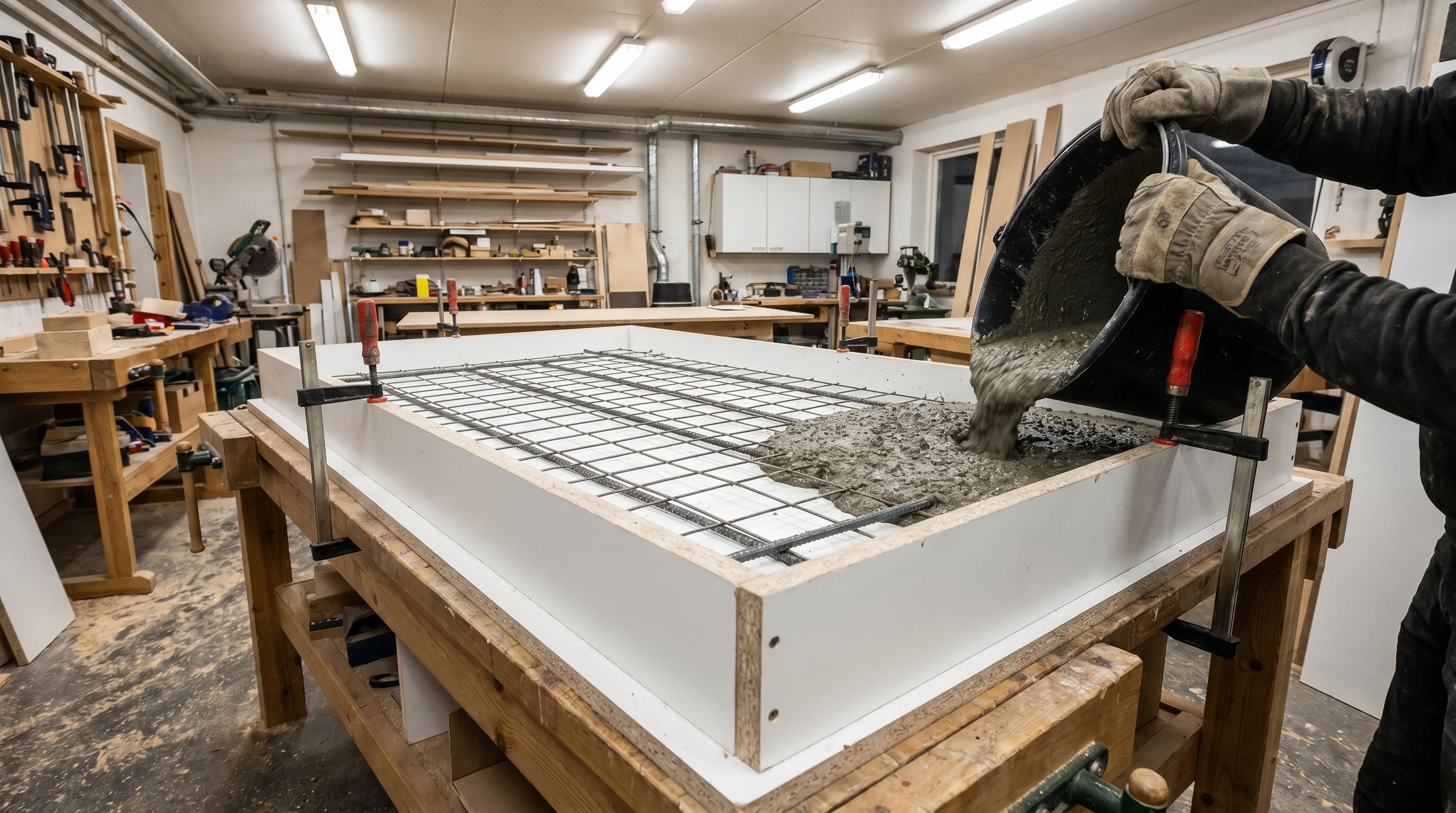
A precast DIY concrete countertop is achievable for a confident DIYer. Plan for two to three weekends of active work plus a week of cure time between casting and installation. Here is the standard process for a precast slab using a premium bagged countertop mix:
- Measure and template. Make a full-scale template of your countertop run from cardboard or thin plywood. Cut sink and faucet holes. Verify the template fits the cabinets perfectly before building forms — once concrete is poured, you cannot resize.
- Build melamine forms upside down. Use 3/4" melamine particleboard for the base and side rails. The smooth melamine face becomes the visible top of the slab. Screw rails from underneath so screws never penetrate the casting surface. Caulk every interior seam with 100% silicone, tooled smooth, for crisp edges.
- Add sink and faucet knockouts. Build foam knockouts (rigid pink insulation foam, sealed with packing tape) for sink openings and faucet holes. Sink knockouts should be sized to your specific undermount sink with 1/4" reveal on each side.
- Place reinforcement. For traditional cast, use galvanized welded wire mesh suspended halfway through the slab thickness with 3/4" plastic chairs. Add #3 rebar around sink cutouts and at any narrow waist. For GFRC, the fibers are mixed into the concrete itself; no mesh is needed.
- Mix the concrete. Follow bag instructions exactly — the water-to-mix ratio is the single most important variable. Mix in batches sized to a 5-gallon bucket using a paddle mixer on a heavy-duty drill. Mix for 5 minutes minimum, scraping the bucket sides. Slump should be like thick pancake batter — pourable but not runny.
- Place and vibrate. Pour the mix into the form in lifts (layers), filling about 1/3 at a time and vibrating each lift with a palm sander pressed against the side of the form for 1–2 minutes. Vibration consolidates the mix and brings air bubbles to the surface. Strike off level with a screed board.
- Cure under plastic. Cover the form with plastic sheeting to prevent moisture loss. Cure for 7 days at 70°F minimum before demolding. A high-humidity cure produces stronger, more crack-resistant concrete than air-drying.
- Demold and polish. Carefully unscrew the form rails, then flip the slab onto padding. The downward-facing surface (which was on the melamine) is now your finished top. Polish progressively from 50 grit through 200, 400, and 800 grit using a wet polisher. Slurry-fill any pinholes between grits with neat cement paste, let dry, then continue polishing.
Concrete Countertop Maintenance & Care
Concrete countertops are surprisingly low-maintenance once properly sealed — but they do require a routine. The exact maintenance depends on the sealer system:
- Daily cleaning: Mild dish soap and warm water, soft cloth or sponge. Wipe up spills (especially acidic ones — citrus, vinegar, wine, tomato) immediately to minimize sealer stress.
- Weekly: A pH-neutral stone or concrete cleaner (such as Black Diamond Stone Cleaner) for deeper cleaning without compromising the sealer.
- Monthly (with wax topcoat): Apply a thin layer of food-safe paste wax with a soft cloth, buff to a soft sheen. Refreshes the protective layer and renews stain resistance.
- Annually: Inspect the surface for sealer wear — water should bead in droplets. If water absorbs into the surface, time to reseal.
- Every 5–10 years: Strip and reapply the penetrating sealer. Most fabricators offer this service for $300–$800 depending on countertop size.
- Never use: Bleach, ammonia, vinegar, citrus-based cleaners, abrasive scrubbers, harsh degreasers, or any cleaner labeled "for granite" that contains acid or alcohol — these strip the sealer and etch the concrete.
- Never set hot pans directly on the surface: Even heat-resistant sealers can soften or scorch above 150°F. Always use a trivet for cookware fresh from the oven or stove.
- Never cut directly on the surface: Concrete is harder than most knives but the sealer is not. Cutting on the counter scratches the sealer, eventually exposing concrete to staining.
Pros & Cons — The Honest Verdict
✅ Fully Custom
Any color, any shape, any edge profile, any embed. Concrete is the only countertop where the fabricator builds to your exact dimensions and aesthetic.
✅ Genuinely Unique
No two concrete countertops are identical — natural variation in color, texture, and aggregate produces a one-of-a-kind result. A handmade artifact, not a factory product.
✅ Heat Resistant
Concrete itself tolerates up to ~600°F before damage — far above any normal kitchen use. The sealer is the limiting factor, not the substrate.
✅ Long Lifespan
50–100 years for the substrate; sealer reapplications every 5–10 years. Outlasts kitchen remodel cycles by decades.
❌ Requires Maintenance
Sealer reapplication, monthly waxing on some systems, and a no-cut/no-hot-pan discipline. Not "set and forget" like quartz.
❌ Quality is Maker-Dependent
A great fabricator produces heirloom work; a careless one produces something that cracks and stains. The brand on the bag matters less than the hands building it.
❌ Will Develop Hairline Cracks
Hairline cracks (under 1/64") are normal and considered patina by most owners — but if you want a perfectly uniform surface forever, choose quartz.
❌ Heavy
Traditional cast concrete weighs 18–25 lb/sq ft — a full kitchen run can hit 600–800 lbs. May require additional cabinet bracing on stock cabinetry. GFRC mitigates this.
Concrete Countertops vs Other Materials
| Material | Cost / sq ft | Lifespan | Customization | Maintenance |
|---|---|---|---|---|
| Concrete | $75–$150 | 50–100 yrs | Total — any shape, color, embed | Wax/seal annually; reseal 5–10 yrs |
| Quartz (engineered) | $60–$120 | 20–40 yrs | Color choice from catalog only | Soap and water; no resealing |
| Granite | $50–$150 | Permanent (porous) | Slab pattern is what you get | Reseal every 1–3 yrs |
| Marble | $75–$200 | Permanent (porous) | Slab pattern only | Reseal frequently; etches from acids |
| Soapstone | $70–$120 | 50–100 yrs | Limited — color only | Mineral oil monthly |
| Butcher block | $40–$100 | 15–30 yrs | Wood species choice | Mineral oil monthly; resand cuts |
| Solid surface | $40–$80 | 20–30 yrs | Catalog colors | None — but scratches easily |
Common Mistakes to Avoid
- Skipping the sample slab. Pouring a full kitchen on the first try with a new mix or pigment ratio is how DIYers end up with countertops the wrong color or full of pinholes. Always cast a 12" × 12" test piece first.
- Adding too much water. The bag's water ratio is engineered for strength. Adding extra water to make the mix easier to work with cuts compressive strength dramatically and increases shrinkage cracking. If the mix is too stiff, use a polymer-based plasticizer instead.
- Inadequate vibration. Air bubbles trapped in the mix become visible voids on the polished surface. Vibrate every lift for 1–2 minutes with a palm sander against the form side until bubbles stop rising.
- Sealing too early. Concrete needs to release water vapor for at least 14 days before sealing. Sealing at 7 days traps moisture and causes the sealer to fail or cloud. Wait the full cure time.
- Choosing the wrong sealer. Acrylic sealers fail in kitchens — they soften from heat and scratch from utensils within a year or two. Use a penetrating fluorinated or polyurethane sealer designed for kitchen use.
- Leaving sharp inside corners. Right-angle inside corners (like the back corner of an L-shaped countertop) are a stress concentration point — cracks initiate here. Add a 1/2" radius fillet at every inside corner during forming.
- Not bracing cabinets for the load. A 30-square-foot traditional concrete countertop weighs 600–700 lbs. Stock cabinets without additional support can sag over time. Add 3/4" plywood across the cabinet tops as a support deck before setting the slab.
- Cutting directly on the surface. Even though concrete is harder than knives, the sealer is not. Use a cutting board — every time, no exceptions.
How to Choose a Concrete Countertop Fabricator
1. Ask to See an Installed Project
- Photos in a portfolio show only what the fabricator wants you to see. Ask to visit a finished installation that is at least 2 years old to see how their work ages.
- Look at edges, sink cutouts, and any seams — these are where workmanship shows. Crisp 90-degree edges and tight sink reveals indicate a professional fabricator.
- Check the sealer condition — has it yellowed, clouded, or worn through? A 2-year-old install should still look fresh.
2. Get a Detailed Written Quote
- The quote should specify: mix type (GFRC vs traditional), thickness, edge profile, sealer system, integral pigment color or stain method, and what is included for tear-out, transport, and install.
- Beware of low-ball quotes that are missing line items — most "surprise" charges show up as add-ons during install when you have no leverage.
3. Verify Insurance & References
- General liability ($1M minimum) — protects your home from damage during install (these slabs are heavy and fragile).
- Ask for three recent client references (within 12 months) and actually call them. Ask about communication, timeline accuracy, and how the fabricator handled any issues.
4. Confirm the Sealer System Up Front
- Ask exactly which sealer they use, whether it is NSF/ANSI 51 certified for food contact, and what the maintenance schedule is.
- If they cannot name the specific product, that is a red flag — a real concrete countertop fabricator has tested multiple sealers and has strong opinions on which one they use.
- Wants the full payment up front — standard is 30–50% deposit, balance on install.
- Cannot show you a finished project in person — every legitimate fabricator has a recent install they can take you to see.
- Uses generic "concrete countertop sealer" without naming a brand — they likely use whatever is cheapest at the contractor supply.
- Quotes a price under $60/sq ft for a real install — at that rate, the labor cost alone is being skipped, which means corners are being cut.
- No written contract — without a contract specifying sealer, color, edge profile, and timeline, you have no recourse if the result is wrong.
FAQ — Concrete Countertops
How much do concrete countertops cost per square foot?
Professionally installed: $75–$150/sq ft, with most kitchens at $90–$120. GFRC and heavily customized work runs $130–$250+. DIY material cost is $8–$25/sq ft, and total DIY project cost is closer to $20–$40/sq ft once you factor tools, mistakes, and finishing supplies.
Are concrete countertops food safe?
Only when sealed with a food-safe sealer. NSF/ANSI 51 certified products like Cheng Concrete Sealer and Surecrete XS-327 are formulated for direct food contact once fully cured. Raw concrete is porous and alkaline and is not safe for food prep.
Do concrete countertops crack?
Hairline cracks under 1/64" are normal and considered patina. Major structural cracks are rare and almost always trace to inadequate reinforcement, an unsupported overhang, or improper curing. GFRC countertops crack the least because the integrated glass fibers carry tension across the slab.
What is GFRC and is it better than regular concrete countertops?
GFRC stands for Glass Fiber Reinforced Concrete — a high-strength mix with alkali-resistant glass fibers integrated throughout. GFRC slabs are 50–70% lighter, can be cast thinner (3/4"–1" vs 1.5"–2"), allow longer overhangs, and crack less than traditional cast concrete. It is the modern professional standard.
Can I install concrete countertops myself?
Yes, with patience and basic carpentry skill. Plan for two to three weekends, $400–$1,200 in materials and tools, and accept a handmade aesthetic. Use a premium bagged mix (Buddy Rhodes or Surecrete) and follow the bag's water ratio exactly.
How long do concrete countertops last?
The substrate lasts 50–100 years. The sealer needs reapplication every 5–10 years for penetrating sealers and 3–7 years for film-forming sealers. With routine resealing, concrete countertops outlive granite and quartz by decades.
Do concrete countertops stain?
A properly sealed concrete countertop resists most kitchen stains — oil, wine, coffee, citrus — when spills are wiped up promptly. The sealer is what blocks staining; raw or under-sealed concrete will stain quickly. The risk goes up over time as the sealer wears.
Can I put hot pans on concrete countertops?
Concrete tolerates heat, but the sealer does not. Most sealers begin to soften above 150°F, and some can scorch or yellow above 200°F. Always use a trivet for hot cookware. The exception is wax-only finishes, which tolerate higher temperatures but offer less stain resistance.
Final Verdict
Concrete countertops are the right choice when you want something genuinely custom, when no other material can deliver the shape, finish, or character you have in mind, and when you appreciate a handmade artifact that ages with patina rather than staying factory-uniform. They are not the right choice when you want set-and-forget low maintenance, perfect uniformity, or the cheapest option per square foot. Cost is competitive with quartz and granite at the standard end and rises sharply for GFRC and full custom work — but you are paying for craft, not material.
If you go pro, the fabricator matters more than the brand of mix on the bag. Use the state finder above to identify candidates near you, see a recent installed project in person, and confirm the sealer system before signing. If you DIY, start with a sample slab, use a premium bagged mix, follow water ratios exactly, and give yourself two to three weekends. Either way, plan to live with hairline cracks and reapply sealer every 5 to 10 years — those are the price of admission for a countertop that nothing else on the market can match.