
Asphalt Milling Services — Cost per SY, Hiring Guide & RFP Checklist (2026)
Quick Answer: What Are Asphalt Milling Services?
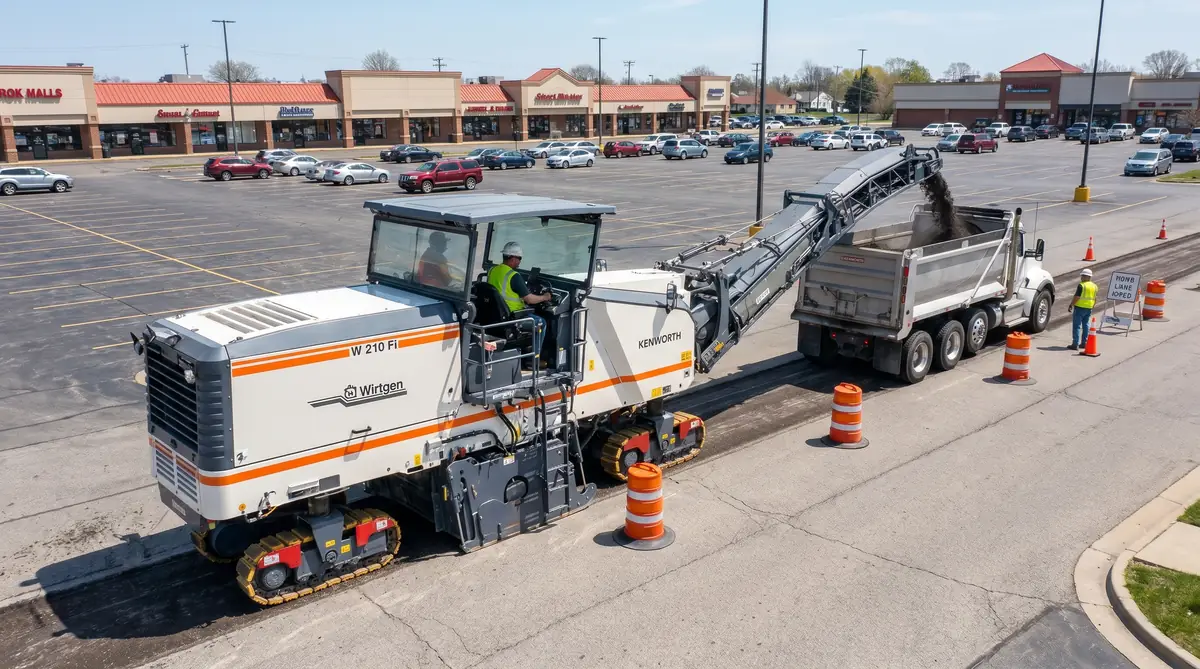
Asphalt milling services are contractor operations that use a cold planer to grind off an existing asphalt surface in preparation for resurfacing, rut removal, grade correction, or full reconstruction. Cost runs $1.50–$4.50 per square yard for standard 1.5–2 inch milling, $3–$7 per SY for full-depth milling, and $4–$9 per SY for micro-milling. Mobilization adds $1,500–$8,000, and most contractors enforce a 500–2,000 SY minimum. The removed material (RAP) is typically kept by the contractor and recycled.
When You Need Milling Services
Milling is the first step of almost every major asphalt rehabilitation. If your project involves any of the following, you need a milling contractor before the paver shows up:
- Resurfacing (mill-and-overlay): the most common use — grind off 1.5–2 inches, then pave a new surface course of the same thickness so the final grade matches existing curbs, gutters, and adjacent pavement
- Rutting removal: wheel-path ruts deeper than 0.5 inch can't be filled with overlay alone — they telegraph through the new mat unless milled out first
- Grade correction: fixing cross-slope or longitudinal profile before overlay — contractor uses grade and slope controls on the milling head
- Manhole and valve adjustment prep: milling exposes the top of utility structures so they can be raised before paving, avoiding bumps
- Curb reveal restoration: after multiple overlays, the curb reveal (vertical curb face visible above the pavement) disappears — milling back to original grade restores drainage and aesthetic
- Structural rehabilitation: full-depth milling removes failed asphalt layers so base and subgrade can be inspected, repaired, or reinforced before repaving
- Bridge deck surface prep: micro-milling before a thin bonded overlay or polymer-modified wearing course
Milling Depth Types — Comparison
| Type | Depth | Drum Tooth Spacing | Typical Use | Cost per SY |
|---|---|---|---|---|
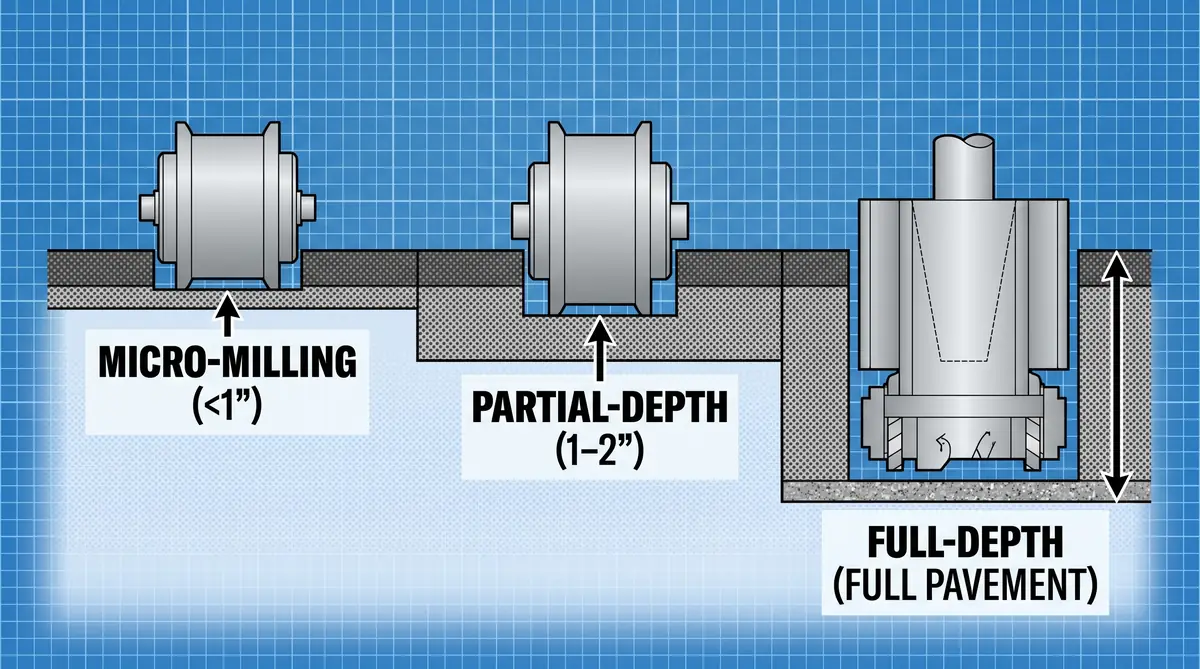
| Micro-milling | 0.25–1 in | ~5 mm (fine) | Texture correction, thin overlay prep, bridge decks, friction restoration | $4.00–$9.00 |
| Partial-depth (surface mill) | 1.5–2 in | ~15 mm (standard) | Mill-and-overlay, curb reveal restoration, routine resurfacing | $1.50–$4.50 |
| Intermediate depth | 2–4 in | ~15 mm (standard) | Removing both surface and binder courses, deeper rutting | $2.50–$6.00 |
| Full-depth | 4–6+ in | ~15 mm (standard) | Complete pavement removal, structural rehab, reconstruction | $3.00–$7.00 |
Depth affects production rate and cost nonlinearly — doubling the depth does not double the cost, because mobilization and traffic control are fixed. It does cut production rate (more tonnage per pass means slower travel speed) and roughly doubles the number of haul trucks needed, which is why deep mills have a per-SY premium.
Cost Breakdown — What You're Actually Paying For
A milling bid isn't a single per-SY number — it's a stack of line items. Understanding the stack is how you spot under-priced bids that will hit you with change orders later.
| Line Item | Typical Cost | What It Covers |
|---|---|---|
| Milling per SY | $1.50–$4.50 | Machine + operator + direct labor for the cutting pass itself |
| Mobilization | $1,500–$8,000 | Trucking the machine to site, setup, demob; higher for full-lane machines and long hauls |
| Traffic control (MUTCD) | $800–$3,500/day | Cones, signs, flaggers, arrow boards, crash trucks on public roads |
| Trucking (RAP haul) | Included or $3–$8/ton | Tandem or triaxle dumps to contractor's yard; may be billed separately |
| Sweeping | $250–$600/day | Broom tractor or vacuum sweeper behind the mill; mandatory before overlay |
| Manhole adjustment | $250–$800 each | Raising or lowering utility casings to match new grade; usually a separate unit price |
| Butt joints / tapered transitions | $15–$40/LF | Hand-cut matches to existing pavement at project edges where milled section meets unmilled |
| Night / weekend premium | +15–30% | Required on many commercial retail and municipal projects |
Equipment Classes — What Machine Does the Work
Contractors run different machines for different job sizes. The machine class drives production rate, minimum economical job size, and what traffic control is feasible.
| Class | Cutting Width | Production (SY/day) | Best For |
|---|---|---|---|
| Small (utility) | 12–24 in | 200–800 | Trench patching, utility cuts, small residential drives, hand work around structures |
| Half-lane | 4–5 ft | 1,500–4,000 | Commercial parking lots, narrow roads, curb-line work |
| Full-lane | 6.5–7.2 ft | 5,000–12,000 | Two-lane road resurfacing, large parking lots, subdivisions |
| Extra-wide (highway) | 7.2–14.5 ft | 10,000–25,000 | Interstate, airport, high-production municipal contracts |
For technical detail on the equipment itself — tooth patterns, conveyor systems, grade control — see our dedicated asphalt milling machine guide.
How Contractors Price Jobs — The Mental Model
Milling contractors reverse-engineer pricing from production rate and fixed costs. Understanding the math helps you read and compare bids.
Fixed costs per move
Equipment mobilization, trucking, traffic control setup — these are the same whether you mill 500 SY or 5,000 SY. Contractors amortize them over the expected daily production.
Machine-hour rate
A full-lane machine costs $350–$700 per operating hour (equipment + operator + fuel). Production is roughly 3,000–8,000 SY per day at 1.5–2 inch depth.
Trucking bottleneck
A tandem dump holds about 10 tons (~20 SY of 2-inch mill). At full production the mill needs a truck every 2–4 minutes — trucking supply often caps real-world production rate, not the machine itself.
RAP credit
Recycled asphalt pavement has resale value ($4–$15/ton delivered to a hot mix plant). Contractors bake this into the price when they keep the millings, which is why letting you keep them raises the bid.
Utilization gaps
Any job that doesn't fill a full day wastes machine utilization. That's why minimums exist and why scheduling flexibility can save you money — telling the contractor "I'm flexible on start date" lets them slot you between bigger jobs.
What to Ask Before Hiring
Before signing a milling subcontract or awarding a purchase order, confirm all of the following in writing:
- Insurance certificates: general liability ($1M/$2M minimum), auto liability ($1M), workers' comp (state limits), and umbrella ($5M+ for any road work)
- MUTCD traffic control plan: contractor provides the stamped plan or works to yours; who furnishes cones, signs, flaggers, arrow boards
- Equipment class and production commitment: exact machine make/model, cutting width, and committed daily production rate
- Depth tolerance: contract spec should state ±1/4 inch or better for the milled depth (highway standard) or ±1/2 inch for commercial work
- RAP disposal clause: explicit who keeps the millings, where they go, and what happens to overages
- Manhole and valve protocol: whether milling around structures is included, who raises them, what the unit price is
- Weather cancellation policy: standby charges, minimum notice, wet-pavement restrictions
- References on similar-sized jobs: three recent projects within 10% of your SY — ask for site visit permission
- Sweeping scope: behind-the-mill sweeping included or extra; what equipment (broom, vacuum, water truck for dust control)
Scope-of-Work Template — What to Put in the RFP
A clear scope eliminates 80% of bid disputes. At minimum, your RFP should specify:
- Project location and access constraints (gate hours, delivery routes, staging area)
- Quantity (SY) and depth (inches) — state nominal and acceptable tolerance
- Mill type: partial-depth, full-depth, or micro-milling with tooth spacing
- Grade and slope requirements if any (state cross-slope target and longitudinal tolerance)
- Treatment of existing features: butt joints, tapered transitions, manholes, drain inlets, valve boxes, patches to preserve
- RAP ownership and haul destination
- Sweeping requirements (how many passes, what equipment)
- Dust control (water truck, fogging)
- Schedule constraints (night work, weekend restrictions, phased closure)
- Insurance and bonding requirements
- Acceptance criteria (depth check method, surface texture, contamination limits)
Typical Timeline
Bid and award
2–6 weeks from RFP to signed contract depending on project complexity and approval chain.
Pre-construction meeting
1–2 weeks before start — confirm traffic control plan, utility markings (call 811), staging, access, and schedule.
Mobilization
Day 0 — machine delivered on lowboy, traffic control deployed, crew stages equipment.
Milling production
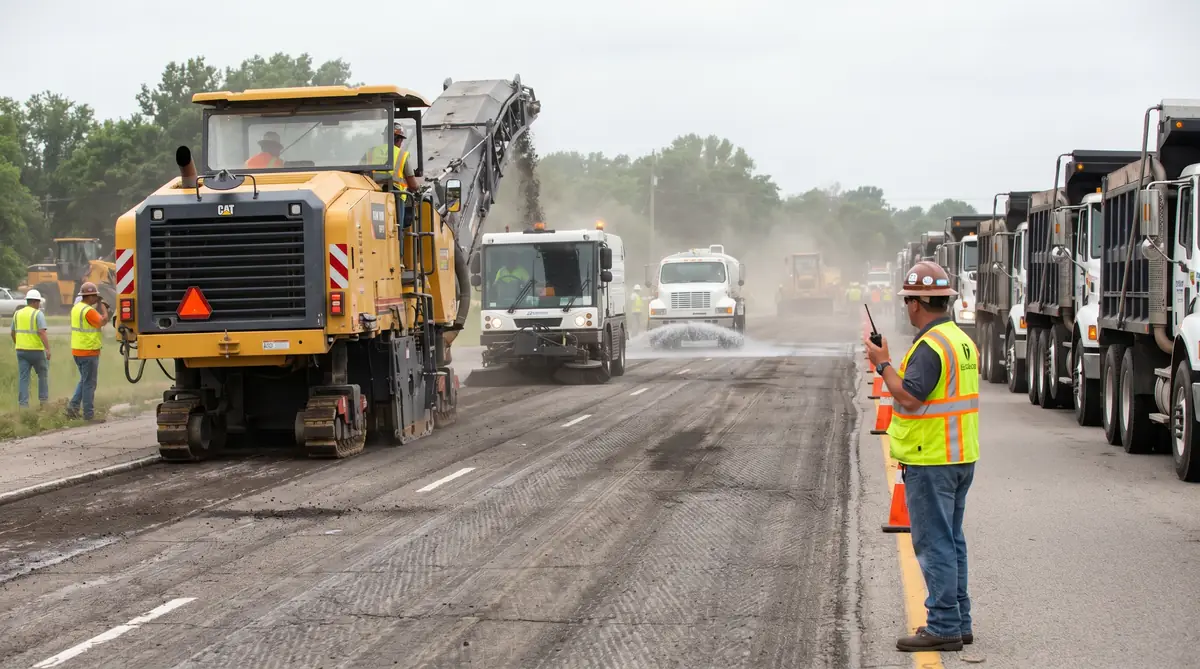
Half-lane machine: 1,500–4,000 SY per day. Full-lane: 5,000–12,000 SY per day. Wide-highway: up to 25,000 SY per day.
Sweeping and handback
Sweeper follows immediately or at shift end. Final sweeping before paver arrives — the milled surface must be clean for tack coat adhesion.
Paving gap
Best practice: same-day or next-day overlay. Maximum 7 days exposure before dust and fines compromise bond — protect with tack coat if delayed.
Common Add-Ons You Might Not Think About
- Butt joints (hand-cut match to existing): 2–4 feet tapered cut where milled section meets unmilled pavement so the overlay feathers cleanly
- Manhole and valve adjustment: raising structures to match new grade — either before paving (risers) or after (riser rings cast into the overlay)
- Crack repair and base failure patching: sometimes revealed by milling and handled before paving
- Tack coat application: often by the paving contractor but can be a separate spec line; see our tack coat guide
- Striping obliteration: removing old pavement markings — milling alone usually handles this for standard paint; thermoplastic lines may need grinding
- Pavement fabric or geogrid placement: between milled surface and new overlay for crack attenuation on severely cracked roads
Red Flags in Milling Bids
- Per-SY rate 30%+ below the market range — almost always means line items are hidden or will show up as change orders
- No mobilization line — either it's baked into per-SY (fine on huge jobs, costly on small ones) or it will reappear mid-project
- "RAP disposal — by owner" but no price reduction — you're paying for trucking you don't get the credit for
- No traffic control line — on any public road this is a multi-thousand-dollar omission
- Vague schedule commitment — "weather permitting, start within 60 days" means you go to the back of the queue when a bigger job calls
- No depth tolerance spec — without a number, you have no basis to reject work
- Unwilling to name the machine — good contractors state exactly which mill is coming; vague answers mean they may sub to the lowest-cost operator
National vs Local Contractors
Three tiers of milling contractor exist in most markets:
| Type | Typical Job Size | Strengths | Weaknesses |
|---|---|---|---|
| National specialty milling | 20,000+ SY | Production capacity, long-haul trucking fleet, highway-qualified crews | High mobilization, rigid scheduling, minimum job size often too large for commercial work |
| Regional paving contractor (mills in-house) | 1,000–50,000 SY | Bundles mill + pave into one contract — single throat to choke, no coordination gap | Per-SY premium over specialty; machine may be older/smaller |
| Small owner-operator | 100–2,000 SY | Low mobilization, flexible scheduling, competitive on small jobs | Limited machine class, insurance/bonding may not meet commercial requirements, no overflow capacity |
Asphalt Milling Services FAQs
How much do asphalt milling services cost per square yard?
$1.50–$4.50 per SY for standard 1.5–2 inch partial-depth milling, $3.00–$7.00 per SY for full-depth, and $4.00–$9.00 per SY for micro-milling. Mobilization runs $1,500–$8,000 and most contractors enforce a 500–2,000 SY minimum. Use our asphalt milling calculator to estimate before calling for bids.
What is the difference between full-depth and partial-depth milling?
Partial-depth removes 1.5–2 inches (the surface course only), leaving the underlying structure in place. Full-depth removes the entire asphalt layer (typically 3–6 inches) down to base or subgrade. Partial-depth is for routine resurfacing; full-depth is for structural rehab. Micro-milling under 1 inch is a third category for texture correction.
Who keeps the millings after the job?
By default, the contractor — RAP has resale value and the per-SY rate is set assuming they keep it. If you want the millings for use on your property, state this in the scope of work; expect a 15–40% price premium and provide a staging area.
How much does milling a commercial parking lot cost?
A typical 10,000 SF (1,100 SY) commercial lot runs $3,500–$8,500 at 1.5–2 inch depth, all-in with mobilization, traffic control, and sweeping. Per-SY drops to $2–$3 on larger lots as fixed costs amortize.
How do I find an asphalt milling contractor near me?
Start with local paving contractors — most mill in-house or refer to a trusted sub. For larger jobs, check your state DOT pre-qualified contractor list. Verify insurance, MUTCD traffic control certification, and at least three recent similar references.
What is micro-milling used for?
Fine-tooth milling at depths under 1 inch — used for texture correction, grinding off rutting before a thin overlay, restoring friction on polished surfaces, and bridge deck prep. The fine surface can carry traffic without immediate overlay, unlike standard milling.
Can you mill in the rain?
Light rain is acceptable — the milled surface gets wet but production continues. Heavy rain or standing water makes conveyor loading and trucking impractical and compromises the broom sweep before paving. Most contractors have a standby clause for heavy weather.
How long can a milled surface sit before overlay?
Best practice is same-day or next-day overlay. Maximum exposure without remediation is about 7 days — beyond that, dust, fines, and oxidation compromise tack coat bond. Extended exposure requires re-sweeping and a fresh tack application. See our paving process guide for what happens after milling.
Related Guides & Tools
References: FHWA Pavement Preservation · National Asphalt Pavement Association · MUTCD Traffic Control Standards