
Recycled Asphalt Pavement (RAP) — Complete Guide to Uses, Benefits & Costs (2026)
What Is Recycled Asphalt Pavement?
Recycled asphalt pavement (RAP) — also called reclaimed asphalt pavement — is old asphalt removed from roads, parking lots, and driveways through milling or full-depth removal, then crushed, screened, and reused in new pavement construction or as a granular base material.
RAP contains both the original mineral aggregates and aged asphalt binder — both reusable. Asphalt is the most recycled material in the United States by volume, with the industry recycling approximately 99% of reclaimed pavement. Over 100 million tons of RAP are reused annually, saving taxpayers and agencies over $2 billion per year in material costs.
By the Numbers — RAP in the United States
What Is Reclaimed Asphalt Pavement — How Roads Are Recycled
Every road has a finite lifespan. After 15–30 years of traffic loading, environmental exposure, and fatigue cracking, an asphalt road surface reaches the point where patching and crack filling are no longer cost-effective — the full surface layer must be replaced. Rather than disposing of the old pavement, highway agencies and contractors reclaim it for reuse.
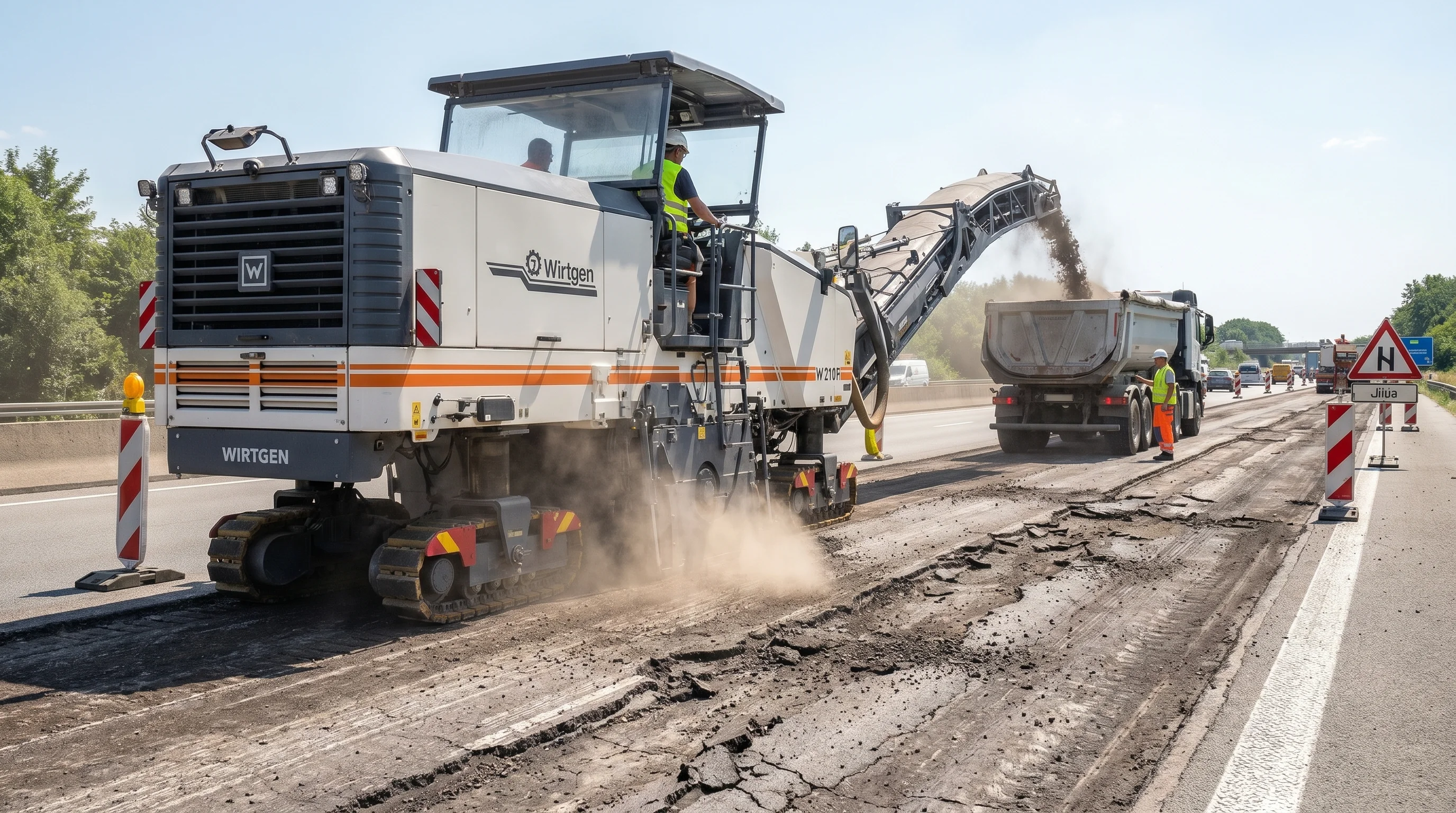
The reclamation process begins with cold milling — a process in which a large, self-propelled machine called a cold planer or milling machine grinds and removes the existing asphalt surface to a precise depth using a rotating drum studded with tungsten carbide cutting teeth. The drum pulverizes the old asphalt into a granular material that drops onto a conveyor belt and loads directly into dump trucks following behind the machine.
Cold milling is highly controlled — operators set the depth precisely using automated grade control systems, removing exactly the worn surface layer (typically 1.5–3 inches) while leaving the structural base intact. The milled surface is then ready to receive a new asphalt overlay, and the reclaimed material — RAP — goes to a processing facility or directly to an asphalt plant for reuse.
In some rehabilitation projects, the entire depth of the pavement is removed rather than just the surface. Full-depth removal generates larger quantities of RAP and is common when the pavement structure has deteriorated to the point where a mill-and-fill approach is not sufficient. Alternatively, full-depth reclamation (FDR) pulverizes the existing pavement in place and reuses it as a stabilized base — eliminating transport costs entirely.
How RAP Is Processed
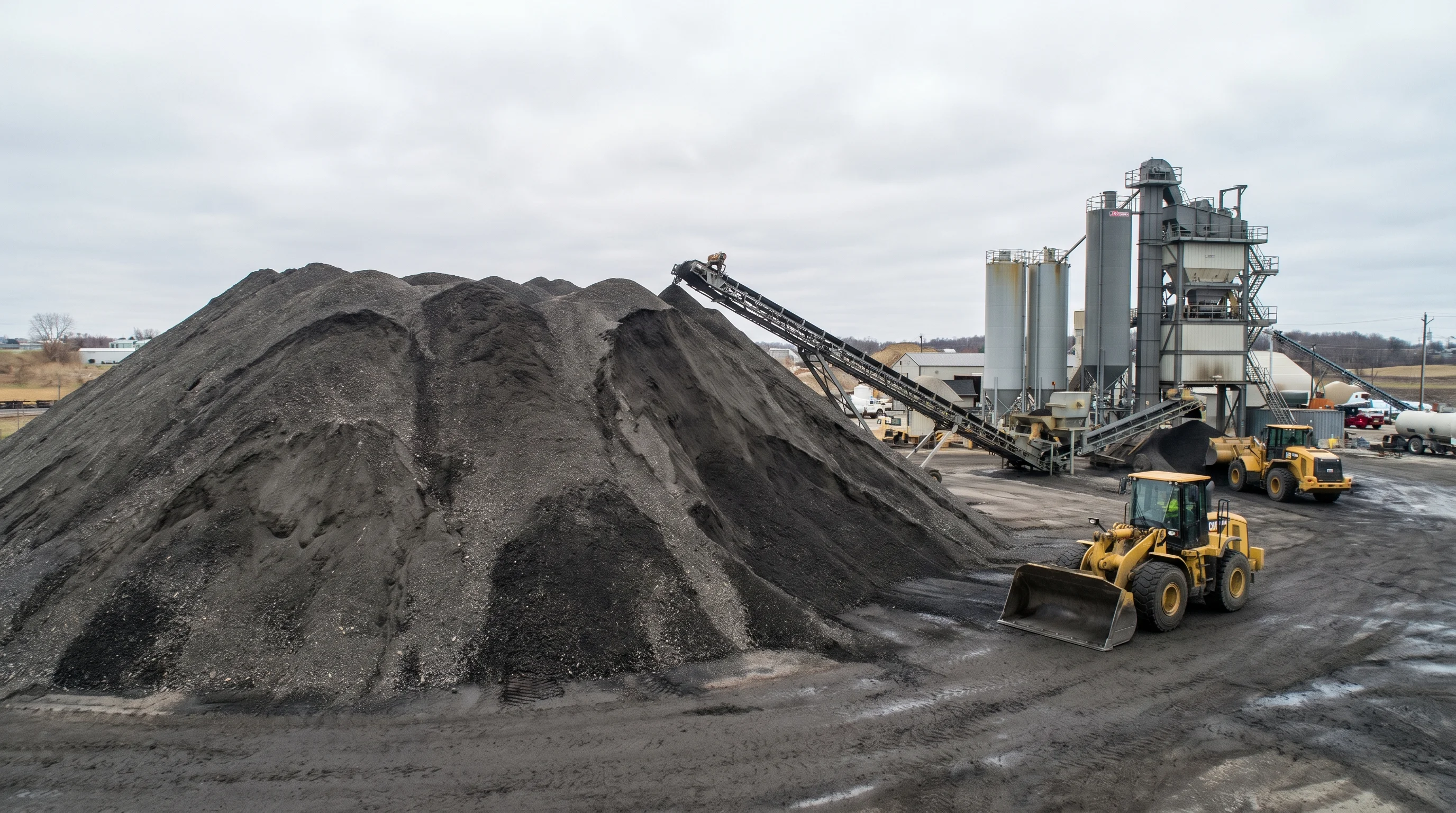
Raw RAP from milling operations varies in particle size — from fine powder to chunks several inches across, depending on milling depth, machine settings, and pavement type. Before RAP can be incorporated into new hot-mix asphalt, it typically goes through a processing sequence:
-
1
Screening and scalping
Oversized chunks and foreign debris (crack repair material, vegetation, utility patches) are removed by passing RAP over vibrating screens. Large pieces that pass through are either returned for further crushing or stockpiled for base course use where gradation is less critical.
-
2
Crushing
Oversized RAP chunks are fed through an impact or jaw crusher to reduce particle size and improve gradation consistency. Crushed RAP is more uniform and blends more predictably into new HMA mixes than raw millings.
-
3
Testing and characterization
Representative samples are tested in a laboratory to determine binder content (typically 4–7%), binder grade and stiffness, aggregate gradation, and moisture content. This data is essential for designing new HMA mixes with RAP — the aged binder in RAP must be accounted for when selecting virgin binder grade.
-
4
Stockpiling
Processed RAP is stockpiled by source and binder content grade. Asphalt plants typically maintain separate stockpiles for RAP from different road types (highway surface, residential streets, parking lots) because binder content and gradation differ significantly between them.
-
5
Incorporation into new HMA
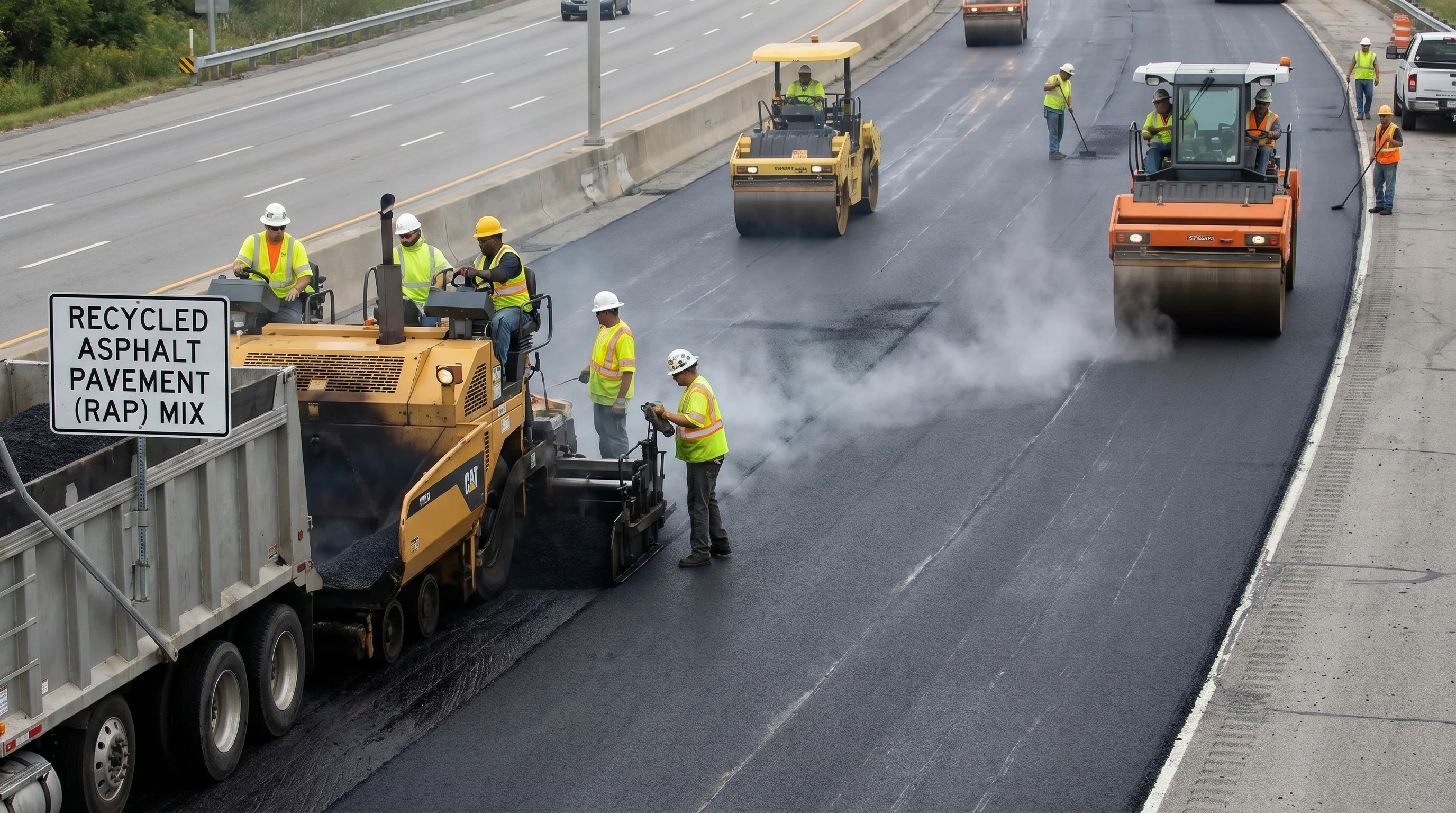
RAP is fed into the asphalt plant's drum mixer or batch plant at a controlled rate — typically 15–50% of the total mix by weight. The plant's burner heats the virgin aggregate to a higher temperature to compensate for the heat absorbed by the cold RAP, ensuring the final mix exits at the correct temperature (275–325°F).
RAP Content in New Hot-Mix Asphalt — Industry Standards
The percentage of RAP that can be incorporated into new HMA depends on the application, state DOT specifications, and whether rejuvenators are used. Higher RAP content requires more careful mix design to compensate for the stiffened aged binder.
| Application Layer | Typical RAP % | Max RAP % (with rejuvenator) | Binder Adjustment Required |
|---|---|---|---|
| Surface course (high-traffic highway) | 15–20% | 30–40% | Softer virgin grade or rejuvenator |
| Surface course (residential road) | 20–30% | 40–50% | Softer virgin grade recommended |
| Intermediate / binder course | 25–35% | 40–50% | Softer grade or rejuvenator |
| Base course (HMA) | 30–50% | 50–60% | Rejuvenator required above 40% |
| Unbound granular base (RAP millings) | 100% | 100% | Not applicable |
Uses of Recycled Asphalt Pavement
RAP is a versatile material used across a wide range of road construction, infrastructure, and private applications. Its uses depend on the level of processing and quality control applied.
1. New Hot-Mix Asphalt Production
The highest-value use of RAP is as a partial replacement for both virgin aggregate and asphalt binder in new HMA. When properly incorporated at the asphalt plant, RAP reduces material costs, conserves non-renewable resources, and produces a mix that performs comparably to 100% virgin HMA. This is the standard use of RAP in road construction worldwide.
2. Granular Base and Sub-Base Course
Crushed RAP compacts similarly to crushed aggregate base and can be used as an unbound granular base or sub-base layer beneath new pavement. Its performance as a base material is well-documented — it drains adequately, resists rutting under compaction, and stabilizes over time as the residual asphalt binder re-binds the material. Some states allow RAP base course without any restriction on percentage, while others limit RAP base to specific layer depths.
3. Unpaved Driveways and Private Roads
RAP millings are widely used as a low-cost surface material for residential driveways, farm lanes, and private roads. Compacted millings create a firm, dark surface that resists dust and erosion better than gravel, binds slightly with heat and traffic over time, and costs 50–75% less than new HMA paving. This is the most accessible RAP application for homeowners and small property owners.
4. Road Shoulders and Low-Volume Roads
Highway agencies frequently use RAP millings to surface or resurface unpaved road shoulders, access roads, and low-volume rural roads. The material provides a stable surface that reduces maintenance compared to native soil or gravel, at a fraction of the cost of HMA paving.
5. Parking Lots and Commercial Areas
Both high-RAP HMA and compacted RAP millings are used in parking lot construction. Millings are particularly common in overflow parking areas, construction staging areas, and low-traffic lots where the lower surface quality of millings vs HMA is acceptable.
6. Full-Depth Reclamation (FDR)
In FDR projects, the entire existing asphalt pavement — surface, base, and sometimes subgrade — is pulverized in place by a reclaimer machine and re-stabilized with a binding agent (cement, lime, foamed asphalt, or emulsified asphalt). The pulverized material is 100% RAP, reused in its original location as a new stabilized base. FDR is one of the most cost-effective pavement rehabilitation techniques for severely deteriorated roads.
RAP Performance vs Virgin HMA
| Property | Virgin HMA (0% RAP) | Standard RAP Mix (20–30%) | High-RAP Mix (40–50%) |
|---|---|---|---|
| Rutting resistance | Good | Equal or better | Better (stiffer mix) |
| Fatigue cracking resistance | Good | Equal (with binder adjustment) | Reduced without rejuvenator |
| Low-temp cracking resistance | Good | Equal (with binder adjustment) | Reduced without rejuvenator |
| Smoothness (IRI) | Excellent | Excellent | Good |
| Mix consistency | High | High (with good QC) | Moderate — more variability |
| Material cost | Baseline | 10–20% lower | 20–35% lower |
The key takeaway from decades of research and field performance data: RAP mixes at 15–30% content perform indistinguishably from virgin HMA when properly designed. The concern with high-RAP mixes is not overall performance but specifically low-temperature and fatigue cracking — both of which are manageable with the right binder grade selection or rejuvenator addition.
Environmental Benefits of Recycled Asphalt Pavement
Asphalt pavement is the most recycled material in the United States — more than glass, paper, aluminum, and plastic combined on a tonnage basis. The environmental case for RAP is compelling across multiple dimensions:
Landfill Diversion
Without recycling, reclaimed asphalt pavement would go to landfill — where it would occupy substantial space and represent a complete waste of the aggregate and binder it contains. By recycling 99% of reclaimed pavement, the US asphalt industry diverts over 100 million tons of material annually from landfills.
Reduced Virgin Aggregate Demand
Stone, sand, and gravel must be quarried from natural deposits — a process that requires land disturbance, energy, and transportation. Every ton of RAP aggregate reused in new HMA is one ton of virgin aggregate that does not need to be quarried. At current RAP usage rates, US quarries avoid extracting tens of millions of tons of virgin aggregate each year due to RAP recycling.
Reduced Asphalt Cement Consumption
Asphalt cement (bitumen) is a petroleum product derived from crude oil refining. The aged binder in RAP, though stiffer than fresh binder, is still functional — when RAP is incorporated into new HMA, the aged binder contributes to the mix's binder content, reducing the volume of new asphalt cement required. At 25% RAP content, roughly 1–1.5% of the new mix's binder can come from the RAP, reducing new asphalt cement demand by 15–25% per ton of mix produced.
Energy Savings
Producing new aggregate and asphalt cement requires significant energy. Reusing RAP avoids much of that energy. Studies have found that incorporating RAP at 20–30% reduces the energy required to produce a ton of new HMA by approximately 10–20%. At the scale of US asphalt production (400+ million tons per year), the cumulative energy savings from RAP recycling are substantial.
| Environmental Metric | RAP Recycling Impact (Annual, US) |
|---|---|
| RAP reused in new construction | ~100 million tons/year |
| Virgin aggregate conserved | ~70–80 million tons/year |
| Asphalt cement conserved | ~3–5 million tons/year |
| Estimated CO₂ reduction vs 100% virgin | ~5–10 million metric tons/year |
| Material cost savings to agencies | ~$2 billion/year |
| Landfill diversion | ~100 million tons/year |
RAP in Road Construction — Standards and DOT Adoption
Every US state DOT has policies governing RAP use in federally funded road projects. Adoption rates vary significantly by state — some are progressive, routinely using 30–50% RAP in surface courses, while others maintain conservative caps of 15–20%.
FHWA and AASHTO Guidance
The Federal Highway Administration (FHWA) and the American Association of State Highway and Transportation Officials (AASHTO) have both published guidance encouraging increased RAP use. AASHTO's Mechanistic-Empirical Pavement Design Guide (MEPDG) provides a framework for designing RAP mixes with predicted performance comparable to virgin HMA. The FHWA's "Reclaimed Asphalt Pavement in Asphalt Mixtures" report provides state-of-the-practice guidance on RAP testing, mix design, and quality control.
Superpave Mix Design with RAP
The Superpave (Superior Performing Asphalt Pavements) mix design system — the current US standard for HMA design — accommodates RAP through a blending chart approach. The engineer determines the aged binder grade of the RAP, the desired final blended binder grade, and back-calculates the required virgin binder grade to achieve the target. At RAP contents above 15%, a softer virgin binder grade is typically specified. Above 25%, a rejuvenating agent is often required to restore the aged binder's low-temperature flexibility.
State DOT RAP Policies (Selected Examples)
| State | Surface Course RAP Max | Base Course RAP Max | Rejuvenator Policy |
|---|---|---|---|
| California (Caltrans) | 15–25% | 40% | Allowed with approval |
| Texas (TxDOT) | 20–30% | 40% | Required above 20% |
| Minnesota (MnDOT) | 30–40% | 50% | Required above 25% |
| Virginia (VDOT) | 20–30% | 40% | Allowed with mix design approval |
| Florida (FDOT) | 20% | 35% | Case-by-case approval |
| Wisconsin (WisDOT) | 40% | 50% | Required above 30% |
RAP for Driveways and Private Use — Sourcing and Pricing
For homeowners and property owners, RAP is most relevant as an affordable driveway and base course material. Compacted RAP millings provide a firm, dark surface at a fraction of the cost of new HMA paving — making them one of the most cost-effective options for long driveways, farm lanes, and private roads.
Where to Source RAP Millings
- Local asphalt plants — most HMA producers stockpile millings from road projects they perform; call and ask about availability and pricing
- Aggregate quarries and suppliers — many accept RAP and sell it alongside crushed stone and gravel
- Asphalt recycling facilities — dedicated facilities that process and stockpile RAP year-round
- Municipal road departments — some agencies sell or give away millings from local road resurfacing; check with your county or township
- Local paving contractors — often have surplus millings from recent milling jobs; may sell cheaply or deliver as part of a deal
Cost Comparison for Driveway Applications
| Material | Material Cost (per ton) | Delivery (avg.) | Total for 600 sq ft / 3" | Lifespan |
|---|---|---|---|---|
| RAP millings (unbound) | $10–$20 | $50–$150 | $200–$400 | 10–20 years |
| Virgin crushed aggregate base | $15–$25 | $50–$150 | $300–$600 | N/A (base only) |
| New hot-mix asphalt (contractor installed) | Included in price | Included | $1,800–$4,200 | 20–30 years |
| Concrete driveway | Included in price | Included | $3,600–$7,200 | 30–50 years |
Limitations and Quality Concerns
RAP is not a one-size-fits-all solution. Several limitations apply depending on the application and the source of the material:
Binder Variability
RAP from different sources — different roads, different eras of construction, different original binder grades — has different aged binder content and stiffness. Mixing RAP stockpiles of unknown origin without testing creates variability in new HMA mixes that can lead to inconsistent performance. Well-managed RAP programs test each stockpile separately and blend with precision.
Aged Binder Stiffness
The biggest technical concern with RAP is that the asphalt binder has been aged (oxidized) by years of UV exposure and thermal cycling. Aged binder is stiffer than virgin binder — it resists rutting well but becomes brittle at low temperatures and is more susceptible to fatigue cracking. Without compensating with a softer virgin binder or rejuvenator, high-RAP mixes can exhibit excessive cracking in cold climates or under heavy traffic.
Contamination Risk
Old roads built before the 1970s may contain coal tar-based sealers or tar-modified pavements. Coal tar contains polycyclic aromatic hydrocarbons (PAHs) — carcinogenic compounds that complicate RAP reuse and may require special handling. RAP from older urban roads should be tested for PAH content before use. Contamination from spills, buried utilities, or non-pavement materials in the millings stream is another concern for unprocessed RAP.
Moisture Sensitivity
RAP stockpiles can absorb moisture — particularly if stored uncovered for extended periods. High moisture content in RAP increases the energy required to heat the mix at the plant and can cause mix temperature to drop below acceptable levels. Plants typically limit RAP moisture content to 3–5% and cover stockpiles during wet seasons.
- Ask the supplier where the RAP came from — highway or arterial road millings tend to be cleaner and more consistent than urban street millings
- Look at the material — it should be consistently dark gray to black; excessive variation in color suggests mixed sources or contamination
- Check particle size — a mix of fine powder and chunky pieces is normal; very large chunks indicate insufficient crushing
- Feel for stickiness on a warm day — slightly tacky RAP compacts well; dry, powdery RAP with no residual binder won't bind and will behave like gravel
- Ask if the RAP has been screened — screened material has had oversized chunks and debris removed, making it more uniform and easier to compact
- Avoid RAP that smells strongly of coal tar or has a very dark, glossy appearance inconsistent with normal asphalt — it may contain tar-based sealant
Frequently Asked Questions
What is recycled asphalt pavement?
Recycled asphalt pavement (RAP) is old asphalt removed from roads, parking lots, or driveways through milling or full-depth removal, then processed and reused in new asphalt mixes or as granular base material. It contains both the original mineral aggregates and aged asphalt binder — both valuable and reusable. Asphalt is the most recycled material in the US by volume, with 99% of reclaimed pavement recycled back into use.
How much RAP can be used in new asphalt?
Standard practice is 15–30% RAP in surface course HMA without significant binder adjustment. Higher RAP content (30–50%) requires a softer virgin binder grade or a rejuvenating additive to offset the stiffness of the aged RAP binder. Base courses can accept 40–60% RAP in many state DOT specifications. High-RAP mixes with rejuvenators can match virgin HMA performance across most metrics.
Is recycled asphalt pavement as good as new asphalt?
At 15–30% content with proper mix design, yes — RAP mixes perform comparably to virgin HMA in rutting resistance, smoothness, and lifespan. At higher RAP content without rejuvenators, cracking resistance can be reduced. Properly designed high-RAP mixes with rejuvenators match virgin HMA performance. The critical factor is mix design — RAP used without binder adjustment can be too stiff and crack prematurely in cold climates.
What is recycled asphalt pavement used for?
RAP is used in new hot-mix asphalt production (15–50% content), as unbound granular base course under new pavement, as surface material for unpaved driveways and private roads, on highway shoulders, in parking lots, and in full-depth reclamation (FDR) projects where existing pavement is pulverized and reused in place as stabilized base.
How much does recycled asphalt pavement cost?
RAP millings for driveways and base course use cost $10–$20 per ton, vs $15–$25/ton for virgin crushed aggregate and $80–$120/ton for new HMA. For a standard 600 sq ft driveway at 3-inch depth, expect $200–$400 delivered for RAP millings vs $1,800–$4,200 for contractor-installed HMA paving.
Where can I buy recycled asphalt pavement?
Sources include local asphalt plants, aggregate quarries, asphalt recycling facilities, municipal road departments (some sell or give away millings), and local paving contractors with surplus material. Search for "asphalt millings near me" or call local paving contractors. Availability is highest in spring through fall when most road milling occurs.
Is recycled asphalt pavement environmentally friendly?
Yes — asphalt is the most recycled material in the US by volume. Recycling 99% of reclaimed pavement annually diverts over 100 million tons from landfills, conserves tens of millions of tons of virgin aggregate, reduces asphalt cement demand, and cuts HMA production energy by 10–20%. RAP is a genuinely circular material — roads paved today become the source material for roads built in 30 years.
What are the limitations of using recycled asphalt pavement?
Key limitations include: binder variability between RAP stockpiles requiring testing before engineered use; aged binder stiffness increasing cracking risk at high RAP content without rejuvenator; contamination risk from coal tar in old pavements; moisture sensitivity in stockpiles; and reduced performance in cold climates at high RAP content without binder adjustment. For private driveway use, the main limitation is surface quality — compacted millings are good but won't match the finish of contractor-installed HMA.