
Tarmac vs Asphalt — What's the Difference? Complete Guide (2026)
Are Tarmac and Asphalt the Same Thing?
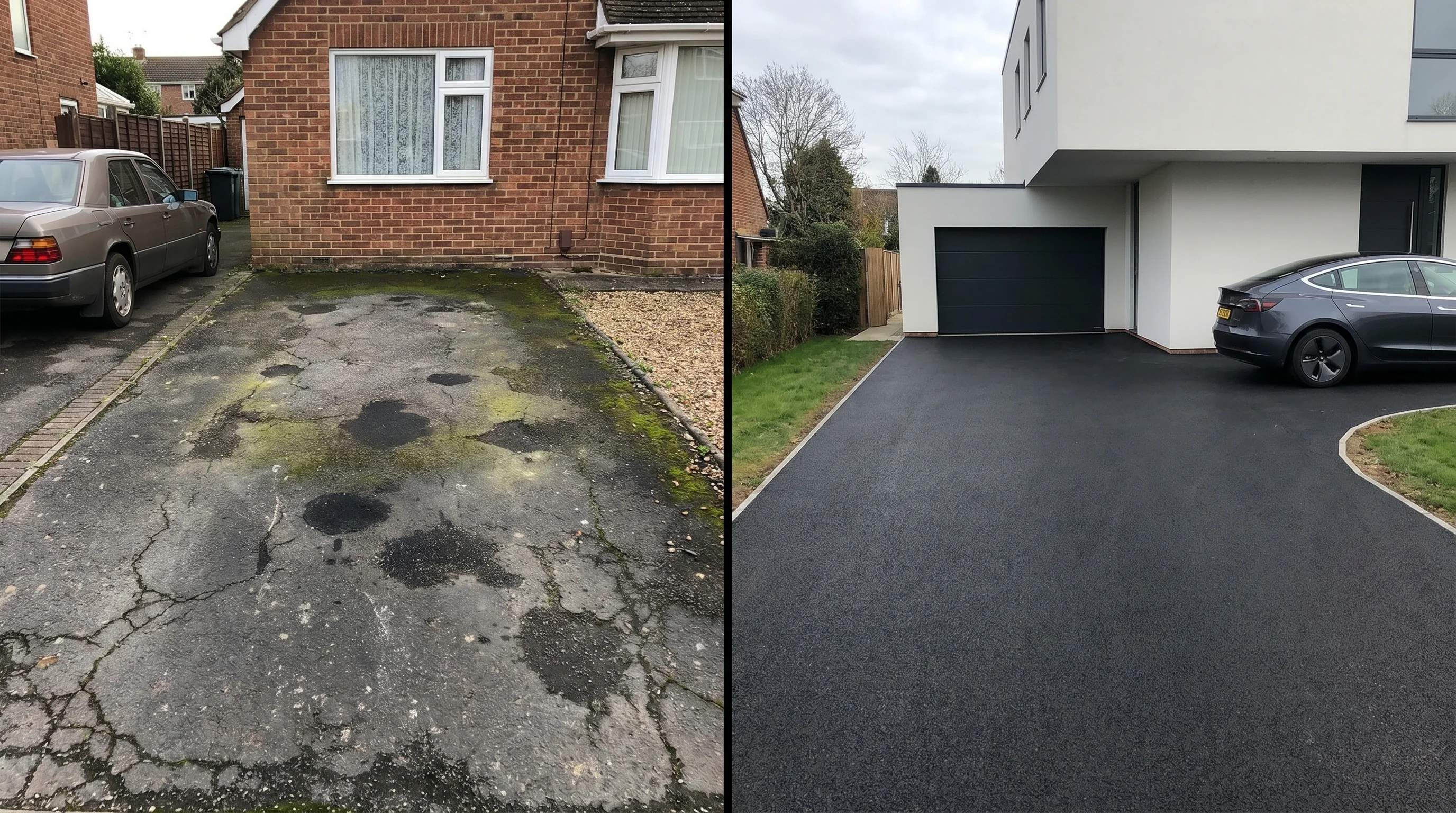
Almost — but not technically. True tarmac (tarmacadam) is a specific material patented in 1901 that uses coal tar as its binder. Modern asphalt uses bitumen — a petroleum by-product — as its binder instead.
In practice, true coal tar tarmac has not been produced since the 1980s–90s due to health concerns. What UK and Irish contractors call "tarmac" today is almost always modern bitumen-based asphalt (dense bitumen macadam / DBM). In the US, the same surface is called asphalt or blacktop — the word tarmac is almost never used for driveways or roads.
Bottom line: For a modern driveway, tarmac and asphalt are the same product — the terminology differs by country and history, not by material.
The History of Tarmac — Where the Word Came From
To understand why "tarmac" and "asphalt" are used interchangeably today, you need to understand how both materials emerged — in different countries, at different times, with different binders — and eventually converged into a single modern product that inherited both names.
John Loudon McAdam and Macadam Roads (1820s)
The story begins with Scottish civil engineer John Loudon McAdam, who in the early 19th century revolutionized road construction with a method that bore his name: macadam. McAdam's insight was that roads did not need a large stone foundation — they only needed a carefully designed layer of small, uniformly graded crushed stone, compacted in layers, with the road surface itself raised above the surrounding ground to improve drainage.
McAdam roads were a dramatic improvement over the deep-rutted, muddy roads of the era. They were smooth, well-draining, and relatively cheap to build and maintain. His method spread rapidly across Britain, Europe, and North America throughout the 1800s. But macadam roads had one persistent problem: dust. The crushed stone surface, dry in summer traffic, generated clouds of dust that coated everything for miles — houses, crops, lungs.
Edgar Hooley and Tarmacadam (1901)
The dust problem was solved — accidentally — by a British surveyor named Edgar Purnell Hooley. In 1901, Hooley was walking near Denby, Derbyshire when he noticed an unusually smooth and dust-free section of road. A barrel of tar had accidentally spilled onto the road surface and someone had covered it with slag (crushed industrial waste) to absorb the mess. The combination had produced a remarkably firm, bound, dust-free surface.
Hooley recognized the potential immediately. He patented the process of mixing tar with macadam aggregate to create a bound surface — and called it tarmacadam, quickly shortened to tarmac. His company, Tar Macadam (Purnell Hooley's Patent) Syndicate Ltd, began commercial production in 1903. By 1905, the material was being laid on public roads across Britain, and it found early enthusiastic adoption at Nottingham racecourse and later at Britain's emerging airports.
The Rise of Bitumen-Based Asphalt (1900s–1950s)
In parallel, the United States and continental Europe were developing a different approach to bound road surfaces — using bitumen, a natural petroleum derivative, rather than coal tar as the binder. Bitumen-based asphalt had been used in limited applications since the 1870s (the first bituminous concrete road in the US was laid in Newark, New Jersey in 1870), but it became the dominant road surface material in America as the automobile age created an urgent demand for paved roads in the early 20th century.
Bitumen had significant advantages over coal tar: it was more readily available as a by-product of the growing oil refining industry, less toxic, and produced a pavement that was easier to work with at moderate temperatures. By mid-century, hot-mix asphalt (HMA) using petroleum bitumen had become the global standard for road paving — while true coal tar tarmac remained primarily a British product.
-
1820s
McAdam introduces macadam road construction
Graded crushed stone compacted in layers — no binder, revolutionary drainage design.
-
1870
First bituminous concrete road in the US
Newark, New Jersey — bitumen binder with aggregate, the precursor to modern HMA.
-
1901
Edgar Hooley patents tarmacadam
Coal tar + macadam aggregate — the original tarmac, named and patented in the UK.
-
1903
Commercial tarmac production begins
Tar Macadam Syndicate Ltd begins laying tarmac on British roads and racecourses.
-
1920s–50s
Hot-mix asphalt dominates in the US
Petroleum bitumen-based HMA becomes the American standard as automobile demand drives mass road construction.
-
1980s–90s
Coal tar tarmac phased out
Coal tar identified as a carcinogen (PAH content) — production ceases. UK "tarmac" contractors transition to bitumen-based macadam.
-
Today
"Tarmac" = modern bitumen asphalt in the UK
The word persists in UK/Irish usage as a generic term for what is actually dense bitumen macadam — the same material as US asphalt.
What True Tarmac Is Made Of
Original tarmacadam as patented by Hooley consisted of two components: macadam aggregate and coal tar binder.
Macadam aggregate was crushed stone graded to a specific size range — typically 3/8 to 3/4 inch — compacted in layers. McAdam's original road-building method did not use any binder at all; the aggregate was simply compacted and relied on stone-to-stone interlock and traffic consolidation for stability. Tarmac added tar as a binder to stabilize and waterproof the surface.
Coal tar is a thick, black, viscous liquid produced as a by-product of heating coal to produce coal gas or coke. It contains hundreds of chemical compounds, including polycyclic aromatic hydrocarbons (PAHs) — many of which are carcinogenic. Coal tar was abundant and cheap in industrial Britain, where coal gas production was widespread. Its adhesive properties made it an effective road binder, and it gave tarmac surfaces excellent resistance to fuel spills (coal tar is not dissolved by petroleum products, unlike bitumen).
The blending ratio was roughly 3–5% tar by weight of aggregate. The mixture was produced at elevated temperatures — typically 200–250°F — and laid while hot, then compacted with rollers. The production and laying process was similar in concept to modern HMA, though the specific materials, temperatures, and mix designs were different.
What Modern Asphalt Is Made Of
Modern hot-mix asphalt (HMA) — what UK contractors call "tarmac" today — uses bitumen rather than coal tar as its binder. The distinction matters both technically and from a health and safety perspective.
Bitumen (called asphalt cement in the US) is the heaviest fraction of crude oil, remaining after lighter products — gasoline, kerosene, diesel, lubricating oils — are distilled off. It is a thick, black, thermoplastic material: solid or semi-solid at room temperature, viscous liquid when heated. Bitumen is the binder that holds the aggregate particles together in asphalt pavement and gives the surface its flexibility and waterproofing properties.
Modern HMA consists of approximately 93–97% mineral aggregate (a specific blend of coarse stone, fine aggregate, and filler) and 3–7% bitumen binder by weight. The exact proportions are determined by a mix design process that optimizes the blend for the specific application — surface course, binder course, base course — and the expected traffic and climate conditions.
In the UK, the dominant road surface material is dense bitumen macadam (DBM) or hot rolled asphalt (HRA) — both bitumen-bound macadam products that are the direct descendants of tarmac in function, if not in binder chemistry. Both are what UK contractors mean when they say "tarmac driveway."
Tarmac vs Asphalt — 8 Properties Compared
| Property | True Tarmac (Historical) | Modern Asphalt (HMA / DBM) |
|---|---|---|
| Binder | Coal tar (from coal distillation) | Bitumen (from petroleum refining) |
| Aggregate | Macadam crushed stone | Graded crushed stone, sand, filler |
| Flexibility | Moderate — less flexible than HMA | High — thermoplastic, handles freeze-thaw |
| Fuel resistance | Excellent — coal tar resists petroleum | Moderate — bitumen softens under fuel spills |
| Heat resistance | Good | Good (polymer-modified grades: excellent) |
| Health / toxicity | High — coal tar contains carcinogenic PAHs | Low — bitumen is not classified as carcinogenic |
| Availability | No longer produced | Global standard — available everywhere |
| Cost (driveway) | N/A (discontinued) | £40–£80/m² (UK) / $3–$7/sq ft (US) |
Why "Tarmac" Stuck — UK Usage, Airports, and Cultural Embedding
The word "tarmac" is one of the most successful examples of a brand name becoming a generic term — similar to hoover (vacuum cleaner), biro (ballpoint pen), or google (internet search). Once Hooley's material became the dominant road surface in Britain in the early 20th century, the word became the default term for any dark-paved surface, regardless of the actual material.
Aviation and the "Tarmac" at Airports
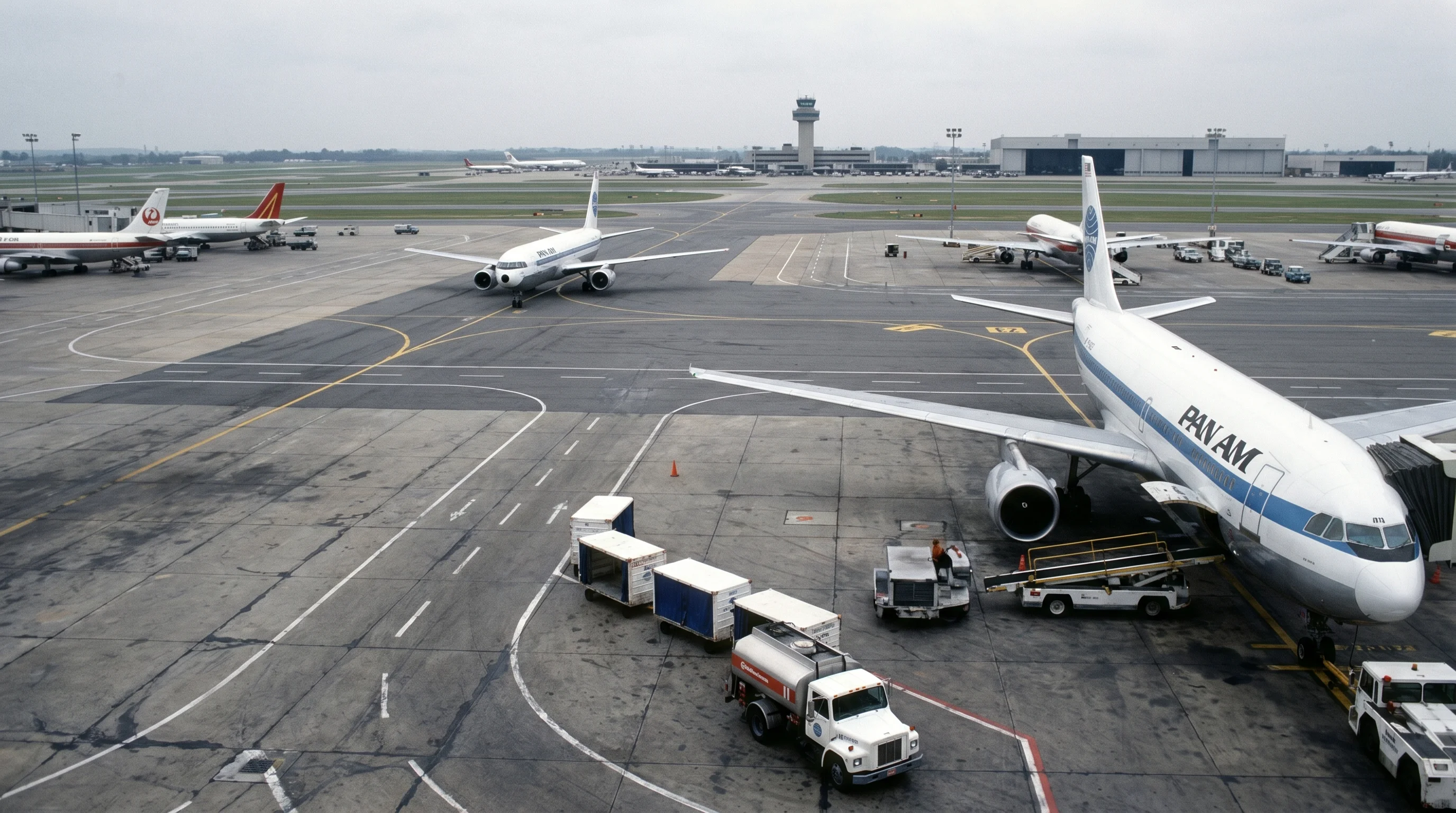
Britain's early airfields — Croydon, Heathrow, and dozens of RAF wartime bases — were surfaced with tarmac in the 1920s and 1930s, when it was the premium paved surface available. Aircraft engineers, ground crews, and passengers all walked and worked "on the tarmac." The word became embedded in aviation vocabulary worldwide — passengers "boarded on the tarmac," aircraft were "on the tarmac," and ground operations were "tarmac operations."
Even as airport surfaces transitioned to modern bituminous asphalt and concrete through the mid-20th century, the word remained. Today, "the tarmac" in aviation means the paved apron or taxiway area — regardless of whether the surface is asphalt, concrete, or any other material. A flight delayed "on the tarmac" is sitting on what is almost certainly modern HMA or concrete, not historical coal tar tarmac.
UK and Irish Construction Industry
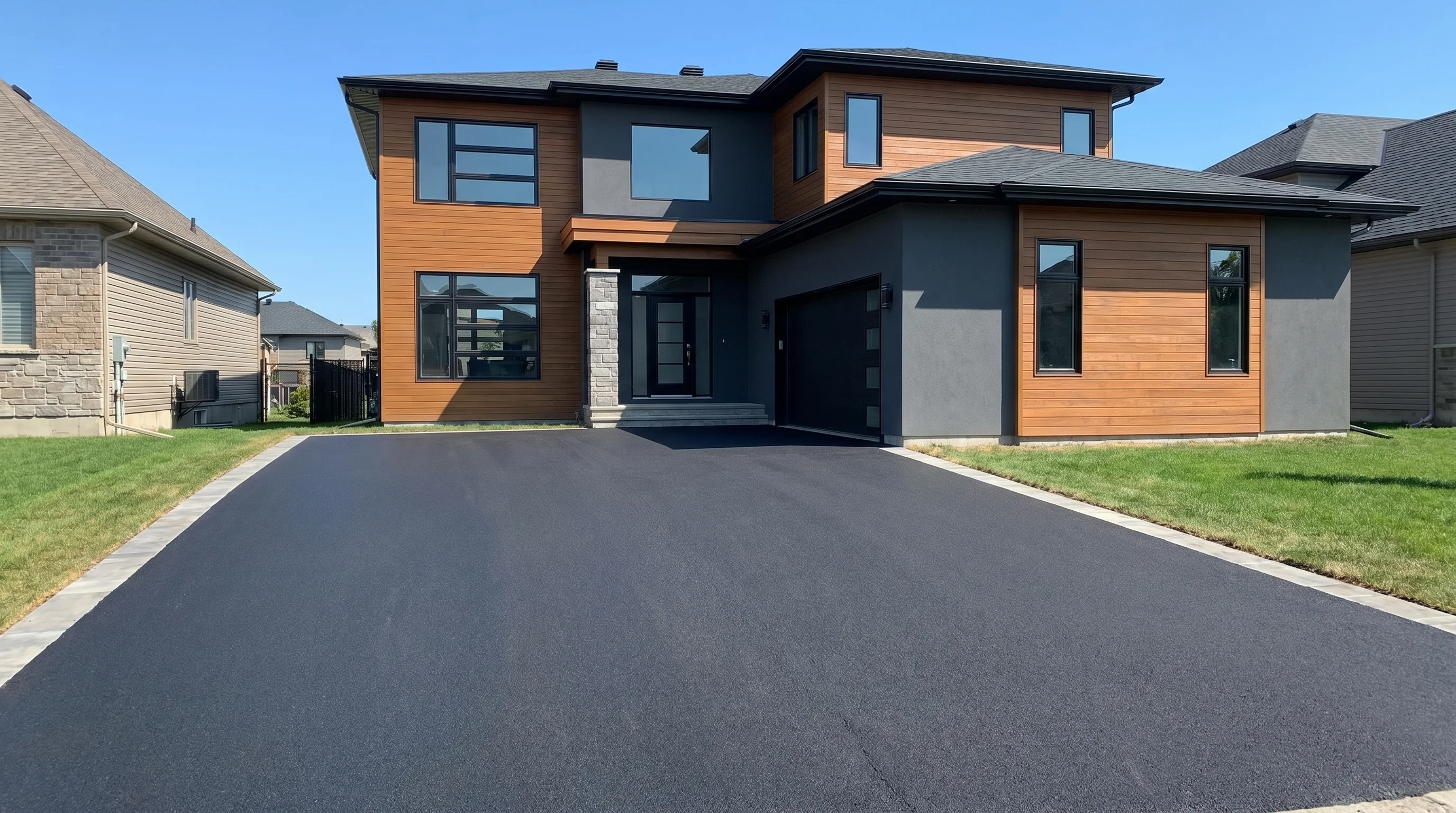
In the UK and Ireland, "tarmac" remains the dominant consumer-facing term for black paved surfaces. Homeowners search for "tarmac driveway" rather than "asphalt driveway." Contractors market their services as "tarmac laying" even though the material they install is dense bitumen macadam or hot rolled asphalt. The company name Tarmac Group (now Tarmac — a division of CRH plc) is one of the UK's largest construction materials businesses, further cementing the word's association with paved surfaces.
In professional and engineering contexts in the UK, the correct term is bituminous macadam (bitmac), dense bitumen macadam (DBM), stone mastic asphalt (SMA), or hot rolled asphalt (HRA) — depending on the specific product. "Tarmac" is essentially a consumer term, similar to how Americans use "blacktop" informally while engineers say "HMA" or "asphalt concrete."
Tarmac vs Asphalt in the UK — What Contractors Actually Lay
When a UK homeowner gets a quote for a "tarmac driveway," here is what they are actually receiving:
- Base course: Dense Bitumen Macadam (DBM) — a coarser, structural layer, typically 60–100mm thick, providing the load-bearing base
- Surface course: Close-Graded Asphalt (CGA) or Hot Rolled Asphalt (HRA) — a finer, smoother wearing layer, typically 20–40mm thick, providing the finished surface
- Binder: Penetration grade bitumen — 40/60, 70/100, or 160/220 depending on climate and traffic
- Sub-base: Typically Type 1 MOT crushed aggregate, 100–150mm compacted depth
This is structurally and compositionally identical to a North American asphalt driveway — the product names, specification codes, and binder grade designations differ between countries, but the underlying technology is the same petroleum bitumen + mineral aggregate pavement system.
Tarmac Driveway vs Asphalt Driveway — Practical Comparison for Homeowners
| Factor | UK "Tarmac" Driveway | US Asphalt Driveway |
|---|---|---|
| Material | Dense Bitumen Macadam (DBM) / Hot Rolled Asphalt | Hot-Mix Asphalt (HMA) / Superpave |
| Binder | Petroleum bitumen | Petroleum asphalt cement (bitumen) |
| Install cost | £40–£80/m² (~$50–$100/m²) | $3–$7/sq ft ($32–$75/m²) |
| Lifespan | 20–30 years | 20–30 years |
| Maintenance | Resealing every 3–5 years recommended | Sealcoating every 3–5 years recommended |
| Appearance | Dark gray-black, smooth to textured | Dark gray-black, smooth to textured |
| Flexibility | High — handles UK freeze-thaw | High — handles US freeze-thaw |
| Repairability | Easy — patch, mill, overlay | Easy — patch, mill, overlay |
The practical takeaway: a well-installed tarmac driveway in Birmingham performs exactly like a well-installed asphalt driveway in Boston. Both use petroleum bitumen as the binder, both use graded mineral aggregate, and both are flexible, durable surfaces that last 20–30 years with proper maintenance. The difference is in terminology, not performance.
Paving Terms People Confuse — Complete Glossary
The asphalt and paving industry has accumulated a confusing array of overlapping terms — many of which mean the same thing in different countries or different contexts. Here is a definitive glossary:
| Term | What It Actually Means | Where Used |
|---|---|---|
| Tarmac | Historically: coal tar + macadam. Today: generic UK/Irish term for bituminous asphalt | UK, Ireland, aviation worldwide |
| Asphalt | Mixture of bitumen binder + mineral aggregate. Also used to mean the binder itself (asphalt cement) | US, international engineering |
| Blacktop | Informal US term for asphalt pavement — identical material to HMA | US (consumer / informal) |
| Bitumen | The petroleum-derived binder in modern asphalt. Called "asphalt cement" in the US | UK, Europe, engineering worldwide |
| Macadam | McAdam's unbound compacted stone road system. Also used for bitumen-bound macadam (bitmac) in UK | Historical + UK engineering |
| Tarmacadam | The original 1901 Hooley patent: coal tar + macadam. No longer produced | Historical UK |
| HMA / Hot-Mix Asphalt | Modern asphalt produced by heating aggregate and bitumen at an asphalt plant, then laying while hot | US engineering standard |
| DBM / Dense Bitumen Macadam | UK equivalent of HMA — the standard road and driveway surface material in Britain | UK engineering standard |
| Hot Rolled Asphalt (HRA) | A specific UK asphalt recipe with high sand/filler content — typically used for surface courses on major roads | UK roads / BS 594987 |
| SMA / Stone Mastic Asphalt | High-stone-content asphalt with gap grading — excellent durability on high-traffic surfaces | Europe, increasingly US |
| Tar | Coal tar — the binder in historical tarmac. Not the same as bitumen. No longer used in road construction | Historical / informal |
| Pitch | A solid or semi-solid form of coal tar or bitumen. "Pitch black" — named after the appearance of coal tar pitch | Industrial / historical |
| Asphalt concrete | Another name for HMA — emphasizing that it is a composite material like concrete but with bitumen binder | Engineering / formal |
Why Coal Tar Tarmac Is No Longer Used
Climate Performance — Tarmac / Asphalt in Cold and Hot Climates
Cold and Freeze-Thaw Climates
Modern bituminous asphalt (UK "tarmac") performs well in cold climates because the bitumen binder remains flexible at low temperatures — it can accommodate slight movement as the ground freezes and thaws without cracking catastrophically. The key variable is binder grade: softer bitumen grades (higher penetration values in UK grading; softer PG grades in US Superpave) are specified for cold climates to maintain flexibility at low temperatures. A driveway installed with the correct binder grade for the local climate will outperform one installed with the wrong grade regardless of what country it's in.
In the UK, where freeze-thaw is common but rarely extreme, standard DBM with 70/100 or 160/220 pen grade bitumen handles winter conditions well. In northern US states with severe winters, Superpave PG 58-34 or PG 52-34 binder grades are specified to maintain flexibility at -34°C to -40°C.
Hot Climates
In hot climates, the challenge is the opposite: asphalt can soften under sustained high surface temperatures, leading to rutting under heavy loads. This is managed by specifying a stiffer binder grade — harder pen grades in UK specifications, higher high-temperature PG grades in the US. Polymer-modified bitumen (PMB) adds polymers to the bitumen binder to improve both high-temperature rutting resistance and low-temperature cracking resistance — a technology used on motorways and busy commercial driveways worldwide.
What to Ask a Contractor When Getting a Quote
- What material will you be using — what is the product specification or grade? (UK: DBM spec; US: mix design type)
- What depth is the surface course, and what depth is the base course?
- What sub-base material and depth will be used under the asphalt?
- Will you remove and dispose of the existing surface, or overlay it?
- What is the compaction method — what equipment will you use?
- Do you guarantee against cracking or settlement for a specific period?
- Is the quote including VAT (UK) / tax (US)?
- Are you registered / licensed and insured? Can I see proof?
A contractor who hesitates or cannot answer these questions clearly is a red flag — regardless of whether they call the product tarmac or asphalt. The quality of the installation depends far more on base preparation, material depth, and compaction than on the specific product name.
Frequently Asked Questions
Is tarmac the same as asphalt?
Not technically — true tarmac uses coal tar as its binder while asphalt uses petroleum bitumen. But in practice, true coal tar tarmac has not been produced since the 1980s–90s. What UK contractors call "tarmac" today is modern bitumen-based asphalt (dense bitumen macadam). For any driveway or road built today, tarmac and asphalt are the same product under different names — the terminology is regional and historical, not a material difference.
Why do airports call it the tarmac?
Britain's early airports were surfaced with coal tar tarmac in the 1920s–30s when it was the premium paved surface. The word became embedded in aviation vocabulary as the generic term for airport ground areas. Even as surfaces transitioned to modern asphalt and concrete, the word remained. "On the tarmac" in aviation today means on the paved airport apron or taxiway — regardless of the actual surface material.
What is the difference between tarmac and asphalt for a driveway?
For a modern driveway there is no meaningful difference — a UK "tarmac driveway" and a US "asphalt driveway" are both bitumen-bound macadam surfaces with identical performance characteristics. Both last 20–30 years, both require periodic resealing, and both are flexible, durable surfaces. The difference is in terminology, not material.
What is tarmac made of?
True historical tarmac: coal tar binder + macadam crushed stone aggregate. Modern UK "tarmac": petroleum bitumen binder + graded mineral aggregate — identical in concept to US hot-mix asphalt. Coal tar has not been used in road construction since the 1980s–90s due to its carcinogenic PAH content.
Which is better — tarmac or asphalt for a driveway?
Since modern tarmac is asphalt, there is no performance difference. Quality depends on the installer's workmanship, base preparation depth, surface course thickness, and whether the correct binder grade was specified for the local climate — not on whether the product is marketed as tarmac or asphalt.
What is bitumen?
Bitumen is the petroleum-derived binder used in modern asphalt pavement — the heaviest fraction remaining after crude oil refining. It is thermoplastic (softens with heat, hardens when cool), which makes hot-mix asphalt workable during placement and durable once compacted. Called "asphalt cement" in the US; "bitumen" in the UK and most of the world.
What is macadam?
Macadam is the 19th-century road construction method developed by John Loudon McAdam — compacted layers of uniformly graded crushed stone without a binder. Tarmacadam added coal tar as a binder to McAdam's aggregate system. In modern UK usage, "macadam" typically refers to the aggregate component of bituminous macadam paving products like DBM.
Is tarmac cheaper than asphalt?
Where both terms refer to the same material (UK, Ireland), there is no price difference. UK tarmac driveways cost £40–£80/m² installed; US asphalt driveways cost $3–$7/sq ft ($32–$75/m²) — comparable once currency and labor market differences are accounted for. Price variation reflects contractor rates, regional material costs, and project scope — not any difference between tarmac and asphalt as products.