
Best Asphalt Sealer for Driveways — Top Products & Brands Compared (2026)
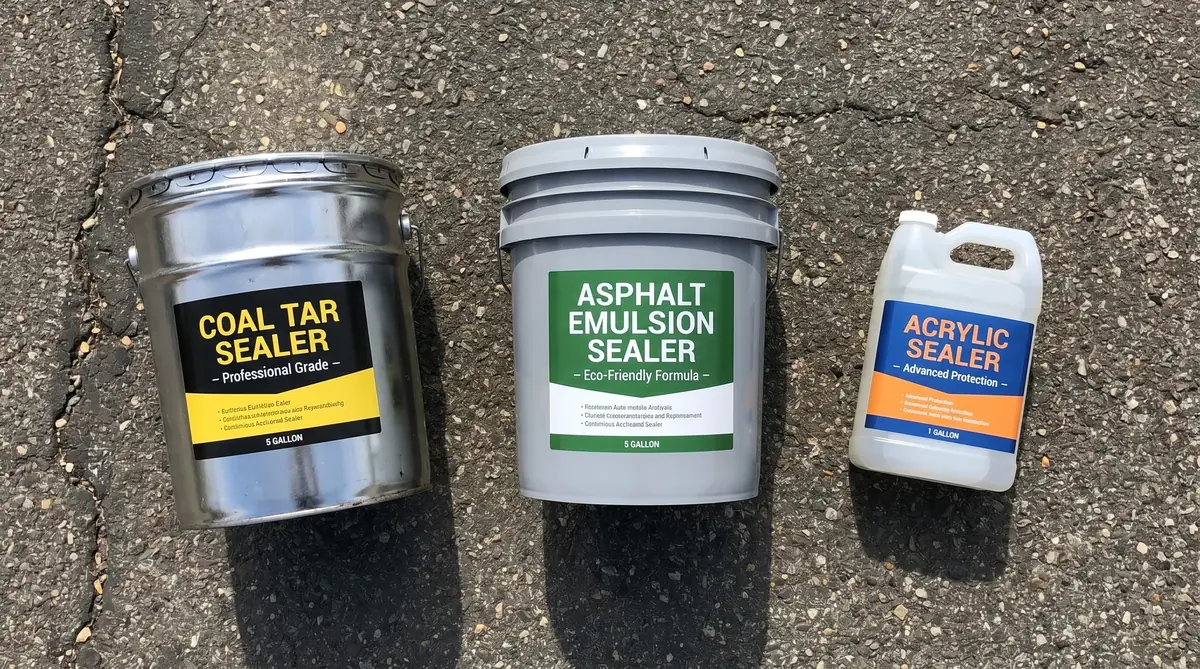
Walk into any home improvement store and the sealer aisle looks straightforward — until you realize there are three completely different chemistries on the shelf, each with different performance, coverage, price, and even legality depending on your state. Picking the wrong asphalt sealer for driveways means either spending too much, getting inferior protection, or buying a product you can't legally use.
This guide cuts through the confusion. We compare every major type of asphalt driveway sealer — coal tar, asphalt emulsion, and acrylic — across the metrics that actually matter: durability, coverage rate, cost per square foot, ease of application, and where each one makes sense. Then we break down the top brands in each category so you can make a confident buying decision.
In this guide
Asphalt Sealer for Driveways: Types Head-to-Head
Before diving into brands, here's a direct comparison of the three main sealer chemistries available for residential driveways in 2026:
| Feature | Coal Tar Emulsion | Asphalt Emulsion | Acrylic |
|---|---|---|---|
| Durability | 3–5 years/coat | 2–3 years/coat | 3–5 years/coat |
| Price (5-gal) | $30–$50 | $20–$35 | $45–$80 |
| Cost/sq ft (2 coats) | $0.08–$0.14 | $0.06–$0.12 | $0.12–$0.20 |
| Coverage/gallon | 50–70 sq ft | 60–80 sq ft | 70–100 sq ft |
| UV resistance | Excellent | Good | Excellent |
| Oil resistance | Excellent | Moderate | Good |
| Finish appearance | Very dark, glossy | Dark, matte | Medium dark, semi-gloss |
| Environmental concern | High (PAHs) | Low | Low |
| Legal everywhere? | No — banned in several states | Yes | Yes |
| Best for | High-traffic, oil-prone driveways | Most residential driveways | New driveways, mild climates |
Coal Tar Sealers for Driveways
Coal tar emulsion is a byproduct of steel production — a thick, black material with outstanding resistance to water, UV rays, gasoline, and oil. It's the original driveway sealer and still the longest-lasting option per coat. A quality coal tar application holds up for 3–5 years in high-traffic conditions where an emulsion coat might last 2–3.
The downside is environmental: coal tar contains polycyclic aromatic hydrocarbons (PAHs), known carcinogens that can wash off into stormwater. It's banned or restricted in Washington state, Minnesota, the District of Columbia, and a growing number of cities and counties nationwide. Always check your local regulations before buying.
SealMaster Coal Tar Pavement Sealer
The contractor-grade standard. SealMaster is what most professional sealcoating companies use — high solids content (35–40%), excellent oil and fuel resistance, and a deep black finish that darkens oxidized pavement dramatically. Available at paving supply houses and some big-box stores. Sold in 5-gallon pails and 55-gallon drums.
Neyra Industries Coal Tar Sealer
A strong alternative to SealMaster, popular in the Midwest and Southeast. Similar solids content and durability, slightly better availability at independent paving supply stores. Good for homeowners who want professional results without having to open a contractor account.
Asphalt Emulsion Sealers for Driveways
Asphalt emulsion sealer is made from the same base material as your driveway — asphalt — suspended in water with emulsifying agents. It's legal in all 50 states, environmentally safer than coal tar, and bonds well with existing asphalt because they share the same chemistry. Performance is slightly below coal tar in oil resistance and raw durability, but the gap is smaller than marketing materials from coal tar companies suggest.
For most residential driveways with normal passenger vehicle traffic, asphalt emulsion delivers excellent protection at the lowest cost. It's the right choice if coal tar is restricted in your area, or if you simply prefer the more eco-friendly option.
Latex-ite Airport Grade Driveway Sealer
The most popular DIY asphalt sealer in the US by volume. Widely available at Home Depot, Latex-ite Airport Grade is an asphalt emulsion with a higher-than-average solids content for the price point (~30%). It applies easily with a squeegee or brush, dries in 4–6 hours, and delivers a clean matte black finish. The "Airport Grade" labeling is marketing — it's not actually used at airports — but the product itself is solid for residential use.
Gardner Seal-Krete Heavy Duty Driveway Sealer
Gardner's flagship emulsion sealer with 35%+ solids content — meaningfully above most big-box products. It spreads thicker, covers slightly less per gallon (which is actually a good sign), and holds up noticeably longer. The Gardner formula resists fuel and oil better than standard emulsions and is a good middle-ground option for homeowners who want better-than-average durability without the coal tar controversy.
Dalton Enterprises Latex-ite Optimum Driveway Filler Sealer
A step up from standard Airport Grade, the Optimum formula includes crack-filling polymer particles that bridge hairline cracks up to 1/8 inch wide as it seals. Not a substitute for proper asphalt crack filler on wider cracks, but a convenient single-step product for driveways in good condition with only surface micro-cracks.
Acrylic Sealers for Driveways
Acrylic driveway sealers are water-based formulas that cure through polymer cross-linking rather than water evaporation alone. They provide outstanding UV protection — better than either coal tar or emulsion — which makes them especially valuable in high-sun climates (Southwest, Florida, Arizona) where UV oxidation is the primary cause of asphalt deterioration.
Acrylic sealers cost 2–3× more than emulsion products but cover more square footage per gallon and last comparably to coal tar. They're the best choice for driveways under 5 years old where the asphalt still has its binders intact and UV protection is the priority.
Armor AR500 Asphalt Sealer
A professional-grade penetrating acrylic sealer designed specifically for driveways. Unlike film-forming sealers that sit on the surface, AR500 penetrates the asphalt matrix and binds the binders from within. This makes it significantly more durable under traffic and less prone to peeling or flaking. It doesn't produce the ultra-dark finish of coal tar — the result is a natural-looking enhancement rather than a painted look.
Foundation Armor SX5000 Asphalt Sealer
A silane-siloxane acrylic hybrid that penetrates rather than coats the surface. Excellent for driveways in freeze-thaw climates because it repels water at the molecular level rather than bridging cracks with a surface film. Long-term value play: costs more upfront but often lasts 5–7 years in well-maintained driveways.
How to Choose the Right Asphalt Sealer for Your Driveway
The best asphalt sealer for your driveway depends on four factors: your location's regulations, your driveway's age and condition, your climate, and your budget.
- Coal tar is banned in your area → Use a premium asphalt emulsion (Gardner, Dalton) or an acrylic sealer.
- High-traffic driveway, oil/fuel stains common → Coal tar (where legal) or Gardner Heavy Duty emulsion for the best oil resistance.
- New driveway under 3 years old → Acrylic penetrating sealer. It protects UV without trapping off-gases from fresh asphalt.
- Driveway in good condition, normal traffic → Latex-ite Airport Grade or equivalent emulsion. Best value, straightforward application.
- High-sun climate (AZ, FL, TX, NM) → Acrylic sealer. UV oxidation is the dominant failure mode in these states, and acrylic significantly outperforms emulsion on UV.
- Harsh freeze-thaw climate (MN, WI, NY, MI) → Coal tar (if legal) or SX5000-type penetrating acrylic for maximum water intrusion resistance.
- Budget is the priority → Latex-ite Airport Grade. Gets the job done at minimum cost. Reapply every 2 years instead of 3.
Solids content is the key number to check. Ignore marketing claims and look at the Technical Data Sheet. Anything under 28% solids is a budget product that wears fast. Good residential sealers run 30–40% solids. Professional-grade products hit 40–50%.
Coverage Rates & How Much Sealer to Buy
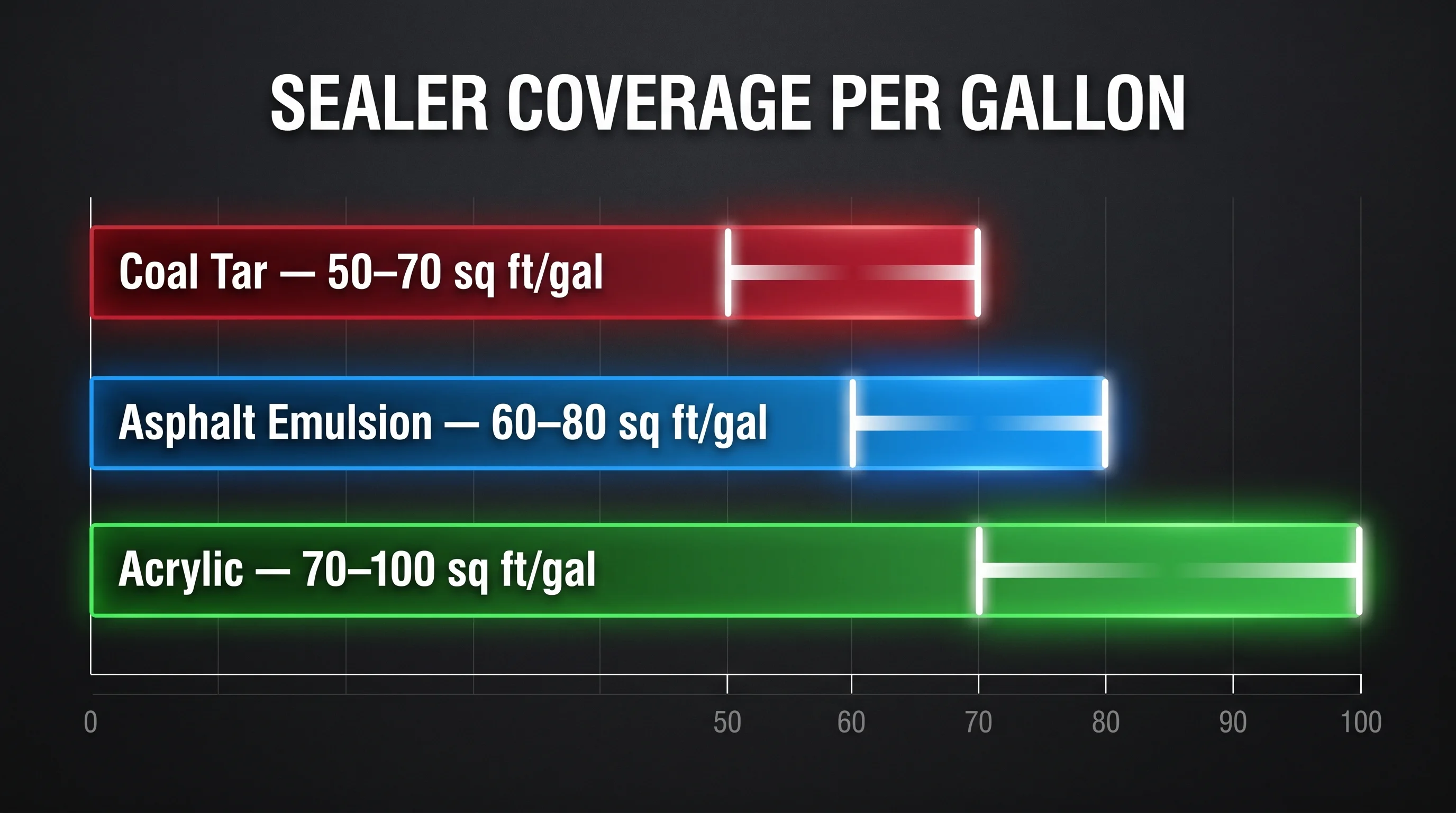
Coverage rates on sealer labels are always optimistic — they assume smooth, non-porous asphalt applied under ideal conditions. Real-world coverage on a typical residential driveway is 15–25% less. Here's how to calculate accurately:
| Driveway Size | Emulsion (2 coats) | Coal Tar (2 coats) | Acrylic (2 coats) |
|---|---|---|---|
| 400 sq ft | 10–14 gal | 12–16 gal | 8–12 gal |
| 600 sq ft | 15–20 gal | 18–24 gal | 12–17 gal |
| 800 sq ft | 20–27 gal | 23–32 gal | 16–23 gal |
| 1,200 sq ft | 30–40 gal | 34–48 gal | 24–34 gal |
Use our sealcoating calculator to get an exact gallon estimate based on your specific driveway dimensions, surface condition, and chosen product type. Always buy 10–15% more than your estimate to account for rough spots and touch-ups.
Application Methods Compared
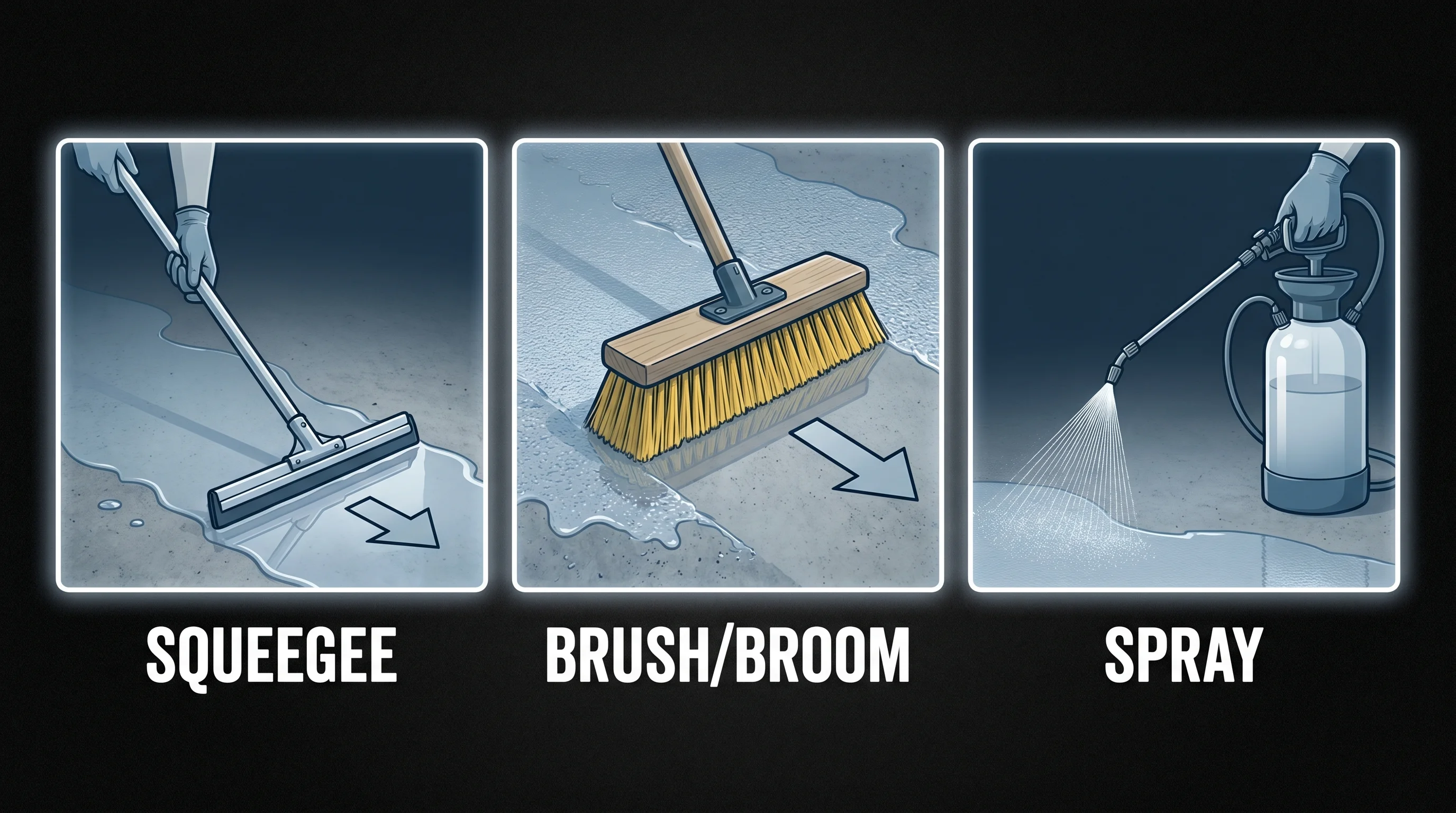
The method you use affects how evenly the sealer goes down and how long the job takes. Each has its place:
Squeegee (Recommended for DIY)
A long-handled rubber squeegee is the standard DIY tool. Pour a ribbon of sealer across the driveway width and push it in overlapping passes. The squeegee forces sealer into surface texture and produces an even coat with no drips. Best for emulsion and coal tar sealers. Cost: $15–$30 at home improvement stores.
Stiff Brush or Push Broom
Works well on rough or textured surfaces where a squeegee may skip over low spots. Takes longer and uses slightly more product, but produces excellent penetration on aged or porous asphalt. Good technique for first coat on a rough driveway followed by a squeegee second coat.
Spray Application (Professional)
Professional contractors use airless sprayers or dedicated sealer spray rigs for fast, even coverage. Spray produces a more uniform coat than squeegee and is 3–4× faster on large driveways. Not practical for most DIYers without equipment access, but some contractors offer spray-only sealing at competitive rates. Acrylic sealers in particular go on better by spray than squeegee.
Two thin coats, not one thick coat
The single most important application tip: always apply two thin coats rather than one thick one. A thick single coat takes too long to dry, traps moisture underneath, and peels within months. Two thin coats — applied perpendicular to each other — double the wear life and cure properly within 24–48 hours.
Best Time to Seal Your Asphalt Driveway
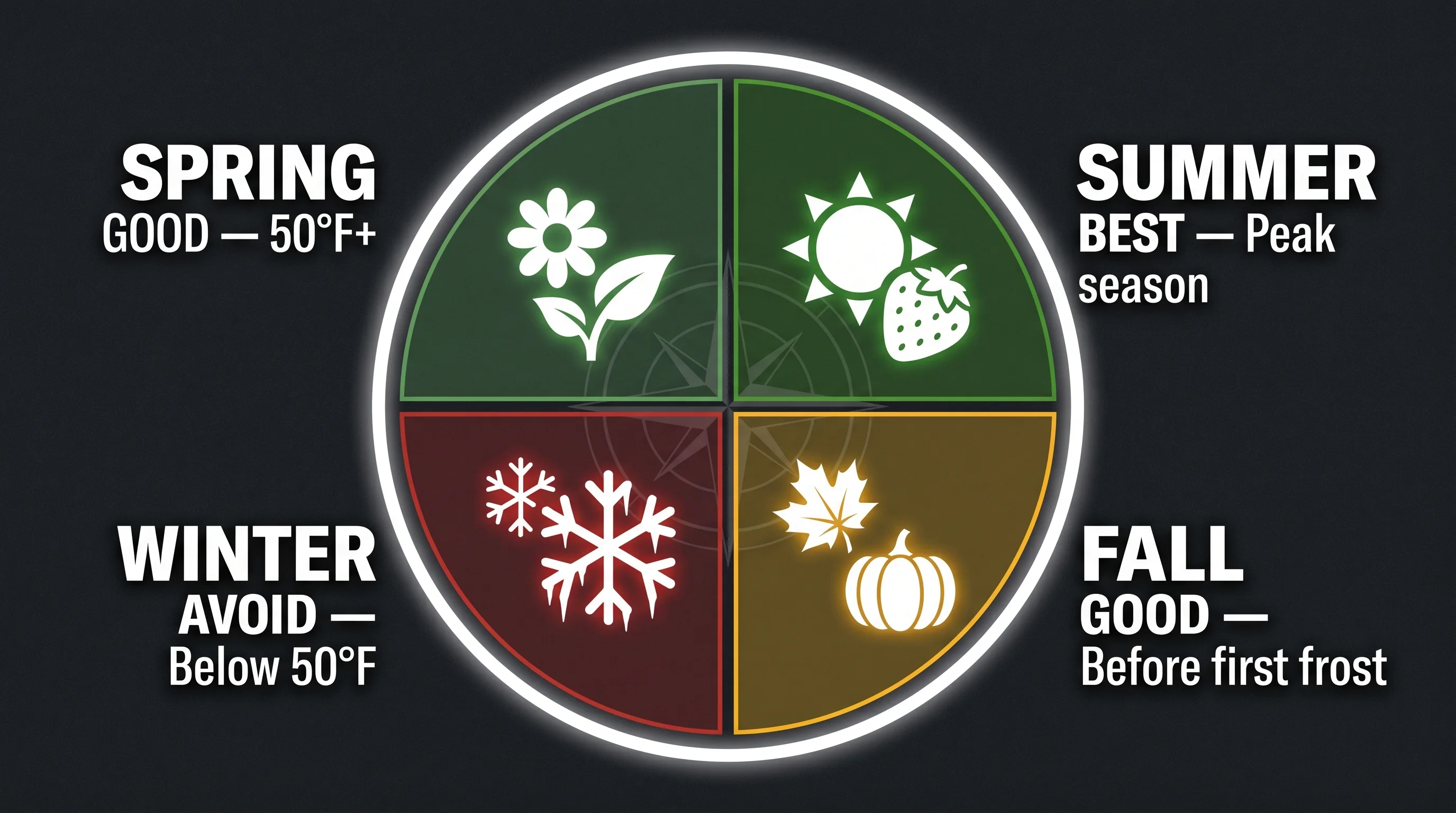
Timing your sealing project correctly makes a significant difference in how long the product lasts. Here's the seasonal breakdown:
- Summer (June–August) — Best. Temperatures above 70°F speed curing, and long daylight hours give you more working time. Sealer bonds best to warm pavement. Avoid the hottest part of the day — applying to pavement over 90°F can cause the sealer to dry before it penetrates properly.
- Late Spring (April–May) — Good. Consistent temperatures above 50°F, lower contractor demand means better pricing. The main risk is unexpected cold nights — sealer applied when temperatures drop below 50°F overnight can fail to cure properly.
- Early Fall (September–October) — Good. Often the best combination of weather and contractor availability. Apply before the first frost — sealcoating within 30 days of a hard freeze risks peeling.
- Winter (November–March) — Avoid. Below 50°F air and surface temperatures prevent proper curing. Sealer applied in cold conditions stays tacky, picks up dirt, and peels in the first freeze-thaw cycle. Wait for spring.
Before sealing, always fill any cracks wider than 1/4 inch with a quality asphalt crack filler and let cure 24 hours. For the full application walkthrough including prep, mixing, and drying times, see our complete asphalt driveway sealer guide.
Frequently Asked Questions
What is the best asphalt sealer for driveways?
For most homeowners: Gardner Seal-Krete Heavy Duty (asphalt emulsion, 35% solids) hits the best balance of performance, price, and universal legality. If coal tar is allowed in your area and you have a high-traffic driveway, SealMaster lasts longer per coat. For new driveways or high-sun climates, go with Armor AR500 acrylic for superior UV protection.
How long does asphalt sealer last on a driveway?
Coal tar: 3–5 years. Asphalt emulsion: 2–3 years. Acrylic: 3–5 years. These are per-coat figures for two-coat applications. A single coat lasts roughly half as long. Actual lifespan depends heavily on traffic load, climate, and surface preparation quality.
How many gallons of asphalt sealer do I need?
For two coats on a standard 600 sq ft driveway: approximately 15–20 gallons of emulsion, 18–24 gallons of coal tar, or 12–17 gallons of acrylic. Use our sealcoating calculator for a precise estimate based on your exact dimensions.
Is coal tar sealer banned?
In Washington state, Minnesota, the District of Columbia, and a number of individual cities across the US. Check your city and county regulations before purchasing — the list of restrictions grows each year. If in doubt, use an asphalt emulsion sealer, which is legal everywhere and performs very well for residential use.
What solids content should I look for in asphalt sealer?
Minimum 30% for a decent product. Premium residential sealers run 35–40%. Below 28% solids means mostly water — it goes on easily but wears through fast. Check the Technical Data Sheet rather than the marketing label. The number matters more than the brand name.
Can I apply asphalt sealer over old sealer?
Yes, as long as the previous coat is firmly adhered with no peeling, flaking, or bubbling. If old sealer is lifting, scrape it off before resealing. Applying new sealer over loose old sealer just buries the problem — it will peel again within one season taking the new coat with it.