
Asphalt Millings for Sale — Where to Buy, Price, Quality & Delivery (2026)
Quick Answer: Where to Buy Asphalt Millings
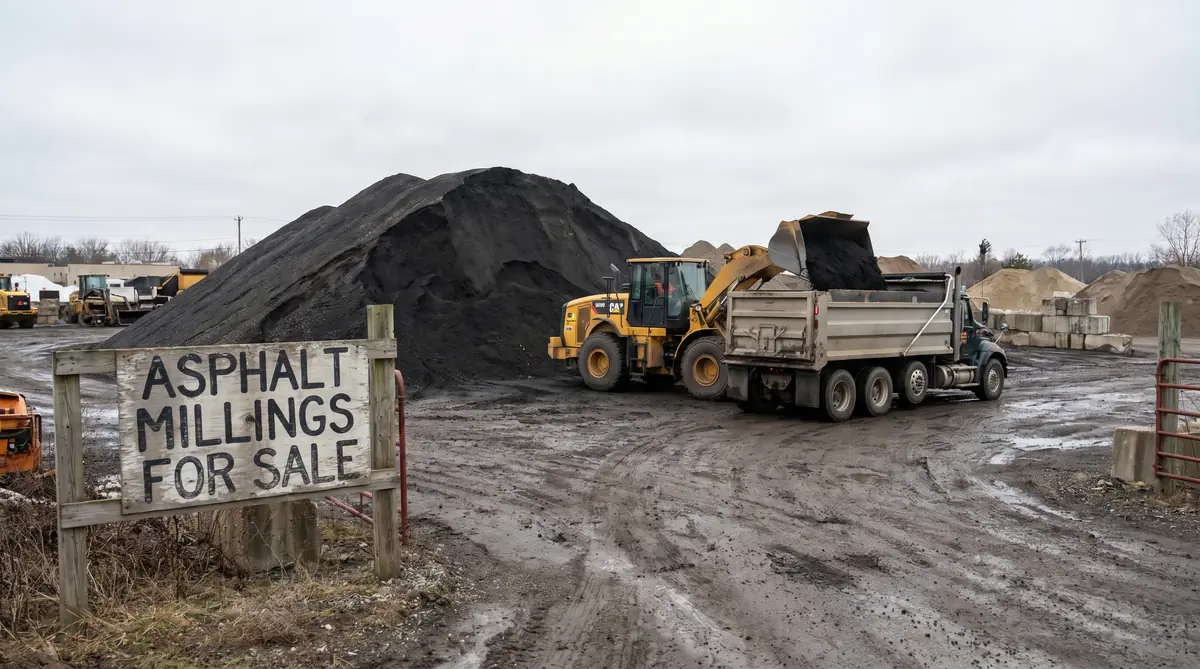
Buy asphalt millings from local asphalt plants, paving contractors with active jobs, aggregate yards, state DOT surplus sales, C&D recycling facilities, or online marketplaces. Typical price: $10–$40 per ton picked up, $15–$60 per ton delivered in 2026. Minimum orders range from 1 ton (retail yards) to 10+ tons (plant pickup). Fresh millings from active mill-and-overlay projects bind better than aged stockpiled material. Scroll down for a state-by-state supplier finder tool.
Where Asphalt Millings Are Sold
Six supplier types dominate the recycled asphalt market. Each has different price, quality, and minimum-order characteristics — pick the one that matches your job size and quality needs.
| Supplier Type | Typical Price | Min Order | Strength | Weakness |
|---|---|---|---|---|
| Asphalt plants | $15–$35/ton pickup | 5–10 tons | Highest volume, consistent stockpile, screened to size | Pickup only at many plants; limited hours |
| Paving contractors | Free–$25/ton | Varies by job | Freshest product (direct off active mill); sometimes free | Sporadic availability; requires networking and timing |
| Aggregate yards / quarries | $20–$45/ton pickup | 1+ ton | Retail-friendly small quantities, delivery available | Often repackaged — may be aged; higher markup |
| State DOT surplus | Free–$15/ton | Varies | Cheapest or free; large quantities available during road work season | Complex paperwork, permit requirements, self-haul only |
| C&D recycling facilities | $10–$30/ton pickup | 1+ ton | Walk-in retail service; mixed loads | Quality varies; may include concrete and other debris |
| Online marketplaces | Free–$25/ton | No minimum | Local pickup deals; occasional homeowner giveaways | No QC, no receipt, seller reliability inconsistent |
🔍 Find Asphalt Millings Suppliers in Your State
Pick your state to see typical price, supplier density, active supplier types, and direct search links.
How to Find Asphalt Millings for Sale Near Me
The millings market is fragmented — no single directory covers every supplier. Use this sequence to find the best option within driving distance:
Google "asphalt plant near me" with a 30-mile radius
Most hot-mix plants either sell millings directly or know who does. Call 3–5 plants and ask: "Do you sell RAP or asphalt millings? What's your current stockpile price per ton?" Plants often have the best bulk pricing.
Check your state DOT materials page
Many state DOTs publish surplus material sales. Search "[your state] DOT surplus materials" or "[your state] RAP sales." Some states list active milling project locations where materials may be free for self-haul. See the state tool above for direct links.
Call local paving contractors directly
During paving season (May–October), contractors running mill-and-overlay projects generate massive RAP quantities. Explain you want 10–50 tons for a driveway — they may quote, refer you to their plant, or sometimes offer free pickup from an active job.
Search Facebook Marketplace and Craigslist
Search "asphalt millings," "RAP," or "recycled asphalt" in Marketplace and Craigslist with your zip. Listings peak May–October. Vet sellers: ask for a stockpile photo, pickup address, and whether they'll weigh on a certified scale.
Use Earth911 and local recycling directories
Earth911.com lists C&D recyclers by zip code. Filter by "Asphalt" or "Construction & Demolition" — many listed facilities also sell screened recycled materials including millings.
Contact county highway departments
County road departments occasionally open stockpiles to the public for free or nominal fees. Call and ask about surplus RAP availability — policies vary by county but cost nothing to ask.
Price by Quantity and Region
Millings pricing is volume-sensitive. Small retail purchases pay 2–4× the large-fleet wholesale rate. Here's the current 2026 breakdown:
| Quantity | Typical Pickup Price | Typical Delivered Price | Best Supplier |
|---|---|---|---|
| Under 5 tons | $35–$60/ton | $50–$90/ton | Aggregate yard, recycling facility |
| 5–25 tons | $20–$40/ton | $30–$55/ton | Asphalt plant, aggregate yard |
| 25–100 tons | $12–$28/ton | $20–$40/ton | Asphalt plant, paving contractor |
| 100+ tons | $8–$20/ton | $15–$30/ton | Paving contractor direct, DOT surplus |
Regional variation is significant — the Northeast and West Coast run 30–50% higher than the South and Midwest due to aggregate scarcity and trucking cost. For the full price breakdown by use and installation, see our asphalt millings cost guide.
Delivery Costs — What Drives the Price
Delivery is priced two ways: per-ton delivered (small jobs, short haul) or flat trip charge plus material (larger loads, longer haul).
| Truck Type | Capacity | Typical Flat Trip | Best For |
|---|---|---|---|
| Pickup / trailer (self-haul) | 1–3 tons | $0 (your time/fuel) | Small patches, walkway edging, single load |
| Single-axle dump (rental) | 3–6 tons | $250–$450/day | Medium driveway, multiple small loads |
| 10-wheeler dump | 8–12 tons | $200–$450/trip | Standard residential driveway |
| Tri-axle dump | 15–22 tons | $300–$600/trip | Large driveway, long lane, parking area |
| Live-bottom / conveyor trailer | 20–26 tons | $400–$800/trip | Large project, spreading in place without dumping |
Quality Checklist — What to Inspect Before Buying
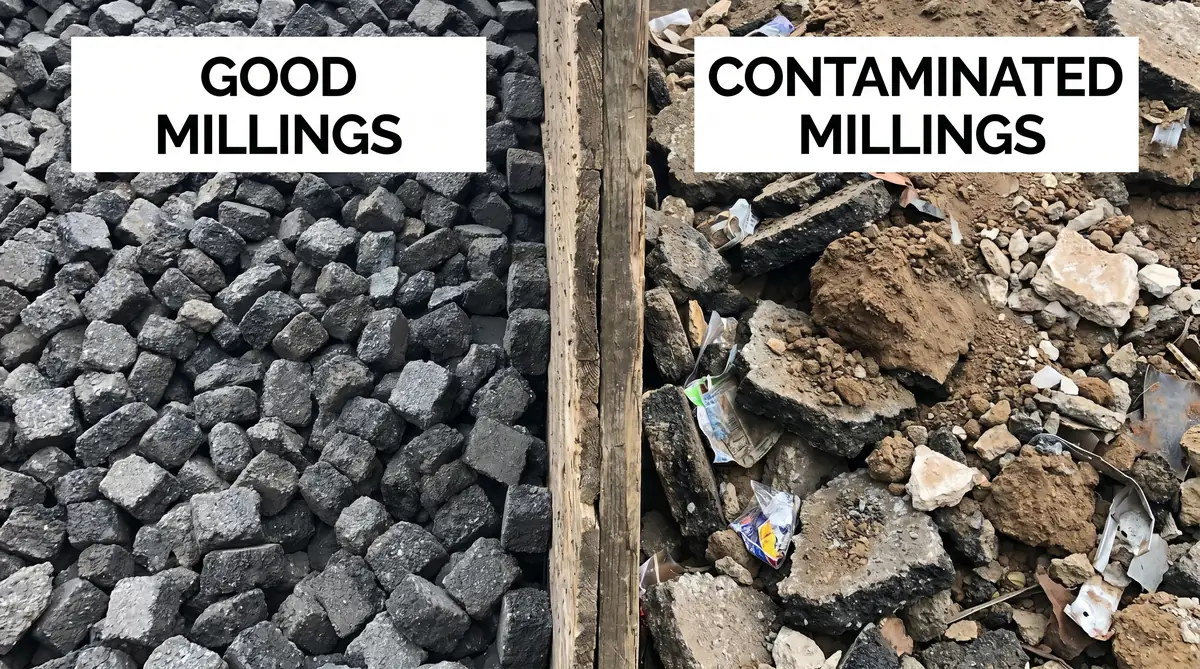
Not all millings are equal. A bad stockpile can be 50% cheaper but yield half the driveway life. Check every pile before handing over money:
- Color: dark black to deep brown = fresh with active binder. Grey or tan = aged, binder oxidized, won't bind well.
- Particle size: ideally screened to 1 inch minus or 3/4 inch minus. Grab a handful — if you see pieces over 2 inches, request screened material.
- Fines content: 5–10% fines (passing a No. 200 sieve) is optimal. Excessive fines (more than 15%) create a powdery surface that won't compact well.
- Contamination: no concrete chunks, rebar, dirt, trash, or yellow/white paint lines. A few painted pieces are normal; piles with 5%+ concrete or debris should be rejected or renegotiated.
- Moisture: slightly damp (freshly watered) is ideal for compaction. Bone-dry stockpiles may be over-aged; soaking-wet piles weigh more per ton (you pay for water).
- Tackiness test: in warm weather (above 70°F), squeeze a handful. Fresh millings feel slightly tacky and clump; dead millings crumble apart completely.
- Origin date: ask when the pile was milled. Under 6 months is fresh. 6–18 months is acceptable. Over 2 years — negotiate or walk away.
- Weigh ticket / certified scale: reputable suppliers issue a weigh ticket. No ticket = you're trusting the supplier's estimate, and short-loading is common in the cash market.
Fresh vs Stockpiled Millings — The Difference Matters
| Factor | Fresh Millings (<6 months) | Stockpiled (1–3 years) | Very Old (3+ years) |
|---|---|---|---|
| Binder activity | Full — active on warm days | Partial — needs sun & heat | Mostly inert — acts like gravel |
| Compaction result | Excellent — binds into solid mat | Good with compaction and heat | Mediocre — stays loose |
| Typical price | $25–$45/ton | $15–$30/ton | $10–$20/ton |
| Best use | Driveways, road base, high-traffic areas | Driveways with compaction, parking pads | Fill, pathways, low-traffic areas only |
Questions to Ask the Seller
- What's the stockpile origin date? (Fresh beats aged.)
- Is it screened? To what size? (1" or 3/4" minus preferred.)
- Can I see the pile before loading? (Reputable suppliers welcome inspection.)
- Do you issue a weigh ticket from a certified scale?
- Is this pure RAP or is it mixed with other recycled material?
- What's the delivery fee to my zip code? (Get it in writing.)
- Do you offer volume discounts above 20/50/100 tons?
- Is there a return / re-delivery option if quality doesn't match what I saw?
Red Flags — When to Walk Away
- Cash-only, no weigh ticket, no receipt — impossible to verify tonnage or claim warranty
- "Mixed" pile description — often means concrete/dirt/RAP blend; you're buying fill, not asphalt millings
- Refuses site/pile inspection before ordering — legitimate sellers invite you to see the stockpile
- Price dramatically below market — under $5/ton delivered usually means aged garbage or will be short-loaded
- No physical address for supplier yard — "we'll deliver from our site" with no address = scam risk
- "Free" with high delivery fee — common bait; total cost often exceeds paid-delivered market rate
- Unmarked or unregistered trucks — no DOT number, no company markings = untraceable if problems arise
Delivery Day — What to Expect
Confirm delivery window
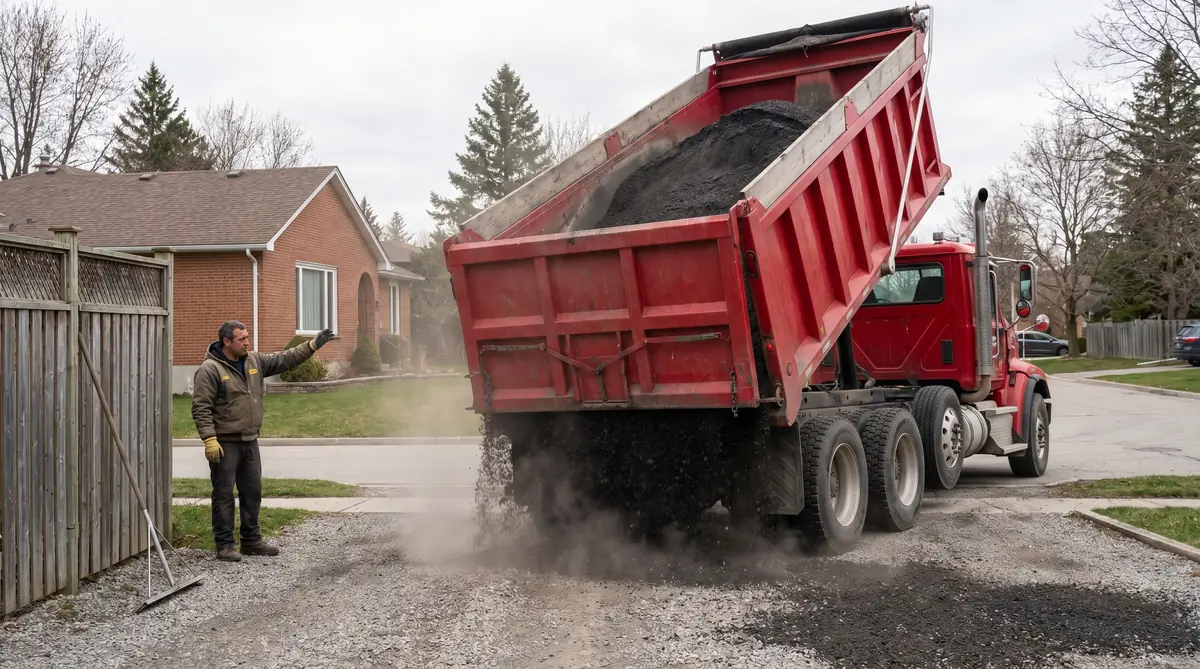
Most suppliers give a 2–4 hour window. Be on-site — you need to direct dump placement and inspect the load before the driver leaves.
Inspect as the truck arrives
Before the driver dumps, spot-check the load: dark color, consistent particle size, no obvious contamination. This is your last chance to reject.
Direct the dump location
Have the driver position so the pile is at the highest point of your work area — easier to spread downhill than uphill. Clear overhead obstacles (tree branches, power lines) before the truck arrives.
Verify tonnage
Take the weigh ticket. If something feels off (pile looks smaller than expected), request re-weigh or note disputed quantity on the ticket before signing.
Start spreading immediately
Fresh millings bind best when spread and compacted within 24–48 hours. If weather or schedule delays you, cover the pile with a tarp to retain moisture and binder activity.
Best Time of Year to Buy
| Season | Availability | Price | Why |
|---|---|---|---|
| May–July (peak) | High | Moderate | Active mill-and-overlay season; fresh supply, but demand also high |
| August–October | Highest | Best value | End of paving season; contractors want to empty yards before winter |
| November–February | Low | Variable | Low supply but also low demand; may negotiate well but selection limited |
| March–April | Moderate | Highest | Stockpiles low after winter, new supply not yet flowing; premium pricing |
Pickup vs Delivered — When Each Wins
Pickup wins when: supplier is within 15 miles, you have a pickup truck or rented dump, job needs under 10 tons, and you can make multiple trips.
Delivery wins when: job needs 15+ tons, supplier is 20+ miles away, you don't have a truck, or your time is worth more than the $100–$300 delivery premium. For a standard 2-car driveway (~16 tons), delivery almost always wins on total cost of effort.
Asphalt Millings for Sale — FAQs
Where can I buy asphalt millings near me?
Local asphalt plants, paving contractors with active jobs, aggregate yards, state DOT surplus programs, C&D recycling facilities, and online marketplaces (Facebook Marketplace, Craigslist). Start with "asphalt plant near me" and a 30-mile radius — or use the state supplier finder tool earlier on this page.
How much do asphalt millings cost per ton?
$10–$40 per ton picked up, $15–$60 per ton delivered in 2026. Bulk orders (25+ tons) drop to $8–$20/ton. Fresh material commands a premium; aged stockpiles are cheaper but bind less effectively.
How many tons do I need for a driveway?
Roughly 1 ton per 50 sq ft at 4-inch compacted depth. A 12×40 single-car driveway = ~10 tons. A 20×40 two-car driveway = ~16 tons. Use our asphalt milling calculator for exact figures. Add 10% overage.
How do I know if asphalt millings are good quality?
Dark color (black to dark brown), consistent particle size (1" minus or 3/4" minus), free of concrete and debris, slightly tacky on warm days, less than 10% fines. See the full quality checklist earlier on this page.
Do asphalt millings harden?
Yes — through compaction, sun exposure (heat reactivates residual binder), and traffic. Properly installed millings reach 60–75% of hot-mix strength at a fraction of the cost. Fresh millings bind faster than aged ones.
Can I get asphalt millings for free?
Sometimes — paving contractors occasionally give away overrun loads, and state DOT projects sometimes allow free public self-haul from active milling sites. Network with local contractors during peak season (May–October) and be ready to pick up on short notice.
Do I need a permit to buy and install millings?
Usually no permit for buying. Installation permits vary by jurisdiction — most residential driveway resurfacing in existing footprints doesn't need a permit, but new driveway construction or right-of-way work often does. Call your local building department before installing.
Can asphalt millings be used on a residential driveway?
Yes — millings are one of the most common residential driveway surfaces in rural and semi-rural areas. See our millings driveway guide for installation steps, thickness, and long-term maintenance.
Related Guides & Tools
References: Earth911 Recycling Locator · NAPA RAP Recycling Program · EPA C&D Material Data