
Asphalt Roller Rental — Cost, Types, Where to Rent & How to Use (2026)
Quick Answer: Asphalt Roller Rental Costs & Types
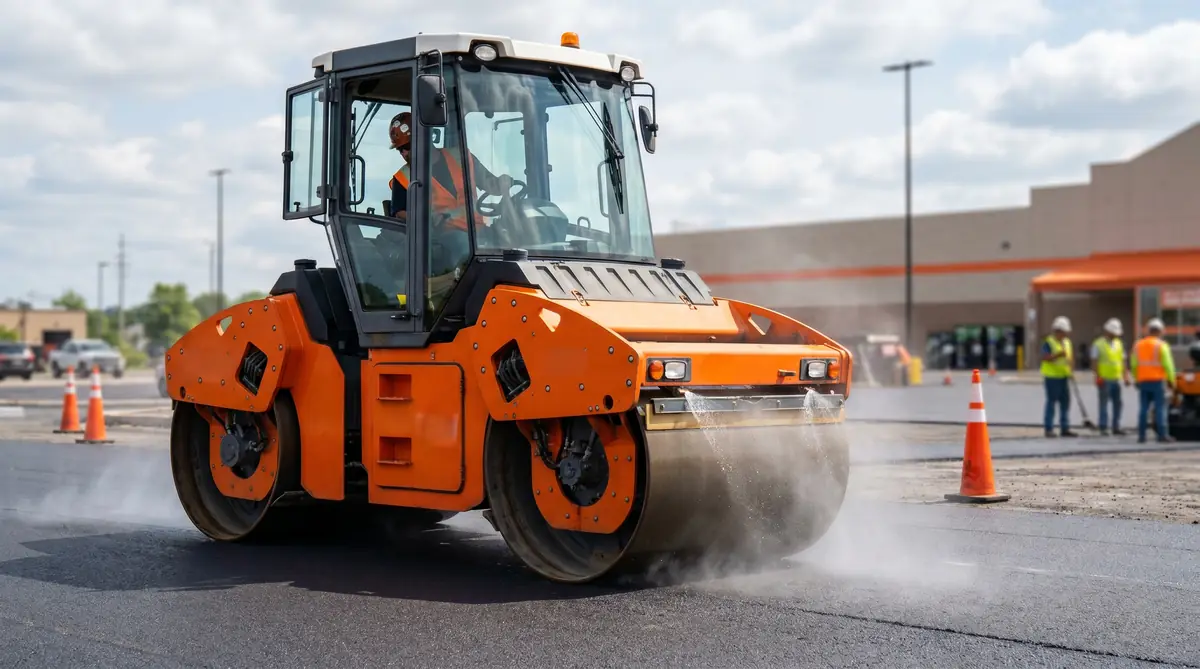
Asphalt rollers rent from $120/day (walk-behind drum) to $600/day (ride-on tandem double-drum). Walk-behind drum rollers ($120–$220/day) handle residential driveways and small patches. Ride-on single-drum ($280–$450/day) works for driveways, small lots, and millings. Ride-on tandem double-drum ($350–$600/day) is the commercial standard for parking lots and roads. Rent from Home Depot Tool Rental, United Rentals, or Sunbelt — delivery adds $80–$200 each way.
Which Roller for Which Job — Start Here
| Project | Recommended Roller | Why |
|---|---|---|
| Residential driveway (up to 20 ft wide) | Walk-behind vibratory drum (24–36") | Fits tight spaces, no trailer needed (some tow behind a pickup), adequate compaction for 1.5–3 in lifts |
| Large driveway or lane (20–40 ft wide) | Ride-on single-drum (48–66") | Faster production, better weight for 2–3 in lifts |
| Commercial parking lot | Ride-on tandem double-drum | Front and rear drums compact simultaneously — standard commercial spec |
| Road resurfacing (contractor) | Tandem double-drum + pneumatic tire intermediate | Full three-phase compaction: breakdown, intermediate, finish |
| Asphalt millings driveway | Walk-behind or ride-on single-drum (static mode) | Millings don't need vibratory — static is sufficient and avoids fines migration |
| Very small patch (under 50 sq ft) | Plate compactor (not a roller) | Rollers can't get close enough to edges; plate compactor is more practical |
| Tight space / around curbs | Walk-behind drum or hand tamper | Ride-on machines can't compact within 6–12 inches of edge obstacles |
The 4 Roller Types You Can Rent
1. Walk-Behind Plate Compactor
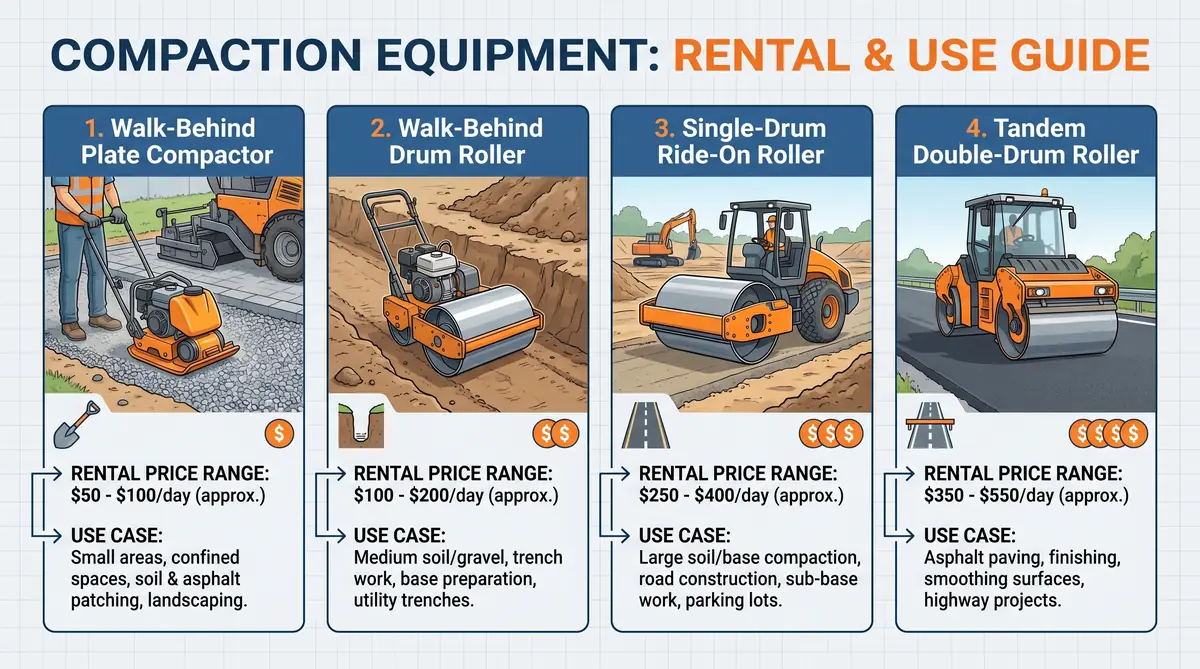
Not technically a roller, but the most commonly available piece of compaction equipment at general tool rental shops. Rental: $70–$120/day. Works for small asphalt patches under 1.5 inches thick, compacting millings, and getting close to edges where a drum can't fit. Does not produce a smooth finish on asphalt — surface will show plate marks. Use when a drum roller is unavailable or impractical for the project size.
2. Walk-Behind Vibratory Drum Roller (24–36")
The go-to choice for residential DIY asphalt. Single steel drum with vibration, operator walks behind and steers with a handlebar. Rental: $120–$220/day, $450–$750/week. Drum width 24–36 inches. Operating weight 1,200–3,500 lbs. Handles standard residential driveway lifts of 1.5–3 inches. Can tow behind a standard pickup truck with a small trailer — no CDL needed, no flatbed required.
3. Ride-On Single-Drum Roller (48–66")
Operator rides, single large steel drum in front, rubber-tired rear axle. Rental: $280–$450/day, $900–$1,500/week. Operating weight 3,500–8,000 lbs. Good compromise between the walk-behind's limited production and the tandem's higher cost. Works well for driveways over 15 feet wide, millings driveways, small commercial lots, and base course compaction. Requires a tandem-axle trailer for transport.
4. Ride-On Tandem Double-Drum Roller
The commercial parking lot and road standard. Two steel drums (front and rear), vibratory on at least the front drum. Rental: $350–$600/day, $1,200–$2,000/week. Operating weight 5,000–14,000 lbs. Drum widths 40–60 inches. Produces the smooth, uniform surface finish expected on commercial paving. Requires a lowboy or flatbed trailer for transport — confirm towing capacity before pickup.
Rental Price by Class and Duration
| Roller Type | Day Rate | Week Rate | 4-Week Rate | Delivery (each way) |
|---|---|---|---|---|
| Plate compactor | $70–$120 | $220–$400 | $600–$1,000 | $60–$120 |
| Walk-behind drum (24–36") | $120–$220 | $450–$750 | $1,200–$2,000 | $80–$150 |
| Ride-on single-drum (48–66") | $280–$450 | $900–$1,500 | $2,400–$4,000 | $120–$200 |
| Tandem double-drum | $350–$600 | $1,200–$2,000 | $3,200–$5,500 | $150–$250 |
Where to Rent an Asphalt Roller
| Chain | Availability | Best For | Notes |
|---|---|---|---|
| Home Depot Tool Rental | Nationwide | Walk-behind drum, plate compactor | Convenient for homeowners; limited heavy equipment — call ahead to confirm stock |
| United Rentals | 1,300+ locations | Full range including tandem double-drum | Largest fleet; online booking; delivery available; good for contractors |
| Sunbelt Rentals | 900+ locations | Full range | Strong Southeastern and Midwestern coverage; competitive pricing |
| Sunstate Equipment | Southwest US | Full range | Best pricing in AZ, CA, CO, TX, NM markets |
| BlueLine Rental | Multi-region | Commercial grade | Strong in infrastructure/commercial contractor market |
| Local independent rental | Varies | Negotiate pricing | Often 15–25% cheaper than national chains; check equipment age before committing |
What Affects the Rental Price
- Drum width and weight: wider, heavier machines cost more
- Vibratory vs static: vibratory adds $30–$100/day over static equivalents
- Machine age: newer machines rent higher; ask how old the unit is
- Season: peak paving season (May–September) can push rates 10–20% higher; off-season = negotiating room
- Damage waiver: 10–15% of rental cost; optional but worth taking on rollers you've never operated
- Fuel surcharge: many chains add 5–8% for diesel equipment
- Delivery distance: some chains charge per mile beyond a base radius; ask before booking
How to Operate a Rental Roller on Asphalt — 8 Steps
Check mat temperature before first pass
Use an infrared thermometer — mat should be 250–300°F for breakdown rolling. Do not start below 230°F. If temperature is dropping fast, skip pre-roll checks and start immediately.
Fill water tank and test spray system
Both drums must be lightly misted throughout rolling. Fill the tank with clean water before every shift. Set spray rate to drip, not flood — you want moisture, not pooling. Confirm both front and rear spray bars work before pulling onto the mat.
Breakdown rolling — vibratory, high amplitude
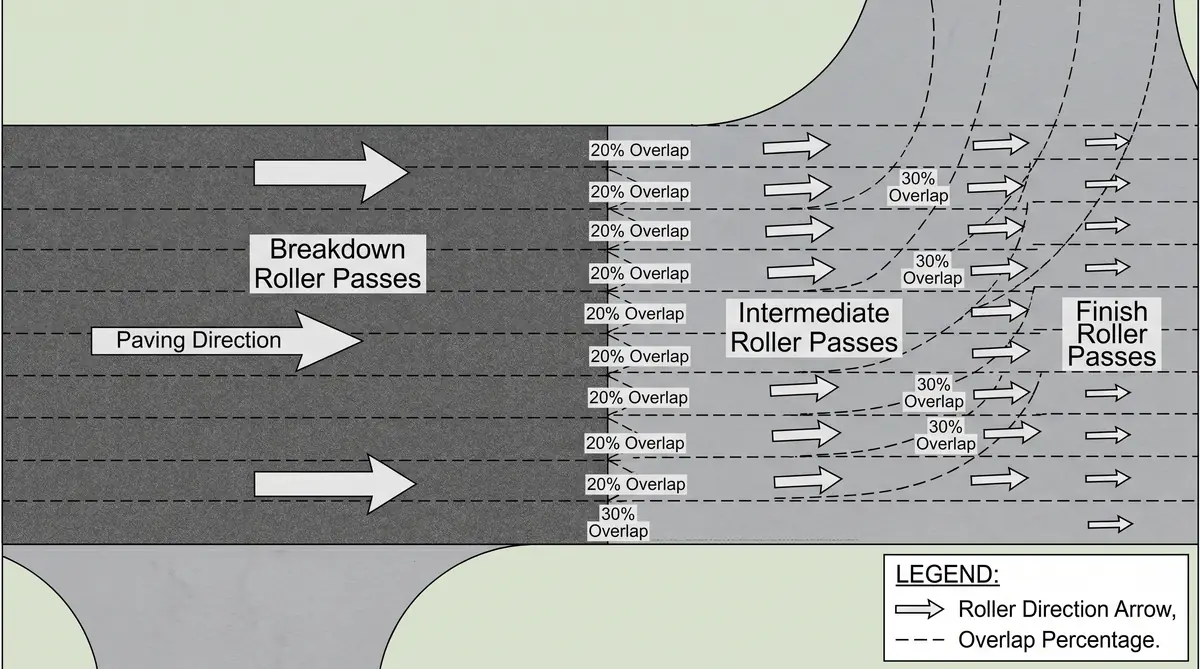
Start rolling parallel to the paving direction, beginning at the low edge of the mat and working toward the high side. Overlap each pass by 6 inches. Drum speed: 2–3 mph. Complete 3–5 passes. This is the most time-critical phase — temperature is dropping.
Avoid stopping on the hot mat
A stopped vibratory drum creates a depression that cannot be corrected. Always keep the machine moving — slow down before stopping, turn vibratory off, drive onto cool pavement or existing surface before halting.
Intermediate rolling — reduce amplitude or switch to static
After 3–5 breakdown passes, mat temperature is 175–230°F. Reduce vibration amplitude to low or switch to static mode. Complete 2–3 intermediate passes. This phase seals the surface and eliminates remaining air voids.
Edge and joint compaction
Roll within 6 inches of edges and longitudinal joints — these are the first places failures appear. Use the edge of the drum to work the joint tight. On large machines, use a hand tamper or plate compactor for the last 4–6 inches against curbs or walls.
Finish rolling — static mode only
Mat temperature 160–185°F. One or two static passes smooth the surface marks from vibratory rolling. Do not use vibration in finish mode — you risk pushing aggregate into the surface at lower temperatures.
Stop rolling at 140°F
Once the mat drops below 140°F, compaction is complete and continued rolling causes shear cracking. Let the mat cool to ambient temperature — at least 4 hours — before opening to traffic.
Temperature Windows — Critical Numbers
| Rolling Phase | Mat Temperature | Mode | Passes |
|---|---|---|---|
| Breakdown | 250–300°F | Vibratory, high amplitude | 3–5 |
| Intermediate | 175–230°F | Vibratory, low amplitude or static | 2–3 |
| Finish | 160–185°F | Static only | 1–2 |
| Stop rolling | Below 140°F | N/A — rolling causes cracking | — |
Water System — Why It Matters
Steel drums without water pick up asphalt mix — the hot binder sticks to the steel and tears the surface on every subsequent pass. Results: pulled surface aggregate, visible drum-track marks, and a compromised mat that will ravel in the first freeze cycle. This is the single most common damage caused by rental operators unfamiliar with the equipment.
- Fill the water tank before driving onto the mat — once you're on, you can't stop
- Set spray bars to drip mode — a fine mist is enough; flooding washes out fines
- Check tank every 30–45 minutes on a hot day (evaporation is fast)
- If the spray system fails mid-job, back off the mat immediately and fix it before continuing
- In cold weather (below 40°F), add windshield washer fluid to prevent tank freezing
Roller vs Plate Compactor — Which Is Right for You?
| Factor | Drum Roller | Plate Compactor |
|---|---|---|
| Surface finish | Smooth, professional | Rough, plate-textured marks |
| Compaction depth | 2–4 inches per lift | Up to 1.5 inches per lift |
| Rental cost | $120–$600/day | $70–$120/day |
| Transport | Small trailer (walk-behind) to flatbed | Pickup truck bed or small trailer |
| Tight spaces / edges | Limited — 6–12" clearance min | Gets very close to edges |
| Asphalt millings | Best — produces density and binding | Adequate for millings under 3" |
| Hot asphalt overlay | Required for quality result | Acceptable for very thin patches only |
Verdict: for any fresh asphalt mat over 1.5 inches thick, use a drum roller. A plate compactor won't produce the 92–96% Gmm density needed for durable asphalt. For millings, a walk-behind drum roller is the best value. For pure edge and joint compaction near obstacles, a plate compactor supplements the roller — both on the same job isn't overkill.
Project Size Calculator — Which Roller and How Many Days?
Use these production rates to estimate rental days needed:
| Roller Type | Drum Width | Speed (mph) | Estimated Production (SY/day, 8 hr shift) |
|---|---|---|---|
| Walk-behind drum | 24–36 in | 1.5–2.5 | 600–1,200 SY |
| Ride-on single-drum | 48–66 in | 2–3 | 1,500–3,000 SY |
| Tandem double-drum | 54–66 in | 2.5–3.5 | 2,500–5,000 SY |
Example: a 2,000 SY commercial parking lot needs approximately 1 day with a tandem double-drum roller (at 3,000 SY/day) plus 0.5 days of intermediate and finish passes — plan for a 2-day rental to be safe. Use our asphalt calculator to convert your project dimensions to square yards.
Pre-Pickup Inspection Checklist
- Walk around the machine with the rental agent — document existing damage on the rental agreement before you sign
- Check drum surface — no flat spots, no built-up asphalt from previous rentals, no visible cracks in steel
- Test vibration: engage vibratory mode and confirm you can feel the amplitude (and hear the frequency change from static)
- Fill water tank and verify both spray bars (front and rear) flow freely
- Check hydraulic fluid level and engine oil — rental companies vary on pre-delivery maintenance
- Confirm fuel type (diesel vs gas) and current fuel level
- Test forward, reverse, and speed controls — confirm smooth response with no jerking
- Verify trailer capacity matches roller weight before you load it
Transport Requirements by Roller Class
| Roller Type | Weight | Trailer Type | Towing Vehicle |
|---|---|---|---|
| Walk-behind drum (small) | 1,200–2,000 lbs | Single-axle utility trailer | Standard half-ton pickup |
| Walk-behind drum (large) | 2,000–3,500 lbs | Tandem-axle utility trailer | 3/4-ton or 1-ton pickup |
| Ride-on single-drum | 3,500–8,000 lbs | Tandem-axle equipment trailer (5-ton) | 3/4-ton diesel pickup minimum |
| Tandem double-drum | 5,000–14,000 lbs | Lowboy or 10-ton equipment trailer | 1-ton diesel pickup or larger |
Common Rental Mistakes — What Costs People Money
- Renting a plate compactor for a full asphalt mat — produces poor density, raveling within 1 season
- Rolling cold mix — waiting too long after paving before starting the roller; fractures aggregate permanently
- Forgetting to fill the water tank — drums pick up asphalt, tear the surface, ruin the mat in 2 passes
- Stopping the vibratory drum on the hot mat — leaves a depression that cannot be repaired without a mill-and-repave
- Not overlapping passes — leaves uncompacted lanes; classic cause of longitudinal cracking after 1–2 seasons
- Too few passes — 2–3 passes feels like enough; 6–8 is what actually achieves spec density
- Wrong trailer — overloaded — equipment dropped from trailer on the way to the job; liability and replacement cost on you
- Skipping pre-rental inspection — rental return disputes about damage that was pre-existing
Asphalt Roller Rental FAQs
How much does it cost to rent an asphalt roller?
Walk-behind drum: $120–$220/day. Ride-on single-drum: $280–$450/day. Tandem double-drum: $350–$600/day. Add delivery ($80–$200 each way), fuel surcharge (5–8%), and optional damage waiver (10–15%). Weekly rates are 3–4× day rates.
Can a homeowner rent an asphalt roller?
Yes — walk-behind and small ride-on rollers rent to anyone with a valid driver's license and a credit card for the damage deposit. No special license required under 10,000 lbs. Large tandem machines may require a commercial license at some companies.
What size roller do I need for a driveway?
A walk-behind vibratory drum roller (24–36 inch drum) is sufficient for a standard residential driveway. It covers 24–36 inches per pass and produces 600–1,200 SY/day — more than enough. A plate compactor is acceptable only for very thin overlays under 1.5 inches.
How many passes does a rental roller need?
3–5 breakdown passes (vibratory), 2–3 intermediate passes, 1–2 finish passes (static). Total 6–8 passes minimum. If you can't test density, never do fewer than 6.
What happens if I roll asphalt that is too cold?
Permanent aggregate fracture — stones crack instead of compact, shear cracks form, surface damage is irreversible. Always check mat temperature with an IR thermometer. Stop rolling once the mat drops below 140°F.
Do I need to wet the drum?
Yes — dry drums pick up asphalt and tear the surface. Fill the water tank before every shift, set spray bars to drip mode, and check the tank every 30–45 minutes.
Can I use a rental roller on asphalt millings?
Yes — a walk-behind or ride-on single-drum in static mode is ideal for millings. Skip vibratory mode — it drives fines down and creates an unstable surface. 3–4 static passes at 2 mph produces a tight, durable millings surface. See our millings driveway guide for full installation specs.
Home Depot vs United Rentals — which is better for roller rental?
Home Depot Tool Rental is more convenient for walk-behind equipment and has nationwide pickup locations, but stock is limited and availability varies by location. United Rentals and Sunbelt have wider equipment selection (including tandem double-drums), more consistent availability, and better support for contractors — but fewer neighborhood locations. For a residential driveway, Home Depot is fine; for a commercial lot, call United Rentals or Sunbelt.
Related Guides & Tools
References: United Rentals Compaction Equipment · Sunbelt Rentals Compaction · FHWA Asphalt Pavement