
Ben's Asphalt Products — Reviews, Where to Buy & How to Use (2026)
Quick Answer: What Is Ben's Asphalt?
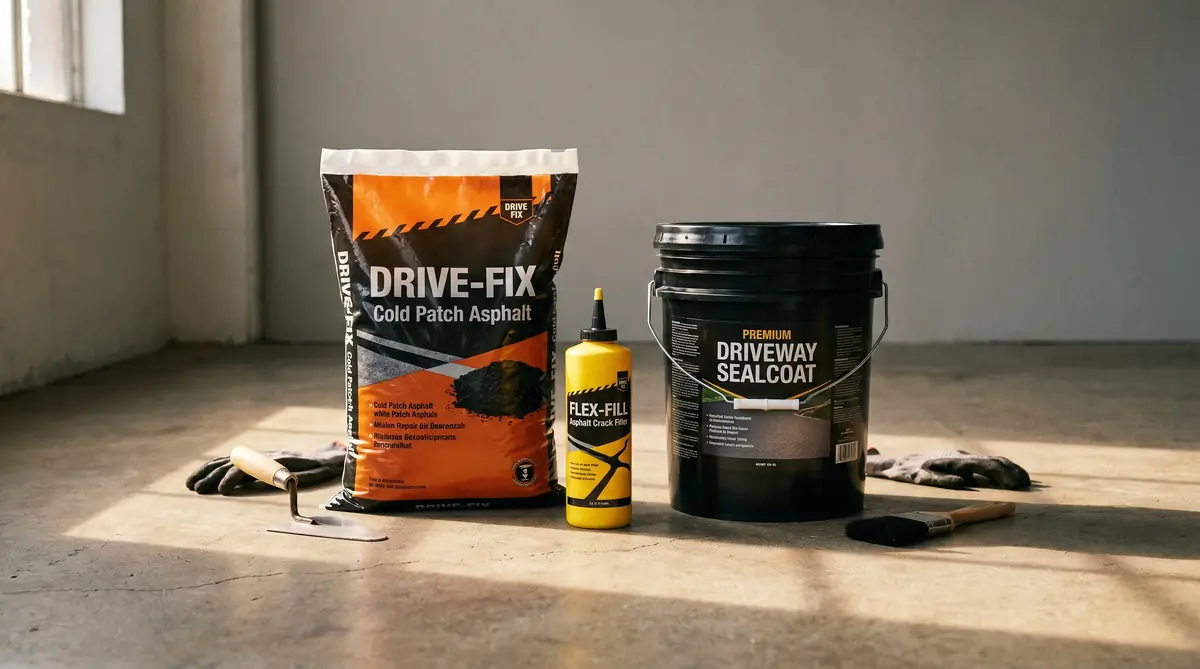
Ben's Asphalt is a brand of ready-to-use asphalt maintenance products — primarily cold patch bags for pothole repair, crack filler, and driveway sealer. Products require no heating or professional equipment. A 50 lb bag runs $8–$14 and covers roughly 1.5–2.5 sq ft at 2-inch compacted depth. Available at Home Depot, Lowe's, Tractor Supply, and Amazon. Best for residential pothole repairs, not for structural failures or full driveway resurfacing.
Ben's Asphalt Product Line Overview
| Product | Type | Sizes Available | Coverage | Price Range |
|---|---|---|---|---|
| Cold Patch | Pothole & patch repair | 10 lb, 50 lb bag | 0.6–1 sq ft (10 lb @ 2"), 3–5 sq ft (50 lb @ 1") | $4–$6 (10 lb), $8–$14 (50 lb) |
| Crack Filler | Liquid crack sealer | 1 qt, 1 gal jug | 50–80 linear ft (1 qt @ ¼" crack) | $8–$12 (1 qt), $22–$32 (1 gal) |
| Driveway Sealer | Sealcoat / surface protection | 4.75 gal, 5 gal pail | 250–375 sq ft per coat | $18–$28 per pail |
| Patch & Crack Kit | Bundled repair kit | 1 kit (bag + crack filler) | Small residential patch + up to 40 ft crack | $20–$30 |
Product Deep-Dives
Ben's Cold Patch — Pothole & Spot Repair
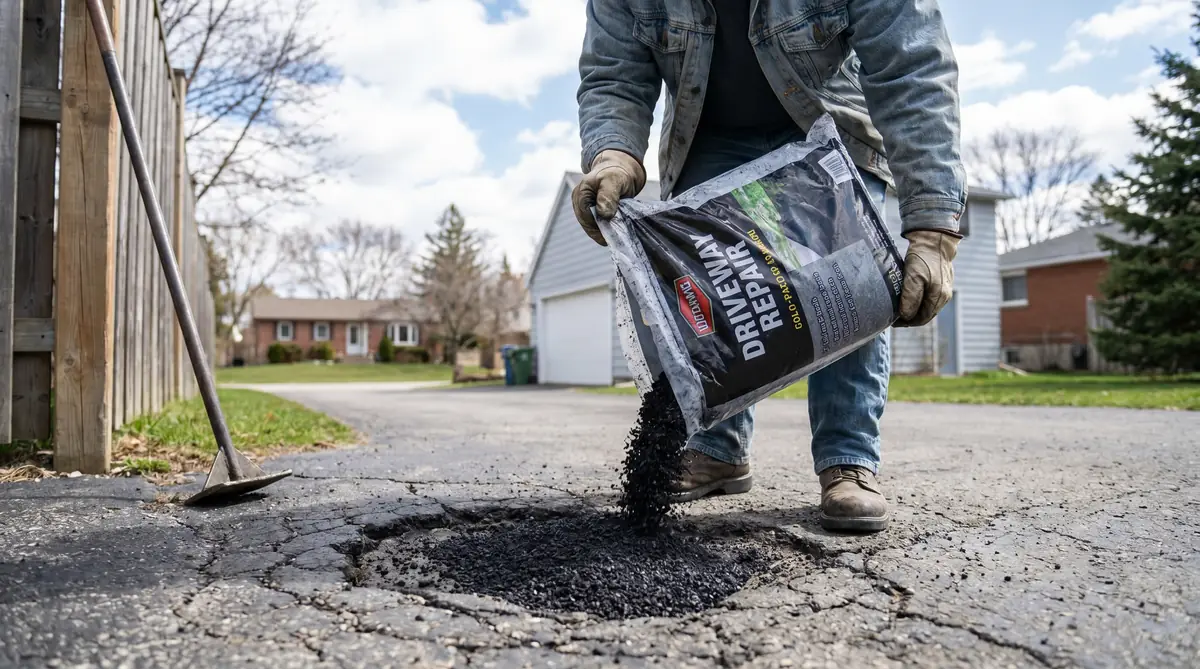
Ben's cold patch is a petroleum-solvent-based asphalt mix that stays workable at ambient temperature — no propane torch, no hot mix delivery required. Pour into the prepared hole, tamp firm, and it's ready for traffic immediately. Petroleum solvent gradually evaporates over 30–90 days as the patch cures to its final hardness.
Best for: Potholes 1–12 inches in diameter, sunken driveway sections, utility cut backfill, edge crumbling up to 3 inches wide. Not for: Alligator cracking (structural failure), areas wider than ~18 inches (use hot mix instead), or surfaces that need to look finished.
Coverage note: At a 2-inch compacted depth — the minimum for any durability — a 50 lb bag fills roughly 1.5–2.5 sq ft. Plan for 1 bag per medium pothole (8–10 inch diameter, 3 inch deep). Always buy 1–2 extra bags. Leftover sealed bags store 12–18 months.
Ben's Crack Filler — Liquid Crack Sealer
A pourable, rubberized asphalt emulsion for filling cracks ¼ to ¾ inch wide. Self-levels into the crack, bonds to both crack edges, and flexes with seasonal pavement movement — reducing the chance of re-opening. Dries to traffic in 4–8 hours depending on temperature and humidity. Do not apply below 50°F or when rain is expected within 24 hours.
Best for: Linear cracks, diagonal shrinkage cracks, and edge joint cracks before sealcoating. Not for: Cracks wider than ¾ inch (use backer rod + crack filler), alligator cracking, or sunken pavement. For cracks over ¼ inch wide, install a backer rod first to prevent product from sinking too deep.
Ben's Driveway Sealer — Surface Protection Coat
An asphalt emulsion sealcoat for UV protection, water resistance, and restoring a dark, uniform appearance to faded driveways. Apply with a squeegee or brush applicator. Standard 2-coat system: first coat applied and allowed to dry 4–8 hours, second coat applied perpendicular to the first. Full cure in 24–48 hours before vehicle traffic; 30 days for full hardness.
Coverage: One 5-gallon pail covers roughly 250–375 sq ft per coat on a prepared surface (2 coats = 125–185 sq ft net per pail). A typical 600 sq ft driveway needs 3–4 pails for a 2-coat application. Calculate exactly with our Sealcoating Calculator.
Best for: Driveways in good structural condition that need surface protection and appearance refresh. Not for: Surfaces with active cracks (fill first), concrete (asphalt sealer doesn't bond to Portland cement), or areas with active water pooling.
Ben's Asphalt vs Competing Brands
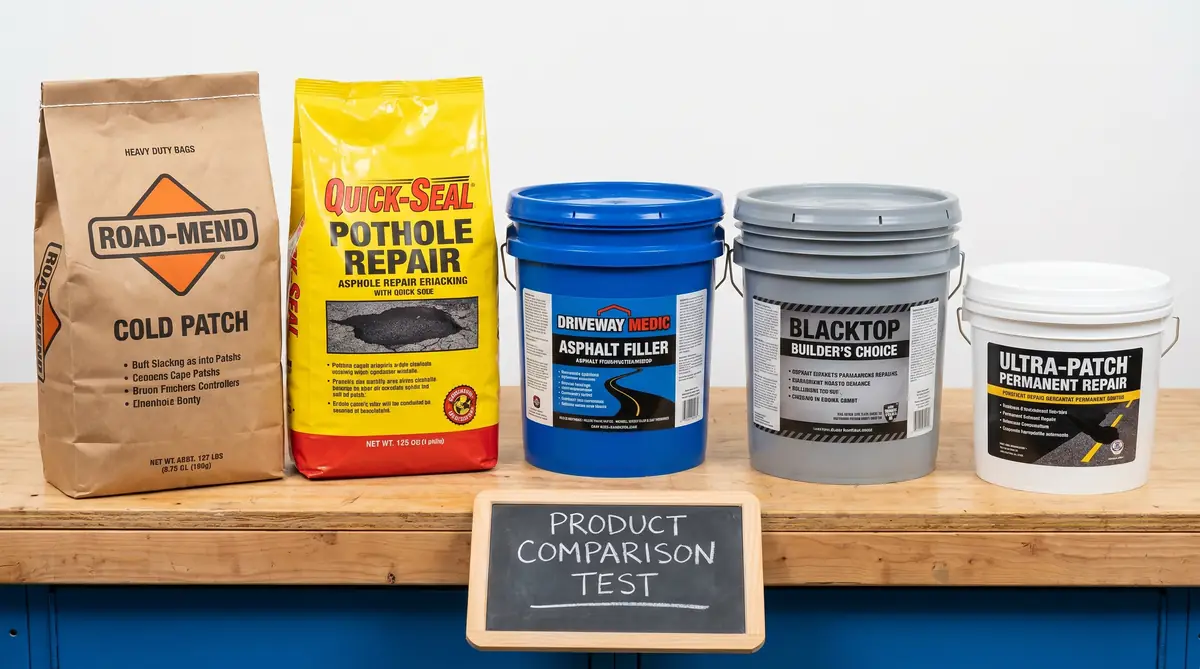
| Brand | Product Type | Price (50 lb) | Quality Tier | Best Trait | Weakness |
|---|---|---|---|---|---|
| Ben's Asphalt | Cold patch, crack filler, sealer | $8–$14 | Consumer | Widely available, affordable | Standard petroleum base — no polymer modifier |
| Quikrete | Cold patch, crack repair | $9–$15 | Consumer | Excellent retail distribution, consistent product | Similar performance ceiling to Ben's |
| Sakrete | Cold patch, asphalt repair | $9–$14 | Consumer | Strong brand recognition, wide availability | No polymer options in most retail SKUs |
| Dalton Enterprises (Pli-Stix) | Crack filler (solid rope) | N/A (linear ft) | Consumer–Premium | Solid rubberized rope melts in — very clean application | Requires heat torch; not for potholes |
| QPR (Quick Patch Road) | Cold patch (polymer-modified) | $18–$28 | Premium consumer | Best-in-class adhesion, polymer-modified, lower solvent odor | 2–3× the price of standard cold patch |
| Aquaphalt | Cold patch (water-activated) | $22–$35 | Premium consumer | Works in wet conditions, no petroleum solvent odor | Highest price; overkill for basic pothole fills |
| Latex-ite (Driveway Sealer) | Sealer (coal tar + asphalt) | N/A (pail) | Consumer | Low price, very wide retail distribution | Coal tar formulas banned in some municipalities |
Where to Buy Ben's Asphalt Products
| Retailer | Products Stocked | Notes |
|---|---|---|
| Home Depot | Cold patch, crack filler, sealer | Most consistent national availability — check in-store vs online inventory separately |
| Lowe's | Cold patch, crack filler, sealer | Similar selection to Home Depot; seasonal stocking — best selection Apr–Sep |
| Tractor Supply Co. | Cold patch bags (50 lb) | Good for rural areas; 50 lb bags often stocked year-round |
| Walmart | Cold patch (seasonal) | Available spring–fall; limited SKU selection vs home improvement stores |
| Amazon | Cold patch, crack filler, kits | Convenient for smaller sizes; confirm in-stock before ordering — listings can be stale |
| True Value / Ace Hardware | Crack filler, sealer | Regional availability; cold patch bags less common than at big-box chains |
| Local asphalt supplier / distributor | Bulk cold patch, sealer | Best price per lb on large quantities; look up "asphalt cold patch distributor" + your city |
Price Per Square Foot Comparison
| Product / Method | Unit Cost | Coverage @ 2" depth | Cost Per Sq Ft |
|---|---|---|---|
| Ben's Cold Patch (50 lb bag) | $10–$14 | ~2 sq ft | $5–$7 / sq ft |
| QPR Cold Patch (50 lb bag) | $18–$28 | ~2 sq ft | $9–$14 / sq ft |
| Aquaphalt (3.5 gal pail) | $28–$38 | ~1.5 sq ft @ 2" | $19–$25 / sq ft |
| Professional hot mix patch | Contractor bid | N/A | $3–$8 / sq ft (installed) |
| Professional infrared repair | Contractor bid | N/A | $6–$12 / sq ft (installed) |
For large repair areas (over 10 sq ft), professional hot mix paving becomes cost-competitive with bagged cold patch and produces a far superior result. Use our Asphalt Repair Cost Calculator to compare options before deciding which route to take.
Step-by-Step: Using Ben's Cold Patch
-
Clear and dry the pothole
Remove all loose material, standing water, vegetation, and debris. Use a wire brush, broom, or air compressor. Cold patch will not bond properly to wet or dirty surfaces — dry conditions are non-negotiable for any durability.
-
Cut back crumbling edges (if needed)
If the pothole edges are crumbling or ragged, cut them back to solid pavement using a circular saw with a diamond blade or cold chisel. Straight, vertical walls give the patch better mechanical anchorage than tapered or crumbling edges.
-
Apply tack coat for deep holes
For potholes deeper than 3 inches, brush a light coat of asphalt tack coat or even used motor oil on the hole walls and base before filling. This acts as an adhesive primer and significantly improves bond for deep patches.
-
Fill in 2–3 inch lifts
Pour Ben's cold patch in layers no more than 2–3 inches thick. For a 6-inch deep pothole, fill in two or three layers and compact each lift before adding the next. Filling all at once leads to poor compaction in the lower material.
-
Overfill the final lift by ½ inch
The final pour should sit ½ inch proud of the surrounding pavement — it will compress down to flush during compaction. If you fill to flush and then tamp, the final surface ends up slightly sunken and water collects there.
-
Compact aggressively
Use a hand tamper, the back of a square shovel, or drive a vehicle over a sheet of plywood placed on the patch. The goal is 10–15 firm strikes per square foot minimum. A plate compactor or rental roller produces the best result — see our roller rental guide for options.
-
Check final height and top up if needed
After compaction, check that the patch surface is flush with or very slightly proud of (1/8 inch max) the surrounding pavement. If the patch is sunken, add more material and compact again. Sunken patches collect water and fail prematurely.
-
Traffic immediately — full cure in 30–90 days
Cold patch is trafficable immediately after compaction. The petroleum solvent continues to evaporate over 30–90 days; the patch gradually hardens during this period. Avoid concentrated loads (dumpster trucks, forklifts) on the repair for at least 2 weeks.
Using Ben's Crack Filler — Key Steps
- Clean the crack: Remove all vegetation, dirt, and loose debris using a wire brush, screwdriver, or compressed air. Any organic material in the crack will prevent adhesion.
- Check crack width: Ben's liquid crack filler is designed for cracks ¼–¾ inch wide. For hairline cracks (under ¼ inch), a diluted sealer coat is sufficient. For cracks wider than ¾ inch, install foam backer rod first to prevent product waste and sinking.
- Pour slowly into the crack: Fill to slightly below the pavement surface — never crown the crack filler above surrounding pavement, as it will track onto shoes and vehicle tires. Use the nozzle to guide the flow.
- Tool flat: Use a putty knife or drywall knife to level the filler flush with pavement surface before it skins over (within 5–10 minutes of pouring).
- Dry time: Allow 4–8 hours before foot traffic, 24 hours before vehicle traffic. Do not apply if rain is expected within 24 hours.
- Sealcoat after 24–48 hours: Once the crack filler is fully dry, apply driveway sealer over the entire surface for a uniform appearance and added protection. Sealcoating over unfilled cracks defeats the purpose of the sealer.
When Ben's Products Are the Right Choice vs When to Call a Pro
| Damage Type | Ben's Product | DIY or Pro? |
|---|---|---|
| Single pothole, under 12" diameter, under 4" deep | Cold Patch bag | DIY — straightforward |
| Multiple potholes (3–10) | Cold Patch bags (bulk) | DIY — cost-effective |
| Linear cracks, ¼"–¾" wide | Crack Filler | DIY |
| Faded surface, no structural damage | Driveway Sealer | DIY |
| Alligator / crocodile cracking | None — base failure | Pro required |
| Pothole over 18" diameter or 4" deep | Cold patch as temp fix only | Pro for permanent repair |
| Edge failures / raveling over large area | Cold patch as temp fix only | Pro mill & overlay |
| Full driveway resurfacing | Not applicable | Pro hot mix paving |
- Applying over wet pavement — the most common failure cause. Cold patch won't bond to wet surfaces and pops out within weeks.
- Under-compacting — a few taps isn't enough. Cold patch needs aggressive, repeated compaction to achieve any density. Light tamping = a soft, loose patch that fails in months.
- Filling alligator cracking with cold patch — alligator cracking is a base failure, not a surface problem. Filling the surface does nothing; the base moves and pops any filler out within one season.
- Using aged, hardened bags — check the bag before purchase. Squeeze it: if it's hard and chunky, it's partially cured and won't compact properly. Refuse those bags.
- Applying sealer over active cracks — fill cracks first, let them dry 24–48 hours, then seal. Sealing over open cracks just bridges them temporarily and leads to early sealer failure at the crack lines.
- Expecting a permanent repair from cold patch — it's a semi-permanent fix (1–3 years). Plan to monitor the repair and re-apply as needed, or budget for proper hot mix patching.
Storage and Shelf Life
| Product | Shelf Life (unopened) | Shelf Life (opened) | Storage Tips |
|---|---|---|---|
| Cold Patch bags | 12–18 months | 3–6 months (reseal tightly) | Store indoors or shaded; heat accelerates curing; cold makes it stiff but not unusable |
| Crack Filler (liquid) | 12–24 months | 3–6 months (reseal cap) | Keep above freezing; freezing can separate the emulsion permanently |
| Driveway Sealer | 12–24 months | 6–12 months (stir well) | Store above 32°F; never allow to freeze; stir from the bottom before use |
Frequently Asked Questions
What is Ben's Asphalt?
Ben's Asphalt is a brand of ready-to-use asphalt maintenance products — primarily cold patch bags for pothole repair, liquid crack filler, and driveway sealer. Products are designed for DIY use with no heating or special equipment required.
How long does Ben's Asphalt cold patch last?
Properly applied and compacted, Ben's cold patch lasts 1–3 years under normal residential traffic. Longevity depends heavily on compaction quality and whether the area has underlying drainage or base issues. It is a semi-permanent repair — not a permanent solution for structural failures.
Where can I buy Ben's Asphalt products?
Home Depot, Lowe's, Tractor Supply, Walmart (seasonal), and Amazon. Availability is strongest in spring and summer. Call ahead to confirm stock — cold patch can sell out quickly during spring pothole season.
How do you use Ben's Asphalt cold patch?
Clean and dry the hole, fill in 2–3 inch layers, overfill by ½ inch, then compact aggressively. Traffic is OK immediately after compaction. Full cure takes 30–90 days. See the step-by-step guide above for details.
Is Ben's Asphalt good quality?
It performs comparably to other consumer-grade cold patch brands (Quikrete, Sakrete) — adequate for residential pothole repairs. For superior adhesion and longevity, polymer-modified products like QPR or Aquaphalt outperform standard cold patch but cost 2–3× more. See the full product comparison guide for all categories.
How much does a bag of Ben's Asphalt cover?
A 50 lb bag covers roughly 1.5–2.5 sq ft at a 2-inch compacted depth. For a standard 12" × 12" × 3" pothole, plan on 1.5 to 2 bags. Always buy 20% extra — running short means a second store trip mid-job.
Can I use Ben's Asphalt in cold weather?
Yes — cold patch is formulated to work at low temperatures and remains workable to about 0°F. Warm the bags in direct sunlight before application if possible, and compact aggressively. Cold-weather repairs may need a top-up in spring.
What's the difference between Ben's Asphalt and hot mix?
Hot mix asphalt (HMA) is installed at 275–325°F and achieves 92–96% of maximum compaction density — the permanent, structural standard for driveways and roads. Ben's cold patch never fully cures to that density level. Use cold patch for spot repairs; hire a paving contractor for anything structural or over 10 sq ft. See our guide on asphalt in bags for a full cold-patch category comparison.
Related Guides
References: FHWA Pavement Preservation · Asphalt Institute · ASTM D4215 Cold Mix Asphalt Standard