
Concrete Cement Mixers — Types, Sizes, Best Models & How to Use (2026)
Quick Answer — Which Mixer Do You Need?
Small DIY jobs (fence posts, footings, steps): 3.5–5 CF electric drum mixer. Rent for $45–$75/day or buy for $250–$400.
Medium projects (small slabs, patios up to 1 CY): 9 CF gas drum mixer. Rent for $75–$110/day. Buying only makes sense if you pour regularly.
Mortar, stucco, tile grout, fiber-reinforced mix: Pan/paddle mixer. Produces far more uniform stiff mixes than a drum mixer.
Large projects (driveways, garage slabs, foundations): Skip the mixer — order ready-mix concrete. At 1+ cubic yards, a ready-mix truck is faster, cheaper per yard, and produces better-quality concrete than any drum mixer.
Do You Actually Need a Concrete Mixer?
Before renting or buying, it's worth answering an honest question: does your project actually require a mixer, or would another approach be faster and cheaper? There are three realistic options for producing mixed concrete on a job site:
Hand mixing in a wheelbarrow or mortar tub works adequately for very small quantities — up to 3–4 bags of concrete mix. It requires no equipment, produces acceptable results for minor repairs and small pours, and takes about 5 minutes per bag with a mixing hoe. The limitation is physical fatigue and inconsistent mixing quality — it's genuinely hard work to achieve a uniform mix by hand with a heavy 80-lb bag.
A drum or pan mixer is the right choice for projects requiring 5 to roughly 30–40 bags of concrete (up to about 1 cubic yard). The mixer dramatically reduces physical effort, produces more consistent results than hand mixing, allows you to work at your own pace, and can be stopped between pours. This is the sweet spot where renting or owning a mixer delivers clear value.
Ready-mix concrete delivery is the correct choice for projects requiring more than 1–1.5 cubic yards. At that volume, a drum mixer becomes a bottleneck — you'd need to run 14–20 batches on a 3.5 CF mixer to pour a single cubic yard, which takes several hours and introduces quality inconsistency between batches. A ready-mix truck delivers precisely batched, consistently mixed concrete at roughly $120–$200 per cubic yard — often less expensive than renting a mixer for multiple days plus the cost of bagged materials at larger quantities.
5 Types of Concrete Mixers — Full Comparison
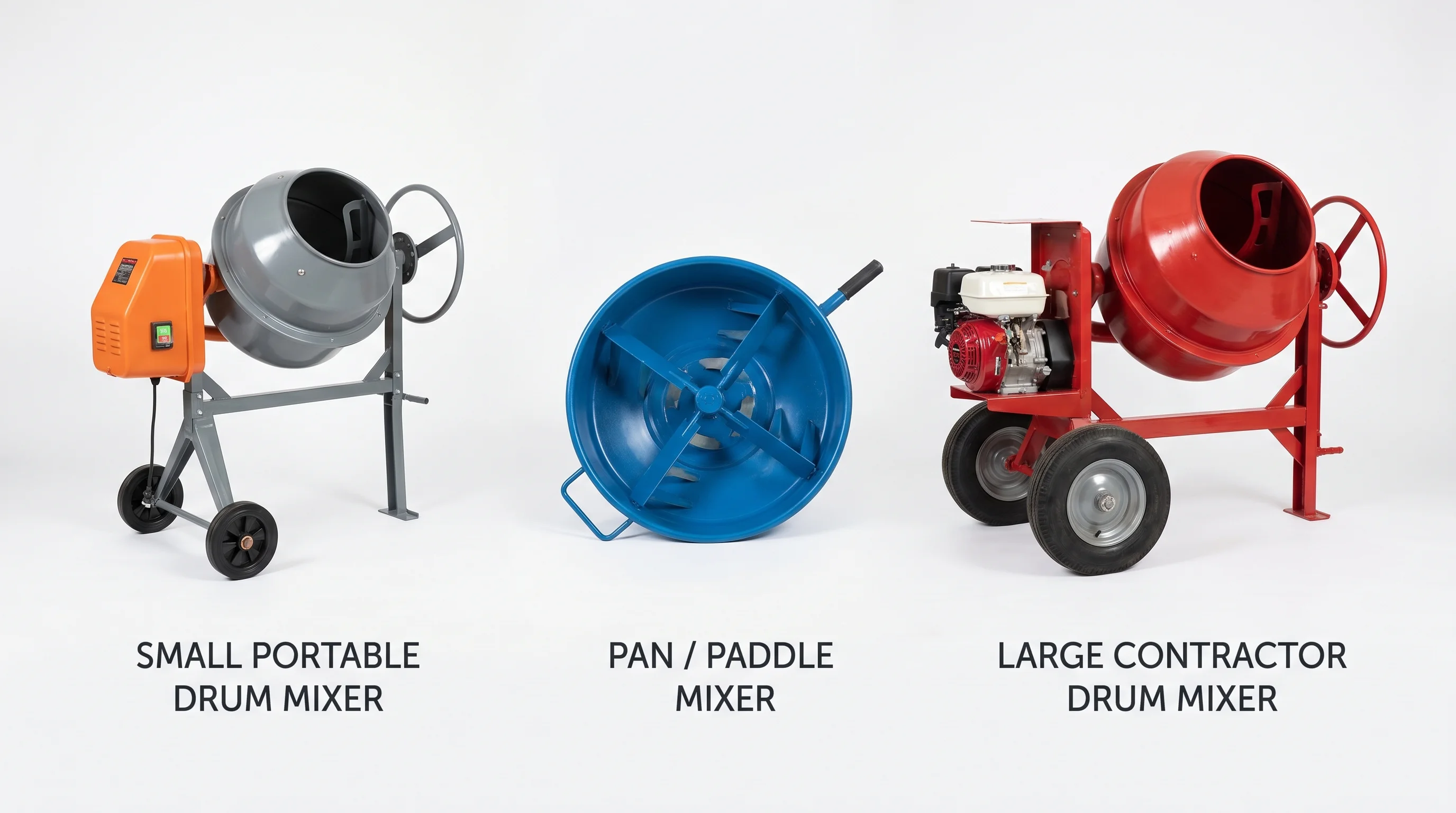
| Mixer Type | Capacity Range | Mixing Action | Best Use | Rental/Day | Buy Cost |
|---|---|---|---|---|---|
| Electric drum mixer | 1.5–5 CF | Tumbling rotation | DIY slabs, footings, fence posts | $45–$75 | $250–$500 |
| Gas drum mixer | 6–12 CF | Tumbling rotation | Contractor jobs, remote sites (no power) | $75–$120 | $800–$2,500 |
| Pan / paddle mixer | 2–10 CF | Paddle shearing | Mortar, stucco, stiff mixes, precast | $80–$130 | $1,200–$4,000 |
| Volumetric mixer | Continuous | Auger batching | Large contractor pours, variable mix designs | $400–$800+ | $80,000–$200,000 |
| Mortar mixer | 3–9 CF | Ribbon/auger paddle | Masonry mortar, plaster, grout | $60–$100 | $700–$2,000 |
Drum Mixers — Deep Dive
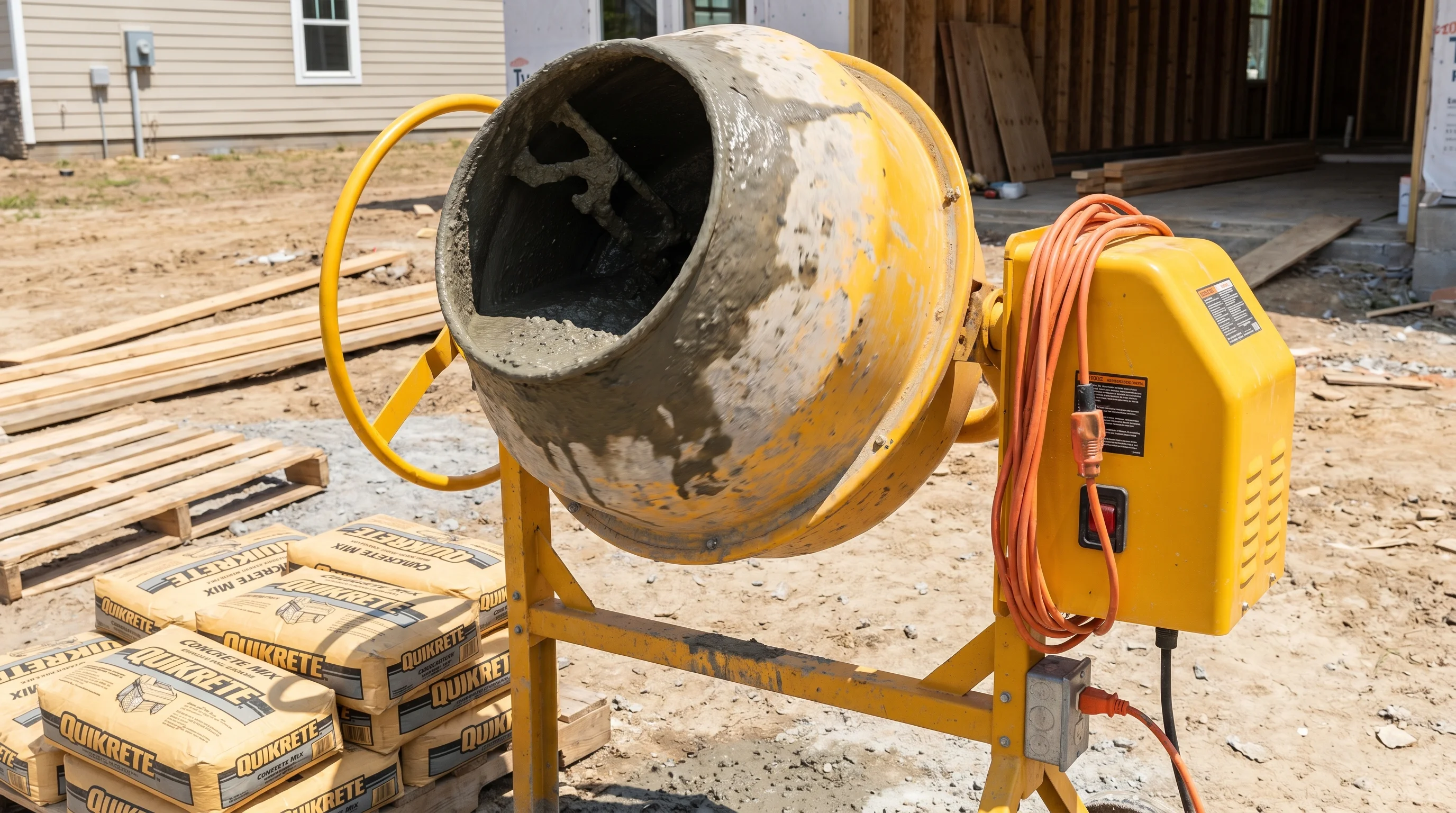
Drum mixers — also called barrel mixers — are the most common type of concrete mixer on residential and light commercial job sites. They consist of a rotating cylindrical drum fitted with internal fins or blades that tumble the concrete ingredients as the drum rotates, achieving mixing through repeated lifting and dropping of the material. They are mechanically simple, reliable, and easy to clean, which is why they dominate the DIY and small contractor market.
Electric vs Gas Drum Mixers
Electric drum mixers are quieter, require no fuel, produce no exhaust fumes, and are significantly less expensive to purchase and maintain than gas-powered units. They are the standard choice for residential projects where a power outlet is accessible within a reasonable distance. The limitation is that they require a 120V or 240V power source — for remote job sites without electrical access, a gas mixer or a generator is needed. Most electric drum mixers in the 3.5–5 CF range draw 5–9 amps at 120V and can run on a standard household circuit with a properly rated extension cord.
Gas drum mixers provide the power and portability needed for larger batches and remote sites. They are louder, require regular maintenance (oil changes, spark plug replacement, air filter cleaning), and cost more to purchase and operate. Gas mixers in the 9–12 CF range are the standard rental unit for contractor-scale work — they can produce the volume needed to keep a small crew consistently supplied with fresh concrete. For DIY use, the added complexity and cost of a gas mixer is rarely worth it unless you are working somewhere without power.
Tilting vs Non-Tilting Drums
Tilting drum mixers have a drum that can be angled to pour mixed concrete into a wheelbarrow or form without moving the machine. The drum is loaded vertically, mixes in the angled position, and tips forward to discharge. This design makes it easy to produce a consistent pour location and simplifies cleanup. Most professional and rental drum mixers use a tilting design.
Non-tilting (fixed-drum) mixers have an opening at one end through which both loading and discharge occur — the drum rotates in one direction for mixing, then reverses to discharge. They are slightly simpler mechanically but less convenient to discharge accurately into a wheelbarrow or narrow form. Most consumer-grade drum mixers sold in home improvement stores use a fixed-drum design to reduce cost and mechanical complexity.
Batch Size Math
A drum mixer's rated capacity (e.g., "3.5 CF") refers to the total drum volume, not the usable concrete output per batch. Because you need room inside the drum for the ingredients to tumble, the maximum practical batch size is approximately 60–65% of the rated drum volume. A 3.5 CF mixer produces about 2.2–2.3 CF of mixed concrete per batch; a 9 CF mixer produces about 5.5–6 CF per batch. To convert cubic feet of concrete to cubic yards, divide by 27 (there are 27 cubic feet in a cubic yard). So a 9 CF mixer at 6 CF output per batch produces roughly 0.22 cubic yards per batch — about 4–5 batches per cubic yard of concrete needed.
Pan / Paddle Mixers — Deep Dive
Pan mixers — sometimes called paddle mixers or forced-action mixers — work on a fundamentally different principle than drum mixers. Instead of tumbling ingredients through rotation of the drum, they use a stationary pan with rotating paddles or augers that move through the mix, applying a direct shearing and kneading action to the ingredients. This produces a more thorough, uniform mix — particularly for stiff, low-slump mixes that don't tumble effectively in a drum.
The forced-action mechanism of a pan mixer makes it the preferred tool for mortar, stucco, concrete block fill, tile grout, fiber-reinforced concrete, and any mix where consistent, thorough blending of stiff material is required. For standard concrete with coarse gravel aggregate, a drum mixer works perfectly well. But for fine-aggregate mixes — mortar for brick laying, rendering mixes, self-compacting concrete — a pan mixer produces measurably better results.
Pan mixers are more expensive to rent and buy, require more thorough cleaning (the pan and paddles need to be scraped and washed), and are less mobile than drum mixers. For most residential DIY concrete work, a drum mixer is the practical choice. Pan mixers are most often seen in masonry contractors' operations, precast concrete shops, and specialty tile and stone installation.
Volumetric Mixers — Deep Dive
Volumetric mixers are truck-mounted continuous-batching machines that carry separate compartments of cement, aggregate, sand, water, and admixtures and mix the concrete on demand as it is dispensed. Unlike a standard ready-mix truck — which carries pre-mixed concrete that begins hydrating during transit — a volumetric mixer produces fresh concrete at the point of placement, allowing the mix design to be changed between pours, eliminating washout waste, and ensuring the concrete is never over-mixed or beginning to set before it reaches the form.
For contractors handling multiple projects in a day, or pours requiring different concrete strengths in different areas (e.g., a stronger mix for a foundation and a standard mix for a slab on the same site), a volumetric mixer is a significant operational advantage. The per-yard cost is comparable to or slightly higher than ready-mix, but the elimination of wasted loads and the flexibility of on-site mix adjustment can reduce overall project cost on complex pours. Volumetric mixer services are available in most metro areas through specialty concrete equipment rental companies.
8 Top Concrete Mixer Models
Kushlan 350DD — Best Overall Electric Drum Mixer for DIY
3.5 CF direct-drive electric drum mixer widely regarded as one of the most reliable consumer-grade mixers available. Direct-drive motor (no belt to slip or replace) provides consistent torque through the full range of mix consistency. Heavy-duty polyethylene drum is corrosion-proof and easy to clean. Wheels for easy repositioning. 1/2 HP motor runs on standard 120V. Approximately $300–$380. Weight: 77 lbs. Produces about 2.2 CF per batch — roughly 10–12 batches per cubic yard of concrete.
Imer Syntesi 100 — Best Professional Electric Mixer
3.5 CF professional-grade tilting drum mixer from Italian manufacturer Imer, widely used by masonry contractors and tile setters. Gear-drive transmission (more durable than belt or direct-drive for heavy continuous use), heavy-gauge steel drum, and a tilting design that makes discharge precise and cleanup straightforward. Built for daily professional use — significantly heavier-duty than consumer models. 110V electric. Approximately $800–$1,100. Ideal for contractors who mix multiple batches per day.
Multiquip MC94SH — Best 9 CF Gas Mixer for Contractors
9 CF tilting drum mixer powered by a Honda GX160 5.5 HP engine — the industry-standard gas concrete mixer for contractor use and equipment rental fleets. Produces approximately 5.5–6 CF of mixed concrete per batch. Heavy-duty steel drum with replaceable mixing blades. Pneumatic tires for site mobility. Electric start option available. This is the machine you get when you rent a "large concrete mixer" at most equipment rental centers. New cost: $2,200–$2,800. Rental: $85–$120/day.
YARDMAX YM0046 — Best Budget Electric Mixer
4 CF electric drum mixer at the most competitive price point for casual DIY use. Belt-drive motor, welded steel frame, and a non-tilting drum with a discharge chute. Coverage: adequate for fence posts, small footings, and repair work. Not built for continuous daily use — the belt drive requires periodic adjustment and is the most common failure point on budget mixers. 120V, 0.5 HP. Approximately $200–$260. A solid choice for a homeowner who will use it for one or two projects a year.
Northern Industrial Tools 3.5 CF — Best for Occasional Homeowner Use
3.5 CF electric drum mixer from Northern Tool targeting the homeowner market. Gear-driven at this price point — a meaningful advantage over belt-drive competitors. Folds flat for storage, which is a practical benefit for users with limited garage space. Produces adequate results for small concrete and mortar batches. 120V, 1/2 HP. Approximately $250–$320. Not intended for professional or daily use; suitable for the homeowner with occasional projects requiring more than hand-mixing but less than a full contractor setup.
Crown Engineering C6 — Best Pan / Paddle Mixer for Mortar & Stucco
6 CF pan mixer with twin-paddle mixing action, ideal for mortar, stucco, GFRC (glass fiber reinforced concrete), and any stiff or fiber-reinforced mix that doesn't tumble effectively in a drum mixer. Heavy-duty steel pan with replaceable wear liner, 1 HP electric motor, and a tilt-discharge mechanism. Used by masonry and plastering contractors for consistent batch-to-batch uniformity. Approximately $1,800–$2,400. Rental: $80–$130/day at specialty equipment rental houses.
Klutch 4 CF Portable Electric Mixer — Best for Tight Spaces
4 CF compact electric drum mixer designed specifically for easy transport and use in confined spaces — basements, crawl spaces, and interior renovation work. Foldable handle and compact footprint allow it to fit through standard doorways. Belt-drive 1/2 HP motor at 120V. Adequate for mortar, thin-set, and small concrete batches in locations where a larger mixer can't fit. Approximately $270–$330. Not the most durable long-term investment, but solves a specific access problem effectively.
Rice Hydro PDM-1 Portable Drum Mixer — Best for Remote Sites
1.5 CF ultra-portable electric drum mixer designed for remote concrete placement — post holes, small repairs, and confined access areas. Runs on 120V and weighs just 50 lbs, making it genuinely portable for one person. Not suitable for large pours — best for finishing the last few bags on a job where ready-mix delivered the bulk. Produces about 0.9 CF per batch. Approximately $400–$550. Niche product but the right tool for specific situations where a standard mixer can't reach.
Rent vs Buy — Decision Guide
| Scenario | Recommendation | Reason |
|---|---|---|
| One project per year or less | Rent | Rental pays for itself vs. storage, maintenance, and depreciation of owned unit |
| 2–4 projects per year | Buy budget model ($250–$350) | Pays off in 3–5 rentals; cheaper than ongoing rental fees |
| Regular contractor use (weekly) | Buy professional model ($800–$2,500) | Durability justifies cost; downtime from budget mixer failure costs more |
| Project over 1 CY concrete | Order ready-mix instead | Mixer too slow; ready-mix is cheaper per yard at this volume |
| Need 9+ CF capacity | Rent | Large mixers cost $2,000+ and are rarely used enough to justify ownership |
| Mortar / stucco only | Rent pan mixer as needed | Pan mixers are expensive to buy; rental cost per job is low |
| Mixed concrete AND mortar regularly | Buy drum mixer + rent pan when needed | Drum handles most work; pan rental covers specialty mixes |
Mixer Size Selection Guide
| Mixer Size | Output per Batch | Batches per CY | Bags per Batch (80 lb) | Best Project Size |
|---|---|---|---|---|
| 1.5 CF | ~0.9 CF | ~30 | 1 bag | Post holes, small repairs |
| 3.5 CF | ~2.2 CF | ~12–13 | 2 bags | Footings, steps, small slabs up to 0.5 CY |
| 5 CF | ~3.2 CF | ~9 | 3 bags | Patios, driveways up to 0.75 CY |
| 9 CF | ~5.5–6 CF | ~4–5 | 5–6 bags | Slabs and pours up to 1.5 CY |
| 12 CF | ~7.5 CF | ~3–4 | 7–8 bags | Large footings, walls, pours 1–2 CY |
How to Mix Concrete in a Drum Mixer — 8 Steps
Consistent technique every batch produces consistent concrete. Varying the water amount, loading order, or mix time between batches produces unpredictable strength and workability — especially problematic on structural pours where all the concrete in a footing or slab needs the same strength.
-
1
Set up the mixer on level, stable ground
Position the mixer on a flat surface close enough to your pour location to discharge into a wheelbarrow with minimal travel. Chock the wheels. If using an electric mixer, run the power cord safely — never run it through water or across a path where it can be tripped on or run over. Start the drum rotating before adding any materials.
-
2
Add approximately half the water first
Pour about half of your total water into the rotating drum before adding any dry ingredients. This wets the drum interior and prevents dry cement powder from clinging to the drum walls and forming dry lumps that never fully incorporate. Use clean potable water — water that is safe to drink is safe for concrete. Avoid seawater, water with high mineral content, or water with visible contamination.
-
3
Add coarse aggregate (gravel)
Add all the coarse aggregate for the batch. The gravel helps scour the drum and begins breaking up any clumped material. For bagged concrete mix (which already contains pre-blended cement, sand, and aggregate), skip steps 3–5 and add the entire bag contents after the initial water addition. This loading order applies when batching from separate ingredients (bulk cement, sand, and gravel).
-
4
Add fine aggregate (sand)
Add all the sand for the batch. Allow the drum to rotate for 30–60 seconds after adding the sand to begin blending with the aggregate before the cement is introduced. Adding cement at this stage rather than earlier prevents it from coating the drum walls and ensures it distributes evenly through the aggregate matrix.
-
5
Add cement — always last among dry ingredients
Add all the Portland cement for the batch. Never add cement to a dry drum — always add it after the aggregates and initial water are already in the drum. Allow the drum to mix for 60–90 seconds after adding the cement before making any water adjustments. This gives the cement time to coat the aggregate particles evenly before you assess consistency.
-
6
Add remaining water incrementally — check consistency
Add the remaining water in small increments (a cup at a time for small batches, a quart at a time for large batches), allowing 30–60 seconds of mixing between additions. Never add all the remaining water at once — it's far easier to add water than to remove it, and a single over-pour of water can ruin a batch's strength. Stop adding water when the mix reaches the correct consistency for your application (see slump test section below).
-
7
Mix for a total of 3–5 minutes after all ingredients are added
Time the full mix cycle from when the last water was added. Three minutes is the minimum for a uniform mix — less than this produces inconsistent cement distribution and reduced strength. Five minutes is ideal. More than 10 minutes begins to work the mix too much; on hot days, excessive mixing can accelerate setting and reduce workability. The finished mix should be uniform gray throughout with no dry pockets, lumps, or visible dry cement dust.
-
8
Discharge, place, and clean immediately
Tilt or reverse the drum to discharge the mixed concrete into a wheelbarrow. Place the concrete promptly — standard concrete without accelerators begins to set within 30–45 minutes of mixing, and workability drops significantly in the first 20 minutes. After each batch, add 2–3 gallons of water and a shovelful of gravel to the rotating drum and run for 2 minutes to clean before loading the next batch. At the end of the job, clean thoroughly before the concrete sets.
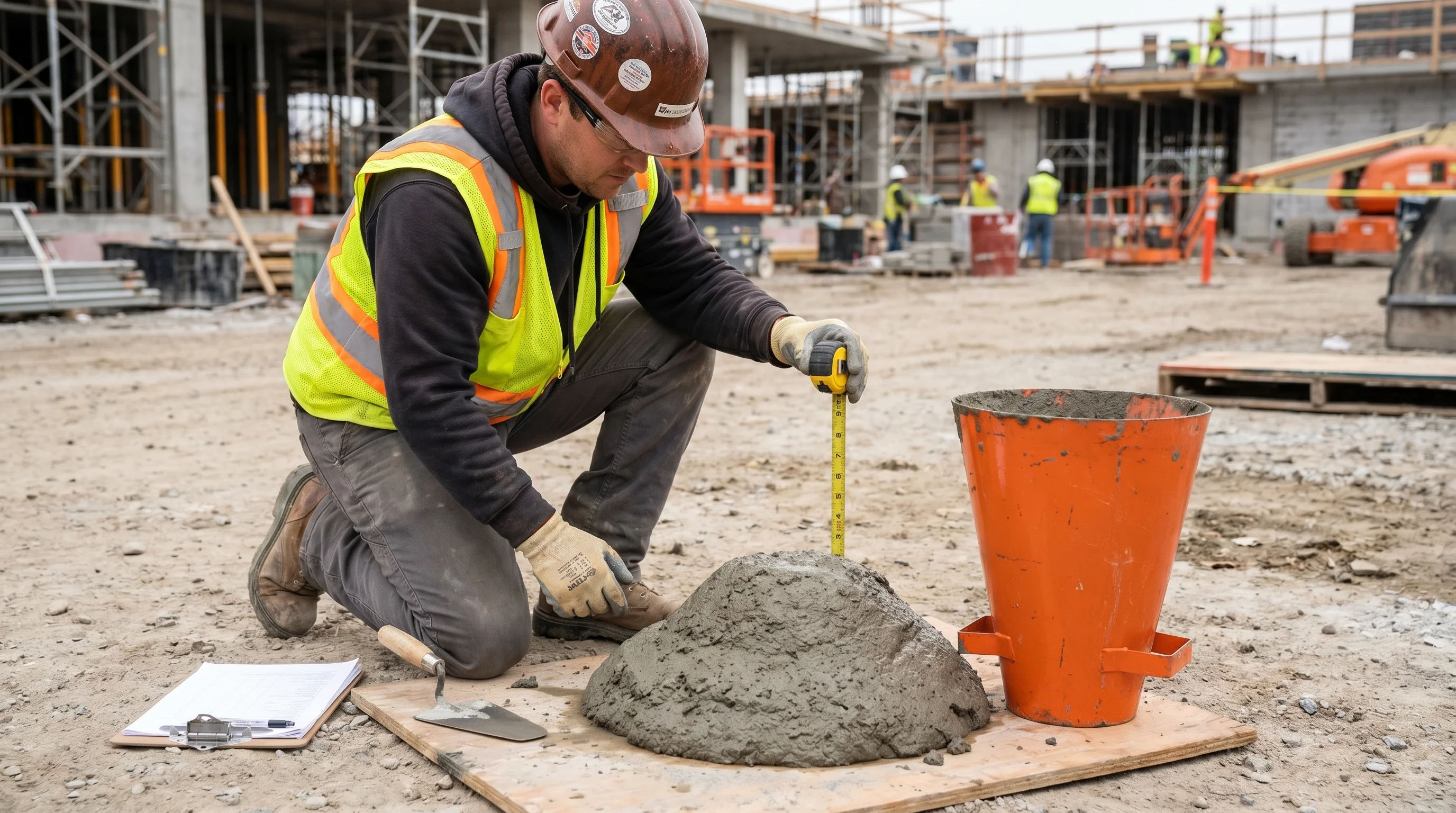
- A slump cone (12 inches tall, frustum shape) costs about $15 and is worth having on any pour where concrete strength matters
- Fill the cone in three equal layers, rodding each layer 25 times with a 5/8-inch rod to consolidate
- Lift the cone straight up and place it inverted beside the concrete mound
- Measure the difference in height between the top of the cone and the top of the slumped concrete — this is your slump value
- 0–2 inches slump: Very stiff mix — good for precast, road base, and any application where the concrete must hold its shape. Hard to place and consolidate.
- 2–4 inches slump: Standard workability — correct for most residential concrete: driveways, slabs, footings, and walls. This is the target range for most DIY pours.
- 4–6 inches slump: Wet, fluid mix — easier to place but weaker. Only acceptable for lightly loaded applications. Indicates too much water was added.
- 6+ inches slump: Overly wet mix — do not use for structural applications. Adds water has permanently reduced strength. Cannot be corrected by adding dry cement.
Concrete Mix Ratios by Application
| Application | Mix Ratio (cement:sand:gravel) | W/C Ratio | Target Strength | Notes |
|---|---|---|---|---|
| General purpose / slabs | 1:2:3 | 0.50–0.55 | 3,000–3,500 PSI | Standard residential concrete — driveways, patios, walkways |
| Foundations / footings | 1:1.5:3 | 0.45–0.50 | 3,500–4,000 PSI | Lower w/c ratio for structural applications; less permeable |
| High strength (structural) | 1:1:2 | 0.40–0.45 | 4,500–5,000 PSI | Stiff mix; requires thorough vibration to consolidate |
| Masonry mortar (type S) | 1:0.5:4.5 (cement:lime:sand) | 0.50–0.60 | 1,800 PSI | For brick, block, and stone; lime improves workability |
| Stucco (scratch coat) | 1:3 (cement:sand) | 0.45–0.55 | N/A | No coarse aggregate; must adhere to substrate |
| Fence post fill | Bagged fast-set mix | Per bag instructions | 4,000 PSI typical | Fast-set concrete in post hole — pour dry and add water in hole |
| Self-leveling underlayment | Pre-blended product only | Per product spec | 3,000–5,000 PSI | Do not batch by hand — flow properties require precise admixture ratios |
Common Concrete Mixing Mistakes
- Adding too much water — the single most common mistake; every extra liter of water beyond the design w/c ratio reduces concrete strength and increases permeability; add water incrementally and stop at 2–4 inch slump
- Overloading the drum — filling beyond 65% of rated capacity prevents adequate tumbling and produces a poorly mixed batch; more ingredients does not mean faster — it means a weaker result
- Wrong loading order — adding cement to a dry drum before the aggregates causes cement to clump on the drum walls; always wet the drum first with water, then aggregate, then cement
- Under-mixing — less than 3 minutes — cement doesn't distribute evenly in short mix times; you can see dry gray streaks in under-mixed concrete; time every batch, especially when fatigued
- Using dirty or contaminated water — sugar, oil, acids, and high mineral content all interfere with cement hydration and reduce strength; use only clean potable water
- Letting concrete sit in the drum too long between pours — concrete begins hydrating immediately after water is added; letting a batch sit for 20+ minutes in a stationary drum causes it to stiffen and partially set; always place promptly
- Not cleaning the drum between batches — residual concrete from previous batches contaminates the next batch with partially set material, reducing workability and creating lumps; rinse between every batch
- Mixing concrete in freezing temperatures without protection — concrete must be maintained above 50°F during the first 24 hours of curing; mixing in near-freezing conditions and placing without insulation or heat causes the concrete to freeze before it cures, permanently destroying strength
Rotating drum mixers present serious injury risks that are frequently underestimated on residential job sites. Never reach into or near a rotating drum for any reason — even to break up a clump of dry material. Always stop the drum before checking consistency or clearing a blockage. Keep loose clothing, gloves, and cords away from the drum opening and drive mechanism. Concrete is highly alkaline (pH 12–13) — prolonged skin contact causes chemical burns; wear gloves and eye protection when handling wet concrete or cleaning the mixer. Never use water to clean a drum mixer while the motor is running — electrical shock risk. Always shut off the motor before directing water into the drum for cleaning.
Renting a Concrete Mixer — What to Check Before Accepting
- Drum interior — no large chunks of hardened concrete that would reduce effective capacity or contaminate your mix
- Drum fins / mixing blades — not excessively worn down (worn fins reduce mixing effectiveness significantly)
- Drive belt or gear mechanism — no visible cracking, fraying, or excessive slack in the belt; gears engage smoothly
- Motor / engine — starts immediately, runs smoothly without excessive vibration or unusual noise
- Electric cord (electric models) — no cuts, fraying, or damaged insulation; ground prong intact
- Tires — adequately inflated for site mobility; check for flat spots that indicate prolonged storage in one position
- Discharge mechanism — drum tilts or reverses smoothly; no binding or sticking
- Frame — no cracked welds, bent supports, or missing fasteners that would affect stability during operation
- Confirm rental includes: mixing paddles (for pan mixers), any required extension cords, and documentation of return condition inspection procedure
Frequently Asked Questions
What size concrete mixer do I need?
For most DIY projects — footings, fence posts, small slabs — a 3.5 to 5 CF electric drum mixer is sufficient. A 3.5 CF mixer produces about 2.2 CF per batch. For projects over 1 cubic yard, order ready-mix instead — it's faster and often cheaper per yard than renting a mixer and buying bagged material.
How long should you mix concrete in a mixer?
Mix for 3–5 minutes after all ingredients including the final water increment have been added. Less than 3 minutes produces under-mixed concrete with uneven cement distribution. More than 10 minutes can accelerate setting. The visual check: uniform gray color throughout with no dry pockets or streaks, and the mix pulls cleanly from the drum walls.
What is the correct water to cement ratio?
0.45–0.55 by weight for most residential concrete. Lower (0.40–0.45) for structural and driveway applications. For an 80-lb bag, start with about 3 quarts of water and add incrementally. Target a 2–4 inch slump. Never add water to fix stiff concrete after placement has begun — it permanently reduces strength.
Can I rent a concrete mixer?
Yes — Home Depot Tool Rental, Sunbelt, United Rentals, and most local equipment rental houses carry 3.5 CF electric and 9 CF gas mixers. Typical rates: $45–$75/day for electric, $85–$120/day for gas. Renting makes sense for one-time or infrequent projects; buying makes sense if you mix concrete more than 3–4 times per year.
What is the difference between a concrete mixer and a mortar mixer?
A drum concrete mixer tumbles ingredients — effective for standard concrete with coarse gravel aggregate. A mortar/pan mixer uses paddles that shear through the mix — better for stiff mixes without coarse aggregate (mortar, stucco, grout). Using a mortar mixer for gravel concrete can overload the paddles. Using a drum mixer for mortar works but produces less uniform results.
How do I clean a concrete mixer?
Immediately after each session: add 2–3 gallons of water and a shovelful of gravel to the rotating drum, run for 2–3 minutes, dump the slurry, and rinse with a hose. Never let concrete cure inside the drum. For hardened buildup, dilute muriatic acid (10:1 water to acid) dissolves cured cement — rinse thoroughly afterward and neutralize with baking soda solution.
How much concrete can a mixer produce per hour?
A 3.5 CF mixer: roughly 15–20 CF (0.55–0.74 cubic yards) per hour with one operator. A 9 CF mixer: roughly 1–1.5 cubic yards per hour. These rates assume 5-minute mix cycles including loading and discharging. Production drops significantly in hot weather as the concrete sets faster and cleanup between batches takes longer.
What order do you add ingredients to a concrete mixer?
Half the water first → coarse aggregate (gravel) → fine aggregate (sand) → cement → remaining water incrementally. Never add cement to a dry drum — the initial water and aggregate coat the drum and prevent dry cement from clumping on the drum walls. For bagged pre-blended concrete mix: half the water → entire bag contents → remaining water to consistency.