
Hot Tub Repair Cost: Prices by Problem, DIY Fixes and When to Replace
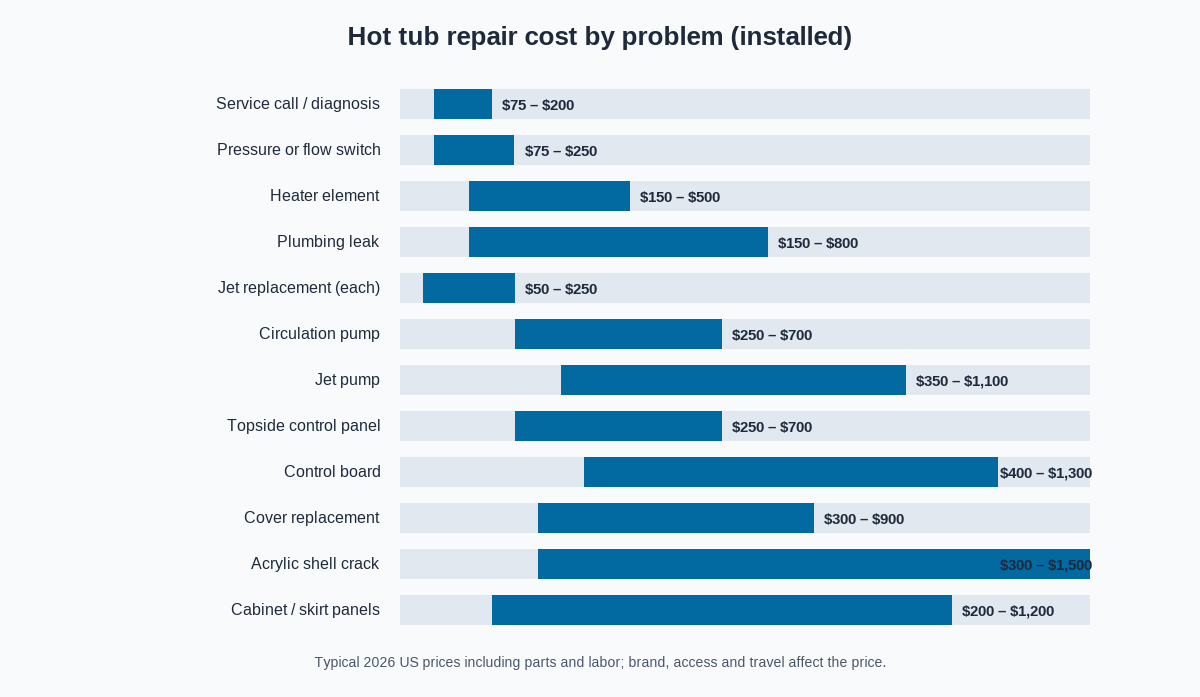
Chart: Asphapro.com
Quick Answer
The typical hot tub repair cost is about $150 to $800, with most homeowners paying around $350 to $500. A service call costs $75 to $200, often credited toward the repair. Common repairs include a pressure or flow switch ($75 to $250), a heater element ($150 to $500), a circulation pump ($250 to $700), a jet pump ($350 to $1,100), a topside panel ($250 to $700) and a control board ($400 to $1,300). Leaks cost $150 to $800 depending on location. If repairs on an older tub would top about half the price of a new one, replacing is often the better choice.
Hot tubs combine water, heat, electricity and moving parts, so something eventually needs fixing. Some problems, such as a tripped breaker, a dirty filter or a stuck pressure switch, cost little or nothing to solve. Others, such as a failed control board or a leak hidden under the shell, are expensive. Knowing typical hot tub repair cost helps you budget, judge quotes and decide whether to fix an older tub or replace it.
This guide breaks down hot tub repair cost by problem, explains what drives the price, covers DIY fixes and shows when replacement makes more sense. For running costs, see how much does a hot tub cost per month.
Hot Tub Repair Cost by Problem
Service Call and Diagnosis: $75 to $200
Most technicians charge a trip or diagnostic fee to come out, test the system and find the fault. Many credit this fee toward the repair if you go ahead. Rural areas and weekend or emergency calls cost more, and some companies charge extra for travel beyond a set distance. The service call is part of almost every hot tub repair cost, so ask about it when you book.
Pressure Switch or Flow Switch: $75 to $250
These switches tell the control system that water is flowing before the heater turns on. A failed or dirty switch can stop the heater and show an error code. The part is cheap, so this is one of the lowest hot tub repair cost items.
Heater Element: $150 to $500
If the tub will not heat, the heater element may have burned out, often from scale, low flow or running dry. Replacing the element is common; replacing the whole heater assembly costs more.
Circulation Pump: $250 to $700
Many tubs have a small circulation pump that runs for filtering and heating. When it fails, water may not heat or filter. Replacement cost depends on the model.
Jet Pump: $350 to $1,100
Jet pumps power the jets and sometimes filtration. A failed motor, seized bearings or a leaking seal are common problems. Rebuilding the motor or replacing just the seal can lower hot tub repair cost compared with a full pump.
Topside Control Panel: $250 to $700
The control panel on the tub's edge can fail from water intrusion, sun or age. Buttons that do not respond or a blank display are common signs, and a cover over the panel helps it last.
Control Board: $400 to $1,300
The main board controls heating, pumps, lights and safety. It can be damaged by power surges, moisture or age. This is often the most expensive electrical hot tub repair cost item.
Leaks: $150 to $800
Leaks at pump unions, heater fittings or jets are often easy to reach and fix. Leaks in hidden plumbing under foam insulation take more time to locate and repair. Leak detection alone can cost $100 to $300, and removing and replacing foam insulation adds labor.
Jets: $50 to $250 Each
Jets can crack, leak or stop rotating. Many can be replaced from inside the tub with a simple tool; others need access from behind the cabinet.
Cover Replacement: $300 to $900
Waterlogged, torn or sagging covers waste energy and should be replaced. Cover cost depends on size, thickness, foam density and the quality of the vinyl and seams.
Shell Cracks: $300 to $1,500
Small cracks in acrylic shells can sometimes be repaired with filler and polish; large cracks, blisters or delamination may mean the tub needs replacing.
Cabinet and Frame: $200 to $1,200
Rotted wood frames, damaged skirt panels or rodent damage need repair to protect the equipment and support the tub. Synthetic cabinet panels resist rot and cost a little more.
What Affects Hot Tub Repair Cost?
Brand and model. Parts for premium brands cost more, and some parts are only available from authorized dealers.
Access. Tubs in decks, gazebos or tight corners take longer to reach and service.
Age. Older tubs may need discontinued parts, adapters or much more labor.
Location. Labor rates and travel fees vary widely by region.
Urgency. Emergency, holiday and weekend calls usually cost more.
Repair or Replace?
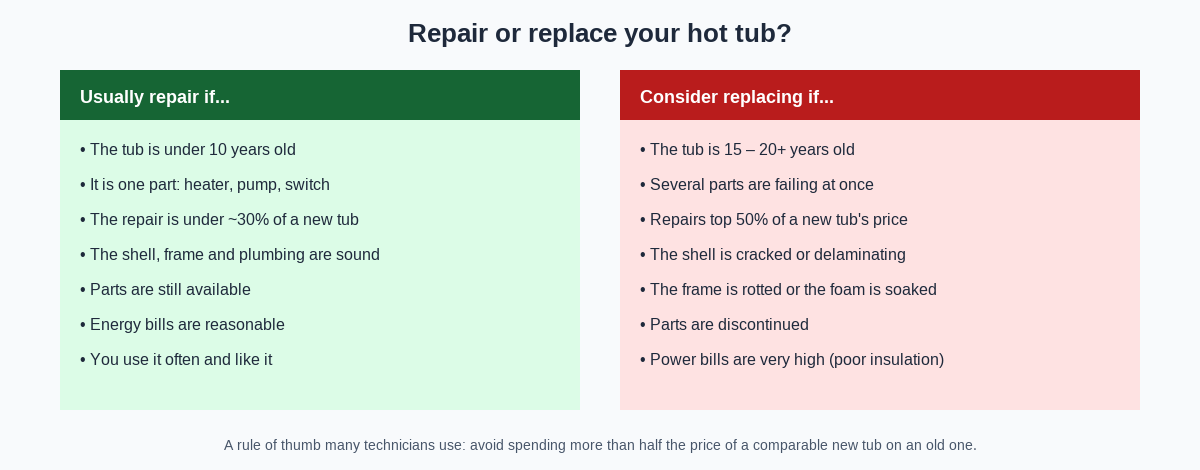
Diagram: Asphapro.com
For tubs under about 10 years old with a single failed part, repair is usually best. For tubs over 15 years old with multiple problems, a cracked shell, rotted frame or soaked insulation, replacing often makes more sense. A common rule is not to spend more than half the price of a comparable new tub. See hot tub cost and hot tub removal cost.
Photo: Wilfredor, Wikimedia Commons, CC0
Hot Tub Repair Cost for Common Error Codes
Most modern tubs show error codes on the topside panel, and each code points to a likely fix and hot tub repair cost. Codes vary by brand, but common ones include:
Flow or "FLO" errors. Usually a dirty filter, low water, an airlock or a faulty flow or pressure switch. Cleaning the filter and topping up water often costs nothing; a new switch costs $75 to $250.
Overheat or "OH" errors. The water or heater is too hot, often from low flow, a stuck relay or a bad sensor. Sensors cost $75 to $250 to replace; a relay or board repair costs more.
Sensor errors. Temperature or high-limit sensors can fail or give mismatched readings. Replacement usually costs $75 to $300.
Dry heater errors. The system thinks the heater has no water, often from an airlock or low flow. Bleeding air and cleaning filters usually fixes it.
GFCI trips. The breaker trips when power leaks to ground, often from a failing heater element, pump motor or wet connection. Finding the cause costs $100 to $300; the hot tub repair cost then depends on the failed part.
Write down the code and check the owner's manual before calling a technician; it may be a simple fix.
DIY Fixes That Lower Hot Tub Repair Cost
Many problems can be solved without a service call. Clean or replace the filter, since dirty filters cause flow errors, poor heating and cloudy water. Check the water level is above the skimmer opening. Bleed airlocks after refilling by loosening a union on the pump until water flows. Reset the GFCI breaker and see if the fault returns. Tighten loose unions to stop small leaks. Replace a worn cover seal or cover clips. Balance water to prevent scale on the heater. These simple steps can save a $75 to $200 service fee and avoid parts replacement altogether, cutting hot tub repair cost to zero in many cases.
Some repairs are best left to professionals: anything involving the control board, wiring, heater replacement on hard-wired tubs, and gas heaters. Hot tubs combine water and high current, so working on live electrical parts is dangerous. Always turn off power at the breaker before opening the equipment bay.
Hot Tub Repair Cost by Tub Type
Inflatable hot tubs. Most repairs involve punctures, which cost $10 to $30 to patch yourself, or the heater and pump unit, which may cost $150 to $400 to replace. Many owners replace the whole tub when the unit fails, since repair cost can approach the price of a new inflatable.
Rotomolded plastic tubs. These simpler tubs have fewer jets and parts. Typical hot tub repair cost is at the lower end of the ranges in this guide.
Acrylic portable tubs. The most common type, with the full range of repairs described above.
Swim spas. Larger pumps, heaters and more complex controls mean higher parts and labor costs, often 20 to 50% more than a standard tub.
Inground spas. Built-in spas share equipment with a pool. Repairs to pumps, heaters and controls are priced like pool equipment, and leaks in concrete spas can be costly. See inground hot tub cost.
Hot Tub Repair Cost After Freeze Damage
Freezing weather can crack pipes, pumps, heaters and jets if the tub loses power or is drained improperly. Freeze damage is one of the most expensive problems, since cracked plumbing is often hidden under foam insulation. Hot tub repair cost after a freeze can run $500 to $2,500 or more, depending on how many pipes and parts are damaged. To prevent it, keep the tub running and covered in winter, or drain it completely and blow out the lines if you shut it down. If the power goes out in freezing weather, cover the tub with blankets and a tarp, and add a small heater in the equipment bay if safe to do so.
Warranties and Hot Tub Repair Cost
Check the warranty before paying for repairs. Many new tubs carry warranties of 5 to 10 years on the shell, 2 to 5 years on plumbing and equipment, and 1 to 5 years on electrical parts. Labor may be covered for a shorter time. Extended warranties are sometimes offered. Warranties often require professional installation, proper water chemistry and regular maintenance. Keep your purchase records and service history. Warranty coverage can reduce hot tub repair cost to just the service call, or nothing at all.
Preventing Repairs
Regular care keeps hot tub repair cost low. Clean filters every one to two weeks and deep clean them monthly. Keep pH and alkalinity balanced to protect the heater and seals. Drain, clean and refill every three to four months. Keep the cover in good shape to protect the controls and cut heater run time. Keep the equipment bay dry and free of debris and pests. Install surge protection for the control board. Schedule a professional inspection once a year. These habits can prevent most heater, pump and board failures.
Choosing a Hot Tub Technician
Look for a technician who works on your brand and has access to parts. Ask about the service call fee, whether it is credited toward repairs, and the hourly labor rate. Ask for a written estimate before work starts, especially for repairs over a few hundred dollars. Check reviews and confirm they are licensed and insured for electrical work where required. A good technician will explain the problem, the options and the likely hot tub repair cost, and will tell you honestly if the tub is not worth repairing.
Hot Tub Repair Cost: Worked Examples
Example 1: tub not heating. A 6-year-old tub shows a flow error and will not heat. The owner cleans the filter, but the error returns. A technician finds a failed pressure switch and replaces it. Total hot tub repair cost: $95 service call plus $120 for the switch and labor, about $215.
Example 2: noisy jet pump. A 9-year-old tub's jet pump screeches and leaks. The technician replaces the bearings and seal instead of the whole pump. Total: about $450.
Example 3: dead control board. After a thunderstorm, a 12-year-old tub will not power on. The control board is fried. With the board at $900 and the tub showing a worn cover and cabinet, the owner weighs the repair against a new tub and decides to repair, adding surge protection. Total: about $1,150.
Example 4: hidden leak. A 16-year-old tub loses an inch of water a day. Leak detection finds several cracked fittings under soaked foam. The estimated hot tub repair cost is $1,800, about half the price of a new tub, so the owner replaces it.
Hot Tub Repair Cost for Lights, Ozonators and Blowers
Smaller accessories also fail. LED light modules cost $50 to $250 to replace, and older halogen bulbs cost less. Ozonators, which help sanitize the water, cost $100 to $350 to replace, and their check valves or tubing can crack. Air blowers, which add bubbles, cost $150 to $400. Waterfall and fountain features may need new pumps or diverters at $75 to $300. These items rarely stop a tub from working, so you can often delay the hot tub repair cost for accessories until it suits your budget.
Hot Tub Repair Cost for Gas-Heated Spas
Inground and some large spas use gas heaters shared with a pool. Gas heater repairs, such as igniters, thermostats, pressure switches, flame sensors or heat exchangers, cost about $150 to $1,500, and a full heater replacement costs $2,000 to $5,000 installed. Gas work must be done by a qualified technician. Hot tub repair cost for gas systems is often higher than for electric portable tubs, but the heaters last a long time when water is balanced and they are serviced yearly.
Hot Tub Repair Cost by Region
Labor rates and travel fees shape hot tub repair cost. In large cities and high-cost areas, technicians often charge $100 to $150 an hour, plus a service fee. In smaller towns, rates may be lower, but travel fees can be higher if the nearest technician is far away. In regions with many hot tubs, such as the Pacific Northwest, Colorado and the Northeast, competition can keep prices reasonable and parts easy to find. In areas with few spa dealers, repairs may take longer while parts are shipped.
Buying a Used Hot Tub: Expected Repair Costs
Used tubs can be good value, but budget for repairs. Before buying, fill the tub and run it for a day if possible, check for leaks under the cabinet, listen to the pumps, test the heater, look for cracks or blisters in the shell, and ask about the age of the cover and any past repairs. Even a tub that works well may need a new cover ($300 to $900) and a filter set ($50 to $150) right away. Set aside $500 to $1,500 for hot tub repair cost in the first couple of years. Factor in delivery and electrical work, which often cost $300 to $1,500.
Budgeting for Hot Tub Repair Cost Over Time
Over the life of a tub, repairs add up. A reasonable estimate is $100 to $300 a year on average for a well-maintained tub, with larger costs every few years for a pump, heater or cover. Setting aside $10 to $25 a month for hot tub repair cost makes repairs easier to absorb when they come. Tubs that are older, used heavily, or kept in harsh climates may need more. Including a repair fund in your monthly hot tub budget gives a more honest picture of ownership cost.
Home Warranties and Insurance
Some home warranty plans offer optional spa coverage for an added fee, which may cover pumps, heaters and controls, with a service fee per claim and limits on payouts. Read the terms closely; many exclude covers, shells, cosmetic damage and pre-existing problems. Home insurance usually covers sudden damage from events such as a fallen tree or fire, not wear and tear or freeze damage from neglect. Neither replaces good maintenance, but both can reduce some hot tub repair cost surprises.
Questions to Ask Before You Approve a Repair
Before saying yes to a repair, ask the technician what failed and why, so you can prevent it from happening again. Ask for the parts and labor breakdown, whether the parts are original or aftermarket, and what warranty comes with the repair. Ask whether other parts look worn and are likely to fail soon. If the tub is older, ask for an honest opinion on whether repair is worth it. Clear answers make it easier to compare hot tub repair cost against replacement and avoid paying for one repair after another on a tub near the end of its life.
Seasonal Problems and Their Fixes
Spring. After winter, covers may be waterlogged, filters clogged and water out of balance. Drain, clean and refill, replace the filter if needed, and check for leaks that may have formed from freezing. Many spring calls are simple fixes once the tub is cleaned and refilled.
Summer. Heavy use and heat can cause overheating errors, pump wear and scale on the heater. Keep the cover on, lower the set temperature if the water gets too warm, and test water more often. Shade the equipment side of the tub to keep electronics cooler.
Fall. Leaves clog filters and skimmers. Check the cover and cabinet for damage before winter, and fix small leaks while the weather is mild.
Winter. Freezing is the biggest risk. Keep the tub running and covered, check it daily during cold snaps, and have a plan if the power goes out. Ice on the cover can damage it; brush off snow gently.
Energy Problems That Look Like Repairs
Sometimes a tub seems broken when it is really losing heat. If the heater runs constantly and the water barely stays warm, check the cover for waterlogging, gaps or tears, check the cabinet insulation, and look for wind blowing under the tub. A new cover or better insulation can solve the problem for far less than a heater or board replacement. Watching your electric bill is a useful early warning; a sudden jump often signals a cover, insulation or heater issue worth investigating before it leads to a larger repair.
How Long Do Hot Tub Parts Last?
Knowing typical part lifespans helps you plan. Heater elements often last 3 to 7 years, depending on water balance. Pumps last 5 to 10 years. Control boards often last 7 to 12 years if protected from moisture and surges. Covers last 3 to 7 years. Ozonators last 3 to 5 years. Acrylic shells can last 15 to 25 years or more. When several parts reach the end of their expected life at the same time, it may be time to compare total repair costs against a new tub.
Keeping a Repair Log
Keep a simple log of every service visit, part replaced, error code and water test. Note the date, the problem, the fix and the hot tub repair cost. Over time, the log shows patterns, such as a heater element that keeps failing because of hard water, or flow errors that appear when the filter is overdue. It also helps a technician diagnose problems faster, supports warranty claims, and gives you a clear total to compare against the price of a new tub. When the log shows repair costs rising year after year, it is a sign to start planning a replacement before the tub fails at the worst time.
Hot Tub Repair Cost: Key Points
- Most hot tub repairs cost $150 to $800, plus a $75 to $200 service call.
- Switches and heater elements are cheap; boards and pumps cost more.
- Hidden leaks and shell cracks are the hardest repairs.
- Replace rather than repair when costs top half the price of a new tub.
Frequently Asked Questions
How much does it cost to fix a hot tub that won't heat?
Usually $75 to $500, depending on whether it is a switch, sensor or heater element. Check the filter, water level and breaker first, since a dirty filter or airlock can stop heating without any hot tub repair cost at all.
Is it worth repairing a 15-year-old hot tub?
For a single cheap part such as a switch, sensor or seal, yes. For major repairs such as a control board plus a pump, or hidden leaks under the shell, the hot tub repair cost may be better spent on a new, more efficient tub.
How much does a hot tub control board cost?
About $400 to $1,300 installed, depending on brand and model. Adding surge protection afterward helps prevent the same hot tub repair cost from coming back after the next storm.
Can I repair my hot tub myself?
Simple fixes such as cleaning filters, bleeding airlocks, tightening unions and replacing a cover are DIY-friendly. Electrical repairs, heater replacements and board work are best left to licensed professionals.
How much is a hot tub leak repair?
About $150 to $800, depending on where the leak is. Leaks at unions and pump seals are cheap to fix; hidden leaks under foam insulation raise hot tub repair cost because of the time needed to find them.
Does home insurance cover hot tub repairs?
Usually not for wear and tear or freeze damage from neglect, but sometimes for sudden damage from events such as a fallen tree, fire or a covered storm.
Sources
- CPSC: Pool and spa safety
- OSHA: Electrical safety
- CDC: Hot tub user information
- Pool and Hot Tub Alliance