
How Much Does a Hot Tub Cost per Month to Run and Maintain?

Photo: BlisswoodB&B, Wikimedia Commons, CC BY-SA 4.0
Quick Answer
A typical hot tub costs about $45 to $130 per month to run and maintain. Electricity is the biggest part at about $20 to $60 a month for a modern, well-insulated tub with a good cover, rising to $70 to $100 or more in very cold winters or for older tubs. Chemicals add $10 to $30 a month, water for refills every three to four months adds $1 to $5, and setting money aside for filters, a new cover and repairs adds about $13 to $38. That makes the yearly cost to maintain a hot tub about $540 to $1,560.
The price tag on a hot tub is only part of what you pay. Once it is installed, it needs power to keep 300 to 500 gallons of water hot around the clock, chemicals to keep it clean, fresh water every few months, and parts that wear out over time. Knowing how much does a hot tub cost per month helps you budget before you buy, and helps you spot problems if your bill suddenly jumps.
This guide breaks down how much it costs to run a hot tub each month, with a hot tub electricity cost calculator, costs by climate and tub type, the full cost to maintain a hot tub over a year, and ways to cut the bill. For the upfront price, see our guide on hot tub cost.
Hot Tub Cost per Month at a Glance
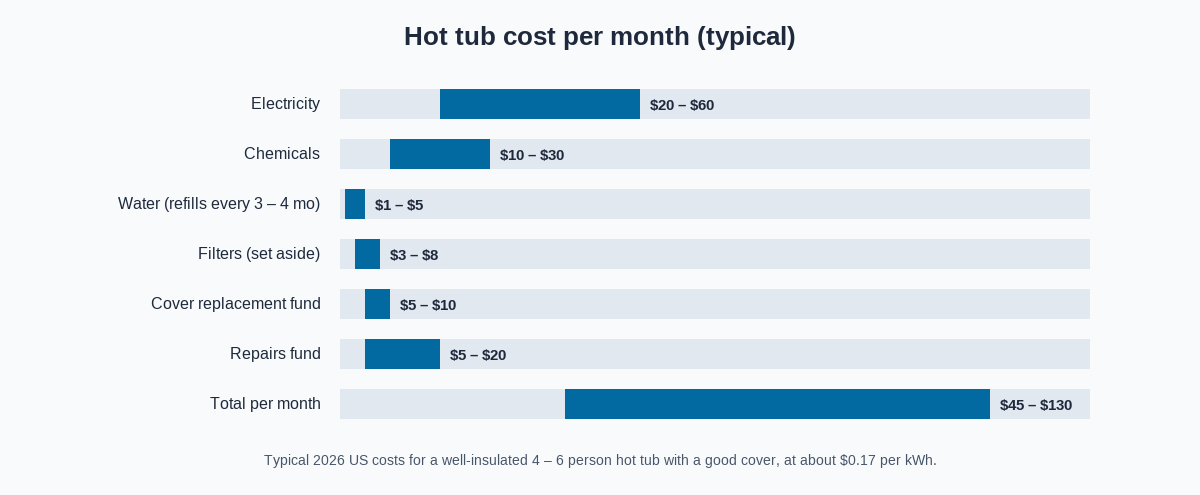
Chart: Asphapro.com
- Electricity: $20 to $60 per month for most modern tubs.
- Chemicals: $10 to $30 per month.
- Water: $1 to $5 per month, averaged over refills.
- Filters: $3 to $8 per month, set aside for replacements.
- Cover replacement fund: $5 to $10 per month.
- Repairs fund: $5 to $20 per month.
- Total hot tub cost per month: about $45 to $130.
How Much Does It Cost to Run a Hot Tub? Electricity Explained
How much does it cost to run a hot tub in electricity? It depends on four things: how much heat the tub loses, how often the heater runs to replace it, the power used by pumps and other parts, and what you pay per kilowatt-hour (kWh).
Most hot tubs have an electric heater rated at about 1 to 5.5 kW (1,000 to 5,500 watts). Plug-and-play 120-volt tubs use smaller 1 to 1.5 kW heaters; 240-volt tubs use 4 to 5.5 kW heaters. The heater does not run all the time. In a well-insulated tub with a good cover, it might run 2 to 4 hours a day in mild weather and 5 to 8 hours a day in cold weather. The circulation pump, which keeps water moving through the filter, uses about 50 to 250 watts and often runs for many hours a day. Jet pumps use 1 to 3 kW but only run when you use the jets.
A typical well-insulated 240-volt tub uses about 150 to 350 kWh a month. At the US average of about $0.17 per kWh, that is $25 to $60 a month. In states with cheap power, such as parts of the South and Midwest, the hot tub electricity cost may be $15 to $40; in states with high rates, such as California and the Northeast, it can be $50 to $120.
Hot Tub Electricity Cost Calculator
Use this hot tub electricity cost calculator to estimate your monthly power bill. Enter your heater size, the hours it runs each day, your circulation pump wattage and hours, and your electricity rate. If you do not know the heater hours, start with 3 for mild weather and 6 for cold weather.
Hot Tub Electricity Cost by Climate
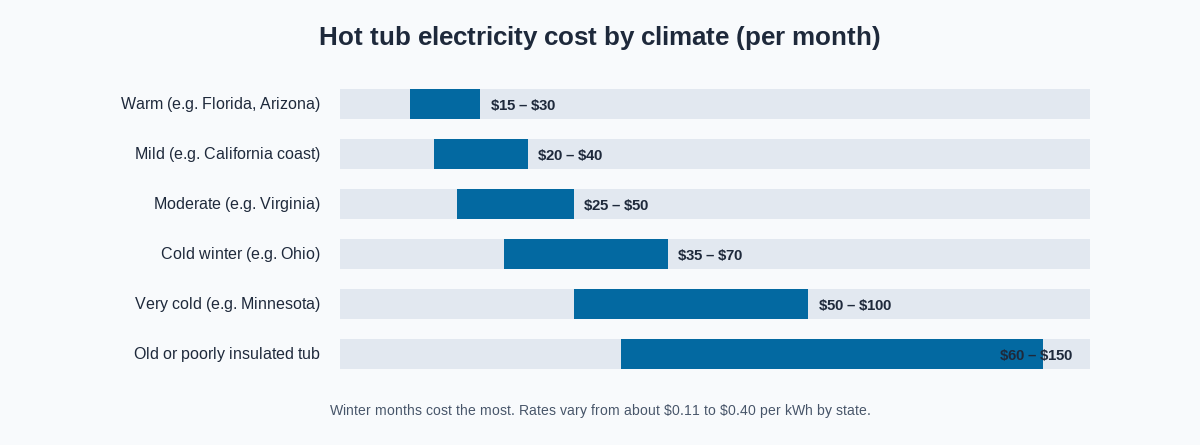
Chart: Asphapro.com
Climate has a big effect on how much does a hot tub cost to run. The colder the air, the faster the water loses heat and the longer the heater runs. In warm states, a covered tub may need only a few hours of heating a day year-round, keeping the hot tub electricity cost to $15 to $30 a month. In cold states, winter months can cost two to three times as much as summer months. Wind also matters: a tub in an exposed spot loses more heat than one sheltered by a wall, fence or gazebo.
Your yearly average gives a better picture than any single month. A tub that costs $25 in July and $75 in January may average $45 a month over the year.
Chemical Costs
Hot tub chemicals cost about $10 to $30 a month, or $120 to $360 a year. The main items are a sanitizer (chlorine or bromine granules or tablets), a non-chlorine shock (MPS), pH and alkalinity adjusters, test strips, and sometimes a calcium increaser, a defoamer, a scale and stain treatment, and a clarifier. Bromine tends to cost a little more than chlorine but is more stable in hot water. Salt water systems for hot tubs cut sanitizer costs but need a cell replacement every few years. Mineral cartridges reduce the amount of sanitizer needed and cost $20 to $40 every three to four months.
How much you spend depends on how often you use the tub, how many people use it and how well you keep the water balanced. Heavy use with several bathers needs more sanitizer and shock.
Water Costs
Most hot tubs should be drained and refilled every three to four months, or more often with heavy use. A 400-gallon tub costs only about $2 to $6 to refill at typical US water rates, so water averages $1 to $5 a month even with an occasional top-up. The bigger cost of a refill is the electricity to heat the fresh, cold water back up, which can use 30 to 60 kWh, or about $5 to $10.
Filter Costs
Hot tub filter cartridges should be rinsed every one to two weeks, deep cleaned every one to three months, and replaced every 12 to 24 months. Cartridges cost $20 to $80 each, and many tubs use two or more. Setting aside $3 to $8 a month covers replacements. Clean filters also lower energy use, since the pump works less hard.
Hot Tub Cover Costs

Photo: TudorTulok, Wikimedia Commons, CC BY-SA 4.0
The cover is the most important part of controlling running costs. Most heat escapes from the water surface, and a good, thick cover that seals well can cut heat loss dramatically. Covers wear out as their foam cores absorb water, get heavy and lose insulation value. A replacement cover costs $300 to $800 and lasts about 3 to 7 years. Setting aside $5 to $10 a month covers this. A waterlogged or damaged cover can easily add $20 to $50 a month to the power bill, so replacing it often pays for itself.
Repair and Maintenance Costs
Over time, hot tubs need repairs. Heater elements cost $100 to $350 to replace, circulation pumps $200 to $500, jet pumps $300 to $800, control boards $300 to $900, and ozonators $100 to $300. Service calls cost $100 to $200 plus parts. Setting aside $5 to $20 a month, or $60 to $240 a year, keeps you ready for repairs. Some owners also pay for a professional cleaning once or twice a year at $100 to $250 each. Together with the other items, this is the full cost to maintain a hot tub.
Cost to Maintain a Hot Tub per Year
Adding it all up, the yearly cost to maintain a hot tub is about:
- Low (warm climate, efficient tub, light use): about $540 to $800 a year.
- Average: about $800 to $1,200 a year.
- High (cold climate, older tub, heavy use): about $1,200 to $2,000 or more a year.
That works out to a hot tub cost per month of roughly $45 to $165 across most homes, with most owners near the middle of that range.
Inflatable vs Acrylic vs Swim Spa Running Costs
Inflatable hot tubs cost less to buy but often more to run in cold weather. They have thin walls and covers, and their small 1 to 1.5 kW heaters may run most of the day in winter. In mild weather, they cost $20 to $40 a month; in cold weather, $50 to $100 or more, and many owners drain them for winter.
Acrylic hot tubs with full foam insulation and a thick cover are the most efficient. Modern models often cost $20 to $50 a month to run in moderate climates.
Swim spas hold 1,500 to 2,500 gallons, so they cost more: often $50 to $150 a month in electricity, plus more chemicals.
Inground hot tubs built into the ground with a pool often use a gas heater and lose more heat, so running costs can be higher. See inground hot tub cost.
How to Lower Hot Tub Running Costs
Keep the cover on and in good condition. This is the single biggest saving. Replace a waterlogged cover, and use a floating thermal blanket under the cover for extra insulation.
Lower the temperature a little. Dropping from 104 °F to 100 °F, or using an economy mode when you are away, saves energy.
Shelter the tub. A windbreak, fence, gazebo or plantings reduce heat loss.
Use off-peak power. If your utility has time-of-use rates, set heating and filtering for off-peak hours.
Keep filters clean and water balanced. Clean filters reduce pump load and balanced water protects the heater.
Check insulation. Add insulation to the cabinet if your tub has little, and seal gaps.
Limit jet and air blower use. Air blowers cool the water quickly.
Hot Tub Cost per Month Through the Seasons
Your hot tub cost per month changes through the year, mostly because of the weather. In summer, the air is warm and the water loses little heat, so the heater may run only an hour or two a day. Some owners even lower the set temperature to 96 to 98 °F for a cooler soak, which cuts power use further. In spring and fall, heater run time climbs as nights get cooler. In winter, especially in snowy regions, the heater may run several times longer than in summer, and the hot tub electricity cost can double or triple compared with July.
Chemical use also follows the seasons, but in the opposite way for many owners: people tend to use the tub more often in cool weather, so sanitizer and shock use can rise in fall and winter. Water refills are spread through the year. If you are planning a budget, use a yearly average rather than the cheapest month. For most owners in moderate climates, a reasonable estimate of how much does a hot tub cost per month across the whole year is $50 to $90 including electricity, chemicals and a repair fund.
Gas vs Electric Heated Hot Tubs
Almost all portable hot tubs use electric heaters, but some inground spas and a few large tubs use natural gas or propane heaters, often shared with a pool. Gas heaters heat water much faster, which is useful when a spa is only heated before use rather than kept hot all the time. But keeping a spa hot around the clock with gas is usually more expensive than with an electric heater in a well-insulated tub, because inground spas lose more heat through their walls and have less effective covers. Propane is especially costly. If you are comparing how much does it cost to run a hot tub with gas versus electricity, look at your local fuel prices and how often you will use the spa. Heat pumps are a third option for larger spas and swim spas; they cost more upfront but use far less electricity than a resistance heater in mild climates.
How to Measure Your Actual Hot Tub Electricity Cost
Estimates are useful, but the best way to know how much does a hot tub cost to run in your home is to measure it. Many utilities now have smart meters and online dashboards that show usage by hour; compare days when the tub is running with days it is off, or watch for the pattern of heater cycles. Some hot tub control systems show heater run time or even energy use. For 240-volt tubs, an electrician can install a sub-meter or a clamp-on energy monitor on the tub's circuit for $50 to $200, which shows exactly how many kWh the tub uses each day.
Once you know the monthly kWh, multiply by your rate per kWh, including delivery charges and taxes, to get the true hot tub electricity cost. Check your bill to find the full rate; the advertised energy price is often lower than the total you pay per kWh. Tracking usage before and after changes, such as a new cover or a lower temperature, shows which savings work best. If you use our hot tub electricity cost calculator and your measured result is much higher, the cover, insulation or heater may need attention.
New vs Old Hot Tubs
The age and build of the tub make a big difference to running costs. Older tubs, especially those made before the 2010s, often have less insulation in the cabinet and floor, weaker covers and less efficient pumps. They can cost $60 to $150 a month to run in cold climates. Modern tubs from reputable makers often use full-foam insulation, sealed cabinets, thick tapered covers and low-wattage circulation pumps, and some are tested to energy standards such as California's appliance efficiency rules, which limit standby power use for portable spas. If you are buying a used tub, factor higher running costs into the price, and ask the seller for recent electric bills if possible. A new cover and a thermal blanket can bring an older tub's costs down a lot, but they cannot fix missing cabinet insulation.
Hidden and One-Time Costs
Beyond the monthly hot tub cost per month, a few costs appear only once or now and then. Electrical installation for a 240-volt tub, including a dedicated circuit and a GFCI disconnect, costs about $500 to $2,500. A concrete pad or reinforced deck costs $500 to $5,000. Steps, a cover lifter and a thermal blanket add $200 to $800. Home insurance may rise slightly, and some insurers ask for a locking cover. Winterizing and draining for a season costs little if you do it yourself, but if you hire a pro it may cost $150 to $300. Removing and disposing of an old tub when you replace it costs $200 to $1,000; see hot tub removal cost.
Cost to Maintain a Hot Tub: Maintenance Schedule
Following a simple schedule keeps the cost to maintain a hot tub predictable. Two to three times a week: test sanitizer and pH with strips and adjust, which takes a few minutes and a small amount of chemicals. Weekly: add a non-chlorine or chlorine shock after use, and rinse the filter if the tub is used often. Monthly: deep clean or soak the filter, wipe the waterline, and clean and condition the cover. Every three to four months: flush the lines with a line cleaner, drain, clean the shell and refill. Every year: inspect the cover, check the heater and pumps, and replace the filter if it is worn. Every three to seven years: replace the cover.
Owners who keep to this schedule usually spend less on chemicals and repairs, since balanced water protects the heater, pumps and seals. Skipping maintenance can lead to cloudy water, scale on the heater and early part failures, which raise the true cost of running the tub.
Is a Hot Tub Worth the Monthly Cost?
For many owners, a hot tub cost per month of $50 to $100 is a fair price for daily relaxation, better sleep, relief for sore muscles and time outdoors with family. Compared with a gym or spa membership, the cost can look reasonable if you use the tub several times a week. If you only use it a few times a month, the cost per soak is much higher. Before you buy, think about how often you will realistically use it, your local electricity rates and climate, and whether you have a sheltered spot for it. Use the hot tub electricity cost calculator above with your own numbers to see what the monthly cost will be in your home.
Hot Tub Electricity Cost by State
Electricity prices vary widely across the US, and that shapes your hot tub electricity cost as much as the weather. Residential rates range from about $0.11 to $0.15 per kWh in states such as Idaho, Washington, Louisiana and Utah, to $0.25 to $0.40 per kWh in California, New England and Hawaii. A tub that uses 300 kWh a month costs about $36 a month at $0.12 per kWh, $51 at $0.17, and $90 at $0.30. If you live in a high-rate state, the cover, insulation and time-of-use savings matter even more. Check your latest bill or your utility's rate page for the exact figure, and enter it in the calculator above to get an accurate monthly estimate.
Bromine vs Chlorine: Effect on Monthly Costs
The sanitizer you choose shapes your chemical budget. Chlorine granules are cheap and work quickly, but chlorine is less stable at high temperatures and can produce a stronger smell. Bromine costs a little more but holds up better in hot water and is gentler on skin for many people. Over a year, the difference is usually $30 to $100. Ozone generators and UV systems reduce the amount of sanitizer you need, and mineral cartridges can cut it further. Choosing a system that suits how often you use the tub is part of keeping the cost to maintain a hot tub low.
Worked Examples
Example 1: efficient tub in a mild climate. A 400-gallon acrylic tub with a 4 kW heater runs the heater 2.5 hours a day and a 150-watt pump 12 hours a day. That is (4 × 2.5 + 0.15 × 12) × 30.4 = about 359 kWh a month. At $0.15 per kWh, the electricity costs about $54. With a new cover and economy mode, heater hours drop to 1.8 a day and the bill falls to about $41.
Example 2: cold climate winter. The same tub in January runs the heater 6 hours a day: (4 × 6 + 1.8) × 30.4 = 784 kWh, or about $133 at $0.17/kWh. Adding a thermal blanket and windbreak cuts heater time to 4.5 hours, saving about $30 a month.
Example 3: inflatable tub. A 1.3 kW inflatable tub runs its heater 12 hours a day in fall: 1.3 × 12 × 30.4 = 474 kWh, about $81 a month at $0.17/kWh.
How Much Does a Hot Tub Cost per Month: Key Points
- Most hot tubs cost about $45 to $130 a month to run and maintain.
- Electricity is the largest cost, about $20 to $60 a month for modern tubs.
- Chemicals, water, filters, covers and repairs add $25 to $70 a month.
- A good cover, sheltered spot and lower set temperature cut costs the most.
Frequently Asked Questions
Is it cheaper to leave a hot tub on all the time?
Usually yes for a well-insulated tub. Reheating cold water uses more energy than keeping it warm with a good cover.
How much does a hot tub add to my electric bill?
About $20 to $60 a month for most modern tubs, and more in cold climates or with older tubs.
Do 120-volt hot tubs cost less to run?
Not always. Their small heaters run longer, so monthly costs are often similar or higher in cold weather.
How often should I change hot tub water?
Every three to four months, or more often with heavy use. Flush the plumbing lines with a line cleaner before draining, then clean the shell and refill with fresh water.
What is the biggest hot tub running cost?
Electricity for heating, which depends mostly on climate, insulation and cover condition. A worn cover alone can add $20 to $50 a month in cold weather.
How much are hot tub chemicals per month?
About $10 to $30 a month for sanitizer, shock, pH adjusters and test strips.
Sources
- EIA: Average price of electricity by state
- US Department of Energy: Pool and spa covers
- CDC: Hot tub user information
- Pool and Hot Tub Alliance