
Home Warranty Pool Coverage: What Is Covered and What Is Not
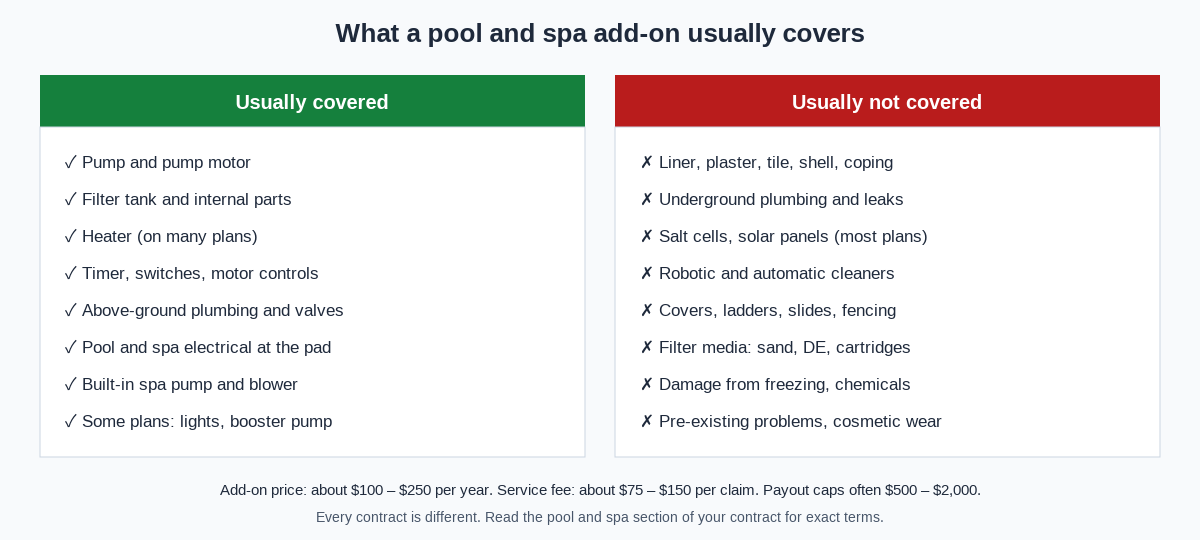
Chart: Asphapro.com
Quick Answer
Home warranty pool coverage is almost never part of a basic home warranty plan. It is sold as an optional pool and spa add-on, usually for about $100 to $250 per year. It typically covers the mechanical and electrical parts of the pool's circulation system: the pump and motor, filter, heater on many plans, timer and controls, and above-ground plumbing. It usually does not cover the liner, plaster, tile, shell, underground plumbing, salt cells, solar heating, automatic cleaners, covers or filter media. Each claim has a service fee of about $75 to $150, and most contracts cap pool payouts at around $500 to $2,000 per year. A home warranty with pool coverage can pay off when your equipment is more than five years old, but read the contract's pool section carefully before you buy.
A pool is a big part of a home's value and a big part of its upkeep. Pumps wear out, motors burn up, heaters fail and timers stop working, usually at the worst time of the swim season. A home warranty promises to pay for repairs to home systems and appliances for a yearly fee, so many pool owners ask whether it will cover their pool too.
This guide explains how home warranty pool coverage works: what it is, what it covers, what it leaves out, what it costs, how claims work and how to decide if it is worth adding. It is based on how pool and spa add-ons from major home warranty companies are usually written. Details vary from company to company and from plan to plan, so use this as a guide to what to look for in a contract, not as a promise of what any one contract includes.
What Is Home Warranty Pool Coverage?
A home warranty is a service contract that pays to repair or replace covered home systems and appliances when they break down from normal wear and tear. Standard plans usually cover things like heating, cooling, plumbing, electrical systems, water heaters and kitchen appliances. Pools and spas are not part of most standard plans because they are expensive to repair and not every home has one.
Instead, home warranty pool coverage is sold as an optional add-on, often called "pool and spa coverage" or "pool/spa equipment." You add it to a base plan for an extra yearly fee. Many companies cover one pool or one spa for the base add-on price, and charge more if you have both a pool and a separate spa with its own equipment. Some plans treat a pool with a built-in spa sharing the same equipment as a single unit.
The important thing to know is that home warranty pool coverage is about equipment, not the pool itself. It covers the machines that move, filter and heat the water. It does not cover the pool structure, the finish, the liner or the deck.
What Home Warranty Pool Coverage Usually Includes
Most pool and spa add-ons cover the main mechanical and electrical parts of the circulation system that are above ground and part of the main equipment pad. Common covered items include:
- Pump and pump motor, including the impeller, seals and capacitor.
- Filter tank, internal parts and multiport valve, though not the media inside.
- Heater on many plans, often with a separate limit for heaters.
- Timer, switches and motor controls.
- Above-ground plumbing, valves and fittings at the equipment pad.
- Electrical parts of the pool system, such as wiring at the pad and relays.
- Built-in spa equipment, such as a spa pump and air blower.
- On some plans, pool lights, booster pumps and chlorinators.
Coverage usually means the company sends a contractor to diagnose the problem and then repairs or replaces the covered part, up to the plan's limits. If a covered part cannot be repaired, the company may replace it with a similar part of equal capacity, not necessarily the same brand or a more efficient model.
Photo: Iveta Drábková, Wikimedia Commons, CC BY-SA 4.0
What Home Warranty Pool Coverage Usually Excludes
The exclusions list is where most surprises come from. Common items not covered by home warranty pool coverage include:
- The pool structure: shell, walls, plaster, pebble finish, tile, coping, liner and deck.
- Underground plumbing and leaks in buried pipes, or the cost of finding them.
- Salt chlorinator cells on many plans, along with chemical feeders.
- Solar pool heating panels and related parts.
- Automatic and robotic pool cleaners, including booster pumps on some plans.
- Pool covers, ladders, slides, diving boards, rails and fencing.
- Filter media: sand, DE powder and cartridges.
- Lights on some plans, especially fiber optic and color systems.
- Damage from freezing, lack of maintenance, poor chemistry or improper installation.
- Pre-existing conditions: problems that started before the contract.
- Code upgrades, permits and access costs, such as removing decking to reach equipment.
Some plans also exclude commercial-grade equipment, pools used for business, and equipment that is not on the main pad. If your pool has unusual features, such as waterfalls with separate pumps, automation systems or heat pumps, ask the company in writing whether they are covered.
How Much Does Home Warranty Pool Coverage Cost?
The cost of home warranty pool coverage has three parts: the add-on price, the service fee and any costs above the payout cap.
Add-on price. Most companies charge about $100 to $250 a year for pool and spa coverage on top of the base plan. Base plans themselves often cost about $400 to $900 a year. A home warranty with pool coverage therefore usually costs about $500 to $1,150 a year in total, depending on the plan, your location and the size of your home.
Service fee. Each time you open a claim, you pay a service fee, also called a trade call fee or deductible, often $75 to $150. Some plans let you choose a higher fee for a lower yearly price.
Payout caps. Pool and spa add-ons usually have an annual limit for pool claims, often $500 to $2,000 per contract year. Some plans have separate, lower limits for heaters or certain parts. If a repair costs more than the cap, you pay the difference.
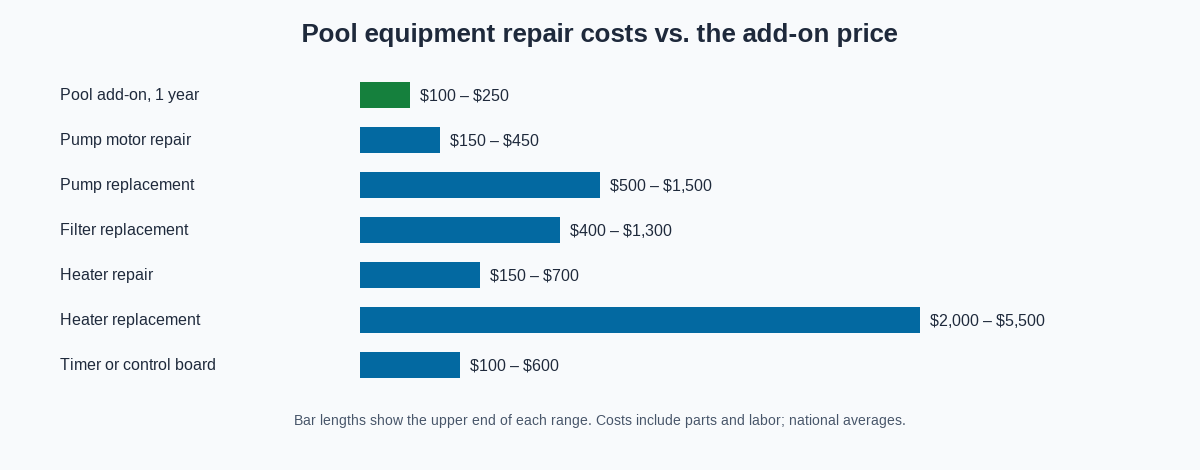
Chart: Asphapro.com
How Claims Work With Home Warranty Pool Coverage
When pool equipment breaks, you contact the warranty company by phone or online and describe the problem. The company assigns a contractor from its network, who calls to schedule a visit, often within a few days. You pay the service fee to the contractor or the company. The contractor diagnoses the problem and reports to the warranty company, which decides whether the failure is covered.
If the repair is approved, the contractor orders parts and completes the work. If it is denied, the company should explain why, usually citing a contract exclusion. In busy summer months, waits for pool contractors can be longer than for other trades, and parts may take time to arrive. During that time, you may need to keep the pool clean with extra chlorine and manual brushing.
You usually cannot choose your own pool contractor under home warranty pool coverage, although some companies allow it with approval and pay a set amount. If you have a trusted pool service company, ask whether it is in the warranty company's network.
Is a Home Warranty With Pool Coverage Worth It?
Whether a home warranty with pool coverage is worth it depends on your equipment's age, your budget for surprise repairs and your patience with the claims process.
It can be worth it when:
- Your pump, filter and heater are more than 5 to 8 years old and closer to failure.
- You just bought a home with a pool and do not know the equipment's history.
- A sudden $1,000 to $3,000 repair would strain your budget.
- The seller is paying for the first year as part of the sale.
It may not be worth it when:
- Your equipment is new and still under the manufacturer's warranty.
- Your main concerns are the finish, the liner, leaks or the salt cell, which are usually excluded.
- You can set aside money each year in a repair fund instead.
- You prefer to use your own pool service company and avoid wait times.
A simple way to decide is to compare the yearly cost, add-on plus one or two service fees, with the likely repairs in the next year. A pump motor repair costs about $150 to $450, a new pump $500 to $1,500 and a new heater $2,000 to $5,500. If your equipment is old, one covered pump replacement can pay for several years of home warranty pool coverage. If it is new, you may pay for years without using it.
Photo: Air fans, Wikimedia Commons, CC BY-SA 4.0
Home Warranty Pool Coverage vs Manufacturer Warranties
New pool pumps, filters and heaters usually come with a manufacturer's warranty, often 1 to 3 years for pumps and heaters and longer for filter tanks. These warranties cover defects in parts, and sometimes labor, but often require installation by a licensed professional and proof of purchase. When your equipment is still under a manufacturer's warranty, home warranty pool coverage may add little value for those parts, though it may still cover labor or other parts.
Some pool builders and installers also offer their own service agreements or extended warranties on new pools and equipment. These can cover the structure or finish for longer periods, which home warranty pool coverage does not.
Home Warranty Pool Coverage vs Homeowners Insurance
Homeowners insurance and home warranties cover different things. Insurance covers sudden, accidental damage from events like storms, fire, falling trees or vandalism, and it may cover the pool structure and equipment as "other structures" on your policy. Insurance does not cover wear and tear or mechanical breakdown. A home warranty covers breakdown from normal wear but not accidental damage. Many owners have both. Pools also raise liability risk, so check your policy's liability limits and any pool requirements, such as fencing.
How to Choose a Home Warranty With Pool Coverage
When comparing plans, get the full contract, not just the brochure, and read the pool and spa section line by line. Look for:
- The annual pool cap and any separate cap for heaters or specific parts.
- The list of covered and excluded parts, especially salt cells, lights, cleaners and heaters.
- Whether a pool and a spa are covered together or need separate add-ons.
- Service fee and response times for pool claims.
- Waiting period: most plans have a 30-day wait before claims can be made.
- Maintenance requirements: you may need to show records of service.
- Cancellation terms and refund rules.
- Reviews that mention pool claims specifically.
Tips to Get the Most From Home Warranty Pool Coverage
- Keep maintenance records and receipts for chemicals, service visits and repairs.
- Take photos of your equipment pad when the contract starts.
- Report problems early, before a small failure damages other parts.
- Ask the contractor to explain the diagnosis and request it in writing.
- If a claim is denied, ask which contract clause applies and appeal if you disagree.
- Winterize the pool properly in cold climates, since freeze damage is usually excluded.
Good maintenance also lowers the chance you need to claim at all. For a full picture of yearly pool costs, see our guides on the cost to maintain a pool and pool leak repair cost.
How Long Pool Equipment Lasts
Knowing how long pool equipment usually lasts helps you judge whether home warranty pool coverage makes sense for your home. A single-speed pool pump often lasts 8 to 12 years, though the motor may need bearings or a capacitor along the way. Variable-speed pumps have more electronics and can fail sooner if exposed to heat, moisture or power surges, often lasting 8 to 10 years. Sand filter tanks can last 15 years or more, cartridge filter tanks 10 to 15 years, and multiport valves 5 to 10 years before they leak or stick. Gas heaters usually last 6 to 12 years, and heat pumps 10 to 15 years, depending on water chemistry and climate. Timers and control boards can fail at any age, especially after storms.
If most of your equipment is in the second half of its life, the chance of a major repair in the next year is high, and home warranty pool coverage is more likely to pay for itself. If the equipment is only a few years old, the odds are much lower.
Home Warranty Pool Coverage When Buying or Selling a Home
Home warranties are common in home sales. Sellers often buy a one-year plan for the buyer as a selling point, and buyers sometimes ask for one in negotiations. If the house has a pool, the base plan offered by the seller may not include pool equipment. Buyers should ask specifically for a home warranty with pool coverage, since the add-on is a small part of the total cost and protects against early equipment failures in a home they do not yet know.
Sellers can also buy coverage during the listing period on some plans, which protects them if equipment fails before closing. Either way, a pool inspection before closing is more useful than any warranty. A pool inspector checks the equipment, the structure and the water, and can spot problems that would be excluded from home warranty pool coverage, such as leaks, cracks and worn finishes.
An Example Pool Claim Step by Step
Here is how a typical claim might go under home warranty pool coverage. On a hot July day, the pool pump hums but does not start. The owner turns it off and opens a claim online. The warranty company assigns a pool contractor, who calls the next day and schedules a visit in three days. The owner pays a $100 service fee when the contractor arrives.
The contractor finds a failed motor and a bad capacitor. Both are covered parts. The warranty company approves replacing the motor, and the contractor orders it. Four days later, the new motor is installed and the pool is running again. The repair would have cost about $450 without coverage; the owner paid the $100 service fee plus their share of the yearly add-on price. While the pump was down, the owner added liquid chlorine and brushed the pool daily to keep the water clear.
Now imagine the same claim, but the contractor finds that the pump failed because water from a leaking pipe under the deck ran into the motor. The motor may be covered, but the underground leak repair is not, so the owner pays for the leak repair separately. This is a common pattern: home warranty pool coverage handles the equipment, while the owner handles the structure and plumbing.
Common Reasons Pool Claims Are Denied
Most denied claims under home warranty pool coverage come from the same few causes. The first is pre-existing conditions: if a contractor thinks the problem started before the contract, the claim may be denied. The second is lack of maintenance, such as a pump that burned out because the strainer basket was clogged for weeks. The third is excluded parts, such as a salt cell, a cleaner or a light that the owner assumed was covered. The fourth is improper installation or code issues, such as wiring that does not meet current rules. Freeze damage, chemical damage and damage from storms or pests are also common exclusions.
To lower the chance of a denial, keep the equipment pad clean and accessible, keep a simple maintenance log, fix small problems quickly and read the exclusions list before you file. If you think a claim was wrongly denied, ask for the decision and the reason in writing, then appeal through the company's process. State consumer protection offices and insurance departments may also help with complaints about service contracts in many states.
Above Ground Pools and Home Warranty Pool Coverage
Some home warranty companies cover above ground pool equipment under the same pool and spa add-on, while others limit coverage to permanently installed inground pools. If you have an above ground pool, ask whether the pump and filter are covered, since these are often smaller, lower-cost units that may be cheaper to replace than to claim. The pool itself, including the wall, frame and liner, is not covered under home warranty pool coverage in either case. For above ground pools with modest equipment, a small repair fund is often the better choice.
Alternatives to Home Warranty Pool Coverage
Home warranty pool coverage is not the only way to protect against equipment costs. Many owners set aside a pool repair fund instead, putting $20 to $40 a month into a savings account for equipment repairs. Over five years, that adds up to $1,200 to $2,400, enough for most pump or filter replacements, and the money stays yours if nothing breaks.
Another option is a service plan with a local pool company. Some pool service companies include basic repairs, priority scheduling or discounts on parts and labor in their monthly service fee. This lets you use a company that already knows your pool. Finally, when you replace equipment, choose quality models with longer manufacturer warranties and keep the receipts, which gives you strong protection for the first few years.
Questions to Ask Before Buying a Home Warranty With Pool Coverage
Before you sign up for a home warranty with pool coverage, ask the company these questions and get the answers in writing. What is the annual limit for pool and spa claims, and are there separate limits for heaters? Are salt cells, lights, automation systems and booster pumps covered? Is a pool with an attached spa covered under one add-on? Do you have pool contractors in my area, and how long do pool claims usually take in summer? What maintenance records will you ask for if I file a claim? Can I cancel and get a refund for unused months? Clear answers to these questions tell you more about the value of home warranty pool coverage than any advertisement.
Keeping Pool Equipment Healthy Between Claims
Even with good coverage, the best outcome is a pool that rarely needs a claim. Simple habits extend equipment life: keep skimmer and pump baskets clear so the pump never runs dry, backwash or clean the filter on time, keep water chemistry balanced so heaters and seals do not corrode, and keep the equipment pad free of leaves, standing water and pests. Have an electrician check bonding and wiring if you notice tingling, tripped breakers or burned smells. These steps cost little and make every part last longer.
Home Warranty Pool Coverage: Key Points
- Pools are not part of standard home warranty plans; coverage is an add-on.
- Add-ons cost about $100 to $250 a year, plus a service fee per claim.
- Covered: pump, motor, filter, heater on many plans, timer and above-ground plumbing.
- Not covered: liner, finish, structure, underground plumbing, salt cells and cleaners.
- Payout caps, often $500 to $2,000 a year, limit large repairs.
Frequently Asked Questions
Do home warranties cover pools?
Not on standard plans. You need to buy a pool and spa add-on for home warranty pool coverage.
Does home warranty pool coverage include the pool heater?
Many plans cover heaters, but some exclude them or set a lower limit. Check the contract.
Is a pool liner covered by a home warranty?
No. Liners, plaster and other surfaces are almost always excluded.
Does home warranty pool coverage include a hot tub?
Many pool and spa add-ons cover a built-in spa that shares equipment with the pool. A separate, stand-alone hot tub may need its own add-on or may be excluded, so check the contract.
Is there a waiting period for home warranty pool coverage?
Usually yes. Most plans have a 30-day waiting period after you buy before you can file a claim, unless the plan was bought at a home sale closing.
Can I add pool coverage to my home warranty later?
Many companies let you add a pool and spa add-on at renewal, and some allow it mid-term. A new waiting period may apply to the pool equipment.
Does a home warranty with pool coverage pay for a new pump?
If the old pump fails from normal wear and cannot be repaired, most plans replace it with a similar pump, up to the pool payout cap. Upgrades to variable-speed models may cost extra.
Who does the repairs under home warranty pool coverage?
A contractor from the warranty company's network. Some companies let you use your own pool technician with approval, often paying a set amount toward the job.
Sources
- FTC: Extended warranties and service contracts
- HomeGuide: Pool pump replacement cost
- HomeGuide: Pool heater cost
- NAIC: Consumer insurance information