
Pool Heater Size Calculator: How to Size a Gas Heater or Heat Pump
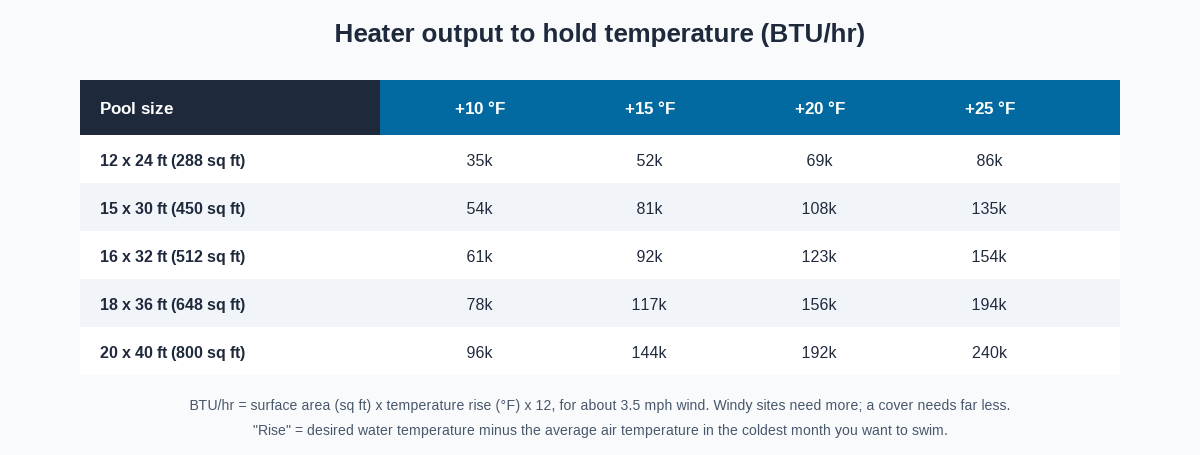
Chart: Asphapro.com
Quick Answer
To size a pool heater, work out two numbers. Holding temperature: pool surface area (sq ft) × temperature rise (°F) × 12 = BTU per hour, where the rise is your desired water temperature minus the average air temperature in the coldest month you want to swim. Heating up: gallons × 8.34 × degrees to raise ÷ hours = BTU per hour. A 16 x 32 foot pool held 20 °F above the air needs about 123,000 BTU/hr of output. For a gas heater, divide output by about 0.84 to get input, so choose roughly a 150,000 to 250,000 BTU model; for a heat pump, choose a unit with at least that output in your coldest swim month. Use the pool heater size calculator below.
A heater that is too small never quite gets the pool warm on cool days, and takes days to heat it up in spring. A heater that is too large costs more to buy, may need bigger gas lines or wiring, and, for gas heaters, can short-cycle on mild days. Sizing correctly saves money and gives you the swim season you want. The good news is that the math is simple once you know your pool's surface area, volume and local climate, and the pool heater size calculator below does it for you.
This guide explains what size pool heater do I need for different pools, climates and heater types, with a pool heater size calculator and a BTU chart. For running costs, see how much does it cost to heat a pool.
Two Ways a Pool Heater Size Calculator Works
Holding temperature (heat loss). Most heat leaves a pool through the surface by evaporation, convection and radiation. A common sizing method multiplies surface area by the temperature rise and a factor of 12 for average wind of about 3.5 mph. This gives the BTU per hour the heater must supply to keep up with losses on a typical day. It is the main method for heat pumps and for pools heated steadily through the whole swim season.
Heating up (heat gain). To raise the temperature of the water, you need about 8.34 BTU per gallon for each 1 °F. Divide by the number of hours you want the heat-up to take, such as 24 or 48 hours for a pool after opening. This matters most for pools and spas heated only before use, which usually use gas heaters.
A good heater meets both needs. The larger of the two numbers is usually the one that sets the final heater size.
Pool Heater Size Calculator
Enter your pool details below. This pool heater size calculator estimates the output you need and suggests a gas heater input size and a heat pump output size.
Gas Heater vs Heat Pump in a Pool Heater Size Calculator
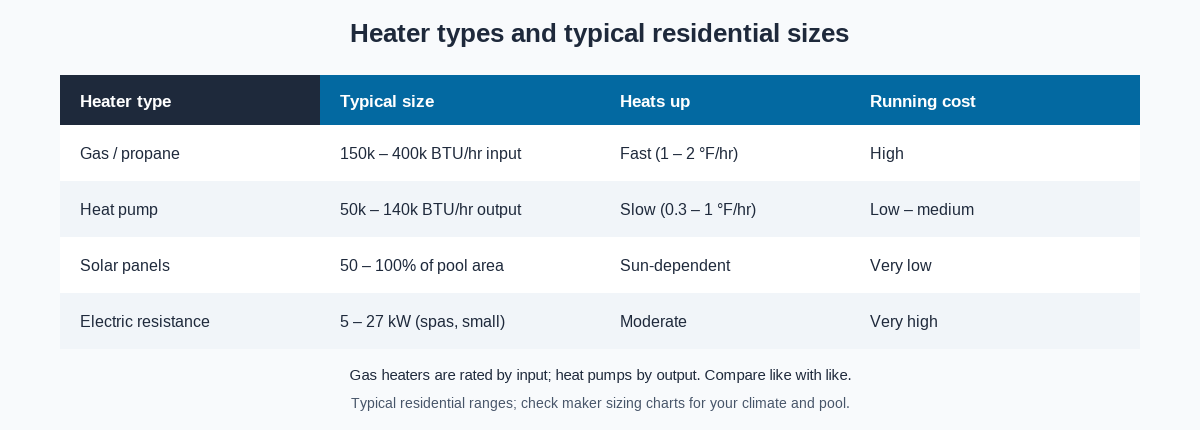
Chart: Asphapro.com
Gas and propane heaters are rated by input BTU, typically 150,000 to 400,000 for residential pools. Output is input times efficiency, about 82 to 95%. Because they heat quickly, gas heaters suit pools heated only on weekends and attached spas. A common rule of thumb is about 50,000 BTU input per 10,000 gallons for steady use, but the surface area method above is more accurate.
Heat pumps are rated by output BTU, typically 50,000 to 140,000. Their output drops as air temperature falls; a heat pump rated at 110,000 BTU at 80 °F air may deliver much less at 50 °F. Size heat pumps for your coldest swim month and expect slower heat-up. They suit pools kept warm through the whole season, where slow but cheap heating is the priority.
Solar heating is sized by panel area, usually 50 to 100% of the pool surface area, depending on climate, roof direction, shading and how much heat you want.
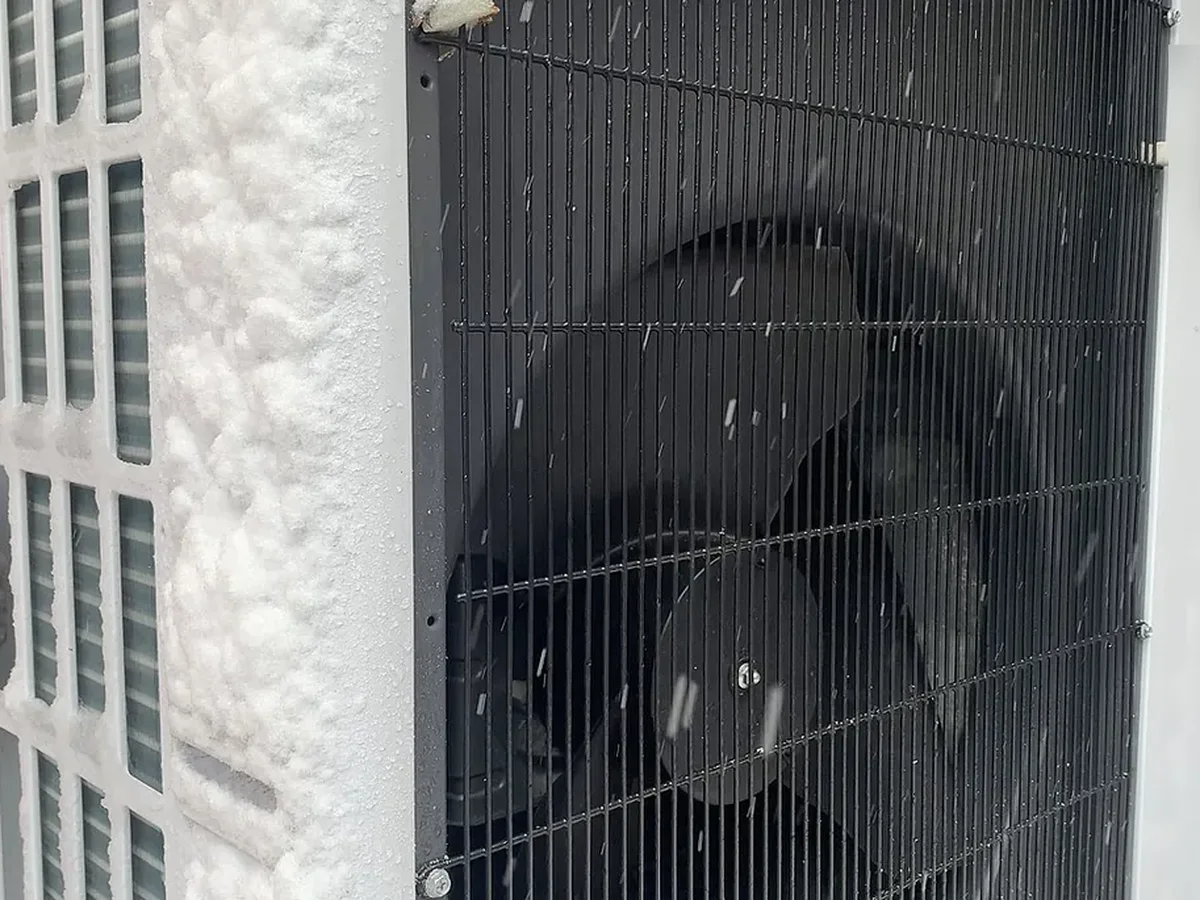
Photo: PeterEastern, Wikimedia Commons, CC BY-SA 4.0 (badge blurred)
What Size Pool Heater Do I Need With a Cover or in Wind?
A cover can cut heat loss by half or more, which means a smaller heater can do the job and run less. Wind increases heat loss sharply; at 7 mph, losses can be about 1.5 to 2 times those at 3.5 mph. Windbreaks such as fences, hedges and walls help a great deal. Shade from trees and buildings reduces free solar gain, so heavily shaded pools need slightly more heater output. When using a pool heater size calculator, adjust for these factors.
Photo: Shixart1985, Wikimedia Commons, CC BY 2.0
What Size Pool Heater Do I Need for Common Pool Sizes?
Here are typical answers to what size pool heater do I need for common residential pools, assuming a 15 to 20 °F rise above the average air temperature, moderate wind and no cover. Use the pool heater size calculator above for your own numbers.
12 x 24 ft (about 10,000 gallons): holding needs about 52,000 to 69,000 BTU/hr. A 100,000 to 150,000 BTU gas heater or a 50,000 to 75,000 BTU heat pump is usually enough.
15 x 30 ft (about 15,000 to 17,000 gallons): about 81,000 to 108,000 BTU/hr. A 150,000 to 200,000 BTU gas heater or a 90,000 to 110,000 BTU heat pump.
16 x 32 ft (about 19,000 to 21,000 gallons): about 92,000 to 123,000 BTU/hr. A 200,000 to 250,000 BTU gas heater or a 110,000 to 140,000 BTU heat pump.
18 x 36 ft (about 24,000 to 27,000 gallons): about 117,000 to 156,000 BTU/hr. A 250,000 to 300,000 BTU gas heater, or a large heat pump of 140,000 BTU or two smaller units.
20 x 40 ft (about 30,000 to 35,000 gallons): about 144,000 to 192,000 BTU/hr. A 300,000 to 400,000 BTU gas heater, or two heat pumps.
With a cover used every night, many pools can drop one size. In cool, windy climates, many need one size up.
What Size Pool Heater Do I Need for a Spa or Hot Tub?
Spas are small but heated to 100 to 104 °F, often from cold, and owners want them hot within an hour or so. For a 500-gallon attached spa heated from 80 °F to 102 °F in one hour: 500 × 8.34 × 22 ÷ 1 = about 92,000 BTU/hr of output, or about 110,000 BTU input on a gas heater. Pool and spa combinations often share one gas heater sized for the larger need, typically 250,000 to 400,000 BTU. Heat pumps can maintain spa temperature but heat up slowly. Portable hot tubs have their own built-in electric heaters, usually 1 to 5.5 kW, and are not sized with a pool heater size calculator.
What Size Pool Heater Do I Need for an Above Ground Pool?
Above ground pools lose heat through their walls as well as the surface, so they need a bit more heat per square foot than inground pools of the same size. A 24-foot round above ground pool (about 450 square feet) held 15 °F above air needs about 81,000 BTU/hr plus 10 to 20% for wall losses. Many owners choose a 50,000 to 100,000 BTU heat pump, a small gas heater, or solar panels. Above ground pools benefit greatly from a solar cover and from insulating the area under the pool. Check that the pool's pump can deliver the heater's minimum flow rate.
Climate and Temperature Rise
The temperature rise you choose has the biggest effect on what size pool heater do I need. To find it, decide your target water temperature, often 78 to 84 °F, and your swim season. Then find the average air temperature in the coldest month of that season. The difference is the rise. For example, if you want 82 °F water from May through September and the average May air temperature is 64 °F, the rise is 18 °F. In mild climates where the season is short, the rise might be only 10 °F. In cool or northern climates trying to swim in April and October, it may be 25 to 30 °F, which needs a much bigger heater. Extending the season into cold months is where heating costs climb fastest.
Using a Pool Heater Size Calculator for Heat Pumps
Heat pumps move heat from the air into the water. Their output and efficiency depend on air temperature and humidity. Makers usually rate heat pumps at 80 °F air and 80% humidity, but output can drop by a third or more at 50 °F air. When using a pool heater size calculator for a heat pump, compare the BTU you need with the heat pump's output at your coldest swim-month air temperature, not its headline rating. Many heat pumps stop working efficiently below about 45 to 50 °F. Their coefficient of performance (COP) of 4 to 6 in warm weather means they use far less energy than gas or electric resistance heaters, which is why many owners accept slower heat-up times.
Gas Heater Input, Output and Altitude
Gas heater sizes on labels are input BTU. Output is input times efficiency: about 82 to 84% for standard heaters and up to 95% for high-efficiency models. A 250,000 BTU input heater at 84% delivers about 210,000 BTU of heat to the water. At high altitude, gas heaters lose output, typically about 4% per 1,000 feet above sea level unless they are built or adjusted for altitude; check the maker's derating. Also check that your gas meter and gas line can supply the heater's full input along with other gas appliances; undersized gas lines are a common reason heaters underperform.
Electrical and Gas Supply Limits
Before choosing a heater size, check your utilities. Large heat pumps need a dedicated 240-volt circuit, often 40 to 60 amps, which may require a panel upgrade. Gas heaters need a gas line sized for their input and the distance from the meter; a 400,000 BTU heater may need a larger meter or line. Propane heaters need a large enough tank and a properly sized regulator. These limits sometimes decide the answer to what size pool heater do I need as much as the pool does. An electrician or gas fitter can confirm what your home can support.
Solar Heater Sizing
Solar pool heating is sized by collector area. In sunny climates, panel area equal to 50% of the pool's surface area may be enough; in cooler or cloudier climates, 75 to 100% or more. South-facing roofs (in the northern hemisphere) work best. Solar heaters have no ongoing fuel cost and pair well with a heat pump or gas heater for cloudy days. A pool heater size calculator for solar focuses on area rather than BTU rating, since output depends on sunlight.
Pool Heater Size Calculator: Worked Examples
Example 1: 16 x 32 ft pool, mild climate, cover at night. Area 512 sq ft, rise 15 °F, cover factor 0.5: 512 × 15 × 12 × 0.5 = about 46,000 BTU/hr to hold. Heating 20,000 gallons by 10 °F in 48 hours: 20,000 × 8.34 × 10 ÷ 48 = about 35,000 BTU/hr. A 75,000 to 100,000 BTU heat pump is plenty.
Example 2: 18 x 36 ft pool, cool climate, no cover. Area 648 sq ft, rise 25 °F: 648 × 25 × 12 = about 194,000 BTU/hr. A 250,000 to 300,000 BTU gas heater, or a heat pump plus a cover to cut losses.
Example 3: pool and spa. A 15 x 30 ft pool with a 450-gallon spa. The spa needs about 83,000 BTU/hr to rise 22 °F in one hour; the pool needs about 108,000 BTU/hr to hold a 20 °F rise. A 250,000 BTU gas heater serves both.
Common Sizing Mistakes
The most common mistake is sizing a heat pump from its warm-weather rating and finding it cannot keep up in spring. Others include ignoring wind, forgetting that gas ratings are input while heat pump ratings are output, skipping the cover, choosing a heater too small for a spa's quick heat-up, and not checking gas line or electrical capacity. Using a pool heater size calculator with honest climate numbers, then checking the maker's sizing charts, avoids most of these problems.
How Long Will It Take to Heat My Pool?
Heat-up time depends on heater output, pool volume and heat losses during heating. Divide the heater's output by 8.34 × gallons to get degrees per hour, then subtract losses. A 250,000 BTU gas heater at 84% efficiency delivers about 210,000 BTU per hour. In a 20,000-gallon pool, that raises the water about 1.26 °F per hour before losses; with losses on a cool, breezy day, maybe 0.8 to 1 °F per hour. A 110,000 BTU heat pump in the same pool raises the water about 0.66 °F per hour before losses, or roughly 0.3 to 0.5 °F after losses in cool weather. That is why heat pumps are usually left running through the season, while gas heaters can be turned on just before swimming. A pool heater size calculator that includes heat-up time helps set realistic expectations.
What Size Pool Heater Do I Need for Year-Round Swimming?
Heating a pool year-round in a climate with cold winters is very demanding. With an average winter air temperature of 45 °F and a target of 82 °F, the rise is 37 °F; a 16 x 32 foot pool would need about 227,000 BTU/hr of output just to hold temperature without a cover. Heat pumps lose efficiency or stop working in such cold, so gas heaters, high-capacity heat pumps designed for cold climates, or a combination are used. An automatic or solid cover is almost essential; it can cut losses by more than half. Many owners find that heating through spring and fall, rather than all winter, gives most of the benefit at a fraction of the cost. When people ask what size pool heater do I need for year-round use, the honest answer is often "a big one, plus a cover."
Using Two Heaters
Some pools use two heaters: a heat pump to hold temperature cheaply through the season, and a gas heater for quick boosts on cold days or for a spa. Others use solar panels as the main heat source with a heat pump or gas heater as backup. Very large pools may use two heat pumps in parallel. Combining heaters gives flexibility and can lower running costs, but adds equipment cost and space. Plan plumbing so the heaters work together, usually with the solar loop first, then the heat pump, then the gas heater.
Matching the Heater to Your Pump
Every heater has a minimum and maximum flow rate. If flow is too low, the heater may shut off or overheat; if too high, water may bypass the heat exchanger or cause wear. Check that your pump, especially a variable-speed pump at low speed, provides enough flow when the heater is running. Many owners set a higher pump speed during heating hours. See our pool pump size calculator for flow rates.
Questions to Ask a Heater Installer
Before buying, ask your installer how they sized the heater: which method, what temperature rise and what wind factor they assumed. Ask whether the heat pump's rated output applies at your spring and fall air temperatures. For gas heaters, ask whether your gas line and meter can supply the full input. For electric heat pumps, ask what circuit and breaker size are needed and whether your panel has room. Ask about expected heat-up times and running costs. A good installer will explain how they answered the question of what size pool heater do I need for your specific pool, rather than just picking a common size.
Using the Calculator for Planning
A pool heater size calculator is a planning tool, not a guarantee. It gives you a reasonable range to discuss with dealers and installers. Run the calculator with and without a cover, and with a few different target temperatures, to see how your choices affect heater size and running costs. You may find that a cover and a slightly lower water temperature let you choose a smaller, cheaper heater that still gives the swim season you want.
Heater Placement and Efficiency
Where and how a heater is installed affects how well it performs. Heat pumps need plenty of open air around them, usually at least 2 to 3 feet on the sides and 5 feet or more above, because they pull heat from the surrounding air. A heat pump boxed in by fences or shrubs recirculates its own cold exhaust and loses output. Gas heaters need clearances from walls, windows and vents for safe combustion and must be vented properly if indoors. Short pipe runs between the heater and the pool reduce heat loss on the way. Placing the heater on a level pad, out of sprinkler spray and with good drainage helps it last. These details matter as much as the number from a pool heater size calculator.
Running Cost by Heater Size
A larger heater does not necessarily cost more to run, because the total heat needed is set by the pool's losses, not by the heater size. A bigger gas heater simply delivers that heat faster. What changes running cost is heater type and efficiency, fuel price, the temperature you keep, how long the season is, and whether you use a cover. Heat pumps usually cost the least per unit of heat in warm and mild weather, gas costs more, and electric resistance heaters cost the most. A cover is the single biggest way to cut running costs for any heater size.
Checklist Before You Buy
Measure your pool's surface area and volume. Decide your target temperature and the months you want to swim, and find the average air temperature for the coldest month. Run the pool heater size calculator with and without a cover. Check gas or electrical capacity. Compare heater outputs at your expected air temperatures. Plan placement and clearances. Make sure your pump provides the heater's minimum flow. Then ask two or three installers for quotes based on the same assumptions, so you can compare their recommendations fairly.
Pool Heater Size Calculator: Key Points
- Holding: surface area × temperature rise × 12 = BTU/hr.
- Heating up: gallons × 8.34 × degrees ÷ hours = BTU/hr.
- Gas heaters are rated by input; heat pumps by output.
- Covers and windbreaks let a smaller heater do the job.
Frequently Asked Questions
What size pool heater do I need for a 20,000 gallon pool?
Often a 200,000 to 300,000 BTU gas heater or a 100,000 to 140,000 BTU heat pump, depending on climate, wind, the temperature rise you want and whether you use a cover. Enter your pool's size and climate in the pool heater size calculator above for a closer estimate.
Is a bigger pool heater better?
For gas, a slightly larger heater heats faster and is fine within the limits of your gas supply. For heat pumps, size for your coldest swim month rather than the warm-weather rating. Very oversized heaters cost more without much benefit.
How many BTUs do I need per gallon?
About 8.34 BTU per gallon per degree Fahrenheit, since a gallon of water weighs about 8.34 pounds and one BTU raises one pound of water by 1 °F.
Can I use a heat pump in cold weather?
Yes, but output drops as air temperature falls, and many units work poorly below about 45 to 50 °F. Cold-climate models and a good cover help.
Does a pool cover reduce heater size?
Yes, often by half or more, because a cover stops most evaporation, which is the largest source of heat loss.
How fast does a pool heater warm the water?
Gas heaters often add 1 to 2 °F per hour in a typical residential pool; heat pumps usually add 0.3 to 1 °F per hour depending on size and air temperature.
Sources
- US Department of Energy: Gas swimming pool heaters
- US Department of Energy: Heat pump pool heaters
- US Department of Energy: Solar pool heaters
- US Department of Energy: Swimming pool covers