
How to Finance a Pool: Your Options, Payments and Tips
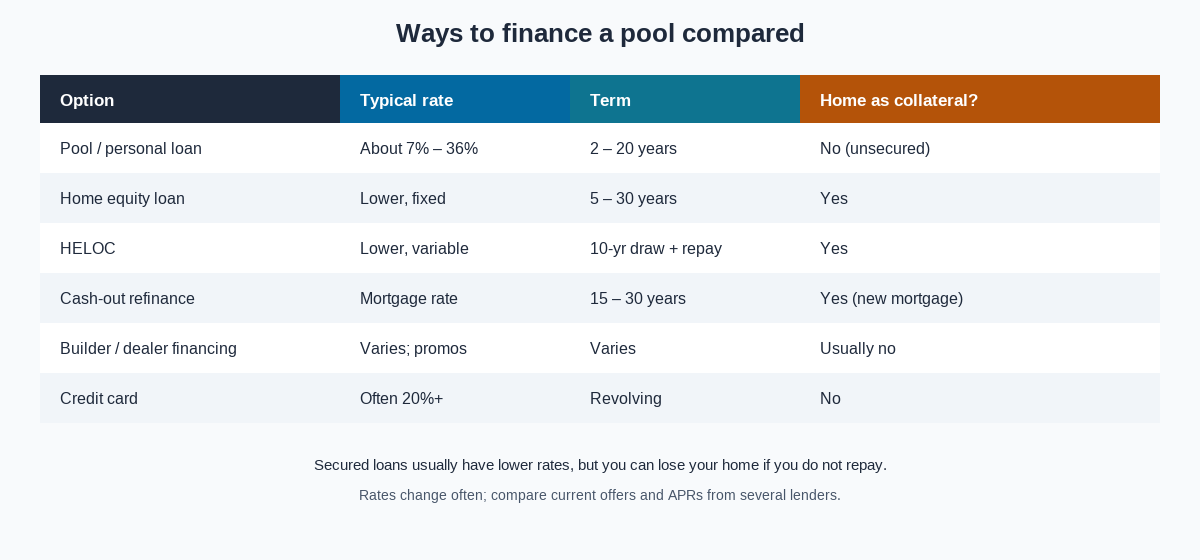
Chart: Asphapro.com
Quick Answer
The main ways to finance a pool are an unsecured pool loan (a personal loan, often 2 to 20 years), a home equity loan or HELOC that borrows against your home at a lower rate, a cash-out refinance of your mortgage, and financing offered by the pool builder. Most lenders want a credit score of about 680 or higher for good rates. For example, a $50,000 pool loan at 9% over 10 years costs about $633 a month and about $26,000 in interest. Use the pool finance calculator below to compare terms, budget for extras like fencing, decking and upkeep, and compare offers from at least three lenders.
An inground pool is one of the largest home projects most families take on. A basic vinyl or fiberglass pool often costs $35,000 to $65,000, and a concrete pool with decking, fencing and landscaping can pass $100,000. Few people pay that in cash, so financing is the norm. The right loan can make the monthly cost manageable; the wrong one can cost thousands of dollars in extra interest or put your home at risk.
This guide explains how to finance a pool, compares the main options, shows what payments look like, and gives practical tips to get a better deal. For a sense of total project costs, see our guides to small inground pool cost and how much does a 12x24 inground pool cost.
Can You Finance a Pool?
Yes, you can finance a pool, and most buyers do. Lenders treat a pool as a home improvement, and many banks, credit unions and online lenders offer loans designed for pools. Pool builders often partner with lenders and can arrange financing as part of the sale. Whether you qualify and at what rate depends on your credit score, income, existing debts and, for secured loans, the equity in your home.
Some government-backed programs do not cover pools. For example, HUD's FHA Title I property improvement loans cannot be used for luxury items such as swimming pools. Most pool financing comes from private lenders instead.
How to Finance a Pool With a Pool Loan
A pool loan is usually an unsecured personal loan marketed for pools. You borrow a fixed amount, get the money in a lump sum, and repay it in fixed monthly payments over a set term. Because the loan is not secured by your home, you do not risk your house if you cannot pay, and approval is often fast, sometimes within days.
The trade-off is cost. Rates on unsecured loans are higher than on home equity loans, often from about 7% for borrowers with excellent credit to 20% or more for fair credit. Loan amounts commonly range up to $100,000, and terms run from 2 to about 12 years, with some pool lenders offering up to 15 or 20 years. Some lenders charge origination fees of 1% to 8%, which are taken from the loan amount.
How to Finance a Pool With a Home Equity Loan
A home equity loan lets you borrow against the value of your home minus what you owe on your mortgage. Lenders usually let you borrow up to 80% to 85% of your home's value, minus the mortgage balance. You get a lump sum at a fixed rate and repay it over 5 to 30 years.
Because the loan is secured by your home, rates are usually lower than unsecured pool loans. The interest may be tax deductible when the money is used to buy, build or substantially improve the home that secures the loan; ask a tax advisor. The risk is that you could lose your home if you cannot make payments. Closing costs, often 2% to 5% of the loan, also apply.
How to Finance a Pool With a HELOC
A HELOC works like a credit card secured by your home. You get a credit line you can draw from as needed during a draw period, often 10 years, followed by a repayment period of 10 to 20 years. Rates are usually variable, so payments can rise. A HELOC is useful for pool projects that are paid in stages, since you borrow only what you need as the builder bills you.
How to Finance a Pool With a Cash-Out Refinance
A cash-out refinance replaces your current mortgage with a larger one and gives you the difference in cash. It can make sense when current mortgage rates are close to or lower than your existing rate. If your current rate is much lower than today's rates, refinancing the whole mortgage just to pay for a pool can cost far more over time. Closing costs are similar to any mortgage.
How to Finance a Pool Through the Builder
Many pool builders offer financing through partner lenders. This can be convenient, and some offer promotional deals such as low rates for a set period or same-as-cash periods. Read the terms carefully: promotional rates may jump after the promo ends, and deferred-interest offers may charge all the interest back if the balance is not paid in full in time. Always compare builder financing with offers from your own bank or credit union.
Pool Finance Calculator
Use this pool finance calculator to estimate your monthly payment and total interest. Enter the total project cost, your down payment, the interest rate and the loan term.
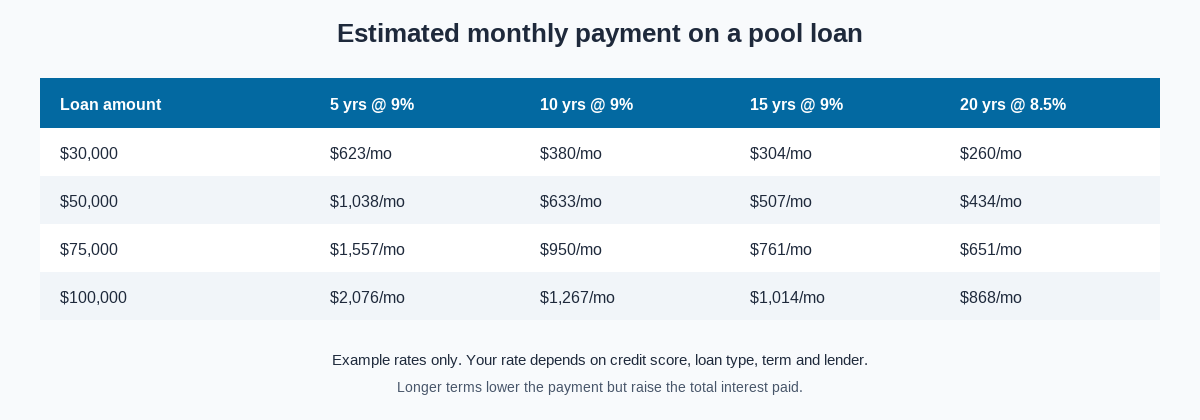
Chart: Asphapro.com
How Long Can You Finance a Pool?
How long can you finance a pool? It depends on the type of loan. Unsecured pool loans usually run from 2 to 12 years, and some lenders that specialize in pools offer terms of 15 or even 20 years for larger loans and strong credit. Home equity loans run from 5 to 30 years. HELOCs typically have a 10-year draw period followed by a 10- to 20-year repayment period. A cash-out refinance spreads the cost over a new 15- or 30-year mortgage.
Longer terms lower the monthly payment but raise the total interest. For example, a $50,000 loan at 9% costs about $1,038 a month over 5 years, with about $12,300 in total interest. Over 10 years, the payment drops to about $633, but interest rises to about $26,000. Over 20 years at 8.5%, the payment falls to about $434, but total interest climbs to about $54,000, more than the original loan. Choose the shortest term you can comfortably afford, and check whether the loan allows extra payments without penalties so you can pay it off faster.
How to Finance a Swimming Pool Step by Step
1. Set a total budget. Before you talk to lenders, know what the whole project will cost. The pool itself is only part of it. Add decking or a patio, a code-required fence, landscaping, electrical work, a heater, a cover, permits and the first year of chemicals. Many owners spend 20% to 50% more than the pool's base price once extras are added. See our guide to pool fence cost for one of the biggest extras.
2. Check your credit. Get your credit reports and scores. Fix any errors, pay down card balances and avoid opening new accounts in the months before you apply. Even a small rise in score can lower your rate.
3. Know your home equity. Estimate your home's value and subtract what you owe. If you have enough equity, a home equity loan or HELOC may give you the lowest rate.
4. Get pre-qualified with several lenders. Many online lenders and credit unions show estimated rates with a soft credit check that does not affect your score. Compare at least three offers, including your own bank, a credit union and the builder's lender.
5. Compare the full cost. Look at the APR, which includes fees, not just the interest rate. Check origination fees, closing costs, prepayment penalties and any promotional terms.
6. Get pool quotes. Get firm, written quotes from builders so you know exactly how much to borrow. Avoid borrowing much more than you need.
7. Apply and close. Submit your application with income documents and the builder's quote. Unsecured pool loans can fund within days; home equity loans and refinances take a few weeks.
8. Plan payments to the builder. Most builders take payments in stages, such as a deposit, payments at excavation and shell, and a final payment at completion. Make sure your loan funds are available when each payment is due.
Photo: Benoît Prieur, Wikimedia Commons, CC0
What Credit Score Do You Need to Finance a Pool?
Lenders set their own rules, but as a general guide, borrowers with credit scores of 720 or higher get the best rates on pool loans and home equity loans. Scores from about 680 to 719 still qualify for good rates. Many lenders approve scores down to about 640, but at higher rates. Below about 620, unsecured pool loans become hard to get, and home equity products may require more equity and lower debt.
Lenders also look at your debt-to-income ratio, which compares your monthly debt payments to your gross monthly income. Many want it below 36% to 43% including the new pool payment. Stable income and a history of paying on time help too.
How Much Does It Cost to Finance a Pool?
The total cost to finance pool projects is the amount borrowed plus interest and fees. Use the pool finance calculator above to see the effect of the rate and term. As a rough guide, financing a $60,000 project with $10,000 down and a $50,000 loan at 9% for 10 years adds about $26,000 in interest. The same loan at 7% adds about $19,700, and at 12% about $36,100. A few points of interest rate make a big difference over the life of the loan, which is why comparing lenders and improving your credit is worth the effort.
Remember the ongoing costs of owning a pool too. Chemicals, electricity, water, repairs and opening and closing typically add $1,200 to $3,500 a year. See our guide to the cost to maintain a pool and build those costs into your budget before you borrow.
Down Payments and Paying Part in Cash
Many pool loans do not require a down payment, but putting some cash down reduces the amount you borrow, the monthly payment and the total interest. Even 10% to 20% down makes a noticeable difference. Some owners pay for the pool with a loan and pay for extras such as landscaping or furniture in cash later, as their budget allows. Others save for a year or two before building, which can shrink the loan and the risk.
Does a Pool Add Value to a Home?
A pool can add some value to a home, especially in warm climates and higher-priced neighborhoods where buyers expect one. But in many areas, a pool adds much less than it costs, and some buyers see it as a cost and a safety concern. Studies and appraisers often estimate a pool adds a modest percentage to a home's value, not the full cost of building it. Finance a pool because your family will use and enjoy it, not as an investment you expect to fully recover when you sell.
Photo: Sönke Biehl, Wikimedia Commons, CC BY-SA 3.0
How to Finance a Pool That Sits Above Ground
Above ground pools cost much less, often $1,500 to $15,000 installed including a deck. For these, a small personal loan, a store credit plan or a 0% promotional credit card can work if you can pay off the balance before the promotion ends. Be careful with deferred-interest store cards, which may charge all the interest from the start if any balance remains when the promo ends. For smaller projects such as a pool cover, heater or resurfacing, the same options apply.
Tips on How to Finance a Pool for Less
Shop around. Rates on the same loan can differ by several percentage points between lenders. Check credit unions, which often offer lower rates to members. Apply within a short period, such as two weeks, so multiple hard credit checks are treated as one for scoring purposes. Ask about autopay discounts, which some lenders offer. Choose a fixed rate if you want steady payments, and be cautious with variable-rate HELOCs if rates are rising. Read every fee and term. Finally, do not let a builder's financing offer rush your decision; you can usually use your own lender with any builder.
Risks to Watch When You Finance Pool Projects
Using your home as collateral means you could lose it if you cannot repay, so be sure the payment fits your budget even if your income drops. Avoid stretching to a very long term just to afford a bigger pool, since you may still be paying for it after the liner or plaster needs replacing. Watch out for high-pressure sales, prepayment penalties and add-ons rolled into the loan. And keep an emergency fund in place, since pools bring their own repair costs. A home warranty with a pool add-on can help with some equipment repairs; see our guide to home warranty pool coverage.
Which Is the Best Way to Finance Pool Construction?
There is no single best way to finance pool construction for everyone. If you have plenty of home equity, good credit and a stable income, a fixed-rate home equity loan usually gives the lowest cost. If you want fast approval, do not want to borrow against your home, or have little equity, an unsecured pool loan is simpler. If the project will be paid in stages over several months, a HELOC lets you draw money only as you need it. If mortgage rates have fallen below your current rate, a cash-out refinance might make sense. Use the pool finance calculator to compare monthly payments and total interest for each option before you decide.
Many families combine methods: a pool loan or home equity loan for the main build, cash savings for the down payment, and a small personal loan or savings later for landscaping and furniture. Knowing how to finance a pool in stages like this keeps the main loan smaller and the monthly payment lower.
Can You Finance a Pool With Bad Credit?
Can you finance a pool with bad credit? It is possible but costly. Some lenders approve scores in the low 600s or even below, but rates can be 20% or higher, and loan amounts may be limited. A co-signer with strong credit can help you qualify for a better rate. A secured loan, such as a home equity loan, may be easier to get if you have equity, but missing payments puts your home at risk. Often the best plan is to spend 6 to 12 months improving your credit, paying down card balances and saving a larger down payment, then applying when you can get a much better rate. Over a 10-year loan, the savings can be thousands of dollars.
Example: How to Finance a Pool on a $60,000 Budget
Here is how to finance a pool project for a typical family. The pool, deck, fence and equipment total $60,000. The family has $10,000 saved and $120,000 in home equity, and credit scores around 740.
Option A is a 10-year unsecured pool loan for $50,000 at 9%. The payment is about $633 a month, with about $26,000 in interest. Option B is a 15-year home equity loan for $50,000 at 7.5%, with about $3,000 in closing costs. The payment is about $464 a month, with about $33,400 in interest over 15 years, but the family could pay it off in 10 years by paying about $594 a month, saving interest. Option C is builder financing at 0% for 12 months, then 15%; this only works if they can pay off the balance in a year, which they cannot.
The family chooses Option B with extra payments, because it has the lowest rate and lets them lower the payment if money gets tight. Running numbers like these with a pool finance calculator makes the trade-offs clear.
How to Finance Pool Upgrades and Renovations
Financing is not only for new pools. Many owners need to finance pool upgrades such as resurfacing, a new liner, a heater, a salt system, an automatic cover or a full remodel. These projects often cost $5,000 to $30,000. The same options apply: a personal loan for smaller jobs, a home equity loan or HELOC for larger ones, and sometimes builder or dealer financing on equipment. Because upgrades often save money, such as a variable-speed pump cutting electricity use, the savings can offset part of the payment. Run the numbers with the pool finance calculator to see how the payment compares with the savings.
Questions to Ask Lenders
When you compare offers on how to finance a pool, ask each lender the same questions so you can compare fairly. What is the APR, including all fees? Is the rate fixed or variable? Is there an origination fee, and is it taken from the loan amount? Are there prepayment penalties? How fast can the loan fund, and can funds be paid to the builder in stages? For home equity products, what are the closing costs, and is an appraisal required? For builder financing, what happens when the promotional period ends? Write down each answer, and choose the offer with the lowest total cost that fits your budget.
Careful planning is the key to how to finance a pool without regret: a clear budget, a strong credit score, several quotes and a loan you can repay comfortably. Then the pool becomes a place to relax, not a source of stress.
Timing Your Pool Loan
Timing affects both the build and the loan. Pool builders are busiest in spring and early summer, so booking in fall or winter can mean shorter waits and sometimes better prices. If you are working out how to finance a pool, apply a month or two before you plan to sign a contract, so you know your budget and can lock a rate. If you choose a home equity loan or refinance, allow extra weeks for the appraisal and closing. Unsecured pool loans fund quickly, which helps if a builder has an opening sooner than expected.
How to Finance a Pool: Key Points
- Pool loans are fast and unsecured but cost more; home equity options cost less but use your home as collateral.
- Terms run from 2 to 20 years for pool loans and up to 30 years for home equity and refinancing.
- A $50,000 loan at 9% over 10 years costs about $633 a month.
- Compare at least three offers and budget for extras and upkeep.
Frequently Asked Questions
What credit score do you need to finance a pool?
Many lenders approve scores from about 640, but scores of 680 to 720 and up get the best rates. Lenders also look at your income, existing debts and, for home equity products, how much equity you have.
Is it better to use a home equity loan or a pool loan?
A home equity loan usually has a lower rate and a longer term. A pool loan is faster, has fewer fees and does not put your home at risk. Compare both with the pool finance calculator before you choose.
How long can you finance a pool for?
Pool loans usually run 2 to 12 years, with some up to 20 years. Home equity loans and refinances can run up to 30 years.
Can you finance a pool with no money down?
Yes. Many pool loans and home equity loans do not require a down payment, but putting some money down lowers the payment and interest, and it can help you qualify for a better rate.
How do I use a pool finance calculator?
Enter the total project cost, your down payment, the interest rate and the term. The calculator shows the monthly payment, total interest and total paid.
Is it smart to finance pool construction?
It can be, if the payment fits your budget, you compare offers and you plan for upkeep. Avoid long terms and high rates that make the pool cost far more than its price.
How to finance a swimming pool if I just bought my home?
With little equity, an unsecured pool loan or builder financing is usually the only option. Some owners wait a year or two to build equity and save for a down payment.
Sources
- CFPB: What is a home equity loan?
- CFPB: What is a HELOC?
- HUD: Title I property improvement loans
- IRS Publication 936: Home mortgage interest deduction