
How Much Does a 12x24 Inground Pool Cost?
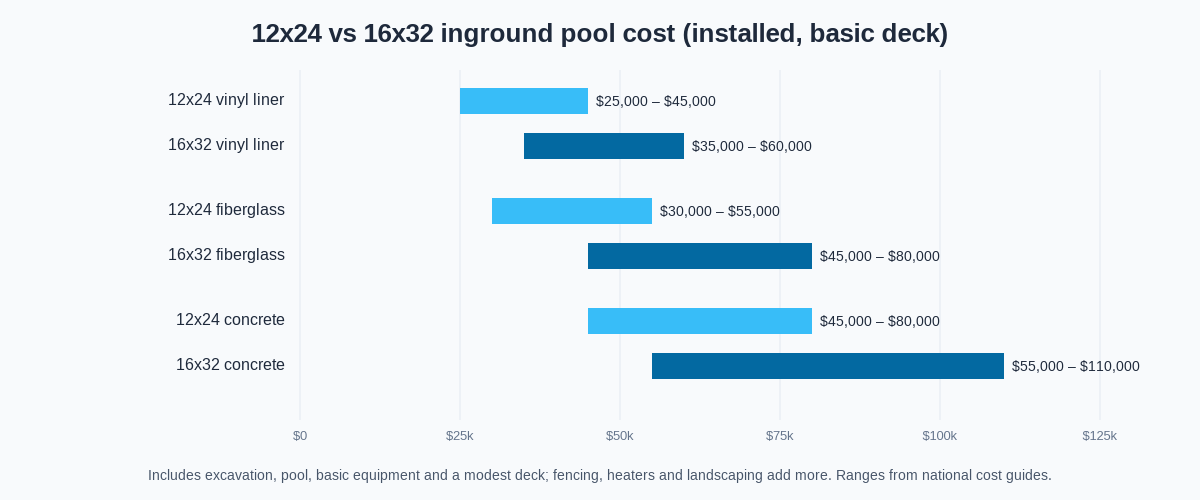
Chart: Asphapro.com
Quick Answer
How much does a 12x24 inground pool cost? Installed with basic equipment and a modest deck, a 12x24 vinyl liner pool costs about $25,000 to $45,000, a 12x24 inground fiberglass pool about $30,000 to $55,000, and a 12x24 concrete (gunite) pool about $45,000 to $80,000. For comparison, 16x32 inground pool cost runs about $35,000 to $60,000 for vinyl, $45,000 to $80,000 for fiberglass and $55,000 to $110,000 for concrete. Fencing, a larger deck, a heater, an automatic cover and landscaping can add $10,000 to $40,000 or more.
A 12x24 pool is one of the most popular small inground pool sizes. It holds about 9,000 to 12,000 gallons, gives room for a few people to swim and play, fits most suburban yards, and costs much less to build and run than a full-size pool. If you are wondering how much does a 12x24 inground pool cost, the answer depends mostly on the pool type, your location, the site and how much you add around it.
This guide explains the cost of a 12x24 inground pool in vinyl, fiberglass and concrete, what is included in a typical quote, the extras most people add, running costs, and how the price compares with a 16x32 inground pool. For all pool sizes and types, see how much does a pool cost.
12x24 Inground Pool Cost by Type
| Pool type | 12x24 installed cost | Build time | Lifespan of main surface |
|---|---|---|---|
| Vinyl liner | $25,000 – $45,000 | 2 – 4 weeks | Liner 8 – 12 years |
| Fiberglass | $30,000 – $55,000 | 1 – 3 weeks | Gelcoat 15 – 25+ years |
| Concrete (gunite or shotcrete) | $45,000 – $80,000 | 6 – 12 weeks | Plaster 10 – 15 years |
12x24 vinyl liner pool
Vinyl liner pools are usually the lowest-cost permanent inground pool. A 12x24 vinyl pool has steel or polymer walls, a sand or grout floor and a custom vinyl liner. It installs in a few weeks and can be built in almost any rectangle size. The main ongoing cost is replacing the liner every 8 to 12 years, which costs $2,000 to $4,500 for this size; see pool liner replacement cost.
12x24 inground fiberglass pool cost
The 12x24 inground fiberglass pool cost is about $30,000 to $55,000 installed. The shell alone costs about $12,000 to $25,000, depending on the model and features like built-in steps, benches and tanning ledges. Fiberglass pools arrive in one piece and are set by crane, so the install is fast. The smooth gelcoat resists algae and uses fewer chemicals, which lowers running costs. Many fiberglass models are close to 12x24, such as 12x24, 12x25 or 13x26.
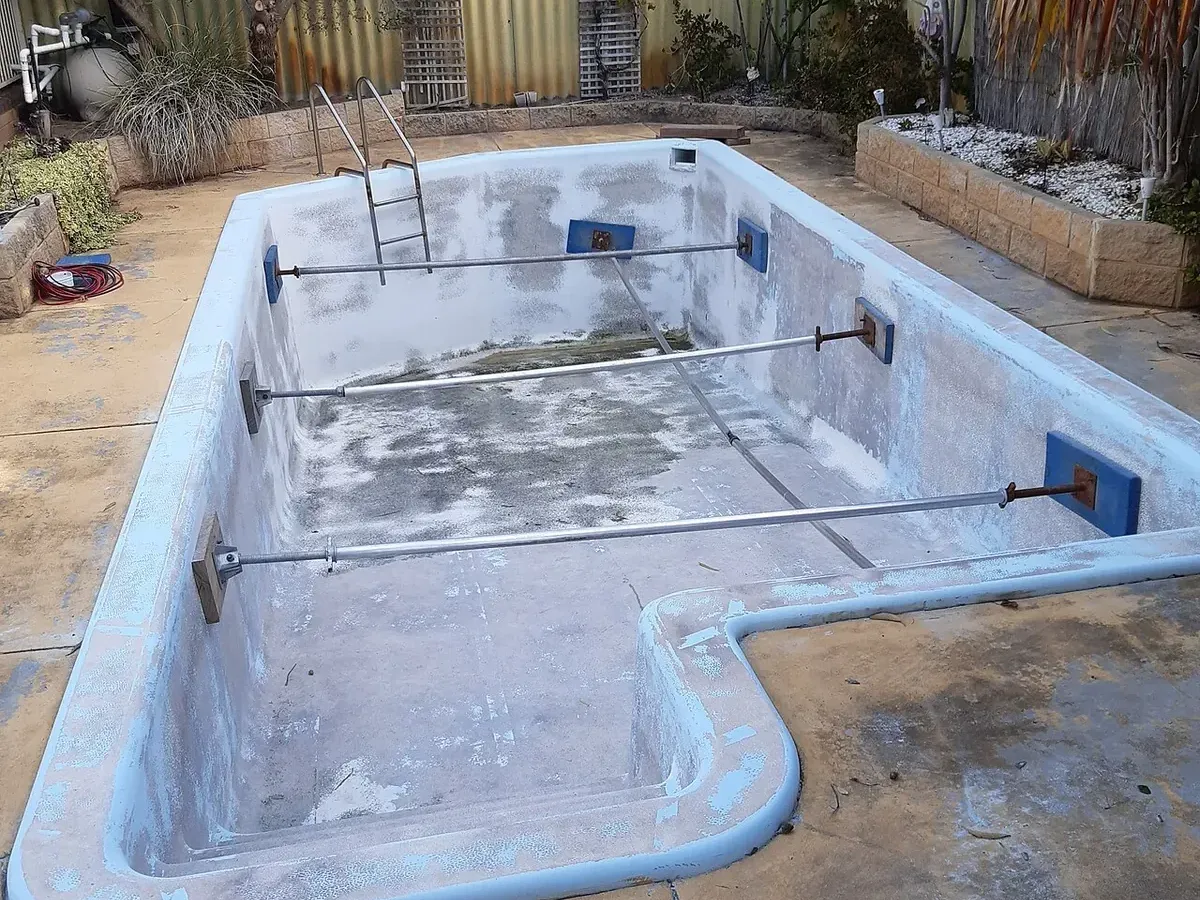
Photo: Calistemon, Wikimedia Commons, CC BY-SA 4.0 (cropped)
12x24 concrete pool
A concrete pool can be any shape and depth, with a choice of plaster, aggregate or tile finishes. It is the most durable structure but the most expensive to build and maintain, because the plaster needs resurfacing every 10 to 15 years and concrete surfaces use more chemicals. A small concrete pool still costs a lot because much of the price is fixed: design, excavation, steel, plumbing and equipment.
What Is Included in a 12x24 Inground Pool Quote?
Most quotes for a 12x24 inground pool include:
- Design and permits
- Excavation and soil removal (or spreading on site)
- The pool structure (walls and liner, fiberglass shell, or concrete shell)
- Plumbing: skimmer, returns, main drain and pipes to the equipment
- Equipment: pump, filter and basic controls
- Electrical bonding and connection (sometimes by a separate electrician)
- Backfill and a basic concrete deck or coping
- Start-up chemicals and an owner orientation
Ask exactly how many square feet of deck are included. Many low quotes include only a narrow coping or 3 feet of deck around the pool.
Extra Costs for a 12x24 Inground Pool
The basic pool price is rarely the final number. Common extras for a 12x24 inground pool:
| Extra | Typical cost |
|---|---|
| Larger concrete deck (400 – 600 sq ft) | $4,000 – $12,000 |
| Paver or stone deck instead of concrete | $8,000 – $25,000 |
| Safety fence | $2,000 – $8,000 |
| Heat pump or gas heater | $3,000 – $7,000 |
| Automatic safety cover | $8,000 – $15,000 |
| Salt chlorine generator | $1,500 – $2,500 |
| LED lights | $800 – $2,500 |
| Landscaping | $2,000 – $15,000 |
| Electrical service upgrade | $1,000 – $4,000 |
| Rock removal or difficult access | $1,000 – $10,000+ |
Adding a full deck, a fence and a heater to a basic vinyl or fiberglass 12x24 pool often brings the total to $40,000 to $70,000. For deck ideas and prices, see concrete pool deck.
What Affects the Cost of a 12x24 Inground Pool?
- Pool type: vinyl is lowest, fiberglass middle, concrete highest.
- Location: labor and permit costs vary widely. Pools in the Northeast and California cost more than in Texas, Florida or the Southeast.
- Site conditions: rock, high groundwater, slopes and poor soil add excavation and engineering costs.
- Access: fiberglass shells need a crane or a wide path; narrow side yards add cost.
- Depth: a uniform 4 to 5 ft depth costs less than a deep end.
- Features: sun ledges, benches, waterfalls, lighting and automation add up quickly.
- Equipment quality: variable-speed pumps, cartridge filters and automation cost more up front but save energy.
- Timing: building in the off-season can bring lower prices and faster schedules.
16x32 Inground Pool Cost Compared
A 16x32 inground pool is the classic "average" family pool, with about 512 square feet of water surface versus 288 for a 12x24 pool. That is almost 80% more surface area, which means more water, more chemicals and more heat. The 16x32 inground pool cost is about $35,000 to $60,000 for vinyl, $45,000 to $80,000 for fiberglass and $55,000 to $110,000 for concrete, installed with a basic deck.
| Factor | 12x24 inground pool | 16x32 inground pool |
|---|---|---|
| Surface area | 288 sq ft | 512 sq ft |
| Typical gallons | 9,000 – 12,000 | 17,000 – 23,000 |
| Vinyl cost | $25,000 – $45,000 | $35,000 – $60,000 |
| Fiberglass cost | $30,000 – $55,000 | $45,000 – $80,000 |
| Concrete cost | $45,000 – $80,000 | $55,000 – $110,000 |
| Yearly running cost | $800 – $2,000 | $1,200 – $3,000 |
| Space needed with deck | about 22 x 34 ft | about 26 x 42 ft |
The 16x32 pool inground option suits larger families and those who want room for games or laps. The 12x24 inground pool fits smaller yards and budgets. The cost of a 16x32 inground pool is usually only 25% to 45% more than a 12x24, because many costs, such as equipment, permits and design, are similar for both sizes.
Photo: Calistemon, Wikimedia Commons, CC BY-SA 4.0
How Many Gallons Is a 12x24 Inground Pool?
Gallons = length x width x average depth x 7.5. A 12x24 pool with a uniform 4.5 ft depth holds about 9,700 gallons; with a 3.5 to 6 ft slope (average 4.75 ft) about 10,300 gallons; and with a deeper 3.5 to 8 ft profile about 12,400 gallons. A 16x32 pool with an average depth of 5.5 ft holds about 21,100 gallons. For other sizes, see how many gallons is my pool.
Running Costs of a 12x24 Pool
Smaller pools cost less every year. Typical yearly costs for a 12x24 inground pool:
- Chemicals: $250 to $600.
- Pump electricity: $150 to $500 with a variable-speed pump.
- Heating (if any): $300 to $1,500 depending on season and heater type.
- Opening and closing (cold climates): $300 to $700.
- Repairs and parts: $100 to $500.
Over 10 years, include one liner replacement for vinyl pools ($2,000 to $4,500) or a resurfacing for concrete pools ($5,000 to $9,000 for this size). Fiberglass pools usually need neither in that period. For full upkeep details, see cost to maintain a pool.
Example 12x24 Inground Pool Budgets
| Project | Items | Estimated total |
|---|---|---|
| Budget vinyl pool | 12x24 vinyl, sand filter, 3 ft concrete deck, mesh fence | $30,000 – $40,000 |
| Mid-range fiberglass pool | 12x24 fiberglass with bench, variable-speed pump, 400 sq ft deck, aluminum fence, heat pump | $50,000 – $70,000 |
| Custom concrete pool | 12x24 gunite, tile, sun ledge, pavers, automatic cover, lights | $75,000 – $110,000 |
How to Save on a 12x24 Inground Pool
- Choose vinyl or fiberglass instead of concrete.
- Keep the shape a simple rectangle with a uniform depth.
- Start with a basic deck and add pavers or landscaping later.
- Get at least three detailed quotes and compare what each includes.
- Build in fall or winter when builders are less busy.
- Consider a DIY kit if you are handy; see DIY inground pool kits.
- Choose a variable-speed pump and a cover to cut running costs.
Is a 12x24 Pool Big Enough?
It depends on how you plan to use it, but for most families of four, yes. A 12x24 inground pool fits about 6 to 8 people comfortably for play, has enough length for short laps and water games, and is easy to keep clean and warm. If you want to swim real laps or host large groups often, a 14x28 or 16x32 inground pool may suit you better. If your yard is small, a 12x24 pool leaves more room for a patio and lawn.
How a 12x24 Inground Pool Is Built
Vinyl liner pool
- The builder lays out the pool, pulls permits and digs the hole about 2 feet wider than the walls.
- Steel or polymer wall panels are bolted together, braced and leveled.
- Plumbing for the skimmer, returns and main drain is run and pressure tested.
- A concrete collar is poured around the base of the walls.
- The floor is shaped and finished with a sand-cement or vermiculite mix.
- The liner is set with a vacuum, the pool is filled, and fittings are cut in.
- The pool is backfilled and the deck is poured.
Fiberglass pool
- The hole is dug to match the shell, and a level base of gravel is placed.
- The shell arrives on a truck and is lifted in by crane.
- Plumbing is connected and tested.
- The pool is filled while gravel is backfilled around it to keep pressure even.
- A concrete bond beam and deck are poured around the top.
Concrete pool
- The hole is dug to the exact shape and depth.
- Steel rebar is tied in a grid, and plumbing is set.
- Gunite or shotcrete is sprayed to form the shell and cured for several weeks.
- Tile, coping and the deck are installed.
- The interior finish (plaster, quartz or pebble) is applied, and the pool is filled.
The longer build time for concrete is one reason its price is higher. For more on the two most popular types, see concrete vs fibreglass swimming pool.
Shapes and Depths for a 12x24 Inground Pool
A 12x24 inground pool is most often a simple rectangle, which is the most efficient shape for small yards and the easiest to cover. Other options in about the same footprint include a rectangle with rounded corners, a Roman end with curved steps, a kidney shape, or an L shape with a shallow lounging area. Freeform shapes use space less efficiently and can cost more to cover with an automatic cover.
Depth matters for both cost and use. A flat "sport bottom" of 3.5 to 5 ft is ideal for games, volleyball and young families, and it keeps water volume and cost down. A slope from 3.5 ft to 6 ft gives a deeper area for older kids and adults. A diving well usually needs 8 ft or more of depth and a longer pool than 24 ft, so most 12x24 pools are not suited to diving boards. Ask your builder which depth profile fits the way you will use the pool, and how each option changes the price.
Vinyl vs Fiberglass vs Concrete for a 12x24 Pool
Choose vinyl if you want the lowest upfront cost and a simple rectangle. Vinyl feels soft underfoot and can be built to any straight-sided size. Budget for a new liner every 8 to 12 years and be careful with sharp toys and pets' claws.
Choose fiberglass if you want fast installation, low maintenance and a smooth surface. The 12x24 inground fiberglass pool cost is higher than vinyl at first, but lower chemical use and no liner changes often make it the best value over 15 to 20 years. Make sure a crane can reach your yard.
Choose concrete if you want a custom shape, special finishes, an attached spa or a design that matches a high-end home. It is the most flexible and durable structure but has the highest upfront and long-term costs.
Permits, Inspections and Timing
Every inground pool needs a building permit, and most also need electrical and fence permits. Permits for a 12x24 inground pool usually cost $500 to $2,500, depending on the town. Inspections typically happen after excavation and steel (for concrete), after plumbing and bonding, and at the end before filling or use. Getting permits can take 2 to 8 weeks, so start early. Many builders book up in spring, so signing a contract in fall or winter often gives you a better place in the schedule and sometimes a lower price.
Financing a 12x24 Inground Pool
Few people pay cash for a pool. Many owners finance a pool with a home equity loan or line of credit, a cash-out refinance, or an unsecured pool loan. Rates and terms vary widely, so compare offers. Ask whether the builder works with lenders, but do not let financing push you into a bigger pool than you need. A 12x24 inground pool keeps the loan smaller and the monthly payment and running costs lower than a full-size pool.
Questions to Ask a Pool Builder
- What exactly is included in the price, including deck size and equipment brands?
- Who pulls permits, and who handles electrical work and inspections?
- What happens if you hit rock or groundwater, and how is that priced?
- What are the warranties on the structure, surface, equipment and workmanship?
- How long will the build take, and what is the payment schedule?
- Can you show recent 12x24 pools you built and give references?
Comparing detailed answers is the best way to know how much a 12x24 inground pool will really cost you, and to avoid surprises once digging starts.
12x24 Inground Pool Cost by Region
Where you live can change the price of the same pool by $10,000 to $25,000. In busy pool markets in the South and Southwest, such as Texas, Florida, Arizona and Georgia, a 12x24 vinyl or fiberglass pool often sits at the lower end of the ranges in this guide, because many builders compete and the climate allows year-round work. In the Northeast, the upper Midwest and California, higher labor rates, permit fees, frost-depth rules and shorter building seasons push prices toward the top of the ranges or above. Remote rural areas can also cost more if the builder or the fiberglass shell must travel far.
Which Features Are Worth It on a 12x24 Pool?
- Variable-speed pump: worth it. It cuts electricity by half or more and is quiet.
- Automatic safety cover: often worth it, especially with young children. It also saves heat, water and cleaning time. A 12x24 rectangle is one of the cheapest shapes to cover.
- Heat pump: worth it in most climates if you want to swim beyond the hottest months. A small pool heats quickly.
- Bench or tanning ledge: worth it. People sit in small pools as much as they swim.
- LED lighting: worth it for evening use; low running cost.
- Waterfalls and fountains: nice, but they add cost, noise and evaporation.
- Salt system: a matter of preference; see salt pool versus chlorine.
Does a 12x24 Pool Add Home Value?
A pool can add some value, especially in warm areas where buyers expect one, but it rarely returns its full cost when you sell. A modest 12x24 inground pool with a clean deck and fence tends to appeal to more buyers than a large, costly pool, because upkeep is lower. In colder areas, the added value is often smaller. Build the pool for your own enjoyment and keep records of permits and maintenance to reassure future buyers.
Safety Costs to Include
Safety is part of the real cost of any pool. Most towns require a barrier at least 48 inches high with a self-closing, self-latching gate. Add door alarms for doors that open to the pool area, a pool alarm, anti-entrapment drain covers (now standard) and a safety cover if you have small children. Budget about $2,000 to $15,000 for safety features depending on your choices; for fence styles, see swimming pool fence ideas.
Common Budget Mistakes With a 12x24 Inground Pool
- Comparing only the base price. One quote may include a full deck, fence and heater while another covers only the pool shell and a narrow coping.
- Forgetting the yard. Grading, drainage, sod and planting after construction often cost $2,000 to $10,000.
- Skipping the electrical check. Older homes may need a panel upgrade for the pump, heater and lights.
- Ignoring running costs. A cheaper pool with a single-speed pump and no cover can cost more over 10 years than a slightly pricier, efficient one.
- No contingency. Set aside 10% to 15% for surprises like rock, roots or changes during the build.
Planning for these items up front gives you a realistic answer to how much a 12x24 inground pool costs in your yard, not just on paper.
Caring for a Small Inground Pool
One advantage of a 12x24 inground pool is how quickly routine care goes. Skimming and brushing take a few minutes, a robotic cleaner covers the floor in an hour or two, and chemicals go further because there is less water. Test chlorine and pH two or three times a week in summer, clean the skimmer and pump baskets weekly, and clean or backwash the filter when the pressure rises. Keep the water level in the middle of the skimmer. In cold climates, close the pool properly each fall, and lower the water below the tile or skimmer before freezing weather. With this routine, most owners spend one to two hours a week on a pool this size, and the money saved on chemicals and power adds up every season.
Is a 12x24 pool cheaper to heat than a 16x32?
Yes. With about 45% less surface area and roughly half the water, a 12x24 pool heats faster and loses less heat, often cutting heating costs by a third to a half.
12x24 Inground Pool Cost: Key Points
- A 12x24 inground pool costs about $25,000 to $45,000 in vinyl, $30,000 to $55,000 in fiberglass and $45,000 to $80,000 in concrete.
- 16x32 inground pool cost is about $35,000 to $110,000 by type.
- Fencing, decking, heaters and covers add $10,000 to $40,000+.
- A 12x24 pool holds about 9,000 to 12,000 gallons.
Frequently Asked Questions
How much does a 12x24 inground pool cost?
About $25,000 to $45,000 for vinyl, $30,000 to $55,000 for fiberglass and $45,000 to $80,000 for concrete, installed with a basic deck.
How much does a 16x32 inground pool cost?
About $35,000 to $60,000 for vinyl, $45,000 to $80,000 for fiberglass and $55,000 to $110,000 for concrete.
What is the 12x24 inground fiberglass pool cost for the shell only?
About $12,000 to $25,000 for the shell, before delivery, crane, excavation, plumbing, equipment and deck.
How long does it take to install a 12x24 inground pool?
About 1 to 3 weeks for fiberglass, 2 to 4 weeks for vinyl and 6 to 12 weeks for concrete, plus time for permits.
How much yard space does a 12x24 pool need?
With a 4 to 5 ft deck and code setbacks, plan on an area of at least 22 x 34 ft, plus room for equipment.
Is a 16x32 inground pool worth the extra cost over 12x24?
If you have the space, a larger family or want to swim laps, often yes. The cost of a 16x32 inground pool is usually 25% to 45% more, while giving almost 80% more water area.
Can I get a 12x24 inground pool for under $30,000?
Sometimes, with a basic vinyl pool, a minimal deck and an easy site in a lower-cost area. A DIY kit can bring it lower.
Does a 12x24 inground pool need a fence?
Yes, in almost all areas. Budget $2,000 to $8,000 depending on the fence type and length.
Sources
- HomeGuide: Inground pool cost
- Angi: Inground pool cost
- Fixr: Cost to build a swimming pool
- US Department of Energy: Pool pumps