
How to Hide Pool Equipment: Methods, Clearances and Costs
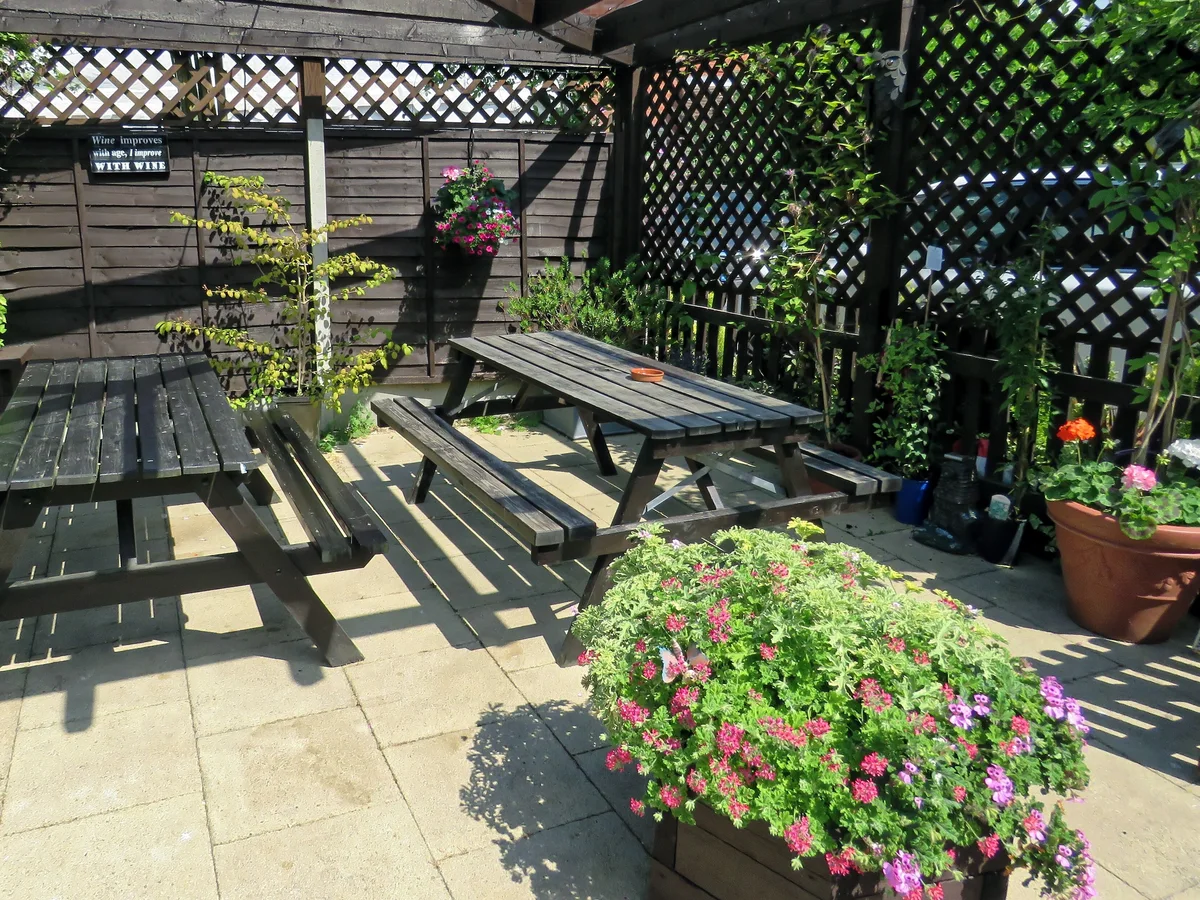
Photo: Acabashi, Wikimedia Commons, CC BY-SA 4.0
Quick Answer
To hide pool equipment, first decide where the view and the noise bother you, then screen only those sides. The easiest methods are painting pipes and tanks a dark, earthy color, planting shrubs or tall grasses 2 to 3 feet away, and building a slatted or lattice screen ($150 to $2,000). For more cover, use louvered aluminum panels ($1,000 to $4,000) or a low wall on the noisy side. Cut noise with a variable speed pump at low speed. Whatever you build, keep airflow, about 3 feet of service space in front, the clearances in your heater and heat pump manuals, an open top over heat pumps and gas heaters, and a gate wide enough to swap a filter.
The pump, filter, heater and valves are the part of a pool nobody wants to look at. They are often placed beside the house, along a fence or right next to the patio, where they hum all day and spoil an otherwise nice backyard. The good news is that it is usually easy to hide pool equipment. The catch is that equipment needs air, light access for repairs and room to breathe. A hiding job that boxes everything in can overheat a motor, choke a heat pump, block a gas heater's vent or make every service call slower and more expensive.
This guide shows how to hide pool equipment the right way, step by step: planning, clearance rules, ten methods from cheap to custom, noise control, costs and common mistakes. For design ideas and enclosure styles, see our gallery of pool enclosure ideas, which includes pool equipment enclosure ideas and a plan layout.
How to Hide Pool Equipment, Step 1: Work Out What You Need to Hide
Before you buy anything, stand where you spend time: the patio, the kitchen window, the pool deck, the lounge chairs. Note which sides of the equipment you can see from each spot. Most pads are visible from only one or two directions. You may only need to screen those sides, leaving the others open for air and access. Then listen. Is the pump noise the main problem, or just the look? Noise needs solid materials or a quieter pump; looks can be fixed with plants or slats. This quick check tells you how to hide pool equipment with the least work and money.
Also look at the pad itself. Measure its size and the height of the tallest equipment, usually the filter tank or heat pump. Note where the electrical disconnect, timer or automation panel is, where the gas line and heater vent are, and which way the heat pump fan blows. Photograph the pad and sketch it with measurements. You will need this when you plan the screen.
How to Hide Pool Equipment, Step 2: Know the Clearance Rules
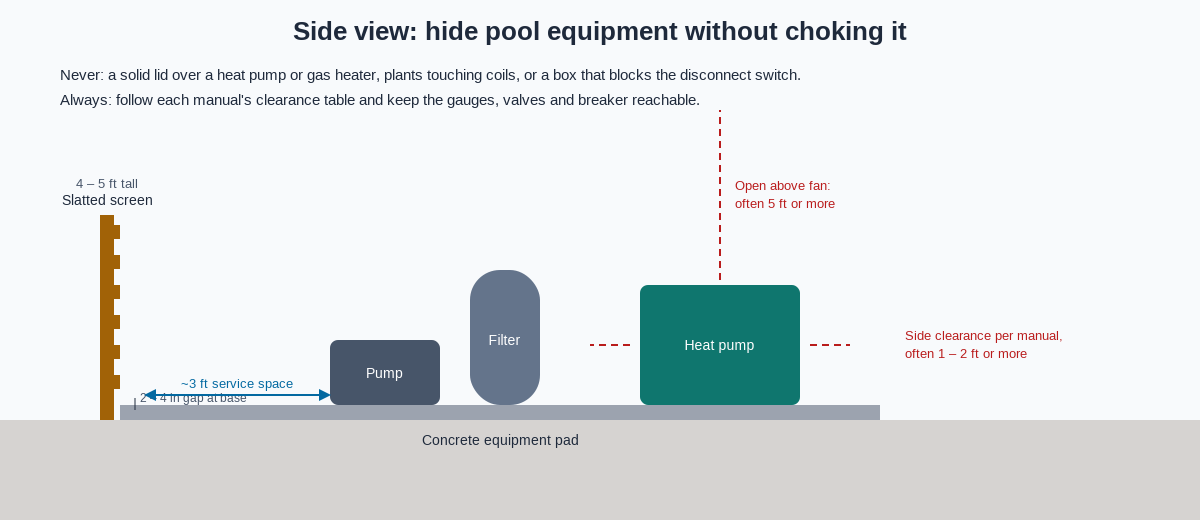
Diagram: Asphapro.com
The diagram shows the rules that every method must follow. When working out how to hide pool equipment, these matter more than the look:
Pump motors need air. Most pool pump motors are cooled by a fan that pulls air through the motor housing. In a tight, closed box, the air gets hot and the motor runs hotter, which shortens bearing and winding life. Leave open slats or gaps and do not build a solid lid right over the motor.
Heat pumps need lots of open air. A heat pump pulls air through its coils on the sides and blows it out the top. Makers typically ask for a foot or two or more on the sides and several feet of open space above the fan, often 5 feet or more. Blocking airflow lowers heating output and can make the unit cycle or ice up. Never put a roof over a heat pump.
Gas heaters need clearances and venting. Gas heaters have minimum distances to combustible materials like wood fences, and they need open air for combustion and for venting exhaust. Codes and manuals set these distances. Outdoor heaters are designed to vent straight up; do not cover them.
Electrical gear needs working space. Electrical codes generally require clear working space in front of panels and disconnects, typically about 3 feet deep and at least 30 inches wide. Do not build a screen or cabinet that blocks them.
Service needs room. Leave around 3 feet in front of the equipment, and make sure a gate or removable panel is wide enough to carry out a filter tank or heater. Technicians charge more when they have to take apart a fence to change a pump.
Always read the installation manual for each piece of equipment. The numbers vary by brand and model, and following them keeps your warranty valid.
How to Hide Pool Equipment, Step 3: Choose a Method
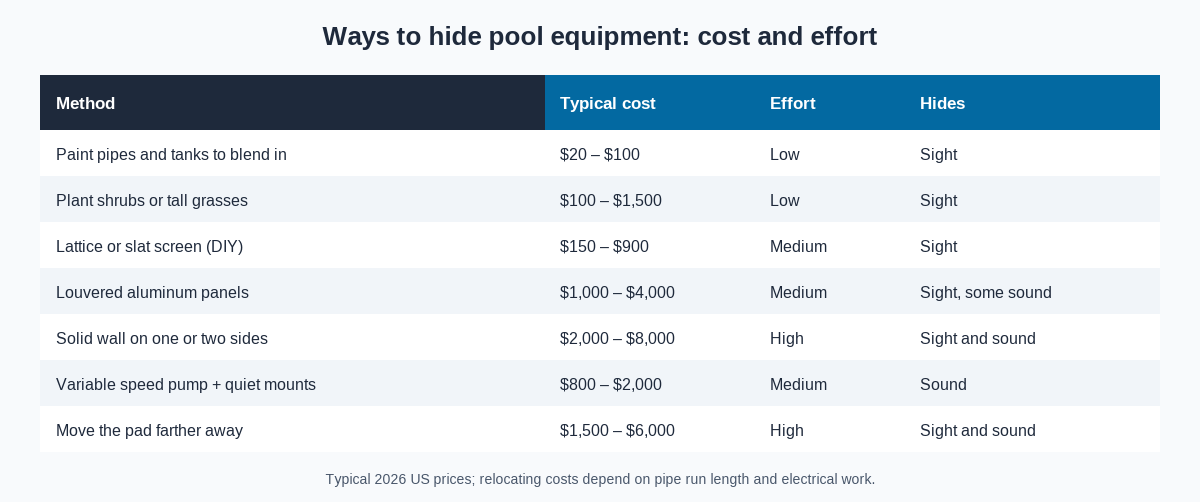
Chart: Asphapro.com
The chart compares the main ways to hide pool equipment by cost, effort and whether they deal with looks, noise or both. Here are ten methods in detail, from the cheapest to the most involved.
1. Paint to blend in. White PVC pipe, gray filter tanks and bright valve handles draw the eye. Painting exposed PVC with a paint made for plastic, in a dark green, brown or the color of the house, makes the equipment far less noticeable. Do not paint motor housings, labels or heat exchanger coils; paint can trap heat and hide warnings. This is the cheapest way to hide pool equipment, often under $50.
2. Tidy the pad. A tidy pad is the first step in how to hide pool equipment well. Neat plumbing with fewer elbows, labeled valves, cables in conduit and no loose hoses or chemical buckets make equipment look intentional instead of messy. Moving chemical storage to a dry, locked cabinet elsewhere also improves safety.
3. Plant a screen. Shrubs, tall grasses or a short hedge on the visible sides can hide pool equipment naturally. Keep plants 2 to 3 feet from the equipment so leaves do not block motor vents or get pulled into a heat pump. Choose evergreen shrubs that do not drop much litter, and avoid thorny plants near the service path. The photo below shows tall ornamental grasses that can screen a low pad in summer.
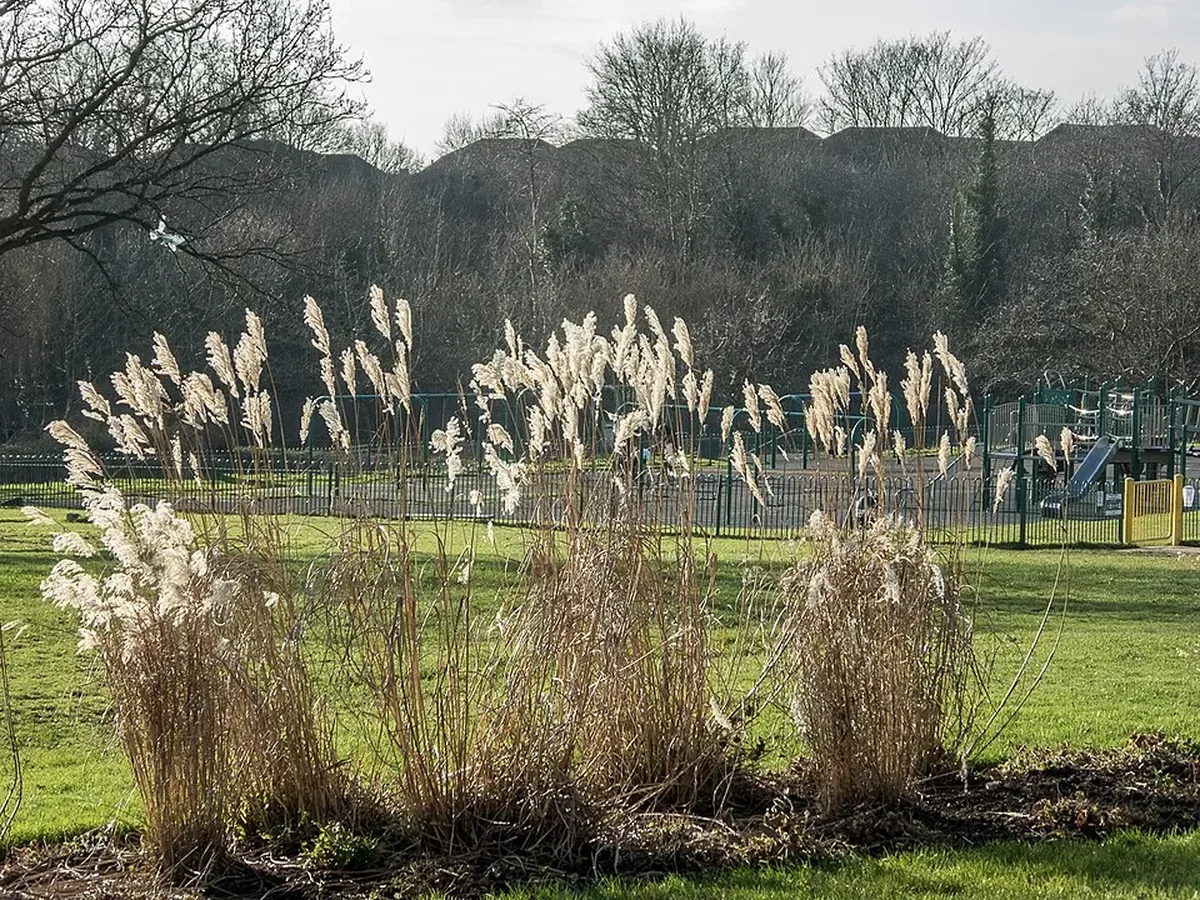
Photo: Christine Matthews, Wikimedia Commons, CC BY-SA 2.0
Grasses like miscanthus grow fast but die back in winter in many climates, so pair them with evergreens such as boxwood, holly, podocarpus, wax myrtle or dwarf arborvitae if you want year-round cover. For more pool-friendly plants, see landscaping ideas for inground pools.
4. Lattice panels. Vinyl or wood lattice is the quickest DIY way to hide pool equipment. Panels screw to simple posts, cost little and let air through. Lattice hides less than slats and does little for noise, but climbing plants on it, as in the photo at the top of this page, soften it nicely.
5. Slatted wood screen. Horizontal boards with half-inch to one-inch gaps give a clean, modern look and allow airflow. Cedar, redwood or pressure-treated pine work well. A three-sided screen with a gate is the most popular way to hide pool equipment, and it costs about $300 to $2,000 depending on size and whether you build it yourself.
6. Louvered aluminum or composite panels. Louvers angle downward so you cannot see through them from outside, while air moves freely. They do not rot, warp or need painting, which suits wet, chlorinated pool areas. Expect $1,000 to $4,000 for a typical pad.
7. Low wall on the noisy side. If you want to hide pool equipment noise as well as looks, a block, brick or stone wall on the side facing the house or the neighbors reflects noise away and hides the equipment completely from that direction. Leave the other sides open or slatted. Walls cost $2,000 to $8,000 or more and need a footing. See concrete block wall cost for prices.
8. Prefab covers and boxes. Ready-made resin or wood enclosures fit over smaller above ground pool pumps and filters. They are easy, but measure carefully: many are too tight for larger modern pumps, and full boxes can trap heat. Choose vented designs.
9. Use the house or a shed. Some owners hide pool equipment behind an extension of the house wall, under a deck with open sides or in a shed with large vents, a removable roof panel or open gable ends. This takes careful planning for ventilation, access and codes, and heaters and heat pumps usually cannot go inside an enclosed shed.
10. Move the pad. If the equipment sits right beside the patio, moving it farther away may be the best long-term fix. Moving a pad involves new plumbing runs, new electrical and sometimes a larger pump to overcome longer pipe runs. It typically costs $1,500 to $6,000 or more. If you are building a new pool, choose the pad location carefully from the start. For a new slab, see our concrete pads guide.
How to Hide Pool Equipment, Step 4: Build a Slatted Screen
Most people who look up how to hide pool equipment end up building a slatted screen. Here is how to build a three-sided screen with a gate around a pad about 5 by 8 feet:
Mark the layout. Place the screen at least 3 feet from the front of the equipment and at the distances your heater and heat pump manuals require. Mark post locations no more than 6 feet apart.
Check underground lines. Call your local utility locating service before digging. Pool pads often have pipes, gas lines and wires buried nearby.
Set posts. Set 4 by 4 posts 2 feet deep in concrete, or use metal post bases bolted to the slab edge if the pad is large enough. Keep posts plumb.
Add slats. Screw horizontal 1 by 4 or 1 by 6 boards to the posts with stainless or coated screws. Use a spacer for even gaps. Start the bottom board 2 to 4 inches above the ground for airflow and drainage.
Build the gate. Make it at least 36 inches wide, add a diagonal brace, use heavy hinges and add a latch that takes a padlock.
Finish and check. Seal or stain the wood. Then check: can you read the gauges, reach every valve, open the heater panel and pull the filter lid? Is the top open over the heat pump and gas heater? Is the electrical disconnect clear?
Materials for this screen usually cost $300 to $900. A carpenter will typically charge $1,000 to $2,500 installed.
How to Hide Pool Equipment Noise
Noise often bothers people more than looks. The best way to quiet pool equipment is to fix it at the source. A variable speed pump running at low speed for most of the day is far quieter than an old single-speed pump at full power, and it also saves energy. Loud grinding or screeching usually means worn bearings; see how long do pool pumps last for signs it is time to replace the pump.
Next, reduce vibration. Set the pump on a rubber pad, make sure it is level and secure, and support pipes so they do not rattle against walls or fences. Then block the sound path. A solid wall or a solid section of fence between the equipment and the patio reflects sound away; slats and plants do much less. Acoustic panels made for outdoor use can line the inside of a slatted screen. Leave the far side or the top open so heat can escape. Together, these steps hide pool equipment noise as well as the equipment itself.
How to Hide Pool Equipment on Above Ground Pools
Above ground pool pumps and filters sit close to the pool wall, often on a small pad of pavers. To hide pool equipment here, build a small three-sided cedar box with slatted sides and a hinged lid that has a gap or vents, place a short slat screen in front of it, or surround it with large potted plants. If the pool has a deck, a vented cubby under the deck stairs can work, as long as the pump has airflow and you can reach the valves and hoses. Do not create a step or ledge next to the pool wall that a child could use to climb in.
How to Hide Pool Equipment in a Small Yard
Small yards leave little room for a separate screen. Slim, tall screens close to the equipment save space, but remember the clearances. Vertical gardens or vines on a trellis can turn a screen into a green wall. Paint the screen the same color as the house or fence so it fades into the background. If the equipment sits along the side of the house, a gate across the side yard with the equipment behind it is often the simplest way to hide pool equipment completely. For more ideas, see pool privacy ideas.
How to Hide Pool Equipment With Lighting and Paths
Hiding equipment does not mean making it hard to reach at night. A small solar or low-voltage path light near the gate and one aimed at the pad let you check gauges and valves after dark without a flashlight. A gravel or paver path from the patio to the gate keeps mud off your shoes and makes the screen look like a planned part of the yard rather than an afterthought. Uplights aimed at the outside of a slatted screen or at the plants in front of it turn the screen into a feature at night and draw the eye away from what is behind it. These small touches are an easy way to hide pool equipment and still keep it practical.
How to Hide Pool Equipment With Automation and Fewer Parts
Older pads often grow messy over the years, with extra timers, old valves, leftover pipes and boxes added by different installers. Simplifying the pad makes it easier to hide pool equipment. A single automation panel can replace several separate timers. A variable speed pump with built-in scheduling removes the need for an external timer. Removing dead pipes, unused valves and old chlorinator feeders shrinks the footprint, so a smaller, cheaper screen does the job. When you replace equipment anyway, ask the installer to tidy the plumbing and keep the layout compact, with all controls on one side facing the gate.
How to Hide Pool Equipment Without Voiding Warranties
Pump, filter, heater and heat pump warranties usually require installation according to the manual, including clearances, ventilation and protection from flooding. If a heat pump fails because it was boxed in without enough airflow, or a motor burns out after months of overheating in a closed cabinet, the maker may deny the claim. Before you hide pool equipment, read the installation section of each manual, take photos of the finished screen with a tape measure showing the clearances and keep them with your receipts. If you hire a contractor, ask them to confirm in writing that the design meets the equipment makers' requirements.
How to Hide Pool Equipment: Costs at a Glance
The cost to hide pool equipment ranges widely. Paint, cleanup and a few shrubs cost under $500. A DIY lattice or slatted screen costs $150 to $900 in materials. A professionally built wood screen with a gate runs about $1,000 to $2,500. Louvered aluminum or composite systems typically cost $1,000 to $4,000. A masonry wall on one or two sides costs $2,000 to $8,000 or more. Replacing an old pump with a quieter variable speed model costs $800 to $2,000 installed and often pays back part of its cost through lower electricity bills. Moving the whole pad typically costs $1,500 to $6,000 or more. Start with the cheapest steps; many owners find that paint, plants and a short screen on one side are all they need.
How to Hide Pool Equipment With Materials That Last
Pool pads are wet, sunny and exposed to chlorine and other chemicals. Choose materials that can take it. Cedar, redwood and pressure-treated pine resist rot but need sealing every few years. Vinyl and composite boards need little upkeep. Powder-coated aluminum does not rust. Use stainless steel or coated screws, since plain steel fasteners stain and fail near chlorinated water. Keep wood off the ground on metal post bases or concrete footings. Store chlorine and acid away from the screen, since fumes can corrode metal and discolor wood. Durable materials mean the work you do to hide pool equipment will look good for many years.
How to Hide Pool Equipment: Mistakes to Avoid
Building a solid box. Fully enclosed boxes trap heat and moisture. Motors overheat and metal parts corrode faster.
Covering heaters and heat pumps. A roof or lid over these blocks venting and airflow. This is unsafe for gas heaters and cuts heat pump output.
Planting too close. Shrubs pressed against equipment block vents, drop leaves into heat pumps and hide leaks.
Blocking service access. A screen with no gate, or a gate too narrow for a filter tank, means extra cost every repair.
Ignoring drainage. Screens that trap water around the pad lead to rust and rot.
Forgetting the electrical panel. Code requires clear working space in front of disconnects and panels.
Hiding a leak. Dense plants and solid panels can hide drips and wet spots for weeks. When you hide pool equipment, leave a way to see under and around it, and look in at least once a week during the season.
How to Hide Pool Equipment: Worked Examples
Pad next to the patio, budget fix. A homeowner paints the white PVC pipes dark brown, moves chemical buckets into a locked deck box and plants three 4-foot evergreen shrubs 3 feet in front of the pad. Total cost: about $350. The equipment almost disappears from the patio view.
Heat pump and pump beside the house. A three-sided louvered aluminum screen, 5 feet tall with an open top and a 3-foot gate, hides the equipment from the yard. The installer leaves 2 feet between the heat pump and the screen and nothing overhead. Cost: about $2,800.
Noisy single-speed pump near a bedroom window. The owner replaces the old pump with a variable speed pump, sets it on a rubber pad and builds a solid wood fence section on the house side with slats on the other two sides. The pump is now barely audible indoors. Total: about $2,200 including the pump.
New pool build. The pool builder places the equipment pad 40 feet from the patio behind the garage, with a slatted screen and a gravel path. A slightly larger pump handles the longer pipe run. Planning ahead avoids the need to hide pool equipment later.
How to Hide Pool Equipment: Key Points
- Screen only the sides you can see or hear from.
- Keep airflow, about 3 feet of service space and manual clearances.
- Never roof over a heat pump or gas heater.
- Paint, plants, slats and louvers hide looks; walls and quieter pumps cut noise.
- Include a wide, lockable gate.
Frequently Asked Questions
What is the cheapest way to hide pool equipment?
Paint exposed pipes and tanks a dark color, tidy the pad and plant shrubs or tall grasses a few feet away. Lattice panels are the cheapest screen.
Can I put pool equipment in a shed?
Pumps and filters can go in a well-ventilated shed with good access, but heaters and heat pumps usually need open air. Check manuals and local codes.
How far should a screen be from pool equipment?
Leave about 3 feet in front for service, and follow each manual's clearances on the sides and above, especially for heaters and heat pumps.
How do I reduce pool pump noise?
Use a variable speed pump at low speed, set it on a rubber pad, secure loose pipes and place a solid wall or fence section between the pump and the house.
Can I cover pool equipment completely?
No. Equipment needs airflow and venting. Use slatted, louvered or open-top designs.
How do I hide pool equipment from my neighbors?
Put a solid fence section or wall on the side facing them, which blocks both the view and much of the noise, and leave the other sides slatted or open for air. Check fence height rules first.
What plants are best to hide pool equipment?
Evergreen shrubs with little leaf drop, such as boxwood, holly, podocarpus and dwarf arborvitae, planted 2 to 3 feet away. Tall grasses add fast summer cover.
Do I need a permit to hide pool equipment?
Simple screens and plants usually do not. Walls, sheds and relocating the pad may need permits, especially when electrical or gas work is involved.
Sources
- US Department of Energy: Heat pump swimming pool heaters
- US Department of Energy: Gas swimming pool heaters
- NFPA 70: National Electrical Code
- CPSC: Pool and spa safety