
How Long to Run Pool Pump: Daily Hours, Turnover and Costs
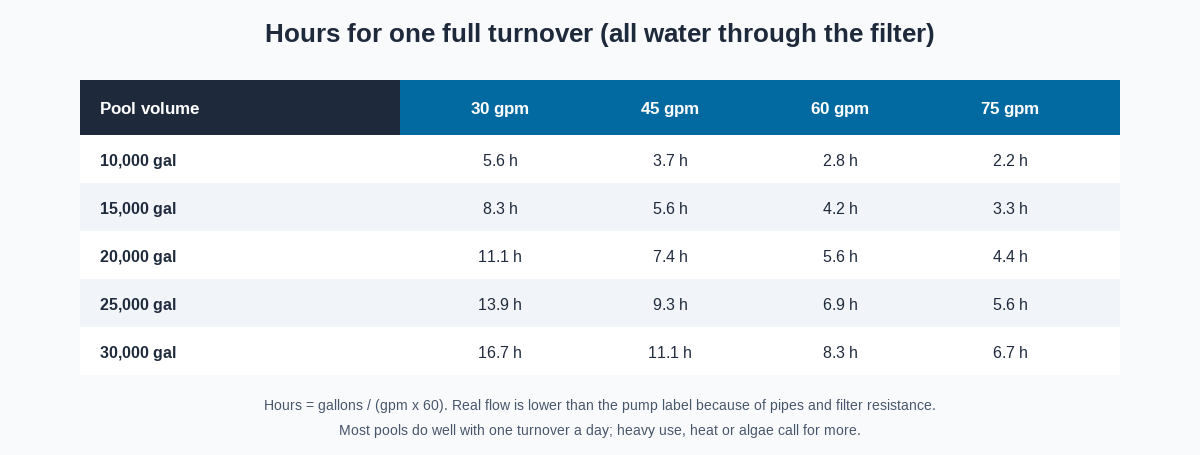
Chart: Asphapro.com
Quick Answer
Most pools should run the pool pump 8 to 12 hours a day in summer, enough to move all the water through the filter at least once (one "turnover"). To work out your hours, divide your pool volume in gallons by your pump flow in gallons per minute × 60. A 20,000-gallon pool with a pump moving 40 gpm needs about 8.3 hours for one turnover. Run it longer in hot weather, after heavy use, or when clearing algae, and less in cool weather. With a variable-speed pump, run it longer at low speed, often 12 to 24 hours, which cleans better and costs far less.
The pump is the heart of your pool. It pulls water through the skimmer and main drain, pushes it through the filter, and returns it clean, sanitized and mixed. Running it too little leads to cloudy water, algae and dead spots where chlorine does not reach. Running it too long wastes electricity and wears out the motor. Knowing how long to run pool pump equipment each day is one of the simplest ways to keep water clear and control costs.
This guide explains how long should a pool pump run, how to calculate turnover for your pool, how run times change with seasons and pump types, what it costs and how to save. For priming and start-up, see our guide on how to prime a pool pump.
The Turnover Rule
Turnover is the time it takes for the pump to move a volume of water equal to the whole pool through the filter. The traditional rule is one full turnover a day for residential pools, and many pool pros suggest one to two turnovers in hot weather or for heavily used pools. Public pools are often required by code to turn over every 6 hours or so.
One turnover does not mean every gallon gets filtered exactly once, since filtered water mixes back in with unfiltered water. After one turnover, about 63% of the water has passed through the filter; after two, about 86%. That is why longer, slower circulation, as with a variable-speed pump, often gives clearer water.
How to Calculate How Long to Run Pool Pump
Step 1: Find your pool volume. For rectangular pools: length × width × average depth × 7.5. For round pools: diameter × diameter × average depth × 5.9. For ovals: length × width × average depth × 6.7.
Step 2: Find your flow rate. Check the pump curve for your pump and plumbing, use a flow meter, or estimate. Many 1 to 1.5 hp pumps on typical residential plumbing move 40 to 60 gallons per minute. Real flow is lower than the maximum on the label.
Step 3: Divide. Hours for one turnover = gallons ÷ (gpm × 60). Multiply by the number of turnovers you want.
Pool Pump Run Time Calculator
Enter your pool volume, flow rate and how many turnovers you want each day, plus your pump power and electricity rate, to see how long should I run my pool pump and what it costs.
How Long Should Pool Pump Run by Season?
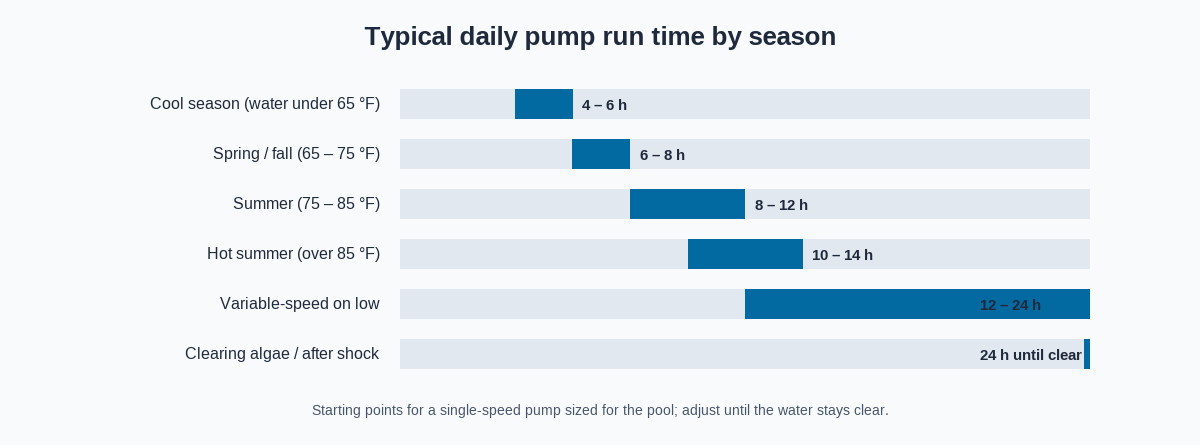
Chart: Asphapro.com
A common rule of thumb is to run the pump about one hour for every 10 °F of air temperature, but water temperature and use matter more. In cool water under 65 °F, algae grows slowly and 4 to 6 hours a day is often enough. In spring and fall, 6 to 8 hours. In summer, 8 to 12 hours. In very hot weather or with heavy use, 10 to 14 hours or more. When clearing algae or after a big storm, run the pump 24 hours a day until the water is clear. Many owners set a summer schedule and a shoulder-season schedule on their timer.
Single-Speed vs Variable-Speed Pumps
A single-speed pump always runs at full power. It moves a lot of water quickly but uses a lot of electricity. For these pumps, run just long enough for one turnover, plus extra time in hot weather.
A variable-speed pump can run at low, medium or high speed. Because pump power drops sharply as speed drops, running at half speed uses roughly one quarter to one eighth of the power. That means you can run a variable-speed pump much longer, often 12 to 24 hours a day at low speed, for far less money. Longer, gentler flow also filters better and keeps chlorine evenly mixed. Use higher speeds briefly for vacuuming, running a heater, salt cell or water features. Many states now require variable-speed pumps for new installs.
How Much Does It Cost to Run a Pool Pump?
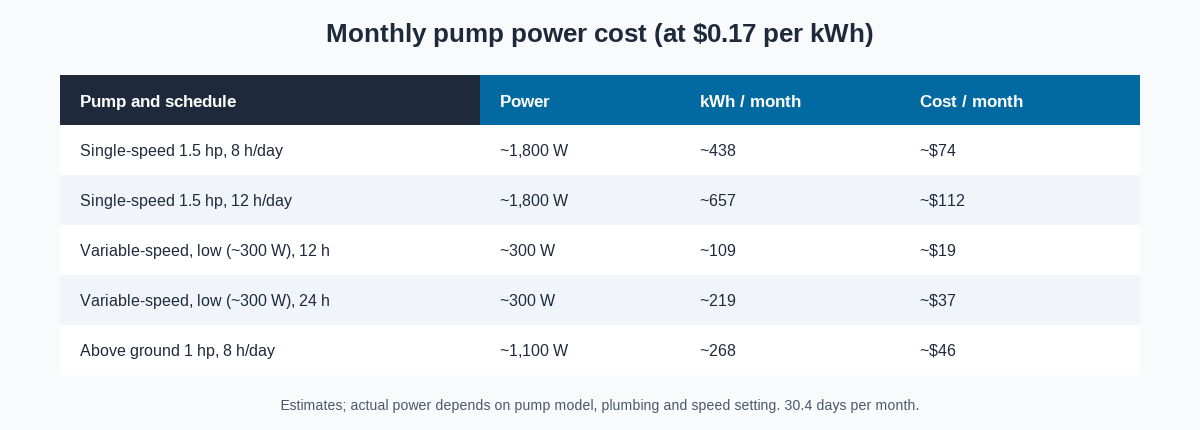
Chart: Asphapro.com
A 1.5 hp single-speed pump uses about 1,500 to 2,000 watts. Running it 8 hours a day uses about 440 kWh a month, around $74 at $0.17 per kWh. Running the same pump 12 hours costs about $112 a month. A variable-speed pump on low speed, around 300 watts, costs about $19 a month for 12 hours a day or $37 for 24 hours. Over a summer, switching to a variable-speed pump can save hundreds of dollars.
Best Time of Day to Run the Pool Pump
Run the pump during the day when possible, especially in the hottest hours, since sunlight and heat use up chlorine and help algae grow. Circulating water then spreads chlorine and filters debris when it is most needed. If you add chlorine at night, run the pump for at least an hour afterward. If your utility has time-of-use rates, schedule most pump time in cheaper off-peak hours and keep some time during the day. Splitting run time into two blocks, such as morning and late afternoon, works well. With a salt system, the pump must run for the cell to make chlorine, so schedule enough daytime run time to meet your chlorine needs.
Photo: Enrevseluj, Wikimedia Commons, CC BY-SA 4.0
Signs You Need More Pump Time
Run the pump longer if the water looks dull or cloudy, chlorine drops quickly, algae appears in corners or on steps, debris builds up on the floor, or the water feels warm and stale. Also check the filter: a dirty filter reduces flow, so the same hours do less work. Clean or backwash when pressure rises 8 to 10 psi above the clean reading, and empty the skimmer and pump baskets often so flow stays strong.
How Long Should You Run Your Pool Pump With a Salt System?
Salt chlorine generators only make chlorine when water flows through the cell, so the answer to how long should you run your pool pump in a salt pool depends partly on chlorine demand. In summer, a salt pool often needs 8 to 12 hours of run time, sometimes more, for the cell to keep up with sunlight and swimmers. If free chlorine drops even with the cell at a high output, add pump time before raising the output to 100%. Variable-speed pumps work well with salt systems, as long as the flow at low speed is enough to trigger the cell's flow switch; check your salt system's minimum flow rate. Many owners run a medium speed during the day when the cell needs to work and a low speed at other times. See how to maintain a saltwater pool.
How Long Should My Pool Pump Run for an Above Ground Pool?
Above ground pools usually hold 5,000 to 20,000 gallons and use smaller pumps of 0.75 to 1.5 hp. Owners often ask how long should my pool pump run for these pools. The same turnover rule applies: divide gallons by flow × 60. A 15,000-gallon pool with a pump moving 35 gpm needs about 7 hours for one turnover, so 8 to 10 hours in summer is a good starting point. Small cartridge filter pumps on soft-sided pools move less water, often 1,000 to 2,500 gallons per hour, and may need to run 10 to 12 hours or more. Keep the filter cartridge clean, since a clogged cartridge cuts flow sharply on small pumps.
How Long Should I Run the Pool Pump With a Heater or Solar?
Heaters need water flowing to work, so when you heat the pool, the pump must run while the heater runs. Gas heaters can raise water temperature quickly, so you may only need extra run time when you want to swim. Heat pumps heat slowly, so they need longer run times, often during the warmest part of the day when they are most efficient. Solar heating panels only work while the sun is up and the pump pushes water through them; run the pump through the sunniest hours, usually 10 a.m. to 4 p.m. If you ask how long should I run the pool pump with solar heat, the answer is usually all of the sunny part of the day in spring and fall. See how much does it cost to heat a pool.
Pump Size and Flow: Why Bigger Is Not Always Better
Many pools have pumps larger than they need. An oversized single-speed pump moves water faster than the filter and pipes are designed for, using more electricity and sometimes reducing filter performance. It may complete a turnover quickly, but the pool still needs enough hours of circulation for skimming, mixing chlorine and running a cleaner. If your pump is oversized, a variable-speed pump set to a moderate speed is often the best fix. When replacing a pump, ask a pool professional to size it for your pool volume, plumbing and equipment rather than simply buying a larger model.
Using Timers and Automation
A timer takes the guesswork out of how long should I run pool pump each day. Mechanical timers with on and off trippers are cheap and simple. Digital timers and pool automation systems allow several schedules, different speeds for variable-speed pumps, and easy seasonal changes. Many variable-speed pumps have built-in schedules. Set your timer for the season, check that it kept time after power outages, and adjust as the weather changes. Some automation systems also adjust run time based on water temperature, which can save energy automatically.
Freeze Protection
In areas with occasional freezes, running the pump during cold snaps keeps water moving so pipes and equipment do not freeze. Many automation systems and variable-speed pumps have a freeze protection mode that starts the pump when the air temperature drops near freezing. If you do not have this feature, run the pump continuously during freezing nights. In areas with long, hard winters, it is safer to winterize the pool properly than to rely on the pump. See how to winterize a pool.
Run Time for Cleaners and Water Features
Suction-side cleaners rely on the pump and need enough flow to work, often more than a variable-speed pump's lowest setting. Pressure-side cleaners with booster pumps need the main pump running too. Fountains, waterfalls and spillover spas may need higher speeds. Schedule these at medium or high speed for a few hours a day, and use low speed the rest of the time. Robotic cleaners have their own motors and do not depend on the pool pump, which lets you keep the main pump at low speed.
Measuring Your Real Flow Rate
Your real flow rate is often lower than the pump label, because pipes, fittings, the filter and the heater all add resistance. A flow meter installed on the return line shows the actual gallons per minute. Without a meter, you can estimate flow from the pump curve and your filter pressure, or time how long the pump takes to fill a bucket from a return with all other returns closed (multiply by the number of returns, with caution). Knowing real flow makes your answer to how long to run pool pump each day far more accurate.
How Long to Run the Pump After Adding Chemicals
After adding chlorine, acid, alkalinity increaser or other chemicals, run the pump for at least 1 to 2 hours so they mix evenly. After shocking, run it at least 8 hours, or overnight. After adding calcium chloride, salt or stabilizer, run it for 24 hours to make sure everything dissolves and circulates. Never add chemicals with the pump off unless the label says to, since concentrated chemicals can damage surfaces or equipment.
Worked Examples
Example 1: single-speed inground pool. A 24,000-gallon pool has a 1.5 hp single-speed pump moving about 50 gpm. One turnover takes 24,000 ÷ 3,000 = 8 hours. In summer, the owner runs 9 to 10 hours; in spring and fall, 6 hours.
Example 2: variable-speed upgrade. The same owner installs a variable-speed pump and runs it 14 hours a day at a low speed of about 30 gpm (moving 25,200 gallons, just over one turnover) using about 350 watts, plus 2 hours at high speed for the cleaner. Monthly cost drops from about $80 to about $35.
Example 3: above ground pool. A 12,000-gallon above ground pool with a 1 hp pump moving 30 gpm needs about 6.7 hours per turnover. The owner runs 8 hours in summer and adds 4 hours after pool parties.
Common Mistakes
The most common mistake is running a single-speed pump around the clock all summer, which wastes a lot of electricity. The opposite mistake, running only a few hours to save money, leads to cloudy water and algae that cost more to fix. Other mistakes include forgetting to change the timer when seasons change, ignoring a dirty filter that cuts flow, running the pump only at night when chlorine is not under attack from the sun, and setting a variable-speed pump so low that the skimmer, cleaner or salt cell does not work properly.
Energy-Saving Tips
Install a variable-speed pump if you have a single-speed one; it is the biggest saving. Keep filters clean and baskets empty so the pump works less hard. Use a cover to reduce debris and evaporation, which reduces the need for long run times. Use time-of-use rates where available. Trim plants that drop leaves into the pool. And check every few weeks whether you can trim run time by an hour while keeping the water clear; small changes add up over a season.
How Long Should a Pool Pump Run in Different Climates?
Climate changes the answer to how long should a pool pump run. In hot, sunny states such as Arizona, Texas and Florida, water temperatures often pass 85 °F in summer, chlorine burns off quickly and algae grows fast. Many owners there run single-speed pumps 10 to 12 hours a day, or variable-speed pumps nearly around the clock at low speed. In milder coastal climates, 6 to 8 hours is often enough even in summer. In northern states with short summers, 8 hours in July and August and 4 to 6 in late spring and early fall usually work. Humid climates with frequent storms may need extra hours after rain. Watch your water rather than a fixed rule: if it stays clear and chlorine holds, your run time is probably right.
How Long Should My Pool Pump Run With Heavy Use?
Swimmers bring in sweat, sunscreen, lotions, hair and dirt, which cloud the water and use up chlorine. After a pool party or a weekend of heavy use, run the pump several extra hours, or even through the night, and check the filter pressure. Families with daily heavy use often add 2 to 4 hours to their normal summer schedule. If you ask how long should my pool pump run when kids swim all day, a good rule is at least one and a half turnovers a day, with extra filtering after the busiest days.
Does Running the Pump Longer Wear It Out?
Pump motors are built to run for long periods, and bearings and seals wear over hours of use. A single-speed pump running 12 hours a day will reach the end of its life sooner than one running 6 hours, but the difference is usually a few years over a typical lifespan of 8 to 12 years. Variable-speed pumps running at low speed run cooler and quieter, and their motors often last longer despite long hours. Frequent starts and stops can be harder on some motors than steady running, so avoid many short cycles. Keeping the pump primed, the baskets clean and the motor dry and ventilated matters more for pump life than run time alone.
How Long Should I Run Pool Pump for a Hot Tub or Spa?
Portable hot tubs have their own circulation pumps and filtration cycles set by the control system, usually running several times a day for 2 to 4 hours each. Attached spas that share equipment with the pool need the pool pump to run while the spa is heated or in use. If you have a spa spillover, schedule enough pump time on spa mode to keep the spa water filtered and sanitized, especially after use. For a hot tub, follow the maker's filter cycle settings and increase them with heavy use. See how much does a hot tub cost per month.
Testing Your Schedule
The best way to find out how long to run pool pump equipment in your own pool is to test. Start with one turnover a day, then watch for a week: check clarity, test free chlorine morning and evening, and look for algae on steps and corners. If everything stays clear, try cutting 30 to 60 minutes and watch again. If problems appear, add time back. Repeat when the weather changes. Within a few weeks you will know the shortest run time that keeps your pool clear, which is the cheapest safe schedule. Write it down so you can reuse it next season.
How Long Should the Pool Pump Run When Opening or Closing?
When you open a pool in spring, the water is often cloudy or green after winter. Run the pump 24 hours a day until the water is clear, cleaning or backwashing the filter as pressure rises, then drop back to your normal schedule. This can take a day for a clean pool or a week for a green one. Before closing, run the pump for a full day after your final shock and chemical additions so everything is well mixed before you lower the water and blow out the lines. If you ask how long should the pool pump run at these times, the simple answer is: as long as it takes for the water to be clear and balanced. See how to open a pool after winter.
How Long to Run Pool Pump: Key Points
- Aim for at least one turnover a day: gallons ÷ (gpm × 60).
- Most pools need 8 to 12 hours in summer and less in cool weather.
- Variable-speed pumps run longer at low speed for much lower cost.
- Run 24 hours when clearing algae, then return to normal.
Frequently Asked Questions
How long should I run my pool pump?
Long enough for one full turnover, usually 8 to 12 hours a day in summer. Divide your pool gallons by the pump's flow in gallons per minute times 60, then adjust for heat, use and how the water looks.
Is it OK to run a pool pump 24 hours a day?
Yes for variable-speed pumps at low speed, which use little power and filter well. For single-speed pumps it is costly for everyday use but fine for a few days when clearing algae or after a storm.
How long should a pool pump run in winter?
In warm climates where the pool stays open, 4 to 6 hours a day is usually enough. In freezing areas, either winterize the pool or run the pump continuously during freezing nights to protect pipes and equipment.
Should I run my pool pump at night?
Some night running is fine, especially with off-peak rates, but run part of the time during the day, when sunlight and heat put the most strain on chlorine.
How long to run swimming pool pump after shock?
At least 8 hours, ideally overnight, or 24 hours a day if treating algae, until the water is clear and chlorine holds.
How long should the pool pump run for an above ground pool?
About 8 to 10 hours in summer for most above ground pools, and longer for small cartridge pumps on soft-sided pools.
Sources
- US Department of Energy: Swimming pool pumps
- ENERGY STAR: Pool pumps
- EIA: Average price of electricity by state
- CDC: Pool chemistry and testing