
Landscaping Ideas for Inground Pools: Plants, Hardscape and Budget Tips
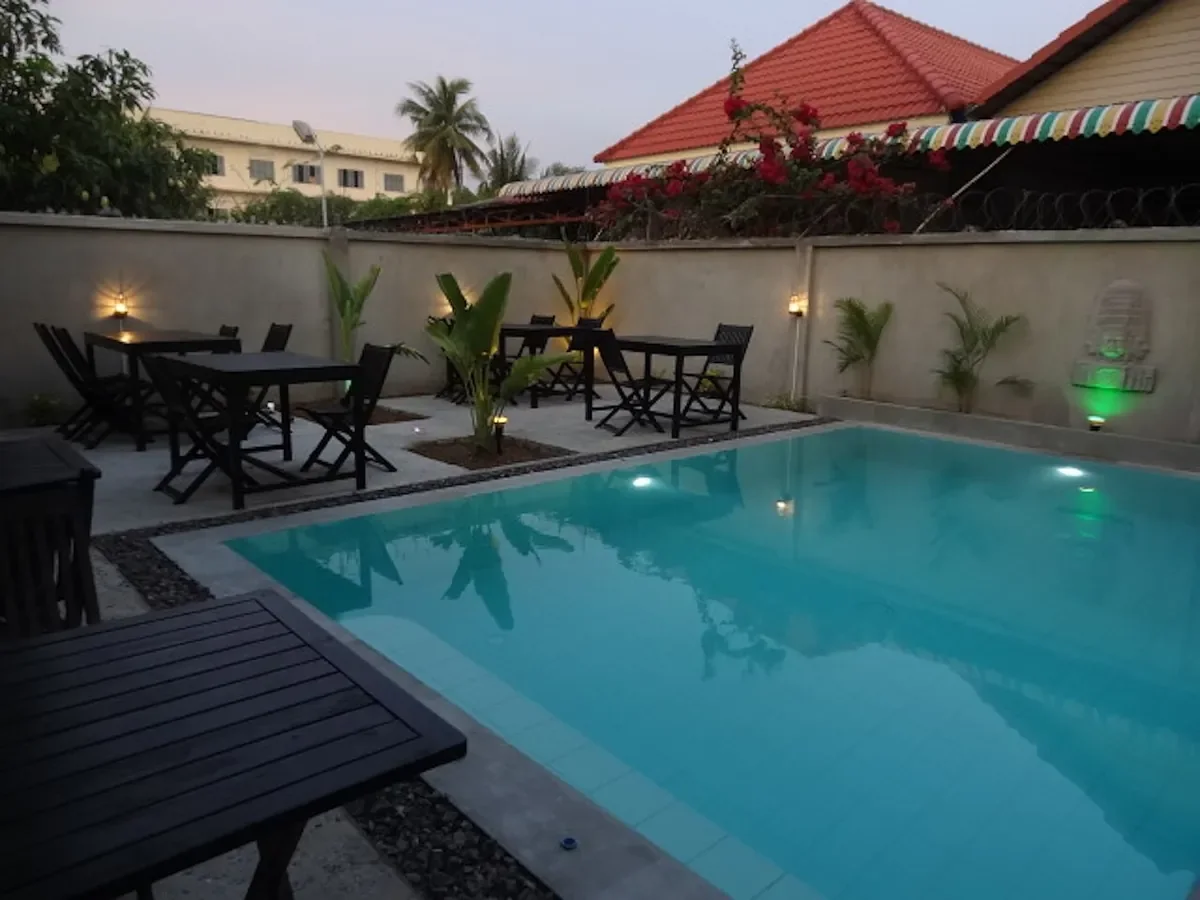
Photo: Rospompom, Wikimedia Commons, CC BY-SA 3.0
Quick Answer
The best landscaping ideas for inground pools keep plants a few feet back from the water and use hard surfaces right at the edge. Plan three zones: a splash zone of paving at least 4 feet wide, a low planting zone of grasses, succulents and potted plants, and an outer screening zone of evergreen shrubs, hedges or small trees for privacy. Choose plants that drop few leaves, have non-invasive roots and handle sun and splash. Add gravel or stone borders, low-voltage lighting and some shade. On a budget, focus on pots, gravel, mulch and a few large plants, which can transform a pool area for $1,000 to $5,000.
Good landscaping turns a pool from a hole in the yard into a place people want to spend time. It adds privacy, shade and color, softens hard edges and hides equipment. Poor landscaping does the opposite: trees that fill the pool with leaves, roots that crack the shell, mulch that blows into the skimmer, and plants that draw bees to the water's edge.
This guide covers practical landscaping ideas for inground pools, from planning and plant choices to hardscape, lighting and inground pool landscaping ideas on a budget. For decking around the water, see our guides on pool deck ideas and deck ideas for inground pools.
Plan Before You Plant: Pool Landscaping Zones
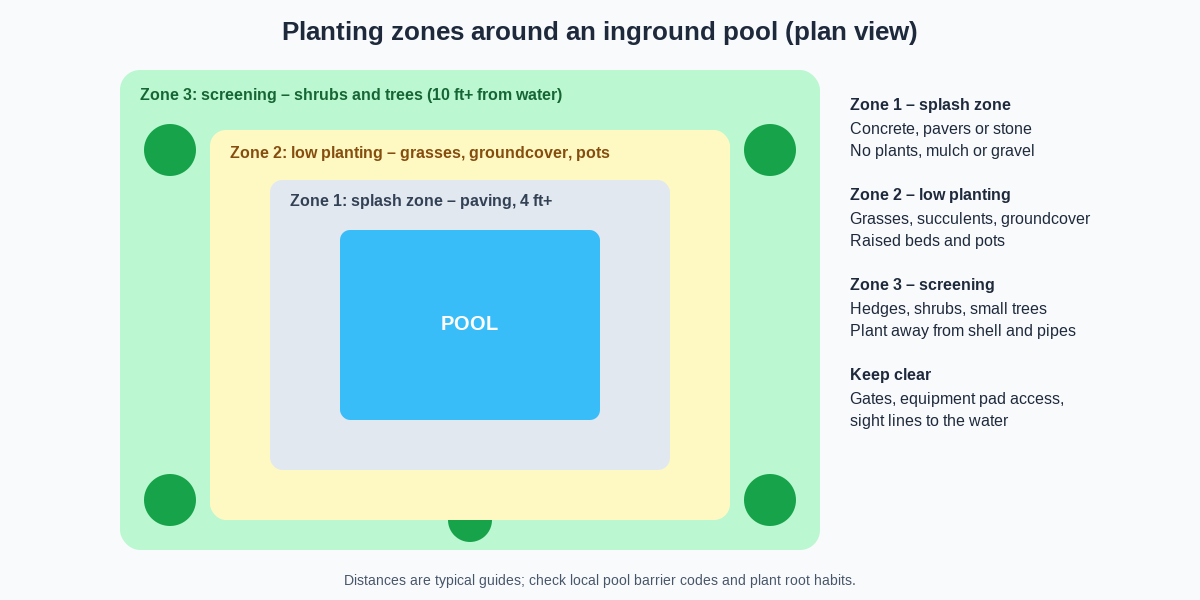
Diagram: Asphapro.com
The most useful of all landscaping ideas for around inground pools is to think in zones. Each ring around the pool has a different job, and plants that suit one zone can cause problems in another.
Zone 1: the splash zone. The first 4 feet or more around the pool should be hard paving: concrete, pavers, stone or a deck. This gives people room to walk, keeps dirt and mulch out of the water, and protects plants from constant splashing with chlorinated water. See our guide on concrete pool deck options.
Zone 2: low planting. Just beyond the paving, use low, tidy plants: ornamental grasses, groundcovers, succulents and pots. These add color and texture without dropping much debris or blocking views of the water.
Zone 3: screening. At the edges of the yard, use taller evergreen shrubs, hedges, small trees or screens for privacy and wind protection. Keep larger trees at least 10 feet from the pool, and further for trees with spreading roots or heavy leaf drop.
Also plan for access. Leave a clear path to the equipment pad for service, keep gates and fences free of plants that children could climb, and keep a clear line of sight from the house to the water so adults can see swimmers.
Best Plants for Swimming Pool Landscaping Ideas
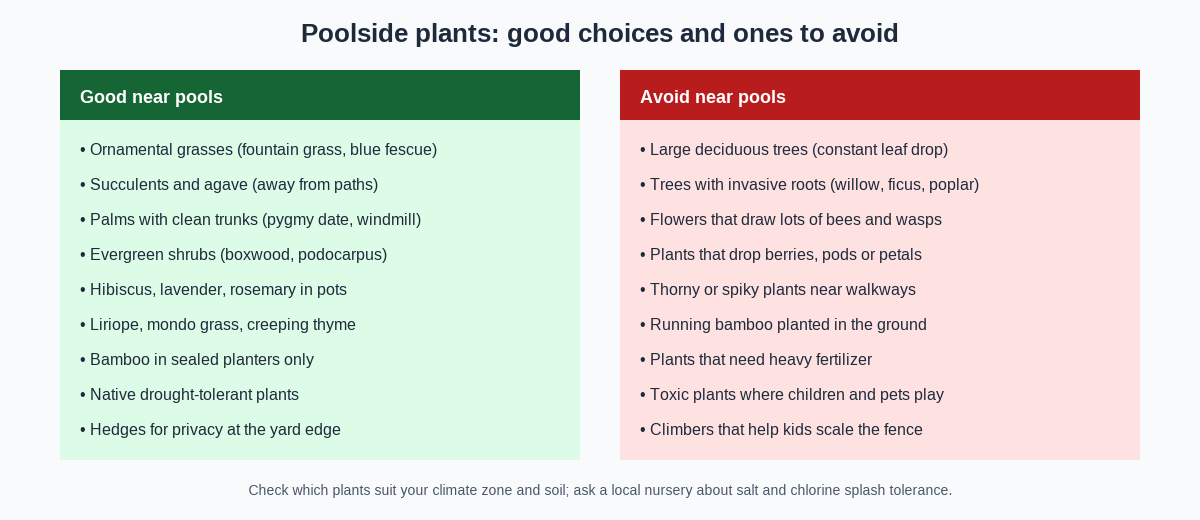
Chart: Asphapro.com
The right plants make or break swimming pool landscaping ideas. Look for plants that drop few leaves, flowers or seeds; have roots that will not damage the pool or pipes; handle full sun and heat reflected from paving; tolerate occasional splashes of chlorinated or salt water; and do not attract lots of bees and wasps.
Ornamental grasses such as fountain grass, blue fescue, feather reed grass and muhly grass are among the best choices. They move in the breeze, need little care and drop little debris. Cut them back once a year.
Succulents and agave suit hot, dry climates and modern designs. Keep spiky types away from paths where swimmers walk barefoot.
Palms with clean trunks, such as pygmy date, windmill, Mediterranean fan and sago (technically a cycad), give a resort feel. Choose types that do not drop lots of fronds or fruit.
Evergreen shrubs such as boxwood, podocarpus, Japanese holly, pittosporum and dwarf yaupon make tidy hedges and borders with little leaf drop.
Flowering plants in pots, such as hibiscus, bougainvillea, lavender and mandevilla, add color where you can control them. Pots are easy to move, replace and keep away from the water's edge.
Groundcovers such as liriope, mondo grass, creeping thyme and dwarf jasmine fill gaps and reduce weeds.
Plants to Avoid Near Inground Pools
Avoid large deciduous trees such as maples, oaks and birches near the pool; their leaves will fill the skimmer every fall and stain the finish. Avoid trees with invasive roots, such as willow, ficus, poplar and silver maple, which can crack pool shells, decks and pipes. Avoid plants that drop berries, pods, cones or petals. Skip heavily scented flowering plants that draw bees and wasps right next to the water. Do not plant running bamboo in the ground; use clumping types or sealed planters. Avoid thorny or spiky plants near walkways, and check for plants that are toxic to children and pets.
25 Landscaping Ideas for Inground Pools
Here are practical landscaping ideas for inground pools, grouped by what they do.
Privacy Landscaping Ideas for Around Inground Pools
1. Evergreen hedge. A row of arborvitae, podocarpus, clusia or privet makes a living wall that blocks views year-round. Plant at the yard edge, not right next to the pool.
2. Clumping bamboo in planters. Tall, fast and dense, clumping bamboo in long planters makes a quick screen without the risk of spreading roots.
3. Slatted wood or composite screens. Horizontal slat screens give instant privacy and a modern look, and you can grow climbers on the outside face.
4. Layered planting. Combine a back row of tall shrubs, a middle row of grasses and a front row of groundcover for depth and privacy.
5. Pool fence with plants. Soften a required pool fence with low plants on the outside. Keep plants on the pool side low so they cannot be used to climb. See our guide on pool fence cost.
Hardscape Swimming Pool Landscape Ideas
6. Gravel or river rock borders. A strip of gravel or smooth river rock between paving and planting beds stops soil washing onto the deck and looks clean. Use larger stones near the pool so they are not kicked into the water.
7. Stone or concrete planters. Raised planters keep soil and mulch contained and lift plants away from the water's edge. They also double as seating.
8. Natural boulders. A few large boulders set into planting beds give a natural look, especially with a rock waterfall or a lagoon-style pool.
9. Retaining walls. On sloped lots, retaining walls create level terraces for the pool, lounge areas and planting beds. See our guide to concrete pads for level outdoor areas.
10. Stepping stone paths. Pavers or flagstones set in gravel or grass lead from the house to the pool and from the pool to a fire pit or lawn.
Shade Landscaping With Pool Ideas
11. Pergola with climbers. A pergola beside the pool gives filtered shade, and climbers such as jasmine or grape add cover. Keep it far enough back that flowers do not fall in the water. See pool pergola ideas.
12. Shade sails. Colored fabric sails stretched between posts are cheap, modern and easy to adjust.
13. Small, tidy trees. A few well-chosen small trees, such as crape myrtle (in pots or well back), olive, Japanese maple in a planter or a multi-trunk palm, give shade without heavy leaf drop.
14. Umbrellas set in planters. Large market umbrellas set into heavy planters give movable shade with plants around the base.
Lighting Landscaping Pool Ideas
15. Uplights on trees and palms. Low-voltage LED uplights on palms or trees create dramatic night views across the water.
16. Path lights. Small path lights along walkways improve safety after dark.
17. Wall and step lights. Lights built into retaining walls, planters and steps light the area without glare.
18. String lights. String lights hung across a pergola or between posts add a relaxed feel for evening swims.
Style-Based Inground Swimming Pool Landscaping Ideas
19. Tropical. Palms, bird of paradise, hibiscus, elephant ears and banana plants in pots, with dark mulch or river rock and teak furniture. Best in warm climates or with plants moved indoors for winter.
20. Desert and xeriscape. Agave, yucca, ocotillo, desert grasses, decomposed granite and boulders. Low water use and very low leaf drop.
21. Modern minimalist. Clean lines, a few repeated plants such as boxwood balls or tall grasses, concrete planters and large-format pavers.
22. Mediterranean. Olive trees, lavender, rosemary, cypress and terracotta pots, with stone or travertine paving.
23. Cottage or natural. Soft layers of grasses, perennials and native plants well back from the water, with a lawn area for kids.
Finishing Touches
24. Hide the equipment pad. Screen the pump and filter with a short fence, lattice or a row of shrubs, leaving at least 3 feet of space for service and airflow.
25. Lawn area. A patch of grass beyond the paving gives children a soft place to play. Keep it at least a few feet from the pool and use edging so clippings stay out of the water.
Inground Pool Landscaping Ideas on a Budget
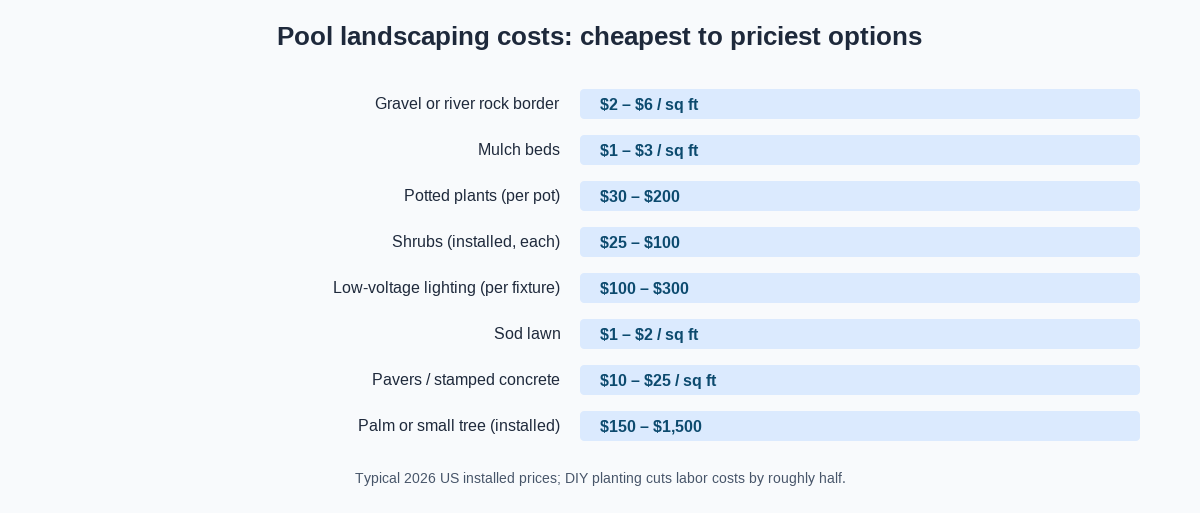
Chart: Asphapro.com
You do not need a big budget to make landscaping ideas for inground pools work. These inground pool landscaping ideas on a budget give the most impact for the least money.
Use pots. A few large pots with palms, grasses or flowering plants add instant color for $30 to $200 each. You can move them around and take them indoors in winter.
Choose gravel and mulch over pavers. Gravel costs $2 to $6 per square foot installed and mulch $1 to $3, compared with $10 to $25 for pavers or stamped concrete.
Buy small plants. One-gallon shrubs and grasses cost a fraction of large specimens and fill in within two or three seasons.
Divide and share. Ornamental grasses, liriope and many perennials can be divided, so a few plants can become many over time.
Plant in stages. Start with the hardscape and a few key plants near the pool, then add privacy screening and lighting over the next few years.
DIY the planting. Doing your own planting and mulching cuts labor costs by about half. Save professional help for trees, lighting wiring and retaining walls.
Solar lights. Solar path and accent lights cost little and need no wiring, though they are less bright and less reliable than low-voltage systems.
A simple budget plan might be: a gravel border around the deck ($800 to $2,000), six large pots with plants ($400 to $1,200), a row of small evergreen shrubs for screening ($300 to $1,000) and solar lights ($100 to $300). That totals about $1,600 to $4,500.
How Much Do Swimming Pool Landscaping Ideas Cost?
A full professional job using inground swimming pool landscaping ideas usually costs $5,000 to $25,000, depending on the size of the area, the plants, hardscape and lighting. Large projects with retaining walls, mature trees, outdoor kitchens or water features can cost $30,000 to $75,000 or more. Simple landscaping with pots, gravel and a few shrubs costs $1,000 to $5,000. Landscape design fees, if you hire a designer, are about $500 to $5,000.
Maintenance Tips for Inground Pool Landscaping Ideas
Even the best landscaping pool ideas need upkeep. Keep planting beds edged and mulched so soil does not wash onto the deck during rain. Use larger bark nuggets or stone rather than fine mulch near the pool, since fine mulch blows into the water. Water plants early in the day so paths dry before swimmers arrive. Avoid fertilizing near the pool, and sweep the deck after fertilizing, since fertilizer adds phosphates that feed algae. Trim plants regularly so they do not hang over the water. Check for roots near the pool shell and pipes. Keep sprinklers aimed away from the pool, since sprinkler water carries soil and fertilizer. For more on why this matters, see how to remove phosphates from pool water.
Drainage and Landscaping Ideas for Around Inground Pools
Good drainage is one of the most overlooked landscaping ideas for inground pools. Planting beds and lawns should slope away from the pool so rain does not wash soil, mulch and fertilizer into the water. Decks should slope away from the pool edge toward drains or planting beds. Use channel drains or a French drain where water collects. Raised planters need drainage holes and a gravel layer so they do not stay soggy. Poor drainage also puts pressure on the pool shell and can cause liners to float or walls to shift.
Safety in Pool Landscaping
Safety should shape all swimming pool landscaping ideas. Keep a clear line of sight to the water from the house and seating areas. Do not plant anything a child could use to climb a pool fence, and keep at least 3 to 4 feet clear on the outside of the barrier, as many codes require. Avoid toxic plants such as oleander, foxglove and some lilies where children and pets play. Use non-slip paving and good lighting on paths and steps. Keep gates self-closing and free of plants that could block them. Check local codes before you plant along a pool fence.
Landscaping Ideas for Inground Pools in Small Yards
In a small yard, the pool often takes up most of the space, so every square foot of planting has to work hard. The best landscaping ideas for inground pools in tight spaces use vertical planting and containers rather than wide beds. Climbing plants on a trellis or a fence, tall narrow shrubs such as columnar junipers or Italian cypress, and wall-mounted planters add green without taking floor space. A single row of tall grasses or bamboo in a long planter can screen a neighbor's window in a space just 18 inches deep.
Keep the paving simple and continuous so the yard feels larger, and repeat the same few plants rather than mixing many types. Light-colored paving and walls reflect light and make a small pool area feel open. Built-in benches with planters behind them give seating and planting in one footprint. Mirrors on garden walls, used with care, can make the space feel deeper. These small-space swimming pool landscaping ideas also cut maintenance, since there is less to prune and water.
Landscaping Ideas for Around Inground Pools on a Slope
Sloped yards are harder to build on but give some of the most striking pool settings. Terraces held by retaining walls create level areas for the pool, a lounge deck and planting beds at different heights. Planting on the upper terraces can spill over the walls with trailing plants such as creeping rosemary or star jasmine, softening the stone or concrete. On the downhill side, the pool wall can be finished in stone or tile, with planting below it to hide the base.
On slopes, drainage matters even more. Water running downhill carries soil, mulch and fertilizer, so the uphill side of the pool needs a swale, a drain or a planted buffer to catch runoff before it reaches the water. Deep-rooted groundcovers and grasses on banks help hold the soil. Many of the best landscaping ideas for around inground pools on a slope come from working with the grade rather than against it, so ask a landscaper or engineer about wall heights and drainage before you dig.
Inground Pool Landscaping Ideas by Climate
Hot, dry climates. Choose drought-tolerant plants such as agave, yucca, desert spoon, lantana, salvia and native grasses. Use decomposed granite, gravel and boulders instead of lawns. Add shade with a pergola or shade sails, since paving gets very hot. Drip irrigation saves water and keeps it off the deck.
Humid, warm climates. Tropical plants thrive: palms, bird of paradise, ginger, crotons, hibiscus and ferns in shady corners. Plants grow fast, so leave room for them to mature and prune often to keep them off the water. Good airflow helps keep mosquitoes and mildew down.
Cold climates. Evergreen shrubs such as boxwood, yew and arborvitae give structure all year. Ornamental grasses look good into winter. Use pots for tropical plants in summer and bring them indoors before frost. Choose hardy perennials for your zone and avoid plants that drop lots of leaves just as you close the pool in fall.
Coastal areas. Salt spray and wind call for tough plants such as sea grapes, rosemary, lavender, Indian hawthorn and coastal grasses. Windbreaks of hardy shrubs or screens make the pool area more comfortable. Matching inground pool landscaping ideas to the local climate is the simplest way to reduce plant losses and maintenance.
Year-Round Swimming Pool Landscape Ideas
A pool area is often in view from the house all year, even when the pool is closed. Good swimming pool landscape ideas include plants that look good in every season. Evergreen shrubs and hedges give a green backdrop in winter. Ornamental grasses hold their shape and color into the cold months, especially when lit at night. Bark and stems, such as red-twig dogwood planted well back from the water, add winter color. Spring bulbs in pots bring early color before the pool opens, and summer flowers in containers peak when the pool is in use. Lighting keeps the space attractive on long winter evenings even when no one swims.
Working With a Landscaper
If you hire a professional for your landscaping ideas for inground pools, choose one with pool experience. Ask to see photos of pool projects they have done and ask how they handle drainage, root barriers and plant choice near water. A good landscaper will ask about how you use the pool, your budget, sun and shade patterns, local codes for barriers, and how much maintenance you want to do. Get a written plan with a plant list, sizes and costs, and ask for the design to be phased if your budget is limited. If the pool is new, coordinate with the pool builder so that drainage, lighting conduits and irrigation lines go in before the deck is poured.
Common Pool Landscaping Mistakes
The most common mistake is planting too close to the water. Plants that look small at the nursery can grow to hang over the pool within a few years. Another is choosing trees that drop leaves, needles, flowers or fruit, which turn pool cleaning into a daily chore. Some owners use fine mulch or loose soil near the deck, which blows and washes into the water. Others forget about roots and plant fast-growing trees that later lift pavers or crack the shell. Sprinklers aimed at the pool area spray fertilizer and soil into the water. Skipping drainage leads to puddles, mud and runoff into the pool. Finally, many people plant without a plan, ending up with a mix of plants that do not suit the space, the climate or each other. Thinking through landscaping with pool ideas as a whole, rather than one plant at a time, avoids most of these problems.
How to Choose Landscaping Ideas for Inground Pools That Suit You
Start by thinking about how you use the pool. Families with young children need open lawn, clear sight lines and safe, non-toxic plants. People who entertain need space for seating, shade and lighting. Owners who want low maintenance should choose fewer, tougher plants and more hardscape. Next, look at the site: where the sun falls through the day, where the wind comes from, which views to hide and which to frame. Then set a budget and decide what to do now and what to add later. With those answers, it is easy to pick the landscaping ideas for inground pools in this guide that fit your yard and your life.
Landscaping Ideas for Inground Pools: Key Points
- Keep at least 4 feet of hard paving around the pool, then low plants, then tall screening.
- Choose low-litter, non-invasive plants that handle sun and splash.
- Use gravel, pots, mulch and small plants to landscape on a budget.
- Plan drainage, lighting, shade and safety along with plants.
Frequently Asked Questions
What is the best landscaping around an inground pool?
A hard paved splash zone, then low grasses, succulents and pots, then evergreen shrubs or hedges for privacy at the edges.
How far should plants be from a pool?
Keep plants at least 4 feet from the water's edge, and larger trees 10 feet or more, further for trees with spreading roots.
What plants do not drop leaves near a pool?
Ornamental grasses, succulents, agave, many palms and evergreen shrubs such as boxwood and podocarpus drop very little.
Is gravel or mulch better around a pool?
Gravel or larger stones are better near the pool since they do not blow into the water. Use mulch further back in beds.
How can I landscape around my pool cheaply?
Use pots, gravel, mulch, small plants and solar lights, do the planting yourself, and add features in stages.
Can I plant trees near an inground pool?
Yes, but choose small, low-litter trees with non-invasive roots and keep them well back from the shell and pipes.
Sources
- CPSC: Pool and spa safety
- University of Minnesota Extension: Planting guides
- EPA WaterSense: What to plant
- USDA Plant Hardiness Zone Map