
How to Prime a Pool Pump: Step-by-Step Guide and Fixes
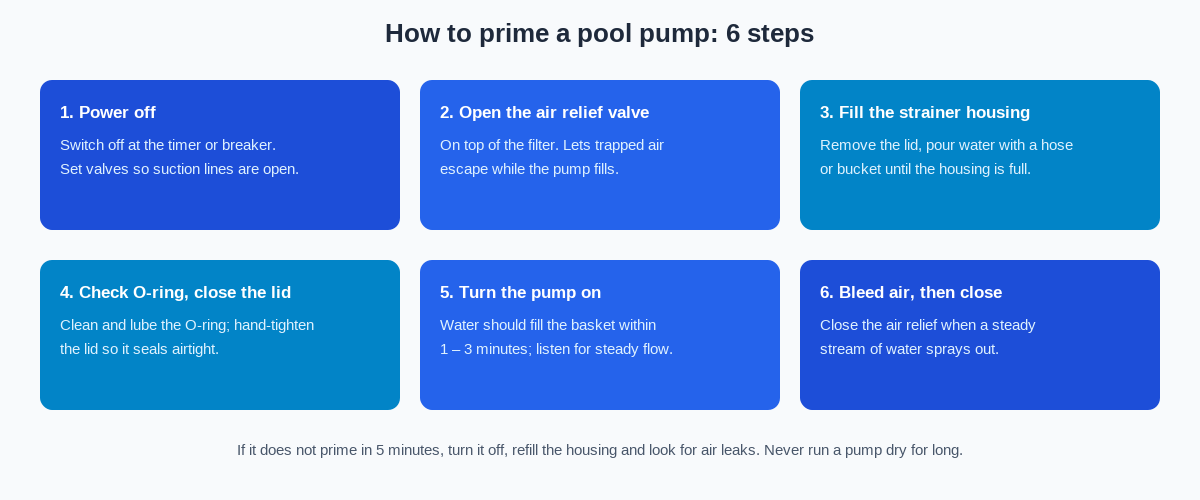
Diagram: Asphapro.com
Quick Answer
How to prime a pool pump: turn the pump off, make sure the pool water is at the middle of the skimmer and the suction valves are open, open the air relief valve on the filter, remove the pump lid and fill the strainer housing with water using a hose or bucket, check that the lid O-ring is clean and lubricated, close the lid hand-tight, then turn the pump on. Water should fill the basket within 1 to 3 minutes. When a steady stream sprays from the air relief valve, close it. If the pump does not prime within about 5 minutes, turn it off, refill the housing and look for air leaks, a low water level or a clogged basket. Never run a pool pump dry for long; it can melt seals and damage the motor.
In any pool and pump system, the pool pump is the heart of the pool. It pulls water from the skimmer and main drain, pushes it through the filter and heater, and sends it back through the returns. But a pool pump can only move water if it is full of water to start. If the pump and the suction pipes are full of air, the impeller spins without moving anything, the pump runs hot, and nothing gets filtered. Filling the pump so it can start moving water is called priming.
You will need to prime a pool pump when you open the pool in spring, after cleaning the pump basket, after backwashing on some systems, after a power outage, when installing a new pool pump, or any time the pump has lost water. This guide explains how to prime a pool pump step by step for inground and above ground pools, why a pump will not prime, how to find and fix air leaks, how to size a swimming pool pump, and how to care for it.
What Does a Pool Pump Do?
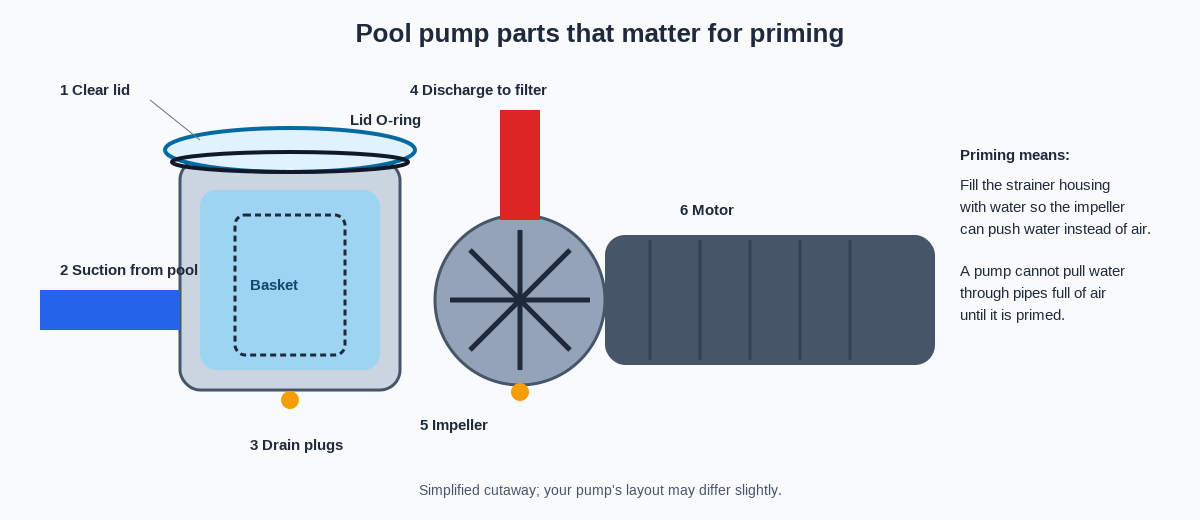
Diagram: Asphapro.com
A pool pump circulates water so it can be filtered, heated and treated. Most pool pumps are centrifugal pumps. The motor spins an impeller, which flings water outward, creating suction at the inlet and pressure at the outlet. Before the water reaches the impeller, it passes through a strainer basket in the pump housing that catches leaves and hair. A clear or solid lid with an O-ring seals the top of the housing.
A centrifugal pump can push water well but cannot pull much air. That is why the strainer housing must be full of water for the pump to create the suction needed to pull water up from the pool. Once water flows, the pump stays primed as long as no air gets in.
How to Prime a Pool Pump: Step by Step
Here is how to prime pool pump systems on a typical inground pool. These are also the steps for how to prime a swimming pool pump on most above ground pools with the pump above the water line.
- Turn off the power at the switch, timer or breaker.
- Check the water level. The pool should be at the middle of the skimmer opening. If it is low, add water first.
- Empty the skimmer basket and pump basket so nothing blocks the flow.
- Set the valves. Make sure the valves on the suction side (skimmer and main drain) are open. If you have several suction lines, open just the skimmer first; it is closer and primes faster.
- Set the filter valve to FILTER (or RECIRCULATE on some systems for faster priming).
- Open the air relief valve on top of the filter so trapped air can escape.
- Remove the pump lid by turning it counterclockwise or loosening the clamp knobs.
- Fill the strainer housing with water from a garden hose or bucket until it is full to the top. Fill slowly so water also runs into the suction pipe.
- Check the lid O-ring. Wipe it clean, look for cracks or flattening, and apply a thin layer of silicone-based pool lubricant.
- Close the lid hand-tight. Do not use tools; over-tightening can crack the lid.
- Turn the pump on. Watch the strainer basket through the clear lid. You should see bubbles, then water filling the basket within 1 to 3 minutes.
- Close the air relief valve once a steady stream of water sprays out of it.
- Open other suction valves (such as the main drain) slowly if you closed them.
- Check the pressure gauge and return jets for normal flow.
If the pump has not primed after about 5 minutes, turn it off. Running dry for too long can overheat the shaft seal and damage the pump. Refill the housing and try again. If it still will not prime after two or three tries, look for the causes listed below.
How to Prime an Above Ground Pool Pump
The steps to prime pool pump units on above ground pools are simpler. Above ground pool pumps usually sit below the water level, so they often prime themselves by gravity. To prime:
- Turn off the pump.
- Open the pump lid or loosen the air relief on the filter.
- Loosen the hose clamp or union on the inlet hose briefly to let air escape until water flows; then tighten it.
- If the housing is not full, top it up with a hose.
- Close the lid, open the air relief on the filter, and turn on the pump.
- Close the air relief when water sprays out steadily.
If the pump sits above the water level (on a deck, for example), prime it just like an inground pump.
How to Prime a Pool Pump After Winter
When you open a pool after winter, the pipes and pump are often empty and full of air. Priming takes longer than usual:
- Reinstall drain plugs in the pump and filter (with their O-rings).
- Remove winter plugs from the skimmer and returns, and remove any antifreeze if your system used it.
- Bring the pool water up to the middle of the skimmer.
- Fill the pump housing, and pour water into the skimmer to help fill the suction line.
- Prime with only the skimmer open, then open the main drain once the pump is running well.
- Run the pump for 24 hours to circulate the water and help clear the pool.
Why Won't My Pool Pump Prime?
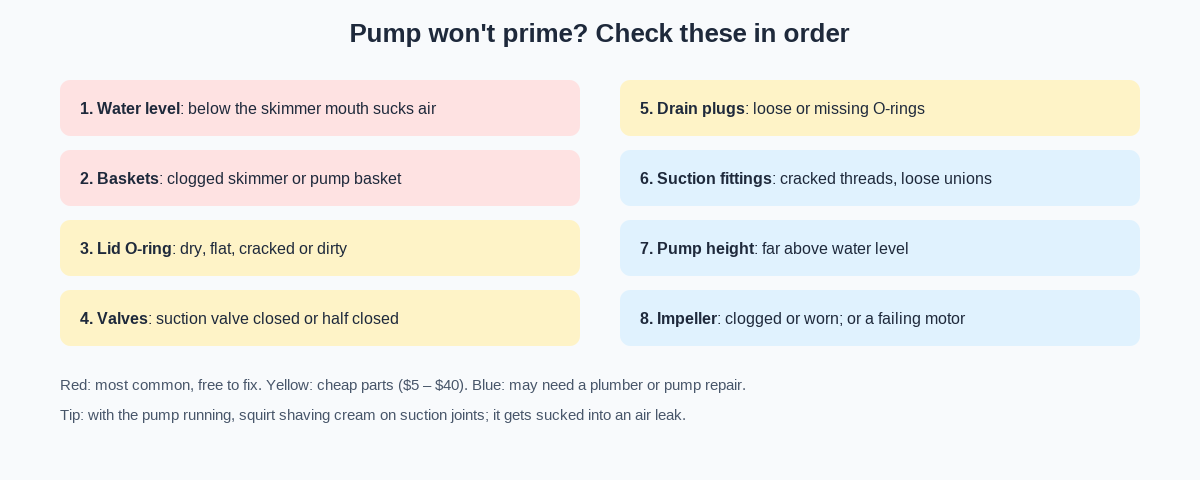
Chart: Asphapro.com
If your swimming pool pump will not prime, the cause is almost always air getting in on the suction side, or water not reaching the pump. Check these in order:
- Low water level. If the water is below the skimmer mouth, the skimmer sucks air. Add water.
- Clogged baskets. A full skimmer basket or pump basket blocks flow.
- Lid O-ring. A dry, flattened, cracked or dirty O-ring lets air in. Clean, lubricate or replace it ($5 to $20).
- Closed or partly closed valves on the suction side.
- Loose drain plugs on the pump, or missing drain plug O-rings.
- Air leaks at suction fittings: cracked threaded fittings at the pump inlet, loose unions, or bad glue joints.
- Clogged impeller. Leaves or hair caught in the impeller reduce suction.
- Pump too high above the water, or long suction lines. Some pumps struggle to lift water more than a few feet.
- Suction line leak underground. Needs a pressure test by a pro.
- Worn shaft seal or motor problems. Leaks under the motor or humming without spinning point to a failing pump.
How to Find an Air Leak in a Pool Pump
Air in pool pump housings is a common problem: bubbles in the pump basket, bubbles from the return jets, a pump that loses prime, or a gurgling sound. Ways to find the leak:
- Shaving cream test: with the pump running, spread shaving cream around the lid, drain plugs, inlet fitting and unions. If it gets sucked in, you have found the leak.
- Water test: slowly pour water over each suction joint while watching the basket. If bubbles stop, that joint leaks.
- Plastic wrap: wrap a suspect joint tightly in plastic wrap; if the bubbles stop, the leak is there.
- Check the lid: look for cracks in the clear lid, especially around the edges.
Fix leaks by replacing O-rings and gaskets, using thread sealant made for plastic pool fittings on threaded joints, or cutting out and re-gluing a bad joint. Air leaks on the suction side also make the pump noisy and reduce filtering, so fixing them helps the whole system. For water leaks elsewhere in the pool, see how to find a leak in a pool.
Priming After Backwashing or a Power Outage
Most pumps stay primed after a backwash, because the water in the housing never drains. If the pump will not restart after backwashing, the water level may have dropped below the skimmer; top it up and prime again. After a power outage, a pump that sits above the water level can lose its prime as water drains back to the pool. When power returns, check that water is flowing through the basket. If it is not, turn the pump off, refill the housing and restart. Some owners add a check valve or a timer delay to avoid running dry after outages.
Priming a Pump With a Heater or Solar System
Heaters and solar panels add length and height to the plumbing, which can trap air. Prime the pump with the heater off and the solar valve set to bypass. Once water flows steadily, turn on the heater or open the solar line. Watch for air bubbles from the returns for a few minutes, and bleed the filter's air relief again if needed. Never fire a gas heater until the pump has full flow, because low flow can damage the heat exchanger.
With these steps, you can prime a pool pump quickly and keep it running smoothly all season.
How to Prime a New Pool Pump
When installing a new pool pump, priming works the same way, with a few extra checks:
- Use the correct thread sealant on threaded fittings; many pump makers say not to use pipe dope on plastic threads.
- Make sure all unions are tight and O-rings are seated.
- Check that the wiring and voltage match the motor (115 V or 230 V).
- Fill the housing completely before the first start.
- Run the pump and check all joints for drips and bubbles for the first few hours.
Pool Pump Calculator: Flow Rate and Run Time
A pool pump should move the full volume of the pool through the filter about once every 6 to 8 hours (one "turnover"). Use this pool pump calculator to find the flow rate you need and how long to run your pump each day.
The math: flow needed (gpm) = pool gallons ÷ (turnover hours x 60). A 20,000 gallon pool with an 8-hour turnover needs about 42 gallons per minute. Real flow is lower than a pump's maximum rating because of pipe friction, the filter and the heater, so use the flow at your system's actual pressure. Variable-speed pumps can run longer at low speed, which moves the same water for much less electricity.
Choosing a New Pool Pump
If your pump keeps losing prime because it is worn out, or you are building a new pool, choose a pump for pool use with these points in mind:
- Variable-speed pumps are now required for most new and replacement inground pool pumps in the US under Department of Energy rules, and they can cut pump energy use by 50% to 90% compared with old single-speed pumps.
- Size by flow, not horsepower. Match the pump to the flow your pool needs and the filter can handle. Oversized pumps waste power and can damage filters.
- Self-priming design. Most inground swimming pool pumps are self-priming once the housing is full; check the rated lift if the pump sits above the water.
- Voltage: 115 V for small pumps, 230 V for most inground pumps.
- Plumbing size: match the inlet and outlet to your pipe (1.5 or 2 inch).
- Above ground pumps are smaller and often come with the filter as a combo unit.
| Pump type | Typical price | Yearly energy use (example) |
|---|---|---|
| Above ground single-speed | $150 – $500 | Low to medium |
| Inground single-speed (older) | $400 – $900 | High |
| Inground two-speed | $500 – $1,000 | Medium |
| Inground variable-speed | $800 – $2,000 | Low |
Installation of a new pool pump adds about $150 to $600 for a pool technician, more if wiring or plumbing changes are needed.
How Long Should You Run a Pool Pump?
Most pools need one full turnover a day, often 6 to 12 hours depending on pump size and speed. Run the pump during the day when chlorine and sunlight are working, and longer in hot weather, after storms or when the pool is heavily used. With a variable-speed pump, run longer at low speed for filtering and boost speed for vacuuming, heating or cleaning. Running the pump less than one turnover a day often leads to cloudy water and algae.
Pool Pump Care to Keep It Primed
- Empty the skimmer and pump baskets weekly, more often in fall.
- Lubricate the lid O-ring every month or two with silicone lubricant.
- Keep the water level in the middle of the skimmer.
- Check for drips under the motor, which can mean a failing shaft seal.
- Keep the motor dry and well ventilated; clear leaves and debris from around it.
- Winterize properly in cold climates: drain the pump, remove the plugs and store them in the pump basket.
- Listen for changes: grinding or screeching often means worn bearings.
Pool Pump Problems and Fixes
| Symptom | Likely cause | Fix |
|---|---|---|
| Pump hums but will not start | Bad capacitor, seized motor or impeller jam | Replace capacitor ($15 – $40); clear impeller |
| Loud screeching | Worn motor bearings | Replace bearings or motor |
| Water dripping under the motor | Worn shaft seal | Replace shaft seal ($10 – $40 part) |
| Bubbles in the pump basket | Suction-side air leak | Find and seal the leak |
| Pump shuts off when hot | Motor overheating; poor ventilation; low voltage | Improve airflow; have an electrician check wiring |
| Weak flow at returns | Clogged baskets, dirty filter or impeller | Clean baskets; backwash; clear impeller |
For filter cleaning, see how to backwash a pool.
Where the Pump Sits: Pool and Pump Layout
How the pool and pump are laid out has a big effect on priming. A pump set close to the pool and at or below the water level primes easily and runs quietly. A pump far from the pool, or several feet above the water, has to lift water through long pipes before it can move anything, and it loses prime more easily when air gets in.
- Distance: keep the equipment pad within about 25 to 50 feet of the pool when possible.
- Height: most self-priming pool pumps can lift water about 5 to 10 feet; check the pump's rating.
- Pipe size: larger suction pipes (2 inch) reduce friction and make priming easier.
- Check valves: on pumps above the water level, a check valve on the suction line keeps water in the pipe when the pump stops.
For a pool with pump equipment on a deck or rooftop, priming problems are more common, and a pro may need to add check valves or move the pump lower.
Pool Pump Energy Use
The pump is usually the biggest energy user in a pool system, after a heater. An old single-speed pump for swimming pool use can draw 1,500 to 2,500 watts and cost $300 to $1,000 a year to run. A variable-speed pump running at low speed for longer hours may use only a fraction of that, often saving $200 to $800 a year, according to the US Department of Energy and ENERGY STAR. Running a swimming pool pump at the lowest speed that still keeps the water clear is the single best way to cut pool energy costs.
| Speed setting | Typical use |
|---|---|
| Low (1,000 – 1,750 rpm) | Everyday filtering, most hours of the day |
| Medium (2,000 – 2,600 rpm) | Heating, salt cell, water features |
| High (2,800 – 3,450 rpm) | Priming, vacuuming, backwashing, spa jets |
Many variable-speed pumps run a short high-speed "priming" cycle on start-up, then drop to the programmed speed. If yours struggles to prime, make sure this priming setting is turned on.
Pool Air Pump vs Pool Water Pump
Searches for a pool air pump usually mean one of two things: an electric air pump used to inflate an inflatable pool or float, or the air blower used in some spas. Neither is the same as a pool water pump, which circulates water through the filter. If your inflatable pool came with a small filter pump, that is a water pump and needs priming like any other; its air pump only fills the walls of the pool.
Safety When Working on a Pool Pump
- Always turn off power at the breaker before opening the pump or touching wiring.
- Release pressure from the filter with the air relief valve before opening anything.
- Never start the pump with the lid off or the valves all closed.
- Keep hands away from the pump inlet and impeller, even when the power is off.
- Have an electrician handle wiring, bonding and GFCI protection, which pool codes require.
When to Call a Pool Technician
Call a pro if the pump will not prime after you have checked the water level, baskets, lid O-ring, valves and visible fittings; if you hear grinding or the motor hums without spinning; if water leaks from under the motor; or if you suspect an underground suction leak. A service call usually costs $75 to $150, plus parts, and a technician can often spot the problem within minutes. Pressure testing the suction lines costs about $150 to $400 and finds hidden leaks that no amount of priming can fix.
How to Prime a Pool Pump: Key Points
- Turn the pump off, open the air relief, fill the strainer housing, close the lid hand-tight, and turn it on.
- The pump should prime in 1 to 3 minutes; stop after 5 minutes if it does not.
- Most priming problems come from low water, clogged baskets, a bad lid O-ring or suction air leaks.
- Never run a pump dry for long.
- Lubricate the lid O-ring regularly.
Frequently Asked Questions
How do you prime a pool pump?
Turn the pump off, open the filter's air relief valve, fill the pump strainer housing with water, close the lid tightly, and turn the pump on. Close the air relief when water sprays out.
How to prime the pool pump faster?
Open only the skimmer line, fill both the housing and the skimmer with water, and use the pump's high-speed priming setting if it has one.
How long does it take to prime a pool pump?
Usually 1 to 3 minutes. After winter, or with long suction lines, it can take up to 5 minutes.
How do you prime a swimming pool pump that sits above the water?
Fill the strainer housing and the suction line as full as possible, close the lid tightly, and start the pump with only the closest suction line open. Pumps set high above the water may need a check valve on the suction line to hold water when off.
How do I prime a pool pump with no air relief valve?
Loosen the pump lid slightly or open a union on the discharge side to let air escape while filling, then tighten before starting.
Why does air in the pool pump come back every day?
A slow suction-side leak, usually at the lid O-ring, a threaded fitting or a drain plug, lets air in while the pump runs. Find it with the shaving cream test.
Can a pool pump run without water?
Only for a minute or two while priming. Longer dry running overheats the shaft seal and can melt plastic parts.
What does a pool pump do in winter?
In cold climates it is drained and shut off. In mild climates it may run at night during freezes to keep water moving and prevent pipes from freezing.
How much does a new pool pump cost?
About $150 to $500 for an above ground pump and $800 to $2,000 for an inground variable-speed pump, plus installation.
How do you prime the pool pump after cleaning the basket?
Before closing the lid, refill the housing with water, check the O-ring, close the lid tightly and restart. It usually primes in seconds.
Sources
- Swim University: How to prime a pool pump
- US Department of Energy: Swimming pool pumps
- ENERGY STAR: Pool pumps
- Pool and Hot Tub Alliance