
How Many Gallons Is My Pool? Calculator, Formulas and Size Charts
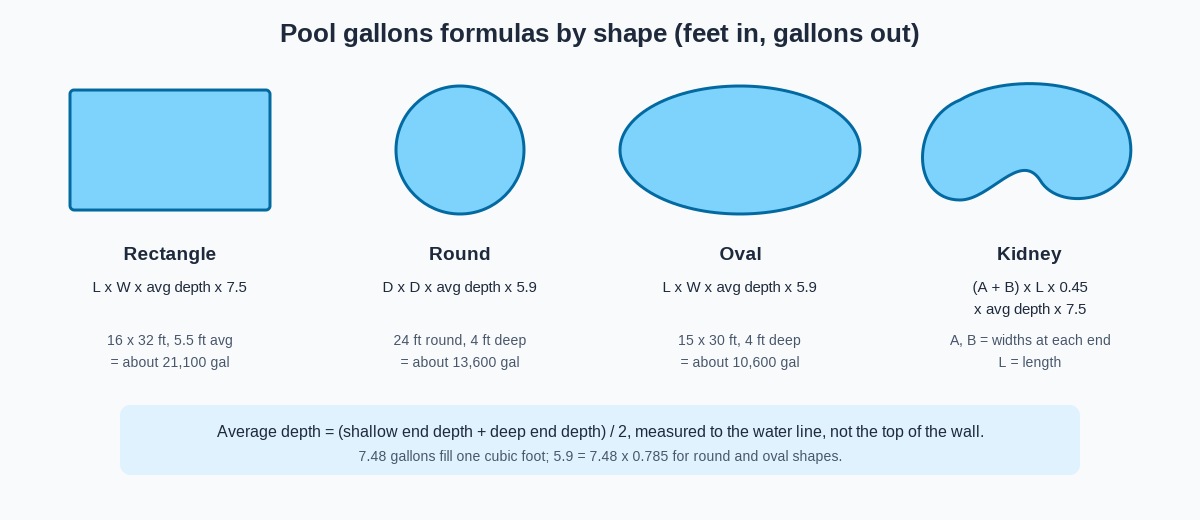
Diagram: Asphapro.com
Quick Answer
How many gallons is my pool? Measure the length, width (or diameter) and average depth in feet, then use the formula for your shape. Rectangle: length x width x average depth x 7.5. Round: diameter x diameter x average depth x 5.9. Oval: length x width x average depth x 5.9. Average depth is the shallow end depth plus the deep end depth, divided by 2. A typical 16 x 32 ft inground pool holds about 18,000 to 22,000 gallons, a 24 ft round above ground pool about 13,600 gallons, and an Olympic pool about 660,000 gallons. Use the pool gallon calculator below for your exact pool.
Knowing how many gallons is a pool you own, and how many gallons are in a swimming pool in general, is one of the most useful numbers a pool owner can have. Every chemical dose, from chlorine and shock to pH and alkalinity adjusters, is based on pool gallons. Your pump and filter size, heater size, salt system, water delivery order and the time it takes to fill or drain the pool all depend on it too. Guessing can mean wasted chemicals, cloudy water, or a heater that never keeps up.
This guide gives you a free pool gallons calculator, the formulas for every common pool shape, how to measure your pool correctly, charts of gallons for common above ground and inground pool sizes, and answers to the most common questions, including how many gallons are in an Olympic swimming pool.
Pool Gallon Calculator
Enter your pool's size in feet. For round pools, enter the diameter in the length box; the width box is ignored. For a pool with one depth (most above ground pools), enter the same number for shallow and deep end.
This gallon pool calculator uses the standard formulas below, the same ones any pool size gallons calculator or gallons in pool calculator uses. Results are close estimates; steps, benches, sloped walls and rounded corners change the real number by a few percent. For chemical dosing, an estimate within 5% to 10% is fine.
How to Measure Your Pool
The first step in how to measure pool gallons is measuring the pool itself. Before you calculate pool gallons, take three or four simple measurements with a tape measure:
- Length: the longest inside distance from wall to wall, at the water line.
- Width: the inside distance across the pool. For a kidney or freeform pool, measure the width at the widest point of each end.
- Diameter (round pools): the inside distance across the center, from wall to wall. Measure twice in different directions and average.
- Depth: measure from the water surface to the floor, not from the top of the wall. For pools with a shallow and deep end, measure both.
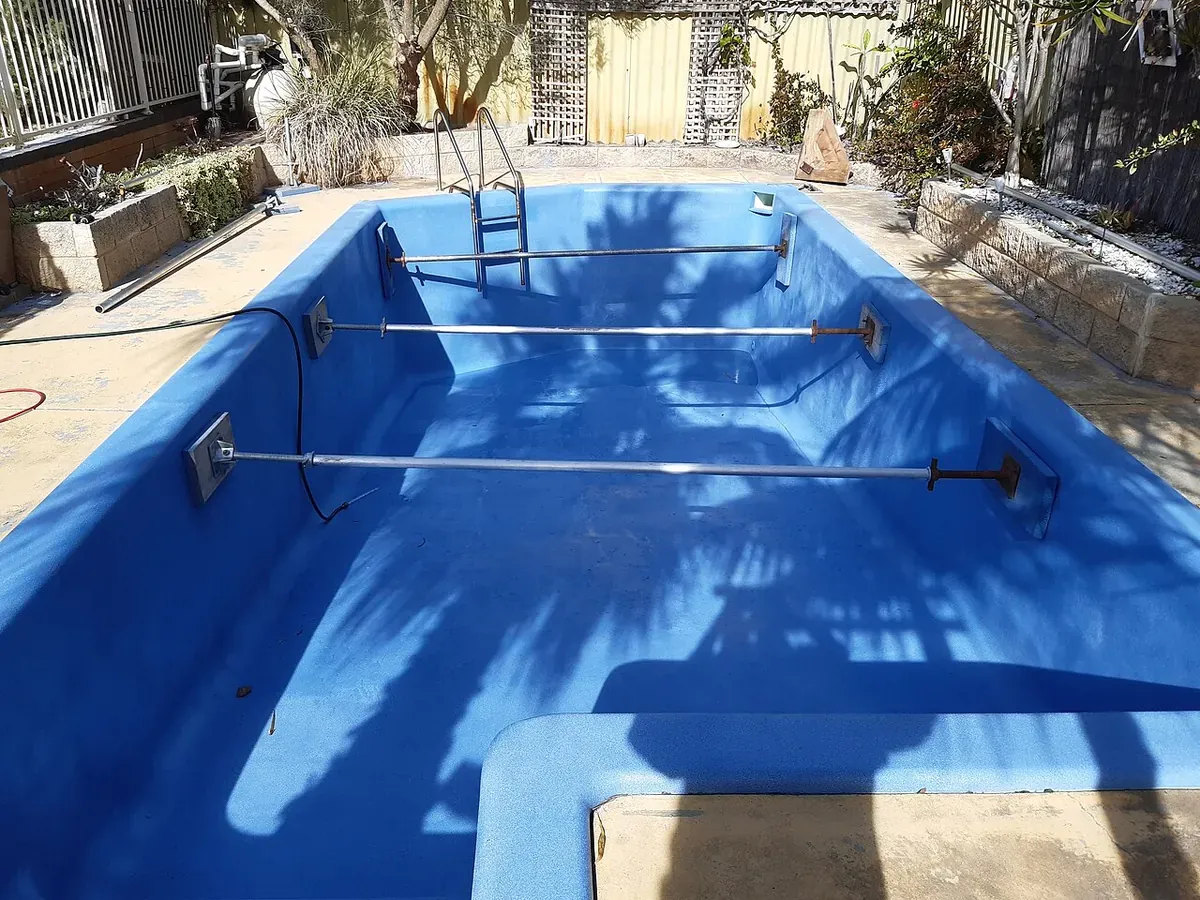
Photo: Calistemon, Wikimedia Commons, CC BY-SA 4.0
Finding the average depth
Most inground pools slope from a shallow end of 3 to 4 feet to a deep end of 5 to 9 feet. Add the two depths and divide by 2. A pool that is 3.5 feet deep in the shallow end and 8 feet at the deep end has an average depth of 5.75 feet.
If the deep part is a small hopper in the middle of a long pool, the simple average overstates the volume. In that case, estimate the share of the pool's length at each depth. For example, if two-thirds of the length is about 4 feet deep and one-third is about 7 feet deep, the average depth is about (4 x 2 + 7) / 3 = 5 feet.
Above ground pools usually have one depth. The water is usually 6 to 8 inches below the top of the wall. A 52-inch wall typically holds about 46 inches (3.8 feet) of water, and a 48-inch wall about 42 inches (3.5 feet).
Pool Gallons Formulas by Shape
If you want to know how to calculate gallons in a pool by hand, or how to calculate how many gallons are in a pool of any shape, the method is the same. All pool volume formulas work the same way: find the surface area in square feet, multiply by the average depth to get cubic feet, then multiply by 7.48, the number of gallons in one cubic foot of water. Many people round 7.48 to 7.5.
Rectangle or square pool
Gallons = length x width x average depth x 7.5
Example: a 16 x 32 ft pool with an average depth of 5.5 ft holds 16 x 32 x 5.5 x 7.5 = about 21,100 gallons.
Round pool
Gallons = diameter x diameter x average depth x 5.9
The 5.9 comes from 7.48 x 0.785 (0.785 is pi divided by 4). Example: a 24 ft round pool with 4 ft of water holds 24 x 24 x 4 x 5.9 = about 13,600 gallons.
Oval pool
Gallons = length x width x average depth x 5.9
Example: a 15 x 30 ft oval above ground pool with 4 ft of water holds 15 x 30 x 4 x 5.9 = about 10,600 gallons.
Kidney pool
Gallons = (width A + width B) x length x 0.45 x average depth x 7.5
Width A and B are the widest points at each end. Example: widths of 10 and 14 ft, length 28 ft, average depth 5 ft: (10 + 14) x 28 x 0.45 x 5 x 7.5 = about 11,300 gallons.
Freeform and irregular pools
Break the pool into simple shapes, such as a rectangle plus a half circle, calculate each, and add them up. A half circle holds half of what a full round shape of the same diameter would.
How Many Gallons in an Above Ground Pool?
Here are approximate gallons for common above ground pool sizes, filled to the usual water line (about 6 inches below the top of the wall).
| Round pool size | 48 in wall (about 3.5 ft of water) | 52 in wall (about 3.8 ft of water) |
|---|---|---|
| 12 ft round | about 3,000 gal | about 3,200 gal |
| 15 ft round | about 4,600 gal | about 5,000 gal |
| 18 ft round | about 6,700 gal | about 7,300 gal |
| 21 ft round | about 9,100 gal | about 9,900 gal |
| 24 ft round | about 11,900 gal | about 12,900 gal |
| 27 ft round | about 15,100 gal | about 16,300 gal |
| 30 ft round | about 18,600 gal | about 20,200 gal |
| Oval pool size | 48 in wall | 52 in wall |
|---|---|---|
| 12 x 24 ft | about 5,900 gal | about 6,500 gal |
| 15 x 30 ft | about 9,300 gal | about 10,100 gal |
| 18 x 33 ft | about 12,300 gal | about 13,300 gal |
| 21 x 41 ft | about 17,800 gal | about 19,300 gal |
How many gallons in a 24 foot round pool?
A 24 foot round pool holds about 11,900 gallons with a 48-inch wall and about 12,900 to 13,600 gallons with a 52 to 54-inch wall, depending on how high you fill it. A 24 ft round pool is the most popular above ground size.
How many gallons in an 18 foot round pool?
An 18 foot round pool holds about 6,700 gallons with a 48-inch wall, and about 7,300 gallons with a 52-inch wall. An 18x48 pool (18 ft wide, 48 in tall) filled to 90% holds about 6,400 to 6,700 gallons.
How Many Gallons in an Inground Pool?
| Rectangle pool size | Average depth 4.5 ft | Average depth 5.5 ft |
|---|---|---|
| 12 x 24 ft | about 9,700 gal | about 11,800 gal |
| 14 x 28 ft | about 13,200 gal | about 16,100 gal |
| 15 x 30 ft | about 15,100 gal | about 18,500 gal |
| 16 x 32 ft | about 17,200 gal | about 21,100 gal |
| 18 x 36 ft | about 21,800 gal | about 26,700 gal |
| 20 x 40 ft | about 26,900 gal | about 32,900 gal |
How many gallons is a 16x32 pool?
A 16x32 pool holds about 17,000 to 23,000 gallons depending on depth. With a 3.5 ft shallow end and an 8 ft deep end (average 5.75 ft), it holds about 22,000 gallons. A 32x16 pool with a flat 4 ft sport bottom holds about 15,300 gallons.
How Many Gallons Is the Average Pool?
How many gallons is an average pool? The average inground swimming pool in the US is roughly 14 x 28 ft to 16 x 32 ft, and holds about 15,000 to 22,000 gallons. The average above ground pool, a 24 ft round, holds about 12,000 to 13,600 gallons. Average swimming pool gallons for all home pools together sit around 15,000 to 20,000, so the average pool size in gallons is a useful starting point if you have not measured yet. Average swimming pool size gallons in hotels and community pools are much higher, often 50,000 to 150,000.
How Many Gallons in an Olympic Swimming Pool?
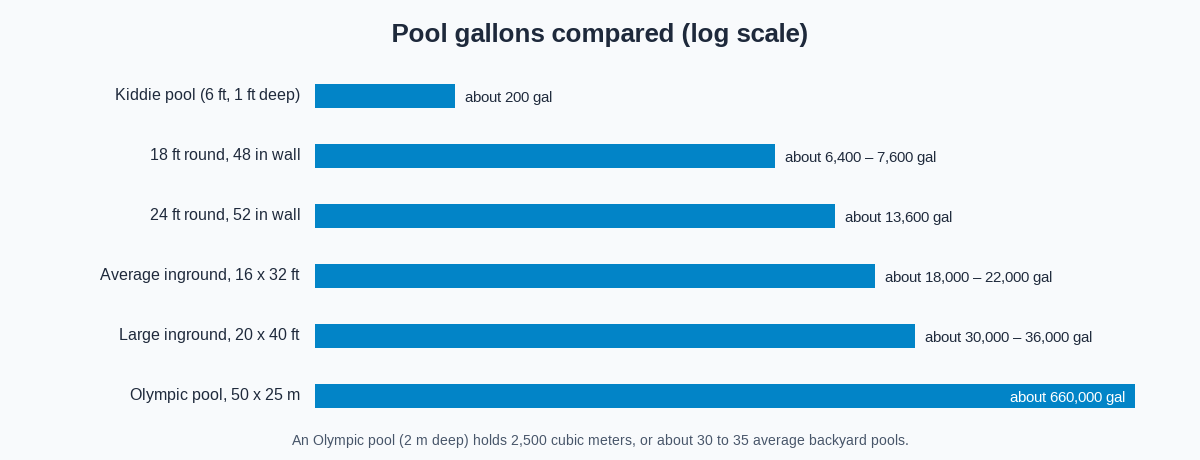
Chart: Asphapro.com
How many gallons in olympic pool tanks? An Olympic size pool is 50 meters long and 25 meters wide. World Aquatics rules call for a depth of at least 2 meters for competition pools, which gives a volume of 2,500 cubic meters, or about 660,000 gallons (2.5 million liters). Some Olympic pools are 3 meters deep and hold about 990,000 gallons. That is as much water as roughly 30 to 35 average backyard pools.
How Many Gallons Is a Kiddie Pool?
Small inflatable and plastic kiddie pools hold very little water: a 4 ft pool filled to 10 inches holds about 80 gallons; a 6 ft pool filled to 1 ft holds about 200 gallons; a 10 ft family inflatable pool filled to 2 ft holds about 1,000 to 1,200 gallons.
Worked Examples: Figuring Out Gallons in a Pool
Here are three full examples of figuring out gallons in a pool, step by step, so you can follow the same method with your own numbers.
Example 1: Rectangle inground pool with a deep end
- Measure: 18 ft wide, 36 ft long. Shallow end 3.5 ft of water, deep end 8.5 ft.
- Average depth: (3.5 + 8.5) / 2 = 6 ft.
- Cubic feet: 18 x 36 x 6 = 3,888 cubic feet.
- Gallons: 3,888 x 7.48 = about 29,100 gallons.
Example 2: 21 ft round above ground pool
- Measure: 21 ft across, water 4 ft deep (52-inch wall filled a bit high).
- Gallons: 21 x 21 x 4 x 5.9 = about 10,400 gallons.
Example 3: Freeform pool split into two shapes
- The main body is a 14 x 24 ft rectangle with an average depth of 5 ft: 14 x 24 x 5 x 7.48 = about 12,600 gallons.
- A round end of 14 ft diameter makes a half circle, about 4 ft deep: 14 x 14 x 4 x 5.9 / 2 = about 2,300 gallons.
- Total: about 14,900 gallons.
When you calculate gallons in a pool by hand, round the result to the nearest hundred. Your measurements are not more exact than that, and chemical labels are written in round numbers anyway.
Gallons per Inch of Water
Knowing the gallons per inch helps you estimate how much water you add with each top-up, how much a leak is losing, and how much to lower the level for winter. Gallons per inch = surface area in square feet x 0.623.
| Pool | Surface area | Gallons per inch |
|---|---|---|
| 18 ft round | about 254 sq ft | about 160 gal |
| 24 ft round | about 452 sq ft | about 280 gal |
| 15 x 30 ft oval | about 353 sq ft | about 220 gal |
| 16 x 32 ft rectangle | 512 sq ft | about 320 gal |
| 20 x 40 ft rectangle | 800 sq ft | about 500 gal |
Pool Volume in Liters and Cubic Meters
If your chemicals are labeled in liters, or you measured in meters, use metric formulas. For a rectangle pool: length x width x average depth (all in meters) = cubic meters. Multiply cubic meters by 1,000 for liters, or by 264.2 for US gallons. For a round pool: diameter x diameter x 0.785 x average depth = cubic meters.
To convert from gallons to liters, multiply by 3.785. A 20,000 gallon pool holds about 75,700 liters (75.7 cubic meters).
How to Estimate Pool Gallons Without Measuring
If your pool has a complex shape or you cannot measure the deep end, there are other ways to estimate gallons in a pool:
- Water meter method: read the water meter before and after filling the pool (or after adding a known number of inches). Many meters read in cubic feet; multiply by 7.48 for gallons.
- Fill time method: measure the flow of your hose by timing how long it takes to fill a 5-gallon bucket. If it takes 30 seconds, the hose flows 10 gallons a minute. Multiply by the total fill time in minutes.
- Builder or manufacturer records: the pool builder's plans, the kit manual or the liner order form often lists the gallons.
- Salt reading: if you add a known amount of salt and measure the rise in salt level, you can work backward to the volume. This is less exact but useful as a check.
How Many Gallons for a Pool Chemical Dose?
Most chemical labels give doses per 10,000 gallons. Once you know how many gallons are in my pool, divide by 10,000 and multiply by the label dose. Here are common examples:
| Task | Typical dose per 10,000 gal | For a 20,000 gal pool |
|---|---|---|
| Raise free chlorine 1 ppm (liquid chlorine, 10%) | about 13 fl oz | about 26 fl oz |
| Shock with cal-hypo (65%) | about 1 lb | about 2 lb |
| Raise alkalinity 10 ppm (baking soda) | about 1.4 lb | about 2.8 lb |
| Raise salt 1,000 ppm | about 83 lb | about 167 lb |
| Raise stabilizer 10 ppm (cyanuric acid) | about 13 oz | about 26 oz |
Always follow the product label, since strengths vary. For salt pools, see how to add salt to pool.
How Long Does It Take to Fill a Pool?
A typical garden hose delivers about 6 to 12 gallons per minute. Here is how long filling takes at about 9 gallons per minute:
| Pool gallons | Time with one hose |
|---|---|
| 5,000 gal | about 9 hours |
| 10,000 gal | about 18.5 hours |
| 15,000 gal | about 28 hours |
| 20,000 gal | about 37 hours |
| 30,000 gal | about 55 hours |
Two hoses on separate spigots roughly halve the time, if your water pressure allows it.
Common Mistakes When You Calculate Pool Gallons
- Measuring to the top of the wall instead of the water line. This can overstate gallons by 10% or more.
- Using the deep end depth only. Always use the average depth.
- Using the rectangle formula on a round pool. That overstates the volume by about 27%.
- Measuring outside the wall on above ground pools. Measure inside.
- Mixing inches and feet. Convert all measurements to feet first (divide inches by 12).
- Forgetting the hopper. A small deep hopper in a long pool means the simple average is too high.
Pool Size in Gallons: Quick Reference
| Pool type | Typical pool size in gallons |
|---|---|
| Kiddie or small inflatable pool | 50 – 1,200 |
| Stock tank pool (8 ft) | about 1,200 – 1,500 |
| Hot tub | 300 – 500 |
| Plunge pool | 2,500 – 8,000 |
| Above ground pool (15 – 30 ft round) | 4,600 – 20,000 |
| Average inground pool | 15,000 – 22,000 |
| Large inground pool | 25,000 – 40,000 |
| Olympic size pool gallons | about 660,000 |
For more on pool dimensions, see size of swimming pool.
Why Pool Gallons Matter
- Chemical dosing: chlorine, shock, pH, alkalinity, calcium, stabilizer and salt doses are all given per 10,000 gallons.
- Pump and filter sizing: pools should turn over their full volume about once every 6 to 8 hours.
- Heater sizing: bigger volumes need more BTUs to heat.
- Filling and draining: to estimate time and cost; see swimming pool filling cost.
- Water delivery: trucks carry 6,000 to 9,000 gallons each; see pool water delivery cost.
- Leak checks: knowing gallons per inch helps estimate how much a leak is costing you.
How Many Gallons Is My Pool: Key Points
- Rectangle: L x W x average depth x 7.5. Round: D x D x average depth x 5.9. Oval: L x W x average depth x 5.9.
- Average depth = (shallow + deep) / 2, measured to the water line.
- A 16 x 32 inground pool holds about 18,000 to 22,000 gallons.
- A 24 ft round above ground pool holds about 12,000 to 13,600 gallons.
- An Olympic pool holds about 660,000 gallons.
Frequently Asked Questions
How do I calculate how many gallons are in my pool?
Multiply length x width x average depth in feet, then multiply by 7.5 for a rectangle or 5.9 for a round or oval pool.
How many gallons are in a pool on average?
About 15,000 to 22,000 gallons for an inground pool and 12,000 to 13,600 for a 24 ft round above ground pool.
How many gallons in an Olympic pool?
About 660,000 gallons at 2 meters deep.
How many gallons is a 24 ft round pool?
About 11,900 to 13,600 gallons, depending on wall height and fill level.
How many gallons in a pool of average size?
How many gallons in a pool depends on size, but the average inground pool holds about 15,000 to 22,000 gallons. Average gallons in a pool for above ground models are lower, about 10,000 to 13,600.
How many gallons in my pool if I do not know the depth?
Measure it with a pole or a weighted tape from the water surface to the floor at the shallow and deep ends. Without a depth, any estimate of how many gallons of water in my pool could be off by 30% or more.
How many gallons are in my swimming pool if it has steps and a bench?
Calculate as if the pool had no steps, then subtract about 2% to 5%. Steps and benches take up space that would otherwise hold water.
How do I use a swimming pool gallon calculator?
Choose your shape, enter the length and width (or diameter) and the shallow and deep end water depths in feet, and press calculate. Any pool calculator gallons tool uses the same formulas shown on this page.
How do you measure gallons in a pool with a water meter?
Read the meter, fill the pool (or add a measured number of inches), then read it again. The difference in cubic feet times 7.48 equals the gallons added.
How to figure out how many gallons in a pool shaped like an L?
Split it into two rectangles, calculate each with length x width x average depth x 7.5, and add them together. This is how to figure gallons in a swimming pool with any odd shape.
How many gallons is an Olympic size pool?
About 660,000 gallons at the minimum competition depth of 2 meters. Gallons in olympic size pool designs with a 3 meter depth reach about 990,000.
How many gallons of water in an Olympic pool in liters?
About 2.5 million liters (2,500 cubic meters) at 2 meters deep. Olympic pool size gallons in US units equal about 660,000.
How many gallons in a 24 round pool with a 54 inch wall?
About 13,600 to 14,200 gallons when filled to 6 inches below the top. 24 round pool gallons rise by about 280 gallons for each extra inch of water.
How many gallons is a 18x48 pool?
An 18 ft round pool with a 48 inch wall holds about 6,400 to 6,700 gallons at a normal fill level.
How many gallons in a 32x16 pool with a flat bottom?
At an even 4 ft depth, about 15,300 gallons. With a 3.5 to 8 ft depth range, about 22,000 gallons.
How many gallons is an above ground pool usually?
Most hold between 4,600 gallons (15 ft round) and 20,000 gallons (30 ft round or large ovals).
What is the easiest way to estimate gallons in a pool?
Use the shape formula with average depth, or a pool gallons calculator. To estimate pool gallons in a hurry, a 16 x 32 pool is about 20,000 gallons and a 24 ft round about 13,000.
How many gallons of water is in a swimming pool after backwashing?
Backwashing removes about 200 to 500 gallons, depending on filter size and how long you run it. Top the pool back up to the middle of the skimmer.
Why does my pool calculator give a different number than the manual?
Manufacturers often list volume at 90% full or to a set water line, and may account for wall slope. Differences of 5% to 10% are normal.
How to measure a pool for a new liner versus for gallons?
For gallons, measure the water. For a liner, measure the structure: wall to wall, wall height and the full depth profile. Liner companies give a separate measuring form.
Sources
- Swim University: Pool volume calculator
- World Aquatics: Facilities rules
- USGS: Water density
- NIST: Units of volume