
How to Find a Leak in a Pool: Step-by-Step Leak Detection
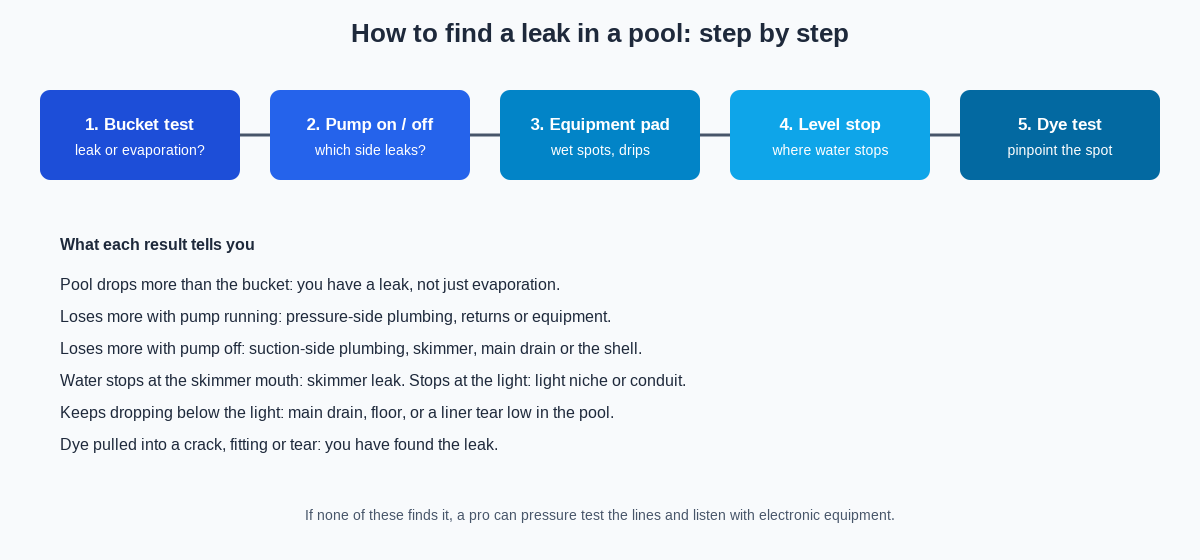
Chart: Asphapro.com
Quick Answer
How to find a leak in a pool: first confirm it is a leak with the bucket test (a bucket of pool water on the step for 24 hours; if the pool drops more than the bucket, you have a pool leak). Then run the test again with the pump off to see whether the leak is in the plumbing or the shell. Check the equipment pad for drips and wet ground. Let the water drop and see where it stops: at the skimmer, the light or below. Finally, use a few drops of dye near fittings, cracks and liner seams with the pump off; the dye gets pulled into the leak. Most pool leaks are at the skimmer, returns, light niche, main drain or underground pipes. If you cannot find it, a pro leak detection costs about $100 to $500.
Anyone learning how to find swimming pool leak spots should start with one fact: every pool loses some water. Sun, wind, swimmers and backwashing all take water out of the pool. But when you are adding water every few days, the water bill is up, or the ground near the pool stays soft, the pool is leaking. A pool leak never fixes itself. Water keeps washing out soil, chemicals and salt, and a small leak in a pool can turn into a big repair if you leave it.
The good news is that you can usually find a pool leak yourself with a bucket, a marker, some tape, a dye bottle and a little patience. This guide explains how to find a leak in a pool step by step, for both inground pools and above ground pools: how to tell if your pool is leaking, how to narrow down where the leak is, how to find a leak in a pool liner, and when to call a pro. For prices once the leak is found, see pool leak repair cost.
Signs Your Pool Is Leaking
Before you start any tests, look for the common signs of a leaking pool. One sign alone may be normal evaporation. Two or more together usually mean the pool is leaking.
- Water loss of more than 1/4 inch a day. Normal evaporation is often 1/8 to 1/4 inch a day in summer. More than that, day after day, points to a leak in the pool.
- Higher water bill. If your auto-fill keeps topping up the pool, a leak can add hundreds of gallons a day to the bill.
- Wet or soft spots in the yard near the pool, the equipment pad or the path of the pipes, even when it has not rained.
- Cracks in the deck or the pool shell, or tiles coming loose. Water washing out soil under the deck causes settling.
- Air in the pump basket or bubbles at the returns. A leak on the suction side often pulls in air while also leaking water.
- Algae that keeps coming back or chemicals that will not stay balanced. Fresh water added to make up for a leak dilutes chlorine and changes pH.
- A liner that pulls away from the wall or wrinkles in a vinyl pool, or water under the liner.
- Standing water at the equipment or under the pump, filter or heater.
If you see any of these signs, the next step in how to find a leak in a pool is to rule out evaporation.
Step 1: Confirm the Leak With the Bucket Test
The bucket test is the simplest way to tell a pool leak from evaporation. It compares the water lost from a bucket (which can only lose water to evaporation) with the water lost from the pool.
- Bring the pool to its normal water level.
- Fill a bucket with pool water to about one inch from the top.
- Set the bucket on the first or second step of the pool, so it sits in the pool water and stays at the same temperature. On an above ground pool with no steps, place it on a ladder step or a stable block in the pool.
- Mark the water level inside the bucket with a marker or tape.
- Mark the pool water level on the outside of the bucket, on the skimmer faceplate, or on a piece of tape on the tile.
- Turn off the auto-fill, do not swim, and run the pump as normal for 24 hours.
- Compare the two levels. If the pool dropped more than the bucket, the pool is leaking.
A difference of 1/4 inch or more in 24 hours is a clear sign. A difference of 1/8 inch may be a small pool leak; repeat the test to be sure. Do not run the test during heavy rain, which adds water to both. If the bucket and pool drop the same amount, the loss is evaporation, and you do not need to find a leak.
Step 2: Test With the Pump On and Off
Once you know the pool is leaking, the next step in how to find a pool leak is to find out whether the leak is in the plumbing or in the pool itself. Repeat the bucket test, this time with the pump off for 24 hours.
| Result | Likely leak location |
|---|---|
| Pool loses more with the pump on | Pressure-side plumbing (after the pump): return lines, return fittings, filter, heater, valves |
| Pool loses more with the pump off | Suction-side plumbing (before the pump): skimmer lines, main drain lines; or the shell, light niche, liner |
| Pool loses the same either way | The pool shell, liner, light niche, skimmer body or fittings in the wall |
| Water level stops dropping at a certain point | The leak is at or near that level (see Step 4) |
When the pump runs, the return lines are under pressure, so a crack pushes water out faster. When the pump is off, suction lines are no longer pulling water in, and a crack in them can leak out by gravity. This simple comparison cuts the search area in half.
Step 3: Check the Equipment Pad
The pump, filter, heater, chlorinator and valves are the easiest places to check, and a lot of pool leaks are there. With the pump running, look at:
- The pump: drips from the shaft seal under the motor, the lid O-ring, drain plugs and the unions. A wet motor bracket or rust under the pump points to a failed shaft seal.
- The filter: leaks at the tank band clamp, the multiport valve, the backwash line, the drain cap and the air relief valve. Check whether water runs out of the backwash line when it should not.
- The heater: water dripping from the heat exchanger or the unions.
- The salt cell or chlorinator: cracked housings and loose unions.
- Valves and pipe joints: look for white crust, green stains, or wet soil around the pad.
Dry the pad with a towel and come back after an hour to see where fresh water appears. A leak at the equipment is usually the cheapest kind of pool leak to fix: a new O-ring, a seal or a tightened union.
Step 4: Let the Water Find Its Level
If the pool loses water even with the pump off, the level stop test helps you find where. Turn off the pump and the auto-fill, close the skimmer valves if you can, and let the water drop. Mark the level each day. The water will usually stop at the level of the leak, because water above the leak flows out and water below it cannot.
- Stops at the bottom of the skimmer mouth: the leak is in the skimmer body, the skimmer throat or the skimmer line. Skimmer leaks are among the most common.
- Stops at the light: the leak is likely in the light niche, the conduit or the light gasket. See how to replace a pool light.
- Stops at a return fitting: check the fitting and the return line.
- Keeps dropping below all fittings: the leak may be in the main drain, the floor, a crack low in the shell, or a tear low in the liner.
Do not let a vinyl liner pool drop too far, and do not drain a pool to look for a leak unless a pro advises it. Low water can let a vinyl liner shrink or float, and an empty concrete or fiberglass pool can lift out of the ground when the water table is high. Most leaks can be found with the pool full or only a few inches low.
Step 5: Use the Dye Test to Pinpoint the Leak
The dye test is the classic way to find a leak in a swimming pool once you know the general area. Leak detection dye is a thick colored liquid in a squeeze bottle. You can also use food coloring, but pool dye sinks slower and is easier to see.
- Turn off the pump and wait for the water to be completely still. Any movement spoils the test.
- Get close to the suspected area. For walls and fittings you will need a mask and snorkel or goggles; for shallow areas you can lean over the edge.
- Squeeze a small amount of dye very close to the surface you are testing: around the skimmer throat, around return fittings, at the light niche, along cracks, around the main drain and along liner seams.
- Watch the dye. If it drifts away slowly, there is no leak there. If it is pulled into a gap, crack or hole, you have found the leak.
- Mark the spot with tape or a waterproof marker so you can find it again.
Move slowly, because your movement creates currents that move the dye. Check every fitting, not just the first one that looks bad; pools can have more than one leak. A dye test at the skimmer is the place to start, since the joint between the skimmer and the pool wall is one of the most common leak spots in older pools.
Photo: Egidio24 / Wikimedia Commons, CC BY-SA 4.0
Step 6: Check the Plumbing Lines
If the pump test points to plumbing and you have found nothing at the equipment or the fittings, the leak may be underground. You can do a few checks yourself:
- Walk the pipe route. Look for wet, soft or greener grass, sunken pavers, or cracks in the deck along the path from the pool to the equipment.
- Plug the lines one at a time. With the pump off, plug the skimmer line, the return lines or the main drain line with rubber plugs (from the pool side). If the leak stops when one line is plugged, the leak is in that line.
- Watch the pump basket. Constant air bubbles in the pump basket often mean a suction-side leak that pulls in air when running and leaks water when off.
- Check after backwashing. A worn multiport valve gasket can send water out the backwash line all the time.
Finding an exact spot in buried pipe usually needs pressure testing and listening equipment. This is where a pro is worth the cost.
Step 7: Call a Pro for Leak Detection
If you have done the bucket test, the pump test, the equipment check and dye tests and still cannot find the leak, call a pool leak detection company. Professional pool leak detection costs about $100 to $500, with many jobs around $300. Pros use:
- Pressure testing: each line is plugged and pressurized with air or water. If the pressure drops, the line leaks.
- Electronic listening devices (hydrophones and ground mics): they listen for the sound of water escaping a pipe or the shell, even under concrete.
- Divers and underwater dye testing of the whole shell, including deep-end fittings and the main drain.
- Electronic liner leak detection for vinyl pools, which finds pinholes by tracing a small electrical current through the water.
- Cameras fed into pipes to see cracks, roots and broken joints.
Many companies credit the detection fee toward the repair if they also fix the leak. A pro search is also wise when the leak is large (more than an inch a day), when the deck is sinking, or when water is near the house.
How to Find a Leak in an Above Ground Pool
Above ground pools have fewer hidden places for leaks, and most leaks are easy to see once you know where to look. Here is how to find a leak in an above ground pool:
- Do the bucket test first, as for any pool.
- Walk around the outside of the pool wall. Look for wet ground, wet sand, a trail of water, or a damp spot on the wall. On a steel wall, look for rust lines. The wettest spot is usually below or near the leak.
- Check the skimmer and return. The faceplates and gaskets where they pass through the liner and wall are the most common leak points in an above ground pool.
- Check the hoses and equipment. Loose clamps, cracked hoses and pump and filter seals leak often.
- Check the liner seams and floor. With the water still, look for dirt being pulled into a spot on the floor, a small hollow under the liner, or a dark line in the sand.
- Use dye near any suspect spot inside the pool.
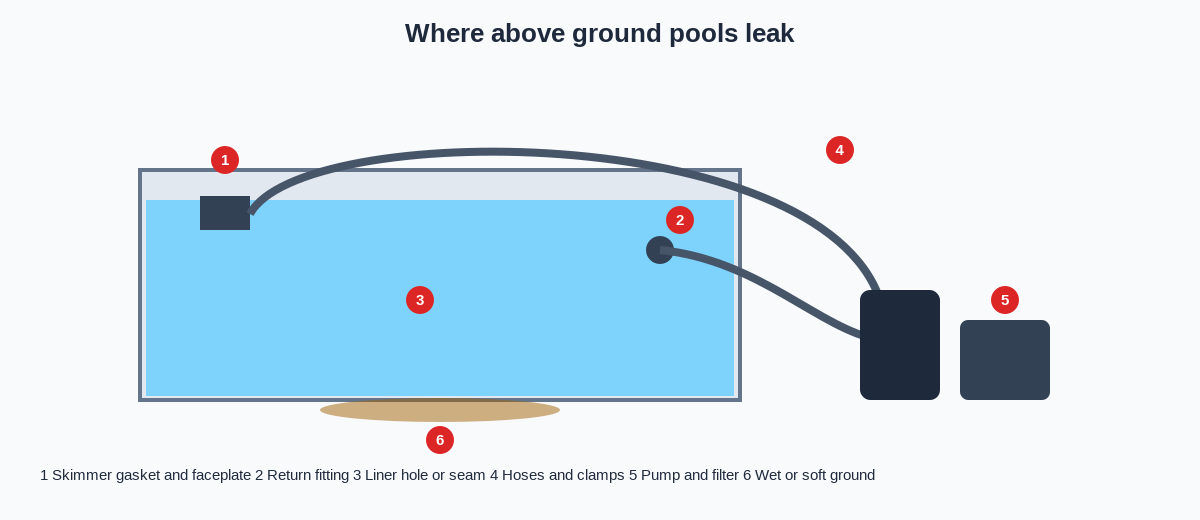
Diagram: Asphapro.com
If water appears on the ground outside the pool but nothing is wrong with the fittings or hoses, the liner probably has a hole low on the wall or in the floor near that spot. Learning how to find a hole in above ground pool liners, or how to find a hole in an above ground pool wall, is mostly patience: go in with goggles and move slowly along the floor and wall near the wet area.
How to Find a Leak in a Pool Liner
Vinyl liners in both inground and above ground pools get small holes and tears from sharp toys, pets, branches, cleaning tools, old age and freezing. To find a leak in a pool liner:
- Look for clues on the floor. Sand or dirt often collects at a hole because water is moving through it. Wrinkles, soft spots or a small hollow in the sand below a hole are common.
- Check the corners, steps and seams. Liners wear and tear first where they fold or stretch: corners, step edges, around fittings and along the bead track.
- Check the water line. Sun and chemicals make the vinyl at the water line brittle. Cracks here leak only when the water is high.
- Use dye along suspect areas. Squeeze a little near the liner and watch for it to be pulled through.
- Feel with your hand. In a small area you can run your fingers gently over the liner to find a tear you cannot see.
For a large liner, an electronic leak detection service can find small pinholes quickly. A swimming pool liner leak is usually patched with a vinyl patch and underwater glue. If the liner has many holes, is brittle or is more than 10 to 15 years old, plan for a new one; see pool liner replacement cost.
How to Find a Leak in an Inground Pool
Inground pools have more hidden pipes and fittings, so learning how to find a leak in a swimming pool that is built in the ground takes more work. Finding a leak in an inground pool takes more steps. Concrete and gunite pools can leak through cracks in the shell, at the tile line, at fittings and through the plaster. Fiberglass pools usually leak at fittings rather than the shell. Vinyl inground pools leak at fittings and liner holes. Focus on these places:
- Skimmer: the joint between the skimmer and the pool shell often separates as the deck moves. Look for a crack or gap at the skimmer throat.
- Return fittings: check the fitting and the gap around it.
- Light niche: the conduit that carries the light cord can leak, and the light gasket can fail.
- Main drain: the drain body and cover sit at the deepest point; a diver or pro may be needed.
- Tile line and coping: the joint between tile and deck, or tile and shell, can open up.
- Shell cracks: look for straight or diagonal cracks in plaster or in the shell.
- Steps and benches: joints at steps are common leak spots, especially in fiberglass and vinyl pools.
When people ask how to find leaks in pool shells and fittings, the answer is to work through the steps in order: bucket test, pump test, equipment, level stop, dye. If the dye tests find nothing and the pool still loses water, the leak is likely underground, which calls for a pro.
How to Tell if Pool Is Leaking or Just Evaporating
Many owners call a leak company only to find out they have normal evaporation. Evaporation depends on the weather. A heated pool, hot days, dry air and wind can make a pool lose 1/2 inch a day or more without any leak. A pool cover cuts evaporation sharply. Here is a simple way to tell:
| Sign | Probably evaporation | Probably a pool leak |
|---|---|---|
| Bucket test | Pool and bucket drop the same | Pool drops more than the bucket |
| Daily loss | About 1/8 – 1/4 inch in summer | More than 1/4 inch on cool, still days |
| Seasons | Higher in hot, windy months | Same loss in all weather |
| Water stops dropping | Never stops, but slows on cool days | Often stops at a certain level |
| Yard or deck | Dry | Wet spots, soft ground, settling |
Splash-out from swimmers and water lost from backwashing also count. If you backwash every week, measure before and after so you do not mistake backwash water for a leak in the pool.
Swimming Pool Leak Checks by Situation
The order of tests stays the same for every pool, but where you look first depends on what you see. These short checklists help you decide how to find a leak in your pool faster.
The pool is leaking only when the pump runs
A swimming pool leak that happens only with the pump on is almost always on the pressure side. Start at the equipment pad: the filter, heater, valves and unions. Then check the return fittings with dye while a helper turns the pump on and off. If the pad is dry and the returns are tight, the leak is likely in a buried return line, and the next step is a pressure test.
The pool is leaking with the pump off
When the pool loses water mostly with the pump off, focus on the skimmer, the main drain, the light niche and the shell. Let the water find its level and dye-test the fitting closest to where it stops. This is also the pattern for a liner hole, so a vinyl pool owner should check the liner closely.
The pool leaking is worse after a cold winter
Freezing water expands and can crack skimmers, pipes and fittings that were not winterized well. After a hard winter, a leak in pool plumbing near the surface or at the skimmer is the most likely cause. Check the skimmer body and the first few feet of pipe.
The deck is sinking or cracking near the pool
Settling next to the pool often means water has been washing soil away for a while. Mark the spot and look for a skimmer, return or pipe near it. A pool leaking under the deck should be checked by a pro soon, because the damage grows each week.
An above ground swimming pool has wet sand under the wall
The rule for how to find leak in above ground swimming pool walls and floors is simple: follow the water. The wettest spot outside the wall is usually close to the hole. If you are wondering how to find leak in above ground pool liners that look perfect, go inside with goggles and move your hand slowly along the floor near that wall. The suction of a small hole is often easier to feel than to see.
The leak is in a swimming pool liner but you cannot see it
The best tip on how to find a swimming pool liner leak that hides in a pattern: turn off the pump, let the water settle overnight and look along the floor early in the morning, when the light is low and dirt patterns are easier to see. Work in strips, the way you would mow a lawn.
DIY or Pro: How to Detect a Pool Leak for Less
Most owners can find leaks in pool equipment, skimmers and fittings on their own in an afternoon. Knowing how to detect a leak in pool plumbing underground is a different story; that work needs pressure gauges and listening gear that cost more than a single pro visit. A sensible plan is to do the free tests first, write down the results, and give them to the leak detection company. Clear notes on the bucket test, the pump test and where the water level stops can cut the time a pro needs, and that can lower the bill.
If you ask how do you find a pool leak in the cheapest way, the answer is the bucket, the tape and the dye. Professional detection only makes sense once those simple steps have narrowed it down or failed.
Tools You Need to Detect a Pool Leak
You do not need much equipment to find a pool leak yourself:
- A bucket (a 5-gallon bucket works well) and a few bricks or rocks to hold it steady.
- A waterproof marker, duct tape or painter's tape.
- Leak detection dye in a squeeze bottle, or food coloring.
- A mask and snorkel, or goggles.
- A flashlight for the equipment pad and underwater fittings.
- Rubber plugs sized for your skimmer and return lines.
- Towels to dry the equipment pad.
- A notebook to record water levels and dates.
The whole kit costs less than $40. Pool leak detection dye costs about $10 to $20 a bottle.
How Much Water Loss Is Too Much?
It helps to know how much water a pool leak can waste. Each inch of water in a pool holds this many gallons, based on surface area:
| Pool size | Gallons per inch of water | Water lost by a 1-inch-a-day leak in a month |
|---|---|---|
| 12 x 24 ft | about 180 gallons | about 5,400 gallons |
| 16 x 32 ft | about 320 gallons | about 9,600 gallons |
| 20 x 40 ft | about 500 gallons | about 15,000 gallons |
| 24 ft round above ground | about 280 gallons | about 8,400 gallons |
Gallons per inch equals length times width (in feet) times 7.48, divided by 12. A leak of an inch a day costs not only the water but also the chemicals, salt and heat that go with it.
Common Mistakes When Looking for a Pool Leak
- Skipping the bucket test. Many "leaks" turn out to be evaporation.
- Leaving the auto-fill on. The pool refills itself and the test shows nothing.
- Doing the dye test with the pump running. The current moves the dye everywhere; turn the pump off and wait for still water.
- Stopping at the first leak. Pools often have more than one leak, especially older ones.
- Draining the pool to look. This risks liner damage, shell cracking or a pool lifting out of the ground.
- Ignoring the equipment. Pump and filter leaks are common and easy to miss.
- Waiting too long. Small pool leaks grow, and washed-out soil under a deck costs far more to fix than the leak itself.
What to Do After You Find the Leak
Knowing how to find leak in pool fittings or pipes is only half the job. Once you know where the leak is, you can decide on the fix:
- Equipment leaks: replace O-rings, seals and gaskets, tighten unions, or replace a cracked part.
- Fittings: seal small gaps with pool putty or underwater epoxy; replace worn gaskets.
- Liner holes: patch with a vinyl patch kit, or replace the liner if it is old.
- Shell cracks: small cracks can be sealed with epoxy or putty; structural cracks need a pro.
- Underground pipes: a pro digs up and replaces the broken section, or relines it.
- Light niche: seal the conduit with a cord stopper or putty; replace the light gasket.
After the repair, repeat the bucket test to make sure the leak is gone. Then rebalance the water, because the fresh water you added changes the chemistry.
How to Prevent Pool Leaks
- Keep the water level in the middle of the skimmer opening, never too low.
- Keep the water balanced; low pH and calcium hardness can eat away at plaster, grout and metal parts.
- Close the pool correctly for winter so pipes and fittings do not freeze and crack.
- Replace pump and filter O-rings every few years and lubricate them.
- Seal the deck joint between the coping and the deck so water does not get under the deck.
- Keep sharp objects and pets' claws away from vinyl liners.
- Have the pool inspected every few years; see pool inspection cost.
How to Find a Leak in a Pool: Key Points
- Start with the bucket test to tell a pool leak from evaporation.
- Test with the pump on and off to see if the leak is in the plumbing or the pool.
- Check the equipment pad, then let the water drop to see where it stops.
- Use dye with the pump off to pinpoint leaks at fittings, cracks and liner seams.
- For an above ground pool, check the wall, ground, skimmer, return and hoses first.
- If you cannot find it, pro leak detection costs about $100 to $500.
Frequently Asked Questions
How do you find a leak in a pool?
Confirm it with the bucket test, then test with the pump on and off, check the equipment, watch where the water level stops and use dye near fittings, cracks and seams to pinpoint the leak.
How do I tell if pool is leaking?
Signs include losing more than 1/4 inch of water a day, a higher water bill, wet ground near the pool, cracks, and a bucket test where the pool drops more than the bucket.
Where is a leak in pool most likely?
Most pool leaks are at the skimmer, return fittings, light niche, main drain, equipment and underground pipes. Liner holes are common in vinyl pools.
How do you find a leak in an above ground pool?
Look for wet ground around the outside wall, check the skimmer, return, hoses and pump, and then use dye inside the pool near the wettest spot to find the hole in the liner.
Can I detect pool leaks with food coloring?
Yes. Food coloring works for a dye test, although pool leak dye is thicker, sinks slowly and is easier to see.
How long should a bucket test take?
At least 24 hours. Repeat it once with the pump on and once with it off.
Will a pool stop leaking at the level of the leak?
Often, yes. Water usually drops until it reaches the level of the leak and then stops. This helps you find leaks at the skimmer, light or returns.
How much does pool leak detection cost?
About $100 to $500, with many jobs around $300. The repair is usually extra.
How to detect leak in pool liner material?
Look for sand or dirt gathering at one spot, check corners, steps and seams, then use dye along suspect areas with the pump off. The dye is pulled into the hole.
Should I drain my pool to find a leak?
No. Most pool leaks can be found with the pool full. Draining can damage a vinyl liner or lift a pool shell out of the ground.
Can a pool leak be in the pipes?
Yes. Underground plumbing leaks are common. If the pool loses more water with the pump running, the pressure-side pipes are a likely cause.
Sources
- Swim University: How to find a pool leak
- Angi: Pool leak detection cost
- HomeGuide: Pool leak repair cost
- INYO Pools: How to find a pool leak
- EPA WaterSense: Pools and spas