
How to Backwash a Pool Filter: Step-by-Step Guide
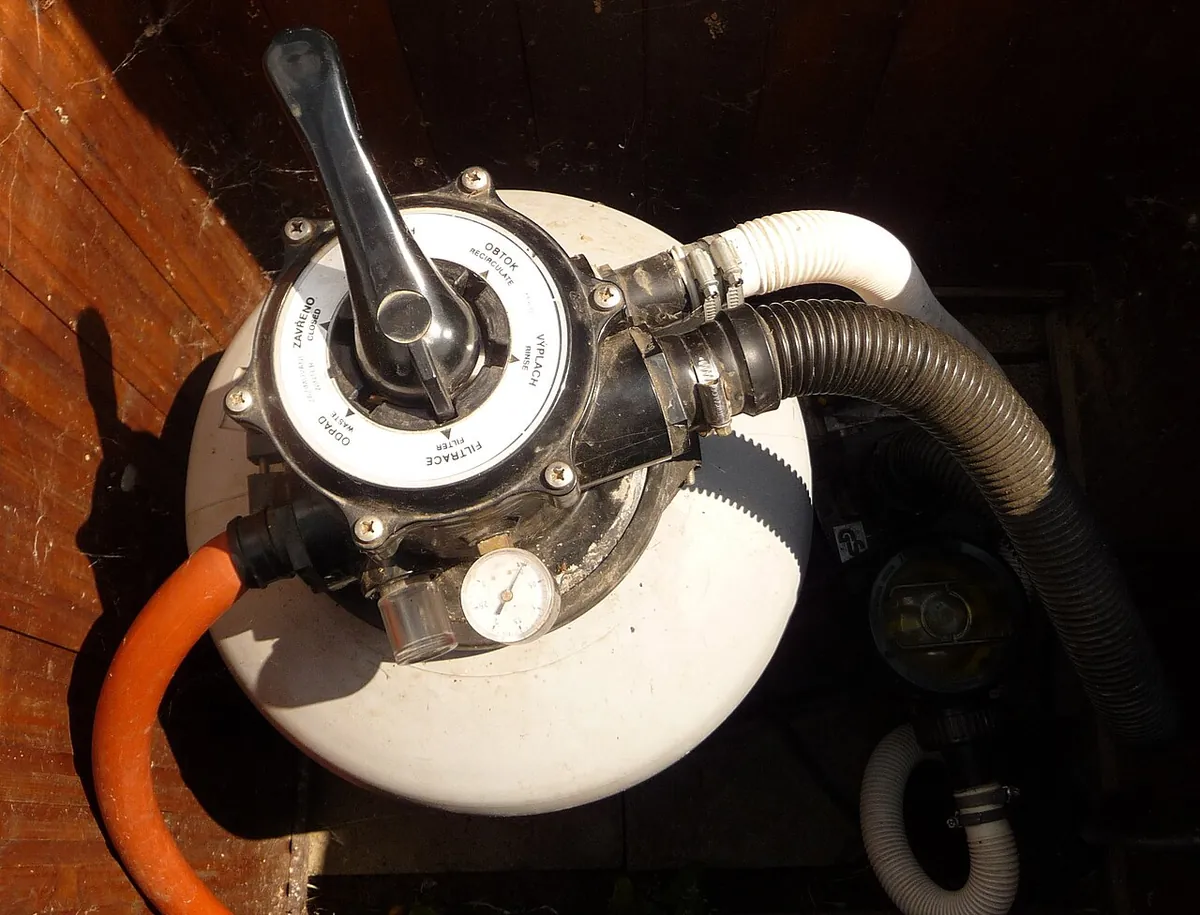
Photo: Wikimedia Commons, CC BY-SA 3.0
Quick Answer
How to backwash a pool: when the filter pressure gauge reads 8 to 10 psi above its clean reading, turn the pump off, attach and roll out the backwash hose, set the multiport valve to BACKWASH, turn the pump on and run it for 2 to 3 minutes (until the sight glass or hose water runs clear). Turn the pump off, set the valve to RINSE, run it for 30 to 60 seconds, turn the pump off again, return the valve to FILTER, and restart. Top up the pool water. DE filters need fresh DE powder added after backwashing. Cartridge filters cannot be backwashed; remove the cartridge and hose it clean instead. Always turn the pump off before moving the valve handle.
Backwash on pool filters is a basic part of upkeep. Your pool filter catches dirt, leaves, hair, dead algae and tiny particles that make water cloudy. Over time that dirt builds up, water flow drops, and the pressure inside the filter rises. Backwashing reverses the flow of water through a sand or DE filter, lifting the trapped dirt and sending it out a waste line. It takes a few minutes and is one of the most important routine jobs for a clear pool.
This guide explains how to backwash a pool filter step by step for sand and DE filters, how to tell when it is time, how long to backwash, how often to do it, what to know about backwash hoses and valves, and how to clean or replace a pool filter cartridge, since cartridge filters are cleaned differently.
What Does Backwashing a Pool Do?
What is a pool backwash, and what does it mean to backwash a pool? What is backwashing a pool? In normal FILTER mode, water flows down through the sand (or through DE-coated grids) and dirt is trapped. In BACKWASH mode, the multiport valve sends water up through the filter in the opposite direction. The sand bed lifts and tumbles, releasing the dirt, which flows out through the waste or backwash port instead of back to the pool.
Backwashing a pool does three things: it restores water flow, lowers filter pressure, and helps the filter trap dirt well again. A filter that is never backwashed lets the pump work harder, reduces circulation, and leads to cloudy water and algae.
Which Pool Filters Can Be Backwashed?
| Filter type | Backwash? | How it is cleaned |
|---|---|---|
| Sand filter | Yes | Backwash, then rinse; replace sand every 5 – 7 years |
| DE (diatomaceous earth) filter | Yes | Backwash, then add fresh DE; take apart and clean grids yearly |
| Cartridge filter | No | Remove cartridge and hose it off; deep-clean and replace every 1 – 3 years |
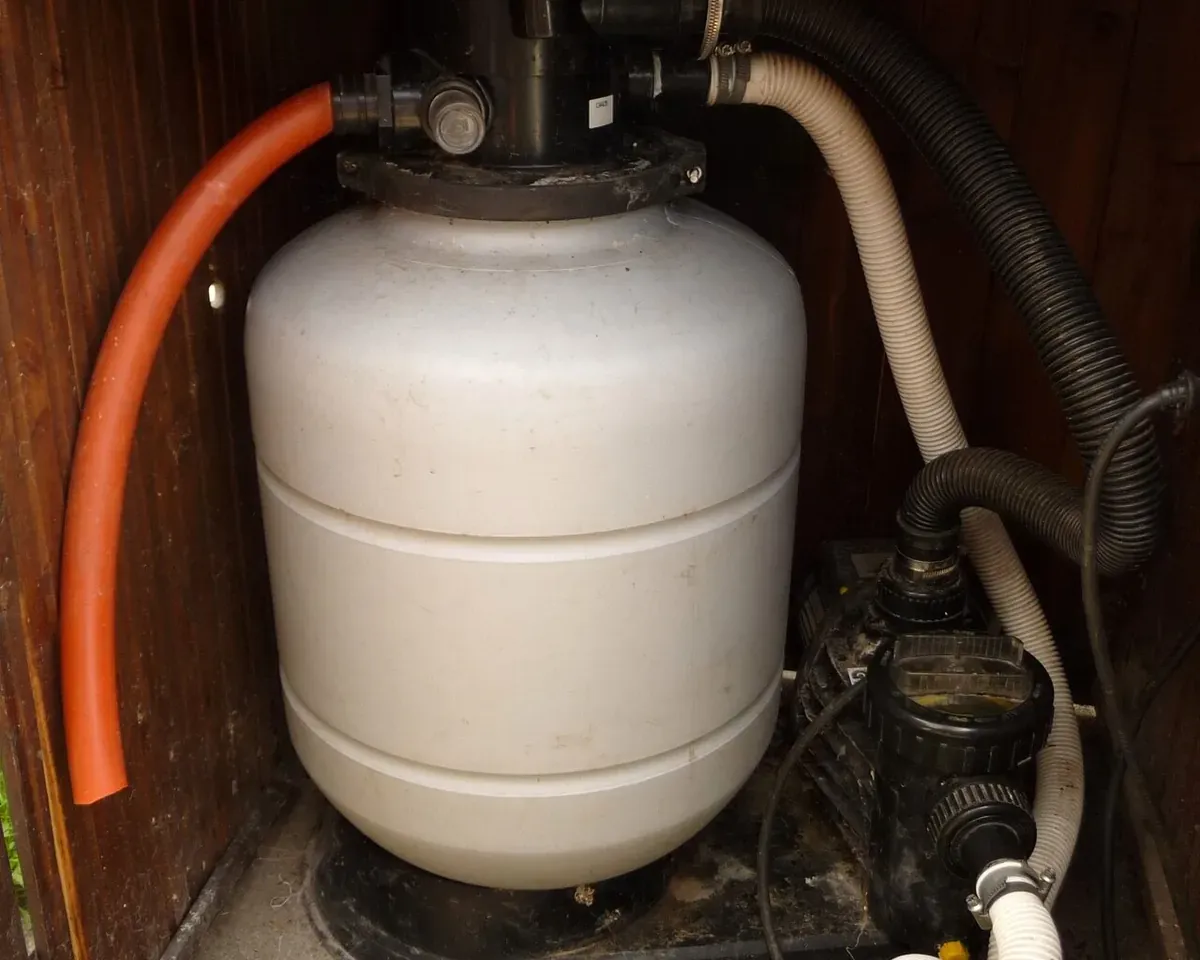
Photo: Wikimedia Commons, CC BY-SA 3.0 (cropped)
When to Backwash a Pool
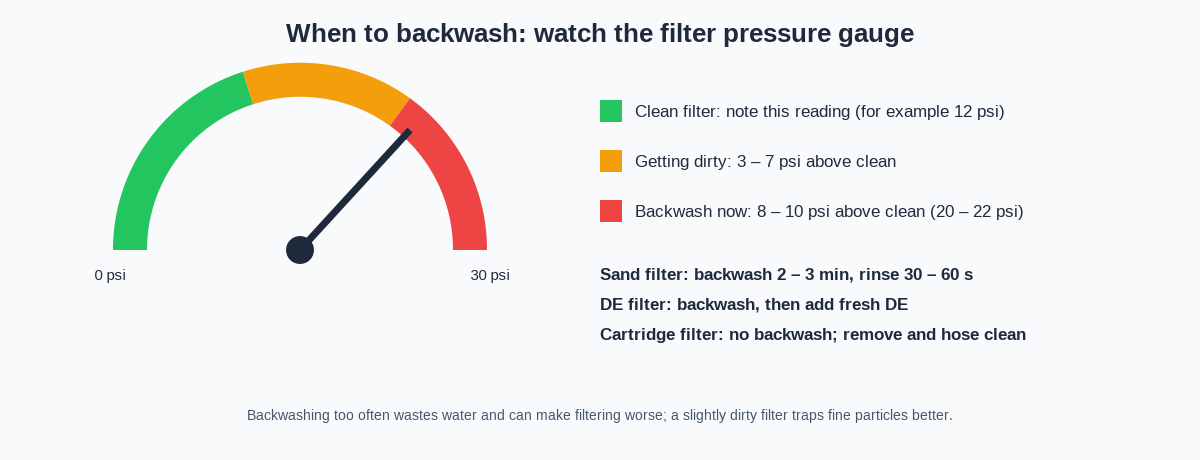
Chart: Asphapro.com
The best guide is the pressure gauge on top of the filter:
- After a fresh backwash (or with new sand), note the pressure with the pump running. This is your "clean" pressure, often 10 to 15 psi.
- Check the gauge every few days.
- When the pressure is 8 to 10 psi above the clean reading, backwash.
Other signs it is time to backwash: weak flow from the return jets, the pool not cleaning well with the vacuum, cloudy water that does not clear, or after vacuuming a lot of dirt or dead algae. Also backwash after cleaning a green pool; see how to clean a green pool.
How to Backwash a Pool Sand Filter: Step by Step
Here is how to backwash a sand pool filter, the most common type. These are also the basic steps for how to backwash a swimming pool with any multiport valve, and how to back wash a pool filter of the DE type with a few extra steps.
- Turn off the pump. Never move the multiport handle with the pump running; it can damage the valve's spider gasket.
- Attach the backwash hose to the waste/backwash port, and roll it out to a place where the water can drain safely: a street drain or yard area allowed by local rules, away from the house foundation.
- Set the valve to BACKWASH. Press the handle down and turn it until it locks at BACKWASH.
- Open any valves on the waste line, and if your pool has a separate suction valve, make sure the skimmer or main drain is open.
- Turn on the pump. Watch the sight glass on the valve or the water leaving the hose. It will be cloudy or dirty at first.
- Run for 2 to 3 minutes, or until the water in the sight glass runs clear.
- Turn off the pump.
- Set the valve to RINSE.
- Turn on the pump for 30 to 60 seconds. Rinse settles the sand bed and flushes any dirt left in the valve to waste, so it does not blow back into the pool.
- Turn off the pump.
- Set the valve back to FILTER.
- Turn on the pump and note the new, lower pressure.
- Top up the pool to the middle of the skimmer opening, and roll up the hose.
How to Backwash a DE Filter
DE filters use grids coated with diatomaceous earth powder, which traps very fine particles. Backwashing removes the dirty DE along with the debris.
- Follow the same steps as for a sand filter, using the multiport or push-pull valve.
- Backwash for 2 to 3 minutes until the water runs clear. Some owners backwash, stop the pump for a minute, and backwash again to release more DE.
- Rinse (if your valve has a rinse setting), then return to FILTER.
- Add fresh DE: with the pump running, mix the DE with water in a bucket to make a slurry and pour it slowly into the skimmer. Use about 80% of the full amount listed on the filter label after a backwash (the label amount is for a fully clean filter).
- Check that the pressure returns to normal.
Check local rules on DE disposal. Some areas do not allow DE to drain into storm sewers; a separation tank can catch it.
Backwashing With a Push-Pull (Slide) Valve
Some sand and DE filters use a push-pull valve instead of a multiport. To backwash:
- Turn off the pump.
- Pull the handle up (or turn it, depending on the model) to the backwash position.
- Turn on the pump and backwash for 2 to 3 minutes.
- Turn off the pump and push the handle back down to the filter position.
- Push-pull valves have no rinse setting; some owners run the pump for a few seconds with the waste line still open before returning to filter.
How Long to Backwash a Pool
How long do you backwash a pool? Usually 2 to 3 minutes, or until the water in the sight glass or hose runs clear. Then rinse for 30 to 60 seconds. Backwashing longer than needed just wastes water and chemicals. A typical backwash and rinse uses about 200 to 500 gallons, depending on the filter size and pump.
How Often to Backwash a Pool
How often to backwash pool filters depends on how dirty the pool gets, not the calendar. Most sand filters need backwashing every 4 to 6 weeks in normal use, more often after storms, pollen season, heavy swimmer loads or algae cleanups. Use the pressure gauge rather than a fixed schedule. Backwashing too often can actually make filtering worse: a slightly dirty sand bed traps fine particles better than freshly cleaned sand.
Pool Backwash Hose Tips
A good backwash hose for pool use makes the job cleaner and faster.
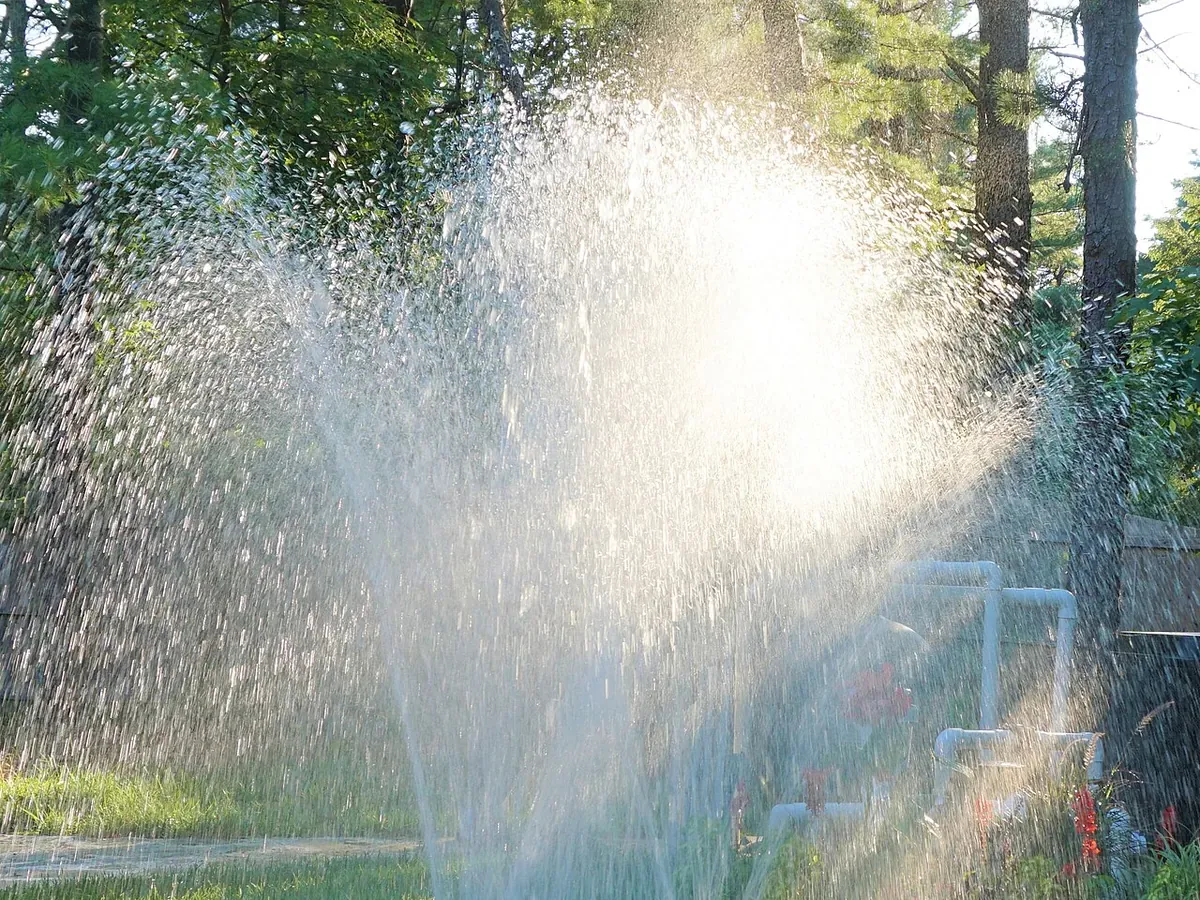
Photo: Ecopooldrain, Wikimedia Commons, CC BY-SA 4.0 (cropped)
- Size: most residential pools use a 1.5 inch or 2 inch flat vinyl backwash hose. Match the hose to the waste port.
- Length: 25 to 50 ft is common; long enough to reach a safe drain point.
- Clamp it: use a hose clamp at the waste port so the hose does not blow off under pressure.
- Where to drain: follow local rules. Many towns require backwash water to go to the sanitary sewer or onto your own lawn, not into storm drains or neighbors' yards. Lower chlorine levels before draining if required.
- Store it rolled up out of the sun to make it last.
How to Clean a Pool Cartridge Filter
A pool cartridge filter (also called a cartridge pool filter or cartridge filter pool system) cannot be backwashed. Instead, you remove the cartridge (or cartridges) and clean them by hand. Cartridge filters are popular because they save water and filter finer particles than sand.
- Turn off the pump and close any valves to stop water flow.
- Open the air relief valve on top of the filter to release pressure.
- Remove the filter lid or clamp band and lift out the cartridge.
- Hose off the cartridge from the top down, spraying between each pleat. Use a spray nozzle, not a pressure washer, which can damage the fabric.
- Check the cartridge for tears, crushed pleats or broken end caps.
- Reinstall the cartridge, check the lid O-ring, close the filter and open the valves.
- Turn on the pump and bleed air from the air relief valve until water sprays out.
Clean cartridges when the pressure rises 8 to 10 psi above the clean reading, usually every 2 to 6 weeks in season. Once or twice a year, soak the cartridge overnight in a cartridge cleaner solution to remove oils and scale.
Multiport Valve Settings Explained
The pool backwash valve on most sand and DE filters is a multiport valve with six or seven settings. Knowing each one makes backwashing and other jobs simple.
| Setting | What it does | When to use it |
|---|---|---|
| FILTER | Water goes through the filter and back to the pool | Normal running |
| BACKWASH | Water runs backward through the filter and out the waste port | Cleaning the filter |
| RINSE | Water runs forward through the filter but out the waste port | Right after backwashing, to settle the sand |
| WASTE (DRAIN) | Water bypasses the filter and goes straight out the waste port | Vacuuming heavy dirt or algae, lowering the water level |
| RECIRCULATE | Water bypasses the filter and returns to the pool | Mixing chemicals when the filter is broken |
| CLOSED | No flow (never run the pump on this setting) | Servicing the pump basket |
| WINTER | Valve parked between settings to relieve gasket pressure | Closing the pool for winter |
Never change settings with the pump running, and never run the pump on CLOSED. Both can crack the valve or the filter tank.
How to Backwash a Hayward Pool Filter
Hayward pool filters are among the most common in the US, so many owners ask how to backwash a Hayward pool filter specifically. The steps are the same as for any sand filter with a multiport valve:
- Turn off the pump at the switch or timer.
- Connect the backwash hose to the waste port on the multiport valve.
- Push down the valve handle and rotate it to BACKWASH.
- Turn on the pump and run it until the sight glass is clear, usually 2 to 3 minutes.
- Turn off the pump, rotate to RINSE, and run for 30 to 60 seconds.
- Turn off the pump, rotate back to FILTER, and restart.
Some Hayward filters use a side-mount valve instead of a top-mount valve, but the settings and steps are the same. Hayward DE filters need fresh DE added after backwashing, and Hayward cartridge filters (like other cartridge pool filters) are cleaned by hand. Always follow the manual for your model.
How to Backflush a Pool (Same as Backwashing?)
"Backflushing" is another word for backwashing, used mainly with DE filters and some above ground pool filters. To backflush a pool filter, you follow the same idea: reverse the water flow through the filter to push dirt out the waste line. Some DE filters also have a "bump" handle, which shakes dirty DE off the grids and lets it re-coat them without draining; bumping is not a substitute for a full backwash when pressure is high.
Pool Filter Cartridges: Cleaning, Replacing and Buying
If you have a cartridge filter for pool use, the cartridge is the part that does the work. Pool filter cartridges are pleated polyester fabric wrapped around a plastic core, with end caps. Here is what to know:
When to replace a pool filter cartridge
- Every 1 to 3 years in normal use, or after about 2,000 hours of run time.
- When the fabric is torn, the pleats are flat or the end caps are cracked.
- When pressure stays high even right after cleaning.
- When cleaning no longer restores good flow and clear water.
Buying cartridges for pool filters
Cartridge pool filters come in many sizes. To buy the right one, match the length, outside diameter, inside diameter of the core, and the type of end cap (open, closed, with handle). The filter's model number usually lists the right cartridge. Replacement cartridges cost about $25 to $80 for small above ground filters and $80 to $300 each for large inground cartridge pool filters; some large filters use four cartridges.
Deep cleaning a swimming pool cartridge filter
Hosing removes loose dirt, but oils from sunscreen and body lotions build up in the fabric over time. Once or twice a season, soak the cartridge for 8 to 24 hours in a bucket or trash can with a cartridge cleaner (or a mild solution of trisodium phosphate), then rinse well. If you have calcium scale, follow with a short soak in a mild acid solution, then rinse again. Always clean with a degreaser before using acid, never the other way round, or the oils set into the fabric.
Can you backwash a pool with a cartridge filter?
No. Learning how to backwash a pool with a cartridge filter is a common search, but cartridge filters have no backwash valve. A few above ground cartridge filters have a "drain" or "rinse" plug, but it does not clean the cartridge. Remove the cartridge and hose it off instead.
Vacuuming to Waste After a Backwash
When you vacuum heavy dirt, sand or dead algae, sending it through the filter clogs the filter fast. Many owners vacuum on the WASTE setting so the dirt goes straight out the backwash hose. This lowers the water level, so add water as you go. After a big waste-vacuum job, backwash and rinse the filter before returning to FILTER. For vacuum steps, see how to vacuum above ground pool.
Troubleshooting After Backwashing
| Problem | Likely cause | Fix |
|---|---|---|
| Pressure still high after backwash | Sand is caked or channeled; old sand; clogged laterals | Backwash again; use a filter cleaner; replace sand every 5 – 7 years |
| Sand in the pool | Broken lateral or standpipe in the filter | Open the filter and replace broken parts |
| Water leaks from waste port in FILTER mode | Worn spider gasket in the multiport | Replace the gasket |
| Cloudy water returns after backwash | Skipped the rinse step; filter too small; chemistry off | Rinse every time; check filter size and water balance |
| Pressure very low after backwash | Clogged pump basket or skimmer; air leak | Clean baskets; check pump lid O-ring |
| DE in the pool | Torn grid or bad manifold | Take the filter apart and replace damaged parts |
How Much Water Does Backwashing Use?
A typical swimming pool backwash and rinse uses about 200 to 500 gallons. A 16 x 32 ft pool loses about 320 gallons per inch, so each backwash lowers the water about 1 to 1.5 inches. Over a season of monthly backwashing, that adds up to 1,500 to 3,000 gallons, which is why cartridge filters are popular in areas with water restrictions. For refill costs, see swimming pool filling cost.
Backwashing an Above Ground Pool Filter
Above ground pools usually have smaller sand filters with a top-mount multiport valve, and the steps are the same as for inground pools. A few differences:
- The waste port often takes a 1.25 or 1.5 inch hose. Some owners simply let the water run out of the waste port onto the ground, but a hose keeps it away from the pool base, which can wash out sand and soil under the wall.
- Smaller filters clog faster, so check the gauge more often, especially after storms.
- The water level drops faster in a smaller pool; check that the skimmer still draws water before starting the pump again.
- Cartridge filters are common on smaller above ground pools and are cleaned by hand, not backwashed.
When to Replace the Sand in a Pool Filter
Backwashing cleans sand, but it does not last forever. Over years, the sharp edges of the sand grains wear smooth, so they trap less dirt, and oils and minerals can clump the sand into channels that water passes straight through. Signs it is time for new sand:
- Pressure rises quickly after each backwash.
- The water stays slightly cloudy even with good chemistry.
- It has been 5 to 7 years since the sand was changed.
To change the sand, turn off the pump, drain the filter, remove the valve, scoop or vacuum out the old sand, cover the standpipe opening, refill with fresh #20 silica pool filter sand (or a glass or zeolite media, if your filter allows it) to the level marked in the manual, reinstall the valve, then backwash and rinse before returning to FILTER. A bag of pool filter sand costs about $15 to $30, and most residential filters need 100 to 350 pounds.
Common Backwashing Mistakes
- Turning the valve with the pump on. This tears the spider gasket and can crack the valve.
- Skipping the rinse. Dirt left in the valve blows back into the pool.
- Backwashing by the calendar. Use the pressure gauge instead.
- Backwashing too long. Wastes hundreds of gallons of treated water.
- Forgetting the hose. Water floods the equipment pad or washes out soil.
- Not topping up. A low water level lets the skimmer suck air and can damage the pump.
- Forgetting DE. A DE filter run without fresh DE lets dirt clog the grids directly.
How to Backwash a Pool: Key Points
- Backwash sand and DE filters when pressure is 8 to 10 psi above clean.
- Always turn the pump off before moving the valve.
- Backwash 2 to 3 minutes, rinse 30 to 60 seconds, then return to filter.
- Add fresh DE after backwashing a DE filter.
- Cartridge filters are cleaned by hand, not backwashed.
- Top up the pool after each backwash.
Frequently Asked Questions
How do you backwash a pool?
Turn off the pump, set the valve to BACKWASH, run the pump 2 to 3 minutes until the water runs clear, turn it off, set RINSE for 30 to 60 seconds, then return to FILTER.
What does backwash a pool mean?
What is backwash for a pool? It means running water backward through the filter to flush trapped dirt out the waste line.
How do you backwash a pool filter if the gauge is broken?
Replace the gauge first; they cost $10 to $25. Until then, backwash when return flow feels weak or the water starts to cloud, and check that the sight glass runs clear.
How long to backwash pool sand filters?
About 2 to 3 minutes, until the water in the sight glass runs clear, followed by a 30 to 60 second rinse.
How often should you backwash a pool?
When filter pressure is 8 to 10 psi above the clean reading, usually every 4 to 6 weeks in season, and after storms or algae cleanups.
When to backwash pool filters after shocking?
Wait a day after shocking and brushing, then backwash if pressure has risen. Backwashing right after a big algae kill removes the dead algae trapped in the filter.
What does backwashing a pool mean for water chemistry?
You lose some water and chemicals, then add fresh water. Test and adjust chlorine, pH and alkalinity after topping up.
Do I need to backwash a new sand filter?
Yes. After filling a new filter with sand, backwash for 2 to 3 minutes and rinse to remove fine sand dust before filtering.
What is a pool backwash hose made of?
Most are flat vinyl or PVC hoses that roll up when empty. A swimming pool backwash hose usually comes in 1.5 or 2 inch sizes and 25 to 200 ft lengths.
Can I backwash pool water onto my lawn?
Often yes, if chlorine is at normal levels and local rules allow it. Spread the water so it soaks in, and keep it away from the house foundation and neighbors' property.
How do I backwash a Hayward pool filter with a push-pull valve?
Turn off the pump, pull the plunger to the backwash position, run the pump for 2 to 3 minutes, turn it off and push the plunger back down to filter.
Sources
- Swim University: How to backwash a pool filter
- CDC: Healthy swimming
- EPA WaterSense: Pools and spas
- Pool and Hot Tub Alliance