
How to Open a Pool After Winter: Step-by-Step Pool Opening Guide
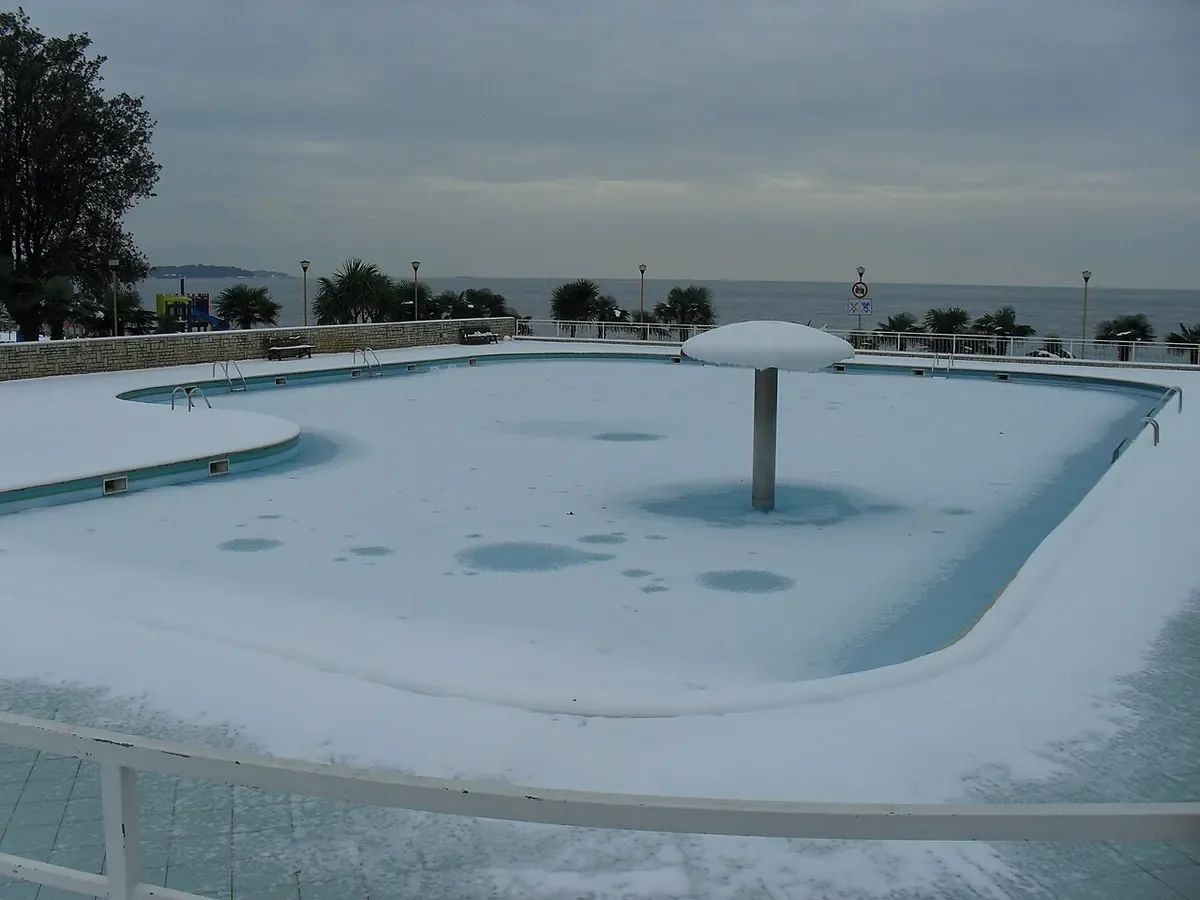
Photo: istra1977, Wikimedia Commons, CC BY 3.0
Quick Answer
To open a pool after winter, pump the water off the cover, clean it and remove it. Skim out debris, take out the winter plugs and ice compensators, and put back ladders, rails and skimmer baskets. Raise the water level to the middle of the skimmer opening. Reconnect the pump, filter and heater, put the drain plugs back in, then prime and start the pump and check for leaks. Brush and vacuum. Test and balance the water in order: alkalinity 80 to 120 ppm, pH 7.4 to 7.6, then calcium and stabilizer. Shock the pool in the evening and run the filter around the clock until the water is clear, which takes 1 to 7 days. Retest before anyone swims.
A pool opening is the job that turns a covered, cold pool into one that is clean and safe to swim in. Done well, opening a pool after winter takes a weekend of work plus a few days of filtering. Done in a rush, it can leave you with green water, a pump that will not prime, or a leak you do not find until the water drops. The steps are the same every year, and once you have done a pool opening yourself, it becomes routine.
This guide covers how to open a pool after winter step by step, with notes on how to open an inground pool and how to open an above ground pool, the water chemistry targets for opening pool water, what to do with a green pool, and what pool openings cost if you hire them out. For the other end of the season, see our guide on how to winterize a pool.
When to Open a Pool After Winter
The best time for opening pool water is when daytime temperatures reach the mid 60s °F (about 18 °C) and nights stay above freezing. Many owners wait until Memorial Day, but opening a pool after winter earlier, in April or early May in most of the US, is usually easier. Cold water slows algae, so the water under the cover is often still clear in early spring. Once the weather warms up, algae grows quickly, and a late pool opening often means a green pool that takes days to clean.
Pool professionals often say "open early, close late". The few weeks of extra filtering and chlorine cost less than the shock, algaecide and time needed to rescue a swamp in June. If you open pool water early and the weather turns cold again, simply run the pump less and keep a little chlorine in the water.
Pool Opening Supplies Checklist
Before you open a pool, gather everything you need so you do not have to stop halfway. A typical pool opening kit includes:
- A cover pump or submersible pump to remove water from the cover, plus a soft broom and leaf net.
- A garden hose to raise the water level and rinse the cover.
- Plugs, o-rings, a pool lubricant and Teflon tape for reconnecting equipment.
- A water test kit or strips that read chlorine, pH, alkalinity, calcium and cyanuric acid.
- Chemicals: shock (calcium hypochlorite or liquid chlorine), pH increaser and decreaser, alkalinity increaser, and stabilizer if needed.
- A pool brush, vacuum head and hose, and a telescopic pole.
- Gloves and eye protection for handling chemicals.
Many pool stores sell a "pool opening kit" with shock, algaecide and a clarifier. These are handy, but testing your own water first tells you exactly which chemicals you need, so you do not waste money on the wrong ones when you open pool water.
How to Open a Pool After Winter: Step by Step
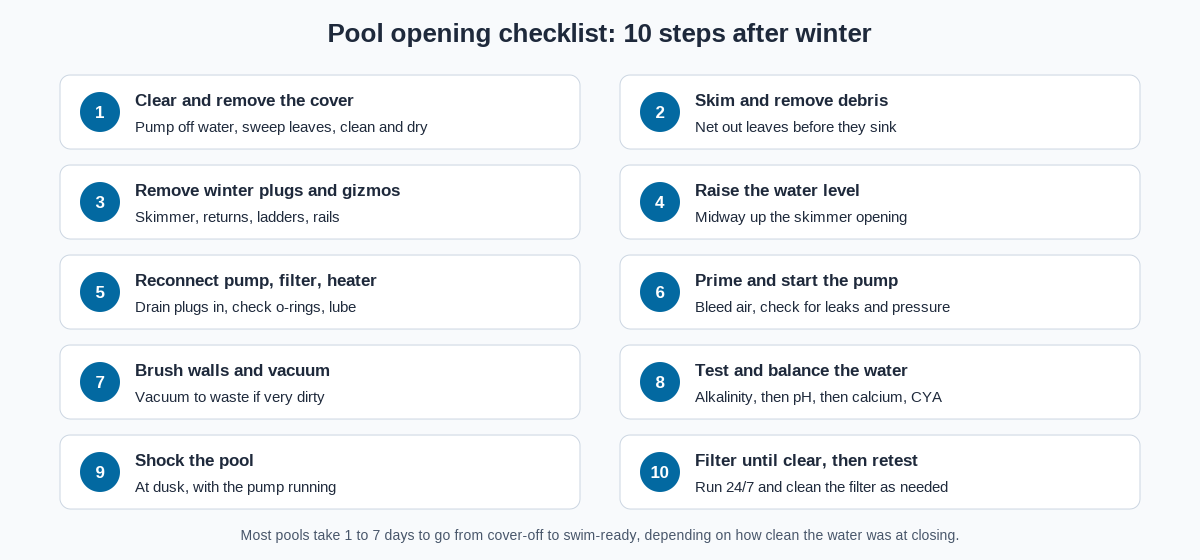
Diagram: Asphapro.com
These are the ten steps for how to open a pool after winter. If you only need a reminder of how to open pool equipment and water each spring, the chart above sums it up. They apply to both inground and above ground pools, with small differences noted in later sections.
Step 1: Clear and Remove the Cover
Start your pool opening by pumping standing water off the cover with a cover pump. Sweep or net off leaves and twigs. If you remove the cover while it is full of dirty water and debris, that mess ends up in the pool. On a solid cover, remove the water bags or loosen the cable; on a mesh safety cover, release the springs from the anchors with an install tool. Fold the cover, lay it on a clean lawn or driveway, hose it off, scrub it with a mild cleaner, and let it dry completely before storing it in a sealed bin away from rodents. Screw the anchors flush with the deck so no one trips.
Step 2: Skim and Remove Debris
Skim floating leaves right away with a leaf net. Leaves that sink stain plaster and vinyl and release phosphates that feed algae. If there is a thick layer of debris on the floor, scoop out as much as you can with a leaf rake before the pump starts, so it does not clog the skimmer or the pump basket.
Step 3: Remove Winter Plugs and Reinstall Hardware
Take out the winterizing plugs from the return fittings and the skimmer, along with any skimmer guard or ice compensator (gizmo). Put the directional eyeballs back in the returns. Reinstall the ladders, handrails, diving board and skimmer baskets. Check the bolts and bumpers on rails and ladders as you put them back, since corrosion can weaken them over winter.
Step 4: Raise the Water Level
Most pools are closed with the water lowered below the skimmer. Fill the pool with a garden hose until the water is about halfway up the skimmer opening. If the water is too low, the pump will suck air; if it is too high, the skimmer will not pull debris well. If you use well water, a metal sequestrant added during filling helps prevent staining.
Step 5: Reconnect the Pump, Filter and Heater
Put the drain plugs back into the pump, filter, heater and any chlorinator. Check every o-ring; replace any that are cracked or flat, and coat them lightly with a silicone or Teflon pool lubricant (not petroleum jelly). Reconnect hoses or unions that you took apart at closing. On a sand or DE filter, set the multiport valve to "filter". On a cartridge filter, put the clean cartridge back in. Reconnect the salt cell if you have one, and put the pressure gauge back on the filter if you removed it.
Step 6: Prime and Start the Pump
Fill the pump basket with water to prime it, close the lid tightly and open any valves on the suction and return lines. Turn the power back on at the breaker, then start the pump. Open the air relief valve on top of the filter until a steady stream of water comes out, then close it. Watch the pump basket fill and the pressure gauge rise. Walk around the equipment and look for drips, which usually point to an o-ring or a loose union. If the pump runs dry for more than a minute or two, stop it and prime again. See our guide on how to prime a pool pump.
Step 7: Brush and Vacuum
Brush the walls, floor and steps to loosen dirt and early algae. Then vacuum the pool. If the floor is covered in silt or debris, set the valve to "waste" on a sand or DE filter so the dirt goes out of the pool instead of through the filter, and keep the hose running to replace the water. Empty the skimmer and pump baskets often during the first day.
Step 8: Test and Balance the Water
Let the water circulate for a few hours, then test it. Balance the water before you shock, because chlorine works best at the right pH. Adjust total alkalinity first, then pH, then calcium hardness and stabilizer. Add one chemical at a time with the pump running and wait a few hours between them. Targets are in the chart below.
Step 9: Shock the Pool
Shock the pool in the evening, since sunlight burns off chlorine. A typical dose is 1 pound of calcium hypochlorite, or 1 gallon of 10 to 12.5% liquid chlorine, per 10,000 gallons for clear water, and two or three times that for cloudy or green water. Pre-dissolve granular shock in a bucket of water before adding it, unless the label says otherwise. Keep the pump running.
Step 10: Filter Until Clear, Then Retest
Run the pump 24 hours a day until the water is clear, which can take one day for a clean pool and up to a week for a green one. Backwash or clean the filter when pressure rises 8 to 10 psi above the clean reading. Retest chlorine and pH daily. When the water is clear, free chlorine holds overnight and pH is in range, the pool opening is done and the pool is ready for swimmers.
Water Chemistry Targets for Opening a Pool After Winter
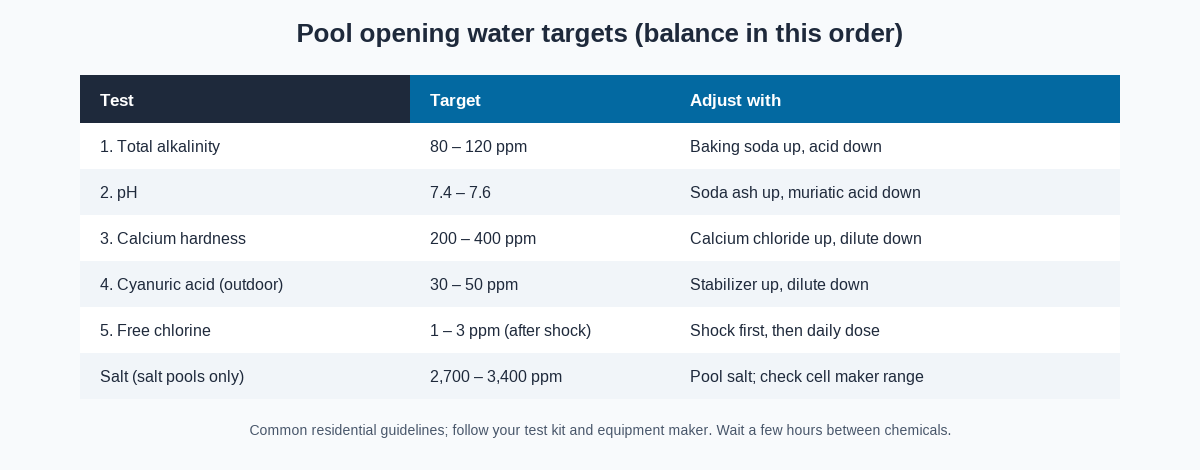
Chart: Asphapro.com
When opening pool water after winter, water chemistry is often far from where you left it. Rain and snowmelt dilute everything, lower alkalinity and calcium, and change pH. Leaves add phosphates and use up chlorine. That is why testing is the most important part of a pool opening.
Total alkalinity: 80 to 120 ppm. Alkalinity holds pH steady. Raise it with sodium bicarbonate (baking soda); lower it with muriatic acid. Fix it first, because changing alkalinity also moves pH.
pH: 7.4 to 7.6. At this pH, chlorine works well and water is comfortable for eyes and skin. Raise pH with soda ash; lower it with muriatic acid or dry acid.
Calcium hardness: 200 to 400 ppm for plaster and concrete pools, and somewhat lower is fine for vinyl and fiberglass. Low calcium can etch plaster; high calcium can cause scale. Snowmelt often lowers it.
Cyanuric acid (stabilizer): 30 to 50 ppm for outdoor chlorine pools, and up to 70 to 80 ppm for salt pools. It does not get used up, so test before adding more. If it is high, the only fix is partial draining.
Free chlorine: 1 to 3 ppm for normal swimming, after the shock has done its job. With higher stabilizer, aim for the upper end.
See our guides on how to raise alkalinity in pool water and how much chlorine to add to pool water for doses.
How to Open an Inground Pool
The steps for how to open an inground pool are the ones above, with a few extra details. Most inground pools use a mesh or solid safety cover held by springs and brass anchors. Release the springs with an install bar, fold the cover lengthwise into a long strip, then fold it into a manageable bundle. Screw the anchors down flush with the deck.
Inground pools often have their lines blown out and plugged at closing, with antifreeze in the lines in cold climates. When opening inground pool lines, the antifreeze will flow into the pool when the pump starts; pool antifreeze is non-toxic and uses up a little chlorine, so you may need slightly more shock. If you have a main drain, open its valve slowly once the pump is primed. Check the heater: turn on the gas and power, and run it only once water is flowing through it. If you have a heater, clean the burner tray of any nests or debris first. Inspect the plaster or liner for cracks, stains or bulges that appeared over winter, and check that the coping and tile line are intact. If the water level has dropped a lot since closing, read our guide on how to find a leak in a pool before you refill.
When you learn how to open inground swimming pool equipment safely, also check the bonding wires and GFCI outlets around the pad. Press the test and reset buttons on each GFCI before you start the pump. If anything looks burnt, corroded or chewed by rodents, call an electrician.
How to Open an Above Ground Pool
The process for how to open an above ground pool is shorter than for an inground pool. If you are wondering how to open above ground pool equipment, the job is easier, because the equipment is smaller and usually sits right next to the pool wall. Remove the cable and winch that hold the cover, pump water off the top, and lift the cover off with a helper. Remove the air pillow from the middle of the pool. Take the skimmer cover plate or winter plug off and put the return eyeball back.
Reconnect the hoses from the skimmer to the pump and from the filter to the return, using clamps and checking the hose ends for cracks. Many above ground pool owners take the pump and filter indoors for winter, so set them back on a level base and plug them into a GFCI outlet. Prime and start the pump as described above.
When opening above ground pool walls and liners, check carefully for damage. Look for rust spots on the wall, loose top rails, and wrinkles, tears or bulges in the liner. Ice can push liners and walls out of shape. Small liner tears can be patched underwater; larger damage may need a new liner. The water chemistry steps are the same as for any pool. For more care tips, see our guide on how to vacuum above ground pool floors.
Photo: JIP, Wikimedia Commons, CC BY-SA 3.0
Opening a Green Pool After Winter
If you lift the cover and find green or black water, do not panic. Opening a pool after winter with algae is common, especially with mesh covers that let sunlight and dirt through. Remove as much debris as possible first; leaves at the bottom use up chlorine fast. Start the pump, brush everything, and test. Bring pH to about 7.2 to 7.4 so chlorine works at its strongest. Then shock heavily: for a green pool, you may need 3 to 4 times the normal dose, and you may need to repeat it each evening until the water turns cloudy blue and then clear.
Run the filter around the clock and clean it often, since dead algae clogs filters quickly. Vacuum dead algae to waste once it settles. Expect a green pool opening to take 3 to 7 days. When the water is clear, test phosphates and treat if they are high. See our guides on how to clean a green pool and how to remove phosphates from pool water.
Opening a Saltwater Pool After Winter
Opening my pool after winter is a little different if it uses a salt chlorine generator. Reinstall the salt cell, but do not turn it on until the water is at least 60 °F (about 15 °C), since most cells shut down or are damaged in cold water. Test the salt level; rain and snowmelt dilute it, so you will often need to add pool salt. Shock with regular chlorine to get the pool clear, then let the salt system take over. Inspect the cell for scale and clean it if needed. For more, see how to maintain a saltwater pool.
How Long Does a Pool Opening Take?
The hands-on work of a pool opening takes about 2 to 4 hours for an above ground pool and 3 to 6 hours for an inground pool. After that, the pool needs time to filter and settle. A pool that was closed clean and opened early may be ready to swim in within 24 to 48 hours. A green pool can take a week. Do not swim until the water is clear, free chlorine is back to the normal range and pH is balanced. See our guide on how long after shocking pool can you swim.
Pool Opening Cost: DIY vs Professional
A DIY pool opening usually costs $50 to $150 in chemicals for a clean pool, and $150 to $300 or more for a green pool that needs repeated shock and algaecide. Replacement o-rings, plugs and lubricant add $10 to $40. A cover pump costs about $50 to $150 if you do not already have one.
Professional pool openings cost about $150 to $350 for an above ground pool and $250 to $600 for an inground pool, depending on your area, the pool size and whether chemicals are included. A green pool, a heater start-up or equipment repairs cost extra. Many pool companies offer bundled opening and closing packages, which can be cheaper than booking pool openings and closings separately. Book early in spring, since pool openings fill up quickly once the weather warms.
Common Pool Opening Mistakes
The most common pool opening mistake is pulling the cover off without first removing the water and leaves on top, which dumps debris into the pool. Another is starting the pump without priming it, which can burn out the seal or melt fittings. Owners also forget to put the drain plugs back, and water sprays out of the filter as soon as the pump starts. Adding shock before balancing pH wastes chlorine. Adding all chemicals at once can cause cloudy water or reactions; add them one at a time. Waiting until the weekend before the first pool party is another mistake, since a green pool can take a week to clear. Finally, many people skip testing and pour in a whole opening kit, which can leave stabilizer too high for the rest of the year.
How Do You Open a Pool Safely?
How do you open a pool without getting hurt? Treat chemicals with respect. Wear gloves and eye protection, read every label, and always add chemicals to water, never water to chemicals. Never mix chlorine and acid, or different kinds of chlorine, in the same bucket; they can react violently or release toxic gas. Store chemicals in a cool, dry place out of children's reach. Turn off power at the breaker before working on electrical equipment. Ask for help lifting heavy covers and pumps. Keep children and pets away from the pool while the cover is off and the water is still murky, since you cannot see the bottom.
Opening Swimming Pool After Winter: Equipment Checks
Opening swimming pool equipment after winter is a good time for a full inspection. Look at the pump motor for rust and listen for grinding or screeching, which can mean worn bearings. Check the filter tank and lid for cracks. Look at the pressure gauge; replace it if it is stuck or full of water. On a sand filter, check that the sand is not channelled or clumped; if it is more than five years old, consider replacing it. Clean or replace cartridge filters. Check timers and automation systems, reset the clock, and set the pump schedule. Test the pool light and look for water inside the lens. If anything is not working, fix it now, before peak season when repair companies are busy. See our guide on how to clean swimming pool filter parts.
How to Open a Swimming Pool After Winter: Worked Examples
Example 1: clean inground pool, early opening. A 20,000-gallon plaster pool with a solid safety cover is opened in mid-April. The water under the cover is clear and cold. The owner pumps the cover, removes it, reconnects the equipment and primes the pump. Testing shows alkalinity at 70 ppm, pH at 7.8 and chlorine at zero. The owner adds baking soda, waits, lowers pH with acid, then adds 2 pounds of shock at dusk. By the next evening the water is sparkling, and the pool opening cost about $70 in chemicals.
Example 2: green above ground pool. A 15,000-gallon above ground pool with a loose cover is opened in late May. The water is dark green with leaves on the floor. The owner nets out leaves, reconnects the hoses and starts the pump, brushes, then shocks with 3 gallons of liquid chlorine. The water turns cloudy blue the next day. After two more nightly shocks, two filter cleanings and vacuuming to waste, the pool is clear on day five. Total chemicals: about $180.
Example 3: salt pool with a leak. A salt pool owner finds the water 8 inches lower than at closing. Before refilling, they do a bucket test, which shows the pool is losing water. A leak detection company finds a cracked skimmer throat from ice. After the repair, the owner finishes the pool opening, adds 200 pounds of salt to bring the level back to 3,200 ppm and turns the cell on once the water passes 60 °F.
How to Open a Pool: Tips for an Easier Opening Next Year
The easiest way to make next year's pool opening smoother is to close the pool well this year. Close it with clean, balanced water and a good dose of chlorine. Use a well-fitted cover and keep it clear of water and leaves through the winter. Add a winter algaecide or a floating chlorine dispenser under the cover in warm climates. Store all plugs, eyeballs and drain plugs in one labelled bag. Write down your water test results at closing, so you can compare them when you open pool water in spring. And keep notes on what you needed at each pool opening, so you can buy only what you need next time.
Opening Pool After Winter in Warm Climates
In warm climates where pools are not fully winterized, opening pool after winter is mostly about cleaning and chemistry. Pools that ran with a reduced pump schedule through winter need a full brushing, a filter clean, a water test and a shock to get ready for the swim season. Increase the pump run time as the water warms, and check that the heater or solar system works before the first warm weekend.
How to Open a Pool After Winter: Key Points
- Open early, when days reach the mid 60s °F, to avoid a green pool.
- Remove water and leaves from the cover before taking it off.
- Raise water to mid-skimmer, reconnect equipment, prime and start the pump.
- Balance alkalinity and pH before you shock, then filter until clear.
Frequently Asked Questions
What do I need to do when opening my pool after winter?
Remove the cover, clean out debris, reinstall hardware, raise the water level, reconnect and prime the equipment, brush and vacuum, balance the water, shock and filter until clear.
Should I shock or balance first when I open a pool?
Balance alkalinity and pH first, then shock. Chlorine works much better when pH is between 7.2 and 7.6.
How long after opening a pool can you swim?
Usually 24 to 48 hours for a clean pool, once chlorine is back to 1 to 3 ppm and the water is clear. A green pool can take several days.
Can I open my pool myself?
Yes. Most owners can do a pool opening themselves with basic tools and a test kit. Hire a professional if you have a heater, complex automation or signs of damage.
How much shock do I need to open a pool?
About 1 pound of calcium hypochlorite per 10,000 gallons for clear water, and 2 to 4 times that for cloudy or green water.
Why won't my pump prime after opening?
Common causes are low water, a loose pump lid, a cracked o-ring, a closed valve or air in the lines. Fix the leak, top up the water and prime again.
Sources
- CDC: Pool chemistry and testing
- CDC: Pool chemical safety
- Pool and Hot Tub Alliance
- Trouble Free Pool: Pool water chemistry