
Pool Pump Size Calculator: How to Determine Pool Pump Size
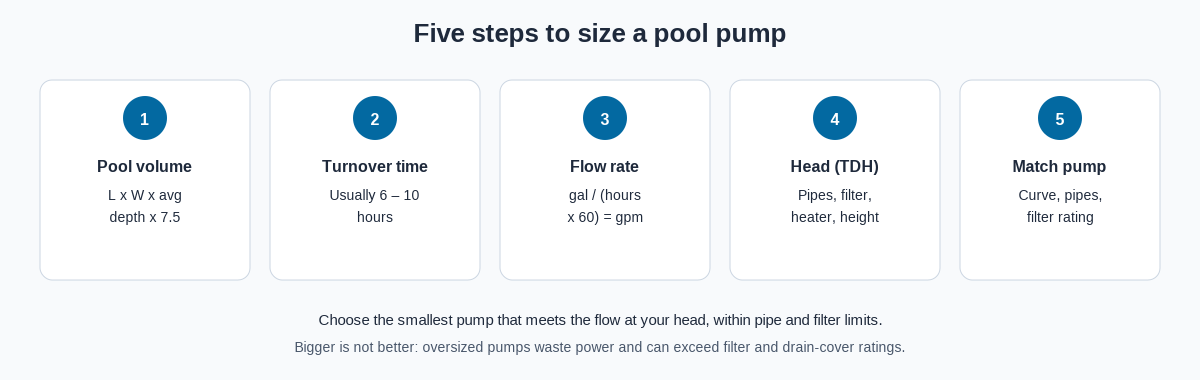
Diagram: Asphapro.com
Quick Answer
To determine pool pump size, work out the flow rate you need, then pick a pump that delivers it at your system's resistance. First find your pool volume in gallons. Divide it by your turnover time in hours (usually 8) times 60 to get gallons per minute (gpm): a 20,000-gallon pool needs about 42 gpm for an 8-hour turnover. Check that flow is within your pipe size and filter rating, then choose a pump whose curve delivers that flow at your total dynamic head, often 50 to 60 feet for home pools. For many 15,000 to 25,000-gallon pools, that means roughly a 1 to 1.5 hp single-speed pump or a variable-speed pump. Use the pool pump size calculator below.
A pump that is too small cannot circulate and filter the water properly, leading to cloudy water and algae. A pump that is too big wastes electricity, can push water faster than the filter and pipes are designed for, and may exceed the safe flow rating of drain covers. Getting the size right saves money and keeps water clear for years, and it is easier than most people think once you know your pool volume and plumbing.
This guide explains how to calculate swimming pool pump size step by step, with a swimming pool pump size calculator, a pool pump size chart and tips on choosing between single-speed and variable-speed pumps. For daily run times, see how long to run pool pump equipment.
Step 1: Find Your Pool Volume
Pool volume is the starting point when you calculate swimming pool pump size. Use average depth, which is the shallow end depth plus the deep end depth, divided by two, adjusted for how much of the pool is shallow.
Rectangle: length × width × average depth × 7.5.
Round: diameter × diameter × average depth × 5.9.
Oval: length × width × average depth × 6.7.
Kidney or freeform: (A + B) × length × average depth × 3.38, where A and B are the widths at each end.
A 16 x 32 foot pool with an average depth of 5 feet holds about 16 × 32 × 5 × 7.5 = 19,200 gallons.
Step 2: Choose a Turnover Time
Turnover is the time it takes to pass a volume of water equal to the whole pool through the filter. Most residential pools use an 8-hour turnover for sizing, and some designers use 6 hours for heavily used pools or 10 to 12 hours for variable-speed pumps that run longer at low speed. Public pools often need 6 hours or less by code, so commercial pumps are sized much larger for the same volume.
Step 3: Calculate the Flow Rate
Flow rate (gpm) = pool gallons ÷ (turnover hours × 60). For 19,200 gallons and an 8-hour turnover: 19,200 ÷ 480 = 40 gpm. That is the minimum flow the pump must deliver through your plumbing and filter, measured at the actual resistance of your system rather than at zero head.
Step 4: Estimate Total Dynamic Head
Total dynamic head (TDH) is the resistance the pump works against, measured in feet. It comes from friction in the pipes and fittings, the filter, heater, salt cell and other equipment, and any height difference between the water and the equipment. Most residential pools fall between 40 and 70 feet of head. A pool with long pipe runs, small pipes, a heater and a cartridge filter may be at the high end. A pool professional can calculate TDH precisely, or you can estimate it from filter pressure: multiply the filter gauge reading (psi) by 2.31 to get feet of head on the pressure side, then add an allowance for the suction side.
Step 5: Match the Pump Curve, Pipes and Filter
Every pump has a performance curve showing how much flow it produces at each head. Find the curve for each pump you are considering, locate your TDH, and see what flow it delivers. Choose the smallest pump that meets your flow at that head, with a little margin. Then check two limits: your pipes and your filter. If the pump pushes more water than the pipes can carry at a reasonable speed, or more than the filter is rated for, it is too big.
Pool Pump Size Calculator
Enter your pool's dimensions or volume, turnover time, pipe size and filter rating. This pool pump size calculator shows the flow you need, checks it against your pipes and filter, and suggests a typical pump range.
Pool Pump Size Chart
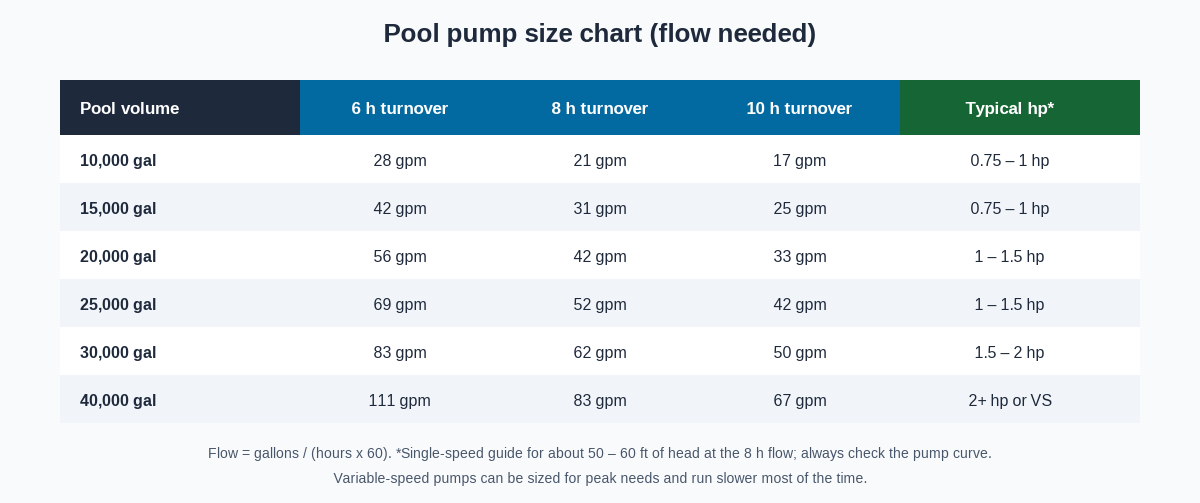
Chart: Asphapro.com
The pool pump size chart shows the flow needed for common pool sizes and turnover times, with a rough single-speed horsepower range. Use it as a starting point, then confirm with the pump curve for your plumbing, pipe size and filter rating.
Pipe Size and Filter Limits When You Determine Pool Pump Size
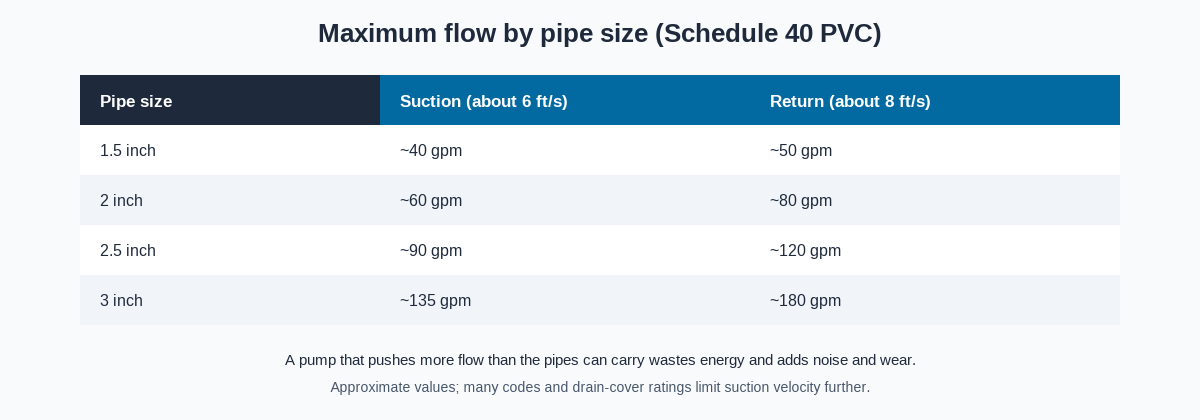
Chart: Asphapro.com
Pipe size limits how much water you can move efficiently. On the suction side, water speed is usually kept to about 6 feet per second or less for safety and efficiency; on the return side, about 8 feet per second. That gives rough limits of about 40 gpm for 1.5-inch suction pipe, 60 gpm for 2-inch, and 90 gpm for 2.5-inch. Filters have a maximum flow rate on their label; exceeding it reduces filtering and can damage the filter. Drain covers also have maximum flow ratings, set for safety against suction entrapment.
Photo: Asurnipal, Wikimedia Commons, CC BY-SA 4.0
What Size Pool Pump Do I Need? Common Pool Sizes
Here are typical answers to "what size pool pump do I need" for common pools, based on an 8-hour turnover and average plumbing. Always confirm with the pump curve for your system.
12 x 24 ft inground, about 10,000 gallons: about 21 gpm. A 0.75 to 1 hp single-speed pump or a small variable-speed pump is usually plenty.
15 x 30 ft inground, about 15,000 to 17,000 gallons: about 31 to 35 gpm. Often a 1 hp pump.
16 x 32 ft inground, about 19,000 to 21,000 gallons: about 40 to 44 gpm. Often a 1 to 1.5 hp pump.
18 x 36 ft inground, about 24,000 to 27,000 gallons: about 50 to 56 gpm. Often a 1.5 hp pump on 2-inch plumbing.
20 x 40 ft inground, about 30,000 to 35,000 gallons: about 63 to 73 gpm, which needs 2.5-inch suction plumbing or two suction lines. Often a 1.5 to 2 hp pump or a variable-speed pump.
Above ground 18 to 24 ft round, about 5,000 to 13,000 gallons: about 10 to 27 gpm. Usually a 0.75 to 1 hp pump.
Above ground 27 to 33 ft round, about 15,000 to 25,000 gallons: about 31 to 52 gpm. Usually a 1 to 1.5 hp pump.
These figures show why the answer to what size pool pump do I need is usually smaller than people expect. Many pools work well with a 1 hp pump, and owners often replace an old pump with a larger one when the same size, or a variable-speed model, would do better.
Single-Speed, Dual-Speed and Variable-Speed Pumps
When you calculate swimming pool pump size for a single-speed pump, you size it to meet the highest flow you need, such as for a heater or water feature, and then it runs at that speed all the time. That often means using more power than daily filtering requires.
A dual-speed pump has high and low speeds. The low speed handles everyday filtering, and the high speed handles vacuuming or features.
A variable-speed pump can be set to almost any speed. You can size it for the highest flow you need and run it at lower speeds most of the day, saving a lot of energy, since pump power drops sharply as speed drops. Since 2021, federal efficiency rules in the US have made variable-speed motors the standard for most new inground pool pumps. If you are replacing a pump, a variable-speed model is usually the best choice, and sizing becomes simpler because you can fine-tune the flow.
Sizing for Heaters, Salt Cells and Features
Equipment adds flow requirements and head. Heaters have a minimum flow rate, often 20 to 40 gpm, below which they will not fire safely. Salt cells have minimum flow rates for their flow switches. Solar heating panels on a roof add significant head because the pump must lift water up to the roof. Suction-side cleaners need enough flow to move, and pressure-side cleaners may need a booster pump. Waterfalls, sheer descents, deck jets and spas can need much more flow than filtering does. When you determine pool pump size, list every piece of equipment and its flow needs, and size the pump (or set a variable-speed pump) to meet the highest one. Some owners use a separate pump for large water features.
Horsepower vs Flow in a Pool Pump Size Calculator
Horsepower is the number most people shop by, but flow at your head is what matters. Two 1.5 hp pumps can deliver quite different flows at the same head. Pump labels may show rated horsepower and a service factor; total horsepower (THP) is horsepower times service factor and gives a better idea of power. "Up-rated" and "full-rated" pumps differ in how much power they draw. To compare pumps fairly, look at their curves and their energy factor (gallons pumped per watt-hour), which ENERGY STAR and the US Department of Energy publish. A pool pump size calculator gives you the flow; the pump curve tells you which model meets it efficiently.
How to Determine Pool Pump Size When Replacing an Old Pump
If you are replacing a pump, start with what you have. Note the old pump's horsepower and model, the pipe size, the filter's rated flow and the clean filter pressure. If the pool stayed clear and the equipment worked well, a pump with similar flow, or a variable-speed pump, is a safe choice. If the old pump was noisy, the filter pressure ran high, or the pump struggled to prime, it may have been oversized for the plumbing or undersized for the equipment. A pool professional can measure flow and pressure to determine pool pump size more precisely. Do not simply buy the next size up; bigger pumps often cost more to run and can make problems worse.
The Cost of an Oversized Pump
Oversizing is common and costly. A 2 hp single-speed pump on a pool that needs only 40 gpm might push 70 gpm or more through 1.5-inch pipes, using around 2,200 watts. A properly sized 1 hp pump might use 1,000 to 1,200 watts for the same filtering. Over a summer of 8 hours a day, that difference can be $200 to $400 in electricity. Oversized pumps also cause higher filter pressure, more noise, faster wear on seals and fittings, and can exceed safe suction velocity at drains. Using a swimming pool pump size calculator before you buy avoids these problems.
What Size Pool Pump Do I Need for an Above Ground Pool?
Above ground pools usually have short pipe runs, small hoses or 1.5-inch pipe, and sand or cartridge filters rated for 30 to 60 gpm. Head is often lower than for inground pools, around 25 to 40 feet. For most above ground pools, a 0.75 to 1.5 hp pump matched to the filter is right. Soft-sided and frame pools often come with small cartridge pumps rated by gallons per hour; divide the pool volume by the pump's gallons per hour to see how many hours one turnover takes. Do not put a large inground pump on an above ground pool; the hoses and filter cannot handle the flow.
Using the Pool Pump Size Chart and Calculator Together
The pool pump size chart above gives a quick view by pool volume, and the pool pump size calculator lets you enter your own numbers. Use the chart to get a ballpark, then use the calculator with your actual volume, turnover time, pipe size and filter rating. If the calculator warns that your flow exceeds your pipe or filter limits, consider a longer turnover time, larger pipes, a bigger filter or a variable-speed pump run at a lower speed. Finally, take the flow number to a pool supply store or professional and ask to see pump curves at your estimated head.
How to Calculate Swimming Pool Pump Size: Worked Examples
Example 1: standard inground pool. A 16 x 32 foot pool averaging 5 feet holds 19,200 gallons. For an 8-hour turnover: 19,200 ÷ 480 = 40 gpm. With 2-inch plumbing (about 60 gpm suction limit) and a filter rated for 75 gpm, a 1 hp pump that gives about 45 gpm at 55 feet of head is a good fit. A variable-speed pump could run at about 40 gpm for filtering and higher for the cleaner.
Example 2: large pool with spa. A 30,000-gallon pool with a spillover spa needs 63 gpm for an 8-hour turnover and about 80 gpm for the spa spillway. With 2.5-inch suction, the owner chooses a variable-speed pump, set to about 50 gpm for daily filtering over 10 hours and 80 gpm when the spa runs.
Example 3: above ground pool. A 24-foot round, 52-inch pool holds about 13,000 gallons. For an 8-hour turnover: 13,000 ÷ 480 = 27 gpm. A 1 hp pump matched to a 40 gpm sand filter is enough.
Common Sizing Mistakes
The most common mistake is choosing horsepower without checking flow and head. Others include ignoring pipe size, exceeding filter ratings, forgetting heater and salt cell minimum flows, not accounting for solar panels on a roof, and replacing a pump with a larger one to "fix" problems caused by a dirty filter or a suction leak. Using a pool pump size calculator, checking the pump curve and asking a professional when in doubt avoids most of these mistakes.
Estimating Head Without a Professional
Head is the hardest number to find when you calculate swimming pool pump size yourself. A simple estimate: with the pump running and a clean filter, read the filter pressure gauge in psi and multiply by 2.31 to get feet of head on the pressure side. Add 5 to 10 feet for the suction side on a typical pool with short suction lines. For example, a clean filter reading of 18 psi gives about 42 feet, plus about 8 feet of suction head, for a total of about 50 feet. If you have no pump yet, use 50 to 60 feet for a typical inground pool and 30 to 40 feet for an above ground pool as a starting point. These estimates are good enough to narrow down pump choices, and a pool professional can refine them with pipe lengths and fittings.
Flow Meters and Why They Help
A flow meter on the return line shows actual gallons per minute and is one of the best tools to determine pool pump size, check that a new pump is working as expected, and set a variable-speed pump correctly. Inline flow meters cost about $50 to $200 and fit on straight pipe sections. With a flow meter, you can see exactly how flow drops as the filter gets dirty, which tells you when to clean it, and you can set your variable-speed pump to the lowest speed that meets your turnover. Many variable-speed pumps also estimate flow on their display, though these readings are less precise than a meter.
Swimming Pool Pump Size Calculator for Spas and Hot Tubs
The same formula works for spas: divide spa volume by the desired turnover time. Spas are usually turned over much faster, often in 30 minutes or less, because the water is hot and heavily used. A 500-gallon attached spa with a 30-minute turnover needs about 17 gpm for filtering, but jets may need 60 gpm or more to feel strong. If the spa shares equipment with the pool, size the pump for spa jet flow and use a variable-speed pump so the pool can filter at a lower speed. Portable hot tubs have their own pumps sized by the maker. You can still use a swimming pool pump size calculator to check whether an attached spa's jets will get enough flow from your current pump.
Energy Efficiency Ratings
When comparing pumps of the right size, look at efficiency. ENERGY STAR certified pool pumps meet minimum energy factor levels, meaning they move more water per unit of electricity. Variable-speed pumps typically have much higher energy factors than single-speed pumps, especially at low speeds. Some utilities offer rebates of $100 to $500 for certified variable-speed pumps. Factoring in these rebates and yearly energy savings often makes a correctly sized variable-speed pump the cheapest option over its life, even though it costs more upfront. See how long to run pool pump for run-time savings.
When to Ask a Professional
For most standard pools, the pool pump size calculator and chart give a good answer. Call a professional when your pool has long pipe runs, many features, roof-mounted solar panels, an attached spa with jets, multiple suction lines, or older plumbing you are unsure about. A pool technician can measure pressure and flow, work out total dynamic head from your actual pipe lengths and fittings, and recommend a pump that meets every need without waste. This is also wise for new construction, where pipe sizes and equipment can still be chosen to suit an efficient pump. The cost of a professional sizing visit is small compared with years of extra electricity from the wrong pump.
Pool Pump Size Chart for Variable-Speed Settings
With a variable-speed pump, you do not pick one size; you pick speeds. A simple approach is to set a low speed that gives about one turnover over 10 to 12 hours, a medium speed for heaters and salt cells if they need more flow, and a high speed for vacuuming and features. For a 20,000-gallon pool, that might be about 30 gpm for 11 hours of filtering, 45 gpm for 2 hours when the heater runs, and 70 gpm for an hour of cleaning. Use the pool pump size chart to find your base flow, then adjust speeds until each piece of equipment works properly and the water stays clear.
Pool Pump Size Calculator: Key Points
- Flow (gpm) = pool gallons ÷ (turnover hours × 60).
- Check flow against pipe size, filter rating and drain covers.
- Match the pump curve at your total dynamic head.
- Choose the smallest pump that works, or a variable-speed pump.
Frequently Asked Questions
What size pool pump do I need for a 20,000 gallon pool?
About 40 to 45 gpm for an 8-hour turnover, often a 1 to 1.5 hp single-speed pump or a variable-speed pump set to that flow. Check the pump curve at your head and make sure the flow suits your pipes and filter.
Is a bigger pool pump better?
No. Oversized pumps waste power, run louder, raise filter pressure and can exceed pipe, filter and drain-cover limits. The right pump is the smallest one that meets your flow at your head.
What size pump for an above ground pool?
Usually 0.75 to 1.5 hp, depending on pool volume, hose or pipe size and the filter's rated flow. Match the pump to the filter rather than buying the biggest model.
How do I know my pump's flow rate?
Use an inline flow meter on the return line, or estimate it from the pump curve and your filter pressure converted to feet of head. Many variable-speed pumps also display an estimated flow.
Should I get a variable-speed pump?
Usually yes. It saves energy, runs quieter, can be set to the exact flow you need for filtering, and can speed up for cleaners, heaters and features. Rebates often reduce the upfront cost.
What is total dynamic head?
The total resistance the pump works against, measured in feet. It includes pipe and fitting friction, the filter, heater and other equipment, and any height the water must be lifted.
Sources
- US Department of Energy: Swimming pool pumps
- ENERGY STAR: Pool pumps
- CPSC: Virginia Graeme Baker Pool and Spa Safety Act
- Pool and Hot Tub Alliance