
How to Get Concrete Splash Off Bricks: Fresh Splatter, Hard Lumps and Haze
Quick Answer
To get concrete splash off bricks, deal with it early. Let fresh splashes firm up for 30 minutes to a few hours, then brush them off dry with a stiff bristle brush; wiping wet concrete with a wet rag smears cement paste into the brick. Scrape hardened lumps with a plastic or wooden scraper, or chip them with a chisel held flat to the brick. Remove the thin gray haze that remains with a masonry cleaner made for brick, applied to brick that has been soaked with water first, then scrub and rinse thoroughly. Test on a hidden brick, avoid strong acid mixes and high-pressure washing, and follow the brick maker's guidance.
Pouring a concrete slab, steps, a patio or a driveway next to brick almost always leaves splashes. Concrete gets flicked onto walls by shovels and rakes, drips from wheelbarrows, sprays from mixers and runs onto brick edging and steps. Masonry work leaves mortar smears on new brick walls too. Left alone, these splashes cure into hard gray spots that bond tightly to the rough brick surface.
This guide explains how to get concrete splash off bricks at every stage, from wet spatter to fully cured lumps and the cement haze left behind, without scratching, staining or burning the brick. It also covers how to get a concrete backsplash off the brick on walls, steps and pavers, and how to prevent splashes on your next pour.
Whether you have one concrete splash on a step or need to get a concrete backsplash off the brick along a whole garage wall, the order is the same: remove what you can dry and early, scrape the rest gently, and use the mildest cleaner that lifts the last concrete splash residue.
Why Concrete Sticks to Brick
Brick is fired clay, and most brick is porous with a slightly rough face. Wet concrete and mortar contain cement paste, a mix of cement, water and fine particles. When paste lands on brick, the brick pulls water from it, drawing the fine cement into the surface pores. As the cement hydrates, it bonds to the brick the same way mortar bonds bricks together in a wall. That is why a splash that is easy to brush off after an hour is very hard to remove after a week.
It also explains why wiping wet concrete with a wet sponge often makes things worse: the water thins the paste and carries it deeper into the pores, leaving a gray film. Letting the splash firm up a little and removing it dry is usually cleaner.
Where Concrete Splash Usually Lands
Knowing where to look helps you catch every concrete splash before it cures. After a pour, check these spots:
- The bottom 2 to 3 feet of brick walls next to the slab, where rakes, shovels and screeds flick concrete splashes.
- Brick steps and stoops beside a new walkway, especially the risers.
- Brick edging and borders around patios and flower beds.
- Brick columns and mailbox posts near driveways.
- Window sills and brick ledges at low heights.
- Along the truck route, where the chute swung or wheelbarrows passed.
Walk the job with a bucket and brush at the end of the day. A concrete splash caught the same day often takes seconds to remove; the same concrete splash after a month can take a chisel and cleaner.
Tools for Removing Concrete Splash Off Brick
- Stiff natural or nylon bristle brush: the main tool for fresh and day-old concrete splashes.
- Plastic putty knife: lifts firm splashes without scratching.
- Wooden paddle or block: a scrap of hardwood scrapes larger mortar splashes off without marking the brick.
- Cold chisel and light hammer: for cured lumps only, held flat.
- Masonry rubbing stone: for small hard spots on dense brick, after testing.
- Pump sprayer: wets the brick and applies cleaner evenly.
- Buckets of clean water: for rinsing as you go.
Removing Mortar Splashes on New Brick Walls
Mortar splashes from bricklaying behave the same way as a concrete splash. Masons usually brush off mortar smears when the mortar is "thumbprint hard," firm enough that brushing does not smear it. Final cleaning of the cement haze on a new wall is usually done after the mortar has cured for a period, often about a week or as the mortar and cleaner makers recommend, so the joints are strong enough to handle cleaning. If you are a homeowner with a new brick wall, ask your mason when and how the wall will be cleaned.
What You Need
- Stiff bristle brush (natural fiber or nylon, not wire).
- Plastic putty knife and a wooden paddle or scraper.
- Cold chisel and hammer for hard lumps.
- Masonry cleaner made for brick (several types, including non-acid products).
- Garden hose and buckets of clean water.
- Pump sprayer for applying cleaner.
- Chemical-resistant gloves, goggles and long sleeves.
- Plastic sheeting to protect plants, windows, metal and wood.
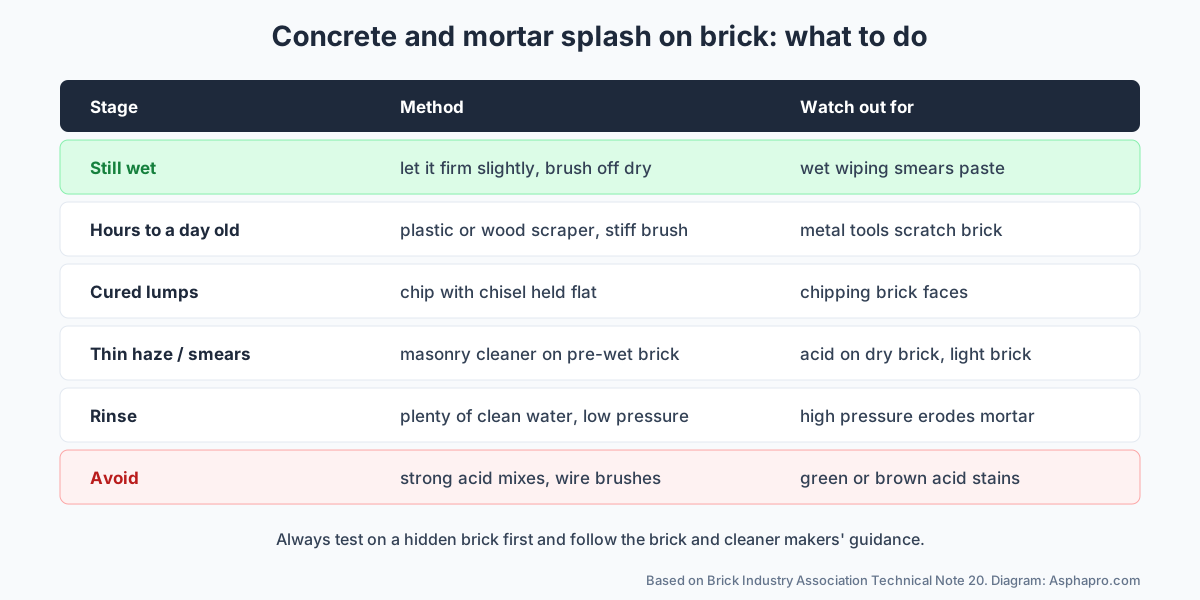
Stage 1: Fresh, Wet Splashes
If you notice the splash while it is still wet:
- Do not smear it. Avoid rubbing with a wet rag or sponge.
- Wait until the splash firms up but is not hard, often 30 minutes to a few hours depending on weather.
- Flick or brush it off with a dry, stiff bristle brush, brushing across the brick rather than into the joints.
- Any remaining residue is easier to clean later than a smear pushed into the pores.
On very large splashes, gently scrape off the bulk with a plastic trowel or putty knife while wet, then brush once it firms.
Stage 2: Hours to a Day Old
Concrete that has set but not fully hardened can often be scraped off:
- Use a plastic putty knife or wooden paddle to scrape off the bulk. Hold it at a low angle.
- Brush with a stiff bristle brush.
- Wet the brick with clean water and scrub again.
- Rinse with a hose at normal pressure.
Avoid metal scrapers and wire brushes on brick faces; they can scratch the surface and leave tiny metal fragments that later rust and stain.
Stage 3: Fully Cured Lumps
Hard, cured concrete lumps need mechanical removal first:
- Hold a cold chisel nearly flat against the brick face, at the base of the lump.
- Tap lightly with a hammer to pop the lump off. Work from the edges in.
- Do not drive the chisel into the brick; you can chip the face.
- For small, thin spots, a stiff brush and masonry cleaner work better than a chisel.
- Leave the remaining thin film for the cleaning step.
A rubbing block made from a piece of brick or a masonry rubbing stone can grind down small residues on hard, smooth brick, but test first, as it can change the surface texture.
Stage 4: Clean the Haze With a Masonry Cleaner
After removing lumps, a thin gray cement haze usually remains. A masonry cleaner dissolves it. The Brick Industry Association's guidance on cleaning brickwork stresses choosing a cleaner suited to the brick, pre-wetting the wall, testing a small area first and rinsing thoroughly.
- Choose the right cleaner: use a product labeled for removing mortar and concrete from brick, and check that it suits your brick color. Some brick makers recommend specific cleaners, and many offer non-acid options.
- Protect surroundings: cover windows, doors, metal, wood and plants. Wet nearby plants and concrete.
- Pre-wet the brick thoroughly: saturate the brick with clean water from the bottom up. Wet brick absorbs less cleaner, so it works on the surface instead of soaking in.
- Test a hidden area: apply to a small, out-of-sight area and let it dry fully to check for staining or color change.
- Apply: brush or spray the cleaner on a small area as the label directs.
- Dwell and scrub: let it work for the time on the label, usually a few minutes, then scrub with a stiff brush. Do not let it dry.
- Rinse thoroughly: flush with lots of clean water, from the top down.
- Repeat if needed: a second light application is safer than one strong one.
About Muriatic Acid on Brick
Diluted muriatic (hydrochloric) acid has long been used to clean mortar and concrete from brick. It works, but it causes many problems when used wrong:
- Acid burn: too strong a mix, or acid on dry brick, can bleach or darken brick and leave a blotchy look.
- Green stains (vanadium): light-colored brick, such as buff, gray or white, can develop green or yellow stains when acid reacts with vanadium salts in the clay.
- Brown stains (manganese): brick colored with manganese can develop brown stains after acid cleaning.
- White scum: poor rinsing can leave dissolved cement and salts on the surface.
- Mortar damage: strong acid erodes mortar joints.
- Safety: acid fumes and splashes are hazardous to eyes, skin and lungs, and acid corrodes metal.
Many brick makers and industry guides now recommend proprietary masonry cleaners over homemade acid mixes because they are more predictable. If you do use muriatic acid, follow the label, always add acid to water, use a weak dilution, pre-wet the brick, test first, and rinse thoroughly. Avoid it on light-colored brick.

Photo: Jeffrey Beall, Efflorescence, Wikimedia Commons, CC BY-SA 3.0.
Efflorescence vs Cement Haze
White deposits on brick after a concrete pour or new masonry can be cement haze or efflorescence. Efflorescence is a white, powdery salt deposit left as water moves through the brick and evaporates. It often appears after rain on new walls. Dry brush it off first; it often goes away by itself as the wall dries over weeks. Cement haze is harder and grayer and does not brush off easily. It needs a masonry cleaner. Using acid on efflorescence can sometimes make it worse by adding more salts, so identify it before treating.
Pressure Washing Brick
A pressure washer can rinse cleaner and loosened residue off brick, but high pressure can erode brick faces and blow out mortar joints. Use low pressure, a wide fan tip, keep the nozzle well away from the surface, and do not aim directly into joints. Many pros prefer a garden hose or low-pressure rinse for brick. Never use a narrow 0-degree tip on masonry.
Brick Pavers and Steps
Concrete often splashes onto brick pavers and steps next to a new slab. The same steps apply: brush off firm splashes, scrape lumps with plastic, and use a cleaner on pre-wet brick. On pavers, protect the joint sand and avoid washing it out. Re-sand joints after cleaning if needed. See paving stones vs concrete.
Masonry Cleaners Compared
| Cleaner | How it works | Good for | Cautions |
|---|---|---|---|
| Non-acid / detergent masonry cleaner | Surfactants and mild chemistry loosen residue | Light haze, light-colored brick | Slower; may need repeat |
| Proprietary acid masonry cleaner | Buffered acid blend with inhibitors and wetting agents | Concrete and mortar haze on most red brick | Pre-wet; test; rinse well |
| Diluted muriatic acid | Strong acid dissolves cement | Heavy residue on dark red brick only | Burns, green or brown stains, fumes |
| White vinegar | Weak acid | Very thin film, tiny spots | Slow; rinse |
| Water and stiff brush | Mechanical scrubbing | Fresh, firm splashes | Needs to be done early |
Start with the gentlest option that will work. A concrete splash that is a day old usually needs only scraping and a brush. A cured haze over a whole wall is where proprietary cleaners earn their keep.
Cleaning by Brick Type
Standard red brick
Most red brick tolerates proprietary masonry cleaners well when pre-wet and rinsed. This is the easiest brick to clean concrete splash off, but still test first.
Light-colored brick (buff, cream, gray, white)
Light brick is the most likely to develop green vanadium stains or blotchy acid burn. Use a non-acid cleaner or a cleaner the brick maker specifically recommends. Remove as much of the concrete splash mechanically as you can so you need less chemical.
Glazed brick
Glazed brick has a glassy coating that concrete does not grip as deeply. Scrape with plastic and wipe with water; avoid acids, which can dull the glaze.
Old, soft or historic brick
Older brick may be softer and more absorbent, with lime mortar that acid and pressure easily damage. Use the gentlest method, mostly mechanical and water. The National Park Service advises the gentlest means possible for historic masonry.
Painted brick
Concrete splash on painted brick usually sits on the paint. Scrape gently with plastic. Cleaners can lift paint; touch up afterward if needed.
Tumbled and antique-style brick
Rough, tumbled brick traps splashes in its texture. A stiff brush and patience work better than chiseling, which can break off edges.
Concrete in Brick Joints
When concrete lands on mortar joints, it can be hard to tell where the splash ends and the mortar begins. Scrape gently with a plastic tool, or use a narrow wooden stick along the joint. Avoid chiseling into joints, which damages mortar. Masonry cleaners also attack mortar to some degree, so rinse joints thoroughly. If mortar is damaged, it can be repointed. See mortar vs concrete.
A Worked Example: New Driveway Against a Brick House
Say a crew pours a new concrete driveway that runs along the brick wall of a garage. By the time the homeowner gets home, there are gray splashes from the ground up to about 2 feet high and a few larger lumps where a chute was swung close to the wall.
- That evening, the splashes are firm but not hard. The homeowner brushes most of them off dry with a stiff bristle brush.
- The larger lumps are scraped off with a plastic putty knife.
- The next weekend, a thin gray haze remains on about 20 bricks. They test a proprietary masonry cleaner on one brick behind a downspout and let it dry. No color change.
- They cover the new driveway edge with plastic, soak the wall with water from the bottom up, apply the cleaner with a brush, wait a few minutes, scrub and rinse from the top down with plenty of water.
- Two bricks still show faint haze, so they repeat once on those.
Because most of the concrete splash came off early and dry, very little chemical was needed.
Preventing Concrete Splash on Your Next Pour
- Cover the brick: tape plastic sheeting or builder's paper over brick walls, steps and edging near the pour, up to about 3 feet high.
- Use a release barrier: some contractors wet brick or apply a temporary protective coating so splashes do not bond as easily.
- Keep a bucket and brush on site: remove splashes as soon as they firm up.
- Mind the chute: keep the truck chute and wheelbarrows away from walls.
- Check at the end of the day: walk the job and brush off any splash before it cures overnight.
- Talk to your contractor: ask how they protect existing masonry and who cleans splashes. Many good crews clean as they go.
Planning a new slab or driveway? See concrete driveway cost and concrete slab cost.
Weather and Timing
Concrete sets faster in hot, dry, windy weather, which shortens your window for easy removal. In cool, damp weather, splashes stay soft longer. Clean with masonry cleaners on mild, overcast days so the cleaner does not dry on the brick. Avoid cleaning when temperatures will fall below freezing before the wall dries. Most masonry cleaner labels also say not to clean brick in direct hot sun.
Common Mistakes
- Wiping wet concrete with a wet rag, which smears paste into the brick.
- Waiting weeks to deal with splashes.
- Using wire brushes or metal scrapers on brick faces.
- Applying acid to dry brick.
- Using strong acid on light-colored brick.
- Skipping the test patch.
- Not rinsing enough, leaving white residue.
- Blasting brick and joints with high pressure.
Checking Your Results
Brick looks darker when wet, which hides leftover haze. Always judge your work after the wall dries completely, usually a day or two later. Look at the wall at a low angle in daylight; any remaining concrete splash residue shows as a dull gray film or spots with sharp edges. Run a hand across the brick: cured concrete splash feels harder and smoother than the brick face around it. If you see white streaks that were not there before, they are likely rinse residue or efflorescence, which often brush off dry. Touch up any remaining spots with a light, second cleaning rather than a stronger mix.
Cost of Removing Concrete Splash From Brick
Removing a few concrete splashes costs almost nothing beyond a brush and a plastic scraper. A gallon of proprietary masonry cleaner is enough for a fair amount of wall when diluted as directed, and a pump sprayer and gloves round out the kit. The main cost is your time, which is why catching each concrete splash early pays off.
Professional masonry cleaning is usually priced by the job or by the square foot of wall, and it costs more for light-colored or historic brick, for walls with previous acid damage, and for work at height. If concrete splashes came from a contractor's pour, check your contract: cleanup of adjacent surfaces is often the contractor's responsibility. For more on concrete project pricing, see concrete price per yard.
Repairing Damage From Past Cleaning
If an earlier attempt to get concrete splash off bricks left acid burn, green vanadium stains or brown manganese stains, do not try to fix it with more acid. Vanadium and manganese stains need specific stain removers designed for them; many brick makers publish guidance or recommend products. Scratches and chipped faces from metal tools usually cannot be undone, but individual damaged bricks can be cut out and replaced by a mason.
Safety When Cleaning Brick
- Wear chemical-resistant gloves, goggles and long sleeves with any masonry cleaner.
- Use eye protection when chiseling cured concrete splash; chips fly.
- Always add acid to water, never water to acid, if a product requires mixing.
- Keep cleaners off windows, aluminum, painted trim, cars and plants.
- Work from a stable ladder or scaffold for high spots, never stretching off a ladder while scrubbing.
- Rinse tools and wash skin promptly after contact.
When to Hire a Pro
For a few splashes, DIY is easy. For a whole wall covered in haze, light-colored or historic brick, or staining from a previous bad cleaning, a masonry restoration contractor has the experience and products to clean without damage. If a concrete contractor caused the splashes, ask them to clean it as part of the job; many contracts include cleanup.
Quick Reference
- How to get concrete splash off bricks while it is fresh: let it firm up, brush it off dry, no wet wiping.
- How to get concrete splash off bricks after a day: plastic scraper, stiff brush, then water and scrub.
- How to get a concrete backsplash off the brick wall once cured: chisel lumps flat, then masonry cleaner on pre-wet brick and rinse.
- Concrete splash on light brick: non-acid cleaner, test first.
- Concrete splash on brick pavers: same steps, protect joint sand, re-sand after.
Frequently Asked Questions
How do you get concrete splash off bricks?
Brush fresh splashes off once they firm up, scrape hard lumps with a plastic scraper or chisel held flat, then clean the haze with a masonry cleaner on pre-wet brick and rinse well.
Will vinegar remove concrete from brick?
Vinegar can soften very thin cement haze but is slow on cured concrete. A masonry cleaner made for brick works better.
Can I use muriatic acid on brick?
Diluted acid can work but can burn or stain brick, especially light colors. Pre-wet, test first and rinse well, or use a proprietary masonry cleaner.
How long can concrete sit on brick before it is hard to remove?
It gets much harder after the first day. Remove splashes the same day if you can.
Can I pressure wash concrete off brick?
Low pressure can rinse loosened residue. High pressure can damage brick and mortar joints.
Why did my brick turn green after cleaning?
Acid can react with vanadium salts in light-colored brick, leaving green stains. Use cleaners suited to your brick.
How do I get a concrete backsplash off the brick?
Scrape off the bulk, chip hard lumps with a chisel held flat, then clean the haze with a masonry cleaner on wet brick and rinse well.
What removes cement haze from brick?
A proprietary masonry cleaner made for brick, applied to pre-wet brick, scrubbed and rinsed thoroughly.
Does sugar water stop concrete splash from hardening?
Sugar slows cement setting, but it is not a reliable cleaning method. Brushing splashes off early is simpler.
Should I seal brick after cleaning?
Usually not required. If you do, use a breathable masonry water repellent and let the brick dry fully first.
Sources
- Brick Industry Association, Technical Notes (including Technical Note 20, Cleaning Brickwork). gobrick.com
- Manufacturer labels for masonry cleaners and muriatic acid.
- Image credits: efflorescence photo by Jeffrey Beall, Wikimedia Commons (CC BY-SA 3.0); other images and chart by Asphapro.com.
Always follow product labels and your brick maker's cleaning guidance. Checked November 2026.
Related Guides
- Mortar vs concrete — differences and which to use