
Cost to Pour a Concrete Slab in 2026: Concrete Pad Cost per Square Foot and by Size
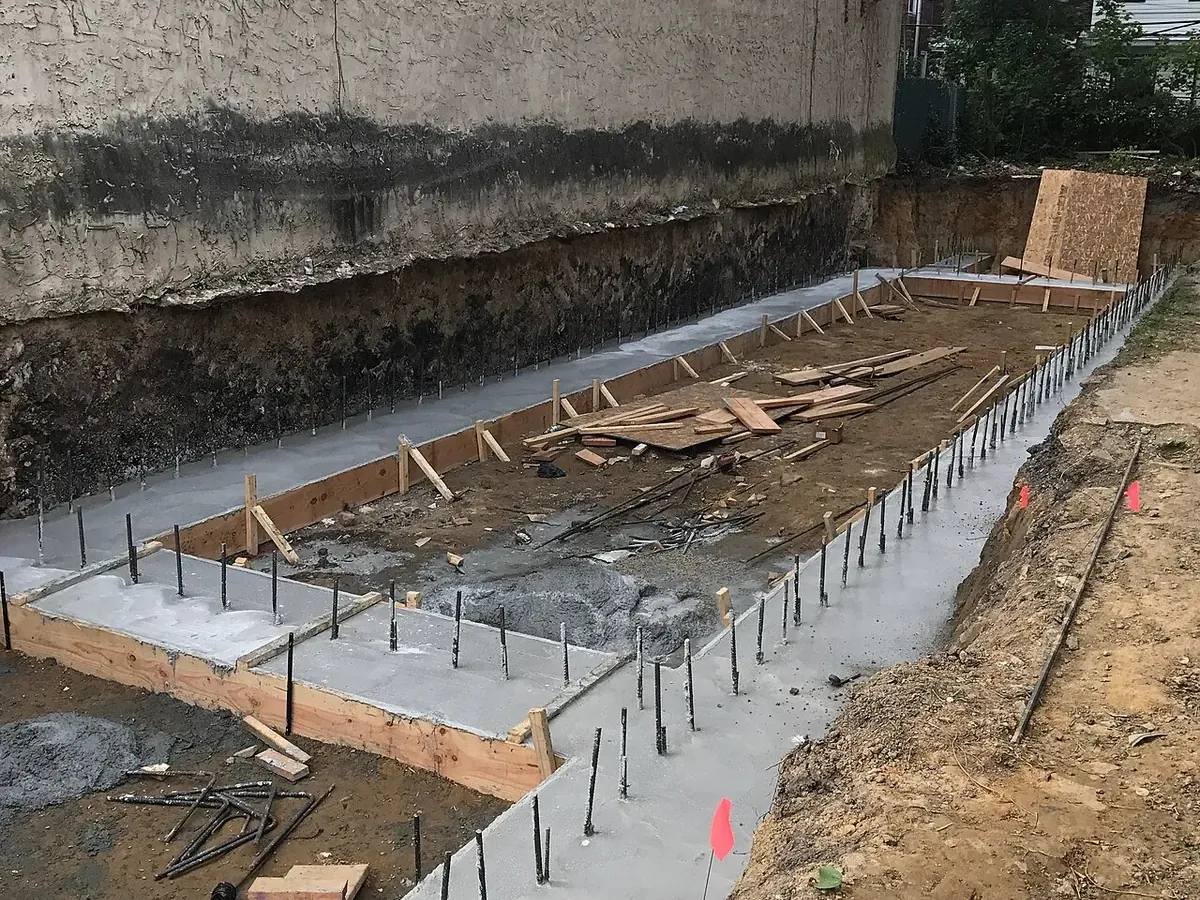
Photo: Beams&Lintels, Wikimedia Commons, CC BY-SA 4.0
Quick Answer
The cost to pour a concrete slab in 2026 is about $4 to $8 per square foot installed for a standard 4 inch slab with a gravel base, forms, reinforcement and a broom or trowel finish. HomeAdvisor puts the average near $6 per square foot. That works out to about $580 to $1,150 for a 12 × 12 pad, $1,600 to $3,200 for a 20 × 20 slab and $3,600 to $7,200 for a 30 × 30 slab. Thicker slabs, rebar, difficult sites and decorative finishes cost more; some 2026 estimators put typical slabs at $6 to $12 per square foot, and high-cost metros can reach $12 to $18.
A concrete slab is the flat base under a shed, patio, garage, hot tub, air conditioner, RV, or a whole house. The concrete pad cost depends mostly on size and thickness, but site prep, reinforcement, access and finish can move the price a lot. Material is only part of the bill; the rest is excavation, gravel, forms, steel, and the crew that places and finishes the concrete before it sets.
This guide breaks down the cost to pour a concrete slab in 2026: price per square foot, totals for common sizes, how thickness changes the price, what goes into a quote, slab foundation costs for houses, and DIY vs hiring a pro. Price ranges come from Angi, HomeAdvisor and HomeGuide, listed in the sources.
Concrete Slab Cost per Sq Ft
So how much does a concrete slab cost per square foot? For a plain 4 inch slab, the average cost of concrete slab work is about $6 per square foot installed, inside a normal range of $4 to $8. The concrete slab price per square foot climbs with thickness, rebar, a vapor barrier and decorative finishes, and it falls a little on large, simple pours where the crew's setup time is spread over more area.
| Slab type | Typical installed cost per sq ft | Notes |
|---|---|---|
| Basic 4 inch slab (patio, shed, walkway) | $4 – $8 | Gravel base, mesh or fiber, broom finish |
| 5 – 6 inch slab (garage, driveway, RV pad) | toward the upper end, or more | More concrete, usually rebar |
| Colored or stained slab | about $8 – $12 | Decorative patios |
| Stamped slab | about $12 – $18 | Patterned patios and pool decks |
| House slab foundation | often $6 – $12 or more | Thickened edges, insulation, plumbing |
The price per square foot drops as slabs get larger, because the mobilization, forms along the edges and minimum charges are spread over more area. A small pad may cost $8 or more per square foot, while a large garage slab may come in near the low end of the range.
Cost to Pour a Concrete Pad by Size
Size is the quickest way to answer how much is a concrete slab for your project. Multiply the area by $4 to $8 per square foot for a plain pad; the cost of concrete pad jobs under about 100 square feet is often set by the contractor's minimum charge instead.
The cost to pour concrete pad sizes under about 10 × 10 feet is mostly setup: the crew, forms, base and truck cost about the same whether the pad is 64 or 100 square feet. That is why the per-square-foot price on very small pads looks high. If you are asking how much to pour a concrete slab for a shed, AC unit or trash-can pad, ask for a fixed job price instead of a square-foot rate.
Here is the concrete pad cost for common sizes at $4 to $8 per square foot for a standard 4 inch slab, with the concrete volume each one needs:
| Slab size | Square feet | Concrete at 4 in. (cubic yards) | Installed cost | Common use |
|---|---|---|---|---|
| 4 × 4 ft | 16 | 0.2 | usually a minimum charge | AC unit, generator |
| 8 × 8 ft | 64 | 0.8 | $256 – $512 (often minimum) | Hot tub, small shed |
| 10 × 10 ft | 100 | 1.2 | $400 – $800 | Small shed, landing |
| 10 × 12 ft | 120 | 1.5 | $480 – $960 | Shed pad |
| 12 × 12 ft | 144 | 1.8 | $576 – $1,152 | Patio, shed |
| 12 × 16 ft | 192 | 2.4 | $768 – $1,536 | Patio |
| 16 × 20 ft | 320 | 4.0 | $1,280 – $2,560 | Large patio |
| 20 × 20 ft | 400 | 4.9 | $1,600 – $3,200 | Two-car pad |
| 24 × 24 ft | 576 | 7.1 | $2,304 – $4,608 | Two-car garage |
| 30 × 30 ft | 900 | 11.1 | $3,600 – $7,200 | Workshop, three-car garage |
| 30 × 40 ft | 1,200 | 14.8 | $4,800 – $9,600 | Pole barn, large shop |
| 40 × 60 ft | 2,400 | 29.6 | $9,600 – $19,200 | Barn, commercial building |
For size-specific breakdowns, see 12x12 concrete slab cost, 20x20 concrete slab cost and 30x30 concrete slab cost. Add about 5 to 10 percent extra concrete for waste and uneven ground.
Concrete Slab Calculator
Use the cubic yard calculator to find how much concrete your slab needs, then multiply by the local price per yard for a material estimate, or by $4 to $8 per square foot for a rough installed price.
How Thickness Changes the Cost to Pour a Concrete Slab
Thickness drives the amount of concrete, which is the single biggest material cost. Going from 4 to 6 inches uses 50 percent more concrete:
| Thickness | Area per cubic yard | Yards for a 20 × 20 slab | Typical use |
|---|---|---|---|
| 4 inches | 81 sq ft | 4.9 | Patios, walkways, sheds, light garages |
| 5 inches | 65 sq ft | 6.2 | Driveways, garages with heavier cars |
| 6 inches | 54 sq ft | 7.4 | Trucks, RVs, equipment pads, hot tubs |
| 8 inches | 40.5 sq ft | 9.9 | Heavy equipment, some commercial slabs |
At about $125 to $200 per cubic yard delivered, the extra 2.5 yards for a 6 inch 20 × 20 slab adds about $310 to $500 in concrete alone, plus a little more labor. It is money well spent if the slab will carry heavy loads; cutting thickness is one of the most common reasons slabs crack. See concrete slab thickness for a full guide.
What Goes Into the Cost to Pour a Concrete Slab
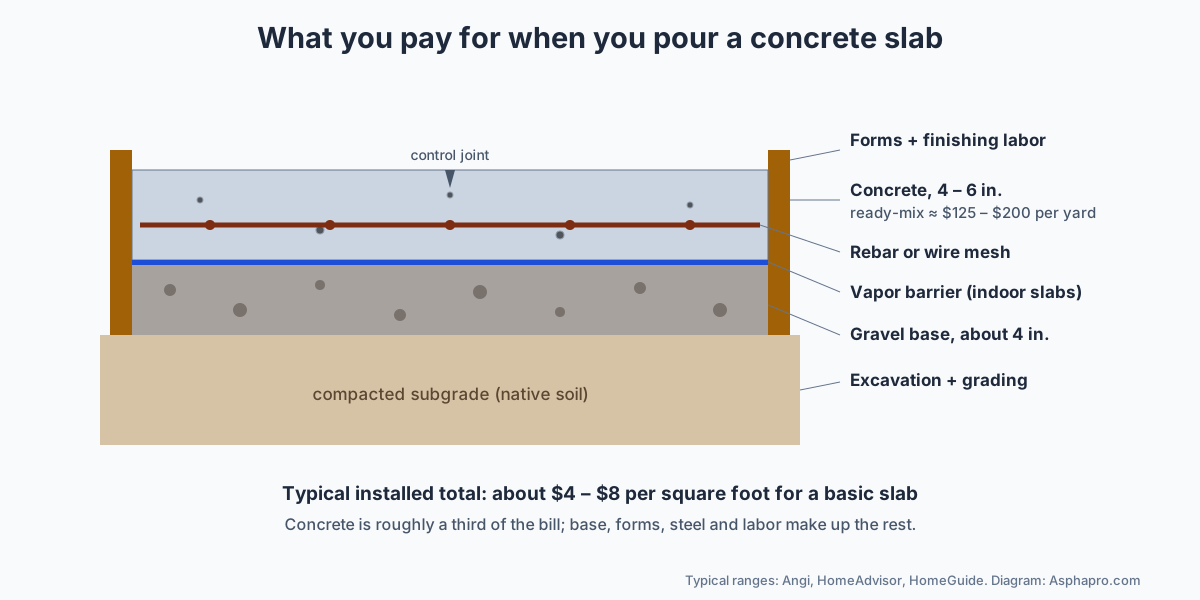
The cost to install a concrete slab is more than the concrete. In most quotes, the ready-mix itself is only about a third of the total; the rest is prep, base, forms, reinforcement and skilled labor. A typical concrete slab installation cost covers the items below, in the order the work happens.
A full quote for pouring a concrete slab usually includes these items. Comparing them line by line is the best way to compare contractors:
1. Site prep and excavation
The area is cleared of grass, roots and topsoil, dug to depth and graded for drainage. Sloped yards, rocky ground, tree roots and poor access raise the cost. Removing an old slab first adds about $2 to $6 per square foot; see concrete removal cost.
2. Gravel base
About 4 inches of compacted crushed stone gives the slab a stable, well-drained base. Soft or clay soils may need more. The gravel calculator can estimate the tons you need.
3. Forms
Wood or metal forms set the edges and finished height of the slab. Curved edges and multiple levels take more labor. See how to build concrete forms.
4. Reinforcement
Wire mesh, rebar or fiber added to the mix helps control cracking and holds cracked pieces together. Rebar on a grid costs more than mesh but is stronger and preferred for driveways, garages and heavy loads.
5. Vapor barrier
Indoor slabs, garages and house foundations usually get a plastic vapor barrier under the concrete to slow moisture rising into the building. Outdoor patios usually do not need one.
6. Concrete
Ready-mix concrete costs about $125 to $200 per cubic yard delivered for a full truck, with short-load fees on small orders. See concrete price per yard for details.
7. Placing and finishing
The crew places the concrete, screeds it flat, floats it, edges it, and gives it a broom finish outdoors or a smooth trowel finish indoors. This is skilled work that must be done before the concrete sets.
8. Control joints and curing
Joints are tooled or saw-cut to control where cracks form. The slab is then kept moist or sprayed with curing compound for a few days. See how long concrete takes to cure.
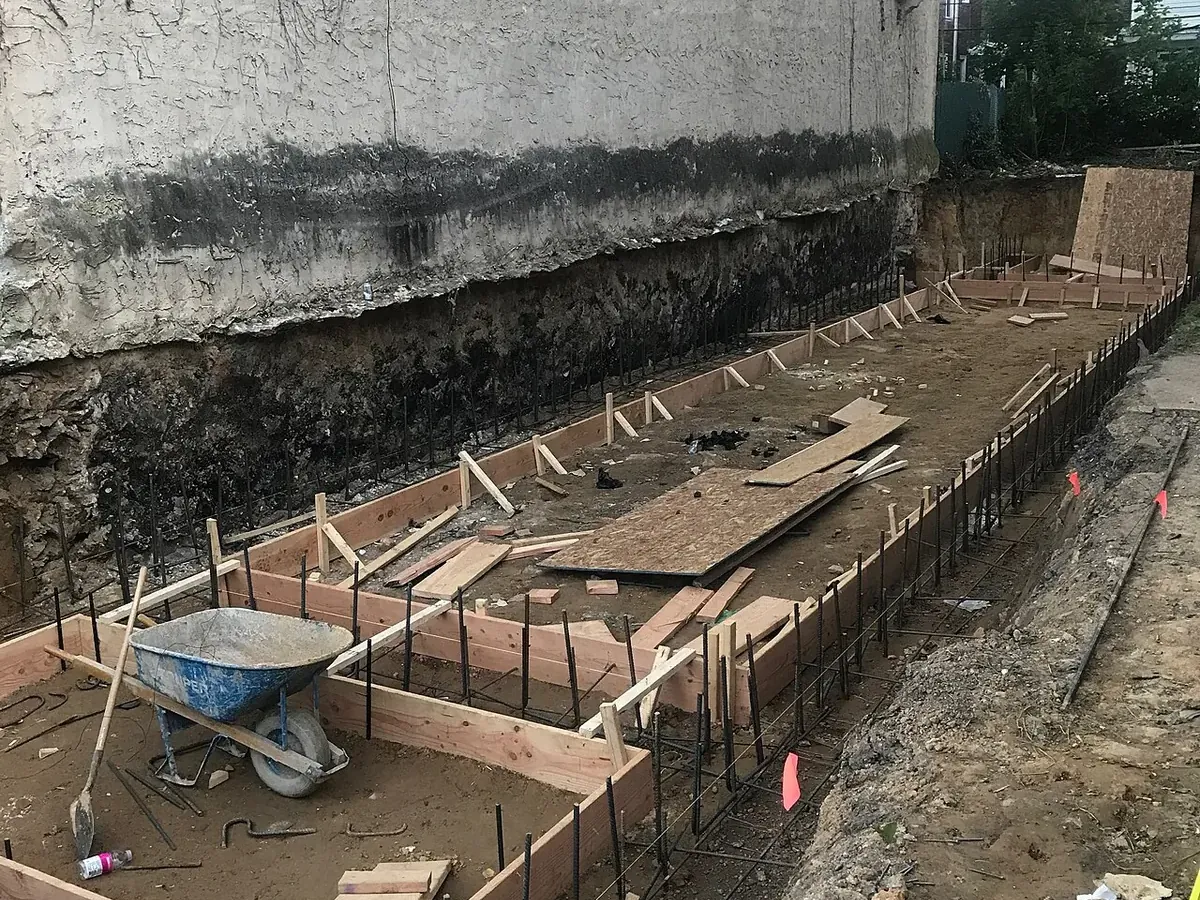
Photo: Beams&Lintels, Wikimedia Commons, CC BY-SA 4.0
Material vs Labor in the Cost of a Concrete Slab
For a basic 4 inch slab, the concrete itself is often about a quarter to a half of the bill. At $150 per yard, the concrete for one square foot of 4 inch slab costs about $1.85. The rest of a $4 to $8 per square foot price covers the base, forms, steel, equipment and labor. Industry guides commonly put slab labor at roughly $3 to $5 per square foot, higher in expensive metro areas. That is why the cost to pour concrete slab yourself can look cheap on paper; the savings come from doing the labor, which is also the hardest part.
Concrete Pad Cost by Use
Shed slab
Common shed slabs are 8 × 10, 10 × 12 or 12 × 16 feet at 4 inches. Expect roughly $400 to $1,500 for a typical shed pad, with small pads often priced at a contractor minimum. Some sheds can sit on a gravel pad instead, which is cheaper.
Patio slab
Plain patios fall in the basic $4 to $8 per square foot range. Decorative stamped patios run about $12 to $18. See stamped concrete vs pavers if you are choosing a patio surface.
Garage slab
Garage floors are usually 4 to 6 inches thick with rebar or mesh, a vapor barrier and a smooth finish. A 24 × 24 foot two-car garage slab often lands around $2,300 to $4,600 or more, depending on thickness and whether it includes thickened edges for the walls.
Hot tub pad
A filled hot tub can weigh several thousand pounds, so pads are often 4 to 6 inches thick with reinforcement. An 8 × 8 foot pad is a small job and is often priced at the contractor minimum.
AC or generator pad
Small precast pads are sold at home centers. Poured pads make sense when you are already pouring other concrete.
RV and boat pads
These need 5 to 6 inches or more, a strong base and rebar. They are large, so the cost per square foot is often near the middle of the range, but the total adds up quickly.
Pole barn and shop floors
Large slabs such as 30 × 40 or 40 × 60 feet often get better pricing per square foot. They may need thickened edges, saw-cut joints and a smooth power-troweled finish.
Slab Foundation Cost for a House
A slab-on-grade house foundation is more involved than a patio or garage slab. It usually includes thickened edges or footings around the perimeter, under-slab plumbing, a vapor barrier, sometimes rigid insulation, and engineered reinforcement. Because of that, house slab foundations typically cost more per square foot than flatwork, often around $6 to $12 per square foot or more in 2026 estimates, depending on region, soil and design. A slab foundation is still often cheaper than a crawl space or basement. For footing prices, see concrete footing cost.
Factors That Raise Concrete Slab Prices
- Small size, which brings minimum charges and short-load fees.
- Thicker concrete or high-strength mixes.
- Rebar instead of mesh or fiber.
- Difficult access that needs a concrete pump or wheelbarrows.
- Removal of an old slab, deck or patio first.
- Poor soil that needs extra base or compaction.
- Slopes that need retaining edges or extra fill.
- Decorative finishes such as color, stain, stamping or polishing.
- Permits and inspections, required for many slabs, especially garages and foundations.
- Location and season, with higher prices in high-cost metros and in the busy season.
DIY Cost to Pour a Concrete Slab
Small slabs are a realistic DIY project for a careful homeowner. For a 10 × 10 foot, 4 inch slab, you would need about 1.2 cubic yards of concrete (about 55 bags of 80 lb mix with waste), gravel, form boards and stakes, wire mesh or fiber, and finishing tools. Material often costs a few hundred dollars. The savings come from labor, but mixing and placing over two tons of concrete by hand is very hard work. See how many bags of concrete are in a yard and how much a bag of concrete costs.
For anything larger than about 100 to 150 square feet, ready-mix delivery and a few experienced helpers make a big difference. A large slab must be placed and finished within a short window, and mistakes are permanent.
DIY steps for a small concrete pad
- Mark the area and dig out grass and topsoil to about 8 inches deep for a 4 inch slab on 4 inches of gravel.
- Compact the soil, spread gravel in layers and compact it with a plate compactor.
- Build forms from 2 × 4 or 2 × 6 boards, staked and leveled with a slight slope for drainage.
- Place wire mesh on supports or plan to use fiber-reinforced mix.
- Mix and place the concrete, starting at the far corner.
- Screed with a straight board, float the surface, edge it and tool control joints.
- Broom finish for outdoor slabs, then keep the slab moist or covered for several days.
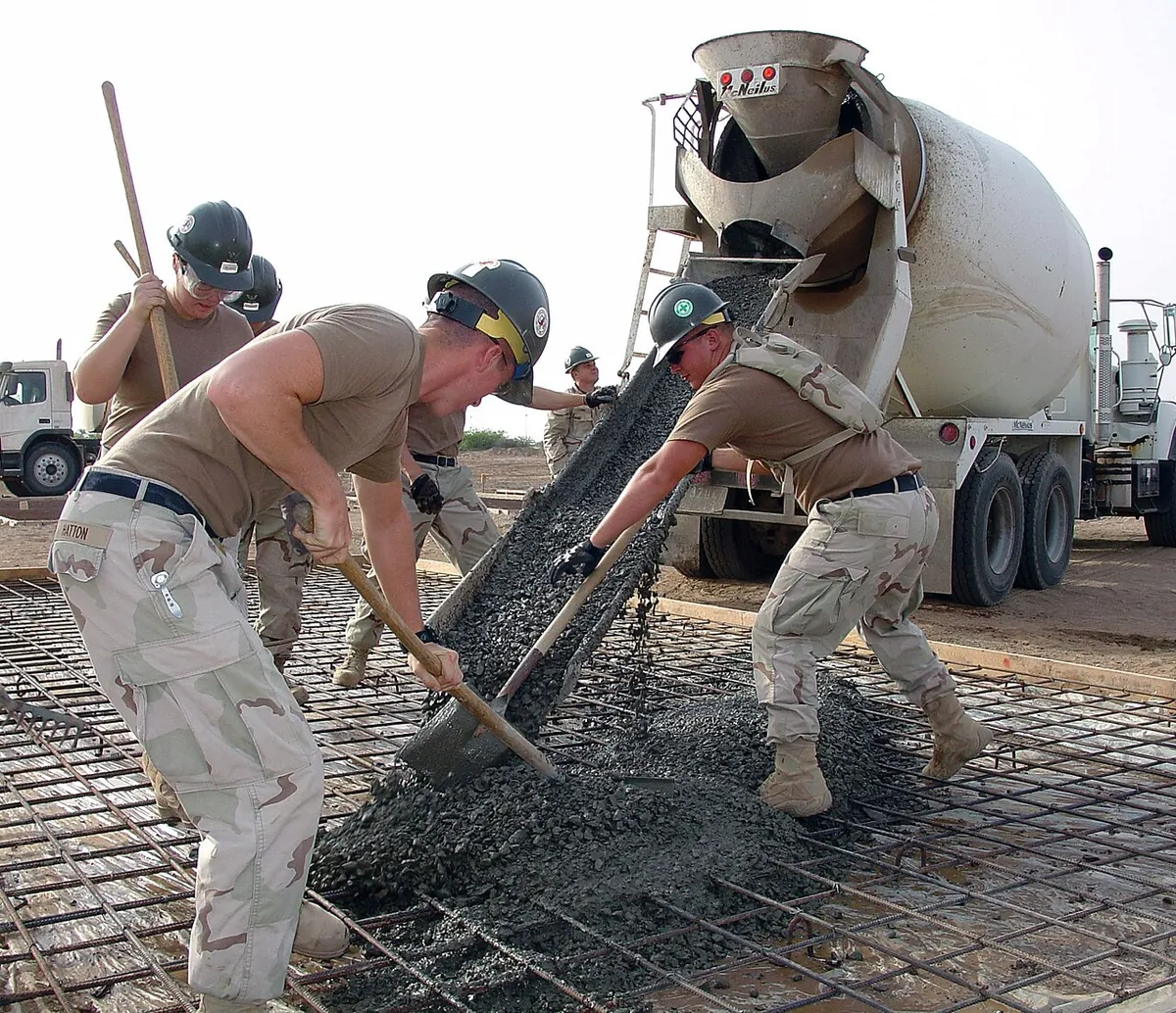
Photo: U.S. Navy, Wikimedia Commons, public domain
How to Save on Concrete Pad Cost
- Pour several slabs at once (patio, walkway, shed pad) to share mobilization and avoid short loads.
- Do the prep yourself: clearing, digging or removing an old deck can lower the quote.
- Choose a plain broom finish and add decoration only where it matters.
- Keep the slab rectangular; curves and steps add forming labor.
- Get three quotes and compare thickness, base, reinforcement and finish.
- Do not skimp on thickness or base; a cracked slab is more expensive than doing it right.
Concrete Slab vs Alternatives
| Option | Typical cost per sq ft | Good for |
|---|---|---|
| Gravel pad | much lower | Sheds, parking, temporary pads |
| Concrete slab | $4 – $8 | Long-lasting, flat, strong base |
| Pavers | $10 – $30 | Patios and walkways with a decorative look |
| Wood deck | varies widely | Raised outdoor living areas |
For patios, many homeowners compare a slab with pavers. See paving stones vs concrete for a full comparison.
Worked Example: Full Cost to Pour a Concrete Slab for a Patio
Here is a realistic budget for a 16 × 20 foot backyard patio, 4 inches thick, plain broom finish, on flat ground with grass to remove:
| Line item | Quantity | How it is figured |
|---|---|---|
| Area | 320 sq ft | 16 × 20 |
| Concrete | about 4.2 yards | 320 ÷ 81 = 3.95, plus about 5% waste |
| Concrete material | about $525 – $840 | 4.2 yards × $125 – $200 |
| Gravel base | about 4 in. deep | roughly 4 cubic yards of crushed stone |
| Installed price | $1,280 – $2,560 | 320 × $4 – $8 |
In this example the concrete is roughly a third of the installed price. The rest pays for excavation, base, forms, mesh, the finishing crew, joints, curing and cleanup. If the patio needed old concrete removed first, add about $640 to $1,920 at $2 to $6 per square foot. If you upgraded to stamped concrete, the price would rise to roughly $3,840 to $5,760.
How Long Does It Take to Pour a Concrete Slab?
A typical residential slab takes about two to four days of work, plus curing time:
- Day 1: layout, excavation and hauling away soil.
- Day 1 or 2: gravel base, compaction, forms, vapor barrier and reinforcement. Some towns inspect at this stage.
- Pour day: the ready-mix truck arrives; the crew places, screeds, floats, edges and finishes the slab in a few hours.
- Next day: forms can often be stripped, and joints are saw-cut if they were not tooled.
- Curing: foot traffic after about 24 to 48 hours, light loads after about a week, and full design strength at about 28 days.
Large slabs and house foundations take longer because of inspections, plumbing and more complex forming.
Weather and the Best Time to Pour a Slab
Concrete cures best in mild weather, roughly 50 to 85°F, with no heavy rain in the forecast. In hot weather, the surface dries too fast and can crack, so crews pour early in the morning and may use a retarder or evaporation reducer. In cold weather, concrete must not freeze before it gains strength; crews use accelerators, heated water and insulated blankets, which add to the cost to pour a concrete slab. Never pour on frozen ground. For more, see pouring concrete in cold weather and can you pour concrete in the rain.
Common Concrete Slab Problems (and How to Avoid Paying Twice)
- Cracking. All concrete shrinks as it cures. Control joints spaced about 2 to 3 times the slab thickness in feet (for example, every 8 to 12 feet for a 4 inch slab) help cracks form in straight lines. See why concrete cracks.
- Settling. Poorly compacted soil or base lets the slab sink. Compact in layers; do not pour on fresh fill.
- Scaling and flaking. Usually from finishing with water on the surface, freezing too soon, or de-icing salt on young concrete.
- Standing water. Outdoor slabs need a slope of about 1/8 to 1/4 inch per foot away from buildings.
- Moisture in indoor slabs. Skipping the vapor barrier can cause flooring problems later.
Doing the base and joints right costs little at pour time. Fixing them later means concrete repair, leveling or full replacement.
Sealing and Maintaining a New Slab
Outdoor slabs last longer with a penetrating or film-forming sealer applied after the concrete has cured, often after about a month. Reseal every few years, especially in freeze-thaw climates or where salt is used. Keep gutters and downspouts from dumping water at the slab edges, and fill cracks early. See how to seal concrete for products and steps.
Do You Need a Permit to Pour a Concrete Slab?
It depends on where you live and what the slab is for. Many towns do not require a permit for a small patio or shed pad, but most require one for garage slabs, house foundations, and work that changes drainage or sits near property lines. Some areas also limit how much of a lot can be covered with hard surfaces. Check with your building department before pouring, and ask contractors whether the permit fee is included in their concrete slab price.
Concrete Pad Cost vs Concrete Slab Cost: Is There a Difference?
People use "pad" and "slab" for the same thing, but contractors often mean slightly different jobs. A concrete pad is usually small and stand-alone: a base for an air conditioner, generator, hot tub, trash cans or a small shed. A concrete slab usually means a larger surface such as a patio, garage floor or foundation. The concrete pad cost per square foot is often higher than for a large slab because the job is small: the crew still has to travel, set forms and finish, and the plant may charge a short-load fee for a yard or less of concrete. If you need several small concrete pads, ask for them to be poured on the same day as a larger concrete slab to bring the price per square foot down. Precast pads from a home center can also be cheaper for very small bases such as AC units.
Concrete Slab Prices by Region
Labor rates vary more than materials do, so the cost to pour a concrete slab is usually highest in large coastal metro areas and lowest in rural areas with competitive contractors and nearby plants. Remote sites can be expensive for a different reason: long delivery distances and short-load fees. Always use national per-square-foot ranges as a starting point, then get local quotes.
Questions to Ask Before You Pour a Concrete Slab
- How thick will the slab be, and what psi mix will you use?
- How much gravel base, and how will it be compacted?
- Rebar, mesh or fiber, and how will it be supported in the slab?
- Will there be a vapor barrier?
- Where will the control joints go, and how far apart?
- Is removal of grass, an old slab or debris included?
- Does the price include a permit, pump or short-load fees?
- What warranty do you offer?
Frequently Asked Questions
How much does it cost to pour a concrete slab?
About $4 to $8 per square foot installed for a standard 4 inch slab, with an average near $6 per square foot. Thicker, reinforced or decorative slabs cost more.
What is the concrete pad cost for a 20x20 slab?
A 400 square foot, 4 inch slab costs about $1,600 to $3,200 installed and needs about 5 cubic yards of concrete.
How much is a 12x12 concrete slab?
About $576 to $1,152 installed at $4 to $8 per square foot, using about 1.8 cubic yards of concrete at 4 inches thick.
Is it cheaper to pour your own concrete slab?
Yes, for small slabs, because you save the labor. Material for a 10 × 10 pad often costs a few hundred dollars. Larger slabs are hard to place and finish without an experienced crew.
How thick should a concrete slab be?
Usually 4 inches for patios, walkways and sheds, and 5 to 6 inches for driveways, garages, RVs and heavy loads.
What is the cost to pour a concrete slab for a garage?
A 24 × 24 foot garage slab usually costs about $2,300 to $4,600 at $4 to $8 per square foot, and more if it is 5 to 6 inches thick with rebar, thickened edges and a vapor barrier.
How many yards of concrete does a slab need?
Divide the area in square feet by 81 for a 4 inch slab, 65 for 5 inches or 54 for 6 inches, then add 5 to 10 percent for waste. A 20 × 20 foot concrete slab at 4 inches needs about 5 cubic yards.
Does a concrete slab need rebar?
Not always. Small patios often use wire mesh or fiber. Driveways, garages, heavy-load pads and foundations usually use rebar.
What is the cost of a concrete slab per square foot?
About $4 to $8 per square foot for a standard 4 inch poured concrete slab with a gravel base and broom or trowel finish, with about $6 a common average. Thicker or decorative slabs cost more.
How much is it to pour a concrete pad for a shed or hot tub?
The cost to install a concrete pad for a shed or hot tub is usually about $500 to $2,000, depending on size. An 8 × 8 hot tub pad is about $260 to $520 at $4 to $8 per square foot, but many contractors charge a $1,000 or higher minimum for small jobs.
Sources
- Angi, "How much does a concrete slab cost?" angi.com
- HomeAdvisor, "How much does a concrete slab cost?" homeadvisor.com
- HomeGuide, "How much does a concrete driveway cost?" (finish ranges). homeguide.com
- HomeGuide, "How much does concrete removal cost?" homeguide.com
- HomeGuide and LawnStarter concrete delivery and price-per-yard guides. lawnstarter.com
- Image credits: slab and forms photos by Beams&Lintels (CC BY-SA 4.0) and rebar photo by the U.S. Navy (public domain), via Wikimedia Commons. Diagram by Asphapro.com.
Prices checked November 2026. They are national ranges; local contractors can be higher or lower.
Related Guides
- Insulated concrete forms cost — ICF wall prices
- How to cut concrete — saws, blades and dust safety
- How to build concrete forms — layout, stakes and slope
- What is concrete made of? — cement, water, sand, gravel and air
- Types of concrete finishes — broom, trowel, stamped, polished
- Can you pour concrete in the rain? — risks and how to protect a pour
- Can you pour concrete in the winter? — cold weather rules and protection
- Why does concrete crack? — causes, joints and prevention
- How long does concrete last? — lifespan by project
- Can rats chew through concrete? — rodent entry points and termites