
Concrete Cost Guide: Prices, Quantities and Every Concrete Guide in One Place
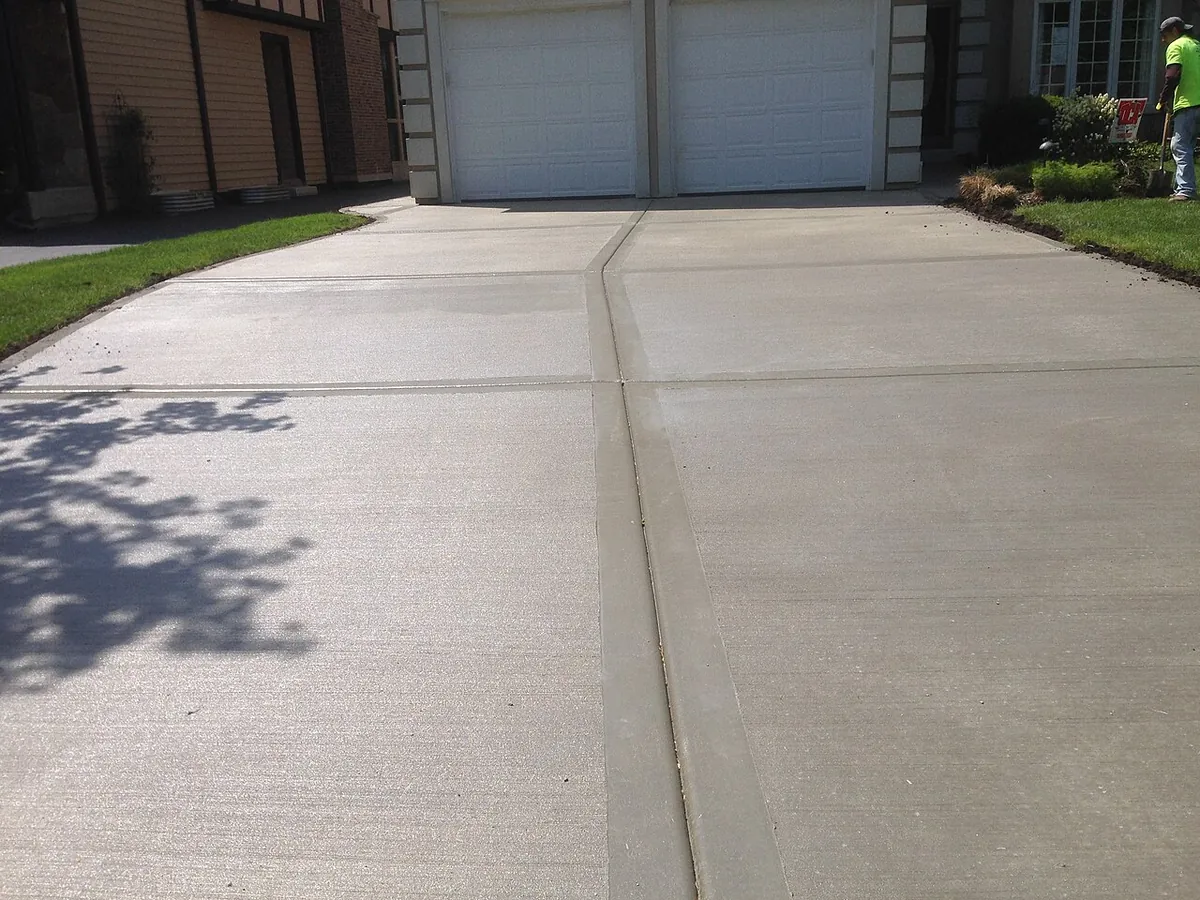
Photo: Catalano Concrete, Wikimedia Commons, CC BY-SA 4.0
Quick Answer
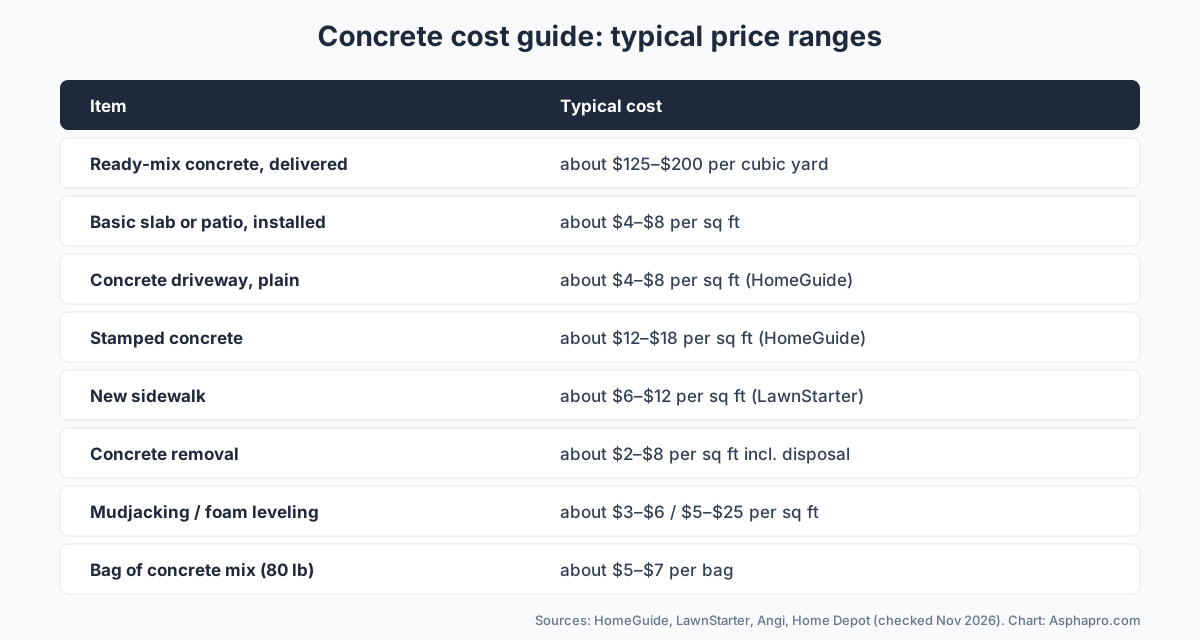
This concrete cost guide brings all of our concrete pricing and how-to guides together. In 2026, delivered ready-mix concrete typically costs about $125 to $200 per cubic yard, a basic installed slab or patio about $4 to $8 per square foot, a plain concrete driveway about $4 to $8 per square foot, and stamped concrete about $12 to $18 per square foot (HomeGuide). An 80-pound bag of concrete mix runs about $5 to $7. Removal usually adds about $2 to $8 per square foot, and leveling a sunken slab costs roughly $3 to $6 per square foot for mudjacking or more for foam. Below you will find what drives concrete costs, how to estimate your project, and links to every detailed guide on slabs, driveways, quantities, repairs, cleaning, finishes and concrete science.
Concrete is one of the most common materials around a home: driveways, sidewalks, patios, steps, garage floors, footings and foundations. It is also one of the easiest places to overpay or under-plan. The price of a project depends on far more than the cost of a truckload of concrete. Labor, base preparation, forms, reinforcement, finishing, access, removal of old concrete and local market rates all add up.
This concrete cost guide is the starting point for our concrete library. Use the price summary to get a quick estimate, the cost drivers section to understand quotes, and the topic sections to jump to the guide you need.
Concrete Prices at a Glance
These are typical national ranges from major cost guides, checked in November 2026. Local prices vary with region, season, site access and contractor demand. Always get several written quotes.
- Ready-mix concrete delivered: about $125 to $200 per cubic yard for full loads, with short-load fees for small orders. See concrete price per yard.
- Installed concrete per square foot: about $4 to $8 for a basic slab, more for thicker, reinforced or decorative work. See concrete cost per square foot.
- Concrete slab: see concrete slab cost, plus sized examples for a 12x12 slab, a 20x20 slab and a 30x30 slab.
- Concrete driveway: plain about $4 to $8 per square foot; stained about $8 to $12; stamped about $12 to $18 (HomeGuide). See concrete driveway cost.
- Sidewalk: new about $6 to $12 per square foot (LawnStarter). See concrete sidewalk cost.
- Steps: see concrete steps cost.
- Removal: about $2 to $8 per square foot including disposal. See concrete removal cost.
- Leveling: mudjacking about $3 to $6 per square foot; polyurethane foam about $5 to $25. See concrete leveling cost.
- Bags: an 80-pound bag about $5 to $7. See how much is a bag of concrete.
What Drives Concrete Costs
1. Size and thickness
More area and more thickness mean more concrete, more labor and more base material. A 4-inch patio and a 6-inch driveway of the same size can differ a lot in price. See concrete slab thickness and how thick a concrete driveway should be.
2. Site preparation
Excavation, removing old concrete or sod, grading, compacting the subgrade and adding a gravel base can be a large part of the price, especially on sloped or poorly drained sites. See how to build concrete forms for what prep involves.
3. Reinforcement
Wire mesh, rebar and fibers add material and labor cost but help control cracking and carry loads.
4. Finish
A broom finish is included in most basic prices. Stamped, colored, exposed aggregate and polished finishes add substantially. See types of concrete finishes, stamped concrete vs pavers and polished concrete cost.
5. Access and delivery
If a truck can back right up to the forms, placing is cheap. If concrete must be pumped or wheeled, costs rise. Small orders below the plant's minimum add short-load fees. See how many yards of concrete are in a truck.
6. Location and season
Labor and material prices vary widely by region. Winter pours may add heating charges and protection costs. See pouring concrete in cold weather.
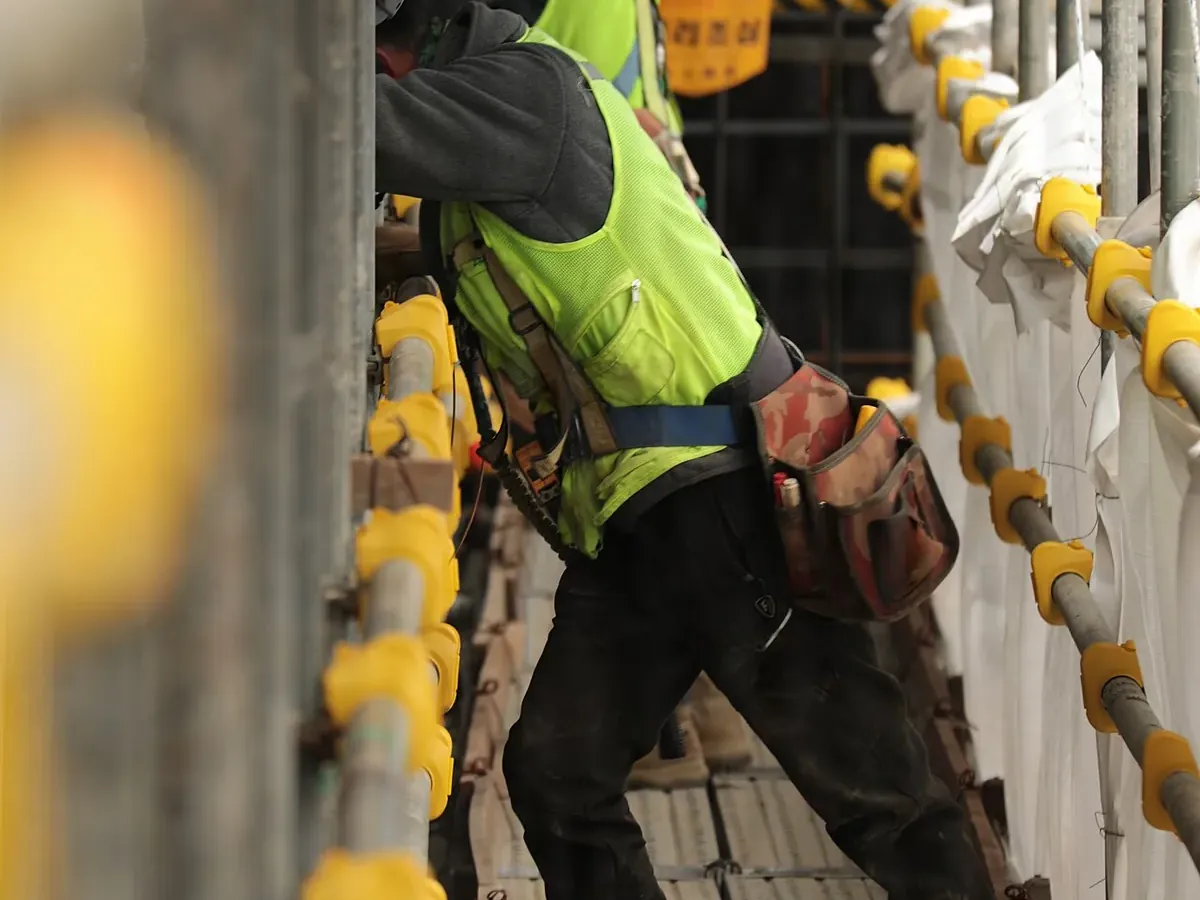
Photo: U.S. Army / Monique Freemon, Wikimedia Commons, public domain
How to Estimate Concrete Costs for Your Project
You can get a rough budget before calling contractors with five steps. This is how we approach every estimate in this concrete cost guide.
- Measure the area. Length times width in feet gives square feet. For odd shapes, break them into rectangles and add them up.
- Choose the thickness. Four inches for patios and walks, often five to six inches for driveways that carry heavier vehicles.
- Work out the volume. Square feet times thickness in feet, divided by 27, gives cubic yards. Add about 5 to 10% for waste and uneven ground. Our guide on how to calculate yards of concrete walks through examples.
- Price the material. Multiply yards by the local ready-mix price, using our concrete price per yard ranges, and add delivery or short-load fees if the order is small.
- Price the installed job. For a contractor-installed project, use the concrete cost per square foot range for your type of work, then add removal, extra base, reinforcement and decorative finishes.
This gives you a realistic range to compare with quotes. If a quote is far below the range, ask what is missing; if far above, ask what is included.
Sample Concrete Project Budgets
These examples use the typical national ranges above. Your concrete costs will vary with location and site conditions.
12x12 patio, 4 inches thick
144 square feet at about $4 to $8 per square foot installed gives roughly $580 to $1,150 for a basic broom-finished patio, before removal of any old surface or extras like stamping. The concrete itself is about 1.8 cubic yards. See the full 12x12 concrete slab cost breakdown.
Two-car driveway, 20x24 feet
480 square feet at about $4 to $8 per square foot for plain concrete gives roughly $1,900 to $3,850, plus removal of an old driveway at about $2 to $8 per square foot if needed. A stamped finish at $12 to $18 per square foot would bring the same driveway to roughly $5,800 to $8,600. See the full concrete driveway cost guide.
Front walkway, 4x40 feet
160 square feet of new sidewalk at about $6 to $12 per square foot gives roughly $960 to $1,900. See our concrete sidewalk cost guide for details on replacing city sidewalk panels.
Leveling two sunken driveway panels
About 100 square feet of mudjacking at $3 to $6 per square foot gives roughly $300 to $600, though many contractors have job minimums. Foam leveling would cost more per square foot. Our concrete leveling cost guide compares both.
Hidden Costs to Ask About
- Removal and disposal of old concrete, asphalt or pavers.
- Excavation and grading beyond basic prep.
- Gravel base thickness and compaction.
- Reinforcement: wire mesh, rebar or fibers.
- Pumping when trucks cannot reach the forms.
- Short-load fees for small orders.
- Permits for driveways, aprons and city sidewalks.
- Sealing after curing.
- Joint sealing and expansion joints.
- Winter protection such as blankets and heated mix.
- Repairs to lawns and landscaping after trucks and equipment.
How to Compare Concrete Quotes
Two concrete quotes can look very different simply because they include different things. To compare fairly, ask each contractor to list:
- Area and thickness of the slab.
- Concrete strength (psi), air entrainment and any fibers or admixtures.
- Base material and thickness.
- Type and placement of reinforcement.
- Joint spacing and how joints are cut.
- Finish type.
- Curing method and whether sealing is included.
- Removal, disposal and permits.
- Warranty terms.
The cheapest concrete price is not always the best value. A slab with a thin base, no air entrainment or poor joints may crack or scale years sooner. See why concrete cracks and how long concrete lasts.
Ways to Lower the Cost of Concrete
- Plan the size carefully: small changes in area or thickness change concrete costs a lot.
- Combine projects: pouring a patio and walkway on the same day avoids two sets of delivery fees and mobilization.
- Do prep yourself: removing sod or old pavers can save labor if your contractor agrees.
- Choose simple finishes: a broom finish costs far less than stamped or polished work.
- Avoid peak season: some contractors offer better pricing in slower months, as long as weather allows good curing.
- Use bags for small jobs: for posts and small pads under about a yard, bagged concrete may be cheaper than a short load.
- Maintain what you have: sealing, crack repair and leveling are much cheaper than replacement. See concrete repair cost.
DIY vs Hiring a Contractor
DIY can save labor on small projects like post footings, small pads and stepping stones. Larger slabs and driveways need several people working quickly, the right tools, and finishing skill; mistakes are permanent. Many homeowners do the prep and demolition themselves and hire a crew for the pour and finish. Whatever you choose, compare the total concrete cost, including tools, rentals, disposal and your time, with professional quotes.
Concrete vs Asphalt vs Pavers: Cost Compared
For driveways and patios, concrete is often compared with asphalt and pavers. Each has a different up-front cost and lifespan:
- Concrete: moderate up-front cost, long life often 25 to 50 years, low routine maintenance beyond sealing and joint care.
- Asphalt: usually cheaper up front, typically about 15 to 25 years with regular sealcoating and crack filling. See asphalt vs concrete driveway cost and is asphalt cheaper than concrete.
- Pavers: higher up-front cost, long life, and easy spot repairs. See paving stones vs concrete and stamped concrete vs pavers.
- Gravel: cheapest to install but needs ongoing grading and new stone. See gravel driveway cost.
When comparing, divide the installed cost plus expected maintenance by the years of service you expect. Concrete often wins on cost per year for homeowners who plan to stay.
Why Concrete Prices Vary by Region and Season
The concrete prices in this guide are national ranges. Local prices can sit well above or below them. Big cities and high-cost regions have higher labor rates, disposal fees and permit costs. Rural areas may have lower labor costs but longer delivery distances and travel fees. Material prices follow cement, aggregate and fuel costs, which change with the economy and regional supply. Season matters too: spring and early summer are busy for concrete contractors, which can push prices up and stretch schedules, while late fall pours may include cold-weather protection. Comparing several local quotes is the best way to see your real concrete cost.
Lifetime Cost: Building It Right
The cheapest slab to pour is not always the cheapest to own. A few hundred dollars spent on a thicker gravel base, proper reinforcement, air-entrained concrete, good joints and curing can add decades of life. The extra concrete cost up front is small compared with replacing a cracked, scaled or sunken slab early. Ongoing care, like resealing every few years and sealing cracks and joints, keeps lifetime costs low. See how to reseal concrete, does salt damage concrete and how long concrete lasts.
Before You Pour: A Short Checklist
- Call 811 to locate utilities before digging.
- Check permits and HOA rules for driveways, aprons and sidewalks.
- Confirm the size, thickness, slope and finish.
- Confirm concrete strength, air content and reinforcement.
- Plan truck access and whether a pump is needed.
- Check the weather forecast for rain and cold.
- Plan curing and when you can walk and drive on it.
- Plan sealing and the first winter without deicers.
Bookmark this concrete cost guide; we update the price ranges and add new guides as costs change.
Ready-Mix vs Bagged Concrete Costs
For small jobs, bagged concrete is convenient: you buy exactly what you need, mix it yourself and avoid delivery fees. At about $5 to $7 per 80-pound bag and roughly 45 bags per cubic yard, bagged concrete costs more per yard than ready-mix, but for a few post holes or a small landing it is still the cheapest option overall. Once a project needs more than about a yard, the labor of mixing dozens of bags, and the risk of uneven batches and cold joints, usually makes ready-mix the better choice even with a short-load fee. Our guides on how many bags of concrete are in a yard and how many bags are on a pallet help you compare.
Mixing equipment changes the math too. Renting a portable mixer makes bagged concrete faster for medium jobs, while a mixer truck or a volumetric mobile mixer suits anything larger. See concrete cement mixers for options.
How We Build This Guide
Every price in this concrete cost guide comes from published cost guides and retailer listings, which we check and date. We list the source next to each range so you can see where it comes from. Ranges are national, so treat them as a starting point and confirm with local quotes. Our how-to and explainer guides use manufacturer instructions and industry sources such as the American Concrete Institute, the Portland Cement Association, OSHA and the EPA where they apply, and we note when a number is a common rule of thumb rather than a standard.
If you are just starting a project, a good path through this concrete cost guide is: check the price ranges, calculate how much concrete you need, read the guide for your specific project such as a driveway, slab or steps, then read the planning guides on thickness, forms, curing and weather before you collect quotes. That order gives you the numbers and the questions you need to talk to contractors with confidence and spot a weak quote quickly.
Concrete Cost Guides by Project
Start here if you want prices. Each guide explains typical cost ranges, what is included, and how to compare quotes.
- Concrete price per yard: what a cubic yard of ready-mix costs, delivery and short-load fees, and how strength and additives change concrete prices.
- Concrete cost per square foot: installed prices for slabs, driveways, patios and decorative work, and how thickness changes the number.
- Concrete slab cost: the full cost of a slab, from excavation and base to forms, reinforcement and finishing.
- 12x12 concrete slab cost: a worked example for a shed pad or small patio, with yards, bags and labor.
- 20x20 concrete slab cost: pricing for a two-car garage pad or large patio.
- 30x30 concrete slab cost: pricing for a large garage, shop or barn floor.
- Concrete driveway cost: plain, stained and stamped driveway prices, removal and apron costs.
- Concrete sidewalk cost: new walks, replacement panels and city sidewalk repairs.
- Concrete steps cost: poured and precast steps, landings and repairs.
- Concrete footing cost: footings for decks, additions, walls and posts.
- Concrete block wall cost: block walls and retaining walls, per square foot and per block.
- Insulated concrete forms cost: ICF walls and how they compare with wood framing.
- Stamped concrete vs pavers: cost, look, repairs and upkeep side by side.
- Polished concrete cost: grinding and polishing floors, from matte to high gloss.
- Concrete coating cost: epoxy, polyaspartic and other garage floor coatings.
- Concrete overlay cost: resurfacing old concrete with thin overlays and stamped toppings.
- Concrete repair cost: crack repair, patching, spalls and partial replacement.
- Concrete leveling cost: mudjacking, foam leveling and when to replace instead.
- Concrete removal cost: breaking out and hauling away old slabs.
Quantities, Weights and Materials
Before you can estimate concrete costs, you need to know how much concrete to order and what it is made of.
- How to calculate yards of concrete: the formula, worked examples and how much extra to order.
- How many bags of concrete in a yard: 40, 60 and 80-pound bag yields and when bags beat ready-mix.
- How many bags of concrete on a pallet: pallet counts by bag size and what a pallet weighs.
- How much is a bag of concrete: bag prices by size and type, including fast-setting and high-strength mixes.
- How much does a yard of concrete weigh: weight per yard and per cubic foot, and why it matters for trucks and trailers.
- How many yards of concrete in a truck: mixer truck capacities and minimum orders.
- How much does a concrete block weigh: block weights by size and type.
- Cinder block vs concrete block: what the terms mean today and which to buy.
- What is concrete made of: cement, water, sand, gravel, air and admixtures, slump and porosity.
- Types of concrete: high performance, precast, gunite, lightweight, pervious and more.
- Mortar vs concrete: the difference, mortar types and which to use.
Planning, Pouring and Finishing
These guides cover the decisions and steps that make the biggest difference to how long concrete lasts and how much it really costs over time.
- Concrete slab thickness: how thick patios, garage floors and shed pads should be.
- How thick should a concrete driveway be: 4 vs 5 vs 6 inches and when to thicken edges.
- How to build concrete forms: layout, stakes, slope and what fill is OK under a slab.
- How long does concrete take to cure: when you can walk, drive and build on new concrete.
- Can you pour concrete in the rain: risks by stage and how to protect a pour.
- Pouring concrete in cold weather: when it is too cold and how to protect concrete in winter.
- Types of concrete finishes: broom, trowel, exposed aggregate, stamped and polished.
- Can you pour concrete over concrete: bonded toppings, overlays and when to tear out instead.
- Can you lay pavers over concrete: sand-set and mortar-set overlays.
- How to use self leveling concrete: flattening floors before new flooring.
- How to cut concrete: saws, blades, control joints and silica dust safety.
- How to remove concrete: breaking out slabs yourself, tools and disposal.
- Types of concrete anchors: hanging things, handrails and removing anchors.
Repair, Maintenance and Durability
- Why does concrete crack: causes, which cracks matter, sealing joints and tree roots.
- How to fix concrete steps: patching edges, treads and crumbling steps.
- Does salt damage concrete: deicers compared, scaling vs spalling and protection.
- How to reseal concrete: sealer types, step-by-step resealing and dry times.
- How long does concrete last: lifespan by project and how to extend it.
- Mold on concrete: what kills black mold and how to dry out a cellar.
- Can concrete burn: fire resistance, heat damage and fire pits.
- Can rats chew through concrete: rodent entry points and signs of termites.
Cleaning and Stain Removal
- How to clean concrete without a pressure washer: brush-and-hose methods, moss and water stains.
- How to remove oil stains from concrete: fresh spills, old motor oil stains and poultices.
- How to remove rust stains from concrete: vinegar, oxalic acid and safe last resorts.
- How to get blood out of concrete: cold water, enzyme cleaners and disinfecting.
- How to get tire marks off concrete: degreasers and hot tire pickup on sealed floors.
- How to remove paint from concrete: spray paint, epoxy and adhesive.
- How to get concrete splash off bricks: fresh splatter, hard lumps and haze.
DIY Concrete Projects
- How to make concrete planters: DIY pots, large planters and white concrete.
- How to make concrete stepping stones: molds, mix, decorating, setting a path and table numbers.
Frequently Asked Questions
How much does concrete cost per yard in 2026?
Delivered ready-mix commonly runs about $125 to $200 per cubic yard for full loads, plus fees for small loads, waiting time or additives.
How much does a concrete slab cost per square foot?
A basic installed slab is typically about $4 to $8 per square foot, more for thick, reinforced or decorative work.
How much does a concrete driveway cost?
About $4 to $8 per square foot for plain concrete, $8 to $12 stained and $12 to $18 stamped (HomeGuide).
Is it cheaper to mix concrete yourself?
For small jobs, bags are cheaper. For anything over about a yard, ready-mix usually costs less and gives better results.
How long does concrete last?
Driveways, walks and patios often 25 to 50 years; foundations 80 to 100 years or more with good construction.
What is the cheapest concrete finish?
A broom or float finish, which is included in most basic concrete prices.
How much concrete do I need?
Multiply length by width by thickness in feet and divide by 27 for cubic yards, then add 5 to 10% extra.
How much does it cost to remove a concrete slab?
About $2 to $8 per square foot including disposal, more with thick reinforced concrete or difficult access.
Is concrete cheaper than asphalt for a driveway?
Asphalt is usually cheaper up front; concrete usually lasts longer, which can make it cheaper per year.
How much does stamped concrete cost?
About $12 to $18 per square foot for typical stamped work (HomeGuide), more for elaborate patterns and colors.
Sources
- HomeGuide, concrete driveway, slab and delivery costs. homeguide.com
- LawnStarter, concrete price per yard and sidewalk costs. lawnstarter.com
- Angi, concrete slab and leveling costs. angi.com
- Home Depot, bagged concrete prices (snapshot, November 2026).
- Image credits: driveway photo by Catalano Concrete (CC BY-SA 4.0); placement photo U.S. Army (public domain), both Wikimedia Commons; chart by Asphapro.com.
Prices are typical national ranges; get local quotes. Checked November 2026.