
Mortar vs Concrete: What Is the Difference and When to Use Each
Quick Answer
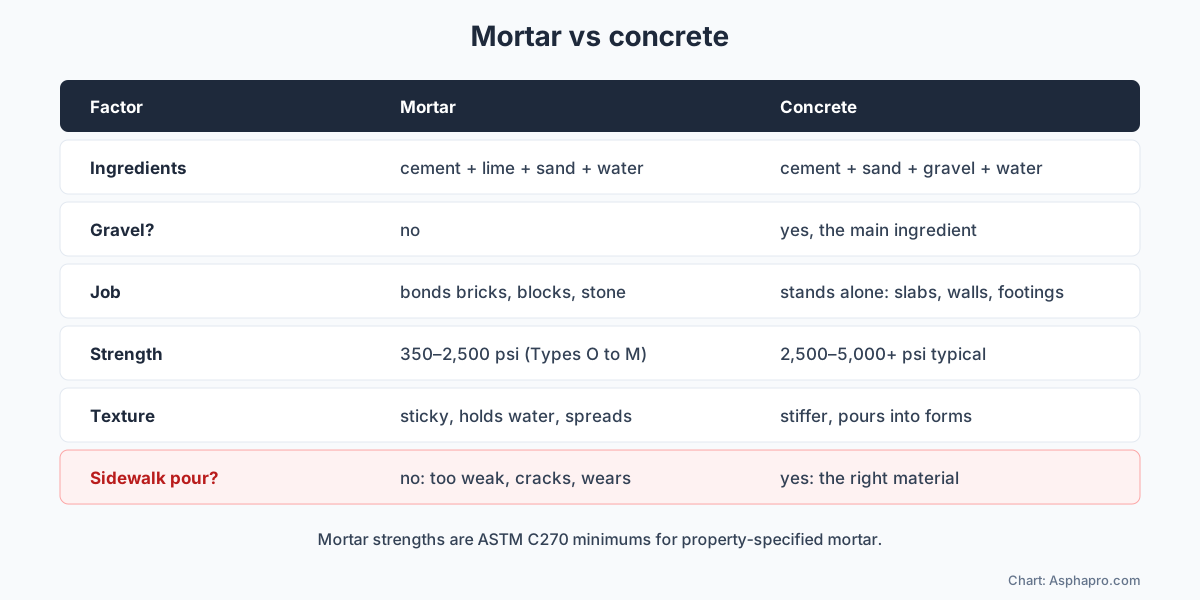
The main difference between mortar and concrete is the ingredients and the job. Mortar is cement, lime, sand and water, with no gravel, and it is made to glue bricks, blocks and stone together. Concrete is cement, sand, gravel or crushed stone and water, and it is a structural material on its own for slabs, footings, walls and driveways. Concrete is typically much stronger, often 2,500 to 5,000 psi or more, while common mortars range from about 350 to 2,500 psi depending on type (ASTM C270). Do not use mortar for a sidewalk concrete pour: it is weaker, shrinks and cracks more, wears faster, and costs more per cubic foot. Use concrete mix instead.
Mortar and concrete look similar in the bag and both turn hard and gray. Both use portland cement, sand and water. So it is easy to assume they are interchangeable. They are not. Each is designed for a different job, and using one in place of the other is a common DIY mistake that leads to crumbling joints or cracked slabs.
This guide compares mortar vs concrete in detail: ingredients, strength, workability, uses, cost, mortar types, and whether you can use mortar for a sidewalk concrete pour. It also explains where grout, stucco and sand mix fit in.
What Is Mortar?
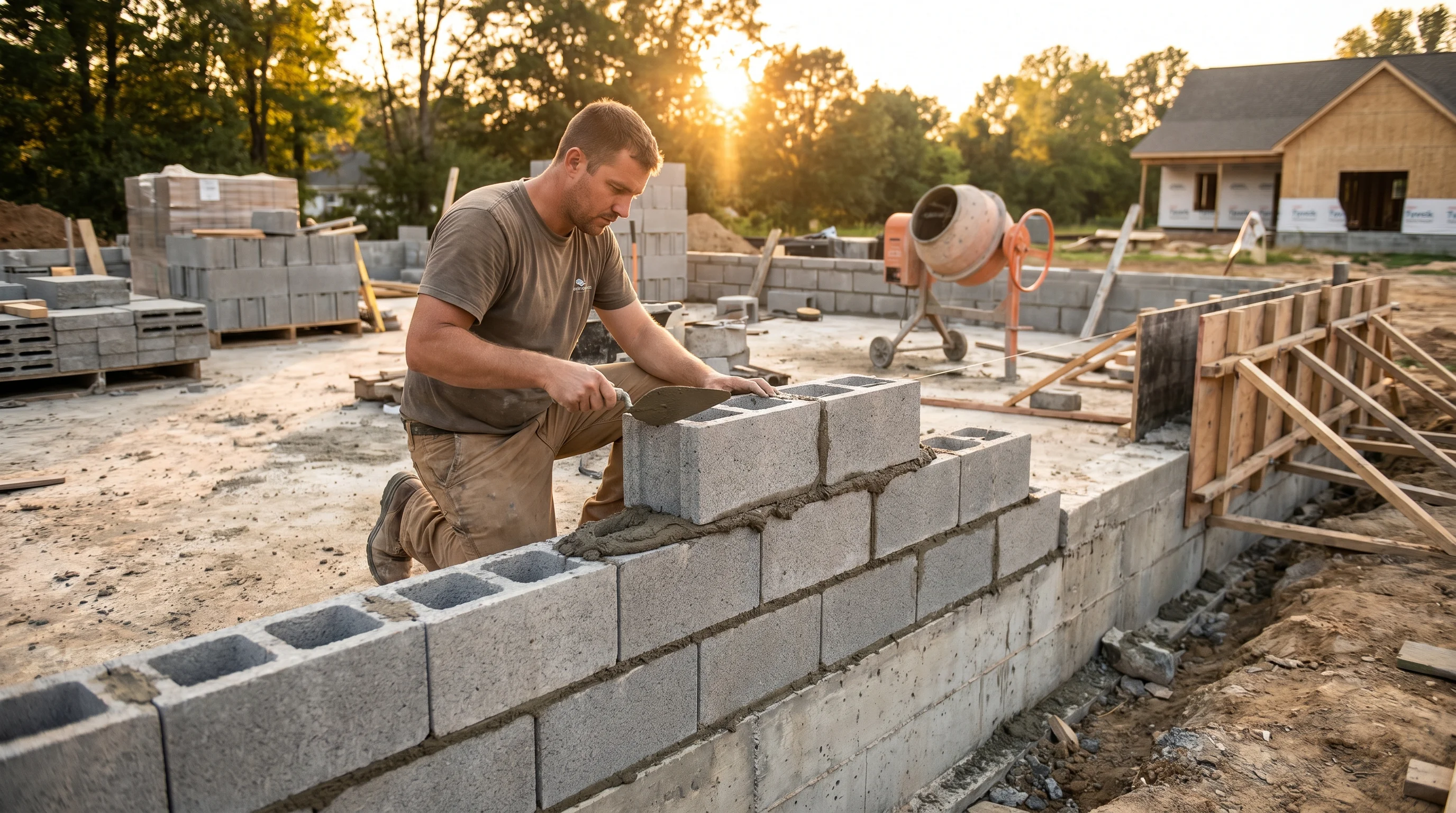
Mortar is a paste of portland cement, hydrated lime, fine sand and water. Masonry cement or mortar cement products combine the cement and lime-like ingredients in one bag. Mortar is spread between bricks, concrete blocks and stones to bond them into a wall, fill the joints, and seal out water.
Mortar is designed to be:
- Sticky and workable: it clings to a trowel and to masonry units and stays soft long enough to set units in place.
- Water-retentive: lime helps it hold water so porous bricks do not suck it dry before it cures.
- Flexible enough: a little weaker than the units it bonds, so small movements crack the mortar joint, which is easier to repair, rather than the bricks.
- Good at bonding: bond strength to the units matters more than raw compressive strength.
What Is Concrete?
Concrete is portland cement, water, sand and coarse aggregate (gravel or crushed stone), often with entrained air and admixtures. It is placed in forms or on the ground and hardens into a strong, self-supporting mass. Concrete is used for slabs, sidewalks, driveways, footings, foundations, walls, columns and posts. See what concrete is made of.
The gravel is the key difference. Coarse aggregate gives concrete its strength and stiffness, limits shrinkage, and lowers cost by reducing how much cement paste is needed.
Difference Between Mortar and Concrete
Concrete vs mortar comes down to the stone. Both use cement, sand and water, but concrete adds gravel or crushed stone, which makes it far stronger in a slab. That is also the difference between a bag of mortar mix vs concrete mix at the store: look for stone in the bag.
| Factor | Mortar | Concrete |
|---|---|---|
| Main ingredients | Cement, lime, fine sand, water | Cement, sand, gravel or crushed stone, water |
| Cement content | High share of paste | Lower share; aggregates are 60–75% of volume |
| Water content | Higher, for workability | Lower, for strength |
| Purpose | Bonding masonry units | Structural element on its own |
| Compressive strength | About 350–2,500 psi (Types O–M) | Commonly 2,500–5,000+ psi |
| Shrinkage | Higher (more paste) | Lower (aggregate restrains it) |
| Placement | Troweled in thin layers | Poured into forms, thick sections |
| Durability as a surface | Poor under traffic | Good; designed for wear |
Mortar Types: M, S, N and O
ASTM C270 defines mortar types by letter, taken from the word "MaSoNwOrK" in alternating letters. Property-specified minimum compressive strengths at 28 days are:
- Type M: 2,500 psi. Highest strength. Below-grade work, foundations, retaining walls, heavy loads.
- Type S: 1,800 psi. Strong, with good bond. Below-grade and exterior walls, patios, areas with high wind or seismic loads.
- Type N: 750 psi. General-purpose above-grade mortar for exterior and interior walls, the most common for brick veneer.
- Type O: 350 psi. Low strength. Interior non-load-bearing walls and some repointing of soft historic masonry.
Stronger is not always better with mortar. Mortar that is harder than the bricks can cause the bricks to crack and spall instead of the joints, which is especially damaging in old, soft brick. Match the mortar type to the masonry and the exposure.
Can I Use Mortar for a Sidewalk Concrete Pour?
No. Mortar mix is not designed to be a slab, and using it for a sidewalk causes problems:
- Lower strength: most mortar is much weaker than concrete, even before accounting for the thick section.
- More shrinkage and cracking: without gravel, the high paste content shrinks more as it cures, leading to cracks.
- Poor wear resistance: the surface can dust, scale and wear under foot traffic and weather.
- Poor freeze-thaw resistance: mortar for walls is not air-entrained like exterior concrete, so it scales in cold climates.
- Higher cost: bags of mortar yield less volume and cost more per cubic foot than concrete mix.
For a sidewalk, use a concrete mix, either bagged for small jobs or ready-mix for larger ones, usually at least 3,000 psi, 4 inches thick, air-entrained in freezing climates, on a compacted base with control joints. See concrete sidewalk cost and how to build concrete forms.
If you need a thin topping or patch under 2 inches, use a sand/topping mix or a concrete resurfacer made for the purpose, not masonry mortar. See concrete overlay cost.
How Mortar and Concrete Are Mixed
Mortar mix ratios
Most homeowners buy pre-blended mortar mix in bags labeled by type, and just add water. If mixing from scratch, mortar is proportioned by volume of portland cement, hydrated lime and sand. A common Type N proportion is roughly 1 part portland cement, 1 part lime and 6 parts sand. Type S uses less lime for more strength, roughly 1 part cement, ½ part lime and 4½ parts sand. Masonry cement products replace the separate cement and lime and are mixed with sand in about a 1 to 3 ratio. Always follow the bag or the specification for your project.
Concrete mix ratios
Bagged concrete mix is pre-blended with gravel; you add water. If mixing from scratch, a common general-purpose concrete mix is about 1 part cement, 2 parts sand and 3 parts gravel by volume. Ready-mix plants batch by weight to a design strength. See how many bags of concrete are in a yard.
Consistency and working time
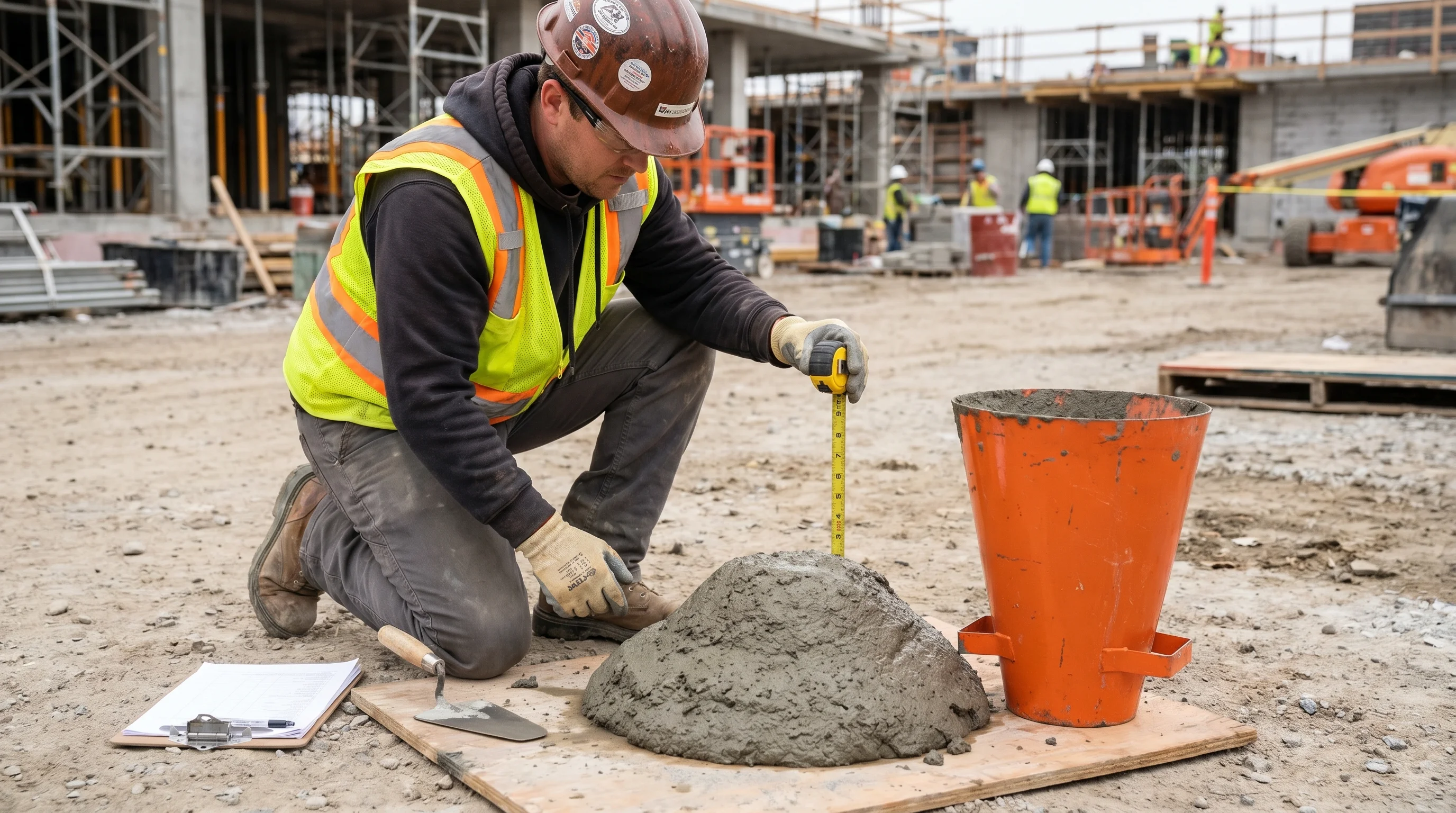
Mortar is mixed to a soft, buttery consistency that holds a ridge on the trowel and sticks when the trowel is turned upside down. It can be "retempered" with a little water within its working time, usually about 2 to 2½ hours, but should be thrown out after that. Concrete is mixed stiffer, like thick oatmeal, and adding extra water to make it flow weakens it. Concrete should be placed within about 90 minutes of mixing in most conditions.
Other Cement Products and How They Compare
- Grout (masonry grout): a fluid cement, sand and sometimes pea gravel mix poured into hollow block cores and bond beams to embed rebar. It is fluid so it fills voids; not the same as tile grout.
- Tile grout: fills the joints between tiles; sanded or unsanded, sometimes epoxy.
- Thinset mortar: a polymer-modified cement adhesive for setting tile. Not interchangeable with masonry mortar.
- Stucco: portland cement, lime and sand plaster applied in coats over lath or masonry for exterior walls.
- Sand mix (topping mix): concrete without gravel for thin layers, patches and small casts.
- Fast-setting concrete: for posts and quick repairs.
- Concrete resurfacer: polymer-modified cement for thin new surfaces on old concrete.
- Hydraulic cement: sets in minutes, even under water, to plug active leaks in basement walls.
Picking the right bag matters. A shelf of gray bags at a home center can include all of these, and each is formulated for one job.
Which One Should You Use? Common Projects
| Project | Use |
|---|---|
| Sidewalk, patio, driveway, slab | Concrete |
| Footings and foundations | Concrete |
| Setting fence or deck posts | Concrete (fast-setting mix) |
| Laying brick, block or stone walls | Mortar (Type N or S, sometimes M) |
| Repointing old brick joints | Mortar matched to the original (often soft, lime-rich) |
| Setting flagstone on a slab | Mortar bed (often Type S) |
| Filling block cores with rebar | Masonry grout |
| Thin patch or topping under 2 in | Sand/topping mix or resurfacer |
| Setting tile | Thinset mortar |
| Plugging an active basement leak | Hydraulic cement |
Repointing: Mortar Matters
Repointing means raking out weathered mortar joints and filling them with fresh mortar. It is one of the most common mortar jobs for homeowners with brick houses, chimneys and walls. The key is to match the new mortar to the old in strength, color and texture. Older brick buildings often used soft lime mortar, and filling joints with a hard, high-cement Type M or S can trap moisture in the bricks and cause them to crack and spall. The National Park Service's guidance on repointing historic masonry recommends a mortar no stronger than the masonry units and the original mortar. When in doubt, use Type N or O, or a lime mortar for historic buildings.
Can You Use Concrete Mix for Small Masonry Jobs?
Concrete mix is not a good substitute for mortar. The gravel prevents thin, even joints, and concrete lacks the stickiness and water retention mortar needs to bond units. Bricks laid in concrete often have weak bonds and uneven joints. Use concrete where the material stands on its own, and mortar where it holds units together.
The reverse is also true for posts and footings. Setting a fence post in mortar instead of concrete wastes money and leaves a weaker base. A fast-setting concrete mix is cheaper and stronger for posts.
Cost Comparison
Per bag, mortar mix and concrete mix are often in a similar price range, but a bag of concrete yields more volume because gravel takes up space cheaply. For a slab or a post, concrete costs less per cubic foot and performs better. For laying 100 bricks or blocks, you need far less material, and mortar is the only right choice. Masonry cement and lime sold separately can save money on large masonry jobs. See how much a bag of concrete costs for bag prices.
Common Mistakes
- Pouring a slab, sidewalk or steps with mortar mix.
- Laying bricks with concrete mix.
- Using Type M mortar to repoint soft, old brick.
- Adding too much water to concrete to make it easier to pour.
- Retempering mortar after its working time has passed.
- Confusing thinset or tile grout with masonry mortar.
- Skipping curing: both mortar and concrete need moisture to gain strength. See how long concrete takes to cure.
How Mortar and Concrete Fail
Looking at how each material fails also shows why they are different. Mortar joints are meant to be the sacrificial part of a masonry wall. Over decades, weather erodes the joints, and they are repointed while the bricks or blocks last much longer. When a wall moves, cracks should follow the mortar joints in a stair-step pattern, which is easier to repair. Concrete slabs, on the other hand, are designed to crack at control joints, and their surfaces must resist foot and vehicle traffic, freezing and deicing salts for decades. A slab made from mortar has no sacrificial partner; the whole surface wears and cracks. See why concrete cracks.
Strength vs Bond: Why Mortar Is Deliberately Weaker
It surprises many people that mortar is designed to be weaker than concrete and often weaker than the bricks it holds. A masonry wall is a system. The bricks or blocks carry the load, and the mortar's main jobs are to bond them, spread the load evenly between uneven surfaces, seal the joints against water and accommodate small movements from temperature and moisture.
If mortar were as strong and stiff as concrete, any movement in the wall would crack the units themselves, which are expensive and hard to replace. Slightly weaker, more flexible mortar cracks first, in the joints, where it can be raked out and repointed. Lime adds to this flexibility and also allows "autogenous healing": tiny cracks can partly reseal as lime reacts with carbon dioxide and moisture over time. So when comparing mortar vs concrete, higher strength is not a goal for mortar; good bond, workability and durability are.
Curing and Weather for Each
Both mortar and concrete harden by hydration, so both need moisture and moderate temperatures. In hot, dry or windy weather, masons may lightly mist new joints and protect walls from direct sun so mortar does not dry too fast, which weakens the bond. Bricks that are very absorbent are sometimes dampened before laying. Concrete slabs are cured with curing compounds, wet coverings or plastic for several days.
Neither should freeze while fresh. Cold-weather masonry uses heated materials, enclosures and blankets; cold-weather concrete uses accelerators, insulated blankets and heated enclosures. Do not use antifreeze products in mortar unless they are specifically made for it, as some can damage steel and stain masonry. See pouring concrete in cold weather.
DIY Example: A Garden Wall and a Path
Imagine a weekend project: a short concrete block garden wall with a concrete path in front of it. Here is which material goes where:
- Footing for the wall: concrete. Dig a trench below the frost line where required, add a compacted base, and pour a concrete footing wider than the block.
- First course of block: mortar. Spread a full mortar bed on the cured footing, set the first block level and plumb, and butter the ends of each next block.
- Upper courses: mortar on the face shells and head joints, checking level and plumb on each course.
- Block cores with rebar (if required): masonry grout poured into the cores.
- Cap: cap blocks set in mortar or construction adhesive made for masonry.
- Path: concrete, 4 inches thick on a compacted gravel base, with control joints and a broom finish.
Using mortar for the path or concrete for the block joints would cause problems in both places. See concrete block wall cost and concrete footing cost.
Choosing a Mortar Type for Your Project
If you are buying mortar for a home project, here is a simple guide. Type N is the default choice for most above-grade exterior and interior brick and block walls, including brick veneer and chimneys above the roofline in many cases. Type S is the usual choice for below-grade work, retaining walls, patios and flagstone set in mortar, and walls that need extra lateral strength. Type M is used where very high compressive strength is needed, such as foundations and heavily loaded below-grade masonry. Type O, or a lime mortar, is used for interior non-load-bearing walls and for repointing soft historic brick. When the project is structural or under a building code, follow the plans or the engineer's specification.
Mortar Joints and Finishes
Mortar joints are tooled once the mortar is thumbprint hard. Tooling compacts the surface and seals it against water. Common joint profiles include:
- Concave: the most common and most weather-resistant.
- V-joint: a crisp line that sheds water well.
- Raked: recessed for shadow lines; less weather-resistant and best for interiors or dry climates.
- Flush: struck flat, often used when walls will be plastered or painted.
Mortar comes in many colors from pigments and colored sands, which can change the look of a brick wall as much as the brick does. Concrete surfaces, by contrast, get their look from finishes like broom, stamped or polished; see types of concrete finishes.
A Brief History of Mortar and Concrete
Mortar is far older than modern concrete. Builders in ancient Egypt used gypsum mortars, and the Greeks and Romans used lime mortars to bind stone and brick. The Romans also made an early concrete by mixing lime and volcanic ash with rubble, which is why some Roman harbors and domes still stand. For most of history, mortar was lime and sand, slowly hardening as it absorbed carbon dioxide from the air.
Portland cement, patented in 1824, changed both materials. Cement-based mortars set faster and stronger than lime mortars, which suited the fast pace of modern masonry. Portland cement concrete became the backbone of modern construction, especially after steel reinforcement was added in the late 1800s. Today's mortar types balance the strength of portland cement with the workability and flexibility of lime, while concrete has grown into a family of engineered mixes with admixtures and supplementary materials. See types of concrete.
Reading the Bag
At the store, the bag tells you what you are buying. Look for these words:
- "Concrete mix" or "concrete": contains gravel; for slabs, posts and footings.
- "High strength" or "5000 psi": concrete with more cement for driveways and structural work.
- "Fast setting": concrete for posts and quick repairs.
- "Sand mix" or "topping mix": no gravel; thin slabs, patches and small casts.
- "Mortar mix" with a type (N, S or M): for laying brick, block and stone.
- "Masonry cement": cement and lime-type ingredients, to be mixed with sand to make mortar.
- "Portland cement": cement only; needs sand and gravel to become concrete or mortar.
- "Thinset" or "tile mortar": for tile, not masonry walls.
Reading the label takes ten seconds and avoids most mortar vs concrete mix-ups.
Safety With Mortar and Concrete
Both materials contain portland cement, which is alkaline when wet and can cause skin irritation and chemical burns with prolonged contact. Wear waterproof gloves, long sleeves and eye protection when mixing and working with either, and wash skin promptly if it gets on you. Kneeling in wet concrete without protection is a common cause of serious burns, so use knee boards and waterproof knee pads. Mixing dry bags releases dust containing crystalline silica, so mix outdoors or with good ventilation and wear a dust mask or respirator. Cutting or grinding hardened mortar and concrete releases much more silica dust; see how to cut concrete for dust safety.
Bags are heavy, commonly 60 or 80 pounds for both concrete mix and mortar mix. Lift with your legs, use a wheelbarrow or hand truck, and get help for big batches. Clean tools before the material hardens; once mortar or concrete sets on a trowel or mixer, it is hard to remove.
Quick Reference
- Mortar vs concrete ingredients: mortar has lime and no gravel; concrete has gravel.
- Difference between mortar and concrete in use: mortar bonds masonry; concrete stands on its own.
- Strength: mortar about 350–2,500 psi by type; concrete usually 2,500–5,000+ psi.
- Can I use mortar for a sidewalk concrete pour? No; use concrete mix.
- Best mortar for most brick walls: Type N; below grade and patios, Type S.
The short version of mortar vs concrete is easy to remember: mortar sticks things together, concrete stands on its own. If your project is a surface or a structure by itself, such as a slab, step, footing or post, reach for concrete. If it is a wall, chimney or veneer made of individual units, reach for the right type of mortar. When the job falls in between, such as a thin topping, a tile floor or a leaking crack, there is usually a specialty product made for exactly that task.
Frequently Asked Questions
What is the difference between mortar and concrete?
Mortar has no gravel and is made to bond bricks and blocks. Concrete includes gravel and is a strong structural material on its own.
Is mortar stronger than concrete?
No. Concrete is usually much stronger. Common mortars range from about 350 to 2,500 psi; concrete is often 2,500 to 5,000 psi or more.
Can I use mortar for a sidewalk concrete pour?
No. Mortar is too weak, shrinks and cracks more, and wears poorly as a slab. Use concrete mix.
Can I use concrete instead of mortar to lay bricks?
No. Concrete's gravel prevents thin, even joints, and it lacks mortar's stickiness and water retention.
What is Type S mortar used for?
Exterior and below-grade masonry, patios and walls needing higher strength and bond, with a 1,800 psi minimum.
Is mortar mix the same as sand mix?
No. Sand mix (topping mix) is concrete without gravel, made for thin slabs and patches. Mortar mix contains lime and is made for bonding masonry.
Can I use mortar to set fence posts?
It works poorly and costs more. Use concrete or fast-setting concrete mix for posts.
Why does mortar have lime in it?
Lime improves workability, water retention and bond, and makes the mortar slightly flexible and self-healing of tiny cracks.
How long does mortar take to cure?
It sets within hours and gains most of its strength over about 28 days. Keep it from drying too fast in hot weather.
Can I patch concrete with mortar?
For small, shallow patches, use a concrete patching compound, sand mix or resurfacer made for concrete instead of masonry mortar.
Sources
- ASTM C270, Standard Specification for Mortar for Unit Masonry (Types M, S, N, O). astm.org
- Portland Cement Association, cement and concrete FAQ. cement.org
- Brick Industry Association, Technical Notes on mortar selection. gobrick.com
- Image credits: images and chart by Asphapro.com.
Checked November 2026.