
Concrete Burial Vault Guide: Types, Grave Liners, Cemetery Rules and Cost
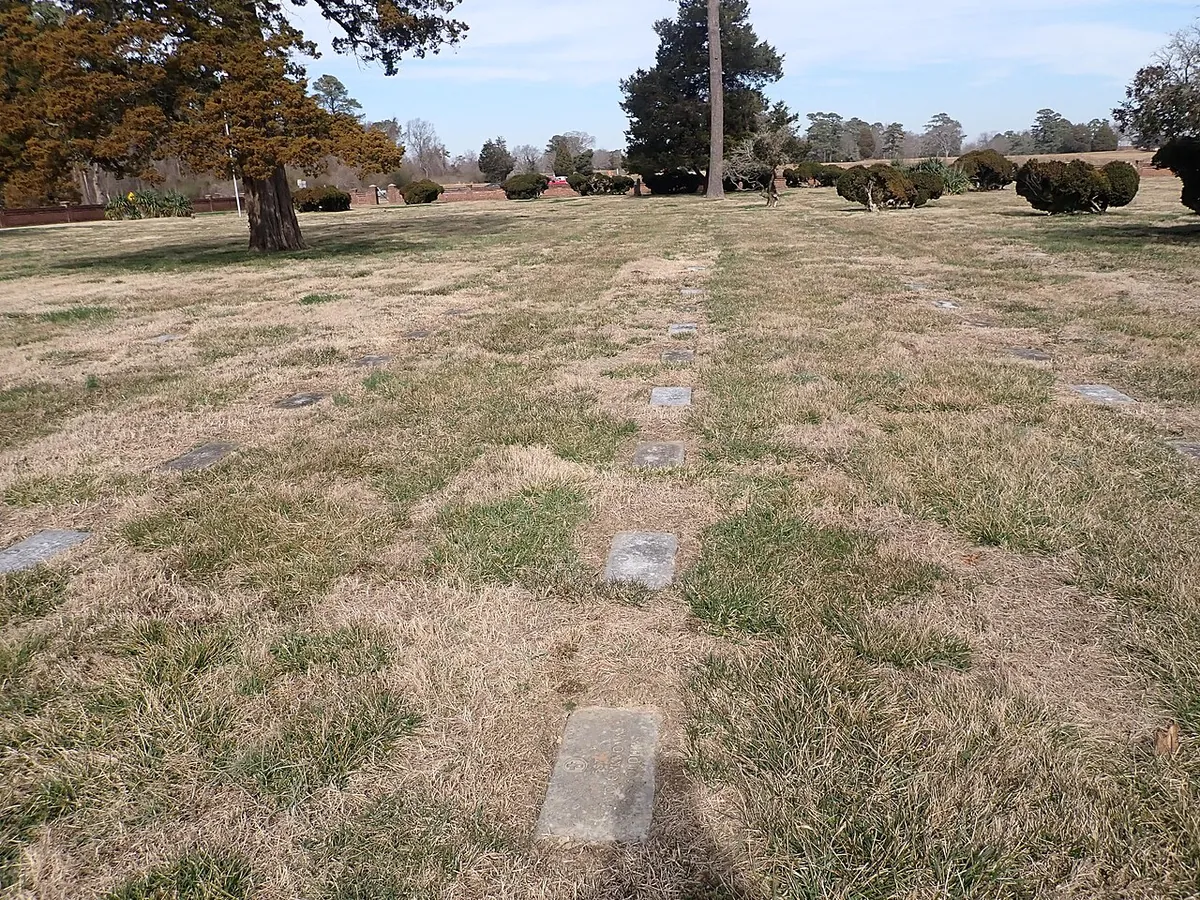
Photo: National Park Service (public domain), Wikimedia Commons
Quick Answer
A concrete burial vault is a reinforced concrete box with a heavy lid that holds the casket in the grave. It carries the weight of the soil and cemetery equipment so the ground does not sink as the casket ages. Most cemeteries in the US require an outer burial container, either a sealed burial vault, lined with plastic, asphalt or metal and closed with a sealed lid, or a simpler, unsealed concrete grave liner. No federal or state law requires one; it is a cemetery rule. A standard adult concrete burial vault weighs about 2,000 to 4,000 pounds. Typical prices are $700 to $1,500 for a grave liner, $1,000 to $5,000 for most lined concrete burial vaults, and up to $13,000 or more for metal-lined premium vaults.
When families plan a burial, the casket gets most of the attention, but in most American cemeteries there is a second container underneath it: a concrete burial vault or grave liner. You never see it after the service, yet it plays a practical role in keeping the cemetery level and safe. The lawn cemetery in the photo above shows the result: flat ground with markers set level in the grass, with no sunken graves, which is what cemeteries are trying to protect when they require concrete burial vaults.
This guide explains, in plain terms, what a concrete burial vault is, why cemeteries require them, the difference between vaults and grave liners, linings and grades, how concrete burial vaults are made and installed, sizes and weight, urn vaults for cremated remains, your rights as a consumer, and what they cost. It is written to help families make an informed decision at a difficult time.
What Is a Concrete Burial Vault?
A concrete burial vault is a precast, reinforced concrete container that is placed in the grave before burial. The casket is lowered into it during or after the committal service, and the lid, which often weighs 1,000 pounds or more, is set on top and sealed. Soil is then filled in over the lid. Most concrete burial vaults are rectangular boxes with walls and a base cast in one piece, a separate lid that fits into a tongue and groove joint, and an interior lining that separates the casket from the concrete.
The term burial vault is also used for above-ground family tombs and mausoleum crypts, which are different. In the funeral industry and in this guide, a burial vault means the in-ground outer container for a casket. The broader industry term, used by cemeteries and the Federal Trade Commission, is outer burial container, which covers both sealed vaults and grave liners.
Why Cemeteries Require Concrete Burial Vaults
Over time, wooden and even metal caskets break down under the weight of soil above them. When they collapse, the ground over the grave sinks, leaving depressions that collect water, damage markers and make mowing dangerous. Heavy equipment such as backhoes, mowers and the trucks that set monuments also travel across graves. A concrete burial vault or grave liner carries that weight, so the surface stays level for decades. That is the main reason most cemeteries, especially lawn cemeteries with flat markers like the one in the photo, require an outer burial container in their rules.
A concrete burial vault also provides some protection for the casket from the weight of the earth and from water, depending on the lining and seal, and some families value that for personal or religious reasons. It is important to understand, though, that no vault will preserve a body indefinitely, and the FTC Funeral Rule prohibits funeral providers from claiming that a vault will do so.
Concrete Burial Vault vs Grave Liner
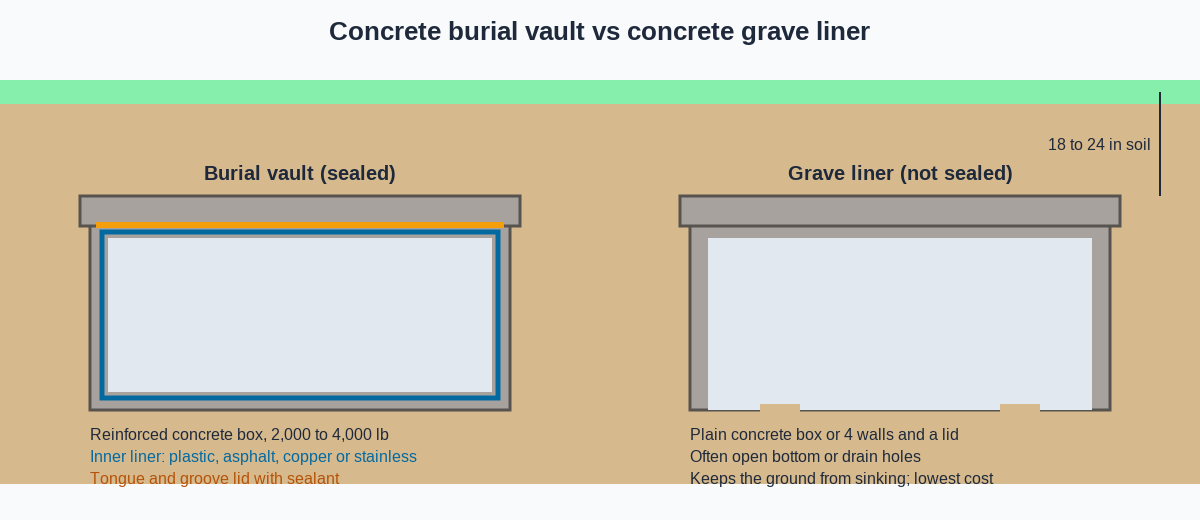
The diagram above shows the two main types of outer burial container. A concrete grave liner, sometimes called a rough box, is the basic option. It is a plain concrete box, or four walls and a lid placed separately, often without a bottom or with drainage holes. It has no lining and no seal. Its only job is to support the ground. Grave liners meet most cemetery requirements and are the lowest-cost option. Veterans buried in VA national cemeteries are provided a government grave liner at no cost.
A sealed concrete burial vault adds an inner lining and a sealed lid. The lining, which may be plastic, asphalt, a composite or a metal such as copper, bronze or stainless steel, separates the casket from the concrete and resists water. The lid fits into a tongue and groove joint along the top of the base, and a sealant, often butyl or another flexible compound, is applied in the joint before the lid is set. Some designs, called air-seal vaults, rely on trapped air to resist water entering from below. Concrete burial vaults cost more than liners but offer more protection for the casket and are available in decorative finishes and personalized designs.
Whether a grave liner or a concrete burial vault is right depends on the cemetery's rules, the family's wishes and budget. Many cemeteries accept either. Ask the cemetery what its rules actually require before choosing.
Types and Grades of Concrete Burial Vaults
Vault manufacturers usually sell several grades of concrete burial vaults, which differ mainly in the lining, the finish and the warranty.
Basic lined vaults have a thin plastic or asphalt-coated lining and a painted or plain exterior. They meet cemetery requirements with more protection than a liner.
Premium plastic or composite lined vaults use thicker high-impact plastic linings bonded to the concrete, sometimes on the inside and outside of the lid, with decorative exterior finishes.
Metal-lined vaults are lined with stainless steel, copper or bronze and are the top of the range, with prices to match. They are often chosen to match a metal casket.
Decorative and personalized vaults have colored or metallic exterior finishes, emblems, and nameplates or printed panels on the lid, which family members see during the committal service before burial.
Oversize and child vaults are made for larger caskets and for infants and children. Double-depth and companion vaults allow two burials in one grave space in some cemeteries.
Concrete burial vaults are made by local and regional precasters across the country, often licensed to use a national brand's designs and linings, because the heavy products must be delivered and set by truck within a limited distance. The National Concrete Burial Vault Association sets voluntary standards for strength and quality.
How Concrete Burial Vaults Are Made
Concrete burial vaults are made in steel molds in a precast plant, similar to other precast concrete products like steps, catch basins and culverts. The lining is placed or bonded into the mold first in many designs. Steel reinforcement, usually welded wire mesh, rebar or fibers, is set in the mold. High-strength concrete, typically 5,000 psi or more, is placed and vibrated to fill the mold completely with a dense, smooth surface. The concrete cures in the mold, then the vault is stripped, inspected, finished and cured further before delivery. Lids are cast separately the same way. See precast concrete, high-strength concrete and concrete vibrator.
Wall and lid thicknesses vary by maker, but walls of about 2 to 3 inches and lids of about 3 to 4 inches of reinforced high-strength concrete are common. The NCBVA standard calls for minimum concrete strength, reinforcement and load testing, so that concrete burial vaults can carry the soil and equipment loads in a cemetery for many decades.
Sizes and Weight
A standard adult concrete burial vault is designed to hold a standard casket, which is about 84 inches long and 28 inches wide. The outside of the vault is typically around 7 to 8 feet long, 2.5 to 3 feet wide and 2.5 to 3 feet high, though dimensions vary by maker and model. The total weight, base and lid, is usually 2,000 to 4,000 pounds. Oversize vaults for larger caskets are wider and heavier. Child and infant vaults are much smaller and lighter. Because of the weight, concrete burial vaults are delivered on special trucks with a hydraulic lifting device and set in the grave by the vault company's crew.
Grave depth depends on state law and cemetery rules, but in most US cemeteries the top of the vault lid ends up about 18 to 24 inches below the surface, which means the grave is dug roughly 4.5 to 5 feet deep for a standard single burial.
Who Makes and Delivers Concrete Burial Vaults
Most concrete burial vaults in the US are made by small and mid-sized family-owned precast companies, many of which have served the same towns for generations. Because a vault weighs one to two tons, it is not shipped long distances; each company typically serves funeral homes and cemeteries within a radius of 50 to 150 miles. Many of these local producers are licensed by national vault brands, which supply the lining systems, designs, marketing and warranties, while the local plant casts the concrete and delivers the finished concrete burial vault. The same companies often make other precast products such as septic tanks, steps and utility boxes. When you buy a concrete burial vault through a funeral home, it is usually one of these local companies that delivers and sets it at the cemetery.
How a Concrete Burial Vault Is Installed
The funeral home orders the vault from the local vault company once the family has chosen it, and coordinates delivery with the cemetery. The cemetery or its contractor opens the grave, digging it to the depth and size for the vault. Before the service, the vault company's crew delivers the base, sets it in the grave and places a lowering device over it. Many families see the vault at the graveside, with the lid displayed nearby. After the committal service, or with the family present if they wish, the casket is lowered into the vault, sealant is applied to the joint if it is a sealed vault, and the lid is lowered into place with the truck's lift. The grave is then closed and the surface restored. Some vault companies also provide graveside tents, chairs and setup.
Urn Vaults for Cremation
Cremated remains buried in a cemetery are often placed in an urn vault, a small concrete or polymer container that protects the urn and keeps the ground level, just as a full-size concrete burial vault does for a casket. Some cemeteries require them for in-ground burial of urns, while others do not. Urn vaults typically cost $100 to $1,000, depending on the material and lining. Some urns are designed to serve as their own vault. See the price chart below.
Your Rights When Buying a Burial Vault
In the US, the Federal Trade Commission's Funeral Rule gives families important protections when buying a concrete burial vault or liner from a funeral home. Funeral homes must give you a price list for outer burial containers before showing them, and must not tell you that state or local law requires a vault or liner when it does not. If a vault or liner is required, it is the cemetery's rule, and the funeral home must say so in writing. You can buy a vault or liner from a third party, such as a vault company or another seller, and the funeral home cannot refuse to handle it or charge you a fee for using it, though the cemetery may require that it meet its standards and be installed by an approved crew. Funeral providers also may not claim that a vault will preserve the body or keep out water and soil indefinitely.
Before buying, ask the cemetery for its written requirements, including whether a liner is acceptable, whether vaults must be sealed, and who may deliver and install it. Compare prices from the funeral home and local vault companies. If you have a concern, the FTC and state funeral regulators accept complaints.
How to Choose a Concrete Burial Vault
Choosing a concrete burial vault usually happens quickly, often within a day or two of a death, so it helps to know what to ask. Start with the cemetery. Ask for its written rules on outer burial containers: whether a plain concrete grave liner is acceptable, whether a sealed concrete burial vault is required, whether there are size limits, and whether the vault must come from an approved supplier or be installed by a particular crew. Some cemeteries own or partner with a vault company, and some include a liner in the price of the grave.
Next, think about what matters to the family. If the only goal is meeting the cemetery rule at the lowest cost, a grave liner or a basic lined concrete burial vault does the job. If the family wants more protection for the casket, a premium lined vault with a sealed lid is the usual choice. Some families want the vault to match the casket, for example a copper-lined vault with a copper casket, or want a personalized lid with a name, emblem or photo that will be seen at the graveside service. Others prefer a plain, simple container for personal, religious or environmental reasons.
Then compare prices. The funeral home's general price list must include the prices of the outer burial containers it sells, and you can call local vault companies directly. Ask what each price includes: delivery, setting, sealing, graveside equipment such as a tent and chairs, and any warranty. Ask whether the warranty is from the manufacturer or the dealer, and what it covers. Warranties on concrete burial vaults typically cover structural failure of the vault for a period of years, and some sealed vaults carry longer warranties against water entry, but read the terms closely.
Finally, consider pre-planning. Many people now choose their own concrete burial vault, along with their casket and cemetery plot, years ahead of time, which spares their family these decisions and allows time to compare options. Pre-need contracts are regulated by state law; make sure any payment is placed in a trust or insurance policy as your state requires.
How Long Does a Concrete Burial Vault Last?
A properly made concrete burial vault is designed to support the weight of the soil and cemetery equipment for many decades. Concrete itself is very durable underground, protected from sun and freeze-thaw cycles below the frost line, and high-strength, well-cured precast concrete can last for a century or more. The lining and the seal are the parts most likely to change over time. A sealed concrete burial vault can resist water entry for many years, but over the very long term, ground water, soil chemistry and the natural breakdown of sealants can allow moisture in. That is why reputable sellers do not claim that a vault will keep water out forever or preserve the remains. What a concrete burial vault does reliably is keep the grave from collapsing and the surface of the cemetery level. See how long does concrete last.
Burial Vaults for Veterans
Veterans and eligible family members buried in a VA national cemetery receive a government-furnished concrete grave liner at no cost, along with the grave, opening and closing, a headstone or marker, and perpetual care. Families may choose to buy a private concrete burial vault instead, but the VA will not reimburse the cost, and the vault must meet the cemetery's size requirements. Veterans buried in private cemeteries may be eligible for a burial allowance and a government headstone or marker, but private cemeteries set their own outer burial container rules. State veterans cemeteries have their own policies, often similar to national cemeteries.
Religious and Cultural Practices
Customs around concrete burial vaults vary. Some faith traditions emphasize a natural return to the earth and prefer that no vault be used, or that the vault have an open bottom so the casket rests on the soil. Traditional Jewish burial, for example, uses a simple wooden casket, and many Jewish cemeteries either do not require a vault or allow a grave liner with an open bottom or holes. Muslim burial traditionally places the body in the earth without a casket, and many Muslim cemeteries make arrangements accordingly. Many Christian families choose a sealed concrete burial vault as a sign of care and protection. Families should discuss their wishes with their faith leader, funeral director and cemetery, since cemeteries often have provisions for religious requirements.
Double-Depth and Companion Burials
Some cemeteries allow two burials in one grave space by stacking them, a practice called double-depth or lawn crypt burial. The first concrete burial vault is placed deeper, and the second is placed on top of it later. Some manufacturers make vaults designed to be stacked, with reinforced lids that support the second vault. Lawn crypts are a related system where the cemetery installs rows of precast concrete chambers before burials, so each grave is ready-built. Companion vaults, wide enough for two caskets side by side, are also available but uncommon. Ask the cemetery which options are allowed and what they cost compared with two separate graves.
Disinterment and Moving a Burial
Occasionally a family needs to move a burial to another cemetery, for example to bring family members together. Disinterment requires a permit from the state or local health department and is done by the cemetery or a specialist contractor. A concrete burial vault makes disinterment easier and more dignified, because the vault can be lifted out intact with the casket inside. Disinterment is expensive, often several thousand dollars, and is usually considered only for strong reasons.
Concrete Burial Vault Cost
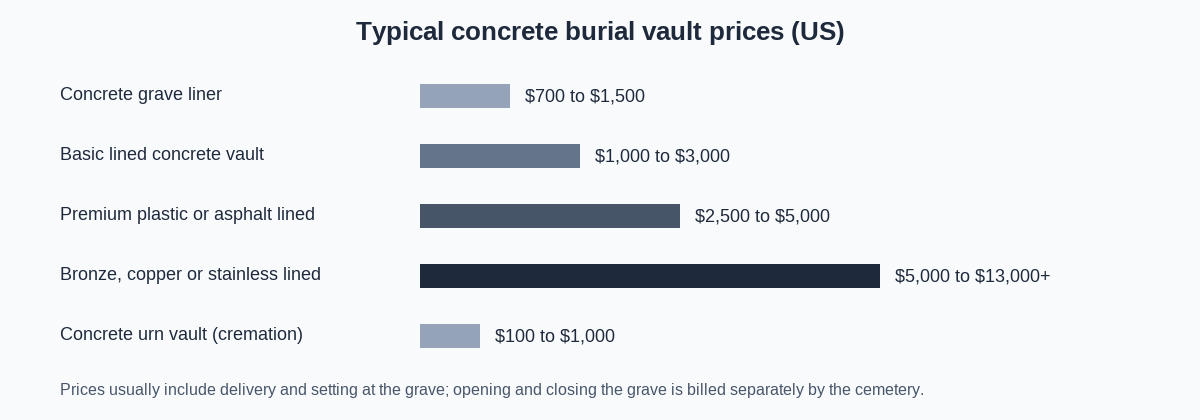
Prices for concrete burial vaults vary widely by region, lining, finish and where you buy. The chart above shows typical US ranges. A plain concrete grave liner usually costs $700 to $1,500. A basic lined concrete burial vault is typically $1,000 to $3,000, premium plastic or asphalt-lined vaults $2,500 to $5,000, and metal-lined vaults $5,000 to $13,000 or more. Prices usually include delivery and setting the vault, and sometimes graveside setup. Opening and closing the grave is a separate cemetery charge, often $1,000 to $3,000 or more. Buying directly from a local vault company is sometimes less expensive than buying through a funeral home, though many families find it simpler to let the funeral home handle the order.
Alternatives to Concrete Burial Vaults
Not every burial requires a concrete burial vault. Green or natural burial cemeteries, and some religious cemeteries, do not require outer burial containers at all, allowing the body to return to the earth naturally in a biodegradable casket or shroud. Some cemeteries accept plastic or polymer grave liners, steel vaults or fiberglass vaults instead of concrete. And some cemeteries without lawn-mowing concerns, such as older churchyards, have no requirement. Families who prefer to avoid a vault should ask about these options when choosing a cemetery.
Concrete Burial Vaults and the Environment
Concrete burial vaults use a significant amount of material: a standard vault contains roughly 0.5 to 1 cubic yard of concrete plus steel and a lining. Across the millions of burials in the US each decade, that adds up. On the other hand, concrete is a durable, inert material made from widely available natural ingredients, and vaults are generally made close to where they are used, which keeps transport distances short. Families who are concerned about environmental impact can consider a simple grave liner without a lining, a natural burial ground that does not require a container, or cremation. See what is concrete made of.
Frequently Asked Questions
Is a concrete burial vault required by law?
No. No federal or state law requires a burial vault or grave liner. Many cemeteries require an outer burial container in their own rules to keep the ground from sinking.
What is the difference between a burial vault and a grave liner?
A grave liner is a plain, unsealed concrete box that supports the ground. A burial vault adds an inner lining and a sealed lid for more protection of the casket.
How much does a concrete burial vault weigh?
A standard adult vault with its lid weighs about 2,000 to 4,000 pounds. They are delivered and set by the vault company's truck and crew.
Can I buy a burial vault somewhere other than the funeral home?
Yes. Under the FTC Funeral Rule, you can buy from another seller, and the funeral home cannot charge a fee for handling it. The cemetery may set standards and installation rules.
Do concrete burial vaults keep water out?
Sealed vaults resist water better than liners, but no vault can be guaranteed to keep water out forever, and sellers may not claim that it will.
Sources
- Federal Trade Commission: shopping for funeral services and the Funeral Rule
- FTC Funeral Rule, 16 CFR Part 453
- US Department of Veterans Affairs: National Cemetery Administration burial benefits
- National Concrete Burial Vault Association
- National Precast Concrete Association