
Concrete Vibrator Guide: How to Vibrate Concrete and Choose the Right Vibrator
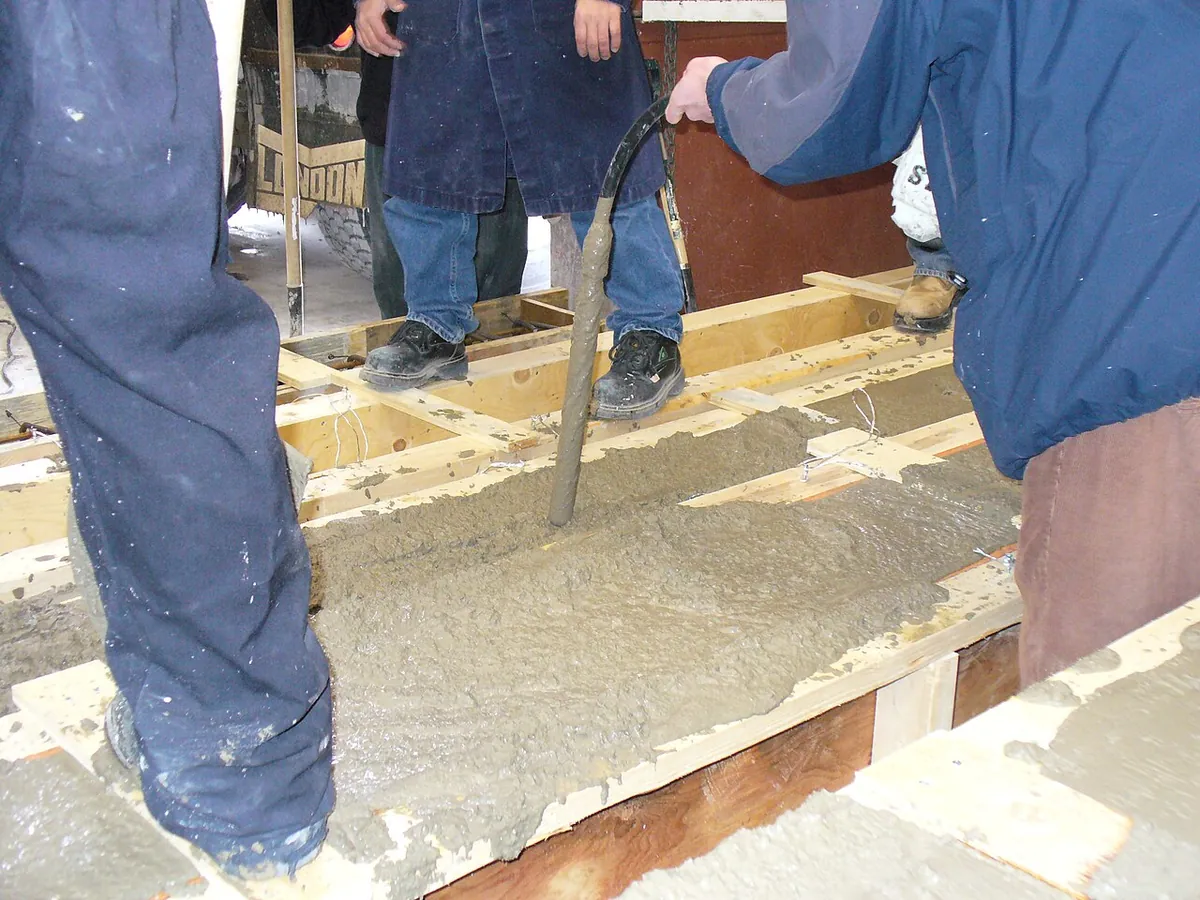
Photo: Neelix at English Wikipedia, Wikimedia Commons, public domain
Quick Answer
A concrete vibrator shakes fresh concrete at high frequency so trapped air rises out and the mix flows tightly around rebar and into the corners of the forms. Without it, walls, footings, columns and thick slabs can end up with honeycombing, voids and weak spots. The most common type is an internal or immersion vibrator, a steel head on a flexible shaft that you insert vertically every 1 to 2 feet, hold for about 5 to 15 seconds until air bubbles stop rising and the surface turns glossy, then pull out slowly. Other concrete vibrators include form-mounted external vibrators and surface vibrators such as vibrating screeds. Corded, gas and cordless models, such as the Milwaukee concrete vibrator in its M18 line, cost from a few hundred dollars, and most homeowners rent one by the day.
When concrete is poured, it is full of entrapped air, pockets of air caught as the concrete tumbles out of the chute and is pushed around with shovels. In a thin slab, raking and screeding work much of it out. In a wall, a footing or a column with closely spaced reinforcing steel, that air has nowhere to go, and the stones can bridge across bars and leave hollow pockets behind. Consolidation is the process of removing that air and making the concrete dense, and a concrete vibrator is the tool that does it.
This guide explains why concrete needs vibration, the main types of concrete vibrators, how to choose head size and frequency, how to vibrate concrete step by step, how to avoid both under- and over-vibration, cordless options, and what it costs to buy or rent a concrete vibrating tool.
Why Concrete Needs Vibration
Before a concrete vibrator is used, freshly placed concrete can contain 5 to 20 percent entrapped air by volume, depending on the mix and how it was placed. These are large, irregular voids, different from the tiny, evenly spaced bubbles of intentional air entrainment that protect concrete from freezing. Entrapped air lowers strength, leaves surface bugholes, and creates paths for water. A concrete vibrator makes the mix behave like a liquid for a moment: the vibration reduces friction between the particles, the concrete settles, air bubbles rise to the surface and escape, and the paste fills in around the stones and the steel.
Concrete consolidated with a concrete vibrator is denser, stronger, less permeable, and bonds better to reinforcement. It also gives smooth, uniform formed surfaces on walls and columns. Poorly consolidated concrete can show honeycombing, rock pockets, cold joints between layers and voids under bars, which can weaken the structure and let water reach the steel. See honeycombing in concrete and rebar in concrete.
When Do You Need a Concrete Vibrator?
You almost always need a concrete vibrator for walls, foundation walls, footings with rebar, columns, beams, piers, thick slabs over about 6 inches, structural slabs with heavy reinforcement, retaining walls, and precast products. Many building codes and project specifications require it for structural concrete under ACI 301 and ACI 318. For ordinary 4 inch slabs on grade, such as patios, walks and driveways, internal vibration is usually not needed: screeding, bull floating and the natural flow of a properly proportioned mix are enough. A vibrating screed often provides the light surface consolidation those slabs need. Self-consolidating concrete, a highly fluid mix designed to flow and consolidate under its own weight, is made specifically so that it does not need vibration.
On small DIY jobs such as fence post holes, steps or a small footing, tapping the forms with a hammer and rodding the concrete with a stick or rebar can help release air, but for anything structural, renting a concrete vibrator is the safer choice.
Types of Concrete Vibrators
Internal (Immersion) Vibrators
The internal concrete vibrator, also called a poker, pencil or immersion concrete vibrator, is by far the most common. It has a cylindrical steel head, typically 3/4 inch to 2 1/2 inches in diameter, containing an eccentric weight that spins at high speed. The head is connected to a power unit by a flexible shaft or cable, usually 4 to 21 feet long, so it can reach down into wall and column forms. Power can come from an electric motor, a small gas engine, compressed air, hydraulics, or a battery. In some models the motor is inside the head itself, which gives steady speed under load.
Small concrete vibrator heads, 3/4 to 1 1/4 inches, are used for thin walls, tight rebar, precast work and small jobs. Medium heads, 1 1/4 to 2 inches, are the general-purpose choice for walls, footings and slabs. Large heads, over 2 inches, are used for mass concrete, large footings and heavy structural work.
External (Form) Vibrators
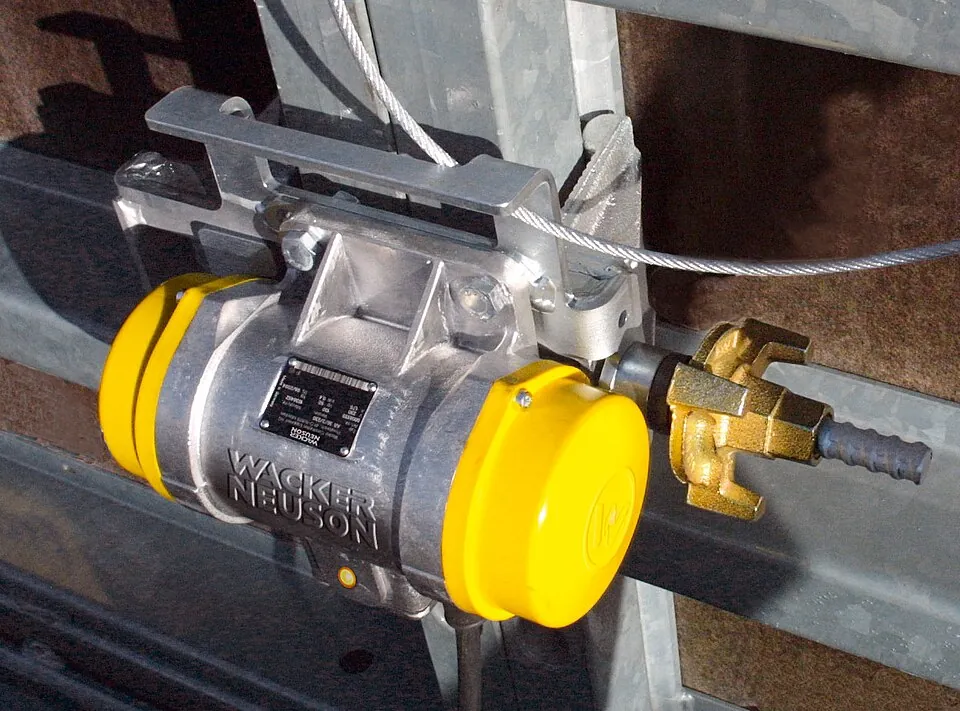
Photo: Baumeister 99 / Wacker Neuson, Wikimedia Commons, CC BY-SA 3.0
External concrete vibrators clamp or bolt onto the outside of steel forms and shake the whole form. They are used where internal vibrators cannot reach, such as thin walls, tunnel linings, densely reinforced sections, and in precast plants. The forms must be strong enough to take the vibration. Vibrating tables used to make precast products, pavers and test specimens are another form of external concrete vibrator.
Surface Vibrators
Surface concrete vibrators work from the top of the slab. Vibrating screeds and truss screeds consolidate the top few inches while striking off, and plate-type surface vibrators are sometimes used on thin slabs and toppings. They are effective for slabs up to about 6 to 8 inches thick; thicker slabs need internal vibration as well. See concrete screed for power screeds.
Choosing Head Size and Frequency
The area a concrete vibrator consolidates around itself is called its radius of action. It grows with head size and with the workability of the concrete: a large head in a fluid mix reaches further than a small head in a stiff mix. As a rough guide, small heads consolidate a circle a few inches across, while larger heads can reach a foot or more. The American Concrete Institute guide ACI 309R gives typical frequencies for internal concrete vibrators of roughly 8,000 to 15,000 vibrations per minute, with smaller heads at the higher end.
In practice, choose a concrete vibrator head that fits easily between the bars and the form face with room to spare, and as large as possible within that limit. For a typical residential foundation wall or footing, a 1 1/4 to 1 3/4 inch head on a 6 to 10 foot shaft is a common choice. For thin walls or very congested steel, step down to a pencil concrete vibrator. For thick footings or large pours, go larger, or use two concrete vibrators at once.
How to Vibrate Concrete, Step by Step
First, place the concrete in layers, or lifts, no deeper than about 12 to 20 inches, rather than filling a wall form all at once. Deep lifts trap air at the bottom where the concrete vibrator may not reach well.
Second, start the concrete vibrator and insert the concrete vibrator head vertically into the concrete, letting it sink under its own weight. Do not push it in at an angle or drag it sideways. When vibrating a new lift, let the concrete vibrator head go about 6 inches down into the layer below, so the two layers knit together without a cold joint.
Third, hold the concrete vibrator head in place for about 5 to 15 seconds, depending on the mix. Watch the surface: large air bubbles will rise and burst, the concrete around the concrete vibrator head will settle, and the surface will turn smooth and glossy as a thin layer of paste appears. When bubbles stop coming up, that spot is done.
Fourth, pull the concrete vibrator out slowly, about 3 inches per second, while it is still running. Pulling the concrete vibrator slowly lets the concrete close the hole behind the head. A fast withdrawal leaves a hole or a soft column of paste.
Fifth, move to the next insertion point, about one and a half times the radius of action away, so the consolidated circles overlap. In a wall, that is often every 12 to 18 inches along the form. Work systematically so no area is missed.
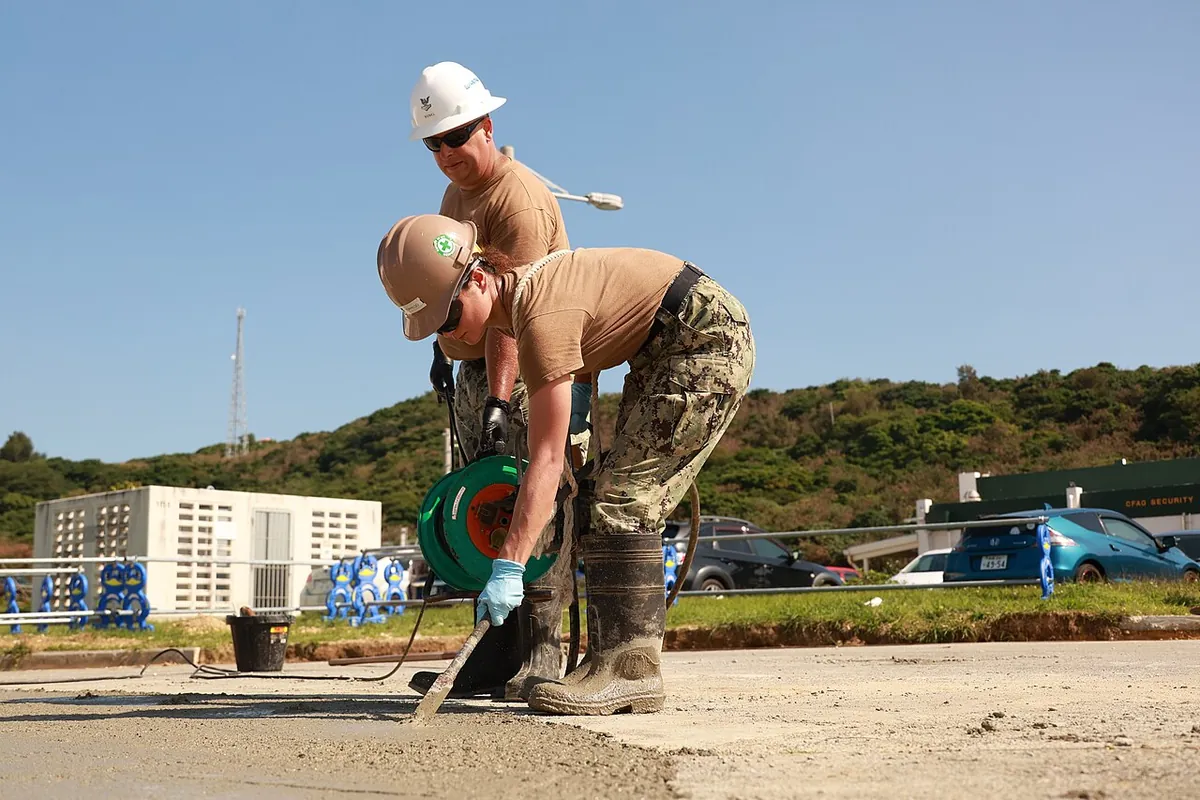
Photo: U.S. Navy, Petty Officer 3rd Class Thomas Flowers, Wikimedia Commons, public domain
Using a Concrete Vibrator on Foundation Walls
Foundation walls are where a concrete vibrator matters most for homeowners. A typical 8 foot basement wall is poured in lifts, working around the wall in a loop so each new lift is placed while the one below is still plastic. One person runs the pump hose or chute, and one or two people follow with concrete vibrators, inserting the head through each lift and into the lift below. Pay special attention below window and door openings, where concrete has to flow sideways under the bucks, at corners, and anywhere the rebar is tightly spaced. Tapping the outside of the forms with a rubber mallet in those spots helps show whether the concrete has filled in. A wall that is vibrated well comes out of the forms with smooth faces and sharp corners; one that is not shows honeycombing at the bottom and around openings, which may need repair before backfilling. See honeycombing in concrete and cold joints in concrete.
Using a Concrete Vibrator on Footings, Piers and Columns
Footings are shallower than walls but often have heavy rebar mats and dowels sticking up for the wall above. Run the concrete vibrator along the footing at regular intervals, making sure the concrete fills under and around the bottom bars, which sit close to the ground on chairs. For piers and columns, the form is narrow and tall, so a pencil or small-head concrete vibrator on a long shaft is lowered to the bottom and worked up through each lift. Do not drop concrete from a great height into a tall column form without a tremie or hose, because it segregates before the vibrator can help. See concrete footings and concrete piers.
How Many Concrete Vibrators Do You Need?
The number of concrete vibrators on a pour depends on how fast concrete arrives. A single operator with a medium-head unit can usually keep up with a modest placement rate, such as one truck at a time feeding a residential wall. On larger pours with a pump placing concrete quickly, contractors plan for two or more operators, plus a spare concrete vibrator in case one fails, because a pour cannot stop and wait for a repair. A useful rule is to watch the placing crew: if concrete is building up in the forms faster than it is being consolidated, you need another vibrator. Running out of capacity is a leading cause of honeycombing on otherwise well-planned jobs.
Gas, Electric, Pneumatic or Battery?
Each power source has its place. Electric concrete vibrators, especially motor-in-head models, keep a steady speed under load and are quiet and clean, but they need a power source and ground-fault protection. Gas-driven units with a flexible shaft are popular on sites without power and are very rugged, but they are noisy and produce exhaust. Pneumatic concrete vibrators run from a compressor and are common in precast plants and some heavy construction. Battery models are the newest and are ideal for small jobs and places where cords are a nuisance. For a homeowner renting for one pour, the rental store's standard electric or gas unit with a suitable head is usually the right choice.
DIY Alternatives to a Concrete Vibrating Tool
For very small projects, people improvise. Tapping the sides of forms with a hammer or rubber mallet, rodding the concrete with a length of rebar or a stick, and jiggling the forms all help release air from small pours such as stepping stones, planters, countertops cast in molds, and fence post holes. Some DIYers hold an orbital sander or a reciprocating saw with no blade against the outside of a mold to vibrate it. These tricks work on small precast pieces but are no substitute for a real concrete vibrating tool in walls, footings or anything structural. For cast countertops and small precast pieces, a simple vibrating table is the better option. See how to make concrete planters and concrete countertops.
Concrete Vibrators and Different Mixes
The mix changes how much vibration concrete needs. Stiff, low-slump mixes need more energy, larger heads and longer insertion times; fluid, high-slump mixes need less and are easier to over-vibrate. Mixes with plasticizers flow well and consolidate quickly. Air-entrained concrete needs normal vibration, which removes large entrapped air but keeps most of the tiny entrained bubbles. Lightweight concrete needs care, because the light aggregate can float to the top if it is over-vibrated. Self-consolidating concrete is designed to need no concrete vibrator at all, though it requires tight forms and careful mix control. See concrete slump and concrete admixtures.
Signs Your Concrete Was Not Vibrated Enough
After the forms come off, look for honeycombing, where the stones show with little paste between them; rock pockets at the bottom of walls; large bugholes on the faces; lines between lifts; and voids under openings. Small surface defects can be patched with a repair mortar. Deep honeycombing in structural members should be checked by an engineer, because it can reduce strength and expose reinforcement. On the next pour, add a concrete vibrator, shorten the insertion spacing, and keep lifts shallower. See concrete patching compound.
Renting a Concrete Vibrator: What to Ask
When you rent a concrete vibrator, tell the rental counter what you are pouring, how deep the forms are, and how much rebar is in them. Ask for a head that fits between the bars, a shaft long enough to reach the bottom of the forms, and the right power source for your site. Check that the concrete vibrator runs smoothly before you leave the store, and ask whether a spare head or shaft is available. If you are renting other equipment such as a mixer or a power screed, pick up the concrete vibrating tool at the same time so everything is on site before the truck arrives. Return it clean; most stores charge a cleaning fee for a concrete vibrator caked with hardened paste.
Planning the pour around the vibrator. Concrete placed faster than it can be consolidated is the most common reason for defects, so match the pour rate to your concrete vibrators and crew. A rented concrete vibrating tool costs little compared with repairing a honeycombed wall.
Under-Vibration vs Over-Vibration
Under-vibration is by far the more common concrete vibrator problem. Insertions too far apart, too short, or skipped in corners leave honeycombing, rock pockets and voids, especially at the bottom of walls, around openings and where steel is congested. Bugholes on the face of walls are also partly a consolidation issue. The fix is planning: enough concrete vibrators and operators for the rate of placement, a clear pattern of insertions, and attention to corners and edges.
Over-vibration with a concrete vibrator can happen too, mainly with very fluid mixes or when the concrete vibrator head is left in one place too long. The heavy stones sink, the paste and water rise, and the concrete segregates, leaving a weak, watery layer at the top and too little paste lower down. Signs are excessive bleed water and a thick layer of paste or foam on the surface. Over-vibration can also reduce the intentional air in air-entrained concrete. With a well-proportioned mix and normal insertion times, it is rarely a serious problem; when in doubt, it is generally better to vibrate a little too much than too little.
Common Concrete Vibrator Mistakes
Using the concrete vibrator to move concrete sideways along a form is a classic mistake. It makes the paste run ahead of the stones and causes segregation. Place the concrete close to its final position with the chute, pump hose or shovels, and use the concrete vibrator only to consolidate it.
Touching the reinforcing steel or the form face with the concrete vibrator head for long periods is another. Vibrating the rebar can loosen concrete that has started to set around it lower down, and holding the head against the form face can mark the finished surface. Brief contact is not a problem, but keep the concrete vibrator head in the concrete.
Other mistakes are running the concrete vibrator head out of the concrete, which overheats it and wears the bearings; inserting at an angle; withdrawing too fast; vibrating only the top of deep lifts; and leaving gaps between insertions. Revibration, going back over concrete that is still plastic after some time, is allowed and can even improve the surface of walls, as long as the concrete still becomes fluid when the head is inserted.
Cordless Concrete Vibrators
Battery-powered concrete vibrators have become popular with contractors and serious DIYers because they need no cords, generator or gas, and they are light enough to carry up ladders and onto decks. Several major tool makers now sell them. The Milwaukee concrete vibrator in the M18 FUEL line, for example, is a pencil-style unit with interchangeable shaft lengths that runs on the same batteries as the company's other cordless tools. Cordless concrete vibrators work well for footings, small walls, columns, steps, piers and slabs; for large walls and continuous pours, corded electric or gas units with larger heads still lead, because they can run all day without battery changes. When comparing models, look at head diameter, vibrations per minute, shaft length options, run time per battery and weight.
Buying or Renting a Concrete Vibrator
Most homeowners rent a concrete vibrator. Tool rental stores usually carry electric or gas flexible-shaft concrete vibrators with a choice of heads and shaft lengths, often at a modest daily rate. Ask for a head size that suits your forms and a shaft long enough to reach the bottom of the deepest form with a little to spare.
Buying makes sense for contractors and for people who pour often. Basic corded concrete vibrators start at a few hundred dollars; professional motor-in-head units, gas-driven backpack models and cordless kits with batteries can cost from several hundred to well over a thousand dollars. External form vibrators and vibrating screeds are separate purchases. See concrete tools for the rest of the tools on a typical pour.
Safety With Concrete Vibrators
Wear waterproof gloves, boots and eye protection, because vibrating concrete splashes paste, which is alkaline and can burn skin; see can concrete burn. Electric concrete vibrators must be used with ground-fault protection, and cords should be kept out of the concrete and away from sharp rebar. Gas units should be run where exhaust can clear. Long periods of use expose hands and arms to vibration, so rotate operators and use anti-vibration gloves where available. Never stand on the concrete vibrator shaft or bend it sharply, which can break the inner core.
Cleaning and Care
After the pour, run the concrete vibrator briefly in a bucket of water to shake loose paste from the head, then wipe the head and shaft clean before concrete hardens on them. Check the concrete vibrator head for wear; a worn head loses diameter and effectiveness. Store the shaft in loose loops, not sharp bends. For flexible-shaft units, grease the core as the maker recommends. Check cords and plugs for damage before each use.
To sum up: use a concrete vibrator on anything thicker or more heavily reinforced than a simple slab, insert it vertically and often, withdraw it slowly, and keep enough concrete vibrators on site for the pour rate. Those habits prevent nearly every consolidation defect, and they turn a rented concrete vibrator into the best few dollars you spend on a structural pour. When in doubt about which concrete vibrator to use, ask the rental store or your concrete supplier.
Frequently Asked Questions
What does a concrete vibrator do?
It removes trapped air and helps fresh concrete flow around rebar and into the forms, making the concrete denser and stronger and preventing honeycombing.
Do I need to vibrate a concrete slab?
Ordinary 4 inch slabs usually do not need internal vibration; thick or heavily reinforced slabs do, and a vibrating screed helps on larger slabs.
How long should you vibrate concrete?
About 5 to 15 seconds per insertion, until large bubbles stop rising and the surface around the head looks glossy.
Can you over-vibrate concrete?
Yes, which can cause segregation and bleeding, but under-vibration is far more common and usually more harmful.
Sources
- American Concrete Institute: ACI 309R guide to consolidation of concrete, and ACI 301 specifications
- Portland Cement Association: placing and consolidating concrete
- National Ready Mixed Concrete Association: CIP 25 (consolidation of concrete)
- OSHA: electrical safety and ground-fault protection on construction sites
Related Guides
- Concrete screed — hand, power and laser screeds
- Concrete burial vault — vaults, grave liners and cost
- Concrete column — columns, rebar, forms and poles
- Concrete beam — beams, rebar and concrete details
- World of Concrete — the industry's annual trade show in Las Vegas
- Concrete worker — job duties, pay, training, safety and career path
- Concrete machines — mixers, placer booms, screeds, trowels, sprayers, saws and scrubbers